From the very beginning, Alexander Endrullat’s work caught our attention for its ability to deconstruct the language of technological objects, transforming them into sensitive surfaces, narrative tools, and at times, ghostly visual traces. Spanning from printing with obsolete laptops to pinhole photography sent as postcards, their practice questions our assumptions around function, identity, memory, and value. In this conversation with Fakewhale, we delve into the mechanics of their creative process, their fascination with error and obsolescence, the role of writing, and the unexplored potential of the digital devices that shape our everyday lives.
Fakewhale: How do you manage to combine your artistic expression, which combines meticulous craftsmanship with an exploration of the boundaries of media, with a balance between experimentation and tradition?
Alexander Endrullat: I don’t see craftsmanship, tradition, and experimentation as contradictory, but rather as an interplay that gives rise to new forms and meanings. Many of my works are created using traditional processes such as printing or analog photography, but I deliberately alienate and technically overstretch them. I am interested in how far a medium or material can be pushed before it loses its function, or something new emerges from it. The line between control and chance, between craftsmanship and spontaneous intervention, is the most productive moment for me.
This creates a balance between tradition and experimentation, in which the craftsmanship provides the foundation that makes the freedom of play possible.
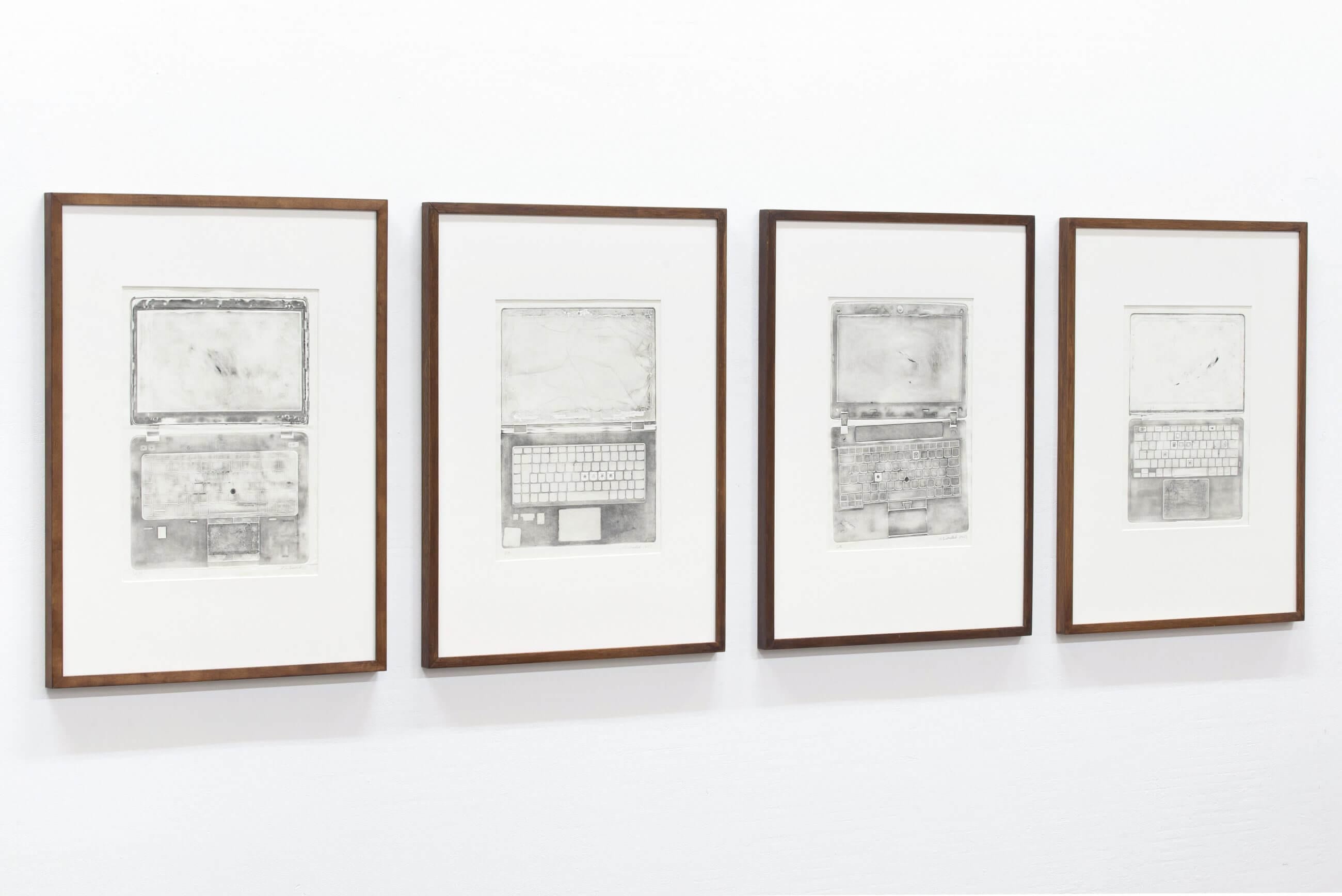
How did you arrive at this conceptual direction of using laptops as printing plates, and how do you see it fitting into the larger context of the dialogue about technology and identity?
I kept having problems with my own technology and at some point I was just frustrated and angry. When my laptop got so old that it couldn’t be updated anymore and I was just stressed out with it, I came up with the idea of just running it through the printing press.
Since then, I’ve used dozens of laptops as printing blocks and printed them that way. Even though the prints are similar, each print is unique. Every device has its own identity, and you can learn a lot about its previous use and user: Did they decorate it with stickers? Did they treat it with care, or is it dented and scratched? Which keys are particularly smooth, meaning they were used most often? With some devices, I even imagine that I can read the owner’s password from the print.
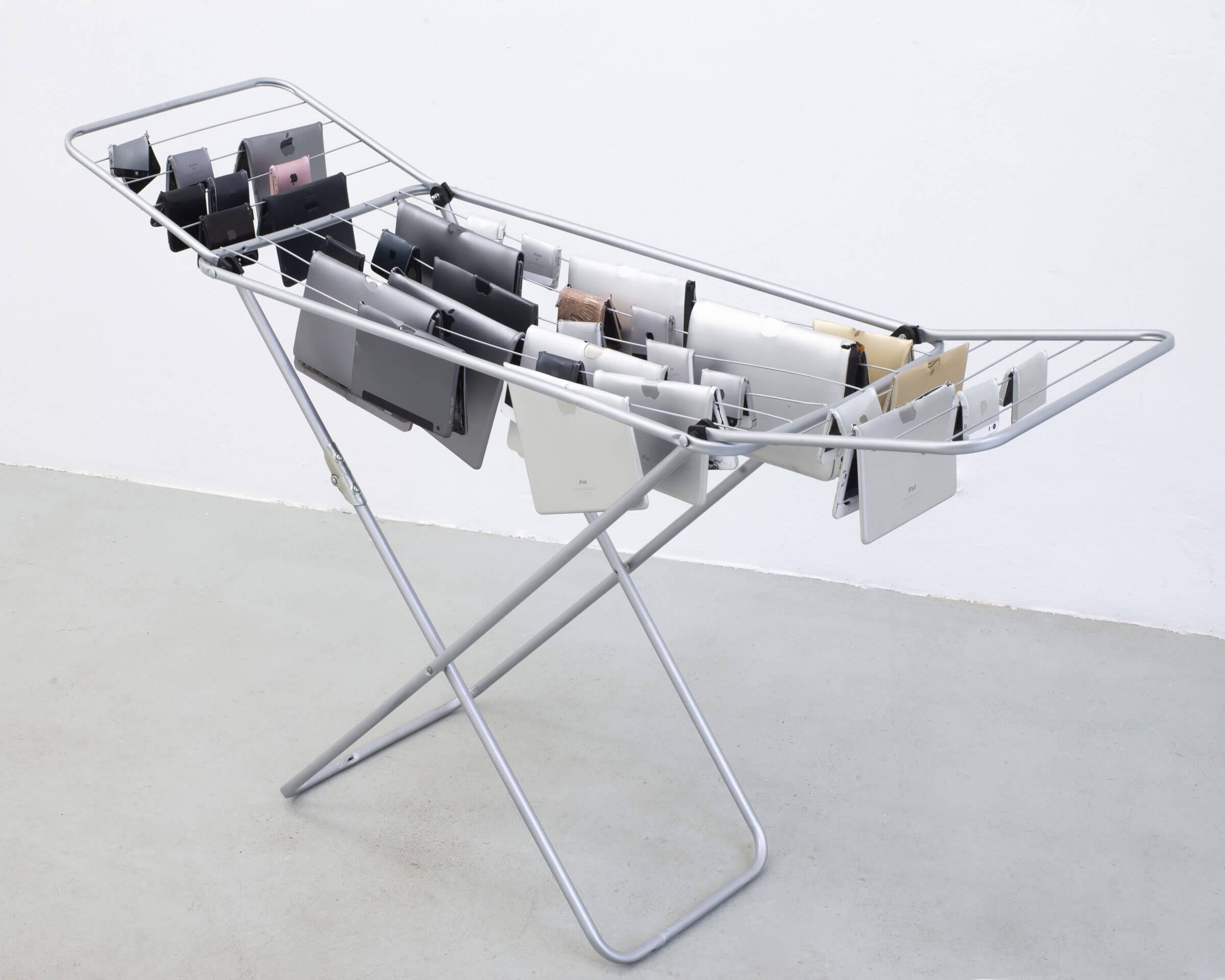
The playful aspect that gave rise to the concept behind my work remains an important component to this day. At the same time, however, I am also interested in the material, aesthetics, and attributions we associate with our everyday technical devices. Apple devices in particular often have a clean, minimalist design and are seen as status symbols, but also as synonymous with functionality and productivity. By bending, pressing, and repurposing them, their functionality is completely dissolved, and expectations of the device are negated, but at the same time transformed and recontextualized.
Your work with objects involves application-oriented approaches. Could you talk about the creative decision-making process in which you reinterpret everyday objects?
I find reinterpreting objects exciting. The original devices always remain recognizable, despite all the processing and alienation. I don’t change the color, remove any major components, or add anything.
At the same time, however, I also ask myself about other everyday objects, about a new function for devices that have become worthless, old, or broken. And also the possibilities of the material: Is it even feasible to fold an iPad like a paper airplane? Or to bend a laptop at a precise 45-degree angle so that it can serve as an edge protector? Does a MacBook still function as a speaker, even if it is welded shut and can no longer be opened or operated?
Your fascination with pinhole photography and its unpredictability seems to run parallel to your painting methods. How does this similarity influence your conception and execution of photographic and painted works?
I love chance, or the unpredictability that comes with this kind of work. Chance often gives me new ideas because it frequently deviates from my own ideal, my own imagination, my own expectations.
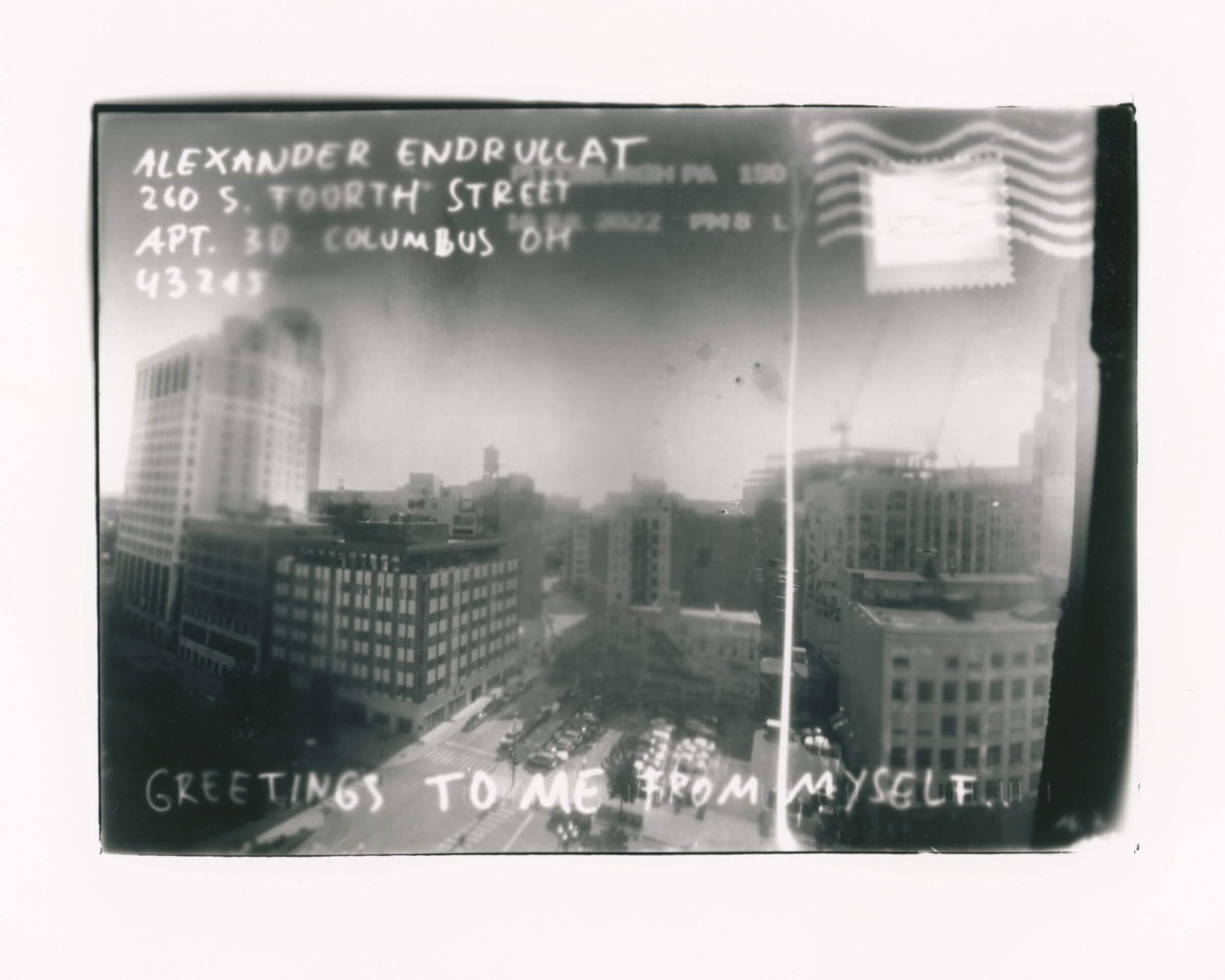
In your series ‘AirMail’, you document your travels through pinhole photography and integrate the physical traces of postcards into the work. What role does the element of chance play in shaping the narrative and aesthetics of this series?
In pinhole photography, chance is an essential principle, as the final result can never be fully predicted in advance. For pinhole photography and the mailing of these in the “AirMail” series, I use a pinhole camera. Due to this technique and the development of the paper negatives on site, the images cannot be completely controlled. Traces such as postmarks, scratches, and creases from mailing are also unpredictable and ultimately become an essential part of the final work.
Materiality and technique are central to your practice. Could you elaborate on the role of writing in your work, particularly the way it complements and contrasts with your visual narratives?
The photographic series AIRMAIL and the painterly series LEERLAUF show how writing complements my visual narratives. The combination of writing and image allows me to achieve a comprehensive and multifaceted effect that reaches the viewer on different levels. Even in older works, in my painting, I often wrote the title of the picture directly onto the canvas as a design element. At the same time, the titles were then, as now, a fundamental conceptual component of the works. They introduce another level of meaning and expand the work on an explanatory, but mostly humorous level. The writing usually completes the work.
Throughout your series, from laptops to folded MacBooks, there seems to be a recurring theme, namely the deconstruction of modern tools. How do you see the relationship between form, function, and meaning in these works?
I am interested in that moment when the object is freed from its purpose: the form remains recognizable, but its meaning shifts. The device becomes something else—an imprint, a relief, a sculpture, a symbol. In this way, the focus shifts from use to perception, from functionality to materiality. Ultimately, I am interested in how strongly our perception of things is tied to their function—and what happens when this connection is dissolved.