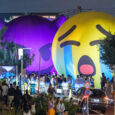
Ran Slavin, Ancient AI, at Hamivne, Tel Aviv

Ancient AI by Ran Slavin, curated by Sivan Sebbag Zelensky, at Hamivne, Tel Aviv, 23–29.12.25.

What if the “cloud” was never really a cloud? What if every algorithm, every data stream we believe to be weightless, bore a mineral echo instead, red quartz glinting deep underground, lithium bleeding silently from the Earth’s crust? Upon entering Ancient AI by Ran Slavin, we’re confronted by this inversion: not the rise of intelligence from technology, but its descent into matter, ancient, dense, undeniable. “From earth to algorithm,” the work seems to whisper, dissolving the boundary between the technological sublime and the geological real.

The exhibition unfolds in an unusual site, a former bank vault beneath Tel Aviv’s Migdal Shalom Meir. The air is thick, the walls steeped in a history of financial control. Yet this underground chamber no longer safeguards capital, it hosts another kind of value: matter as metaphor, mineral as myth. The soundscape is minimal, nearly swallowed by the concrete. Visually, the rhythm is deliberate, red obelisks glowing like encoded signals, surfaces encrusted with real minerals that refuse the role of image or simulation.

The quartz stones, red, luminous, sourced from Brazil and India, crackle beneath our feet. Not pixels. Not data. But compressed time, crystallized into physical form. Around them: lithium, cobalt, rare earths, the elements powering our digital lives, violently extracted from global terrains. We weren’t simply navigating aesthetics, but tracing supply chains, political geographies, and ecological wounds.

Slavin’s material choices reject illusion. Nothing is merely represented, everything is real. There are no romanticized portrayals of pink toxic lakes or industrial wastelands, only residues, remnants, and testimonies of extractive violence. The flamingos? Survivors of toxicity, not icons of elegance. The swans? Mythic, unstable, unsettling, hybrid beings in a reshaped ecology.

Red obelisks punctuate the space with a quiet menace. Are they beacons, monuments, or futuristic transmitters still humming after humanity has gone? Their repetition forms a kind of network, perhaps a distributed consciousness, yet one devoid of warmth. A technological mythology takes root here, where power no longer hovers above us but lies buried beneath our feet.

We thought we heard it, the crackle of quartz underfoot, the echo of pink chemical fog, a thought formed from shattered stone. Ancient AI doesn’t preach. It reveals. It asks us to imagine a future not above the earth, but of it. And the vault holds no treasure, but a truth.

Exhibition view: Ancient AI, Ran Slavin, curated by Sivan Sebbag Zelensky, Hamivne, Tel Aviv. Ph: Harel Gilboa

Founded in 2021, Fakewhale advocates the digital art market's evolution. Viewing NFT technology as a container for art, and leveraging the expansive scope of digital culture, Fakewhale strives to shape a new ecosystem in which art and technology become the starting point, rather than the final destination.

Fakewhale Log is the media layer of Fakewhale. It explores how new technologies are reshaping artistic practices and cultural narratives, combining curated insights, critical reviews, and direct dialogue with leading voices.