

The Artist as Channel
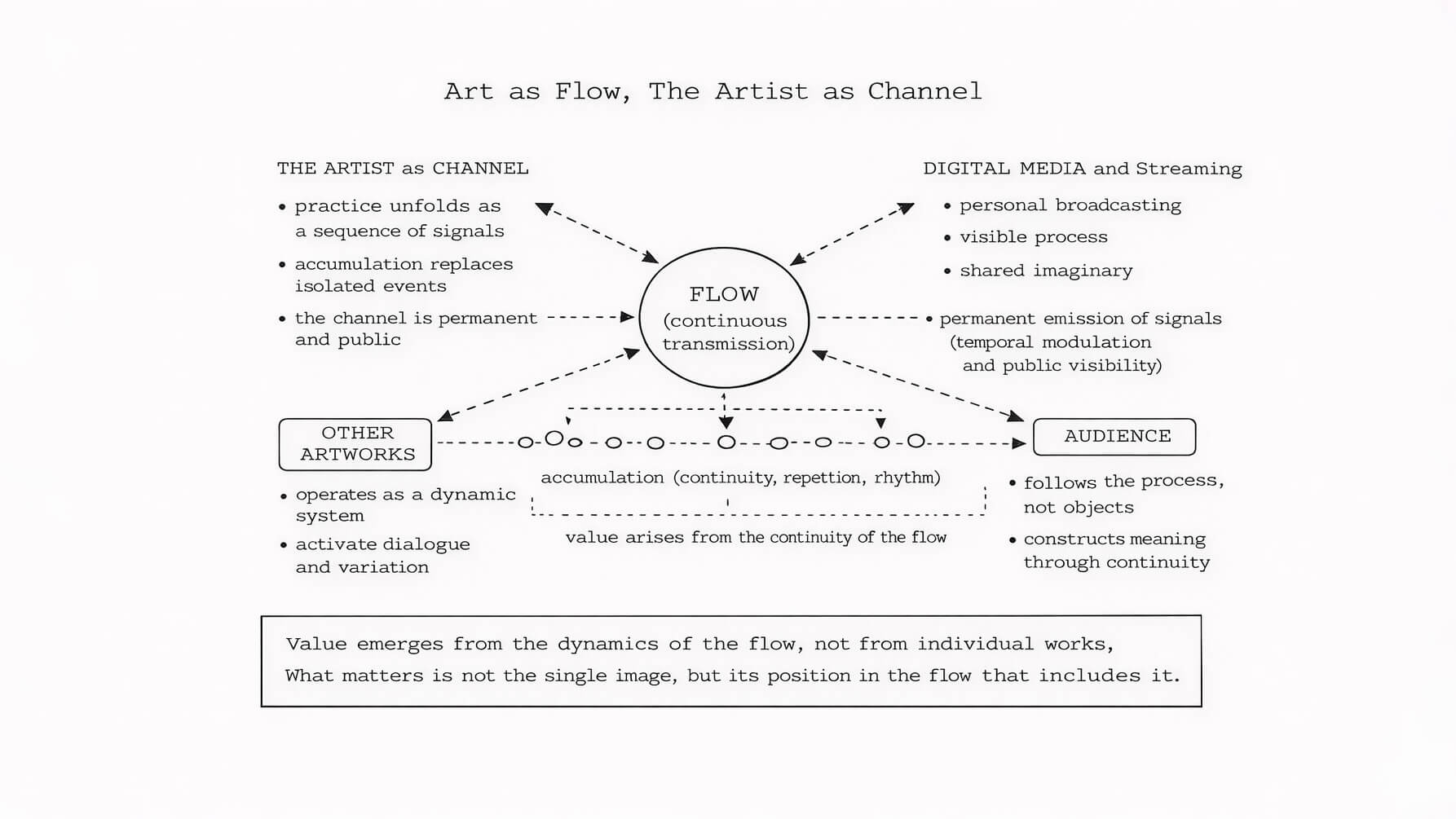
Increasingly, in contemporary artistic practice, the focus is no longer on the individual artwork but on the flow that contains it. A continuous stream of images, thoughts, gestures, positions taken, silences, and returns. Artists do not simply produce works, they build channels, channels of constant transmission in which time, repetition, and variation become integral parts of the work itself.
In this sense, social media, and more broadly digital media, function as true personal television networks, spaces of permanent streaming where artistic practice appears as a living process rather than an isolated object. This is not entirely new in the history of art, but today, for the first time, technology makes this flow visible, continuous, public, and structurally central.
In such a context, focusing on the single artwork risks becoming a perspective error. It is like debating the color of the ball during a football match, a detail that may become a symbol, a relic, an icon, but that says nothing about the real dynamics of the game. Meaning lies elsewhere, in movement, in relationships, in rhythm, in the tension between players, audience, and the space of the event.
Art increasingly works this way today. Value does not arise from the individual image, but from the continuity of the flow that generates dialogue, critical thought, and a shared imaginary. To understand the digital, then, means learning to read and master this flow, because that is where contemporary art is truly taking place.
From gesture to continuous emission, the artist as a channel
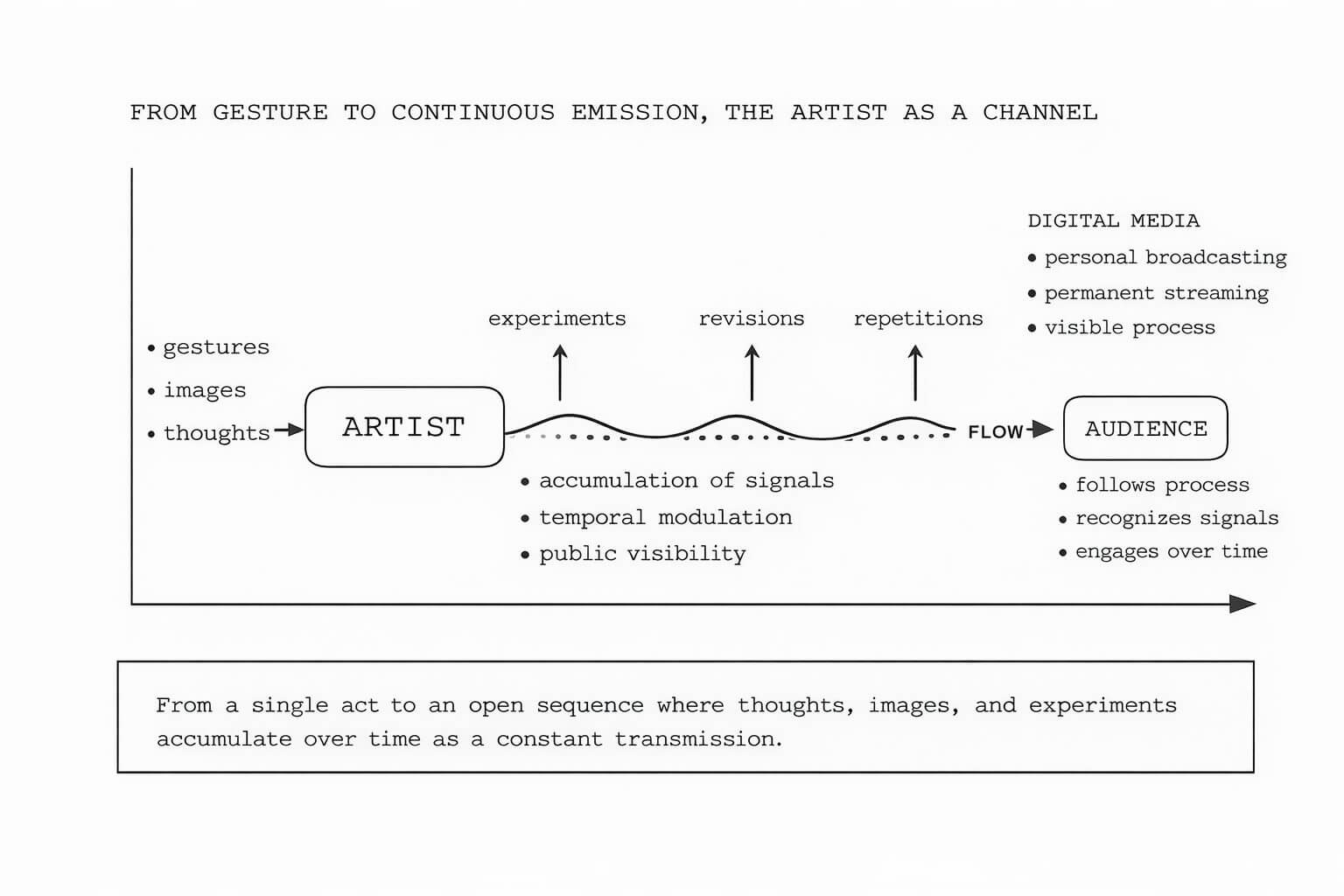
In the contemporary context, the artist is no longer simply someone who produces works, but someone who keeps a channel active. A channel of continuous emission, in which the creative gesture does not concentrate in a single conclusive moment, but unfolds over time as a sequence of signals. Thoughts, images, experiments, revisions, repetitions, all contribute to forming a constant transmission, a presence that manifests through accumulation rather than through isolated events.
This shift did not originate today, but today it has become evident. In the past, many artists constructed their practice as a flow, through diaries, archives, seriality, open processes, and conceptual practices that rejected the artwork as a final goal. The difference is that this flow remained largely invisible, mediated, fragmented. Today, by contrast, technology makes this continuous movement legible, public, and structurally central. The channel is no longer a side effect of the practice, it becomes an integral part of it.
Social media, in this sense, function as personal broadcasting systems. Each artist chooses their own format, their own rhythm, their own visual grammar. Some work through rarefaction, others through saturation, some build coherent narratives, others unstable fields of tension. In all cases, what matters is not the single image, but the continuity of emission. Value emerges from the coherence of the flow, from its ability to generate expectation, recognizability, and thought.
This radically changes how we read art. The individual artwork loses its status as an absolute center and becomes a node within a broader network. A moment of intensity, certainly, but always embedded in a larger dynamic. To view a work in isolation from the flow that produced it is to misunderstand its function. It is like extracting a sentence from an ongoing conversation and expecting it to contain the entire meaning on its own.
The artist as channel does not communicate through definitive statements, but through modulations. Each gesture is a variation on a theme, each image an adjustment of the signal. The audience is no longer asked to interpret a closed work, but to follow a process, to orient itself within a moving field of forces. This produces a different kind of attention, perhaps less contemplative, but more relational, more temporal, and closer to the way meaning is constructed today.
In this scenario, the flow becomes a responsibility. Keeping a channel open means assuming the weight of continuity, of coherence over time, of relationship with those who observe. It is not about producing content, but about sustaining a presence. The artistic gesture does not end with the creative act, but with the capacity to inhabit one’s own signal, to recognize its effects, and to accept its contradictions.
Perhaps it is precisely here that one of the most profound transformations of contemporary artistic practice is taking place, in the shift from the artwork as event to art as transmission. Not a message to be delivered, but a flow to be kept alive. Not an object to be isolated, but a field to be traversed. In this sense, the artist today does not simply “show” their work, they transmit it, circulate it, and allow it to unfold over time.
The flow as artistic material
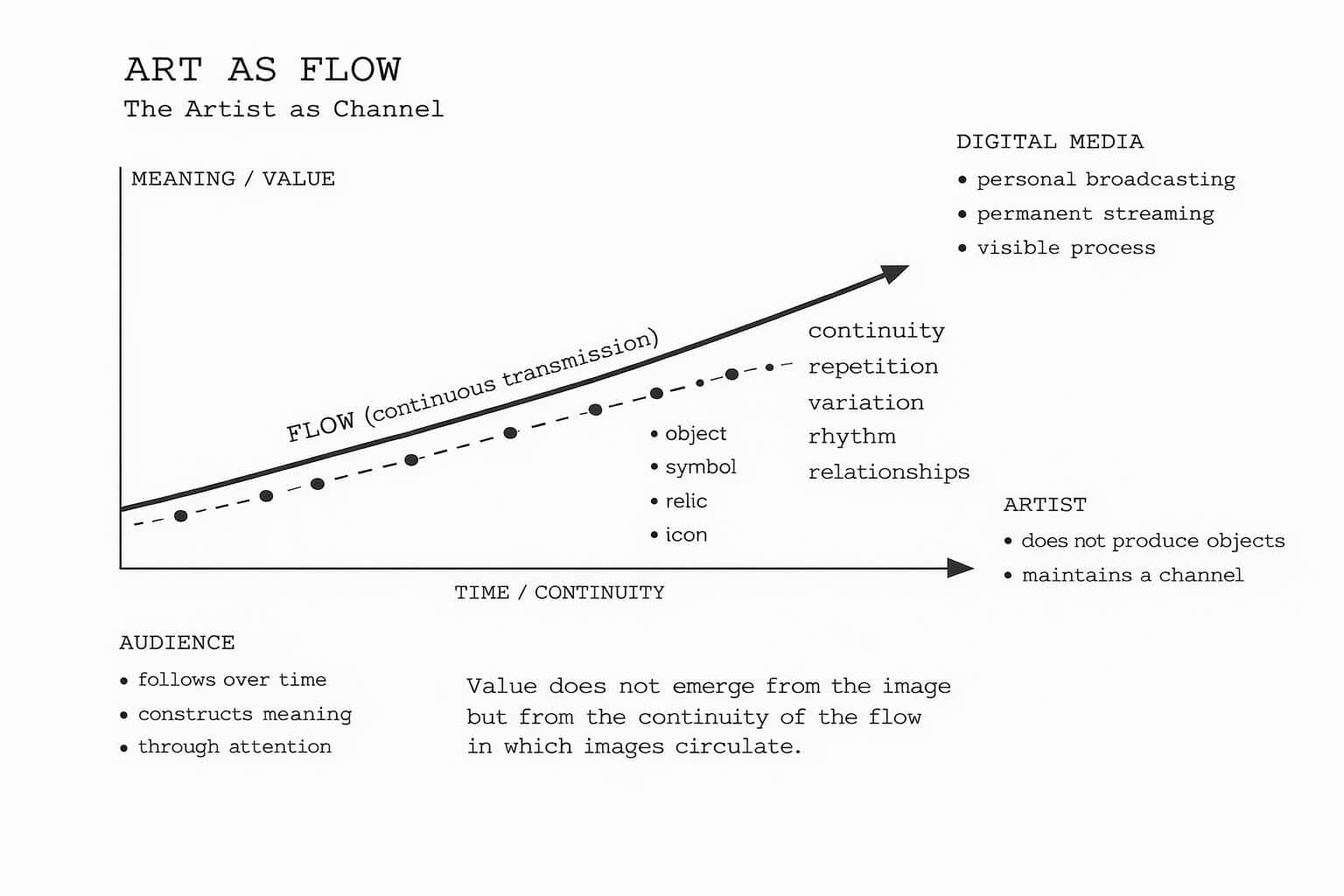
If the artist has become a channel, then the flow is no longer a secondary effect of the practice, it is its primary material. Not a communicative frame, but the very field in which art takes shape. Today, what matters is not so much what is shown, but how and with what continuity that something enters circulation. The flow is the place where thought settles, changes, and turns back on itself.
In the digital regime, the material of art is not only visual or conceptual, it is temporal. Rhythm, frequency, repetition, pause, accumulation. Each gesture gains value in relation to the gestures that precede and follow it. A single isolated image may be interesting, but a coherent sequence of images over time constructs a language. It is within this duration that meaning is generated.
The digital finally makes legible what once remained implicit in artistic practice, the process. Not as backstage, not as didactic revelation, but as a real operational space. The process is no longer what leads to the artwork, it is what is the artwork. Art does not manifest as a result, but as a continuity of decisions, deviations, returns, and insistences. The flow makes the internal structure of artistic thought visible.
In this context, speaking of individual works risks becoming reductive. The artwork functions as a point of density within a broader field, like a temporary node in a network of meaning. Its value is not self-sufficient, it depends on the position it occupies within the flow, on its relationship to what surrounds it. A work may acquire meaning because it comes after a long sequence of attempts, or because it abruptly interrupts a continuity, or because it resumes it in an unexpected way.
The flow also produces a new form of visual intelligence. It does not demand immediate interpretation, but observation over time. It requires attention, memory, and the ability to recognize patterns and deviations. It is an art understood through progressive exposure, not through instant revelation. In this sense, the flow educates the gaze, shifting it from the event to the trajectory, from the symbol to the dynamic.
There is also a crucial aspect, the flow is shared. Unlike the closed artwork, the flow involves the audience as part of the system. Every reaction, every comment, every silence contributes to defining its trajectory. Value no longer arises solely from the artist’s intention, but from the interaction between the emitted signal and the ecosystem that receives it. The flow is, by nature, relational.
Treating the flow as material therefore means taking a precise position, recognizing that contemporary art no longer lives in exception, but in continuity. Not in the isolated object, but in the field that makes it possible. The digital does not introduce this logic, it makes it visible, practicable, unavoidable. This is where value shifts, not in what remains still, but in what continues to move.

Beyond the artwork, why value emerges from dynamics
When the flow becomes the material of art, the artwork inevitably loses its role as an absolute center. It does not disappear, but changes function. It is no longer an endpoint, but a moment of intensity within a broader dynamic. In this scenario, value does not arise from the object itself, but from the relationships the object activates, between artist and audience, between successive images, between context and interpretation.
Insisting on the single artwork today is equivalent to stopping a process in motion. It is like isolating one action from a match and expecting it to explain the entire game on its own. Real meaning emerges instead from continuous interaction, from shifting strategies, from audience responses, from tensions that accumulate over time. Art increasingly operates as a dynamic system, not as a collection of static entities.
Within this system, value is no longer tied solely to form or to the intrinsic quality of a work, but to its capacity to activate thought. A work matters because it generates confrontation, because it alters the perception of the surrounding flow, because it introduces a meaningful variation into an already existing continuity. Value is an effect, not a property. It arises from use, reception, and relation.
These dynamics also include the context of dissemination. An image seen once may be negligible, the same image, when inserted into a coherent sequence, becomes legible as part of a discourse. The digital amplifies this mechanism, every gesture is immediately placed in relation to other gestures, every artwork confronts a field of signs in constant transformation. Value is constructed through difference, position, and friction.
The role of the viewer also changes. No longer a distant observer, called to decipher a closed meaning, but an active element of the dynamic. To follow a flow means to move through it over time, to recognize its patterns, to accept its discontinuities. The audience contributes to the construction of meaning, not because it “interacts”, but because its attention is an integral part of the value system.
From this perspective, the single artwork can still become an icon, a symbol, a collectible object. But that role is secondary to the dynamic that generated it. The object becomes a trace, a record of a broader process. Without the flow that sustains it, it remains mute, with the flow, it becomes legible.
Recognizing that value emerges from dynamics means shifting one’s gaze. No longer asking whether an artwork “works” on its own, but whether it participates in a living field of forces. No longer measuring art in terms of exception, but in terms of meaningful continuity. It is in this movement, in this tension between elements, that contemporary art produces meaning, and where its real stakes are now being played out.
Attention to the flow, a new critical literacy
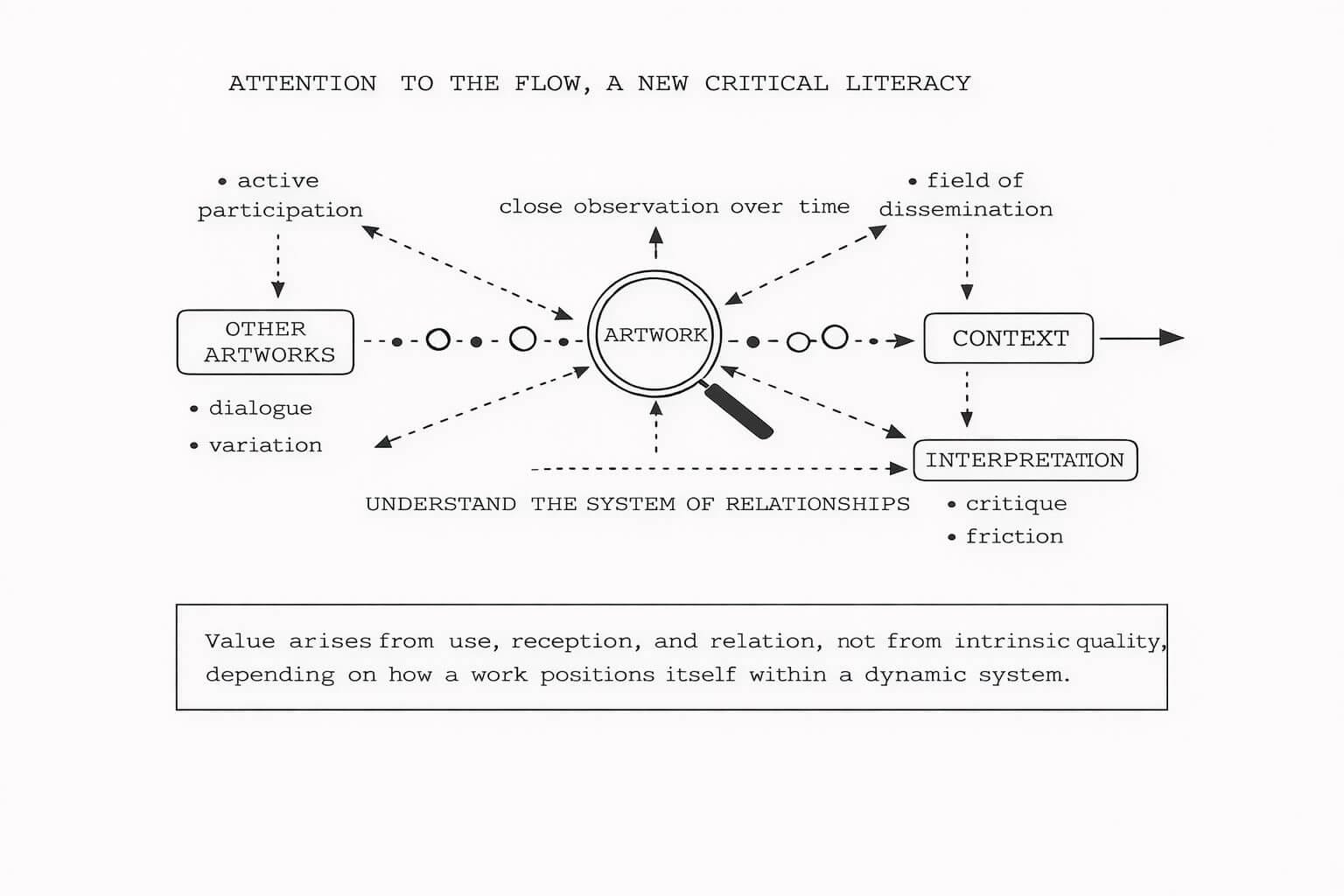
If the value of art shifts from the single object to the flow that sustains it, then the way art is read, interpreted, and judged also changes radically. Training the eye to form is no longer sufficient, it must be trained to duration. Recognizing an effective image is not enough, one must understand the system of relationships in which that image operates. In other words, a new critical literacy is required, an education in attention to the flow.
For a long time, discourse on art focused on exception. The artwork as a rare event, as a climax, as an isolable object. This model worked as long as art moved within relatively stable spaces and times. But in the digital context, where everything unfolds through continuity and overlap, exception loses its centrality. What matters is the trajectory, not the peak, the progression, not the single moment.
Reading the flow means observing how an artist constructs meaning over time. It means grasping recurrences, deviations, and insistences. Understanding when an image reinforces a line of thought and when it disrupts it. Evaluating not only what is shown, but what is reiterated, what is omitted, what is allowed to settle. It is a less spectacular form of attention, but a deeper one.
This literacy concerns all actors in the system, critics, curators, collectors, institutions. Continuing to judge art exclusively on the basis of individual works is equivalent to using categories from the past to read a phenomenon whose structure has changed. The risk is to misunderstand what truly matters, to mistake details for the center, symbols for dynamics. Like debating the color of the ball while the match is underway, ignoring the relationships between players, the audience, and the tension of the game.
The digital makes this gap even more evident. The flow is always visible, always accessible, always in transformation. Ignoring it does not make it disappear, it impoverishes interpretation. Learning to observe it, by contrast, makes it possible to understand how an artist’s authority is built today, how a community of meaning is formed, how value emerges even before it is formalized by the market.
Attention to the flow does not mean abandoning judgment, but refining it. Shifting it from object to relation, from instant to duration, from closed form to open process. It is a change of perspective that requires time, patience, and a willingness to follow rather than possess. But it may be the only way to read contemporary art with clarity as it actually happens today, not as a series of isolated works, but as a living system of signals in motion.
fakewhale
Founded in 2021, Fakewhale advocates the digital art market's evolution. Viewing NFT technology as a container for art, and leveraging the expansive scope of digital culture, Fakewhale strives to shape a new ecosystem in which art and technology become the starting point, rather than the final destination.
You may also like

TICK TACK Presents Allen-Golder Carpenter’s Sojourn: On Memory, Erasure, and the Politics of Remembrance
At TICK TACK in Antwerp, Allen-Golder Carpenter presents Sojourn (25 July – 6 September 2025), the

“Mirage” at Kunstverein Braunschweig
“Mirage,” a group exhibition featuring works by Gleb Amankulov, Wisrah C. V. da R. Celes
Graphic Giants: 5 Digital Artists to Follow Before They Explode
As the digital art landscape continually evolves, a compelling narrative unfolds at the intersection
