
Some time ago, we found ourselves scrolling through a late-night feed with no particular intention, letting images follow one another in a continuous flow. After a few minutes, a peculiar sensation emerged: faces changed, contexts shifted, yet the gestures remained strikingly similar. The same emotional postures, the same gazes, the same bodily tensions. We could no longer recall the specific content, but we recognized the forms. It felt like witnessing a memory that belonged to no one in particular and yet already felt like our own.
At that moment, it became clear that the issue was not the sheer quantity of images, but the way they return. Not as an orderly archive, but as recurrence. Not as a linear story, but as a circuit. It is here that the thought of Aby Warburg reasserts itself with unexpected force.
Warburg understood that culture moves through visual survivals: gestures that traverse time, emotional formulas that resurface in different contexts. Images, for him, do not preserve the past; they reactivate it. They do not explain; they generate tension. They do not represent; they transmit energy.
Today, immersed in digital environments governed by repetition, resonance, and recognizability, his work appears as a decisive theoretical root. Social networks take shape as automatic atlases, emotions as reusable formulas, memory as an unstable flow that returns without ever fully settling.
This article begins here: with an attempt to dismantle Warburg’s work in order to grasp its scope, and to place it in direct dialogue with the present. Not to update it superficially, but to test how deeply his thought is already inscribed, silently, within the visual architecture we inhabit every day.
Images as Vectors of Historical Energy
In Warburg, the image thus becomes a vector of historical energy. It does not transmit information; it transmits intensity. It does not recount a closed story, but keeps a conflict open. It is within this conception that his thought finds a striking resonance with the present, where visual memory operates less and less as preservation and increasingly as continuous reactivation.
In Aby Warburg’s work, cultural memory never takes the form of a stable repository. It does not function as an archive that stores the past, but as a field of forces that constantly reactivates it. Images do not safeguard what has been; they set it back into circulation. Every visual form carries an energetic charge that moves through time, ready to re-emerge in new contexts.
Warburg observes that Western culture does not advance through clean breaks, but through survivals. Gestures, postures, and compositional schemes return even when their original meaning appears to be lost. What persists is not content, but intensity. Cultural memory manifests itself as the return of forms charged with tension, capable of reactivating affects, conflicts, and unresolved polarities.
This approach radically shifts how images are read. The image is not interpreted as an isolated aesthetic object, but as a temporal node. Each figure contains multiple, overlapping times. The present does not erase the past; it hosts it. Art history thus becomes a history of reappearances, of unpacified returns.
Memory, in this sense, does not coincide with stability. It coincides with controlled instability. Images survive precisely because they remain ambiguous, because they do not settle into a single, fixed meaning. Their power lies in their ability to adapt, to migrate, to take on new functions without losing their original tension.
This model introduces a dynamic vision of culture. The past does not act as a distant origin, but as a latent presence. Each era reactivates what it needs, reorganizing inherited forms according to its own urgencies. Cultural memory emerges as a selective, discontinuous, emotionally oriented process.

It is as if we were watching a crowd responding again and again to the same signal. Faces change, places change, but the movement remains identical. A hand to the face, a gaze lifted upward, a body that tenses or withdraws. The sensation does not concern what happens, but how it happens. The emotion seems already scripted, ready to be reactivated as soon as it finds the right form.
It is precisely within this mechanism that Aby Warburg’s concept of Pathosformel is situated. For Warburg, images do not merely convey meanings; they crystallize collective emotional states. Gestures and postures become formulas capable of traversing time while preserving their charge of tension.
These formulas do not describe an emotion; they condense it. They function as affective shortcuts: they trigger immediate recognition, produce engagement, generate resonance. Pathos is not explained but evoked. It is this economy of intensity that allows images to survive, migrate, and reappear across different historical and cultural contexts.
Within the landscape of social media, this dynamic becomes especially evident. Platforms favor the circulation of recognizable, formalized, and replicable emotions. Shock, desire, indignation, melancholy take on recurring visual configurations. Emotion becomes a reusable form, a shared language that precedes specific content.
Pathosformeln thus turn into emotional templates. Not through conscious imitation, but as an implicit grammar of vision. A gesture works because it has already been seen. An expression strikes because it belongs to a collective visual memory. Intensity arises from recognizability, not from exception.
From this perspective, emotion gradually detaches itself from individual experience and assumes a structural dimension. Pathos is modulated for circulation, optimized for attention, adapted to formats. Warburg allows us to read this transformation without nostalgia: the formulas do not diminish, they become automated. They continue to transmit energy, but they do so within a system that privileges repetition over duration.
Automatic Atlas: From Warburg’s Critical Montage to the Feed’s Logic of Recognition
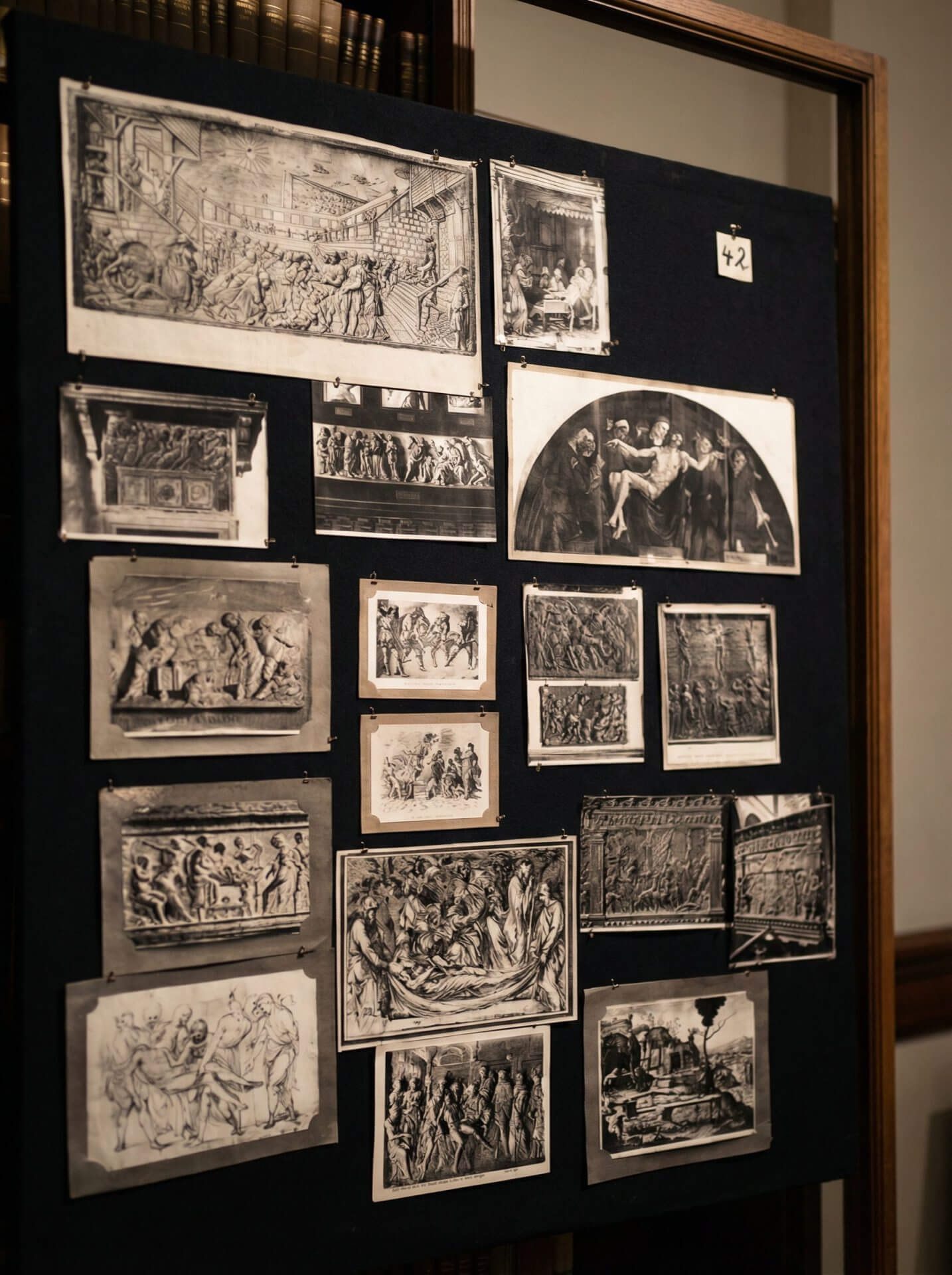
No prescribed path, no evident hierarchy. Only relationships. As we move through the space, meaning does not emerge from a single image, but from their coexistence, from what calls to one another, contradicts itself, repeats.
The Mnemosyne Atlas arises precisely from this logic. Warburg does not organize images by period or style, but by constellations. The atlas does not explain; it relates. Meaning is not given in advance but produced in the act of looking that traverses the connections. Knowledge takes shape as montage, not as linear narration.
If we observe how social media operates, the parallel becomes evident. The feed presents itself as a real-time atlas, a surface of images continuously placed side by side. Here too, meaning emerges through proximity, repetition, resonance. We do not read a story; we move through a visual constellation in constant update.
The difference, however, is crucial. Warburg’s atlas is conceived as an instrument of complication. Images are juxtaposed to generate friction, to make survivals visible, to bring unresolved historical tensions to the surface. The feed, by contrast, tends to reduce complexity. Images are ordered to maximize recognizability, continuity, and the persistence of attention.
In this sense, the feed can be read as an automatic atlas, composed not by a scholar but by ranking systems. The relations between images no longer respond to critical inquiry, but to performance criteria. What returns is what works. What repeats is what keeps the gaze engaged.
This transformation has a direct effect on cultural memory. Images do not disappear, but tend to circulate within the same configurations. Constellations stabilize. Return no longer produces rupture, but confirmation. The atlas loses its exploratory function and becomes an environment of continuous recognition.
Warburg allows this condition to be read with clarity. The problem is not an excess of images, but the poverty of the relations that bind them. When the atlas ceases to generate tension and begins to reproduce patterns, cultural memory does not deepen, it flattens. It remains active, but loses the capacity to surprise, to destabilize, to open new fields of meaning.

Memory Without Sedimentation
It is as if we were confronted with a memory that functions without a past. Everything returns, yet nothing remains. Images reappear continuously, recognizable, familiar, charged with intensity, but without duration. The sensation is not one of forgetting, but of remembering too quickly. A memory that does not settle, but flows.
It is here that Aby Warburg’s thought reveals its deepest critical force. His idea of cultural memory always presupposes a tension: between impulse and control, between return and distance, between pathos and form. The survival of images never coincides with their neutralization. Every return carries a risk, a friction, a potential for disorder.
In the digital present, this tension tends to weaken. Images continue to be reactivated, but within an environment that privileges fluidity. Return no longer destabilizes; it reassures. The formula is reiterated without deviation. Memory becomes performative, oriented toward continuity rather than transformation.
This condition produces a paradox: high visual intensity coupled with low temporal depth. Images strike, but they do not stratify. They activate emotions, but they do not build history. Visual culture remains in constant motion, yet struggles to generate lasting meaning.
For Warburg, memory is always conflictual. Images survive precisely because they remain unresolved, because they carry an excess that resists full integration. When this excess is neutralized, memory loses its critical function and turns into an operational surface.
The present therefore calls for a renewed form of awareness. The task is not to oppose the circulation of images, but to reintroduce friction, distance, and the possibility of critical montage. To recover Warburg today means recognizing that cultural memory does not reside in the quantity of images, but in the quality of the relations we are able to construct between them. In a world that remembers without sedimentation, the real stake becomes the capacity to restore depth to time.