Tracing Layered Histories and Structural Logics
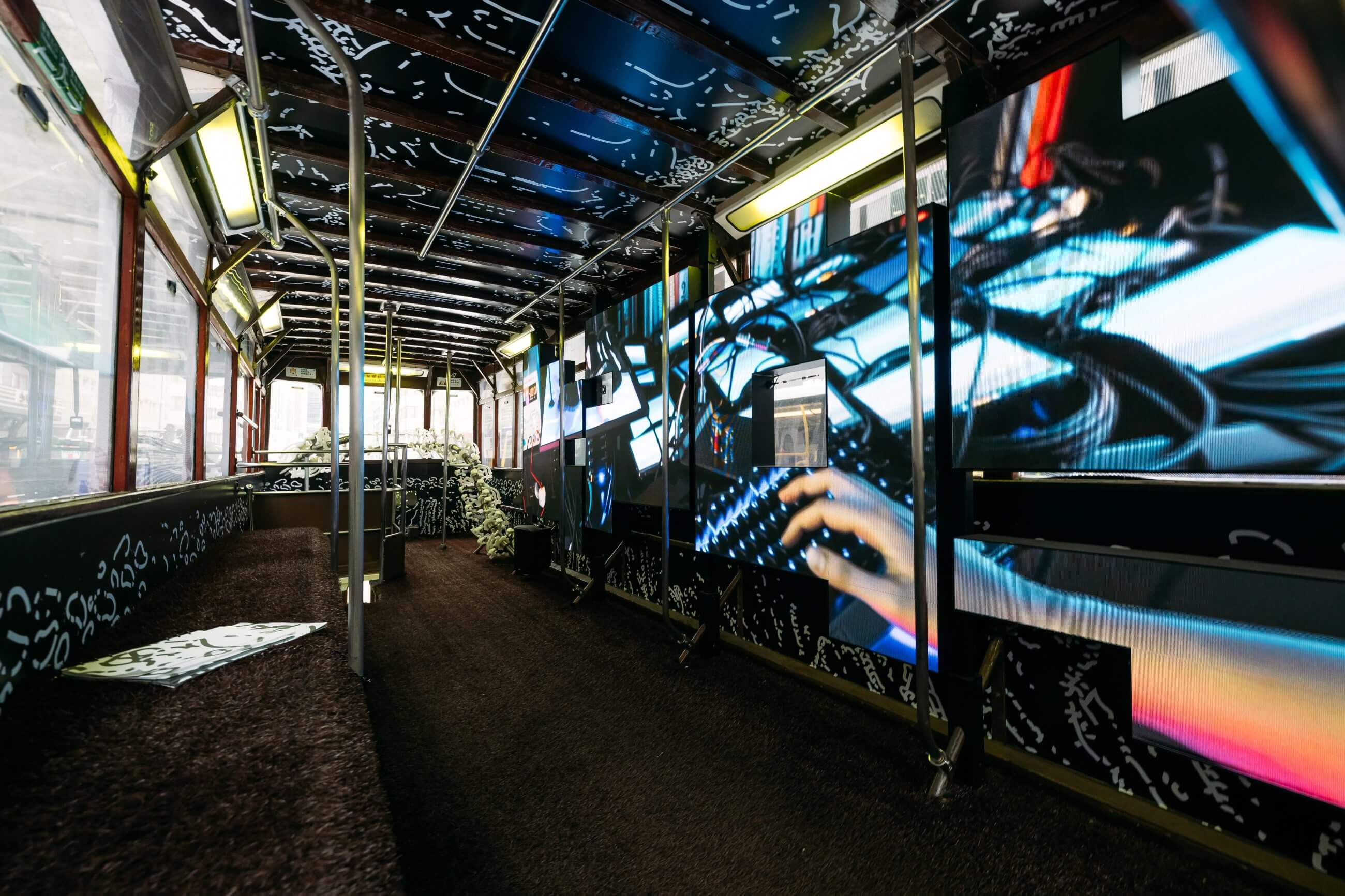
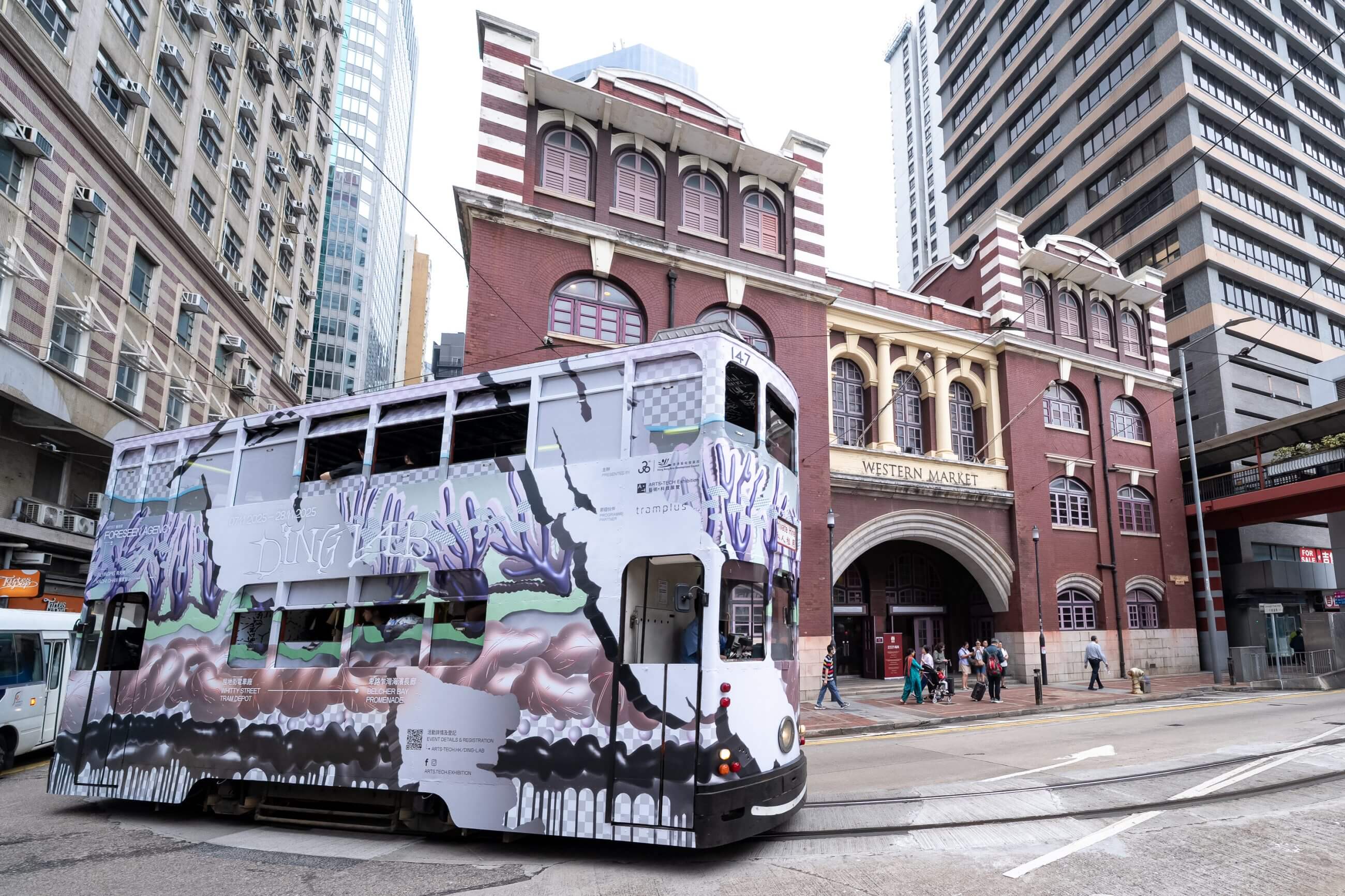
Ding Lab is the most recent chapter of the ARTS·TECH Exhibition 3.0 and was created earlier this year. Artists Shan Wong (Flyingpig) and Kachi Chan reimagined a ‘ding ding’ tram as Tram0, a mobile exhibition made of LED installations, live video, DIY virtual pet devices, and AI-generated visuals. It illuminates the logics of Hong Kong, where human and machine systems intersect. I visited the project last November and joined a guided tour that brought me closer to the artworks along the route, imbuing the journey with nostalgia.
‘This artwork does not represent Hong Kong; it emerges from within it.’
Pat and Kachi spent a total of nine months at the depot. During that time, they researched the vehicles and uncovered their hidden stories. One of their discoveries focused on the iconic green. Back in the day, foreign armies brought large quantities of green paint to Hong Kong, which was then applied to public transport, the Star Ferry, and industrial buildings. That particular shade, now impossible to replicate exactly, inspired the duo’s investigation of heritage.
This history clings to the tram itself. Affectionately known as the ‘ding ding‘, it carries passengers amid a century of industrial and colonial legacies. Its presence is so familiar that many locals no longer register its weight, it moves in plain sight. Its creaks, vibrations, and routes are repositories of collective experience, which the artists use as both medium and narrative.
The whole project consists of several components: Tram0 itself, Defragmentation Programme, The Vitiligo – The Absence of Green, Greenie, and Stranded Matter. Together, they show how human activity, technology, and the city’s form influence one another via everyday acts of maintenance.
Encountering the City from Within
The story kicks off on board Tram0. Friction is everywhere, visible in the way lived experience and ‘algorithms’ overlap. This is where Ding Lab first steps in. The artists treat public transportation as a diary and insist that archives are never neutral. In their words, ‘Machines do not remember more than humans; they remember differently, and often incompletely,‘ revealing both organic and synthetic traces.
While most machines like repetition and aggregation, human attention preserves nuance. Stories travel imperfectly across contexts and emotions. That keeps the past plural, even as hybrid identities and informal expressions often remain undocumented in Hong Kong. By situating this mobile infra among these forms of memory and emerging technologies, Ding Lab asks whether noise, gaps, and multiplicity can make it here.
Archives, Residue, and Machinic Systems
From inside the tram’s network, the artists observed a kind of intelligence that is undigitizable. Motormen described driving as an exercise in foresight, not a routine. Through anticipation and timing, they develop what the artists call ‘visionary attention,’ a skill beyond data. Even as automation advances, human craft remains central to how the system functions.
A similar insight emerged from the painting master responsible for the metal shell’s iconic green. The original shade, applied by the US Army after World War II, now exists only as an echo. Unable to translate it into present color schemes, he attempts to recreate it through embodied practice. Here, knowledge is somatic.
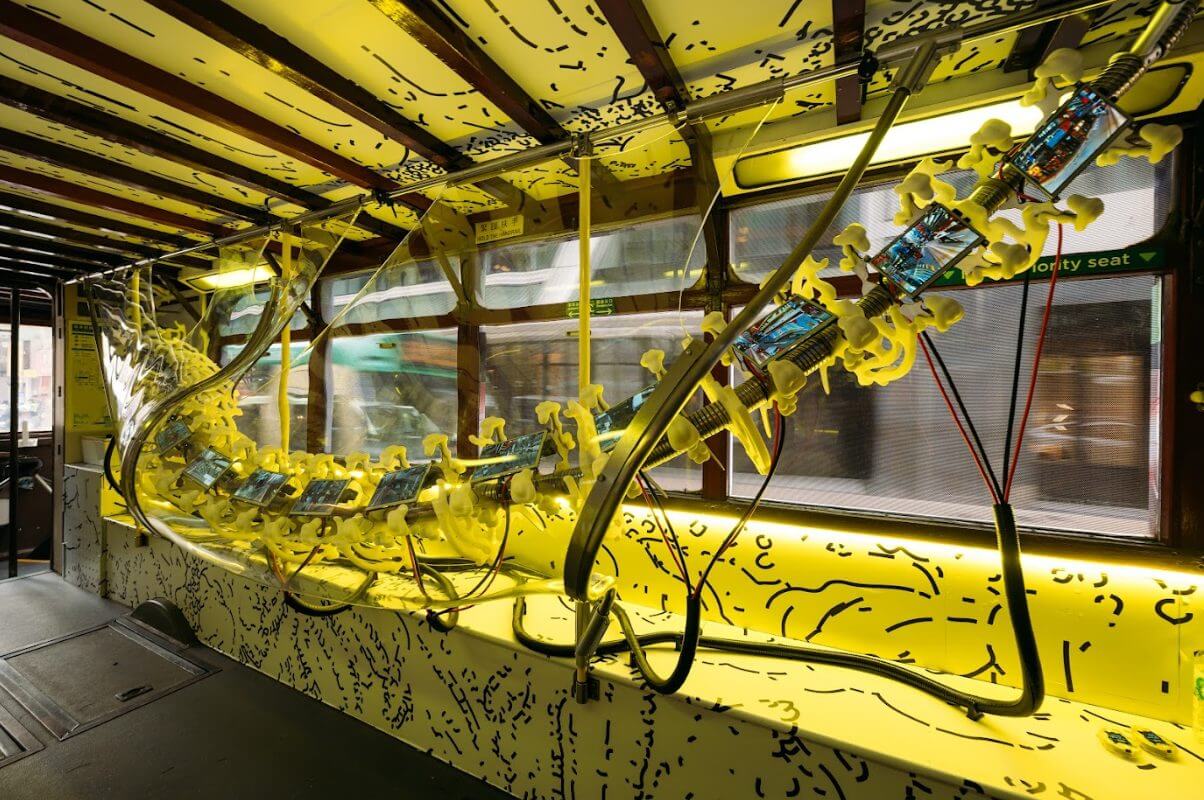
This logic extends into Defragmentation Programme on the lower level of the double-decker tram. Shaped like a spine, sixteen little screens display real-time street views. In a speculative AI future, green elements are suppressed, a sign of loss. Archival images of old Hong Kong appear intermittently. These glimpses reveal what is gradually being forgotten, disrupting perception and reminding viewers that history is never complete or objective.
Above, The Vitiligo – The Absence of Green presents a short LED video tracing Tram0’s search for the lost color. It unites AI-generated imagery, residue, and perception. At the center of the show, the project takes on the logic of an organism, attuned to the city’s rhythms and defined by what is missing. Set in 2066, the narrative imagines a world without green. Its search is described as ‘primarily cultural,’ refusing uniformity while preserving complexity.
Human Craft Against Seamless Futures
Optimization and reorganization attempt to standardize scattered data, but Tram0’s pursuit of green cannot be fully smoothed out. Its movement remains uneven, caught between nostalgia and the demands of progress.
Greenie, a Tamagotchi-like interface, translates this tension into a playful form. Beneath its surface is a critique of contemporary governance: care for infrastructure becomes individualized and gamified. Civic responsibility is increasingly mediated through digital interfaces. When does care begin to resemble control?
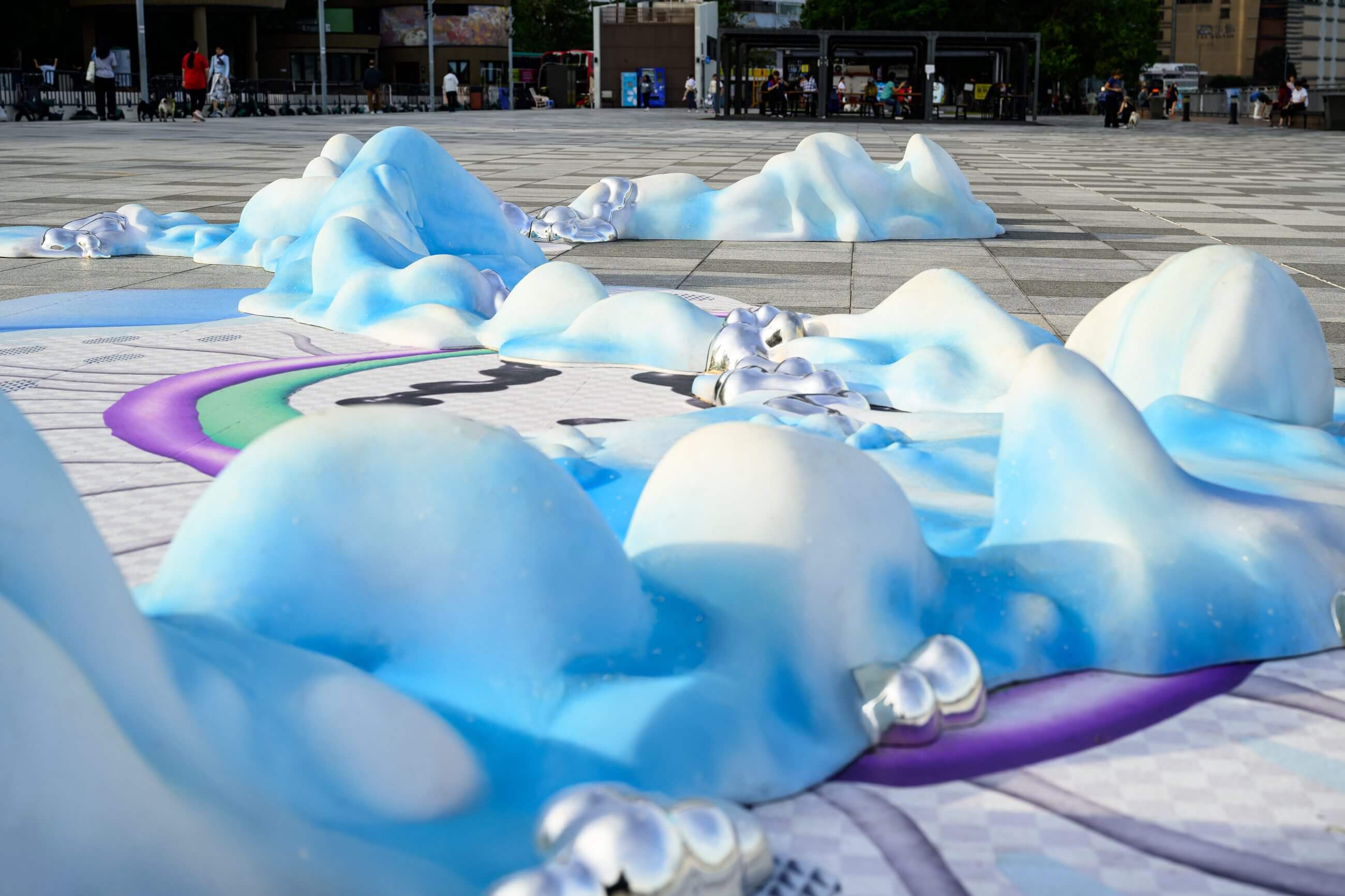
Stranded Matter brings the narrative to Belcher Bay. The tram used to meet the sea here; land reclamation has since erased the shoreline. A fibreglass wave marks this absence, transforming disappearance into foundation, inviting reflection on loss and change. The installation reconnects the tram’s mobile trajectory to the land itself, highlighting the city’s transition and the marks it leaves behind.
To wrap up, Ding Lab points to persistence. It is anchored in Hong Kong’s labor and material foundations, where continuity carries forward without relying on erasure. The motormen’s foresight, the painter’s tactile knowledge, and the work of a full workforce remain present, transmitted rather than overwritten.
The tram is neither a relic nor a frictionless object; it exists as a coherent ecosystem. Hong Kong’s future retains its delays, its multiplicities, its layered green, and the hands that keep the city moving, even as they recede from view. The story remains in upload.
———————
Artists:
Foreseen Agency (www.fore-seen.com)
[Shan Wong (Flyingpig) + Kachi Chan]