
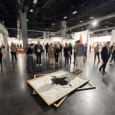

Tokyo doesn’t do silence, even when it’s melting outside. I haven’t been hitting many shows lately — not as many as usual, anyway. My batteries are cooked. But this one stayed on my radar. I stopped by the pre-opening talk at TOKYO NODE. I hadn’t planned to check out the exhibition so soon; in this kind of weather, I’d usually be camped out under my aircon with a fresh can of Dr Pepper. Two days later, though, I gave in and headed to the opening in Bakurocho.
Silver Trail is the latest curatorial project from NEORT++ and VolumeDAO, building on the momentum of dialog(), their 2024 traveling exhibition that moved across Tokyo, Taipei, Seoul, and Shanghai. That series of shows was ambitious, drawing connections across East Asia’s generative art scenes through code. I caught it in both Tokyo and Seoul. At times, it felt a bit utopian, like a Bright Moments for this side of the world, with less hype (nothing negative here, I <3 BM a lot!) and more depth.
In contrast, Silver Trail takes a different road. There’s no sprawling lineup or big group ‘art party’, just two artists having fun: Ayumu Nagamatsu from Japan and Chih-Yu Chen from Taiwan. Their collaboration unfolds on GitHub, where they pass code back and forth like letters, with the online space acting as their shared convo room.
The result is spare but not empty, with an economy at play. Fewer gestures, more meaning per move. It recalls what Vilém Flusser described as meaning emerging from structure itself. This kind of silence is everything but blank; it’s dense and intentional, almost charged. The exhibition isn’t small out of modesty; it tightens the frame, inviting whoever made it to the gallery to look closer and engage deeper.
In 2025, while most digital culture obsesses over going ‘harder, better, faster, stronger’, Silver Trail asks us to slow down. Maybe that’s its real critical value, not chasing the wow effect, but tuning it out. The show avoids growth or noise, yet still calls for audience awareness.
Generative art? Sure, that’s at the core. But this curation also explores moderation and steady process. The team didn’t fight for attention; they created something that rewards it. And it works beautifully


So, what can we see here? The whole thing is a form of documentation; not in the archival sense, though. A living log? Maybe. Or, if you prefer, an open GitHub diary of commits, code changes, notes, and occasional visual outputs. Everything is public, a WIP deployed through max-transparency mode.
And there’s something quite radical in that. In generative art, the process is often present but rarely the focus. Here, the process is the work. As viewers, we’re invited to observe the push and pull of daily practice, the back-and-forth, hesitations, playful edits, and maybe even the mood of the day. There’s no separation between studio and gallery. The repo becomes the exhibition, and the code turns into canvas and conversation.
I remember walking through the space and being drawn less to the screens, projections, and printed visuals than to the messages between them, short commit notes on the screen, edit trails. It was like decoding a story, overhearing something meant to be <private> but made public. Again, transparency.
There’s also a special intimacy here. An infrastructural one along with a structural trust. Co-creating that way requires a mutual vulnerability rarely seen in the art world. Usually, collaborations are performative, clean binaries of “artist A” and “artist B,” with clear outputs and maybe a li’l touch of branding. But this show was different; two artists popping up at the same campfire each day to see what’s going on

The Anti-Spectacle of Process
What stays with you from engaging with this show is not what you see (though it’s visually kick-ass IMO), but what you sense in its deliberate refusal to time-pressure. In digital and media art, generative work, blockchain, and Web3 culture, where almost everything leans into trends, this exhibition was, maybe unintentionally, anti-accelerationist, which I really appreciated. It was a well-assumed rejection of polish and the idea that the work should ever be considered finished. Because it’s not. It never has to be. That approach, especially today, comes across as both generous and timely.
We live inside the madness of hyper-articulation. Every project needs a pitch. Same for images with their captions, for gestures and their audiences. I’ve done it myself. You probably have as well. We all have in the end. It’s how things move. Still, Silver Trail didn’t seem especially interested in movement. It was asking a different question that I received as: What if we just sit here with the work as it comes?
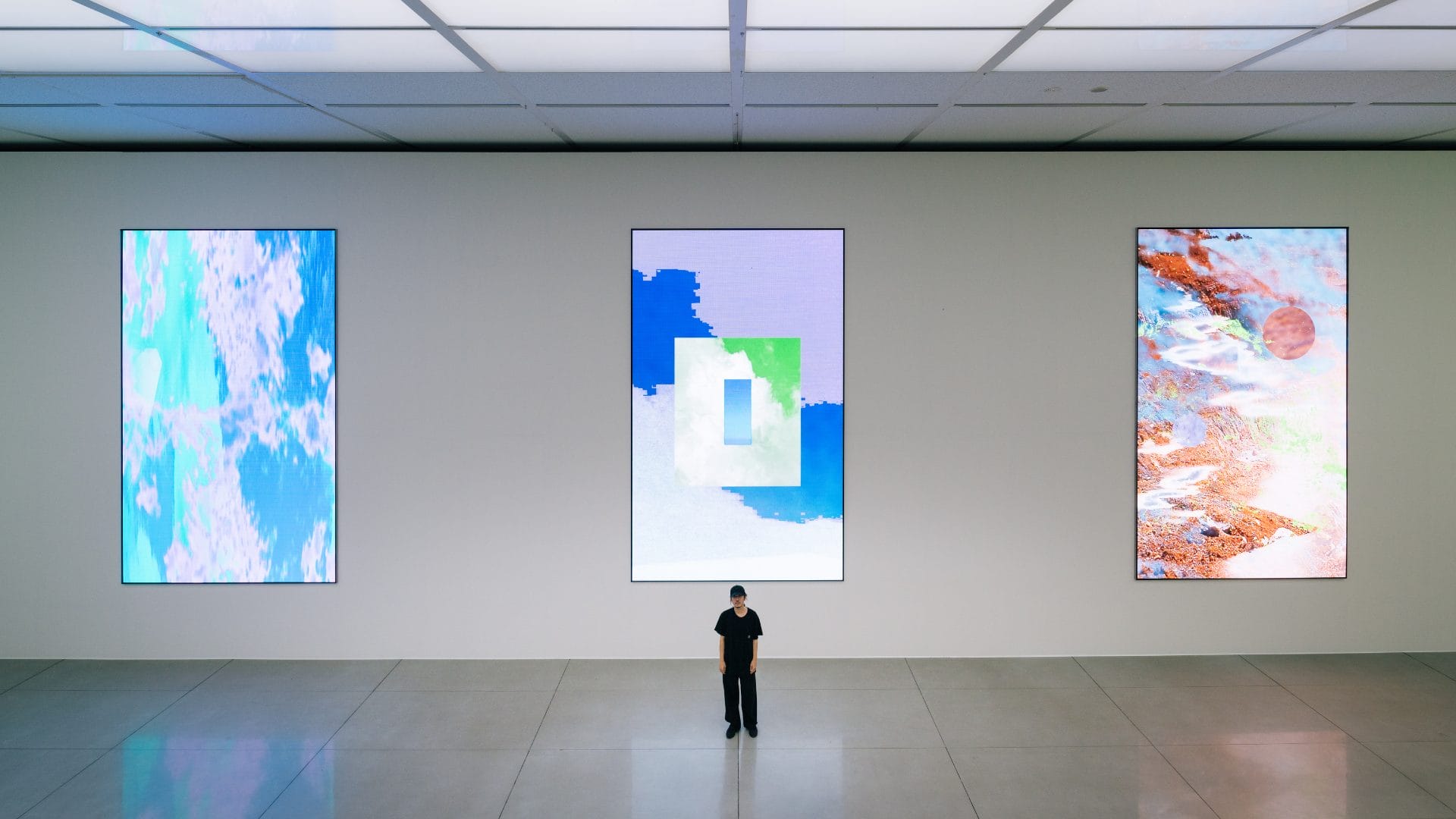
There were visuals, yes. Precise, stunning ones I would say. Shader-generated forms, shimmering with restraint. Voila, A vocabulary of points, clusters, barely-there motion. But they were the wake, not the center. What mattered was the path left behind by ideas.
It sidesteps spectacle, responding instead to the pressure for instant legibility. You won’t see anything cryptic, but it’s not trying to explain itself either. You have to meet it where it is and spend time. Let your perception adjust to its pace.


Post-Dialog(), Pre-Whatever-Comes-Next
This recent chapter in the whole project exists in a strange space. It falls between a follow-up and a standalone. dialog() was a big swing, bringing together multiple cities, formats, and generations. It opened questions about cross-border dialogue, local code histories, and the role of blockchain infrastructure in Asia’s art scenes. And it did that in such an A1 mode. That said, I think this initiative is one of the more interesting moves precisely because it steps away from those big questions. Instead, it studies the mechanics of joint focus.
Silver Trail doesn’t resolve anything or point toward a pattern. It’s just an example, a tiny one, of what happens when you commit, literally, to join forces on a daily basis and let your syntax evolve in relation to someone else’s.
I wonder what would happen if more digital artists worked like this. Away from secrecy or NDAs, and outside product teams or content creators. But as close partners in a durational experiment. Without even trying to “collaborate” in the traditional way, just sitting inside the same system, influencing each other’s logic.
Buried beneath all the commitments is a philosophical proposition: that dialogue is better understood as structure rather than metaphor. That two minds, in this case Ayumu and Chih-Yu, generate meaning not by blending styles, but by remaining in orbit, writing to one another through code over time. Like a silver trail, subtle, continuous, never quite ending.
About dialog()
“dialog()” is a generative art exhibition connecting Tokyo, Taipei, Seoul, and Beijing. It explores the expressive potential of algorithms, showcasing works by 40 artists from across these cities. Through diverse dialogues that transcend linguistic and cultural boundaries, the exhibition opens up new creative perspectives.
About NEORT
The initiative supports connections between digital artists and society. In April 2022, the team opened NEORT++, a physical space in Bakurocho, Tokyo, dedicated to digital art. Their aim is to create new art experiences that bridge online and offline worlds.
About VOL DAO
VolDAO, founded at the end of 2021, is Taiwan’s first NFT art collective composed of creators, curators, and collectors. It bridges Web2 and Web3, decentralized networks and contemporary art, as well as the virtual and physical realms through curated exhibitions and collaborative projects. “Vol” stands for “Volume.” Beyond its meanings of sound and social media “buzz,” it also refers to a collectible unit, a volume, a book, a part of a series. We collect artworks we believe are worth investing in and that could shape the future history of art. At the same time, we curate events and strive to foster a more vibrant public sphere for the metaverse. Let us pursue art that’s worth collecting, and become collectors of action.