


Fakewhale in dialogue with Alex Hartley
In his most recent body of work, Alex Hartley appears to undertake an operation that is as physical as it is visionary: peeling back the surface layer of the present to connect with latent energies and layered narratives, geological, cosmic, and cultural, that move through uncertain, looping, and never fully closed timelines. From the Arctic voyage of Nowhereisland to the evocative stones of Dartmoor, from modernist ruins to sci-fi architectures, his practice unfolds as an ongoing negotiation between inner and outer landscapes, between speculative imagination and the material reality of the world. At Fakewhale, we had the pleasure of speaking with him, tracing the energy of these mysterious, resonant, and deeply human connections.
“All of us just dust” is a poetic and evocative title. Where did that phrase come from, and what does it mean to you in the context of the work?
I like to listen to loud music when I am working, particularly in the post-planning making phase, and often my titles relate to lyrics. I think this titled arrived via a misheard Damon Albarn/Lou Reed lyric from ‘Some Kind of Nature’ (2010) which is a great song that seems to be about the strangeness of contemporary materials. Whilst placing the images of standing stones into a painted floating cosmos I was trying to tune into the idea of the interconnectedness of everything – nothing created and nothing destroyed. I think the actual lyric that drifts in and ends the track is ‘All we are is stars’ and that somehow fell into the work and stuck to it. I find it quite helpful to hold a title in my mind whilst making a work, and for it to roll around becoming the work and the work becoming the title.
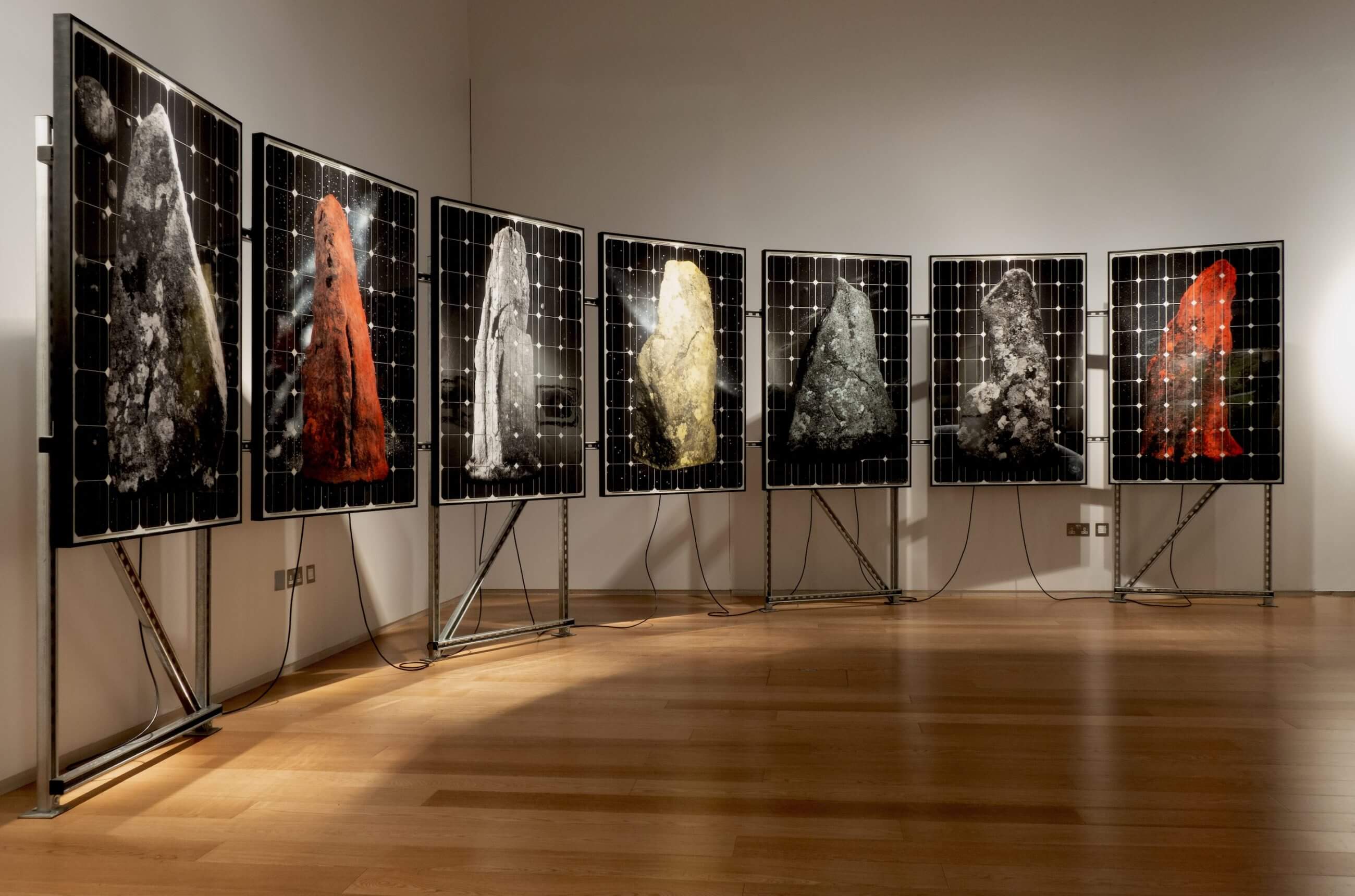
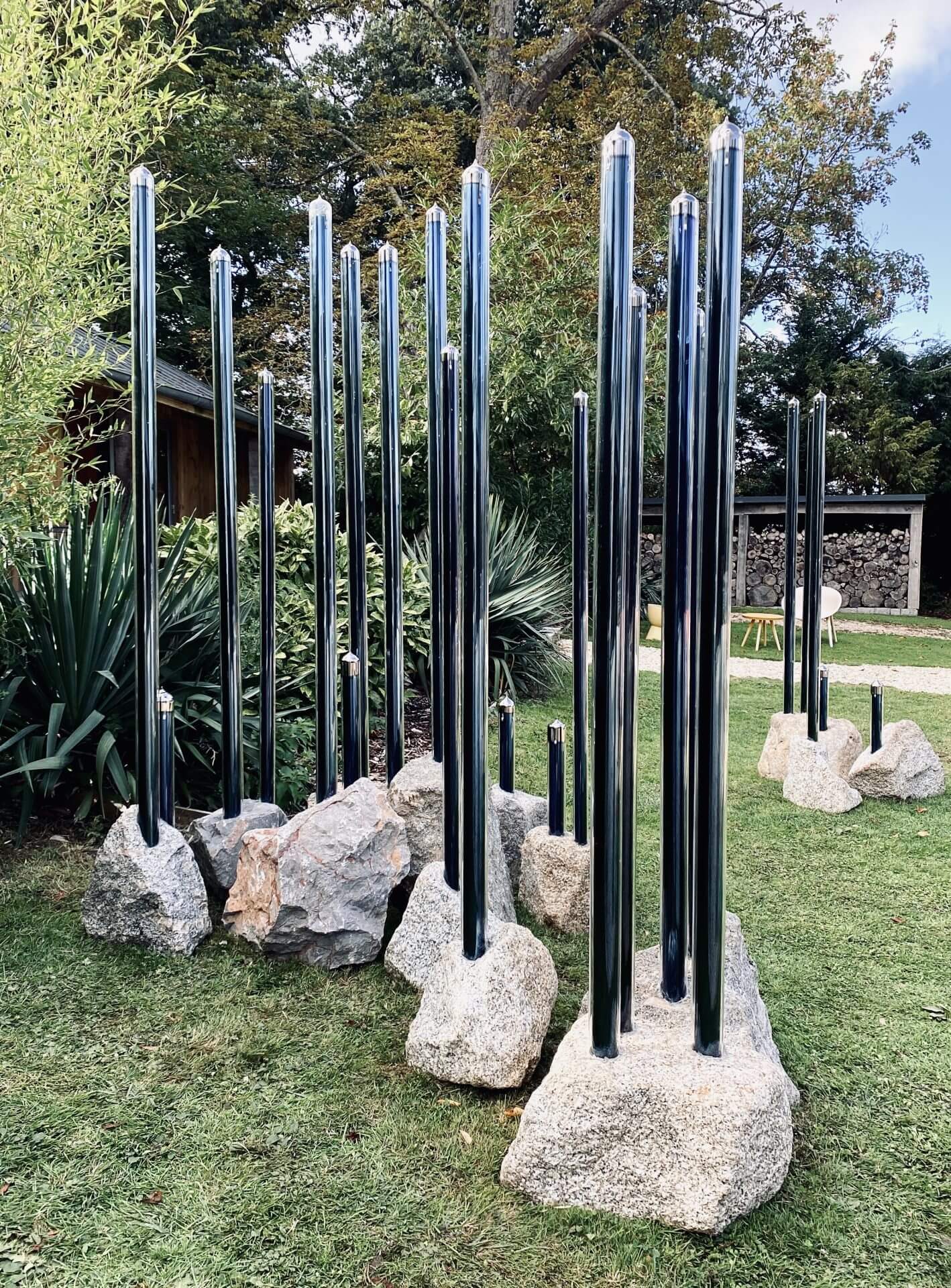
With “All of us just dust” I wanted to directly allude to the first law of thermodynamics, where energy cannot be created or destroyed – only transferred, where everything can be expressed as energy, particles, or dust. The work adopts the language of a solar array deployed by a satellite, and sets up a positive feedback loop where the power of the rocks is captured and transferred via the solar panels (ubiquitous units of energy capture). The energy moves around the work via the cosmic floating stone circle. The glass tubes are solar evacuated tubes (very common in rural settings where they heat water directly from the sun) – this solar thermal element is connected to the physical limestone rock, and leaves the question open as to whether the energy transfer is moving from the panels to the rock, rock to panels, or just part of a closed circuit of constantly flowing ancient energy.

When viewing the piece, one notices an unusual combination of materials, solar panels, glass, stone. What drew you to bring together such diverse elements?
I’ve had a few recycled second-hand solar panels around the studio for several years, and I’d also used them (as per their intended use) in previous projects where I built and lived in geodesic domes. I was interested in the PV panel as ground, their retro futuristic graphic quality, and – given I was trying to depict some sort of portal into space – in the infinite black layered depth of the material. I also liked the compact over-layering of the panels and how that brought to mind a satellite’s deployed solar array.
This latest body of work has tapped more directly into animism – the power that animates the material universe, in this case the power of the stones. The predecessor of All of us just Dust was a multi-panel work titled The Summoning Stones where composite images of resonant ancient stones (photographs taken of Dartmoor’s Neolithic stone rows and circles) were placed onto recycled solar PV panels.
I visited loads of neolithic sites – many of which seemed to me to not have much going on, – no magic – but some of which had a tangible energy and real hidden power with a direct link and connection back through time. It was these stones that I selected to feature in The Summoning Stones and All of us just dust. I was fascinated by some early 20th century photography of these sites that I found in an archive, where the black and white image of the stones often had a figure standing beside the stone, perhaps to lend the composition a sense of scale – and typically the figure had placed their hand on the stone. This simple act of touching the stone seemed to reflect the connection to the power of the stone and to indicate some sort of exchange.
I’ve been taking my own images of these sites and their stones. I print my images, cut them out, hand dye them and embed them under a layer of resin onto the recycled solar phot-voltaic panels. The resin layer seems important to me, as it places the painted cosmos and the photo standing stones into the solar panel, rather than on its surface. The work seeks to capture the vibrant power of the chosen stones which are removed from their land-based context and placed in a newly imagined cosmic constellation, proposing a language of activated energy transference, inviting the viewer to stand at the centre of the work, and to complete the circuit – plugging into the mainframe!

In many of your works, you invite the viewer to physically enter or activate the piece with their presence. How important is this direct engagement with the audience in your artistic process?
I have a deep love for sculpture. I relish the encounter with real things, real material in space, the relationship with scale. I am aware of the presence of the viewer as the missing element in the work I make, that the viewer completes the work, and consequently I consciously leave space for them – either in the making or the viewing of the work. Once the viewer enters the work or engages with it, the artwork is complete.
I recognise it’s a different challenge with audience beyond the confines of the gallery audience, but I also know the I’ve had incredible experiences allowing the work to exist outside of these confines. I’ve made several projects where an integral part of the artwork has been creating community around it. These have proved very meaningful ways of working, where building of the community that made, occupied or lived in the work, became more significant and impactful than the object we built.
Your long-term engagement with Nowhereisland introduced many of the ideas that seem to echo throughout your current work: supranational space, radical recontextualization, and speculative displacement. Looking back, do you see Nowhereisland as a conceptual turning point, or more as an early manifestation of something that is still evolving?
I’m writing these answers whilst on the Eurostar train back from Den Haag, where I visited the International Court of Justice – it is one of 10-12 supranational spaces on our planet. I was so happily surprised by the way people interacted with the line/boundary separating Holland from non-Holland. It took me back to how easily people understood what we were trying to do with Nowhereisland. That we could take a newly discovered Arctic island out into International Waters, declare it a new nation and invite anyone to become a citizen and to help us imagine what we might do differently if we were to start again.
The work absolutely marked a change – a change both in ambition, scale and relationship with audience – the work required huge collaboration and trust in others, and a seemingly impossible step into the unknown. The project felt like such a risk – no one sensible would choose to make a work of art that exists on the sea that is subject to all the vagaries of weather and tide. I’m well aware that before any larger work is made that there’s this period where you ask the people involved to step into an imaginative world of possibility, to believe in something that hasn’t ever happened yet. Somehow the artist has to convince others that it can be done, even if they themselves aren’t yet convinced of it, and with Nowhereisland it seemed most likely it wouldn’t be possible, that it wouldn’t work – but we had to create a belief that it was possible.
Nowhereisland allowed me to believe that I could make whatever I wanted if I could take people along with me on this journey – literally and metaphorically.
Many of the core ideas from Nowhereisland remain central to my practice, and I find myself returning to them over and over again.
In Nowhereisland in Space, you launched a fragment of the island into the stratosphere, suspending it beyond Earth’s atmosphere. A poetic gesture, but also one loaded with speculative implications. Do you feel this cosmic dimension, literal or metaphorical, is becoming increasingly central in your practice?
By the time we came to the end of Nowhereisland’s journey from the High Artcic and then around the coast of the UK, thousands of citizens had signed up and become involved in the project. We really worried about how to end the work in a generous and open way – so we decided that every citizen who was interested would be sent a small individual piece of the island attached to a unique certificate. At the same time, we sent a small island shaped rock piece up into space attached to a weather balloon. Inside the balloon we loaded fine dust ground from the island’s arctic rocks. When the balloon burst in the earth’s upper atmosphere over 32 miles above the earth’s surface, the dust was released and would (at least in theory) remain suspended there forever, whilst the island shaped rock and the cameras returned to earth. I hadn’t connected this act of dispersal directly to the title ‘All of just dust’ until now, but as often when it feels like I’m heading off at a tangent, I end up surprised by the very direct connection to past work.
The Houses series, in which nature reclaims modernist architectural icons, seems to suggest a kind of “distant future” where architecture already exists as ruin. How does this imaginary relate to your ongoing interest in collapse, decay, and cyclical time?
My long running series The Houses suggest future ruins. These works exaggerate and emphasise the foregrounded ‘nature’. In order for these modernist houses to have large open glass-fronted rooms, the privacy screen had to be moved to the property’s boundaries in the form of hedges, fences and trees. It’s this vegetation that I would have to crawl through to move my camera into a position where I could photograph the architecture. Back in the studio I then painted these foregrounded living elements onto the work’s plexiglass surface that sits above the photograph and frames the image. The plant life then hovers over a mounted photograph seeming to swallow up the building. These works all take place in a melancholic grey scale. This iconic architecture was photographed whilst I lived in Los Angeles where the sun always shines – it’s a city I have a long-standing love affair with – but in these images there seems to be sense of narrative, of the viewer having arrived at a situation of ambiguous cause and uncertain outcome.
The frozen moment of the photograph is further isolated and made physical through the doubling and over layering of the painted surface.
I climbed a lot of these buildings and wrote a climbing guide to the city called “LA CLIMBS” where the city was reduced to mere surface to touch and navigate. Sometimes I had permission to do these climbs, sometimes I didn’t, but this side-project connects directly to these images as I had to trespass through the hedges and fences in order to access the iconic houses. I was thinking about Burt Lancaster in The Swimmer, where he takes a direct route across a fancy suburb of Connecticut – jumping fences and connecting neighbourhood pools. In LA Climbs the routes took in the best of LA’s houses as well as cinemas, parking lots, bars and freeways.
I currently live in the countryside in the UK, in a lush situation that requires a lot of active maintenance to attempt to slow down nature taking complete control. Our built environment is no match for Supernature.

In your installation A Gentle Collapsing II, the rear entrance of Victoria Miro becomes a portal, a temporal shift. How important is it for you to create narrative, immersive experiences for the viewer? And how much does the specific site shape the way a piece is conceived?
I’ve made a few of these large-scale installations, placing architecture in landscape, where the structure sits away as a point in nature – like a folly – drawing you towards it. The works are intended to create a state of unease, to ask the question “what has happened here?”.
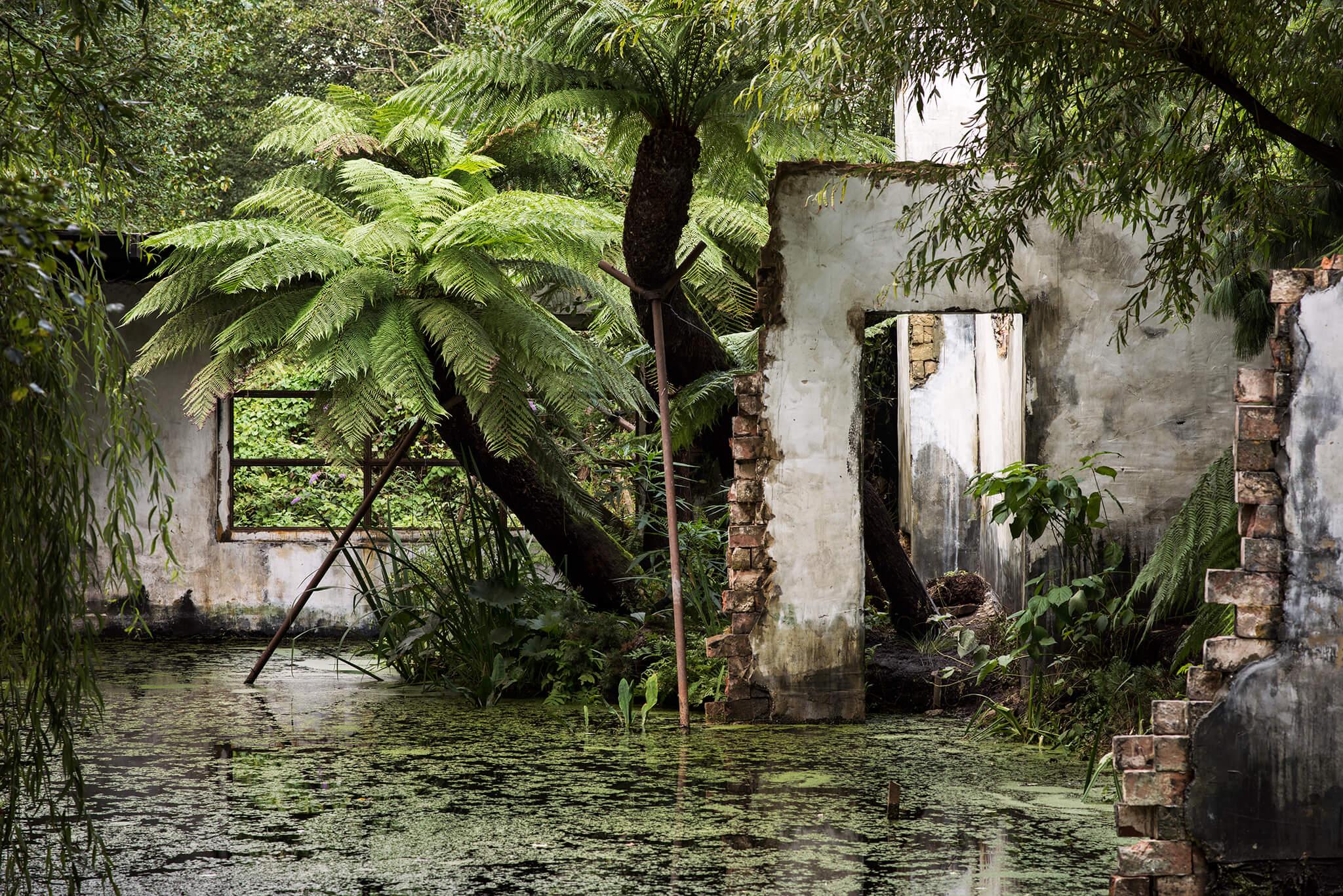
A Gentle Collapsing II is probably the most successful of these works, and I think this comes down to the work’s lack of edge – it felt impossible to tell where the piece started and ended – it managed to take on the canal and garden into which it was built, and everything became part of the work – the weed, the water, the trees, the ferns. I’ve also made (and seen) many outdoor works where the opposite occurs – the badly destroyed or relayed turf surrounding the base of public sculpture that breaks any allusion of belonging. It was a joy with A Gentle Collapsing II the way it integrated into its drowned setting.
The work formally resembled an International Style domestic building apparently abandoned to the elements and was built on the bank of a canal and into the water itself. The work encapsulates classic modernist tropes – yet the structure and what it appears to portray – a home vacated without explanation, open to the elements, its white rendered walls peppered with black mould rising from the waterline – stands in stark contrast to images of domestic architecture and attendant aspirational lifestyles. The work integrates the exisitng tree ferns suggestive of an ancient subtropical or temperate landscape, A Gentle Collapsing II looks to have undergone an accelerated process of ageing. It is as if we have been teleported into the future in order to look back at the present or very recent past.
The work’s reflection on themes of entropy and decay, is, in some ways, emblematic of a wider collapsing – of ideals, spirit or our climate. There is an established aesthetic pleasure in ruins – their compelling, romantic transportive quality. Perhaps this pleasure is increasingly challenged as we become increasingly familiar with the realities and displacements of climate change, the devastation of flooding, rivers bursting their banks in storm event, and rising sea levels reclaiming our built environments and ways of living. In this sense, A Gentle Collapsing II becomes a kind of time machine that frees the mind to wander, gently collapsing or dislocating a sense of linear time as it does so but taking us to darker futures.
In The Clearing and Dropper, the idea of self-sufficiency and alternative living enters your practice through lived experience. What did it mean for you to inhabit your own artworks, and how did this experience inform your ongoing research?
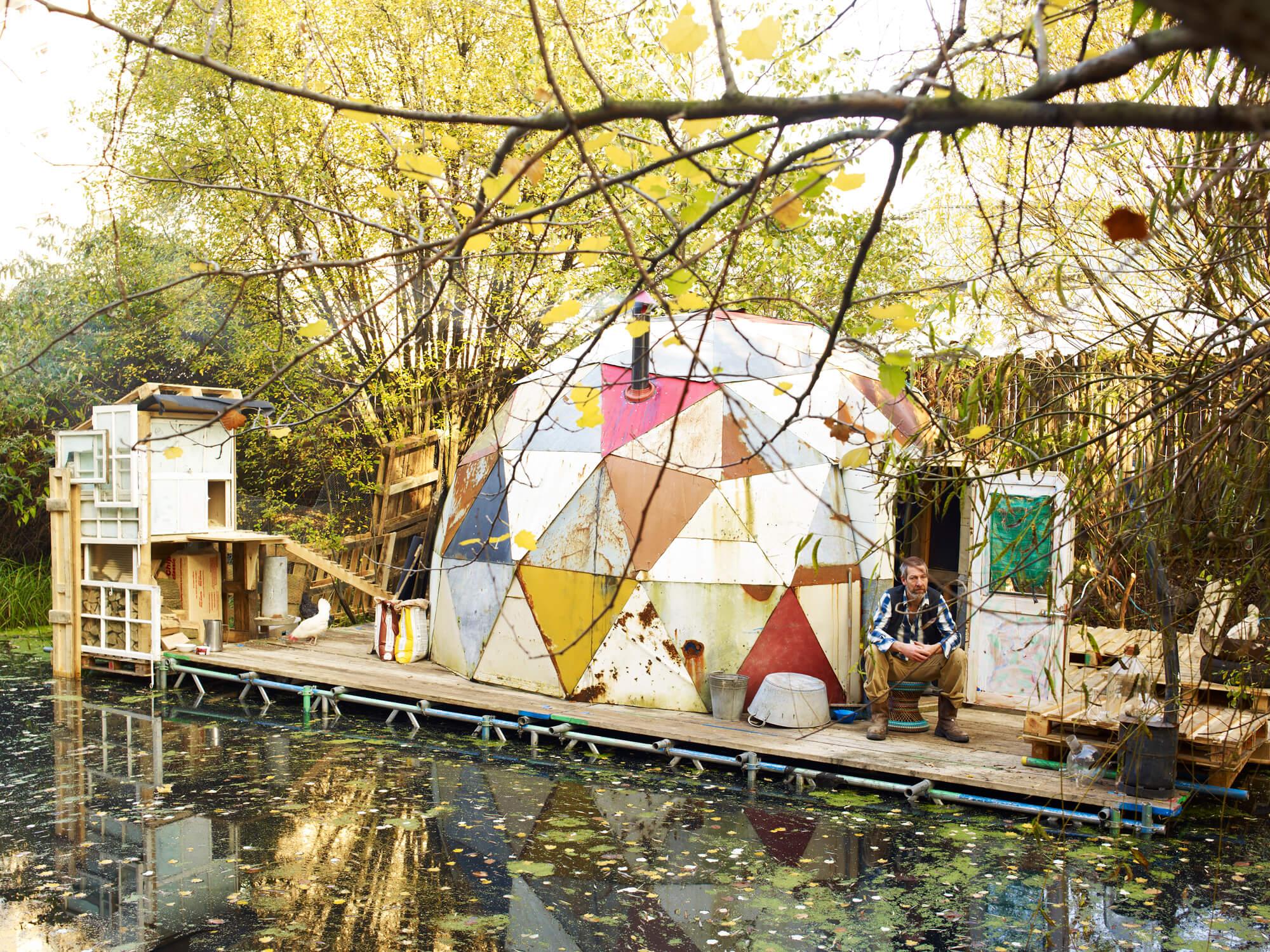
With Dropper I built and lived in the work during the run of my show at the gallery. It wasn’t intended as any kind of durational performance – it was more that my presence seemed important to animate and activate the work which gave context to the pieces shown inside the adjacent gallery. The dome was built like those built for Drop City, from car rooftops and bonnets/hoods (only the cars in the UK are so much smaller that it was hard to get triangles big enough for each section).
The story I told myself as I lived in the dome, tending the chickens, chopping the firewood and ignoring the gallery-goers, was that I had somehow stumbled across this abandoned decaying dome and that for the few months of the show I had taken it over and was using it as my own.
At the end of the exhibition I gave the dome to Occupy where it was installed amongst the tents at Finsbury Square. For a while it was used as the community’s gathering and debating space, but as the winter became wetter and wetter, drug-users moved in because it was dry – and (in an echo of what happened in the original Drop City) this preceded the collapse of the whole site.
You’ve often cited sci-fi, from Star Trek to J.G. Ballard, as a key influence. In your own work, how do you reconcile a nostalgia for speculative futures with a critical perspective on the ecological, social, and political realities of today?
We going to need some pretty effective speculation, and huge imaginative leaps to get us out of our current situation; to deal with the future that’s coming, and the future that has arrived. I’ve always got caught up in how science fiction can so compellingly imagine different worlds and possibilities, ways of being, and to look to the future – predicting it, possibly shaping it, and at the same time hold up a critical mirror to what we are doing now.
Also, a lot depends on what you expect from your art viewing experience. There’s some debate in the UK (particularly amongst funding bodies) over the need for art not to just point towards our problems but also to provide solutions to some of these ‘realities’ of today. I’ve never seen this as the job of art, and I worry if we’re relying on artists to fulfil this role. However, I’m in no doubt of the importance of art to reflect our experience as individuals and as a society and I am fully signed up to the transformative power of art and creativity.
You’re currently working on a piece inspired by the Dyson Sphere, a hypothetical device for harvesting energy from a star. Do you see this as a utopian vision, or more as an allegory for our need to reconnect with deeper, inner, and planetary energy sources?
The latter (!) – I love the idea of a mega structure surrounding a star that can capture the output of that star – again something that started as science fiction might create future realities. My new work takes the form of encased energy entrapment that wraps around you, reconfiguring the images of the ancient stones into a circle that the viewer can step into and enter. I’ve had a long fascination with the idea of Orgone – a sort of pseudoscientific esoteric theory of energy put out by Wilhelm Reich. He built these structures, orgone energy accumulators – that you could sit in and have you own vital state enhanced, he had some super unconventional ways of thinking that never reached anything like wider acceptance. This new work is caught up in these preoccupations even if they are quite strange. But then something really strange, and not easy to explain, happens to us when we lose ourselves in the vibrant material transportive experience of art.
fakewhale
Founded in 2021, Fakewhale advocates the digital art market's evolution.Viewing NFT technology as a container for art, and leveraging the expansive scope of digital culture, Fakewhale strives to shape a new ecosystem in which art and technology become the starting point, rather than the final destination.
You may also like

Urbach Justin, Vall Tatjana, Kiel Johannes, “NO MIND NO MATTER”, at Kunstarkaden Munich
“NO MIND NO MATTER” by Urbach Justin, Vall Tatjana, and Kiel Johannes, curated by Kunsta

The Warhol Effect: We Are All Sons of Andy
A Pittsburgh-born artist, Andy Warhol emerged as one of the most recognized artists in the 1960s New

Mathias MU, Marnix Van Soom, Davide Zulli, Thijs Jaeger, Jo Caimo, Julie De Kezel, Anton Cla, Spells & Promises at The Creative Factory, Turnhout
Spells & Promises by Mathias MU, Marnix Van Soom, Davide Zulli, Thijs Jaeger, Jo Caimo, Julie De
