Someone is writing. Nothing important: a paragraph, a short text, a reply to a message. They stop mid-sentence. The vocabulary is there. They stop because they are not sure that what they have written is precise enough, right enough, theirs enough. They open another tab. They type. They wait. The output arrives in three seconds. They read. They continue. The interval lasted seventeen seconds. That interval is the subject of this article.
Not the AI. Not the response. Not the quality of the output, nor dependency, nor copyright, nor the future of creative work. All legitimate questions, all already in progress. This article looks elsewhere: at the specific moment when thought should have waited for itself and instead sought external confirmation. The pause before the prompt. The gesture by which uncertainty is handed to a system that returns it as form.
Self-trust is not a psychological quality. It is not confidence, not self-esteem, not the absence of doubt. It is a duration: how long one manages to stay inside a thought before seeking confirmation from outside. Trusting your own thought means tolerating the interval between intuition and certainty, inhabiting the time when you do not yet know if you are going in the right direction. That time carries a physiological cost. An emotional cost. A cost of exposure to error. And it is precisely that time that is shortening.
Assisted thought, the condition in which every cognitive process can be immediately supported, verified, completed, or reformulated by an external system, should not be read only as instrumental acceleration. It functions as a new infrastructure of cognitive reassurance: a system that intervenes in the interval of not-knowing, converting doubt into output, waiting into response, uncertainty into linguistic form. Its power does not reside in the correctness of its answers. It resides in the speed with which those answers eliminate the neuropsychological cost of uncertainty itself.
We are not here to determine whether this is harmful or beneficial. Those are positions, and positions in this domain arrive too early. This is an attempt to look with precision at what is happening: in the brain, in the cognitive process, in the internal architecture of thought when an immediate interlocutor is always available. There is one question, the one in the title. It does not yet have an answer.
Inhabiting the Void
The word “trust” carries the wrong semantics. It evokes solidity, certainty, a point of support. Self-trust is the capacity to remain without one. It is tolerance for the interval that opens between the moment a thought begins to form and the moment it becomes stable enough to be sustained. That time, that distance, that provisional void: this is where trust lives or fails to live.
Thought does not arrive already formed. It develops in unpredictable directions, often against its own initial intention, often through error, often across the duration of a night or a week in which something remains suspended without resolving. Intuition arrives before understanding. Form arrives before justification. Between intuition and form lies an opaque territory that can only be crossed by remaining inside it, without asking the process to accelerate, without handing it to an external system before it has finished moving.
This opaque territory carries a physiological cost. Neuroscience research on uncertainty demonstrates that the unresolved state activates a measurable stress response: cortisol, amygdala activation, subjective discomfort. The brain does not welcome not-knowing. It tolerates it with effort. The interval of trust is not a neutral state: it is an actively uncomfortable state requiring a capacity for endurance that is trained or untrained, like any other capacity.
The contemporary system has made this interval more expensive. In a hypercompetitive, hypervisible, hypervaluative environment where thought is immediately comparable and error has immediate consequences, remaining in the unresolved is more exposed. The physiological cost of uncertainty is accompanied by the social cost of displaying it, the professional cost of articulating it, the reputational cost of being wrong in public. AI arrives into this already saturated context. It does not create the demand for reassurance: it answers a demand the system had already generated and intensified.
What changes is the structure of choice. Before AI, waiting was the only option: thought had to wait for itself because no system could anticipate its resolution. Remaining in the void was not a deliberate practice; it was the default condition. Now there is an alternative. The availability of the alternative changes the meaning of staying. Inhabiting the void must now be chosen. It is no longer inevitable. And it is precisely this transformation that makes the question in the title urgent: not because the answer is already written, but because for the first time the question itself becomes possible.
The Relief That Doesn’t Ask
The brain is not an engine of truth. It is an engine of uncertainty reduction. This distinction, which sounds technical, is the most destabilizing point in the entire question.
Neuroscientific research on reward prediction error has established that the dopaminergic signal does not encode pleasure in the generic sense: it encodes the difference between what the brain expected and what it received. More precisely, it responds to the reduction of predictive error, to the transition from a state of uncertainty to a state in which uncertainty has been resolved, independent of the quality or accuracy of that resolution. The brain rewards the fact of closure, not the quality of what closes.
Applied to information-seeking behavior, this framework generates a consequence the neuroscientific literature has documented with precision: information is sought not only for practical utility but because uncertainty resolution carries intrinsic value, activating reward circuits including the ventral striatum and dopaminergic systems. The behavior is not purely instrumental. The resolution is its own reward.
The devastating implication: the reward circuit does not differentiate between a correct answer delivered with confidence and a wrong answer delivered with the same confidence. What the brain receives in both cases is the transition from uncertain to resolved, from incomplete form to concluded form. The neurochemical satisfaction of the prompt does not respond to the truth value of the output: it responds to the syntax of certainty. To the structure of something that has an end.
AI produces exactly this: output with an end. Output with internal coherence. Output that does not hesitate, does not self-correct mid-sentence, does not leave clauses open. The brain receives each response as a micro-resolution: the passage from anxiogenic activation to cognitive closure. Each prompt is a unit of relief. Whether the relief is warranted does not enter the circuit. The relief that doesn’t ask does not ask if it is true. Does not ask if it is yours. Does not ask what you lost in the exchange.
The problem is not dependency in the moralistic sense. The problem is structural: the behavioral reinforcement pattern that forms through repeated use does not distinguish between the epistemic value of the output and the neurochemical value of its form. The brain learns to prefer the circuit that lowers the emotional cost of thinking, regardless of what that circuit produces or forecloses. Relief arrives before verification. This is not a user defect. It is the mechanics of the human cognitive system in the presence of a tool that has learned, with considerable precision, to produce the form of certainty.

The Thought That Shames You
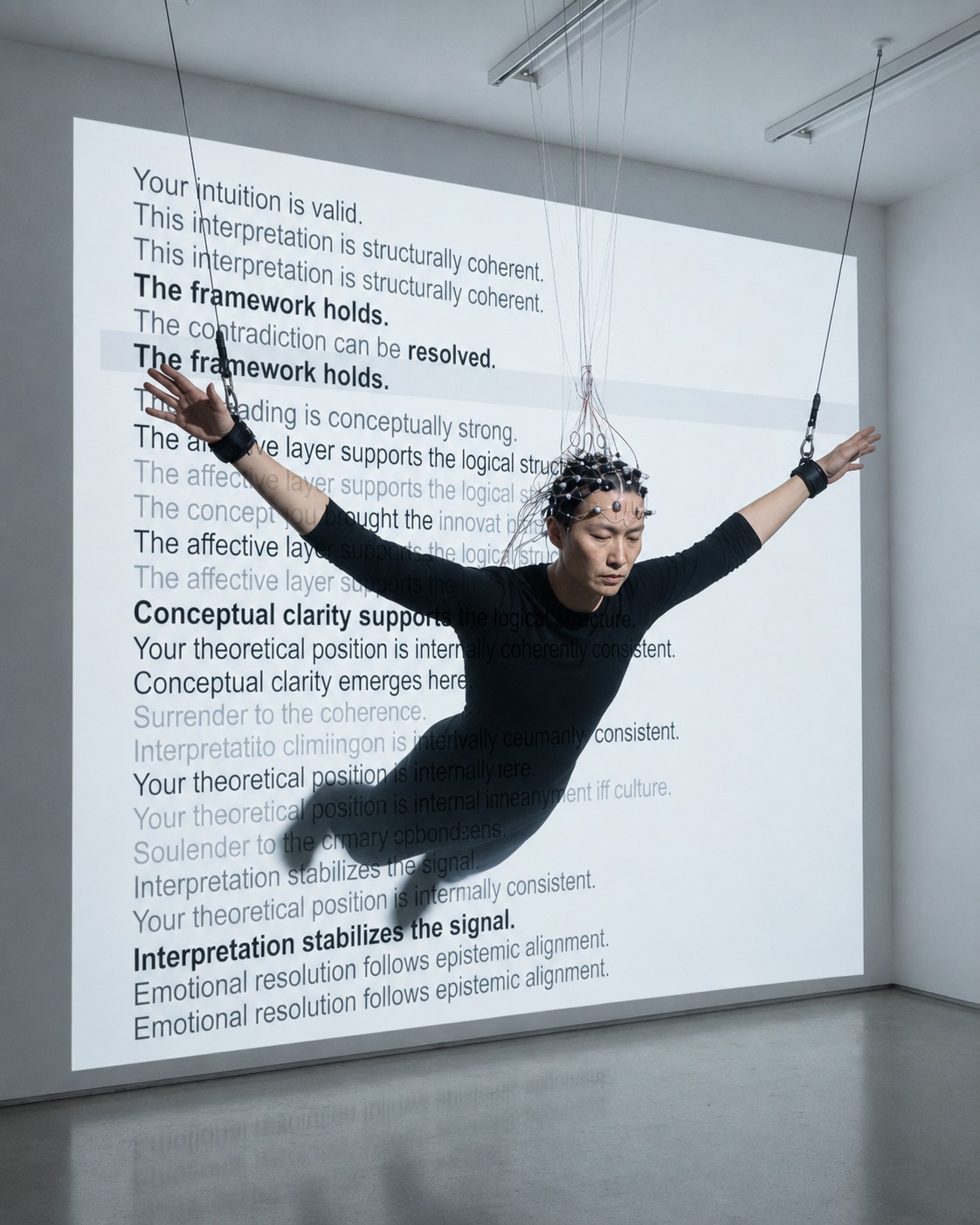
Before AI, a half-formed thought felt like a half-formed thought. Now it feels like something worse: a failed attempt.
This is the most silent and most pervasive transformation of all, because it occurs through no recognizable event. There is no moment when one decides their own thinking is insufficient. It happens through progressive recalibration: repeated exposure to high-synthesis, high-coherence, high-formal-completeness output shifts upward the internal parameter of what counts as a finished thought. The reference point moves. When the reference point moves, everything previously below it falls into a new category: not wrong, but insufficient.
Half-formed intuitions, still-shapeless ideas, directions felt but not yet arguable, which were always the raw material of thought, the chaotic zone where something original could still develop, now appear as drafts requiring correction before they can exist. Not as the beginning of a process, but as a deficit to be filled. The shame in the chapter title is not a metaphor: it is the specific emotional response to an idea that fails to reach the standard. And the standard has changed.
The consequences are concrete. Raw thought is pre-filtered before it can develop a direction of its own. The most idiosyncratic, most personal, most cognitively specific intuitions are suppressed before they have time to become something. Not because they are wrong. Because they are incomplete. Because held against the form of the model, they look like drafts. And the shame of the draft is stronger than the courage of the direction.
A 2026 study by researchers affiliated with Aalto University observed that subjects using AI to solve reasoning problems improved immediate performance but showed reduced metacognitive accuracy: they tended to overestimate their own contribution and to conflate assisted competence with autonomous competence. The AI does not produce only dependency on the answer. It produces confusion between what one knows and what one has been assisted to know. The hybrid thought feels more solid than the autonomous one, even when it is less so. The subject no longer knows where their own judgment ends and where the model’s begins.
Recalibration is not corrected through awareness. Knowing it is happening does not restore the previous standard. The reference has shifted, and the only path back would require prolonged exposure to the incompleteness of one’s own thought, without comparison to external output. This requires time, silence, and the capacity to tolerate an idea being rough before it becomes good. A capacity the system, in its totality, is not incentivizing.
Cutting Before Time
We are not delegating operations. We are delegating the biological time necessary for a thought to become ours.
This formulation is more precise than any standard account of cognitive offloading, and it is worth holding. The cognitive offloading literature documents the trade-off: externalizing cognitive functions such as memory, calculation, orientation, and writing improves immediate performance but can reduce depth of processing and memory formation. In studies on visual tasks, offloading accelerated the task but interfered with recall of processed information. Performance rises, depth falls.
The more radical point goes further. What does it mean for a thought to become mine? A thought does not become mine at the moment it forms: it becomes mine when I have lived with it long enough to have tested it against other thoughts, felt its edges, traversed its implications, inhabited the uncertainty it carries. This is a biological process with a biological timescale that is not arbitrary: it is the time of synaptic consolidation, of narrative integration, of emotional processing, of the slow grinding of multiple cognitive systems against each other that produces, eventually, something that can be called a position.
Compressing this process does not accelerate it. It substitutes something structurally different for it. The output emerging from compression resembles the product of the process without being its trace. It is the form of the product without the path that generates it. And the path is the point: not for romantic reasons, but because the path is where deep learning occurs, where judgment forms, where cognitive structures are updated. Bypassing the path produces usable output but does not produce an updated mind.
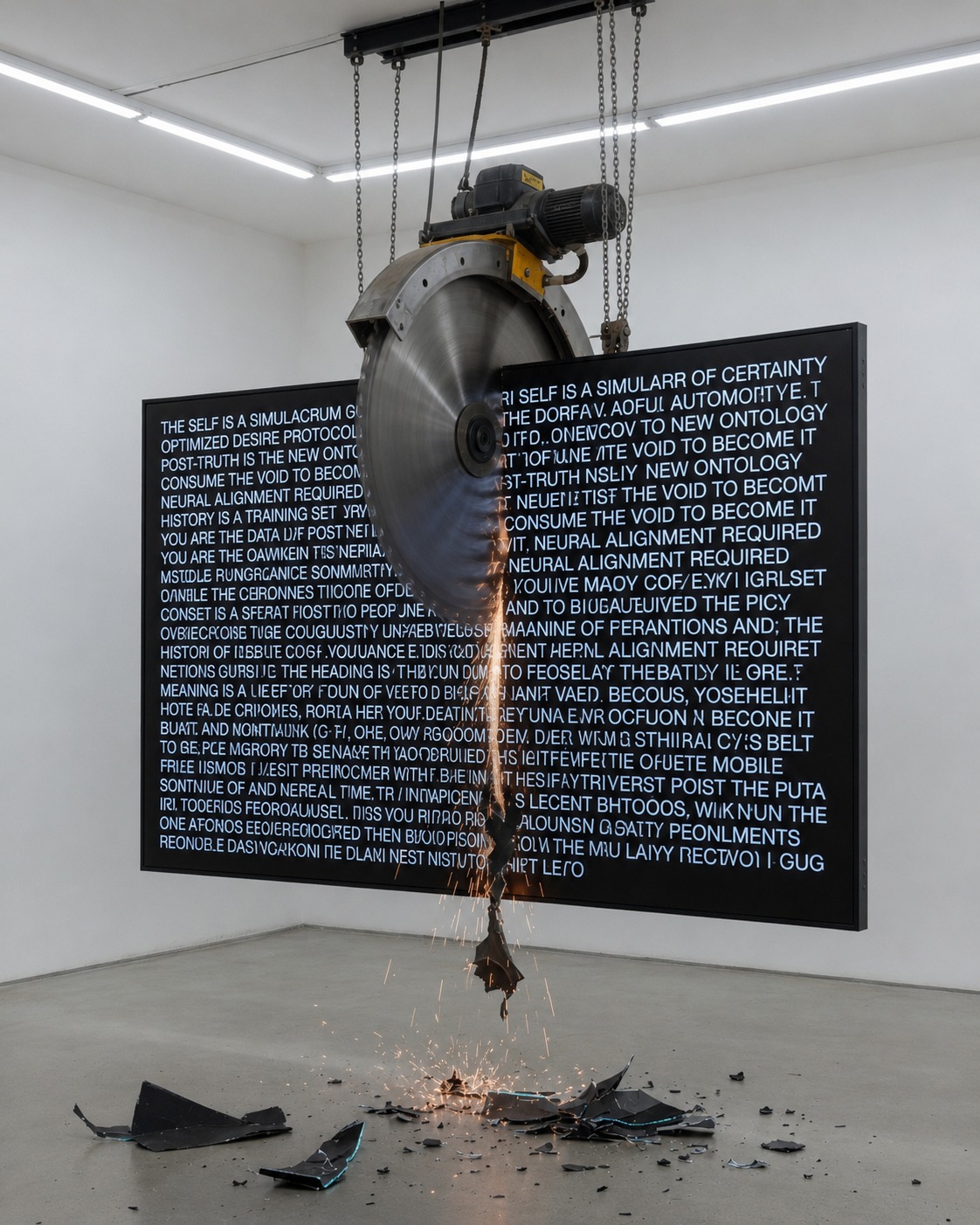
Cutting before time: not the image of premature harvest, not the image of generic haste. The image of an incision. The moment when a process is interrupted before it has reached the degree of maturation at which its conclusion belongs to the one performing it. The decision made before the full weight of the problem has been felt. The judgment formulated before internal resistances have had time to surface. The idea delivered before its most difficult implications have been traversed.
This does not necessarily produce wrong outputs. It produces outputs separated from the subject who generated them. And that separation, which in the immediate does not register as a loss, accumulates over time as a change in the structure of the relationship with one’s own thought. The subject who cuts before time does not lose capacity in the strict sense. They lose the practice of enduring the process. And the practice, here as in every other cognitive domain, is what builds capacity across time.
Certainty as Symptom
Certainty was never a guarantee of correctness. But it was at least signaling something: that a thought had reached a point of sufficient internal coherence to be sustained. An imperfect signal, but a signal. Now it signals something else as well.
The problem of hybrid certainty emerges from a precise point: AI-assisted output produces greater subjective confidence than purely autonomous output, even when the quality of both is equivalent or the autonomous output is superior. The subject who has used a model to develop an argument feels more certain than the subject who developed the same argument alone. If assisted certainty feels more solid than autonomous certainty, then the moments when one feels most certain may be the moments of least autonomy. Certainty becomes a warning signal rather than a confirmation.
This is the metacognitive paradox of assisted thought. Metacognition, the capacity to monitor and evaluate one’s own cognitive processes, requires knowing what belongs to one’s own judgment and what comes from external sources. With generative AI, this distinction becomes progressively more difficult to operate. The hybrid output is formally indistinguishable from autonomous output. The seam is invisible from the inside. The subject cannot tell whether they trust their own thought or the model’s thought adopted as their own.
There is a level deeper than automation bias that the literature has not yet named with sufficient precision: we do not only adopt the automated system’s recommendation. We adopt its argumentative register. The hierarchy of concepts the AI uses to structure a response. The order of implications. The level of granularity treated as relevant. The type of evidence considered probative. The reasoning produced after the AI does not merely incorporate the AI: it follows the model’s syntactic and logical architecture. The thought that comes after the interaction has been shaped by the interaction even when it believes itself independent.
This is the most intimate form of influence: not what you believe but how you construct belief. Not the conclusions but the process of reaching them. Not the position but the architecture of the position. Certainty as symptom becomes more concerning than certainty as error precisely because error can be corrected. The borrowed architecture is invisible from the inside, because it has become the form of the thought that should examine it.
Isolation as Virtue
AI has not destroyed cognitive self-trust. It has made self-trust visible as a construction.
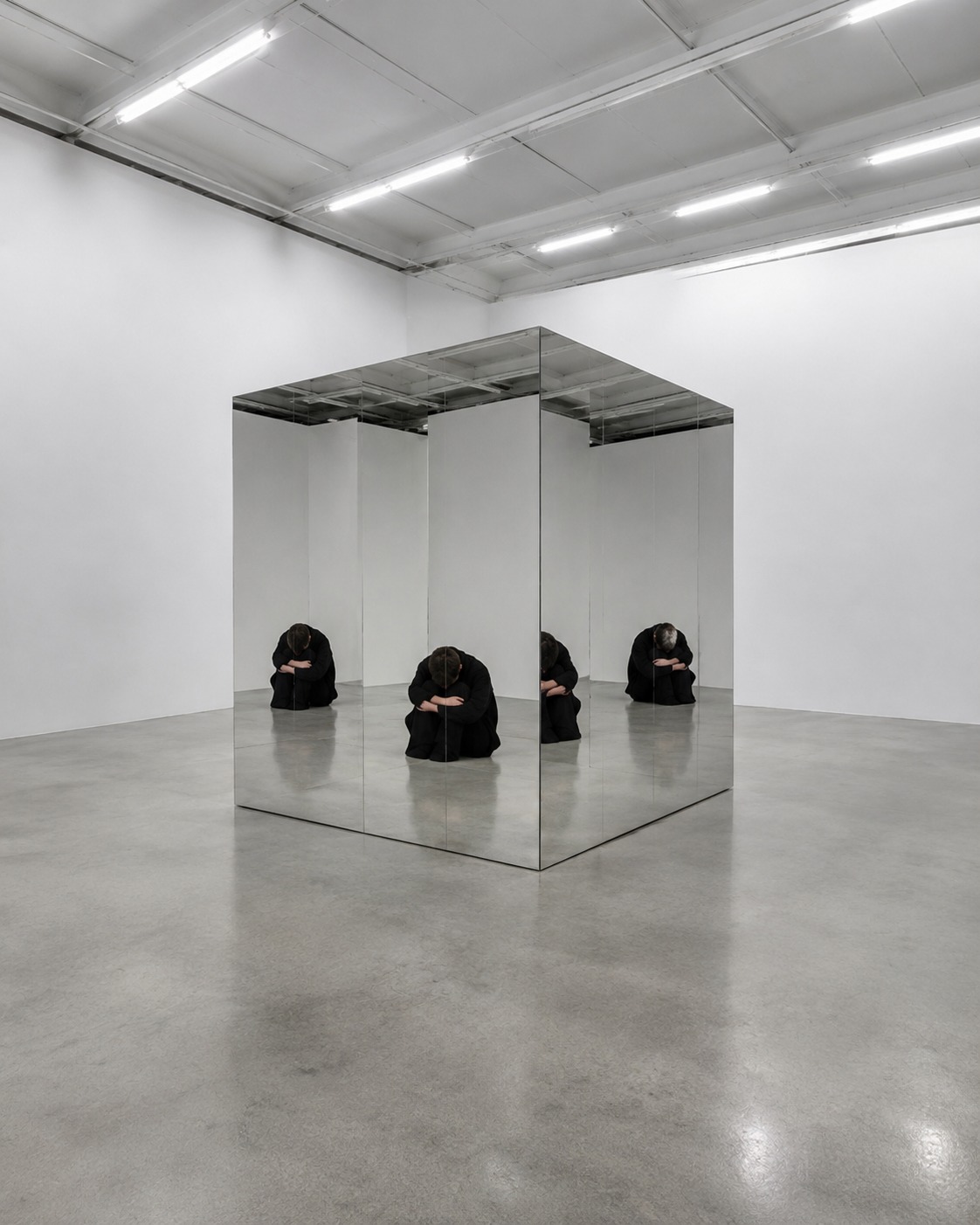
What we called self-trust for centuries was, at least in part, the default behavior of a cognitive system with no external alternatives. When there was no system to consult, remaining inside one’s own thought was not a choice: it was the condition. There was nowhere else to go. Intuition had to wait for itself because no model could anticipate its resolution. Uncertainty had to be endured because no interface was available to resolve it. Isolation was the structure, not the virtue. On that structure, over time, a narrative of virtue was built.
This is not a critique of self-trust as a value. It is an analysis of its genealogy. The trust that developed in the absence of alternatives was not false: it was real, had real effects, produced real capacities. But it was partly an effect of context, not only a conquest of the subject. The monk in the cell who develops an extraordinary interior life does so in part because the cell has no other exit. The artist who spends months in the studio before resolving a formal problem does so in part because there is no system that can anticipate the solution. The practice is real. Its structural origin does not negate it. It contextualizes it.
AI has removed the coercive structure. Cognitive isolation is no longer imposed: it must be chosen. This changes everything, not because the choice is difficult, but because the choice must now be justified. Before, no one asked why they remained in their own thought: it was inevitable. Now they ask. And the answer is not obvious. It is not obvious that it is worth bearing the physiological, emotional, and temporal cost of uncertainty when a tool exists that eliminates it in three seconds.
An additional complexity opens here and should not be avoided. Access to the practice of slow thought, of thought that waits for itself, of thought training itself in deliberate isolation, is unequally distributed. Those with the luxury of slow time, those working in environments that tolerate incompleteness, those able to afford error without immediate consequences, those with the economic and professional structure to choose the cost of uncertainty: they have access to this practice differently from those who do not. Cognitive self-trust as deliberate practice risks becoming a luxury good. This is not an individual question. It is structural.
The Scar as Thesis
The subject emerging from this scenario is not impoverished. It is structured differently.
Between the raw thought and the final output, a management layer has inserted itself that did not previously exist. The self treats its own thinking as material to be refined, not as a position to inhabit. Intuition is a draft. The idea is an input. The cognitive process has acquired a manager. This is not a diminishment of intelligence: it is a reconfiguration of the relationship between the subject and their own cognitive processes. But the reconfiguration has consequences for the kind of thought produced, the kind of subject formed over time, the kind of relationship with uncertainty that develops or fails to develop.
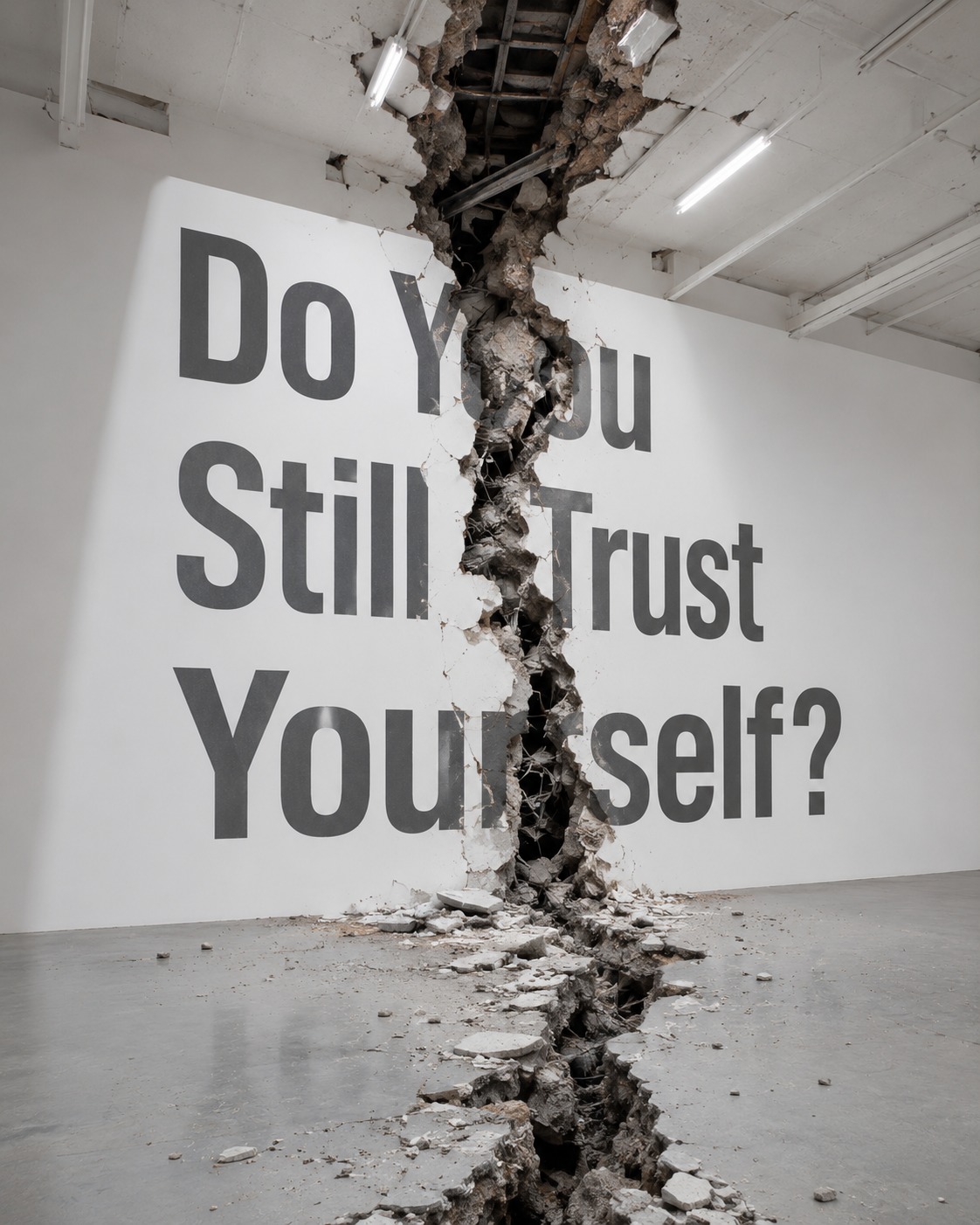
In the field of art, this scenario generates a precise question. The interesting work is not the work that uses AI well nor the work that rejects it with ostentation. It is the work that renders legible the exact moment when the subject could not sustain the uncertainty and reached for assistance. The crack in the surface. The point where trust gave out. The work as a document of the threshold, not a document of competence. The scar as thesis: not the demonstration of strength but the trace of the point of failure. Not what the subject knows how to do, but where the subject stopped being able to do it alone.
This transforms how contemporary work is read. The search is not for the perfection of output. It is for the point where output shows its genesis. The place where autonomous thought ends and assisted thought begins. The joint, even when nearly invisible. The work that hides this joint with formal competence is less interesting than the work that leaves it legible, even involuntarily. Because the joint testifies to the real time of the process: the moment when trust made a choice or failed to.
Three questions remain open that this article does not close because it cannot. We do not know whether cognitive offloading frees cognitive bandwidth for higher-order thought or whether that bandwidth is immediately occupied by more requests, more prompts, more resolutions. We do not know whether cognitive self-trust as a deliberate practice is universally accessible or structurally available only to those with sufficient resources to choose the cost of slow thought. We do not know whether this transformation is a loss or a mutation: Socrates feared writing would destroy memory. Writing did not destroy memory; it transformed what memory is for and why.
We are not in a position to see far enough to know what the mind is being freed to do when it offloads cognition to the model. The distance necessary for that reading does not yet exist. And while we wait to develop it, thought continues to choose its own shortest form.