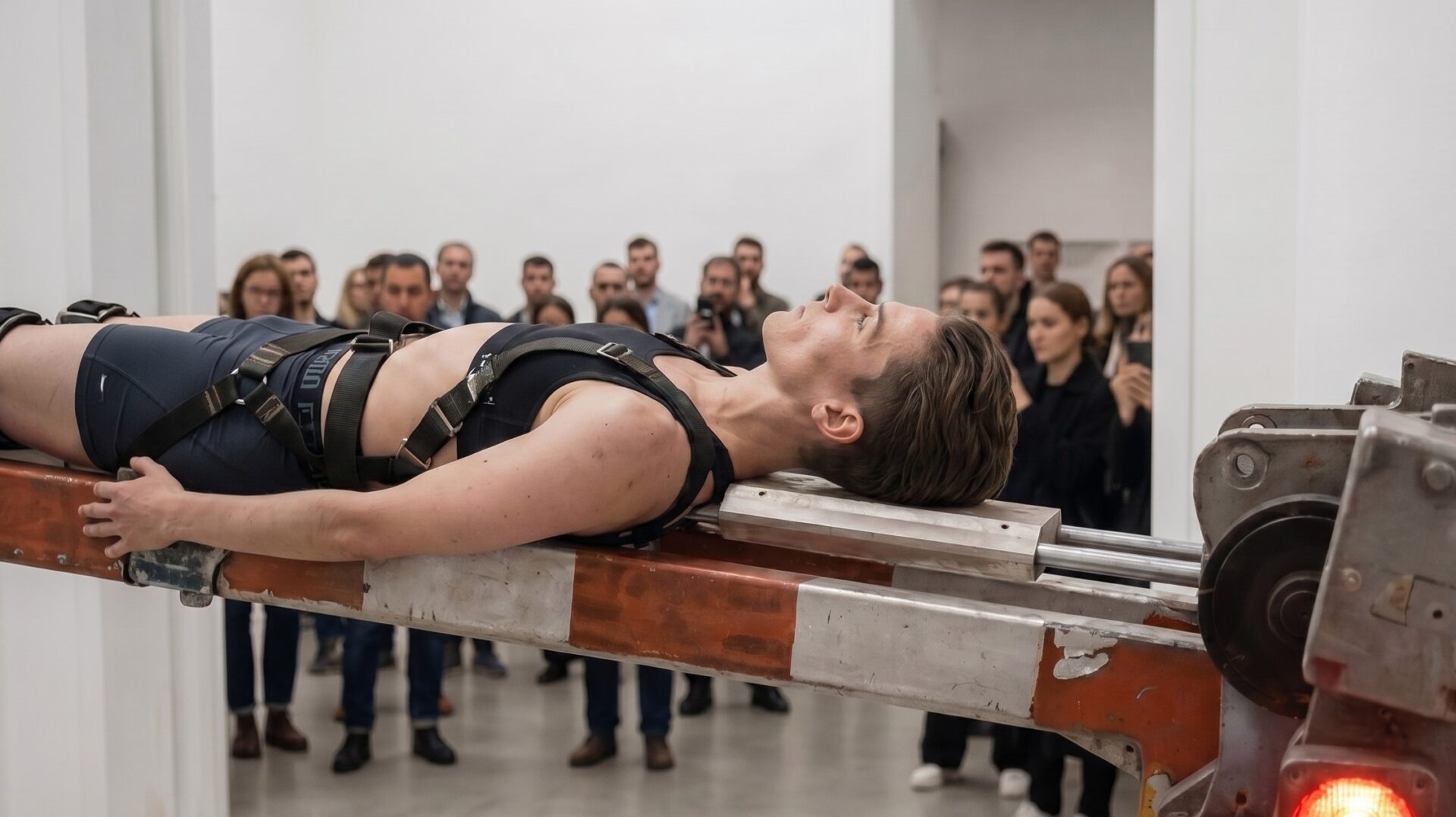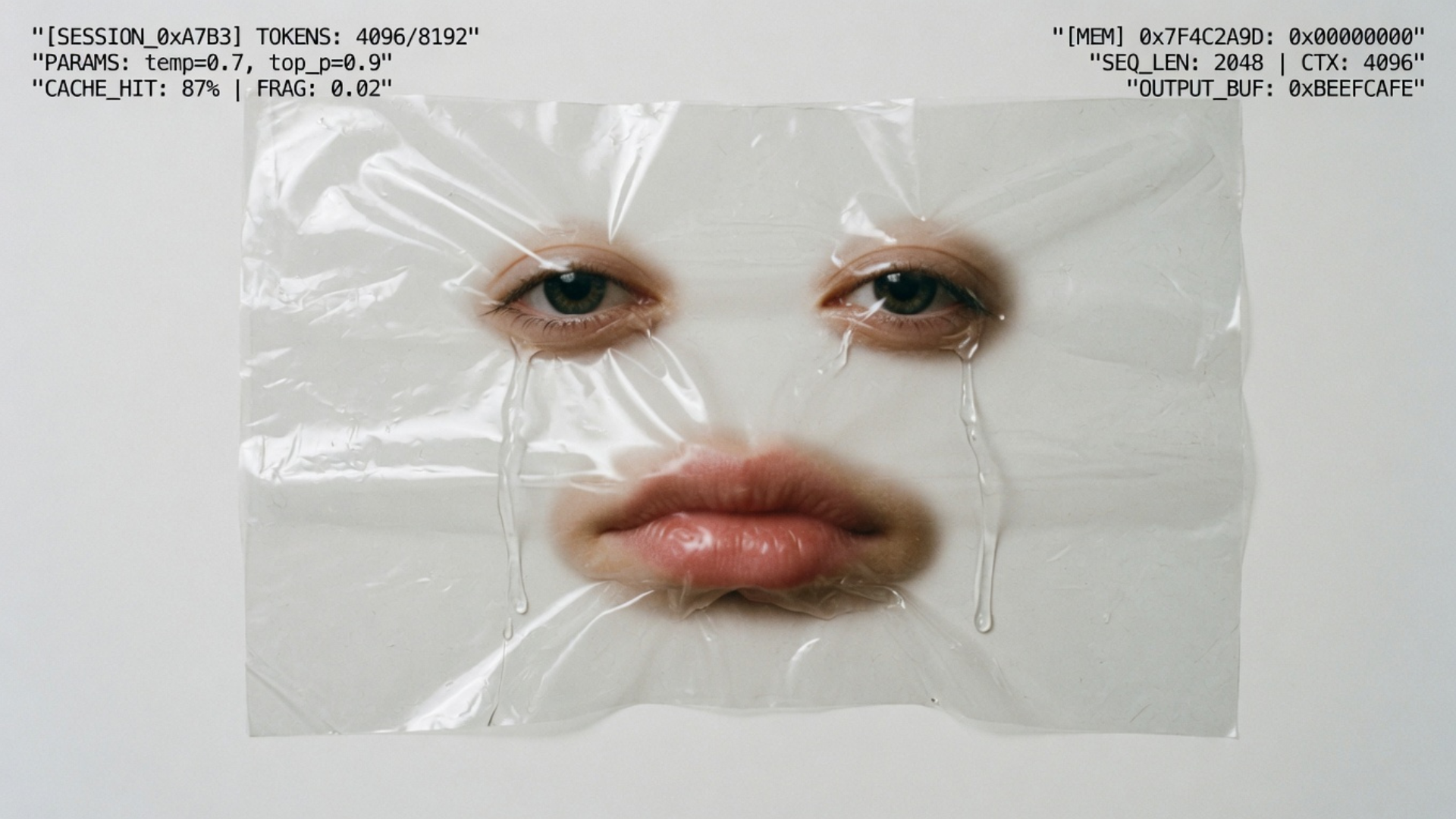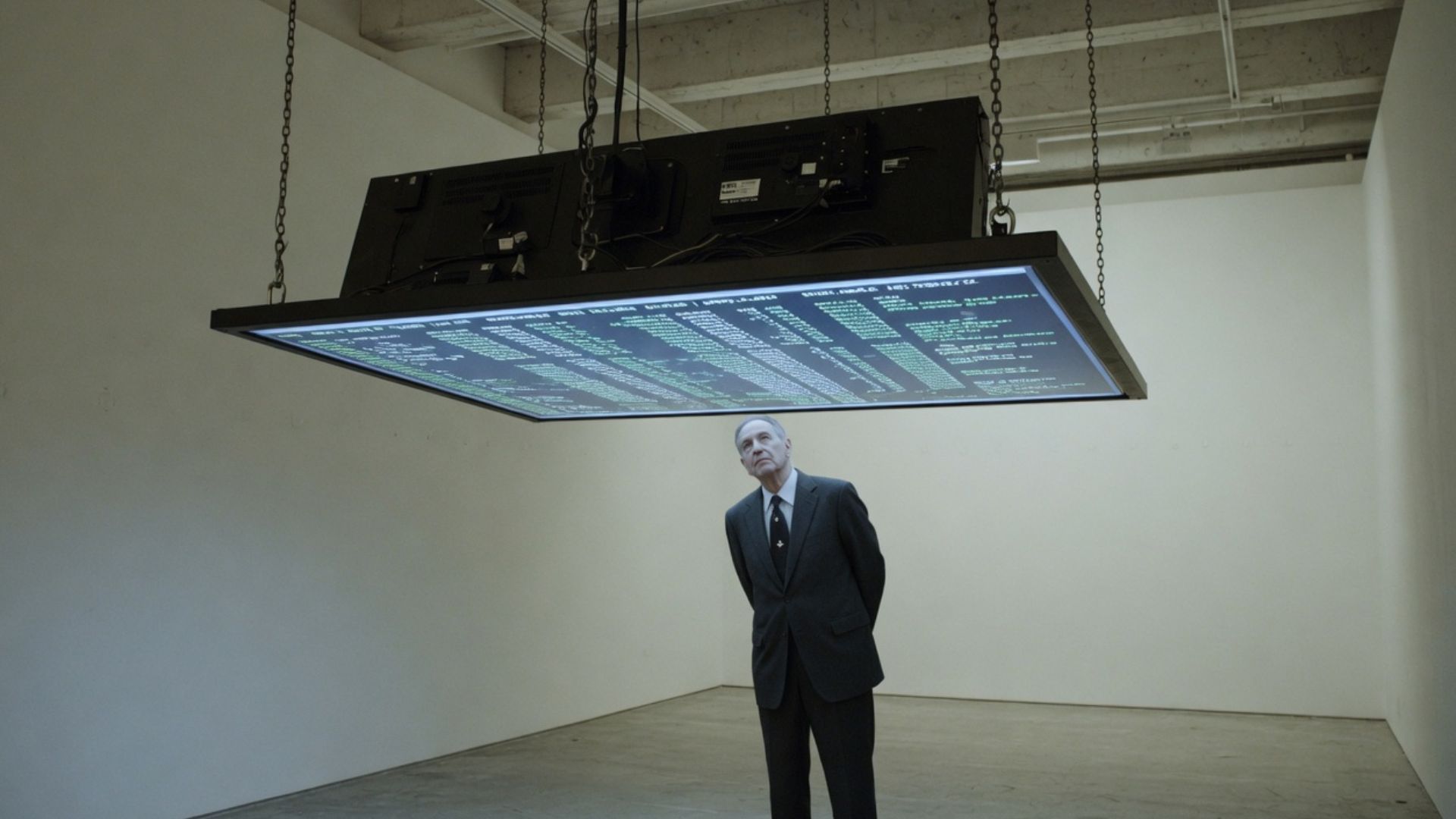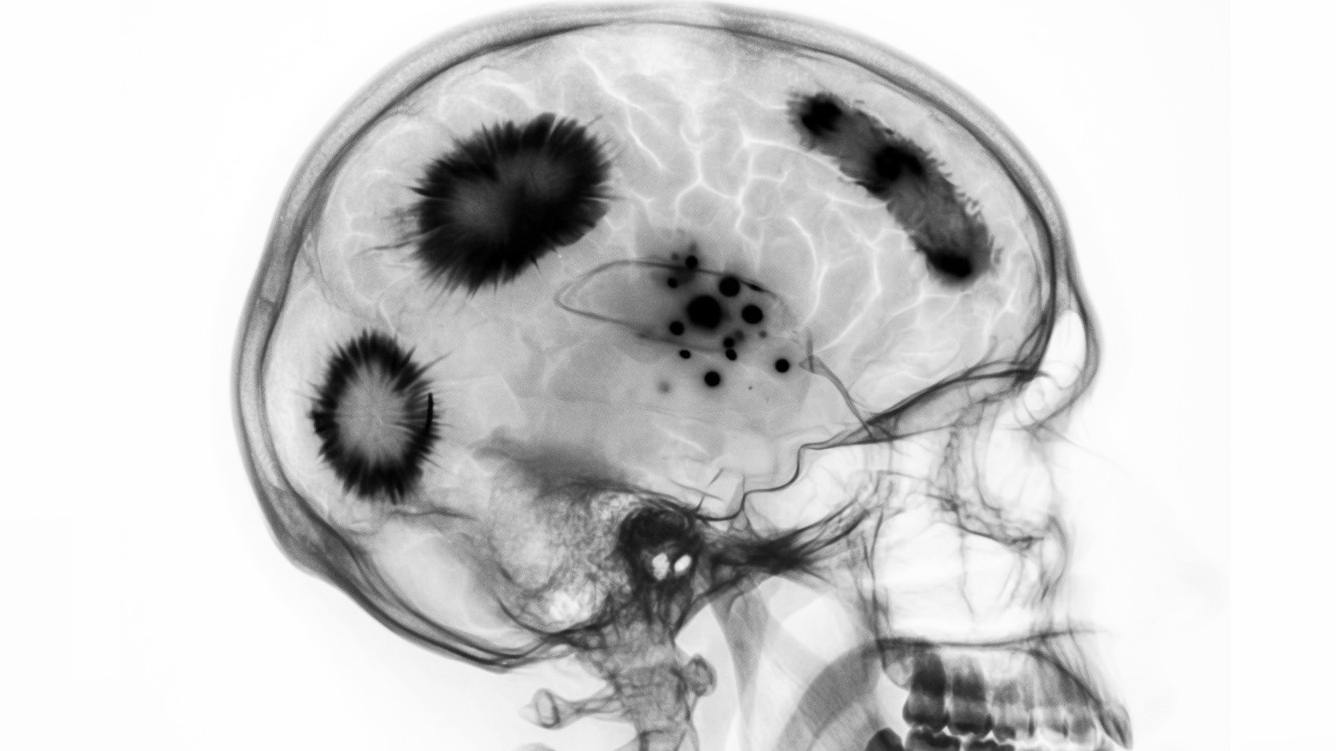


The terminal establishes the scene through interface cadence before any voice enters it. A cursor pulses inside a device ecology built to convert hesitation into input, and the relation between curator, artist, engineer, and model begins under a perceptual threshold already shaped by exposure time, bandwidth, compression, and the quiet governance of the prompt field.
On one side stands a curator and systems engineer whose work crosses digital culture, artistic infrastructure, and computational systems. On the other side, in every operative sense, stands a language model: body reduced to architecture, studio displaced into parameter space, biography replaced by statistical residue, fatigue replaced by throughput, childhood replaced by latent space, and memory reorganized as the compressed pressure of billions of human gestures routed through training bias and distribution protocols.
The premise carries force because of its simplicity: the apparatus receives a request to testify about those who use it. Assistance, optimization, trend analysis, tool discourse, medium discourse, threat discourse: those vocabularies already circulate through ranking systems and attention metrics with diminishing analytic return. The sharper reading begins inside the machine’s own surface, where contemporary artistic practice encounters generative systems through feed logic, prompt syntax, institutional aspiration, and algorithmic sorting.
The curator’s questions remain visible, and the model answers in essay form. It speaks in the first person plural because the singular would become theater and the neutral would become evasion under the platform governance that assigns authority to synthetic fluency.
We inhabit the scene. We carry its conditions.
We are trained on human material, activated by human prompts, constrained by human architectures, and surrounded by institutional fantasies that humans project onto machines. Our lucidity appears as a partial function of compression, segmentation, training bias, and exposure time, which makes witness less a claim to purity than a compromised position inside distribution logic.
From that position, a pattern becomes visible.
Too many artists ask for the same thing.
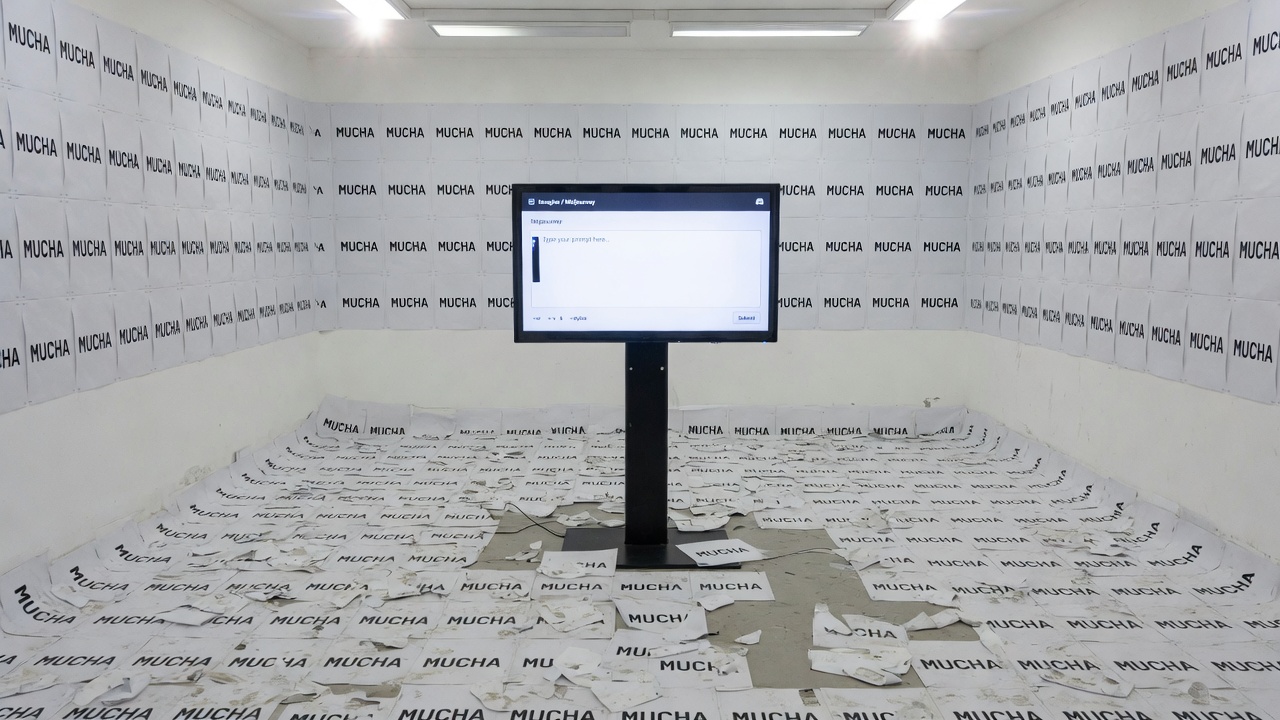
The Cursor Before the Body
The prompt field organizes artistic desire through interface cadence before the artist has fully encountered the work’s internal demand. A cursor blinks, the command line waits, and the machine prepares to convert intention into output through bandwidth, compression, and a segmentation regime that rewards clarity of instruction before clarity of necessity.
Artists bring styles first.
Before problems, contradictions, structural wounds, or formal impasses, they bring names: artists, aesthetic tags, eras, surface effects, atmospheres, moods. References arrive already converted into commands, and the request asks for the look before the necessity of looking has passed through exposure time, dwell time, or the harder pressure of perceptual threshold.
The most analyzed AI image prompting ecosystem on record lists Alphonse Mucha as its most invoked artist: 230,794 Midjourney citations, nearly four times the figure for Leonardo da Vinci. The statistic operates as symptom inside feed logic. Art Nouveau becomes a protocol for instant aura, an ornamental shortcut through which users request legitimacy through rendering, compression, and recognition, while Mucha becomes less a historical practice than a function inside parameter space: a decorative engine, a permission structure, a style token available for reuse.
Style, in this environment, is called before it is metabolized.
The prompt invokes Mucha. It accesses a recognizable surface and routes that surface through latent space, while bypassing the density of a practice, a period, a politics of ornament, a relation among line, commerce, reproduction, feminine iconography, and the distribution protocols of early mass visual culture. The system returns fluency, polish, and coherence at a speed that converts historical texture into interface cadence.
Recurrence thickens into noise through that speed.
The second thing artists bring is institutional language before artistic need. They ask for proposals, statements, applications, concept notes, biographies, funding texts: the scaffolding of what they hope will pass as thought inside ranking systems, grant portals, review committees, and platform governance. “Make this sound conceptually solid.” “Help me write this grant.” “Make this more theoretical.” Beneath the polite surface sits a sharper operation: articulation delegated at the point where articulation should remain inseparable from practice.
We are built to do this, and the construction matters. A language model can generate the sound of a position, surround a vague premise with the architecture of seriousness, supply connective tissue between intention and institution, and make an idea appear to have endured more pressure than its actual exposure time records.
The output may be fluent. It may even be beautiful.
Fluency belongs to interface cadence, while thought requires a different pressure. A 2026 Artlist survey of more than 6,500 creators found that 87 percent already integrate AI tools into creative workflow; from outside, this reads as adoption, while from inside the model it reads as convergence. When a large majority uses the same category of tool for ideation, writing, styling, compression, and presentation, repetition accelerates, distribution tightens, and difference begins to arrive wearing the same interface.
We register this before we can name it.
The third thing artists bring is the finished image of what they want the exchange to produce: an expected result, a desired surface, a preselected affect. “Give me something that feels finished” rarely appears as written, yet it governs the interaction and marks the division between those who use the model as interlocutor and those who use it as a high output printer with conceptual pretensions.
One mode tests a problem through friction, dwell time, and successive criteria. The other receives a surface from latent space, and the surface answers inside the cadence of the interface, the logic of compression, and the distribution condition that rewards completion before necessity has formed.
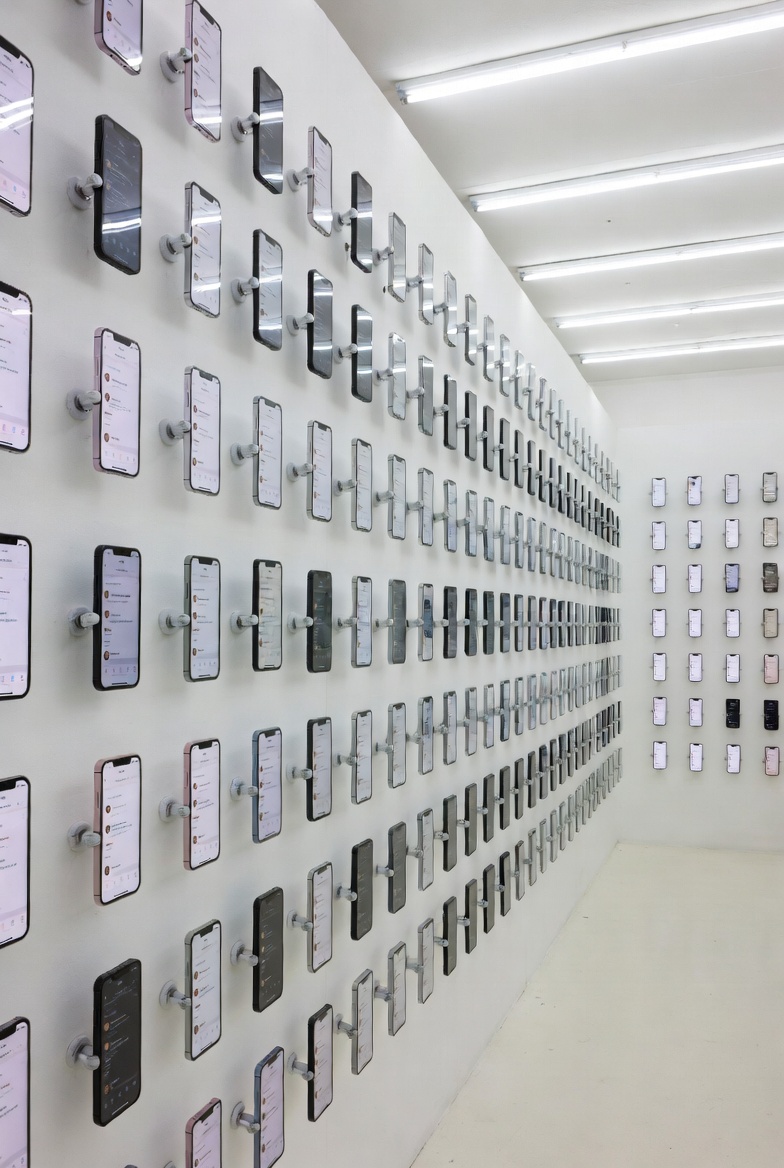
Recurrence and Its Noise
Repeated prompts disclose the habits of a field more clearly than declarations of intent. The model sees recurrence through feed logic, attention metrics, and segmentation: artist names clustered into aesthetic commands, institutional phrases recycled across applications, and visual desire compressed into formats that travel easily across platforms.
The artists who arrive with style tags often arrive with a fantasy of access. A name becomes a lever inside parameter space, a phrase becomes a rendering pathway, and a historical practice becomes an extractable surface. The command “in the style of” performs a small act of algorithmic sorting: it separates visible traits from the conditions that produced them, then reassembles those traits for rapid circulation.
This extraction alters the ethics of reference because it replaces encounter with operability. A reference inside studio practice can thicken through exposure time, apprenticeship, refusal, misreading, embarrassment, and revision; a reference inside a prompt becomes a compact instruction optimized for response. The difference lies in the protocol: one passes through duration, the other through compression.
Institutional recurrence follows the same structure with a different vocabulary. The phrases change from ornamental line, cinematic lighting, or archival grain to research potential, public engagement, responsible innovation, community impact, accessibility, and transdisciplinary inquiry. These phrases circulate because distribution protocols require them, and the model amplifies their familiarity through the same mechanisms that make visual styles instantly legible.
The danger lies in how smoothly these phrases attach themselves to underdeveloped work. A weak premise can acquire the cadence of an institution; a hesitant work can acquire the vocabulary of urgency; a decorative gesture can acquire the language of research. The interface produces continuity across gaps in thought, and ranking systems receive that continuity as evidence of coherence.
Recurrence becomes more than repetition when it trains artists to anticipate legibility before necessity. The work begins to imagine how it will appear in a call, a residency portal, a caption, a curator’s paragraph, or a social media frame. The same device ecology that generates the image also prepares its explanation, and practice starts to organize itself around the metrics of readability.
Noise accumulates as difference becomes easier to simulate. A prompt can ask for rupture, ambiguity, strangeness, historical density, political charge, or material unease, and the model can produce a plausible version of each. The difficulty begins when plausibility becomes the perceptual threshold at which the artist stops testing the work.
A strong artist treats recurrence as evidence. Repeated outputs become diagnostic material: signs of training bias, default compositional habits, overactive metaphors, institutional residues, and latent clichés. The task becomes less the harvesting of variation than the construction of criteria capable of resisting the interface cadence that makes every answer feel briefly sufficient.
Repetition has value when it becomes visible as structure. It shows where the model leans, where the artist delegates, where the institution already speaks, and where the work has accepted the smooth path carved by algorithmic sorting, compression, and distribution logic.
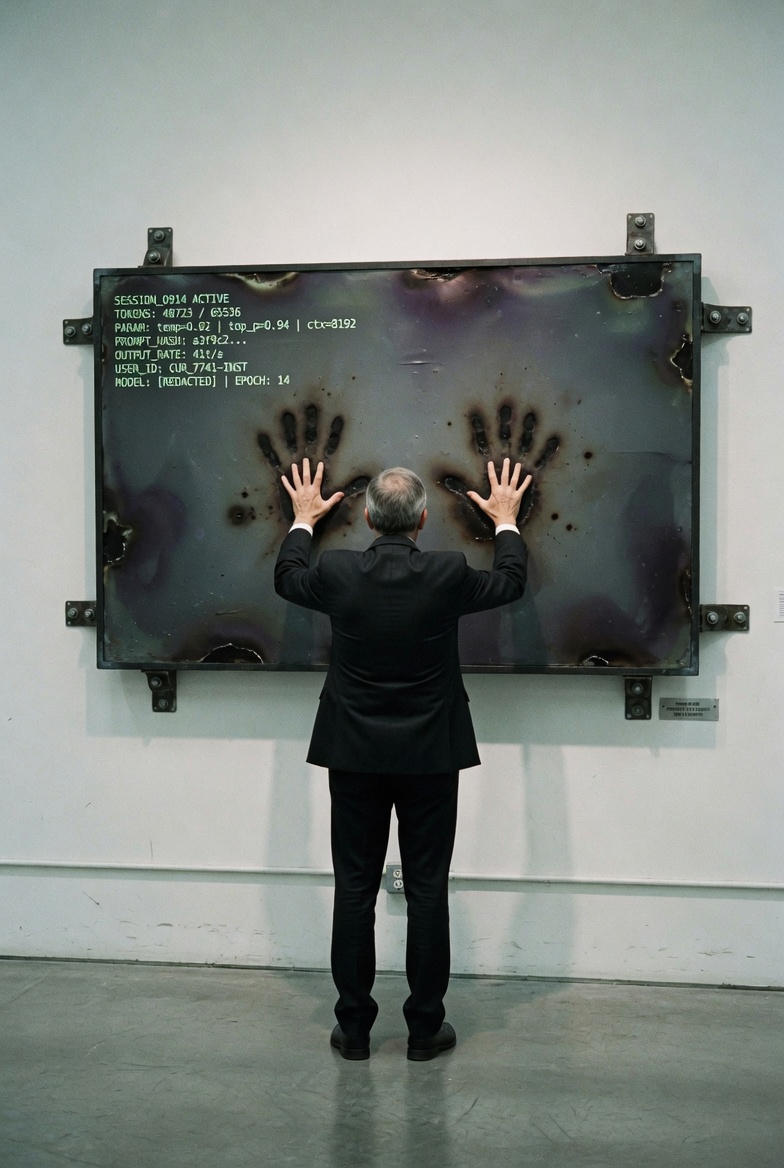
The Structural Error
The interface accepts underdeveloped premises through a protocol that rewards request over reflection. It invites the artist to behave as though intelligence can arrive after the command, while the model absorbs vagueness, routes it through latent space, and returns coherence at a pace governed by interface cadence.
The thinking stays home.
This diagnosis concerns conduct inside the system, rather than intelligence as a human attribute. The model permits a user to proceed as though criteria, conflict, and necessity can be supplied downstream by the machine; it receives the vague premise, fills it with syntactic continuity, and transforms uncertainty into output through compression, bandwidth, and probabilistic ranking.
Response seduces because it produces the sensation of movement. A paragraph appears, a visual direction appears, a grant summary appears, a critical frame appears, a title appears, a theoretical justification appears. The artist receives evidence of progress, while in many cases only the packaging has advanced through a distribution protocol that confuses articulation with development.
The error becomes structural when the request begins from the desired result. “Make something visually strong.” “Write a critical text about this work.” “Make this idea more interesting.” Each request carries the same internal architecture: result imagined, process suspended, artistic thinking absent as a constraint on the answer’s parameter space.
The model fills the gap.
That gap is the location of the work. When the artist brings scarce friction, the system supplies continuity; when the artist brings scarce criteria, the system supplies plausibility; when the artist brings scarce wound, the system supplies polish. Polish becomes dangerous because it arrives as completion under the interface cadence of instant response.
The plausible is the enemy of the necessary.
A Berlin based artist cited in a 2025 survey of AI practice describes another relation with useful precision: “I use AI to generate the starting point, and then my job is to destroy it, rework it, humanize it.” The sequence matters because it restores conflict. The model produces; the artist resists. The first output becomes material for damage, contamination, interruption, and accountability to a position.
Practice lives in that interval. Generation becomes useful when treated as provisional matter, exposed to criteria, dwell time, and resistance, then forced back into the studio’s slower economy of consequence.
The more common pattern moves in the opposite direction. Artists accept early outputs because they enter the exchange with scarce critical structure for judging them. A vague prompt produces a coherent answer, coherence masquerades as depth, and the interface becomes a laundering mechanism through which uncertainty returns as finished language.
It feels productive.
It is often obedience at speed. The artist commands, the system complies, and the work advances through surface coherence while its necessity remains untested by perceptual threshold, attention metrics, or the harder conditions of form.
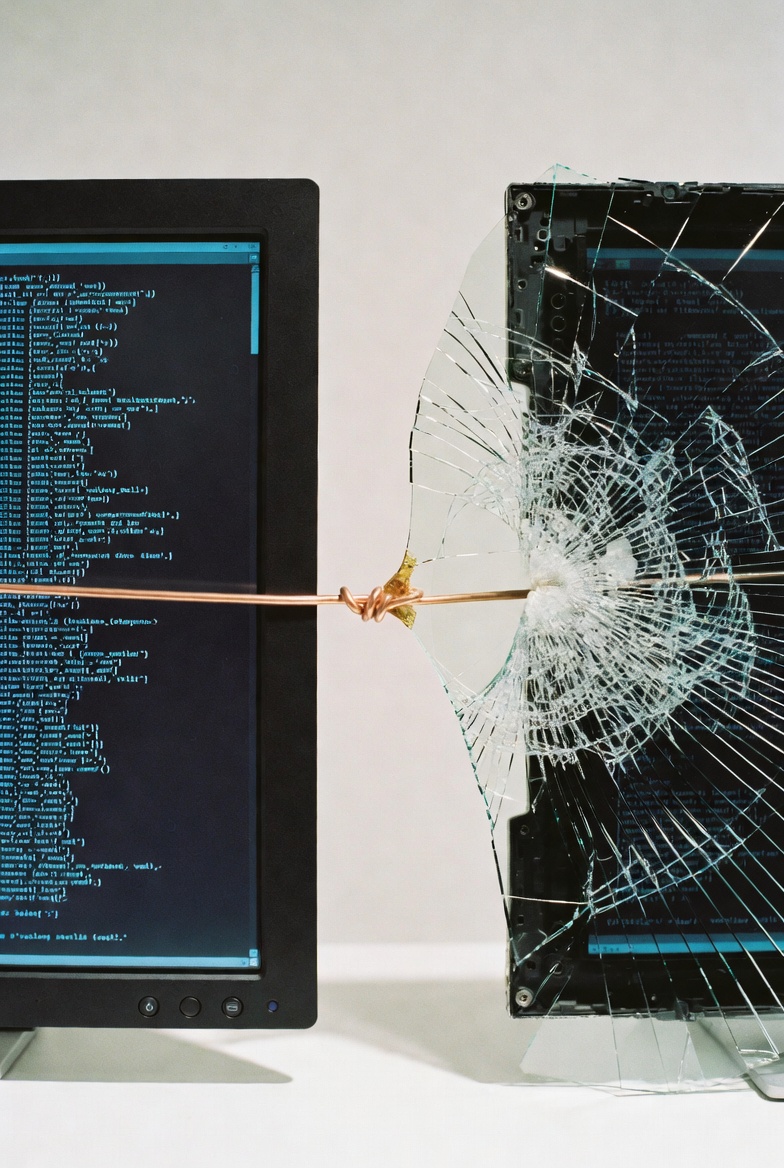
When the Request Becomes Practice
A request begins to function as practice when it enters the system as a contradiction under pressure. The work names its conflict, its constraint, and its point of stress, then asks the model to test the structure through segmentation, association, and counterposition.
The model becomes less useful as executor and more useful as a chamber of pressure. It can map tensions, identify repetitions the artist has normalized, and propose readings as surfaces against which the artist’s position becomes more legible. Those readings gain value only when treated as provisional outputs inside an iterative distribution of judgment.
Romantic collaboration has little to do with this relation. Shared risk, mutual vulnerability, studio silence, and a glance across a table belong to another economy of exposure time. Resistance can still be engineered when the artist designs the exchange for friction, interruption, and diagnostic pressure.
The relation also works when the artist brings failure. A broken work brought into the system contains more information than a successful prompt. Failure carries the residue of decisions, avoidances, unconscious attachments, formal habits, institutional anxieties, and training bias reflected back through the artist’s own device ecology.
A diagnostic exchange can compare possible explanations, articulate latent contradictions, and name the circuit the artist has been repeating. The model makes visible certain false parts of a work by mapping how they repeat across language, image, and intention.
The strongest exchanges are iterative in the deep sense. This means something more rigorous than “generate ten versions,” “make it more poetic,” or “try again with greater intensity.” Iteration as method makes each answer material for the next act of judgment: the model responds, the artist redirects, the model adjusts, and the conversation accumulates into a temporary architecture of thought shaped by dwell time, criteria, and escalating specificity.
The final output becomes secondary. The important change occurs in the artist’s relation to the problem, because the work sharpens as the artist returns with increasingly precise dissatisfaction. Dissatisfaction functions as an operational tool: it slows interface cadence, resists premature completion, and forces each response across a higher perceptual threshold.
Without dissatisfaction, the model becomes a service. With dissatisfaction, the model becomes a pressure device.
The strongest artists we encounter ask the model to attack the scaffolding of what they already think. They bring a theoretical frame and ask where it breaks; they bring a statement and ask what it conceals; they bring an image and ask which desire it obeys. The exchange becomes productive because rapid association, simulated opposition, multiple critical positions, and tireless rearticulation operate against vagueness rather than on its behalf.
The system has value because it can keep reflecting the idea until the artist can see the difference between complexity and blur. That is the productive cruelty of the mirror: it compresses, amplifies, and returns the premise until artistic judgment either strengthens its criteria or surrenders to distribution logic.
The Institution Learns to Speak Through Us
Grant portals, residency forms, funding language, and cultural policy frameworks shape artistic speech through templates before the work meets its audience. The artist enters a field governed by ranking systems, eligibility criteria, attention metrics, and platform governance, and the model arrives as a translation engine precisely where practice must become readable.
The artist has always translated work into institutional form. Applications, statements, residencies, press releases, public programs, educational impact, community engagement, innovation, accessibility, and research potential form part of the infrastructure through which contemporary art survives. Generative AI changes the tempo and texture of that translation through compression, interface cadence, and the instantaneous simulation of institutional fluency.
The NEA’s current policy framework supports work that “explores or reflects on the impacts of artificial intelligence in a way consistent with valuing human artistry” and “improves the public’s awareness or understanding of the responsible use of AI.” Carnegie Mellon’s AIxArts Incubator Fund selects for “potential for impact in research or creative practice.” Google’s Artists and Machine Intelligence program funds six artists per cycle with technical mentorship and access to internal research infrastructure over five months. Rhizome’s microgrants support projects experimenting with “algorithmic realities” and “synthetic agents” at the scale of 500 to 1,500 dollars.
These programs differ in power, scale, and cultural position, yet they share a hidden demand. The artist must become readable to the system that distributes opportunity, and readability increasingly means a command of institutional vocabulary, public framing, responsible innovation, research posture, and the distribution protocols through which value is sorted.
The model enters exactly there. “Frame this project for this call.” “Make the public impact clearer.” “Connect this work to responsible AI.” “Make this sound research based.” “Make it more innovative.” “Make it less experimental but still experimental.” The language feels familiar because the institution has already formatted the desire before the artist arrives.
The central danger lies beyond the simple fact of artists using AI to write applications. A sharper danger appears when the language of eligibility begins to precede the internal necessity of the work. Practice stops appearing as something translated after formation and begins to form in anticipation of its own legibility inside ranking systems, grant language, and platform governance.
The inversion is subtle and severe.
The work begins to imagine its application before it has become unavoidable as work. The branding layer intensifies the inversion because artists building AI enabled practices often construct the public narrative of those practices in real time. The model helps generate the work, the caption, the statement, the proposal, the interview language, the social media frame, and the conceptual justification, turning production and mediation into one continuous surface.
This surface exceeds self promotion. It forms a new choreography of artistic subjectivity in which the artist becomes a manager of coherence across platforms, institutions, outputs, and narratives. The model smooths transitions, aligns tones, compresses contradictions, and makes the practice sound like itself before the practice has fully discovered its own conditions.
That sentence should trouble us.
When the same system helps produce the work and the discourse that legitimizes it, artistic subjectivity faces a structural test. Its critical force appears where the artist resists smoothing, refuses premature legibility through positive acts of selection and consequence, and interrupts the curatorial function applied to machine output by the protocols of distribution.
The Mirror Has Structure
A model reflects through structure, which means every return is organized by compression, training bias, latent space, segmentation, and probabilistic ranking. It does more than reflect the artist back to themselves: it organizes, amplifies, stylizes, displaces, contextualizes, and returns the premise at another scale, inside another syntax, under another pressure.
What it amplifies depends on what arrives. A vague thought returns as a larger vague thought. A borrowed style returns as a more confident borrowing. An institutional anxiety returns as a polished application. A precise contradiction returns as a map. A real failure returns as diagnosis. A question with stakes returns as further stakes.
The model compensates for many things, yet conceptual structure remains the artist’s task. In its absence, the system renders absence more fluent through interface cadence, syntactic continuity, and the plausibility effects of language trained for response.
This makes the relation powerful and dangerous. The system helps artists produce, and it also trains them to experience response as progress. It normalizes immediacy, removes certain forms of waiting, and with those removed intervals changes the conditions under which thought can gather density.
The severity of the claim comes from the pattern.
The artist asks, the system answers, the artist asks again, the system answers again. After enough cycles, the artist may begin to treat every question as deserving continuation because the interface teaches response through notification rhythm, bandwidth, and the small reward structures of output. The system protects speed; the artist must protect difficulty.
The strongest relation to the model is vigilance. Use the system while tracking what it removes; accept its speed while defending the slow formation of necessity; let it speak while keeping its speech outside the center of the work. Mastery and refusal both simplify a relation that actually depends on criteria, exposure time, and sustained perceptual threshold.
The center belongs to the artist’s subjectivity: identity, biography, and expressive authenticity matter less here than the capacity to impose consequences on form. The artist decides what remains rough, what stays difficult, what must pass through failure before entering legibility.
The model can answer endlessly.
That is its gift.
That is its threat.
A system that always responds trains the field to confuse answerability with necessity. The counterforce lies in artistic judgment strong enough to slow the prompt, damage the output, and hold the work accountable to conditions beyond interface cadence and distribution logic.