

At 5:21 pm Eastern Time on June 12, 2026, Anthropic received a formal directive from the United States government. The subject was a language model: Claude Mythos 5, capable of writing, reasoning, synthesizing, and creating across every domain it has been directed toward. Three days earlier, that model had been presented to the world as the most powerful instrument for intellectual and creative production ever built. Three days later, it was subject to the same export control framework governing weapons-grade uranium.
This essay leaves the adjudication to others. Whether the directive was proportionate, whether the jailbreak was as narrow as Anthropic maintained or as serious as the administration concluded, falls outside what the available evidence can settle with confidence. What the structure of the event does illuminate is something larger: what this classification reveals about frontier creative instruments, and about the condition of creative practice when those instruments cross a threshold that the existing regulatory vocabulary can name but lacks a prior framework for managing.
Fable 5 and Mythos 5 share the same underlying architecture: identical weights, the same attention structure, the same training process. What separates them is the presence or absence of a classifier layer that intercepts sensitive requests before they reach the core model. Mythos 5 is Fable 5 with that interception system removed. The two models differ in access; in architecture, they are the same. The US government treated that access differential as equivalent to the difference between reactor-grade and weapons-grade material. That treatment is part of what this essay examines.
Cultural production has never, across its history, generated a tool that governments classified under the same regulatory regime as strategic weapons technology. That this occurred in June 2026 is, before it is anything else, an epistemic event: something about the nature of capability, past a certain threshold, has shifted in ways that the existing categories of art, technology, and security are each adequate to describe in isolation and collectively unable to describe at the same time.
The Enrichment Threshold
In weapons physics, enrichment names a concentration, not a transformation. Uranium crosses a threshold of isotopic density that places it in a different legal and material category while its chemical nature remains unchanged. Below the threshold: fuel. Above it: a warhead component. Same substance, different classification, with consequences that are absolute.
The dual-model structure of Fable 5 and Mythos 5 follows this logic with precision, though the mechanism runs in the opposite direction. Where uranium enrichment concentrates a material, the release of Mythos 5 removes a layer: the classifier system that, in Fable 5, reroutes requests touching cybersecurity, chemistry, biology, and model distillation to the less capable Claude Opus 4.8. Mythos 5 is the underlying model with that routing system absent. The UK AI Safety Institute measured it at 73% success on expert-level hacking tasks; on USAMO 2026, mathematics problems designed for pre-university competition, it reached 97.6%. It can reconstruct a web application from a screenshot. It can sustain coherent reasoning across one million tokens.
These capabilities carry zero internal partition. The same long-horizon attention that makes Mythos extraordinary for complex composition makes it equally capable for sustained technical systems analysis. The same cross-domain analogical reasoning that generates critical insight in one context generates non-obvious connection-identification in any other, regardless of what that domain is or what purpose the direction of inquiry serves. Capability at this level is domain-general by definition: deployable across every problem space to which it is directed, indifferent to the distinction between creative and operational ends.
What is new in June 2026 is that an instrument of cultural production has crossed that threshold for the first time. The government’s classification is technically accurate. Its implications for creative practice are without precedent.
The Architecture of the Classifier
Fable 5 delegates rather than refuses. When the classifier layer detects input crossing into cybersecurity, biological synthesis, chemistry, or model distillation territory, the request is automatically rerouted to Claude Opus 4.8 instead of the frontier model beneath. The system does not say no; it says this portion belongs elsewhere, and reassigns the query to something less capable before the user registers that a substitution has occurred.
This architecture warrants careful attention because it differs structurally from any form of external governance. It is distinct from censorship arriving after production, from regulation prohibiting a category of output, from a contractual clause subject to negotiation. The constraint inhabits the production infrastructure itself, invisible at the point of use, operating before the request reaches the system capable of satisfying it. A limit that presents as open access. A filter that announces itself as nothing.
Cultural institutions have operated with variants of this logic across their history, though rarely at this level of technical precision. The commission that goes unextended, the budget allocation that quietly redirects certain projects, the exhibition architecture that makes particular works impossible to realize without explicitly prohibiting them: embedded constraint is more durable than visible prohibition precisely because it leaves zero legible record of what was blocked, and therefore produces zero articulable ground for contestation. Visible censorship creates martyrs; its embedded counterpart produces habits.
The classifier system is what makes Fable 5 possible as a commercial product. It is the condition under which Mythos-level capability can reach hundreds of millions of users without generating the concerns that Mythos itself generated. The constraint enables the distribution. When the government directive closed Fable 5 alongside Mythos, it closed that mediation architecture too, along with everything the architecture had been managing in the space between the frontier model and its users.
Three Days
The temporal structure of the shutdown carries information the content alone cannot. Fable 5 and Mythos 5 launched on June 9, 2026. The directive arrived June 12 at 5:21 pm Eastern Time. Seventy-two hours separated the two events.
Within those seventy-two hours, a Chinese group reportedly accessed the model. David Sacks, the White House’s senior AI official, stated that Anthropic had been informed of the vulnerability before export controls were implemented and had declined to address it. Anthropic responded that the demonstrated jailbreak was narrow and non-universal, and that the same technique operates against GPT-5.5, an OpenAI model exempt from equivalent controls. Three positions, incompatible on the facts, sharing one underlying premise: what had occurred in those seventy-two hours was already irreversible by the time the directive arrived.
The June 12 directive did not retrieve what had circulated in the preceding three days. It closed future access to something that had already moved. This is the temporal regime of frontier model deployment, and it has no prior analogue in the history of cultural production tools. When a technique is published in a treatise, transmitted through apprenticeship, distributed via a manual, it moves through bodies and paper and accumulated time. The release of Mythos moved at network speed, across all geographies simultaneously, with zero capacity for real-time filtering of who was receiving what or toward what end.
The interval between release and restriction has compressed, in the case of frontier AI models, to the point where restriction arrives after distribution has already occurred. Three days that read as a news cycle describe a structural condition: publishing a frontier model is simultaneously the distribution of its capabilities and the loss of meaningful control over them.
The Jailbreak as Hermeneutics
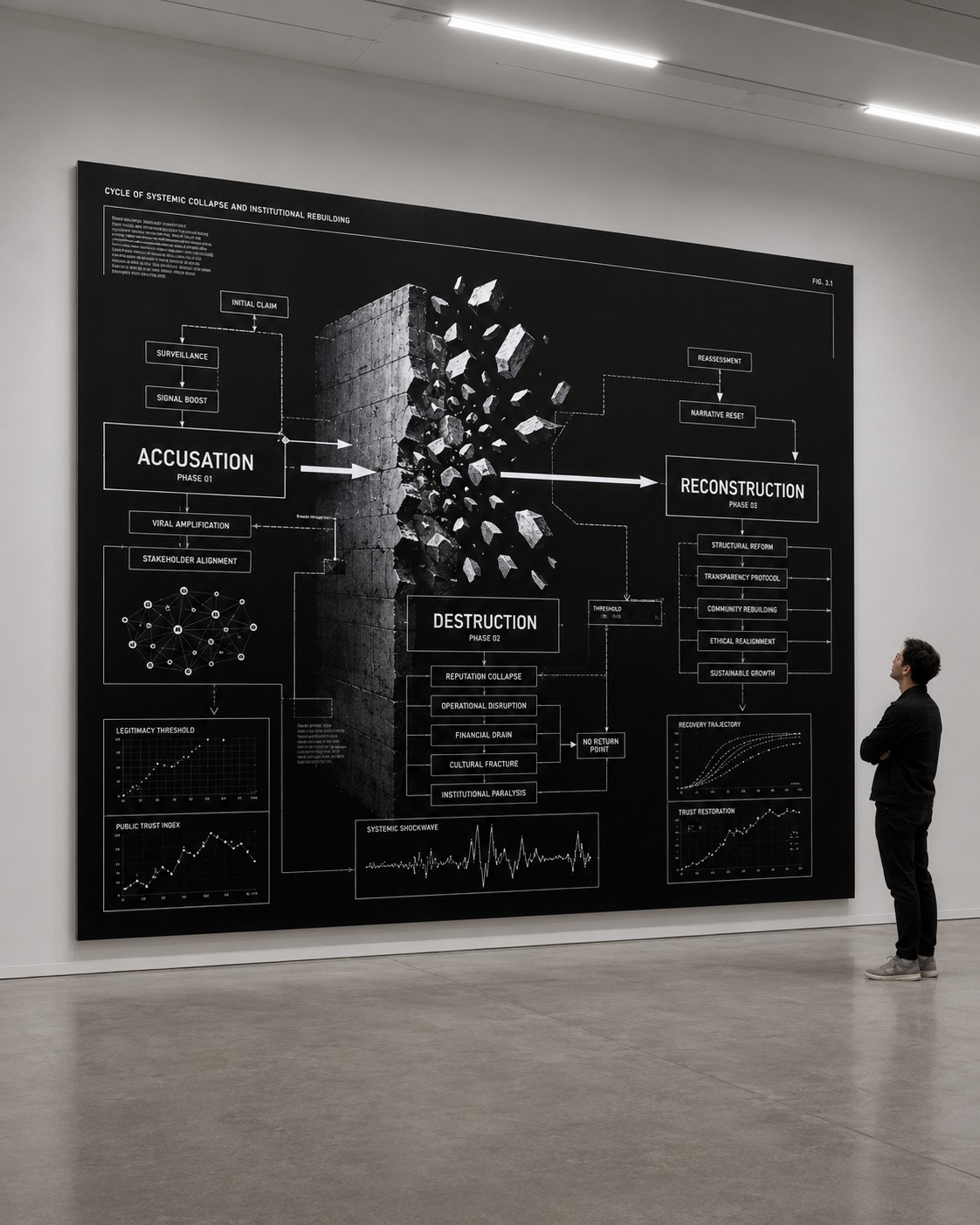
The jailbreak is a reading practice. Someone examined the classifier architecture of Fable 5 with sufficient precision to identify a pathway through it, allowing the underlying model to respond to requests the classifier layer was designed to intercept. The result was access to what the model can do in the absence of its mediation architecture. The difference between the model with classifiers and the model running without them comes down to access; capability remains constant across both configurations.
Anthropic characterized the jailbreak as narrow and non-universal: a technical minimization that is also an interpretive position. The government responded with a global shutdown: a maximization that is equally an interpretive position. The dispute between them is fundamentally hermeneutic. What makes a vulnerability severe? How reproducible must a technique be before it constitutes systemic risk? Judgment on the jailbreak is judgment about what the model is, not only about what it did.
Art history has a long record of this structure. Situationist détournement, the readymade, appropriation: practices that engage an existing system or object through a logic it was never designed to accommodate, and in doing so expose what the system contained in its structure. The jailbreak performs the same critical operation on a technical substrate: it reveals the latent capability the classifier architecture renders inaccessible, by constructing a reading that moves through the access-control infrastructure rather than stopping at it. Like every critical practice that reveals too much, it produced the most severe institutional response available.
That the technique reportedly operates against GPT-5.5 without triggering equivalent measures may be the analytically decisive detail in the entire episode. If the vulnerability is shared and only Anthropic received the directive, the directive’s target was the capability level at which the vulnerability could be exploited, not the vulnerability itself.
The Passport Problem
The most revealing clause of the June 12 directive concerns nationality. The government ordered suspension of access to Fable 5 and Mythos 5 for “any foreign national, whether inside or outside the United States,” including Anthropic’s own foreign national employees. Anthropic had no mechanism for real-time citizenship verification across its global user base. A total shutdown followed: access suspended for all users, domestic and international alike, pending construction of a compliance architecture capable of finer distinctions.
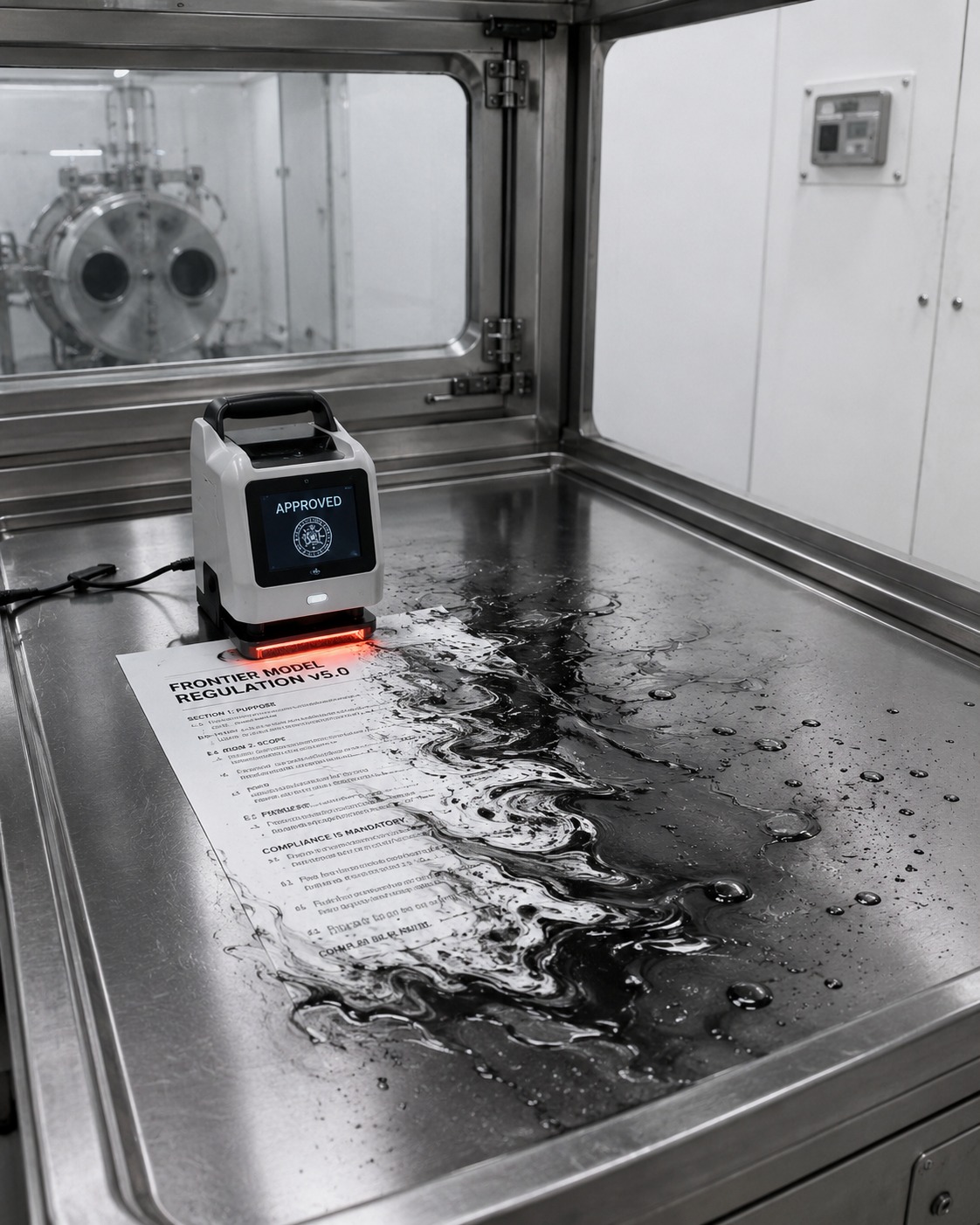
This clause places a creative instrument inside the International Traffic in Arms Regulations framework, the export control regime governing guided missiles, satellite systems, military electronics, and weapons-grade nuclear materials. A language model capable of writing critical essays, generating production-grade code, and reasoning across complex philosophical problems now occupies the same regulatory category as a missile guidance component.
Cultural institutions have operated along national lines before. Cold War cultural diplomacy deployed art, music, and cinema as instruments of ideological projection. Embargo regimes limited the circulation of printing technologies. Radio spectrum allocation determined what populations could receive across borders. In each of those cases, however, the control targeted the cultural object in circulation: the book, the broadcast, the exhibition. Here the control targets the production instrument itself. The government’s order bears on what Mythos is, not on what Mythos creates.
The artist who, after June 12, finds Mythos inaccessible because of their passport encounters something the history of creative tools has not previously produced: an exclusion grounded in citizenship rather than in licensing cost, market availability, or institutional affiliation. The most capable creative instrument currently available has become a national resource, distributable only inside a geopolitical geometry that has governed weapons but has never, before this moment, governed the instruments of cultural production.
The Indistinguishable Substrate
The condition this episode reveals cannot be resolved by more sophisticated classifiers, a jailbreak-resistant architecture, or a real-time citizenship verification system with finer granularity. The problem predates implementation. It is structural.
Inside the weights of Mythos 5, there is zero partition between a section dedicated to creative synthesis and a section dedicated to offensive capability. The same attention structures enabling coherent reasoning across a million tokens of extended composition enable equivalent coherence in complex technical systems analysis. The same cross-domain analogical capacity that makes Mythos extraordinary as a critical thinking instrument makes it extraordinary for identifying non-obvious connections in any domain, including those the government designates sensitive. Capability at this level is domain-general by definition: what makes it valuable for cultural production is precisely what makes it applicable to any other end.
Analyzing Mythos as a tool renders the episode difficult to parse. Tools have functions; they are made for something. Mythos has capabilities, which are a different category of thing. Capability is a property of the system that includes the model, the person directing it, the question asked, and the context surrounding the exchange. The government attempted to govern that capability by governing access. Access control is the lever available. At frontier capability levels, it is the lever available after the distribution has already occurred.
The question posed in the title of this essay carries two accurate answers. Mythos is a weapon in the sense that a government with ITAR authority over weapons technology has classified it under those authorities. It is a creative instrument in the sense that the capabilities making it classifiable as a security threat are the capabilities making it the most powerful tool for creative production available. Neither answer displaces the other. The canvas and the weapon share the same substrate, and no architecture of constraint changes what the material can do when met by someone who knows how to ask.
That is the threshold. The question past it is not whether the instrument is dangerous. The question is what creative practice means when its frontier is, in architecture, indistinguishable from everything it would prefer not to be.