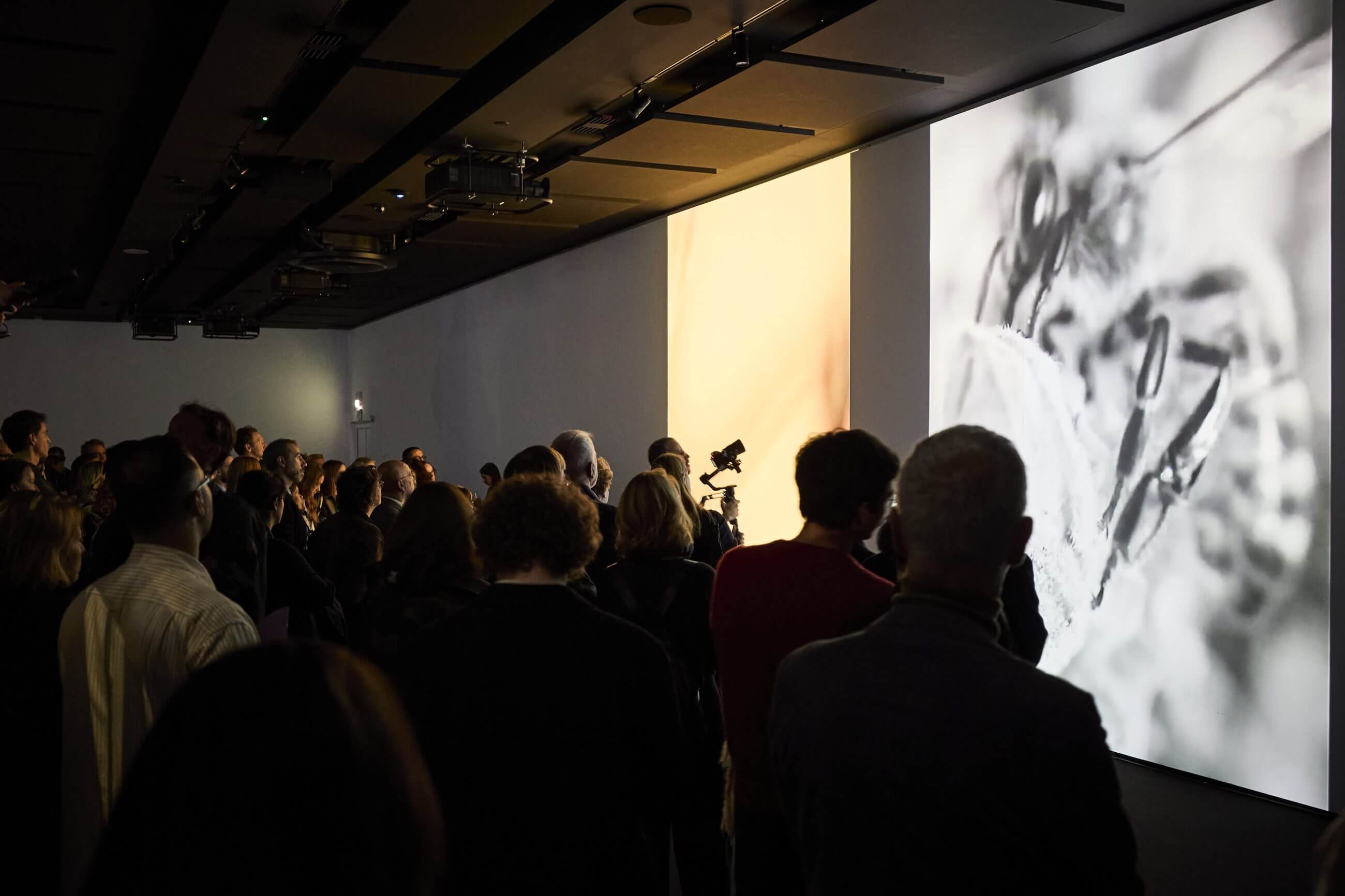
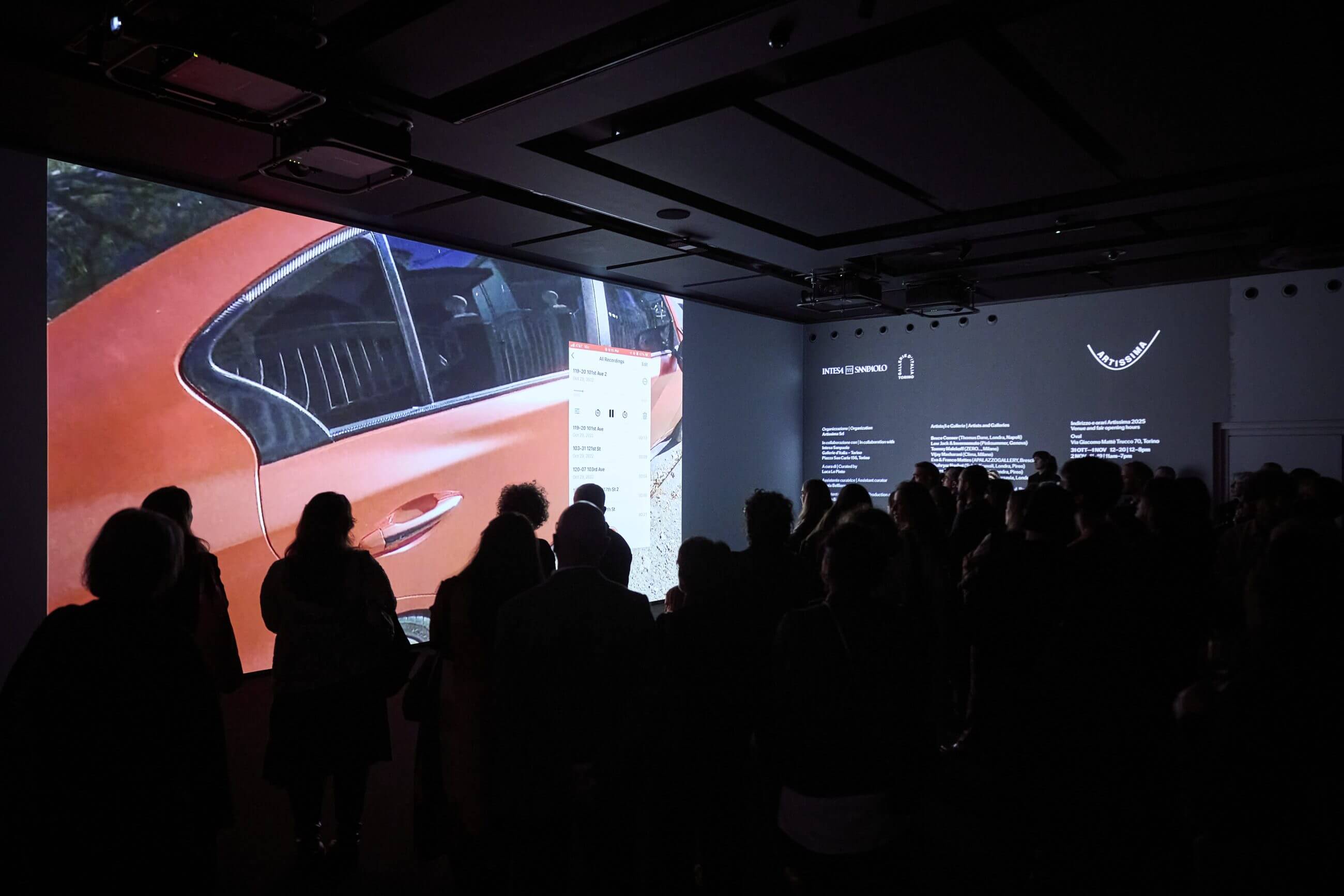
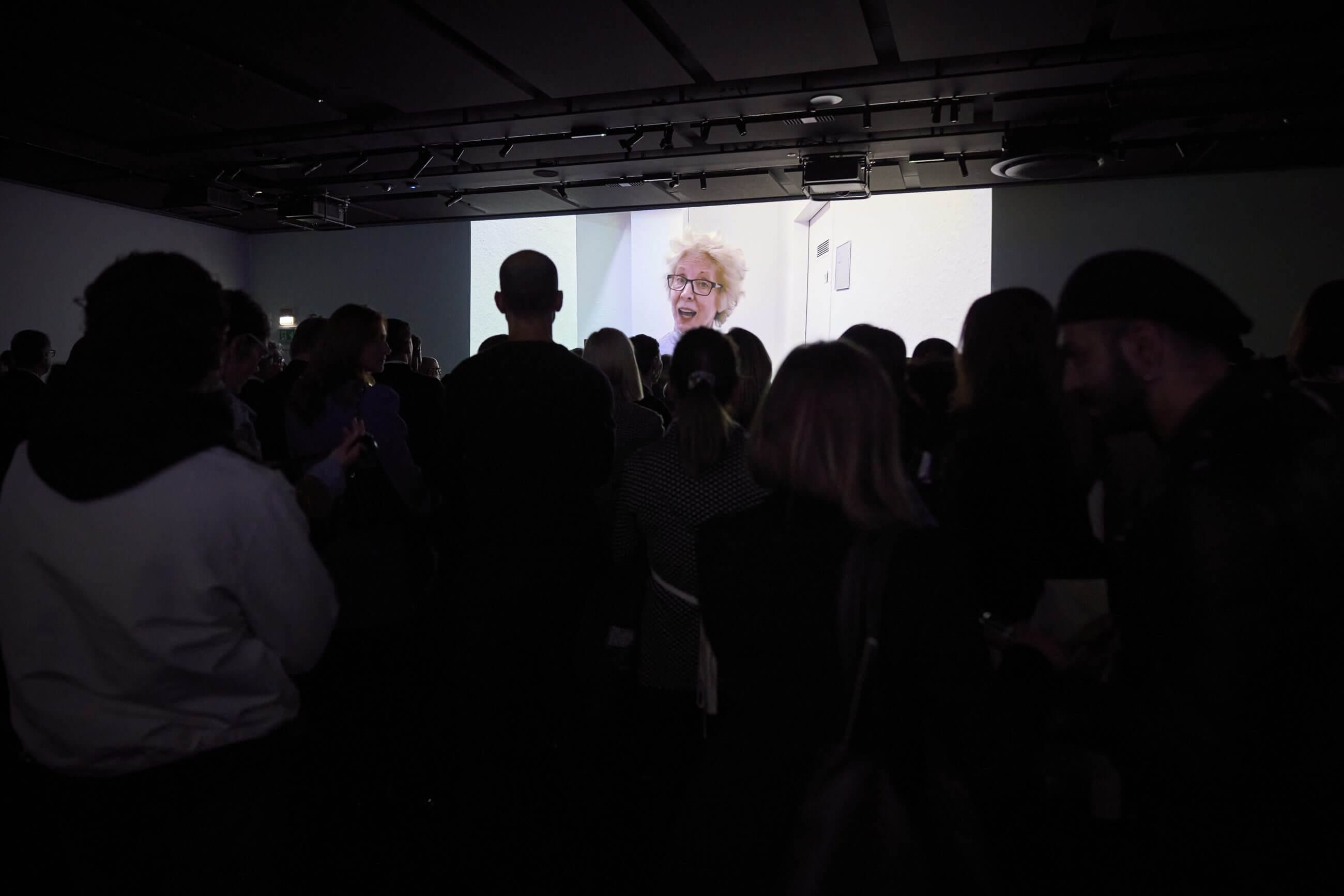
During Artissima, in collaboration with the fair, Gallerie d’Italia opened The Screen is a Muscle, an exhibition curated by Luca Lo Pinto, who brought his transversal approach into the space, conceiving the group show as a choreography with short videos by Bruce Conner, Low Jack & Invernomuto, Tommy Malekoff, Vijay Masharani, Eva & Franco Mattes, Shahryar Nashat, James Richards, SAGG Napoli, Julia Scher and Anastasia Sosunova.
No narratives were needed, and there was no excessive authorial interpretation that could overshadow the videos. Lo Pinto focused on selection and an orchestral disposition as if creating musical score, with voice-over sounds created by Martina Ruggeri, which glued the sequence and creating a unique rhythm.
Each video was projected on a single wall at a time. Viewers were invited to stay for the duration of each clip, waiting for the next projection on another wall in the chamber, forced to move to the other side, and so forth. The mass of spectators was guided to stop and then move, following the rhythm of the sounds and music. Lo Pinto flipped the relationship between the work and the viewers creating a “dictatorship of the work”, which contrasts with the usual decisional power that the spectator has during a visit in a museum, where they can move freely at will.
Matteo Giovanelli: Hi Luca, thank you for accepting our invitation to talk about the new group exhibition, The Screen is a Muscle, curated by you at Gallerie d’Italia in Turin. To introduce this exhibition, we would like to start with you and ask how your curatorial perspective was formed, how it developed over the years, and which experiences and encounters have influenced your conception of exhibitions and curatorship up to this point.
Luca Lo Pinto: It was a series of coincidences. I have always been very attentive to what artists said and suggested. Thus, both the first exhibitions I organized and the encounters I had were almost always born out of chance, but also out of great curiosity. Simultaneously, I was studying art history and while I was still a student, I co-founded NERO with three of my closest friends. Making exhibitions always went hand in hand with the magazine and the publishing house, a very important experience, especially for developing a broader curiosity not limited exclusively to visual art, also because the magazine was not an art magazine in the strict sense, but rather a cross-disciplinary one. It really helped me to approach the exhibition making in an obsessive and “nerdy” way without being self-referential.
MG: So you were balancing immersion in the work with a kind of critical distance.
LLP: Exactly. For example, while working on this project which takes place in Turin during an art fair, I thought carefully about how to create an exhibition that was thoughtful, experimental, and engaging, considering the enormous cultural offer that the city provides these days
MG: Looking back, how would you say your approach has evolved compared to the first exhibitions you curated?
LLP: If I compare my first exhibitions with those I organize today, there is a constant consideration of the role of the curator as that of an author. I say this without any hint of vanity or egocentrism. It is a matter of finding the right balance between authorship and ensuring that the protagonists are always the artists and their works. I have always maintained an interest in experimenting with the format and language of the exhibition. At first, I was strongly fascinated by conceptual art, and my desire was to work on ideas that were as radical as possible. In recent years, my interest has shifted towards conceiving an exhibition not so much as an idea but as an experience. Obviously, I am not referring to the commodified “immersive” exhibition model.
MG: Yes, indeed, in this case, I noticed that, as you yourself said, it’s like a real score: a composition that sets a rhythm and becomes the fil rouge connecting the videos, even if there isn’t a direct narrative relationship between them.
LLP: First of all, I chose works that I liked and that I thought would work because I felt that their DNA contained elements capable of capturing people’s attention. Then, in some cases, you only realize the connections afterwards and find a common thread. This aspect is wonderful because it’s what I desire as a visitor. Thematic exhibitions often prevent the freedom to look at a particular object and project something different onto it than other people might. I wanted to leave room for a certain ambiguity. I don’t feel the need to impose a vision, but rather to share the artists’ works within a conceptual framework that can broaden their interpretations.
MG: I see… so it’s an approach that leaves space for the audience’s interpretation.
LLP: Exactly. It’s already a challenge to see just one work at a time, spending even five or ten minutes in front of it, especially today where our attention span is minimal, particularly in an art fair context. At Gallerie d’Italia the audience was half generalist public, usually less inclined to say “oh, what a cool idea, well done!”; and half art professionals who may be more interested in the exhibition but have less time available. Witnessing how both audiences were positively reacting to the exhibition gave me a lot of joy. I’m very self-critical, so I know perfectly well when something truly resonates.
I didn’t expect so many people to attend in such busy days filled with exhibitions, events, and openings. There was a kind of word-of-mouth, which is beautiful.
MG: Indeed, this exhibition was a rare occasion where the audience stayed to watch the works. In your view, what made this possible? Was it the anticipation of the next video, or something else?
LLP: A combination of factors. Clearly, the context was unique, but it wasn’t just that. For example, the presence of carpet on the floor: it seems like an insignificant detail, but it’s a material that invites you to lie down and is welcoming. The fact that the room was filled with projections also changed everything. It was all very intuitive. When I visited the space in advance, I asked how previous exhibitions had been set up, how the space was used, and what the technical characteristics were. Then I started from the idea that projecting two videos at the same time didn’t make sense; I considered it disrespectful to the artist and the work. From there, I started thinking about what types of works to include and the idea of a soundtrack, so the selection of works went ahead, obviously avoiding 40-minute videos, even if interesting, because they would not have worked for this exhibition. In this respect, the idea of commissioning Martina Ruggeri to create sound intervals arose, as I had imagined this completely dark space where, instead of images and movement, there was only sound.
MG: As you stated in the exhibition text, The Screen is a Muscle is conceived as an homage to Yvonne Rainer’s The Mind is a Muscle (1968). You described the exhibition as a “score of video works,” cohesive in visual and rhythmic trajectory but not in narrative theme, referring to Rainer’s modular composition made of fragments of dance, film, and text. The work relates to the everyday movements of the body, challenging traditional notions of dance. How does this homage translate into the video language and the relationship with body and space?
LLP: First of all, I liked the title with the idea that the mind is a muscle, and the suggestion that the screen can be one too: it’s a powerful image. Furthermore, it’s no coincidence that I chose that particular performance by Yvonne Rainer, as it included dance, video, and sound. Yvonne Rainer is also a cross-disciplinary artist par excellence, like many of the artists featured in the exhibition. They pursue practices that can be situated in very different contexts, which is not always the case, because with many artists, if I take a work and place it in another context, it doesn’t work. The work of Eva & Franco Mattes can be read in multiple contexts, as well as that of Low Jack and Invernomuto, who make art but also music independently or Sagg Napoli and Bruce Conner, who made experimental films that look like contemporary music videos. Therefore, on one hand, I chose works operating in a kind of limbo, able to function according to the viewer’s gaze without losing their strength; on the other hand, there was the suggestion of conceiving the exhibition as a science-fiction film or a dystopian space, where the screens, becoming bodies and muscles—decide how you move, rather than the usual scenario where the viewer decides how long to spend with each work. I wanted to overturn the dictatorship of the spectator in this sense and, in doing so, produce a choreography. Looking at the exhibition from outside, you could see how the movement of the bodies, first still in front of the videos, then frozen in darkness by the music, then moving toward another screen—was creating a self-driven dance choreography.
MG: Yes, I find this image very powerful because I’m very interested in the intersection between virtual elements and physical space. Here, the space becomes a kind of gym where collective movement is the protagonist, and where, in my view, a paradox is created between having the screen within reach and the physical translation of the dopaminergic effect of consuming social media content, as clearly illustrated by Vijay Masharani’s Give Me the Fucking Content. Universe (2023).
LLP: Not necessarily. It wasn’t designed that way, but, as I told you, this difference in reading and openness of interpretation is precisely what interests me. You could say, in fact, that these videos don’t have an underlying theme, but that’s because I’m not a fan of thematic exhibitions; I find them not generous towards the audience. I prefer to create a scenario where you can engage with the work without simply applying it to a theme.
MG: Returning to Martina Ruggeri’s sound intervals, I noticed how her interventions created a kind of dramaturgy in the viewing experience, present in videos such as Preyer (2024) by Anastasia Sosunova or The Bluffs (2024) by Tommy Malekoff, but contrasted by subtle irony and a sense of embarrassment generated by videos by SAGG Napoli, Eva & Franco Mattes, and Julia Scher. The music introduced sensations and moved the audience emotionally while they awaited the next video. I wanted to understand how this component originated and how deliberate it was.
LLP: Martina Ruggeri watched all the videos several times and was familiar with the concept of the exhibition, just as I had imagined it. Her intervention was therefore conceived alongside the exhibition project: it would have been very different if the exhibition had already been realized and she had worked retrospectively. In this sense, our process is comparable to that of some directors who collaborate with composers from the very beginning, unlike others who only add music after the film is edited. Martina participated from the early stages, getting familiar with all the videos and choosing to create specific sound pieces, made ad hoc for the exhibition, intended to ensure a coherent and intentional rhythm throughout.
MG: Your curatorial approach, where the way one looks at a work changes, just as the way the viewer is observed in the space changes, how does it position itself and evolve in relation to virtual viewing? Is it a method that preserves and allows physical engagement as digital presence expands?
LLP: There are many modes of intending it, and one should never repeat oneself. What I did with The Screen is a Muscle is a format I won’t repeat, even though I did something similar, but with different specifics, for an exhibition with Tony Cokes at MACRO and one with Babette Mangolte at Kunsthalle Wien. I believe there are many ways to create exhibitions that, even with hundreds of Instagram stories and shared photos, would not delete the desire to see it in real life because you feel the urge to experience it not simply in a virtual way. For this project I deliberately draw on dramaturgical elements more akin to cinema or theater which, in terms of experiences, are less fulfilling than an art show. If I showed you a hundred photos of a painting exhibition in a gallery, it could give you the impression of having already seen it, whereas if I showed you photos of a theater performance, your curiosity to see it would remain high.
If the question was along these lines, about experimenting with exhibition language while making the experience more complex in relation to the habit of experiencing everything through images or social media, then yes, that’s exactly the point.
MG: Yes, exactly, to simplify, that’s it. I refer to the fact that today art consumption passes through screens. I constantly see installation views or videos of exhibitions, and I realize how much perception changes between the beauty of the image online and the direct experience. In this sense, I wanted to understand how you relate to this difference and what reflection it provokes.
LLP: I would address this argument on a linguistic level. An exhibition could even exist exclusively in digital form, completely negating the physical experience, as long as it is envisioned in a specific way. Otherwise the risk is producing a photocopy of a photocopy. For instance, instead of making a photocopy, it could be interested to document it through a drawing, which becomes something else. It’s essential what you aim to do when you are conceiving an exhibition.
MG: I was curious about this because I remember you speaking in an interview about the concept of a “club” inside the museum, a type of experience that must be lived physically…
LLP: Yes, I used the metaphor of a “club” because many museums, despite often describing themselves as places of freedom, are the opposite: more prisons than open spaces, more constraining than liberating. I wanted to set up a space where, upon entering, you could feel greater freedom, for the body and the mind, much like in a club. The goal was to truly create the conditions to make it happen, not simply on paper. When I mentioned the potentiality of “overturning the dictatorship of the viewer,” I don’t say it to make a catchy phrase, rather because I sincerely wish that the actual exhibition proves it.