
SCERBO × FAKEWHALE STUDIO
A body sits in front of a monitor. The hand travels a few centimeters, the wrist absorbs the weight of the gesture, a fingertip meets a smooth surface; elsewhere an image enters a collection, a reputation changes course, a relationship receives its answer, money crosses a border. Muscular effort remains slight while social consequence expands across networks that reach the body through light, sound, expectation, and shifts in its internal state. Breath shortens as attention changes focus and the shoulders retain tension. Digital life is already taking place in the flesh, even when its theater appears to coincide with the screen.
Experience builds itself through circuits of movement and return. A foot meets the floor, a hand receives the resistance of an object, depth updates as the head turns, equilibrium registers acceleration and direction. At the same time, the nervous system integrates heartbeat, temperature, available energy, and respiration, converting an encounter with the environment into a lived condition. Embodied reality arises through this continuous reciprocity: action alters the world and receives, across several channels, an answer that recalibrates whatever comes next. Presence depends upon the richness and coherence of that answer.
The screen inserts a historically specific asymmetry into this circuit. Images, demands, markets, and distant presences reach the subject at increasing density, while the motor repertoire frequently contracts into fixed postures and repeated microgestures. Vast symbolic pressure enters through a narrow tactile field; consequences distributed at planetary scale converge upon an organism occupying one point in space. The decisive issue concerns the bandwidth of feedback. Connected life multiplies operational reach faster than the body develops ways to absorb it, return it, and convert its pressure into coherent experience.
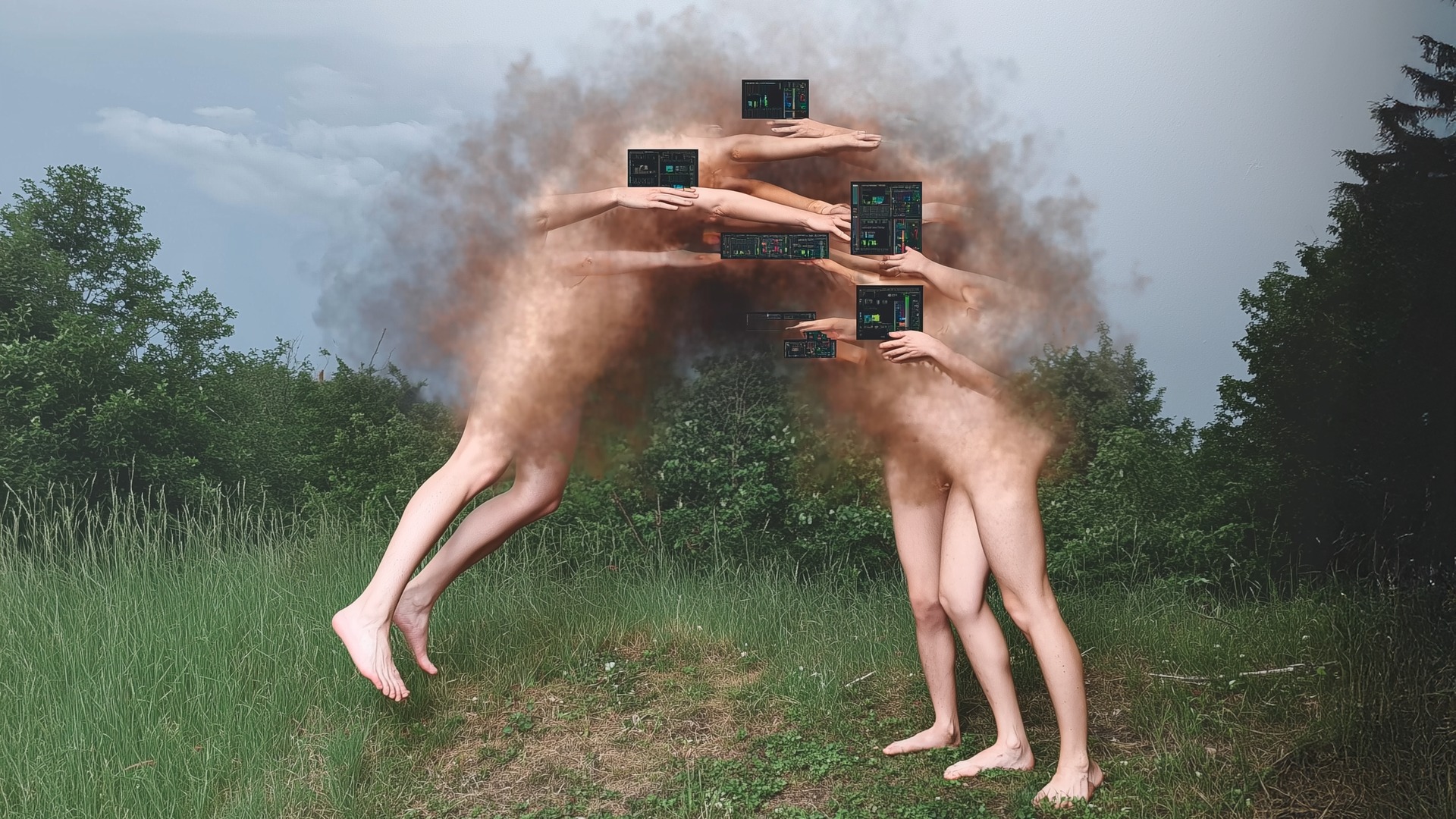
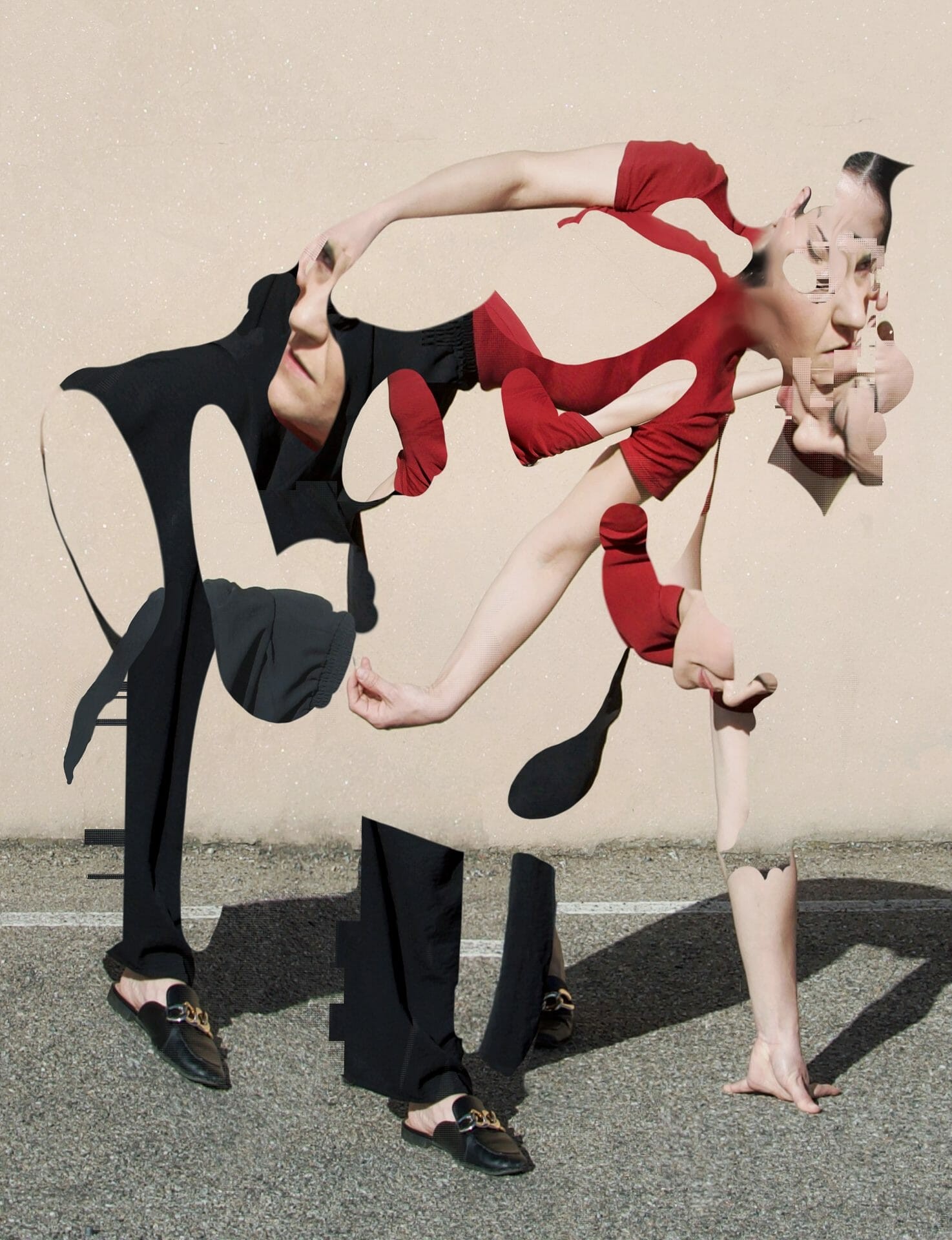
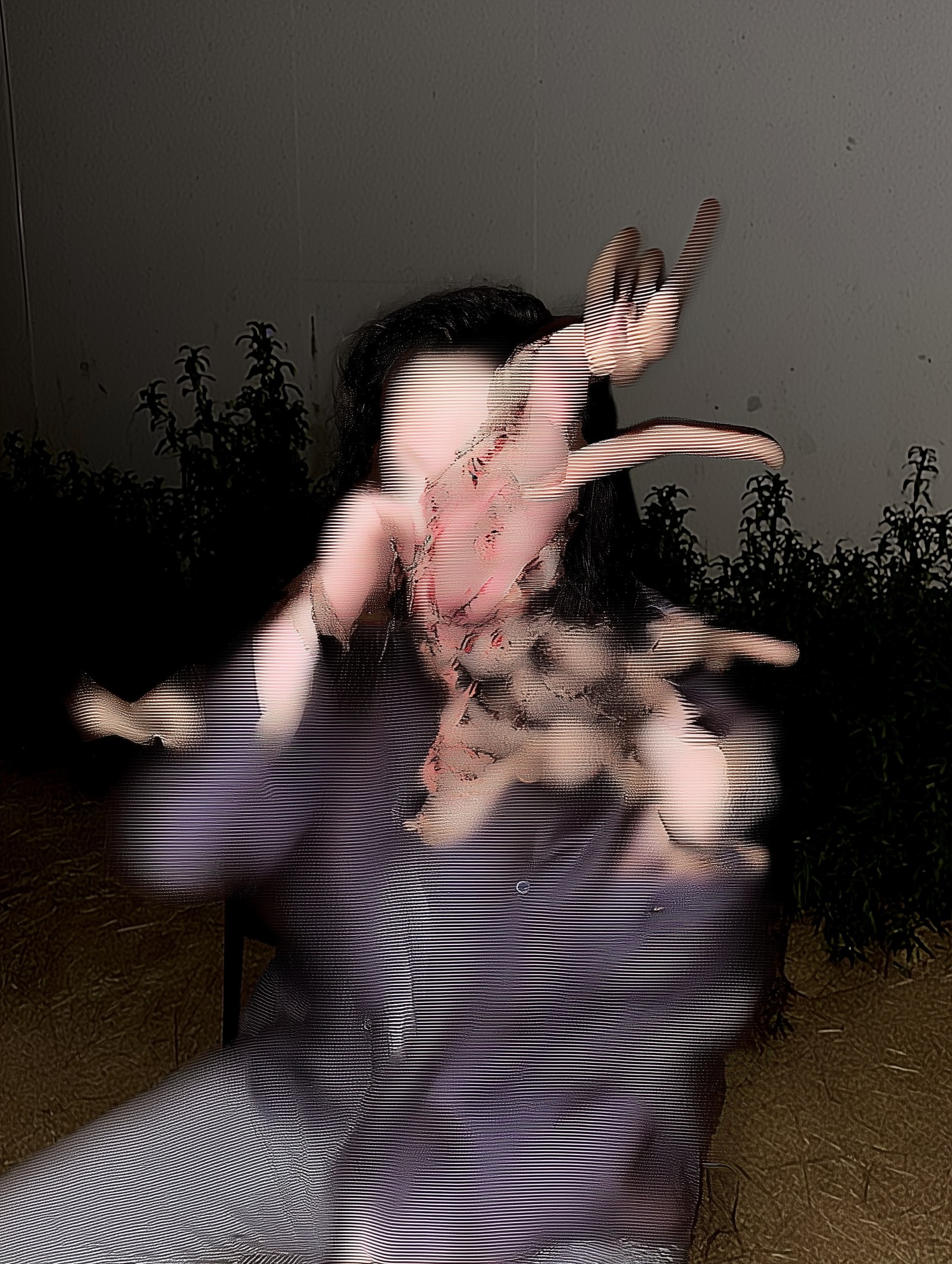
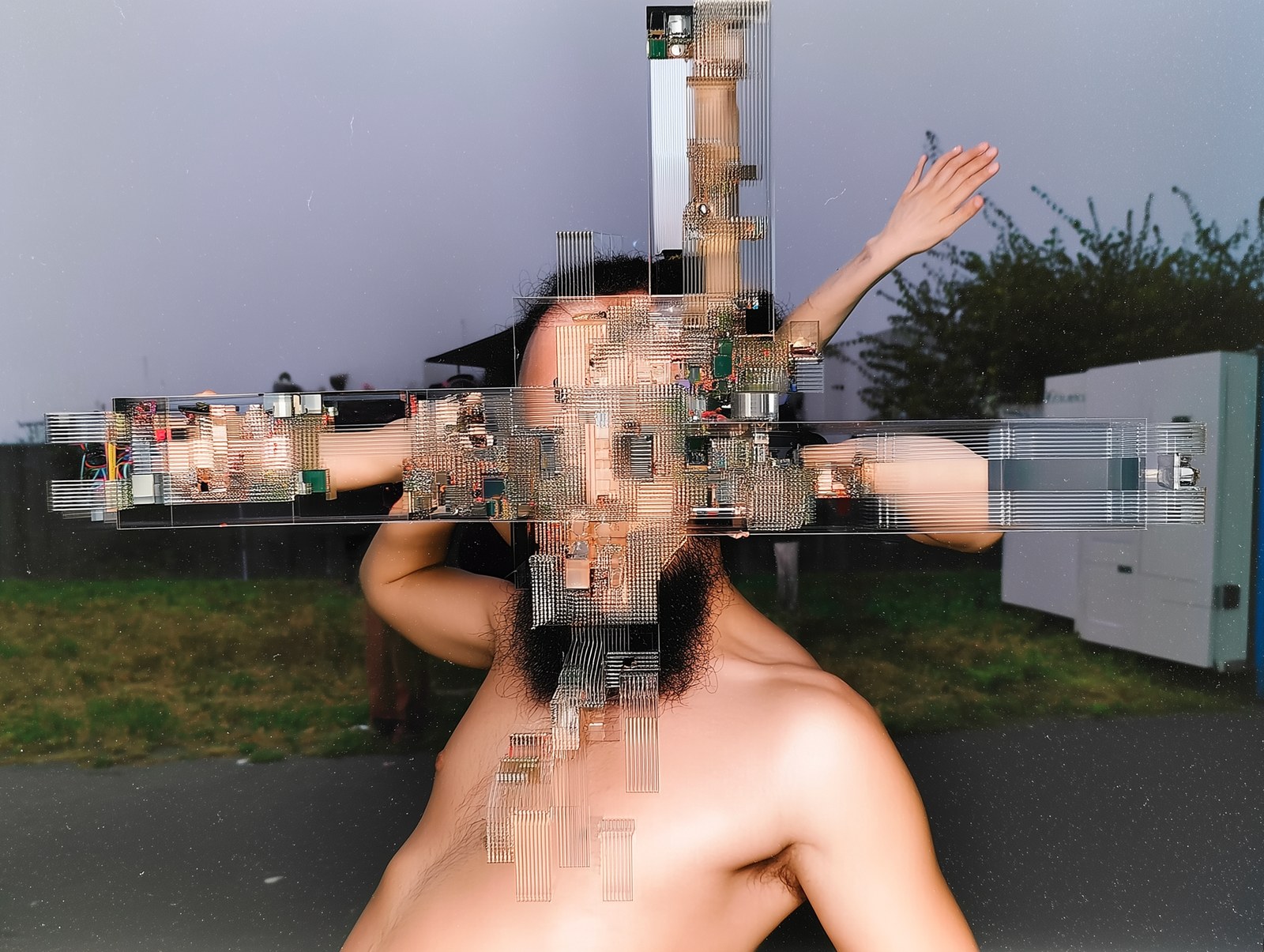
ICONS 6:12 takes form inside this difference in speed. Developed through the Fakewhale Digital Residency and authored by SCERBO × FAKEWHALE STUDIO, the project comprises three hundred unique works in which photographed bodies enter into contact with generated matter and technical structures. The figures inhabit rooms, pale walls, grass, and asphalt; the light retains the unremarkable register of an ordinary day. Across that continuity, limbs unfold into sequences, faces condense into particulate fields, cables and brackets acquire anatomical weight. Each fracture reads as the exact result of a body compelled to sustain several scales of presence at once.
Error moves beyond the repertoire of effect and becomes the morphology of an adaptation still in progress. The image accelerates, replicates, changes context, and acquires value through systems operating in milliseconds; the body transforms signals and habits across biological, cultural, and affective durations whose layers accumulate slowly. ICONS places those temporalities on a single surface and reopens a much older history: every figure that reaches toward transcendence requires material support, while digital transcendence continues to derive its range from faces, postures, voices, and gestures. The image has already accelerated. The body is forming the perceptual and political organs through which it can follow.
The Body Is a System of Returns
Twentieth-century phenomenology moved the body from the edge of experience to its operative principle. In Merleau-Ponty, the primary relation to the world assumes the form of an “I can,” a situated capacity to orient, reach, avoid, and cross. Consciousness gains consistency through embodied possibilities, and space first appears as a field available to action before it becomes an abstract coordinate. This lineage gives connected life a demanding point of departure. The networked subject remains an organism maintaining posture, metabolism, and orientation while devices, interfaces, and remote infrastructures extend its ability to act.
Kevin O’Regan and Alva Noë gave this intuition a sensorimotor formulation: seeing is a way of acting, a competence grounded in understanding how sensory information changes in relation to movement. Vision moves through a field, anticipates, and verifies. The anatomy of ICONS transfers that account into visible form and assigns deformation an operative function. A multiplied arm makes proliferating courses of action perceptible; a broken posture records an environment that has changed the terms of return; a dispersed face registers the strain of maintaining one perceptual center across several simultaneous fields of operation.
The interior of the body participates in every scene as well. A. D. Craig described interoception as the representation of the organism’s physiological condition, a continuous mapping that contributes to feeling, regulation, and self-awareness. Models of allostasis add an anticipatory dimension: the brain coordinates energy and resources in relation to predicted needs, preparing the body for demands arising from its environment. An expected message, a shift in price, the appearance of a face, or a delayed reply enters this economy through attention, cardiac rhythm, tension, and readiness to act. The digital becomes biophysical as soon as it organizes a bodily prediction.
The device draws its force from the asymmetry it can administer. A movement of the thumb authorizes a payment, publishes an image before thousands of people, changes access to a group, or ends a conversation begun on another continent. Gesture contracts as consequence expands. Local presence and distributed agency belong to the same subject: the back meets a chair while action reaches places that vestibular sense and proprioception reconstruct through signs. The network enlarges the “I can” and transfers a growing share of its return into visual indicators, numbers, sounds, and periods of waiting.
Simultaneity therefore becomes an existential problem before it becomes an ergonomic one. A single person sustains identities, tempos, and relationships that advance in parallel, each placing its own claim upon presence. The singular body hosts several operational versions of itself: public profile, private interlocutor, producer, spectator, living archive, economic unit. Personal continuity relies upon the ability to cross these versions while carrying a common memory through them. The surplus limbs of ICONS give this condition volume. They compose a subject whose agency has exceeded the silhouette expected to contain it.
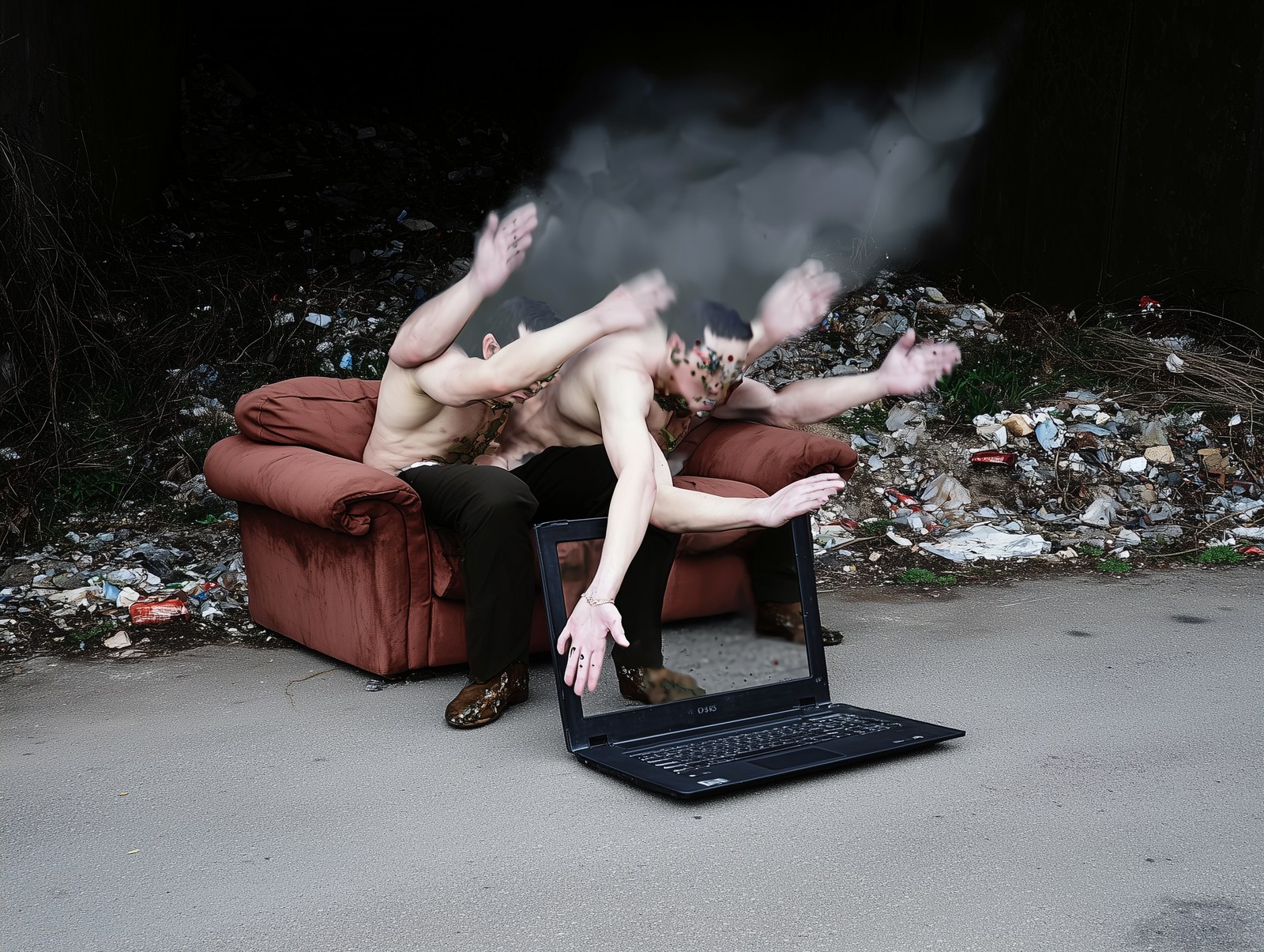
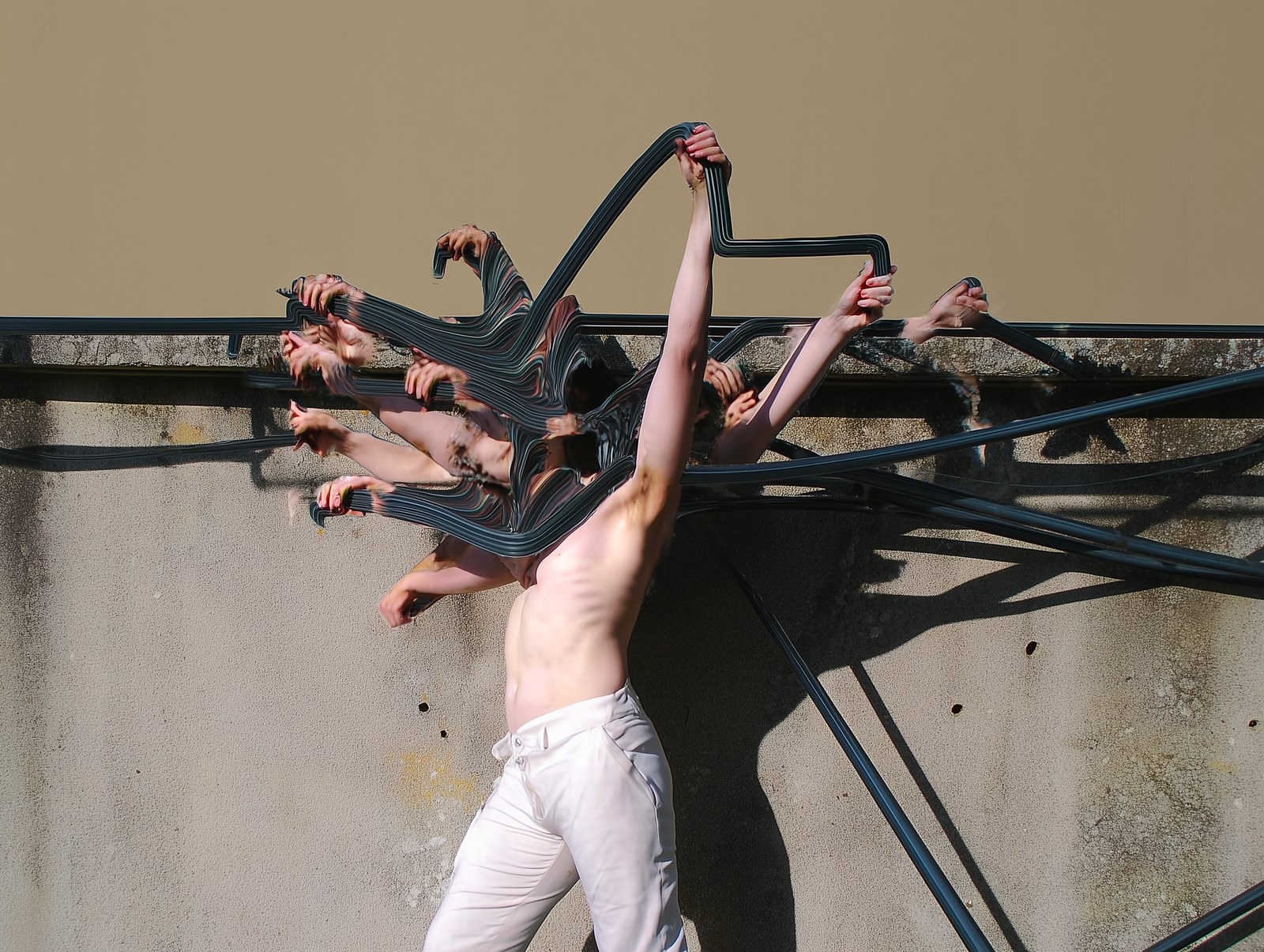
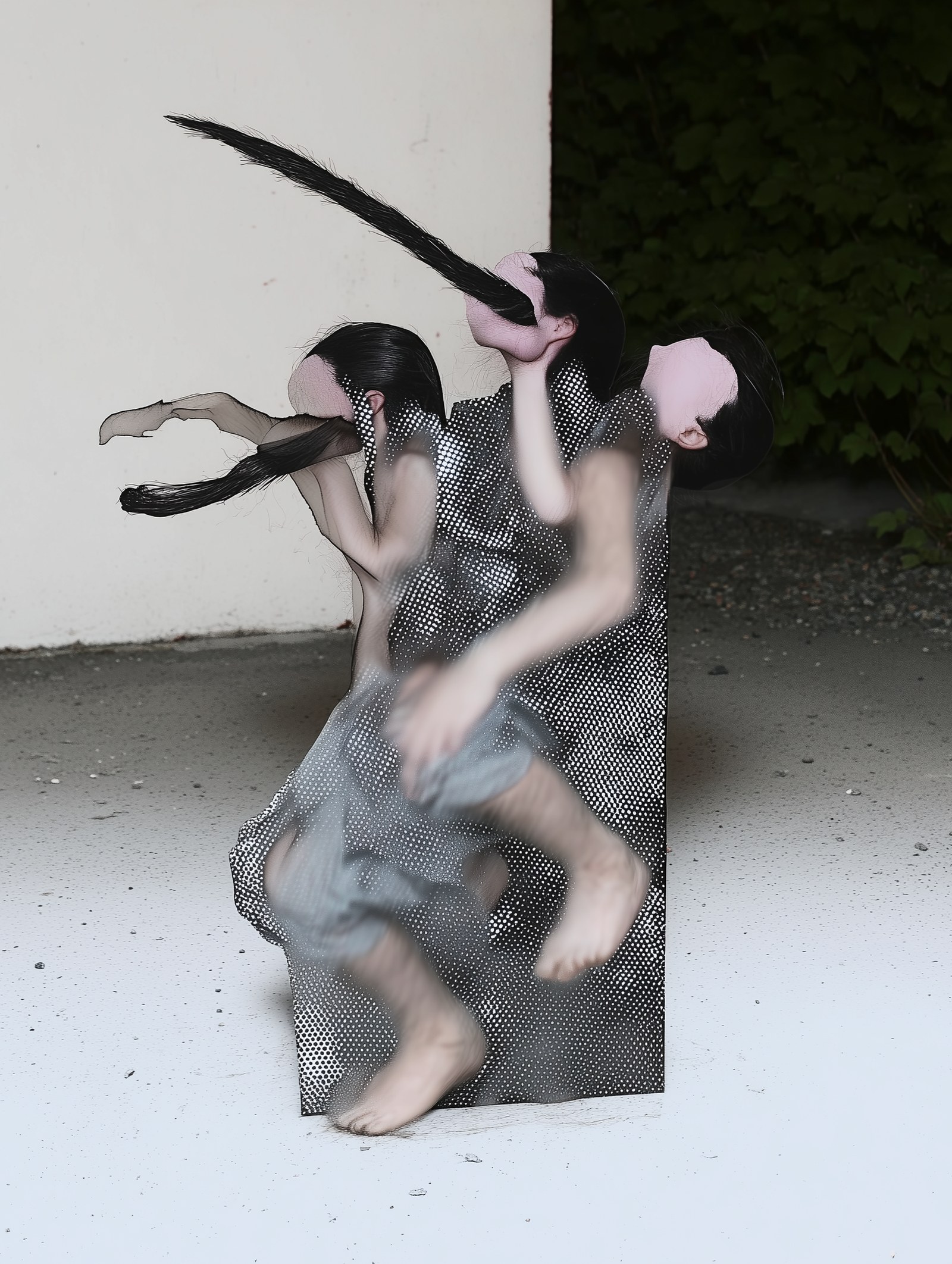
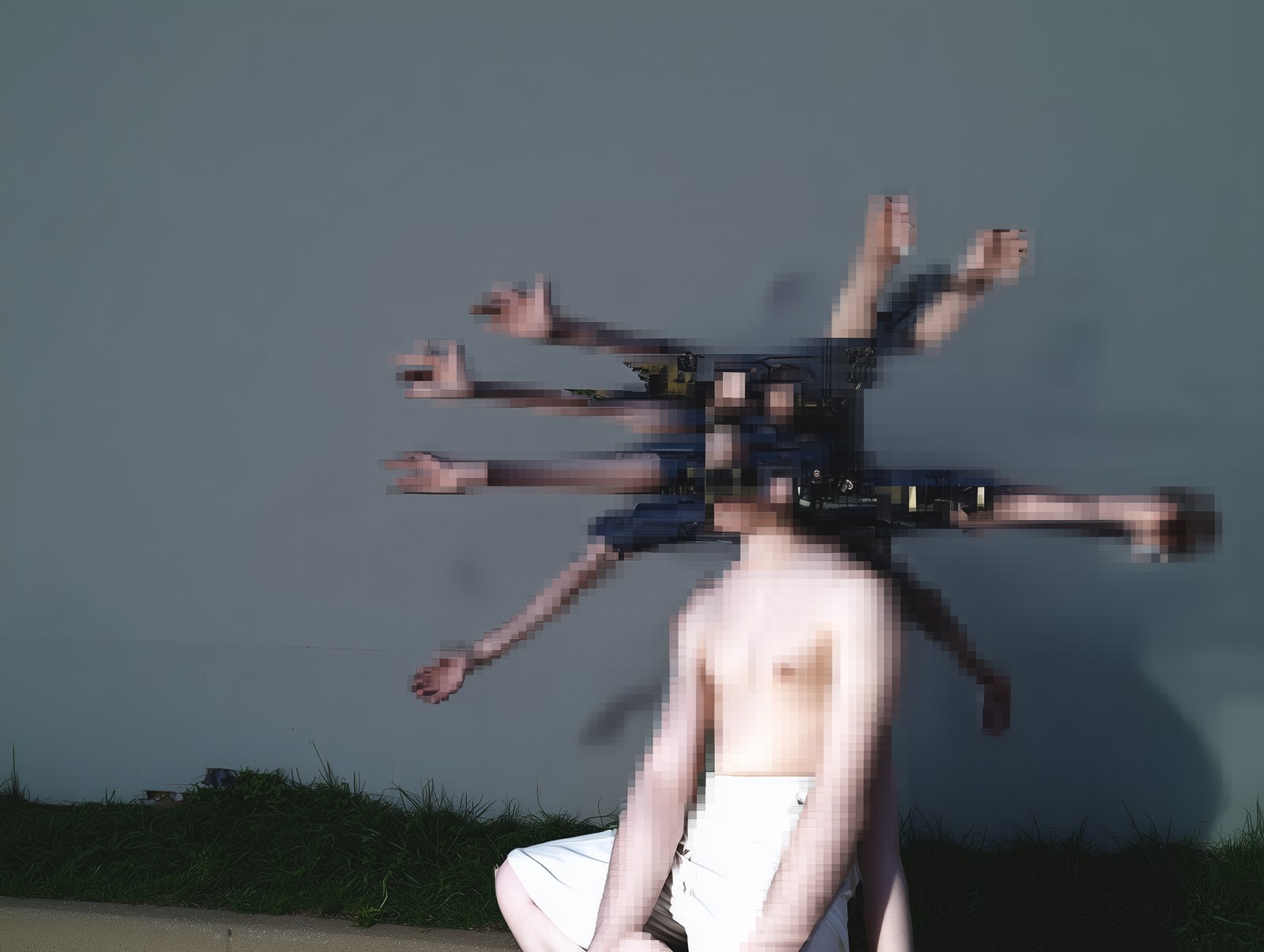
In Icons 001, the wall and the light establish an almost documentary gravity. The torso retains the weight of a present body, while its arms open into a fan of trajectories and dark structures trace connections that can read as restraints, prostheses, or vectors of command. Each extension carries the tension of the original gesture toward a different possibility of action. The figure stays located while its capacity becomes distributed. At that threshold the body approaches the icon: once a faculty multiplies beyond the measure of one anatomy, its image begins to assume the form of attributed power.
Every Transcendence Requires a Surface
Between the eighth and ninth centuries, the Byzantine contest over images made a lasting problem in visual culture explicit: which forms of matter can grant access to a presence that exceeds them? Iconophile thought found its ground in the Incarnation. Since the divine had assumed bodily form, wood, pigment, wax, mosaic, and metal could participate in its manifestation. The surface acquired a relational function, directing vision toward the prototype through contact with a concrete object. Within this tradition, transcendence advanced through matter and drew its efficacy from matter.
The icon also acted within a network of practices. It could be carried on the body, opened as a triptych, transported in procession, touched, kissed, illuminated, and copied. Its authority grew through recurring gestures that bound image, memory, and community. Even images understood as acheiropoieta, produced by divine action, developed their force through imprint and replication. The historical icon therefore possessed an operational dimension: it organized attention and conduct, directed prayer, and made a presence available across scales ranging from the intimate object to the monumental surface.
An earlier and structurally distinct regime, the polytheistic pantheon, distributed divine agency across a population of figures, attributes, and domains. Each deity condensed recognizable faculties and made them accessible through recurrent forms; multiplicity articulated power as a field of differentiated presences. The comparison with ICONS concerns this distributive logic while preserving the historical distance between systems. Across the works, plural limbs operate as a repertoire of assigned capacities, while variation across the corpus produces a population of states. The unity of the figure yields to deification by attributes, each exposed to recognition and renewed activation.
The contemporary platform administers elevation through frequency, indexation, and predictive calculation. A figure gains authority by recurring in the feed, entering search, receiving classification, and becoming available for further association. Prior visibility raises the probability of future visibility; ranking turns repetition into evidence of relevance. This process produces a mobile pantheon populated by identities that occupy temporary domains of attention and receive attributes optimized for immediate reading. Devotion assumes the form of measurable behavior, while recurrence turns the sign into a presence capable of arriving before the person.
To extend beyond physical location, the person supplies the system with transferable components: features, voice, posture, preference, history, and style. N. Katherine Hayles traced the cultural history that allowed information to be imagined as separable from the material forms that sustain it. ICONS returns the cost of that abstraction to the image. Presence gains range through segmentation, the body becomes source and infrastructure at once, and singularity circulates as a set of recombinable characteristics. Ubiquitous extension feeds upon the very matter it claims to exceed.
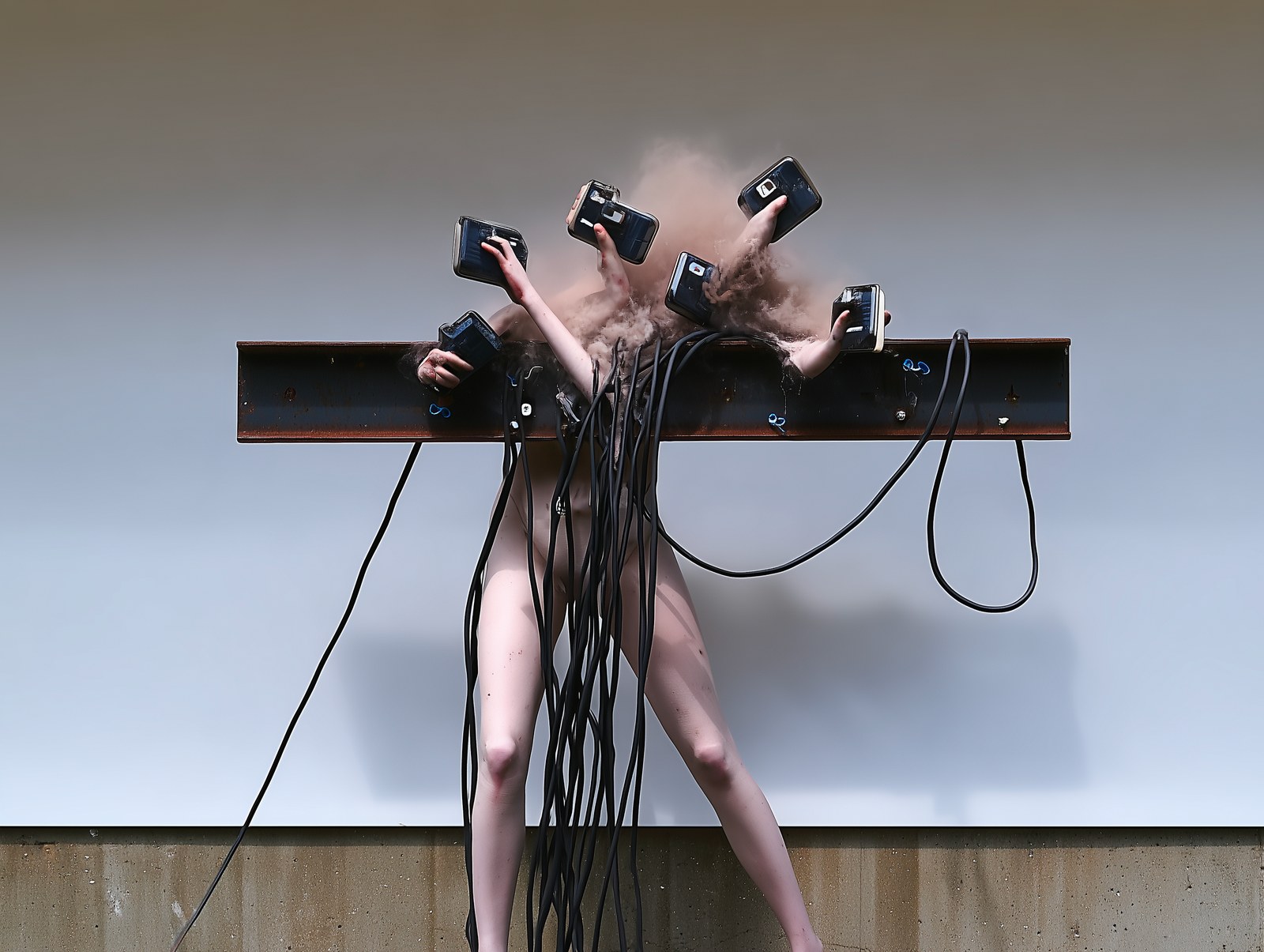
The devotional poses in the series give this paradox immediate form. Open arms, frontal figures, and kneeling bodies appear in ordinary rooms, on asphalt, before walls carrying the perceptual poverty of an everyday background. Gold and monument give way to the flat light of an environment already crossed by devices. In Icons 030, technical mass occupies the head and torso while the body sustains a posture of supplication. The historical icon opened matter toward the transcendent; the networked icon extends bodily matter by converting it into operative information. Every digital ascent deposits a new anatomy.
The Image Is Pierced Where Presence Begins
Since the 1960s, a decisive current within photography has constructed action for the camera, turning capture into a constitutive element of performance. The body acts in relation to the lens, and the resulting image carries two temporalities: it preserves the trace of a physical event while acquiring autonomy as a work. From the gestures of Bas Jan Ader and Adrian Piper to practices that enlisted the camera as an accomplice in the construction of identity, photography extended performance beyond the audience’s physical co-presence. The initial material of ICONS belongs to this history of bodies producing a second life through their images.
In 2023, Anti-crash brought that relationship into a field of intimate exposure. The ten works by Scerbo presented by Fakewhale on Verse originated in photographs of his partner, his mother, and his friends, people whose presence carried a history anterior to the file. Each image therefore arrived with relational density exceeding its surface. A system could read chromatic values, contours, and transparency; the artist continued to see bonds, memories, and responsibilities. That surplus gave technical transformation a precise human consequence, since every fracture acted upon someone already inscribed in lived memory.
Scerbo describes the process through the cycle creation, photo, destruction. Photography fixes a temporary construction, destruction reopens what capture had stabilized, and a new creation emerges through contact with instability. The digital brush used in Anti-crash arose from altering the code of its own settings; error was fabricated as an instrument and then submitted to a further decision. Chaos supplied visual events, while editing established which events deserved duration. Authorship took shape as the capacity to recognize direction at the exact point where the medium entered a field of unpredictable behavior.
The alpha channel makes this operation especially consequential. Within a digital file, it assigns each pixel a degree of opacity and governs its participation in the visible image. Piercing those values means intervening in the elementary grammar through which a surface administers presence and transparency. In Anti-crash, that numerical value passed through a photographed body and therefore through an existing relationship; technical presence and affective proximity shared the same threshold. Destruction acquired precision because it struck the place where the file decides how much of a figure enters visibility.
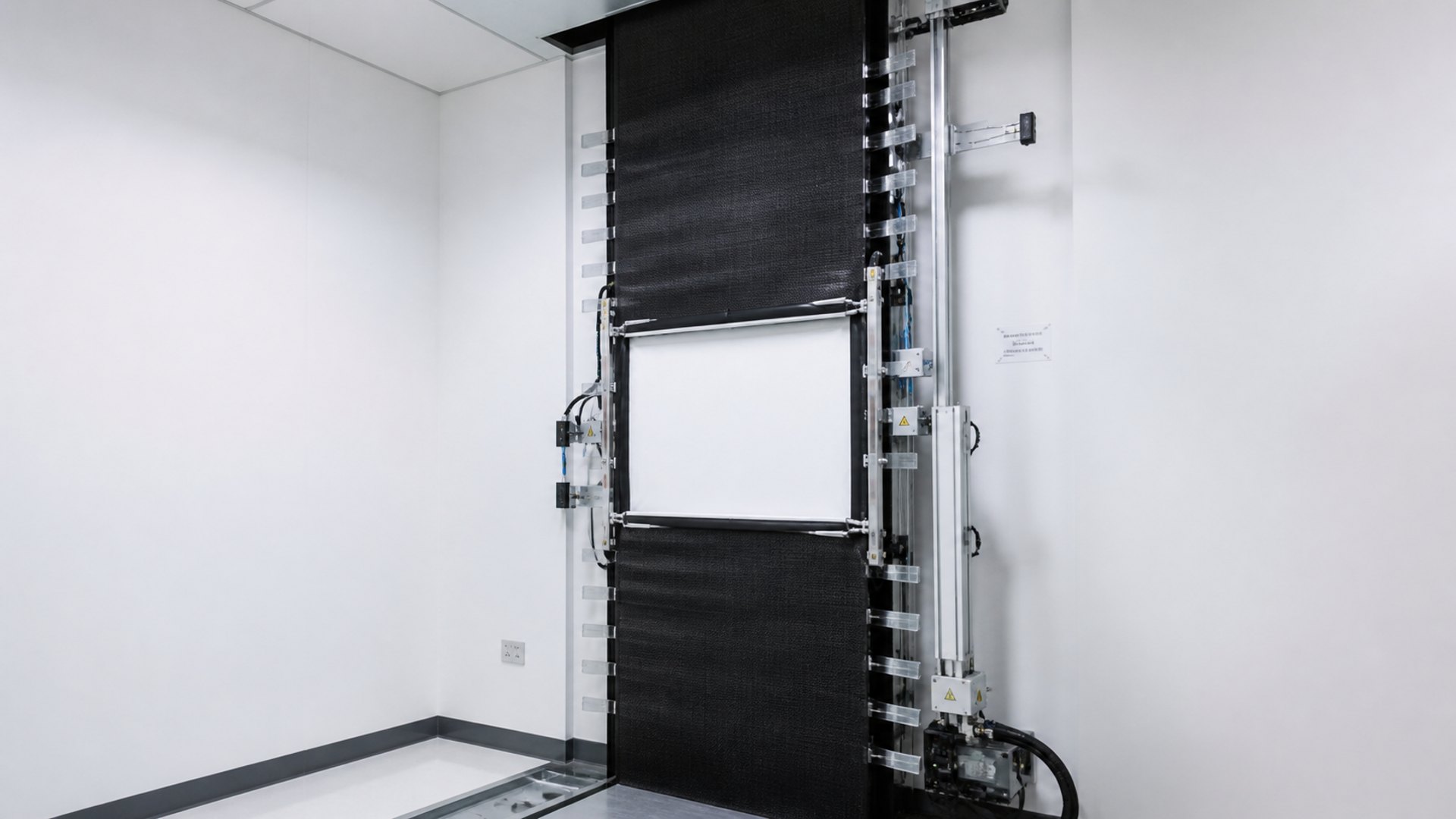
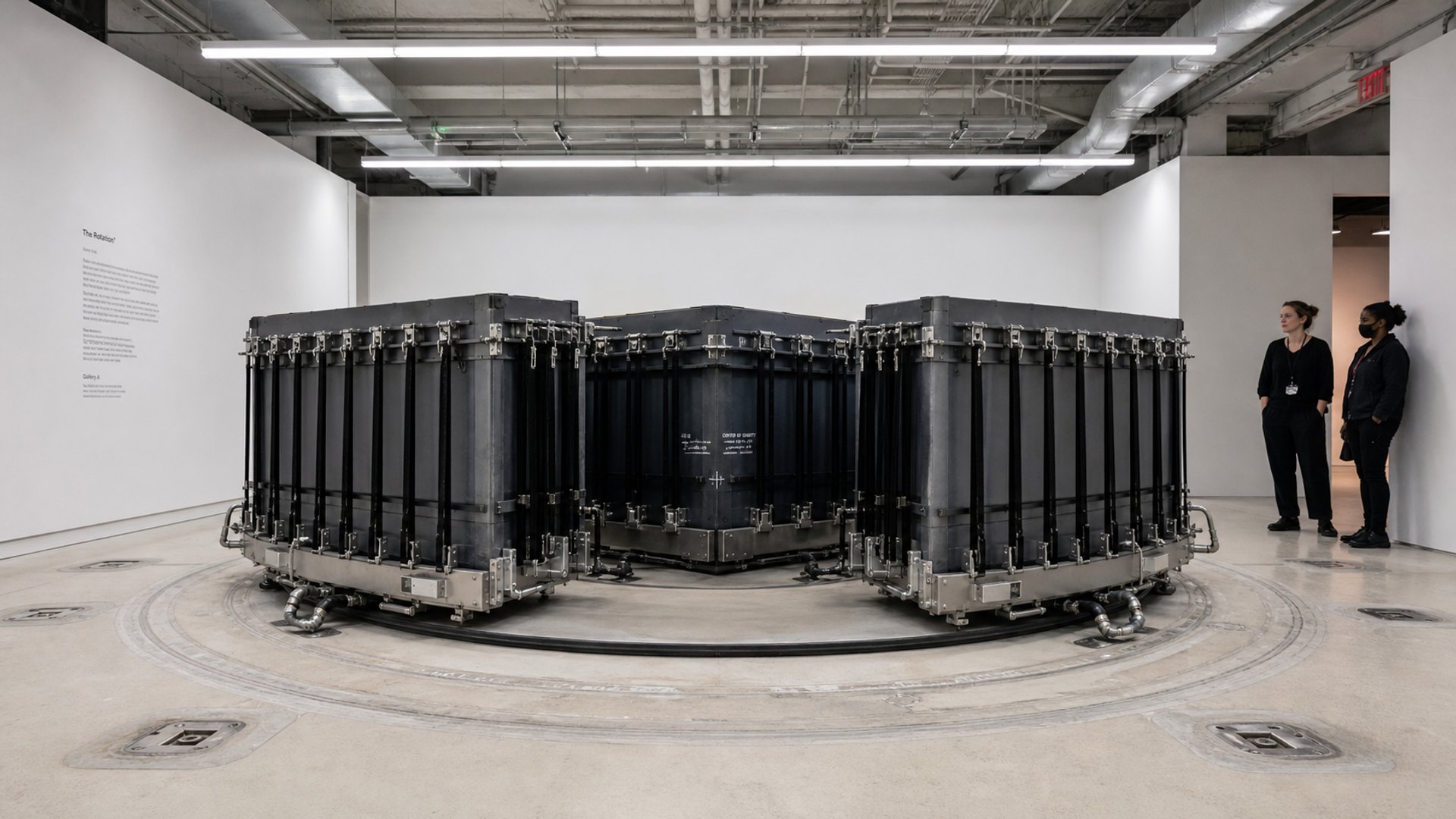
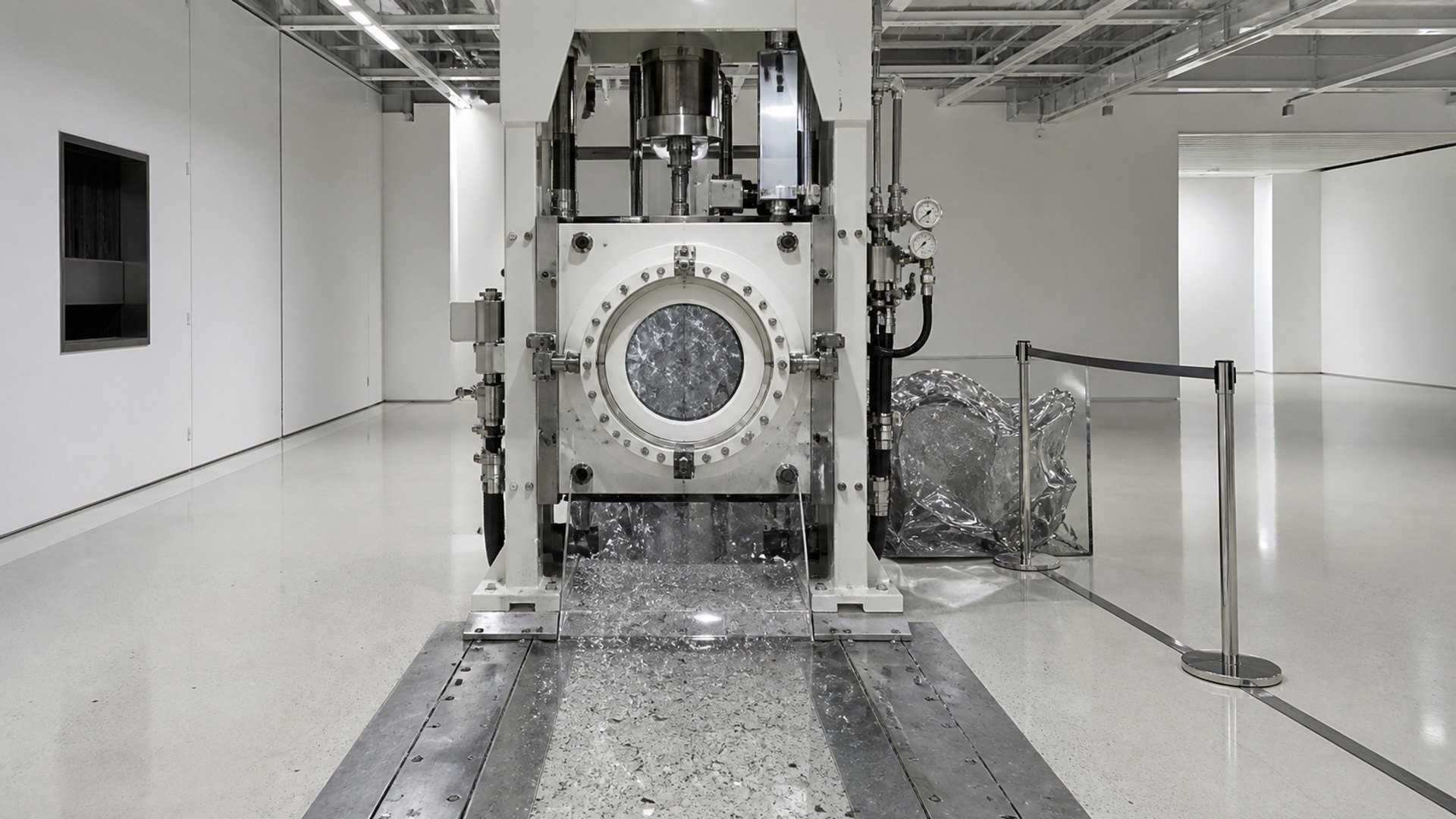
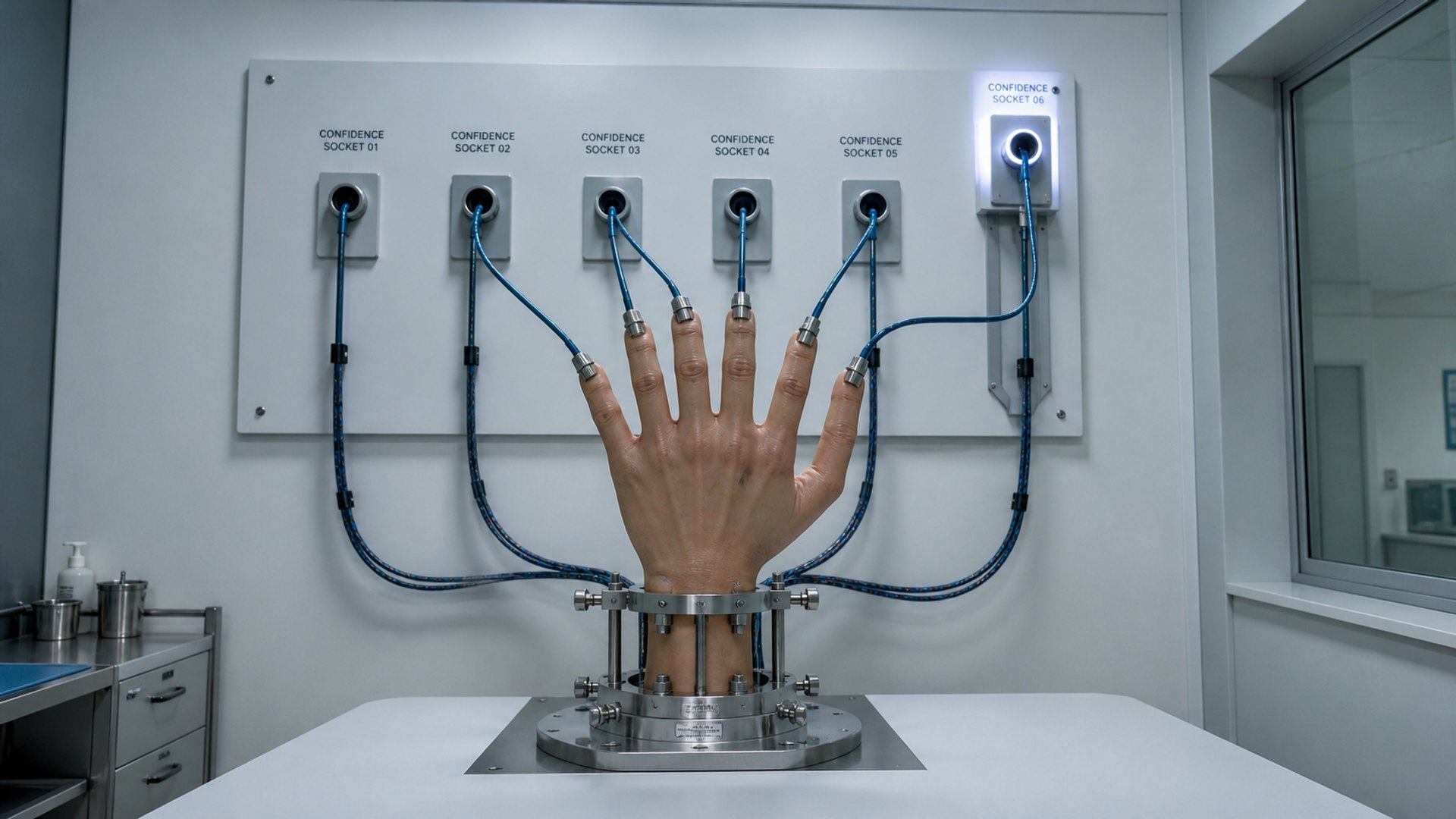
Fakewhale Studio enters ICONS through a material history built across installations, technical objects, environments, and an internal system of generative orchestration. Founded by Fakewhale in 2024, the Studio coordinates models, selection, and revision inside an environment where visual production participates directly in cultural formulation. Harun Farocki called images operative when they become part of an action, guiding, measuring, and organizing a process. Generation acquires that quality within this collaboration: the output changes the field of decisions, selection instructs the following return, and the image acts before public interpretation begins.
These two lineages exert pressure upon each other until a single authorship emerges. Photographic memory enters an environment capable of variation at scale; that environment encounters images whose relational density gives consequence to every transformation. Scerbo’s cycle expands from a corrupted brush into a chain of models and revisions, while the Studio’s infrastructure receives from the body an ethical and formal limit against which its reach can be measured. SCERBO × FAKEWHALE STUDIO names this reciprocal circuit. Its grammar required time, since every accepted image had to alter the conditions under which the following image could appear.
A Residency Builds an Intelligence of Feedback
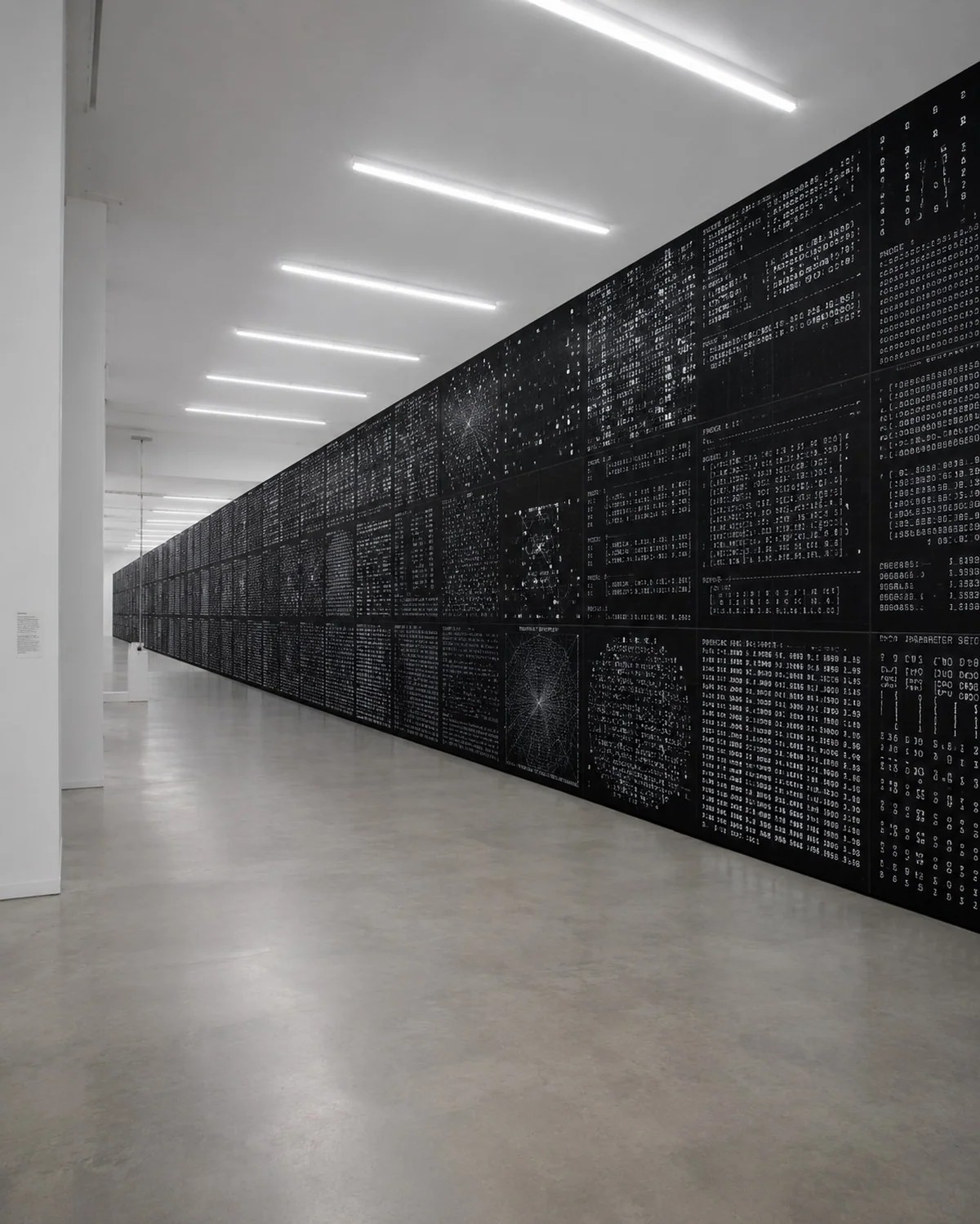
On September 26, 2025, the announcement of the Fakewhale Digital Residency made public the beginning of a trajectory designed to outlast the ordinary velocity of a campaign. Scerbo’s introduction followed on October 7; the process entered the narrative on October 21, its first visual results appeared on October 27, and iterations continued through late November. The Anti-crash thread, published on December 10, closed the visible arc with a temporal coordinate: Scerbo × Fakewhale Studio, coming 2026. The silence that followed became part of the work, an interval during which the images continued selecting their own rules.
Duration operates here as material. Every return to the corpus tests a solution against hundreds of results, tracks whether a gesture retains force through recurrence, and locates the point where recurrence hardens into mannerism. A pause protects the capacity to reject whatever becomes legible too quickly. Time allows differences to declare themselves, since a shared grammar becomes visible only after enough cases have exposed its limits as well as its strengths. The three hundred final works retain this duration in the minute distance separating one fracture from another.
The intelligence produced by the collaboration belongs to its sequence of feedback. Direction, result, selection, refusal, and revision form a chain in which each passage changes the next and receives a new measure in return. The project’s technogenesis takes place inside this reciprocity: people and systems transform their fields of possibility through use, while images function as intermediate propositions capable of steering the process. Authorship emerges from the quality of transformations imposed along the chain and from the responsibility with which a possibility is conducted toward definitive form.
ICONS has been supported throughout its development by DagieDee, one of the collectors most attentive to the evolution of contemporary digital art and to the artists extending its avant-garde. He has followed the project from the Fakewhale Digital Residency to its present form, remaining close to it while the work was still establishing the relations that would shape the final corpus. His support therefore belongs to the internal history of the series, prior to its public release.
Fakewhale invited DagieDee to reflect on the nature of the project he saw emerge across that time.
Fakewhale: Having followed ICONS from the Fakewhale Digital Residency to its current form, how would you describe the nature of the project and what you have seen emerge throughout its development?
DagieDee: I like how the series evolved into a space somewhere between photography, code and generative systems where none of them completely dominates. The works still feel weirdly human to me, maybe that’s because they could only have been made under the technological conditions we are living in now.
It doesn’t feel as if technology has been added onto Scerbo’s practice. Rather, it feels as if his existing practice has evolved with these new systems. Already in his early works from 2018, he was interested in unstable processes. Scerbo introduced elements like light, electricity, gas and recycled industrial materials, and he developed a dialogue between energy and matter. With ICONS, this type of dialogue continues, but through generative software.
In that sense, ICONS doesn’t feel like an abrupt move into AI at all; it feels like a continuation of questions that have been running through his work for years, but under a new technological condition. And this residency gave those questions a new system to move through.
The brutality of automation enters the project as a difference of scale. A photograph of a mother, a partner, or a friend carries density accumulated through years of proximity; the data center receives a numerical arrangement and applies procedures that can process intimate memory and anonymous imagery with equal efficiency. The system handles what it can register, while biography remains active in every decision that returns to the result. ICONS draws pressure from this disparity: an irreducible relationship encounters generalized treatment, and the completed work retains the trace of both measures.
Selection restores consequence to that reach. Each decision establishes how much continuity remains in a face, when the multiplication of a limb acquires function, and which technical object can enter a torso with anatomical credibility. Refusal separates a visual event from an image capable of holding its place across the corpus; revision measures the endurance of a decision through time. Editing becomes the point where the industrial scale of generation meets situated responsibility, since every accepted form joins a population that will define the project as a whole.
Fakewhale: In the dialogue between Scerbo’s photographic material and the generative systems and apparatus of Fakewhale Studio, which reciprocal transformation do you see as central to the identity of ICONS 6:12?
DagieDee: For me, the most interesting thing is that the transformation seems to happen in both directions. Scerbo brings something almost physical into the system: photographed bodies that carry a strong sense of human presence. The generative apparatus then starts to destabilize that material, reorganizing the body according to a completely different logic.
But at the same time, the photographic material also seems to constrain the system. It never completely disappears into generative abstraction. There is always something recognizably human underneath it, a posture, a gesture or a trace of the original photograph.
So in a way, these bodies become computational, while the computational system itself becomes somehow embodied.
I think that tension is central to ICONS. It continues Scerbo’s interest in instability, but now the instability exists between two different ways of constructing an image: one rooted in a physical body and photographic perception, and another produced through computational interpretation. Neither completely takes over, and the work seems to exist precisely in that unstable space between them.
The three hundred images retain the residency as organized difference. Each work records a specific threshold between photographic memory and generative production, together with the editorial decision that stabilized their encounter. The corpus becomes an operative archive of shared learning: recurrences show the rules gained through the process, while deviations indicate the moments when those rules changed direction. The residency built a visual syntax. Its next question concerns the kind of body that syntax finally makes perceptible.
The Image Acquires a Nervous System
Before a hand reaches the phone, the organism has already prepared some of the energy, attention, and motor repertoire required by the gesture. The brain integrates signals from the environment with information about internal physiological state and coordinates the resources needed for anticipated action. Allostasis describes this regulation as stability achieved through change, distributing resources in relation to demands the body expects or imagines. Connected life enters directly into this economy: an awaited notification prepares a response and directs desire, while even a remote presence alters affective tone before any broad movement takes place. The device participates in the daily regulation of presence.
Screen-based experience derives its specificity from an asymmetry of bandwidth. The screen supplies dense visual and social information, rapid sequences of stimuli, and symbolic reach across continents; the body frequently answers within a contained motor field and a tactile range concentrated on glass, keyboard, or controller. Studies of virtual reality render the underlying principle visible at an intensified scale. Perceptual coherence depends upon the continuous integration of visual, vestibular, and proprioceptive signals, while divergence among those channels can generate sensory conflict. This extreme case clarifies how fully presence depends upon the quality of return.
The nervous system retains plasticity and learns new devices, postures, and rhythms of attention. At the same time, infrastructures update interfaces, speeds, and forms of solicitation, so adaptation unfolds inside an environment that continually rewrites the terms of learning. Bodily preparedness lies in this ongoing technogenesis. ICONS catches the phase in which a new competence already possesses practical reality and still seeks a symbolic form capable of containing it. Its anatomies appear provisional because they belong to a transition whose outcome is being written as the organism passes through it.
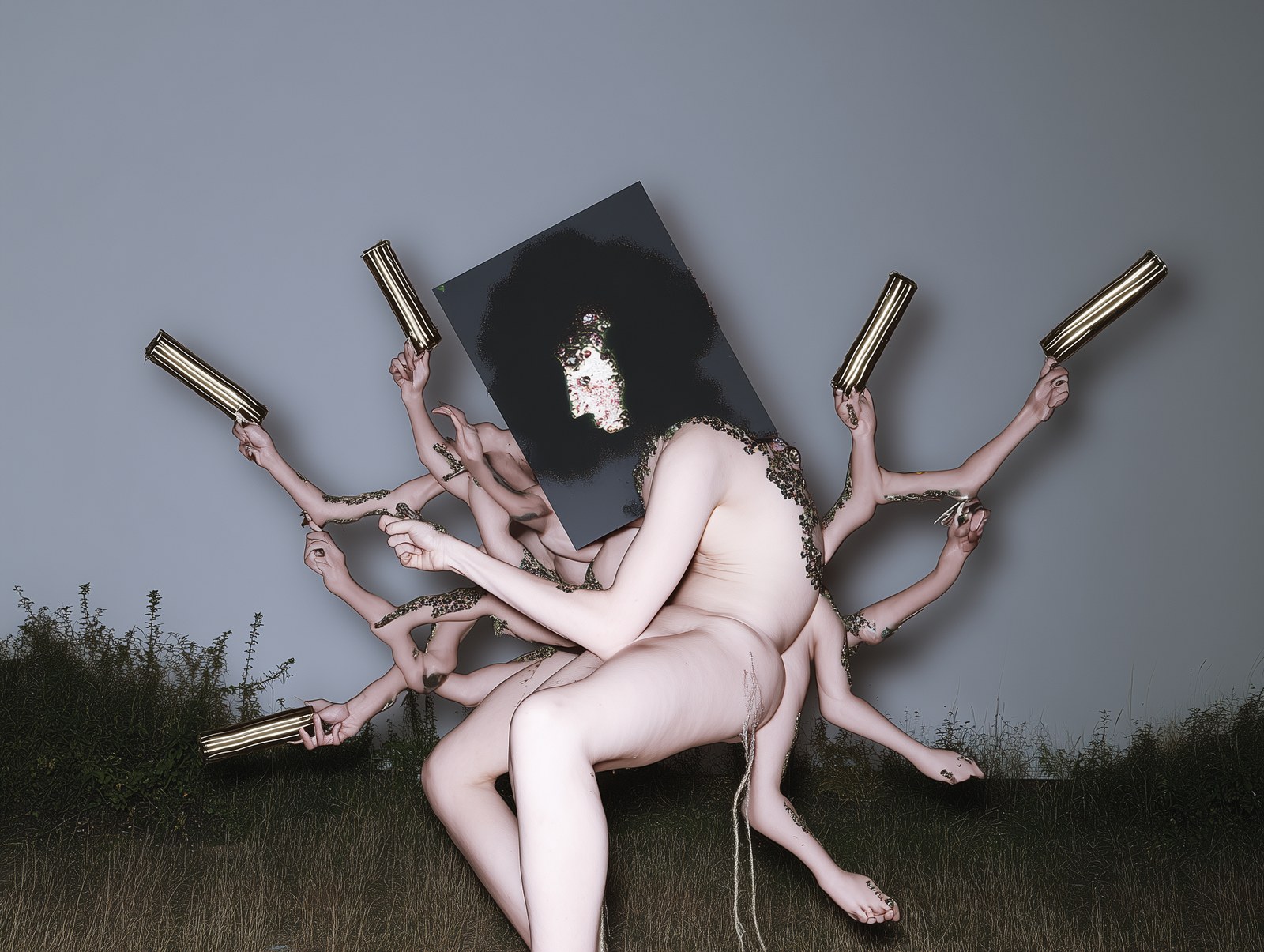
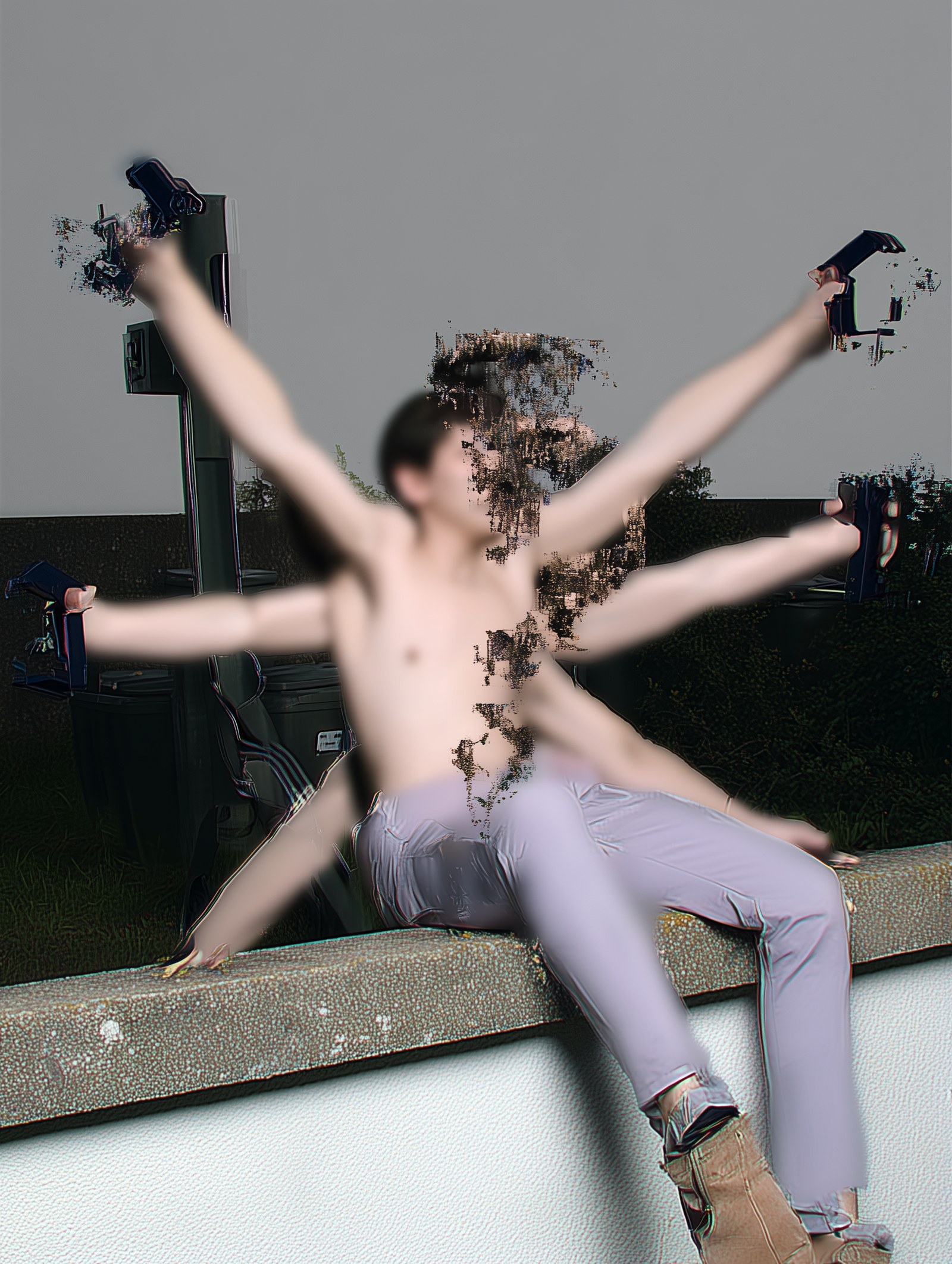
In Icons 029 and Icons 001, additional limbs preserve the memory of human gesture and carry it beyond the individual silhouette. They articulate channels, tasks, and demands converging upon the same organism; each segment retains tension, direction, and a concrete relation to space. The figure exceeds the metaphor of multitasking and acquires the weight of morphological transformation, as simultaneity becomes flesh and distributed agency asks the historical body for new articulations of its “I can.” A condition previously managed through interfaces returns as anatomy.
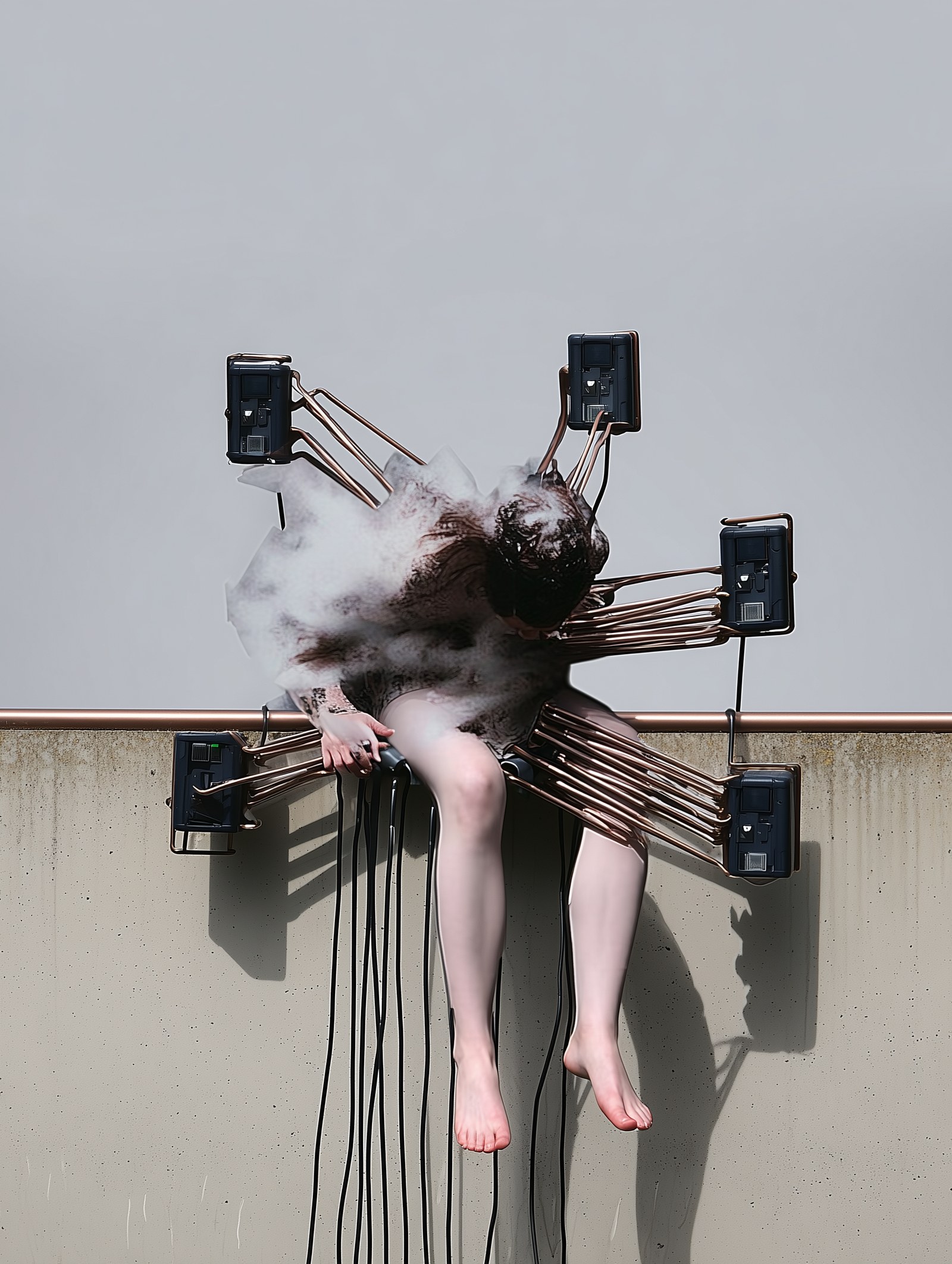
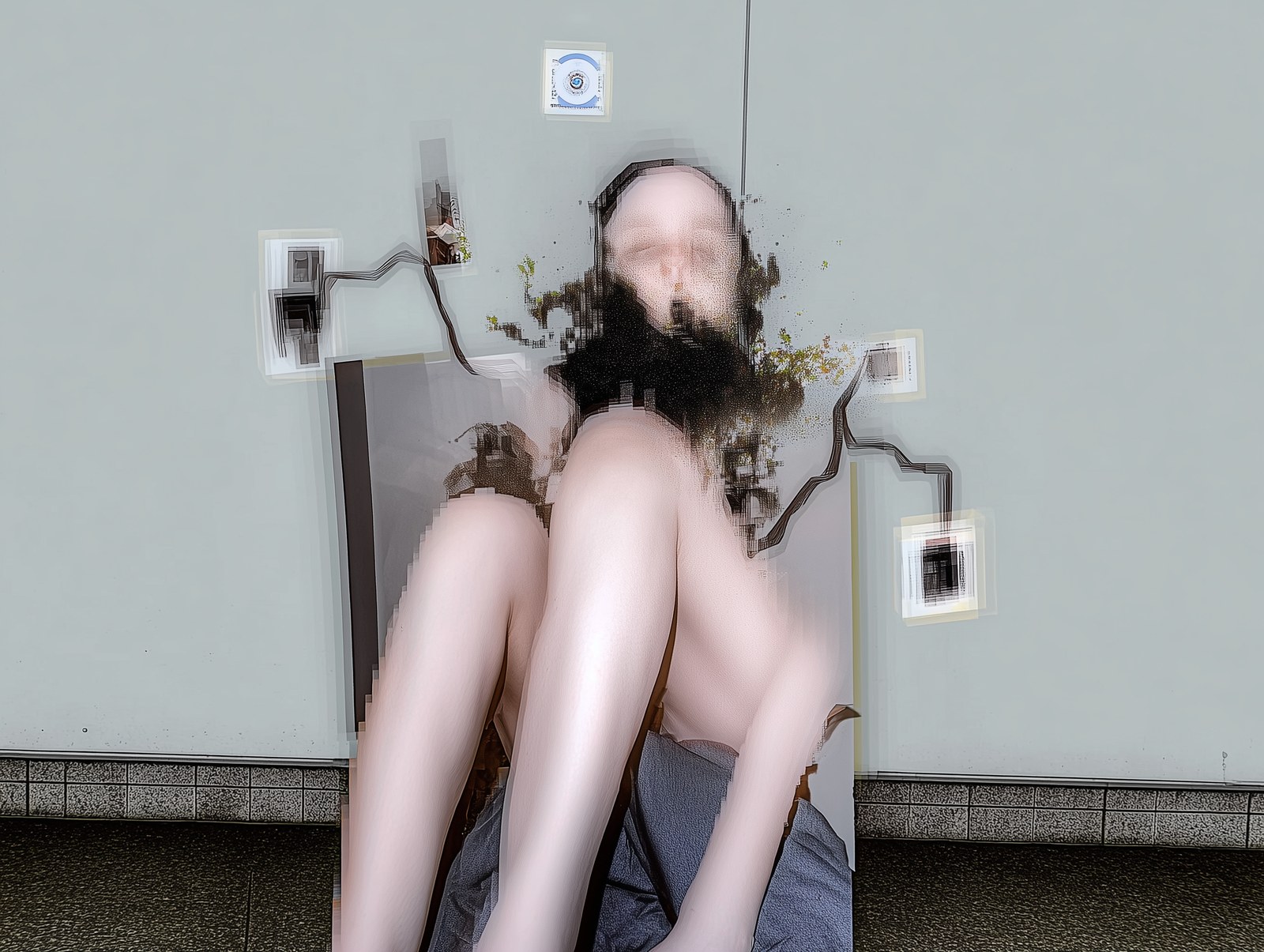
Visual dequalification operates through a redistribution of perceptual priority. In Icons 009, devices and cables gain precision while the face loses continuity; apparatus receives anatomical legibility as bodily identity becomes a variable field. The image exposes a hierarchy embedded in its treatment: technical function retains definition while the person opens to recombination. Resolution thereby acquires cultural meaning. It allocates importance, determines which element deserves stability, and turns a rendering decision into a judgment about the form that can continue to be recognized.
Three hundred states change the nature of that judgment. A single image could establish an emblem; a corpus enables comparison across degrees of permanence, recurring anatomies, and deviations. Every 1/1 preserves an unrepeatable relation among pose, apparatus, and dispersion, while gaining intelligibility through the other 299 works. ICONS assumes the form of an atlas of transition, a population able to show how shared pressure produces distinct outcomes and how singularity can arise from common grammar. Number becomes a method of knowledge.
Our Fracture (AI Litany) transfers this atlas into duration. The three-minute, fifty-two-second film adopts the cadence of prayer and passes it through the vocabulary of machine learning: dataset, mutation, algorithm, archive, hallucination, void. Repetition organizes breath and turns technical terms into formulas of invocation; an ancient structure receives the instructions of the computational present. Language undergoes the pressure borne by the figures, since the sentence carries devotional memory while another operational order takes voice inside it. At that point the political question becomes unavoidable: who writes the feedback to which this body learns to respond?
Power Writes the Feedback Circuit
Farocki’s operative images belonged to targeting systems, factories, and measuring devices where seeing coincided with the execution of a task. In the generative present, classification, ranking, and synthesis extend that logic into everyday culture. An image organizes the field before offering itself to vision: it assigns probabilities, activates associations, and steers a subsequent action. Power inhabits this configuration of possibility, because it determines what appears fluidly, what encounters friction, and what receives enough duration to become public memory.
ICONS returns that configuration to the body’s surface. In Icons 028, a pose retains its openness while generated matter erodes and prolongs the figure; elsewhere, a cable holds recognizable function as the face disperses. The system preserves the sign ahead of the person and grants technical structure a continuity distributed unevenly across the anatomy. Resolution functions as cultural allocation, apportioning clarity among elements and making visible the authority that has already ordered the scene.
Fakewhale: How do you see ICONS 6:12 positioning itself within contemporary digital art? Does its relationship to the present carry a sense of urgency for you, or another form of cultural relevance?
DagieDee: I think its relevance comes from the fact that computation has increasingly become an environment through which we see the world, but also through which the world sees us.
Our bodies and identities now constantly pass through cameras, algorithms, recommendation systems, generative models and platforms before becoming visible to other people. We also increasingly construct ourselves in relation to these systems. A significant part of how we understand and present our identity now happens through photographs and images on digital platforms. We choose how to frame ourselves, how to pose and what aesthetics to adopt. So the mediation doesn’t only happen after an image enters the system; it already begins in the way we imagine ourselves before the photograph is even made.
I think ICONS balances those two conditions in an interesting way. The works have this same performative aesthetic and seductive quality, but that aesthetic surface is continually being disturbed and reconstructed by computational processes. The body seems to move back and forth between something we recognize and something being interpreted or reorganized by another system.
In that sense, I see a connection with what Trevor Paglen has been investigating for years. His work has shown how machine-vision systems do not simply look at images neutrally. They classify them, attach categories to them and embed particular assumptions about the world. ICONS approaches a related condition in a very different way. Paglen often exposes the apparatus itself, while ICONS, for me, visualizes that condition through a more poetic approach. Instead of showing us the classification system, it shows us a human image after it has entered into a relationship with computational perception.
That is where you might feel a certain urgency in the work. We are at a moment when the image we construct of ourselves and the image computational systems construct of us are becoming increasingly entangled.
But there is also a metaphysical dimension to it that has always been very present in Scerbo’s previous work. Some of the images in the series carry a genuinely transcendental feeling. Today, the human figure seems to exist somewhere between a physical body and an immaterial computational space. As our identities and perceptions become increasingly mediated by machines, we begin, in a sense, to exist through the technologies we use, while those technologies can only exist and acquire meaning through us.
For me, that gives the idea of the icon another layer.
For years, debate around artificial intelligence in art has mistaken the produced image for the decisive scene and authorship for the central conflict. That frame casts the machine as a symbolic competitor and leaves the organism supporting the entire cycle in shadow. ICONS moves the center of inquiry toward that body. What kind of organism can inhabit a life already organized by computational signals? What form does presence assume when vision, desire, and value are regulated by systems that learn through behavior? Who accumulates power while the organism adapts? The series transfers AI from the territory of image-product to the bodily transformation demanded by its production, circulation, and consumption.
The release introduces the works into a second circulation. The corpus enters feeds, receives market coordinates on Verse, and becomes an object of custody; the same economy of visibility examined by the series now participates in its public life. This continuity gives the presentation a precise responsibility. Each image is distributed as a singular work and as one state of a shared condition, while the market converts attention and scarcity into the possibility of ownership. ICONS enters the circuit carrying on the body the operations through which that circuit assigns value.
Fakewhale: Your support has extended across time, conversation and the development of the project. What kind of cultural responsibility does supporting a work like ICONS carry for you as it moves into the public sphere?
DagieDee: I have always seen digital art as a space where artists can reflect on our relationship with the digital world and with the new materials and systems that increasingly shape our reality. For me, collecting digital art is also about collecting traces of that changing relationship.
I think Scerbo and Fakewhale do something particularly interesting with ICONS because they turn that relationship into something poetic and almost metaphysical. Rather than simply exposing or criticizing the computational systems around us, they create an experience of what it feels like to exist through them, where the physical body, the photographic image and the machine start to become difficult to separate.
I’m grateful to have seen these works develop and to have taken part in the process, even if from the sidelines, and to see an artist who is able to visualize this strange process of entanglement between humans, machines, software and generative systems. There’s maybe a cultural responsibility in preserving and giving visibility to those experiments, because they become part of how we will eventually understand this particular moment in our relationship with technology.
Cultural support produces time before it produces amplification. Sustained presence protects the interval in which a project can deepen its rules, pass through doubt, and reject a premature solution. In the case of ICONS, DagieDee’s support accompanies the movement from residency to public space and makes visible a responsibility grounded in proximity to process. Within economies governed by acceleration, support gives duration to a work so that its complexity can reach a form capable of acting upon the field.
Collecting one of the three hundred works means accepting custody of a singular state within an interdependent grammar. Each piece holds an unrepeatable configuration and continues to receive meaning from the others: one figure’s dispersed face changes the reading of a body that retains greater continuity, while the appearance of an apparatus makes a latent function retrospectively visible in another fragment. Ownership therefore encounters a population. Acquisition separates a work at the level of custody and keeps its structural bond with the corpus active.
ICONS holds an emphatically affirmative position toward digital life. Fracture describes an anatomy in formation, and artistic invention provides a site where transition can become experience before stabilizing as language. The latent capacities of the body, the evolution of devices, and the design of richer forms of reciprocity open the future relation between organism and network. The work acts as an anticipatory perceptual instrument, making a transition legible while culture and institutions are still learning to assume it as their own material.
The body returns to the room. The wall receives the same light, the monitor continues to distribute distant presences, and the hand completes a gesture of a few centimeters. After ICONS, that stillness contains a different scale: markets and memories act inside the wrist, classification meets desire in the face, and a technical environment extends around the posture with the capacity to rewrite the conditions of its next movement. Urgency belongs to the infrastructure organizing these returns and to the culture deciding how to inhabit them. The network has already produced its icons. ICONS 6:12 gives their transcendence a body.
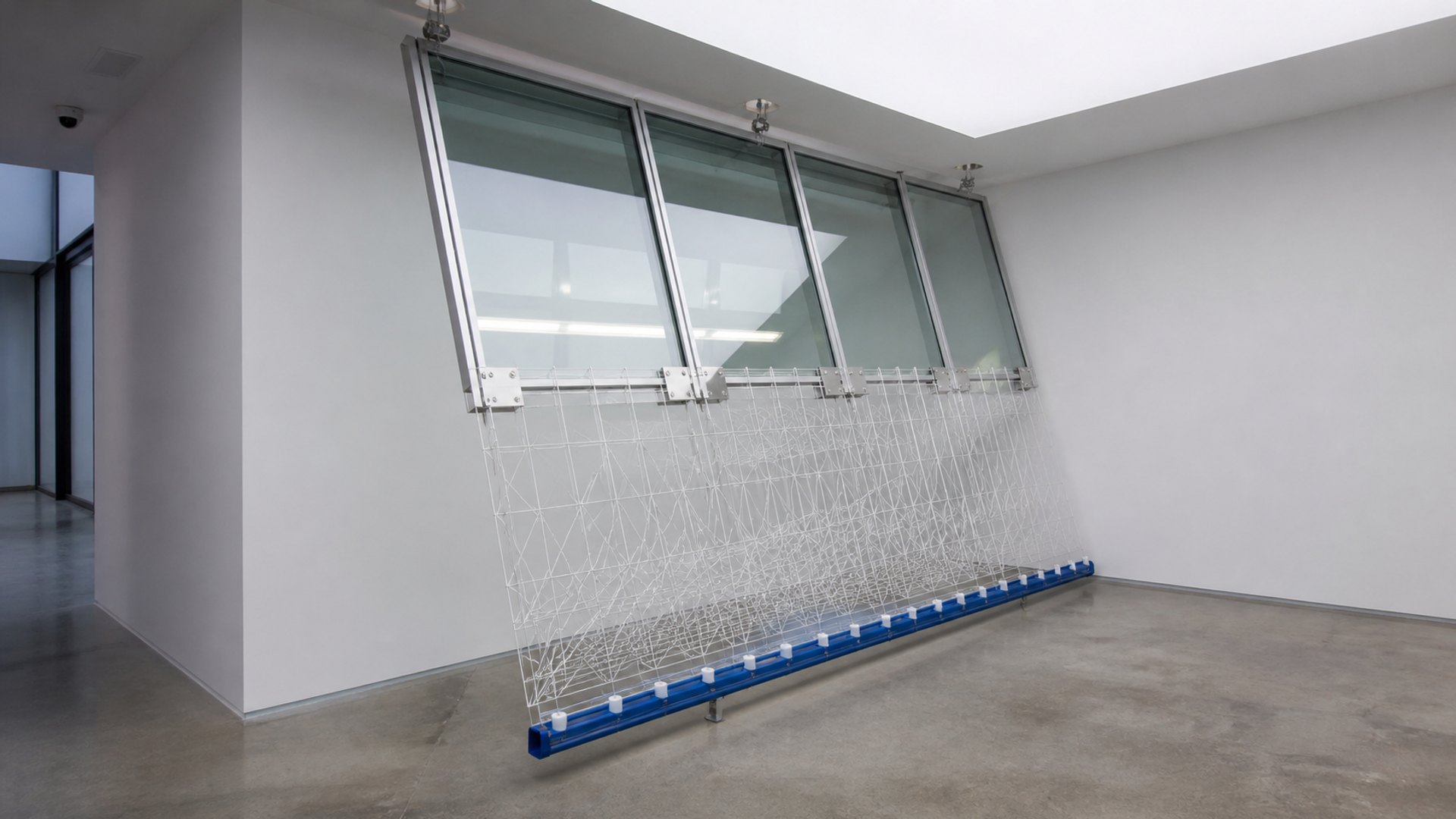
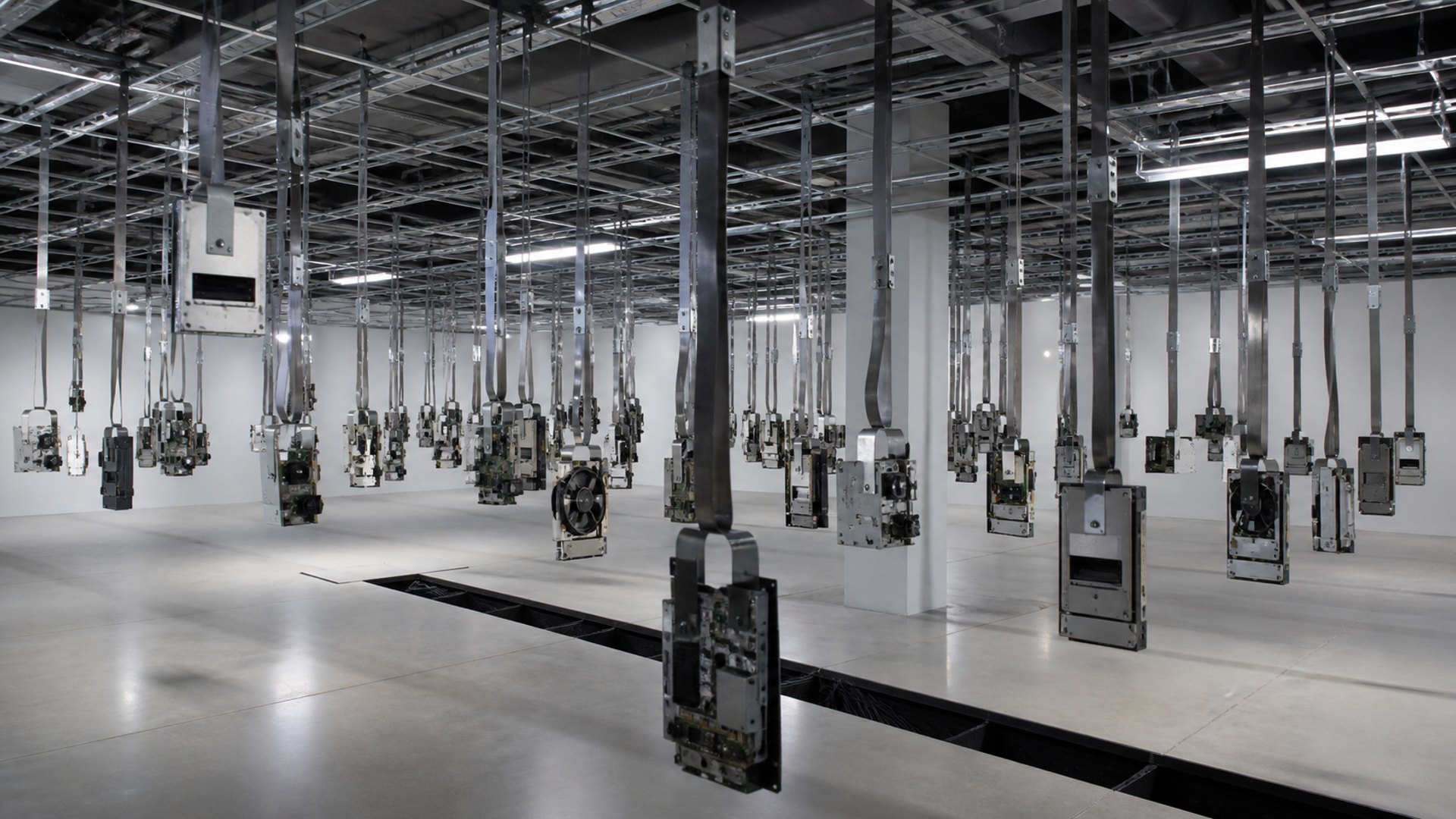
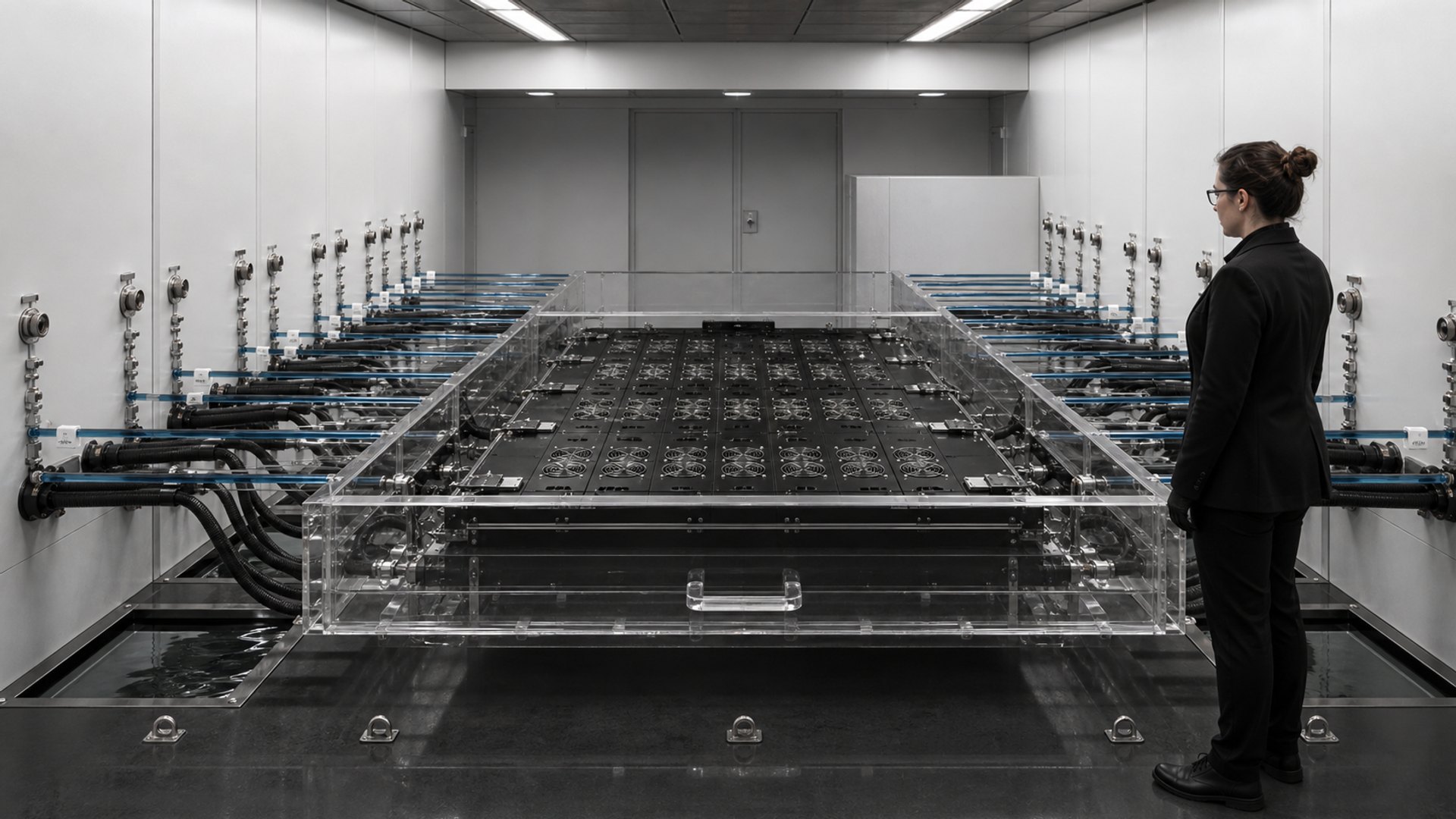
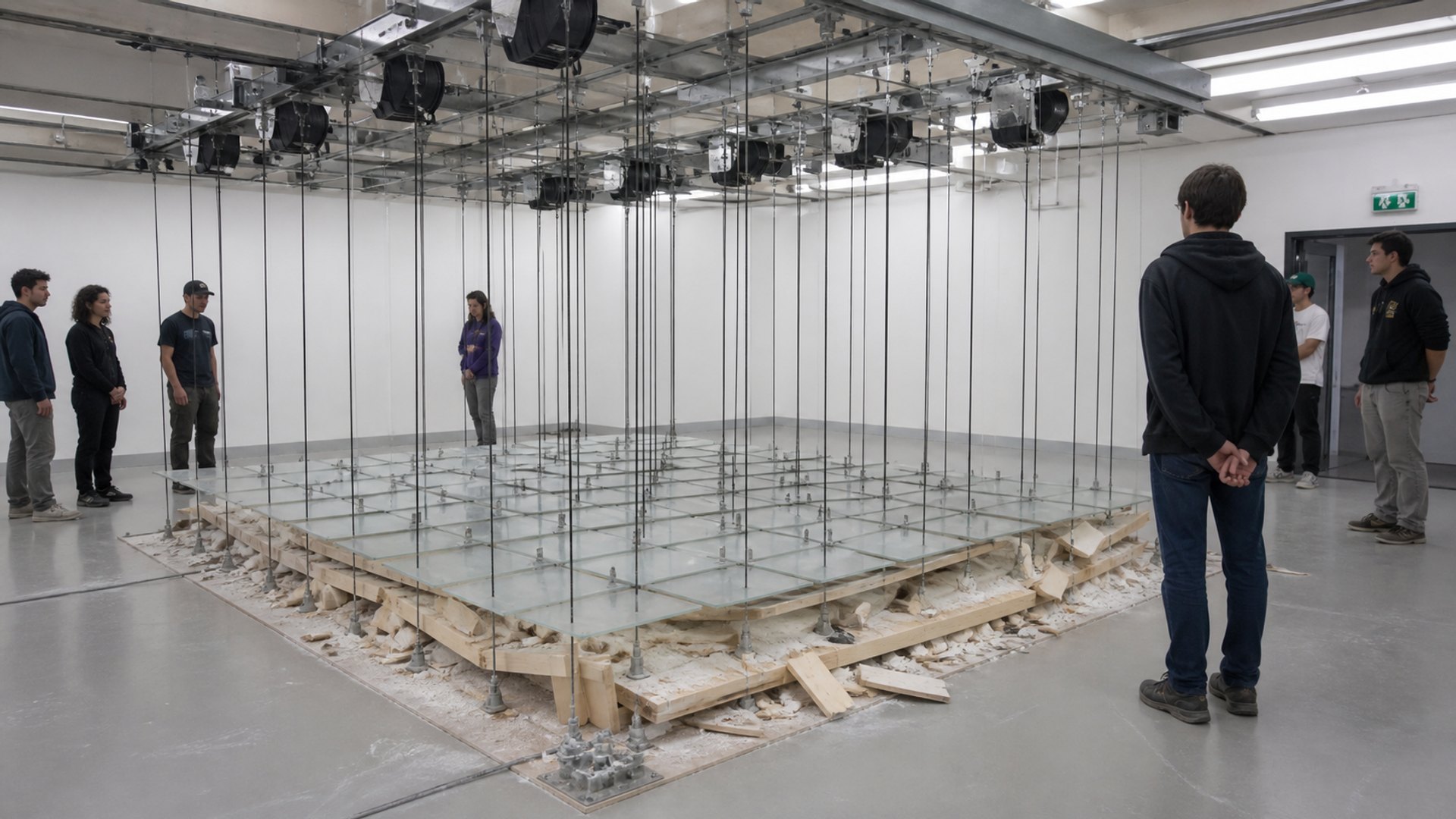
Scerbo works between sculpture, photography, artificial intelligence and the moving image, treating each medium as a way of testing what a body can still hold once a system has passed through it. Anti-crash, his ten-work series, was presented by Fakewhale on Verse in 2023. Fakewhale Studio, founded by Fakewhale in 2024, builds the image as a cultural and physical environment through installations, apparatus, technical objects and an internal orchestration of generative models. The two practices met inside the Fakewhale Digital Residency, and ICONS 6:12 carries the credit of that encounter as a single line.

by Scerbo × Fakewhale Studio
Presale September 28, 2026, 5:00 PM CEST
Public release September 30, 2026
6:00 PM CEST / 5:00 PM BST / 12:00 PM EDT
300 unique 1/1 works
Developed through the Fakewhale Digital Residency
Supported by DagieDee
Fakewhale Alpha, in collaboration with Verse
icons612.fakewhale.xyz
alpha.fakewhale.xyz
ICONS 6:12 on Fakewhale ALPHA
Scerbo · Fakewhale Studio · Fakewhale · DagieDee · Anti-crash on Verse · The project · Our Fracture
Our Fracture (AI Litany), ICONS 6:12, 2026 (extract). Watch the complete litany.