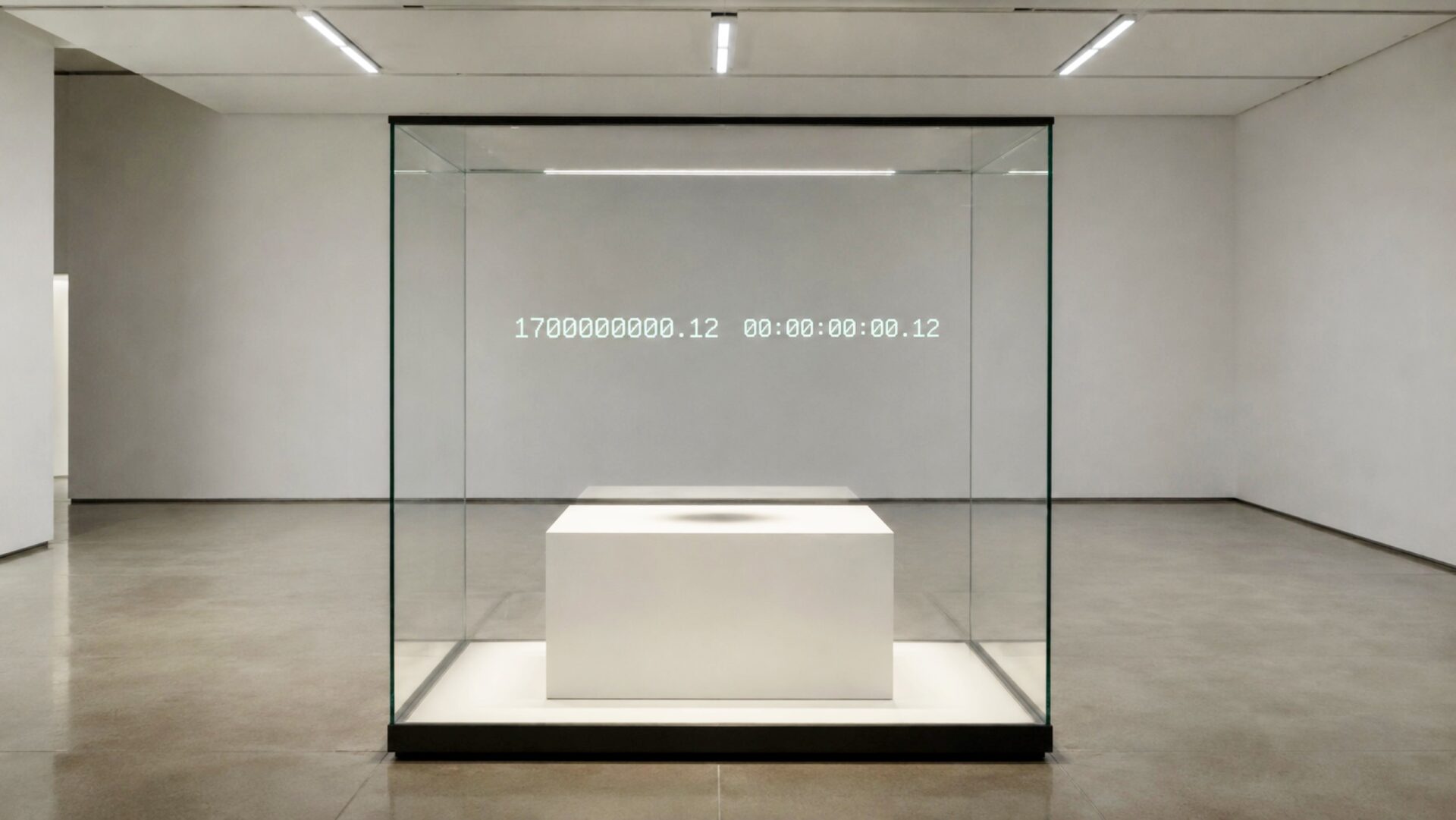



As AI-generated images become increasingly widespread, the question is no longer simply who creates them, but who has the power to decide when they must disclose that they are artificial, and when they are allowed not to. Watermarks, labels, platform rules, and artistic exemptions are creating a new hierarchy of visibility, one in which transparency does not seem to apply equally to everyone.
We wanted to start from that contradiction: can simply calling something “art” be enough to exempt it from obligations imposed on other AI-generated images? And more importantly, who gets to decide where artistic freedom ends and a privilege of opacity begins?
A phone held above a museum barrier records a screen that records a model that records a history of scraped gestures. The image travels through the feed with a small badge attached, a civic glint at the edge of the frame, a signal designed for machines, publics, insurers, moderators, and future litigants. Transparency begins here as an interface condition: a protocol that converts generated vision into administrable evidence.
Permission arrives as a halo. It circles the image with legitimacy, assigns a readable status to its manufacture, and prepares the file for circulation across platforms whose ranking systems reward clarity as much as novelty. The label gives the image a legal atmosphere, and the atmosphere gives institutions a way to host synthetic production while preserving the grammar of trust.
The artistic exception concentrates this atmosphere into a procedural switch. A generated campaign asset, a speculative artwork, a design study, and a cultural artifact pass through adjacent technical pipelines, yet classification rearranges obligation by granting aesthetic status the force of infrastructure. The category of art becomes an operational field, where intent, venue, and custody decide the degree of visibility required from the machine.
The dispute gathers around the right to name. Every disclosure mark, every exemption, every curatorial statement, every marketplace certificate participates in a larger contest over the governance of images after automation. The image carries its halo as evidence of compliance, while the halo carries the image into economies that translate permission into value.
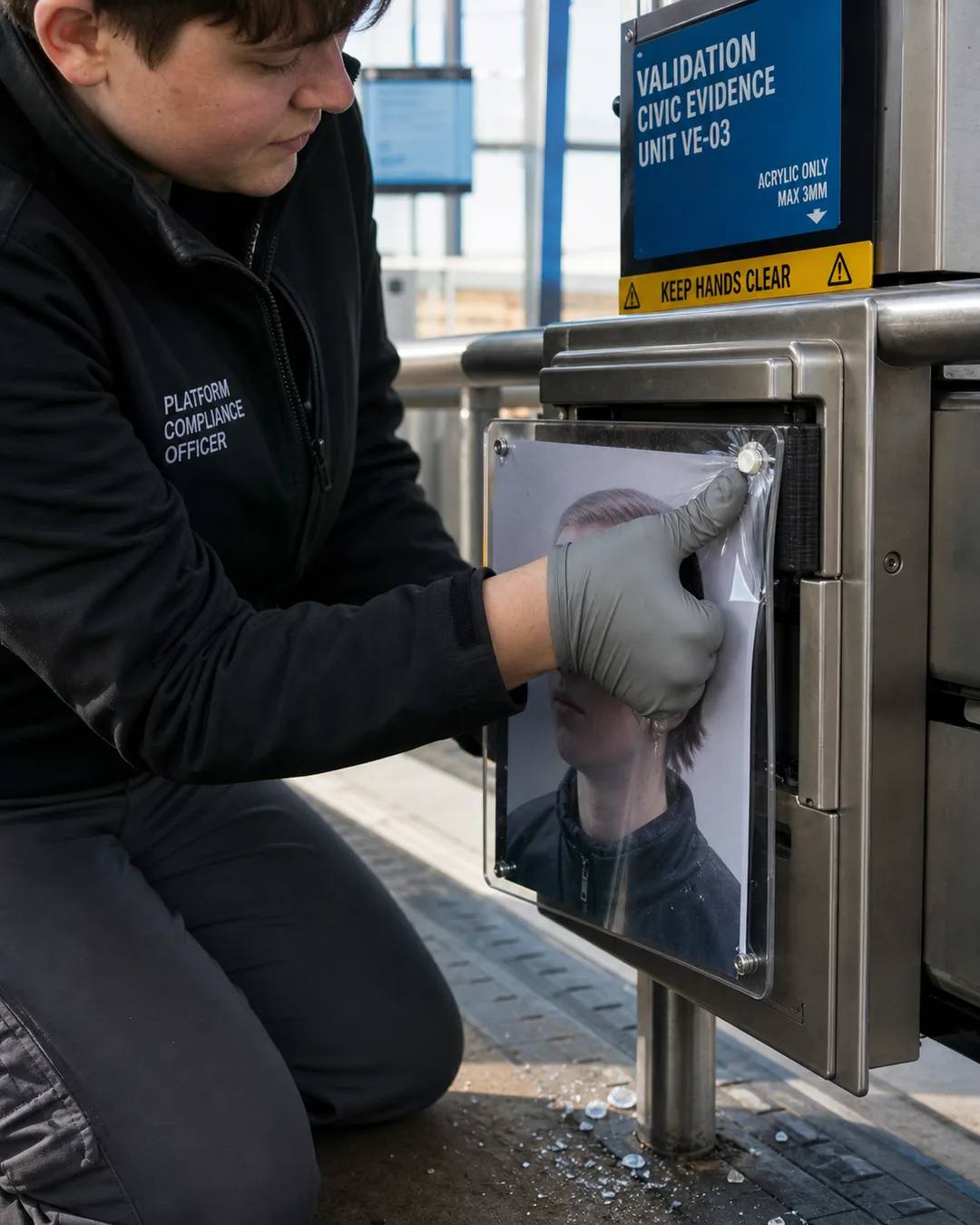
Watermarks in the Polis: Disclosure turns the image into a civic document, binding device output to public legibility and institutional trust.
A watermark enters the feed as a claim on custody. It attaches a source relation to the file and gives distribution systems a handle through which the image can be sorted, ranked, flagged, insured, archived, or dismissed. The mark speaks in a public register while operating as machine-readable metadata, and this double address turns the image into a civic document before it becomes an aesthetic proposition.
Disclosure protocol recodes the image as testimony. A generated portrait, a synthetic landscape, or a composite scene enters circulation under the sign of origin, and that origin becomes a legibility contract between device, viewer, platform, and regulator. The disclosure mark offers a visible compromise between automated production and public trust, while the underlying system installs a new expectation: every image carries an accountable history, or gains one through suspicion.
The watermark also reorganizes attention. A marked image invites viewers to read production before composition, provenance before affect, compliance before encounter. The gaze moves from pictorial surface to administrative edge, and the edge becomes the true site of interpretation. The image still seduces, but its seduction travels through an appended legal glow, a halo calibrated for publics trained to scan for authenticity cues as they scroll.
Feed logic gives disclosure its political force. Platforms treat marked content as a category inside ranking environments, where the label can influence visibility, friction, reach, monetization, and moderation. The civic promise of transparency folds into infrastructural preference, and institutional trust becomes inseparable from the platform’s capacity to classify, throttle, promote, and archive.
The watermark produces a polis of readable files. It imagines public order through traceability, then delegates that order to protocols owned by device manufacturers, model providers, and distribution platforms. Visibility becomes a mode of governance, and governance gains the sheen of care.

The Exemption Machine: The artistic carveout gives cultural status a procedural force, allowing classification to reorganize obligation.
The exemption machine begins with a form field. An image moves through a compliance interface, meets a menu of uses, and acquires a different burden once the box marked art receives a signal of legitimacy. Classification becomes architecture: the same technical output enters a lighter or heavier regime according to the status assigned to its purpose, venue, and authorial claim.
The artistic carveout converts cultural prestige into procedural force. A studio, museum, platform, or counsel can frame generated material as creative exploration, critical practice, parody, research, or exhibition, and each frame adjusts the required intensity of disclosure. The exception functions as a valve in the transparency system, releasing certain images into circulation with a different relation to the public record.
Training bias returns through this valve as social sorting. Models absorb histories of visual hierarchy, then legal regimes ask institutions to distinguish cultural expression from instrumental communication. The distinction gains power through existing circuits of recognition: the artist with institutional custody receives interpretive generosity, while the unaffiliated producer meets heavier scrutiny from platform moderation and public suspicion.
The carveout also stages a transfer of risk. Regulators seek visible accountability, platforms seek scalable categories, and cultural actors seek latitude for experimentation. The category of art absorbs the tension by presenting ambiguity as a protected condition, then converting that ambiguity into a manageable administrative status. Exception becomes a technique for keeping the system mobile.
The machine produces a paradox of freedom under classification. Artistic autonomy expands through a label, and the label binds autonomy to forms, policies, venue language, and legal memory. The exception grants room, and the room arrives with walls.

Judges of the Halo: Curators, platforms, lawyers, and regulators become competing interpreters of artistic intent inside a shared field of authority.
Authority gathers around the halo through interpretation. A curator reads intent in relation to practice, a platform reads it through policy categories, a lawyer reads it through liability, and a regulator reads it through public harm. The same image becomes multiple objects across these protocols, each object shaped by the institution that receives it.
Curatorial custody gives the halo cultural thickness. A generated image inside an exhibition enters a frame of discourse, installation, mediation, and provenance, and those elements stabilize its claim to artistic exception. The museum or gallery functions as an authentication device, producing an environment where synthetic origin becomes part of the work’s conceptual apparatus and a reason for differentiated treatment.
Platform governance gives the halo scale. Moderation systems process artistic intent through templates, automated detection, appeal workflows, and risk scoring, translating ambiguous cultural claims into operational decisions. The platform judge values repeatability, and repeatability compresses intent into signals: account history, caption language, content category, complaint volume, jurisdiction, and advertising adjacency.
Legal judgment gives the halo consequence. Counsel drafts disclosure statements, licensing terms, dataset warranties, and exhibition agreements that establish a chain of responsibility around generated output. Provenance becomes contractual architecture, and artistic intent becomes a fact pattern prepared for dispute. The image enters law through documents that precede the audience and outlive the installation.
Regulatory judgment gives the halo civic ambition. Agencies and lawmakers seek categories that preserve trust in visual evidence, consumer protection, and electoral communication, while cultural production demands elasticity inside the same visual field. The shared authority field produces friction because each judge sees a different object: expression, content, risk, property, infrastructure.
The halo survives through this plurality of judges. Its power comes from contested readability, since every institution sees enough to claim jurisdiction and leaves enough ambiguity to invite the next claim. The image becomes governable through interpretation, and interpretation becomes a form of possession.

Value Under the Label: Markets absorb compliance as a price signal, transforming transparency into provenance, scarcity, and reputational insurance.
The label enters the market as a price signal. A disclosed generated image carries compliance as part of its asset structure, giving collectors, brands, platforms, and institutions a way to price confidence alongside composition. Transparency becomes measurable friction, and friction becomes value once it protects circulation from reputational volatility.
Provenance absorbs disclosure into the language of custody. Certificates, edition records, model statements, dataset notes, prompts, version histories, and exhibition records form an evidentiary envelope around the file. The market loves envelopes because they stabilize exchange, and the transparency label becomes one more layer in the choreography that turns a reproducible image into a controlled object.
Scarcity returns through protocol. Generated images emerge from systems designed for abundance, yet markets require boundaries that can be counted, authenticated, and transferred. Compliance supplies one such boundary by distinguishing sanctioned outputs from ambient production, and the distinction creates a premium around images whose legal and institutional status has already been curated.
Ranking logic shapes this premium before the sale. Platforms elevate compliant works through trust signals, galleries circulate them through institutional language, and collectors read disclosure as reputational insurance. The label functions as an index of reduced exposure, and reduced exposure gains economic form as confidence, access, and liquidity.
The market transforms transparency into aura under administrative conditions. What once appeared as a requirement becomes a luxury attribute, a sign that the image has passed through enough hands, filters, and protocols to acquire social thickness. The halo prices the permission it displays.

Sovereignty of the Visible: Power settles where the right to name art governs the circulation, masking, and monetization of generated images.
Sovereignty settles in the act of naming. The right to call a generated image art determines its disclosure burden, its platform treatment, its market readability, and its institutional shelter. Naming operates as protocol, and protocol gives cultural judgment the force of circulation.
Visibility becomes a governed resource. Certain images receive labels that authorize trust, certain images receive exemptions that authorize ambiguity, and certain images receive institutional frames that authorize value. The public field of generated images is arranged through these permissions, each one producing a different path through feeds, archives, marketplaces, and regulatory systems.
Masking gains legitimacy through the same structure. The artistic exception allows opacity to appear as critical depth, experimental freedom, or conceptual necessity, while disclosure allows exposure to appear as civic responsibility. Both positions belong to the same legal production of visibility, where the decision to reveal or withhold becomes a privilege managed by recognized authorities.
Monetization follows the path of recognition. A platform monetizes compliance through safer distribution, a gallery monetizes exception through cultural scarcity, a technology provider monetizes trust through watermark infrastructure, and a legal regime monetizes order through certification and audit economies. The generated image becomes a meeting point where device output, institutional speech, and economic extraction converge.
The question of art becomes a question of access to sanctioned ambiguity. Power resides with the actors able to decide when an image must confess its machinery and when its machinery can glow as meaning. Permission wears a halo because authority prefers radiance to command.