What if the most radical work of art were one that accomplished absolutely nothing? Throughout modern and contemporary art history, artists have transformed seemingly pointless gestures, ordinary objects, and absurdly insignificant actions into works of extraordinary conceptual significance. An empty room becomes an exhibition. A glass of water becomes a tree.
A person spends a thousand hours staring at a blank sheet of paper. A block of ice is pushed through a city until nothing remains. These artistic gestures reject traditional expectations of craftsmanship, beauty, permanence, and productivity.
Instead, they suggest that art might emerge precisely where usefulness disappears. By celebrating the negligible, the ridiculous, the invisible, and the apparently meaningless, these artists expose the fragile conventions through which society determines what deserves attention and value. Here are 10 remarkable works that demonstrate how doing almost nothing can become one of the most provocative acts in contemporary art.

MARCEL DUCHAMP – 50 CC OF PARIS AIR (1919)
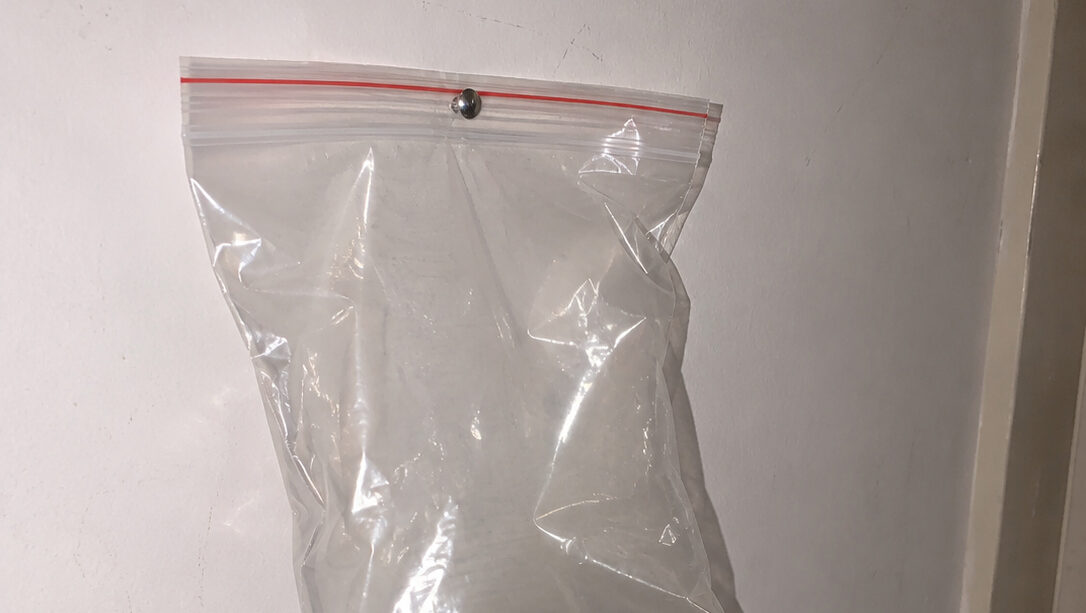
In 1919, Marcel Duchamp purchased a small glass ampoule from a Parisian pharmacist, had its original contents removed, and asked for it to be resealed. He presented the object to his friend and patron Walter Arensberg as a souvenir containing fifty cubic centimetres of Parisian air. There was no sculpture to admire, no image to interpret, and virtually nothing to distinguish the contents from the atmosphere surrounding them. Yet this modest gesture would become one of the most revealing examples of Duchamp’s challenge to the conventional definition of an artwork.
The idea was consistent with his earlier experiments with readymades, ordinary manufactured objects transformed into art through selection and designation rather than traditional craftsmanship. But 50 cc of Paris Air introduced a particularly elusive variation on that principle. While a bicycle wheel or a urinal remained recognizable physical objects, here the supposed artistic substance was invisible, commonplace, and practically impossible to distinguish from anything else. The glass container served primarily to establish a boundary around something that ordinarily has none.
The work also complicated the relationship between possession and value. Air is freely available, impossible to exhaust through ordinary consumption, and generally considered worthless as an individual commodity. By isolating a small quantity and identifying its geographical origin, Duchamp turned it into something that could be owned, preserved, exchanged, and eventually collected by a museum. What made this particular air significant was not its chemical composition but the circumstances of its selection. Its value depended on a proposition that could not be independently verified simply by looking at the object.
There is a further irony in the title itself. The apparently precise measurement of fifty cubic centimetres suggests scientific accuracy, yet the original ampoule actually contained more than twice that volume. The designation was introduced years after the work’s creation. This discrepancy reinforces the distance between the authority of a description and the physical reality it supposedly identifies. The title does not merely explain the object. It actively determines how the object is understood, even when its factual precision is questionable.
The distinction became especially significant in 1949, when the original ampoule was accidentally broken and subsequently repaired. If its contents were released and replaced by the surrounding atmosphere, could the work still legitimately be described as Parisian air from 1919? The physical substance that supposedly defined it was no longer guaranteed to be present, yet the work retained its identity. Its continued existence suggested that the artistic proposition had become more durable than the material it originally designated.
This incident exposes a central contradiction. The ampoule was intended to preserve something intangible, but the authenticity of its contents depended on an uninterrupted physical condition that could be destroyed in an instant. At the same time, the artwork could survive that destruction because its significance had already migrated into another system: the artist’s intention, its documented history, and the institutional recognition surrounding it. The object was both materially fragile and conceptually resilient.
There is also a peculiar tension between visibility and knowledge. The transparent glass permits the viewer to inspect the entire container, but this visual access provides almost no meaningful information about what makes the work distinctive. Nothing in its appearance proves that the enclosed air originated in Paris. To examine its contents scientifically would require interfering with the very conditions that made them worth preserving. The viewer is therefore confronted with an object whose most important quality cannot be established through ordinary observation.
Duchamp’s gesture raises a question that extends beyond the familiar claim that anything can become art. If the substance of an artwork is indistinguishable from an ordinary element of everyday life, where exactly does its artistic identity reside? In this case, the answer cannot be located exclusively in the object, the artist, or the institution. It emerges from the relationship between them, from a collective willingness to treat an otherwise negligible quantity of matter as something historically and culturally exceptional.
What initially resembles an elaborate joke becomes an investigation into the mechanisms through which significance is produced. 50 cc of Paris Air demonstrates that artistic value does not necessarily correspond to material rarity, technical difficulty, or observable transformation. A commonplace substance can acquire extraordinary status without acquiring any extraordinary physical properties.
Duchamp did not make the air more beautiful, useful, or materially distinctive. He altered the conditions under which it could be perceived and valued. The apparent futility of the gesture is precisely what makes the work consequential: it reveals how much of what we recognize as culturally important depends on systems of attribution rather than on the intrinsic characteristics of things.
YVES KLEIN – LE VIDE (THE VOID) (1958)
On April 28, 1958, Yves Klein opened an exhibition at Galerie Iris Clert in Paris that appeared to contain absolutely nothing. The gallery had been emptied of conventional artworks, its interior surfaces painted white, and visitors arriving in anticipation of paintings or sculptures instead encountered a nearly vacant room. The exhibition, officially titled La spécialisation de la sensibilité à l’état matière première en sensibilité picturale stabilisée, became widely known as Le Vide, or The Void. What might initially have appeared to be an elaborate provocation was, for Klein, an attempt to present art without relying on any visible artistic object.
The exhibition was not as spontaneous or effortless as its apparent emptiness suggested. Klein carefully orchestrated the entire experience. The gallery’s exterior was marked by his characteristic blue, an ultramarine curtain framed the entrance, and two Republican Guards stood in ceremonial uniform during the opening. Guests were served blue cocktails, and the event attracted thousands of visitors. Every element surrounding the vacant exhibition space contributed to an atmosphere of anticipation and exceptional significance. The absence of artworks was therefore accompanied by an unusually elaborate apparatus of presentation.
This contradiction was essential to the exhibition’s operation. Klein was not simply suggesting that an empty room could be considered art. He believed that artistic sensibility could exist independently of material representation, occupying space as an invisible yet perceptible presence. Having explored the expressive possibilities of monochromatic painting, particularly through his distinctive blue surfaces, he was attempting to move beyond pigment altogether. Instead of presenting color as something to be seen, he proposed that its effects might be experienced without any visible manifestation. The gallery was intended to contain what he described as an immaterial pictorial sensibility.
Such an ambition introduced a fundamental difficulty: how could an audience distinguish an invisible artistic presence from its complete absence? Nothing in the physical environment could conclusively establish that the space contained the sensibility Klein claimed to have produced. Visitors could experience the room, observe its surfaces, and respond to its atmosphere, but the proposed artistic substance remained beyond objective verification. The exhibition consequently depended upon a peculiar relationship between suggestion, perception, and belief. The audience was invited to encounter something whose existence could neither be demonstrated nor definitively disproved.
Yet to interpret Le Vide exclusively as a test of credulity would overlook its more substantial implications. The exhibition shifted attention away from the artwork as an autonomous object and toward the circumstances that make an artistic experience possible. The architecture, the institutional setting, the expectations of visitors, and the collective atmosphere of the opening all became active components of the work. The gallery was no longer simply a neutral container for art. Its own spatial and social conditions had become the principal medium through which art was proposed.
The white surfaces played an important role in this transformation. They did not represent a complete absence of visual information but established a deliberately controlled environment, stripped of the distinctions and interruptions normally provided by exhibited objects. Without individual artworks to organize their attention, visitors were left to confront the space itself and their own presence within it. The distance between walls, the movement of other spectators, and the duration of observation acquired an unusual prominence. Rather than directing perception toward a specific object, the exhibition made the experience of looking increasingly conscious of its own mechanisms.
There was also something revealing about the contrast between the elaborate public ceremony and the near-total absence of material content. The guards, invitations, blue decorations, and publicity established that an event of cultural importance was taking place before visitors could determine what that importance consisted of. Klein exploited the conventions of exhibition-making while simultaneously withdrawing the objects those conventions were designed to celebrate. The spectacle did not compensate for the missing artworks. It exposed how much authority and expectation already surround an artwork before anyone encounters it.
The public response became inseparable from the exhibition’s meaning. Some visitors approached the empty space as a serious artistic proposition, while others understood it as a joke or provocation. Both reactions were significant because they demonstrated the extent to which the exhibition challenged the relationship between artistic intention and public interpretation. Without a conventional object to mediate the experience, visitors were compelled to negotiate directly with the artist’s claim. Their uncertainty was not incidental to the work but one of the conditions through which it operated.
Two years later, the artist Arman offered an almost literal reversal of Klein’s experiment with Le Plein (The Full), an exhibition at the same gallery in which the available space was packed with discarded objects. The contrast between the two projects was striking, but both revealed how the quantity of material present in a gallery could become an artistic proposition in itself. Whether emptied or filled beyond ordinary usability, the exhibition space could be transformed by a simple alteration of its expected function. The comparison also demonstrated that Klein’s intervention belonged to a broader reconsideration of what an exhibition could be, rather than merely what it could contain.
The lasting importance of Le Vide lies in this reconsideration. Klein removed the conventional object of contemplation without eliminating the structures that give contemplation its artistic character. What remained was not pure nothingness but an encounter between an intentionally constructed environment and an audience prepared, or perhaps challenged, to experience it as art.
The exhibition ultimately revealed a paradox within the idea of artistic emptiness. To make absence visible as an artistic condition, Klein had to frame, announce, organize, and carefully distinguish it from ordinary vacancy. The less the exhibition offered as material content, the more significant its surrounding conditions became. Le Vide did not demonstrate that nothing and art are interchangeable. It showed that an artwork can exist as an experience structured around an absence, and that the mechanisms through which art becomes perceptible may be as consequential as the objects traditionally placed at its center.
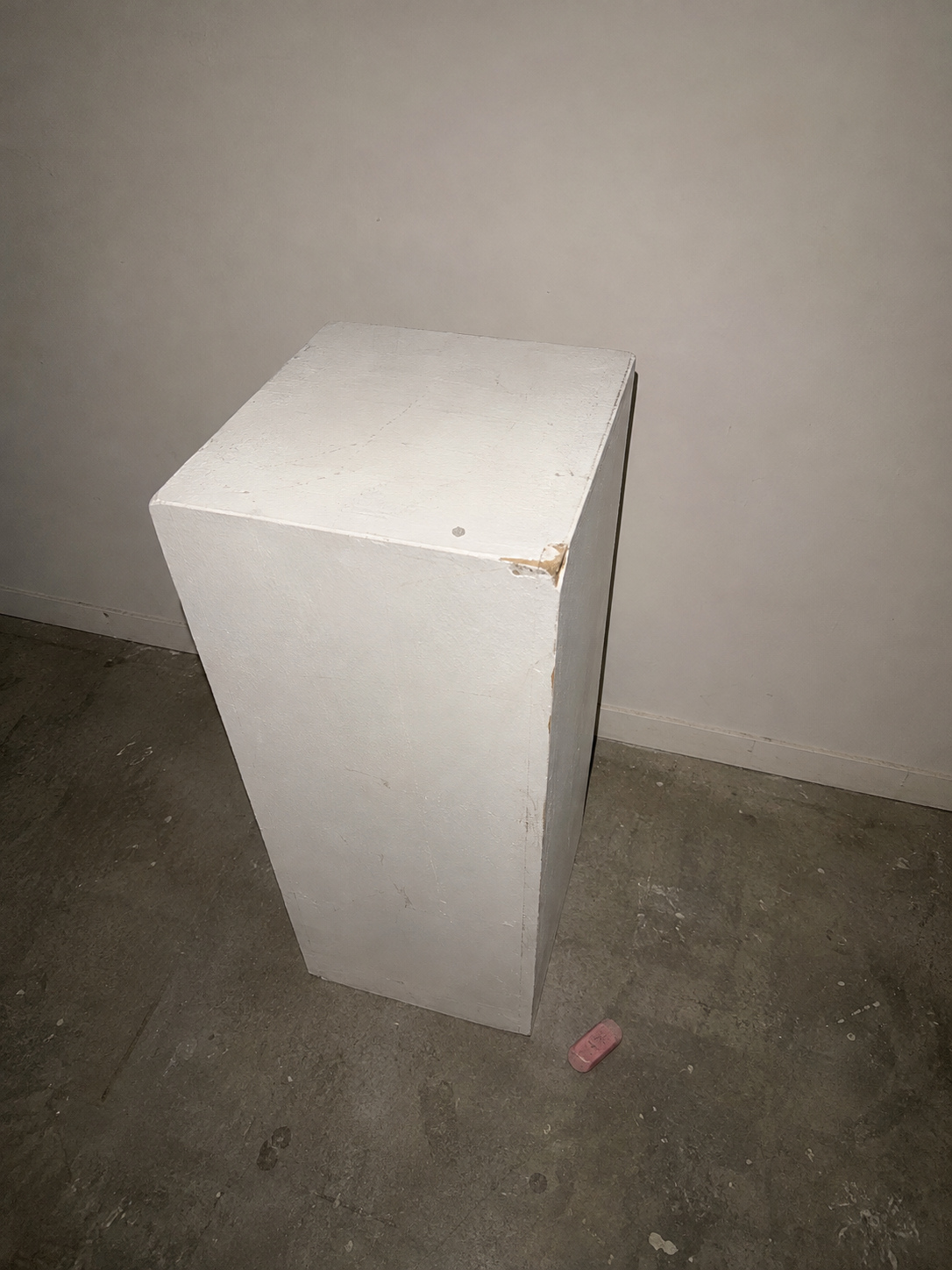
PIERO MANZONI – FIATO D’ARTISTA (ARTIST’S BREATH) (1960)
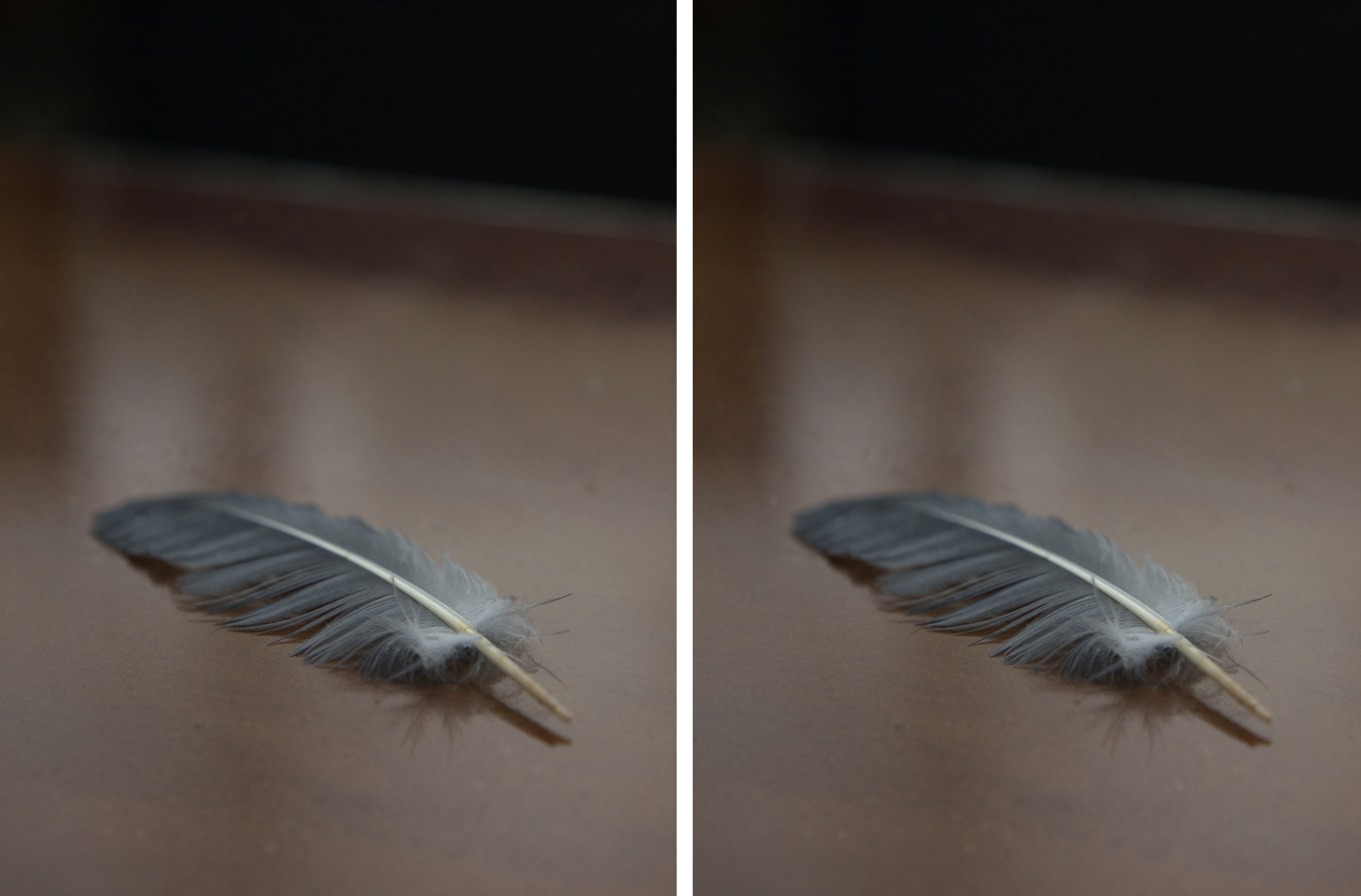
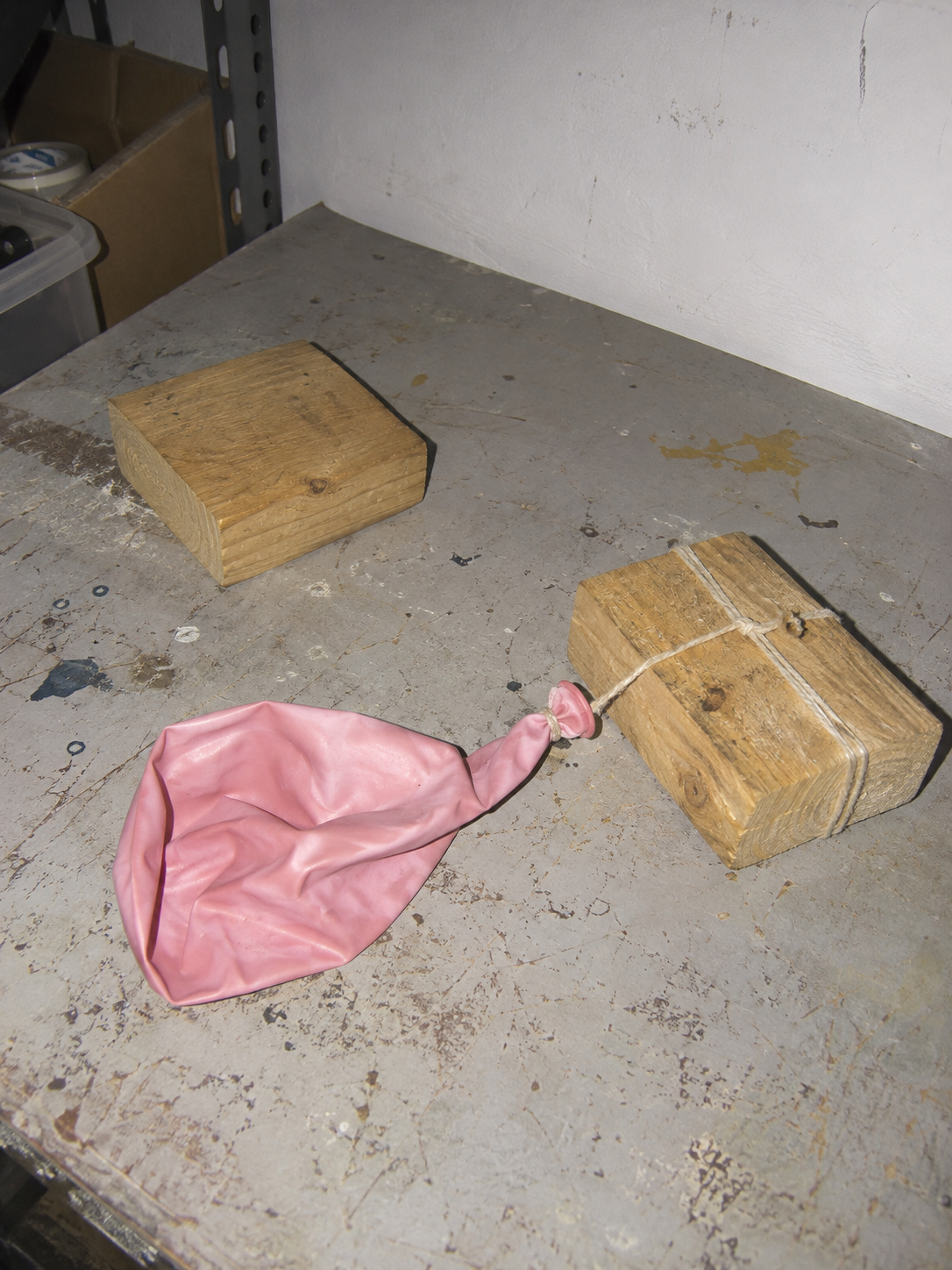
In 1960, Italian conceptual artist Piero Manzoni created Fiato d’artista (Artist’s Breath), a series of works consisting of balloons inflated with his own breath and attached to small wooden bases. The gesture was almost embarrassingly simple. Rather than carving marble, modeling clay, or constructing a permanent object, Manzoni merely exhaled into a balloon and declared the resulting object a sculpture. His breath became the artistic material, transforming an involuntary biological function into something supposedly worthy of preservation and collection.
The works emerged from his experiments with Corpi d’aria (Bodies of Air), inflatable sculptures that could be assembled by their owners. Manzoni introduced a crucial distinction between a balloon filled with ordinary air and one inflated by the artist himself. In the latter case, the presence of his breath supposedly conferred an additional artistic value. He even proposed charging for this personal intervention according to the volume of air supplied, effectively converting his own breathing into a measurable artistic commodity.
The absurdity of the proposition was deliberate. Throughout art history, the physical involvement of the artist had been associated with creativity, individuality, and authenticity. A painter’s brushstroke or a sculptor’s manipulation of material could be interpreted as evidence of a distinctive artistic personality. Manzoni pushed this logic toward its most elementary conclusion. If artistic value originated from the physical presence of the creator, why should that presence require technical skill or an elaborate creative process? Why could the artist’s breath not be sufficient?
Unlike the traditional gesture of artistic expression, breathing requires neither exceptional ability nor conscious aesthetic judgment. It is a biological necessity shared by every living person. Yet the moment Manzoni identified his own breath as artistic material, an ordinary physiological activity acquired a status unavailable to the same action performed by someone else. The difference lay not in the substance itself but in the identity of the person producing it.
This distinction exposed the increasingly important role of authorship in determining artistic value. The inflated balloon was materially indistinguishable from an ordinary balloon, but its association with Manzoni transformed its cultural and economic identity. The artist’s name became a mechanism capable of converting a negligible physical contribution into a collectible object. In this sense, Fiato d’artista was not simply a parody of artistic genius. It was an investigation into how the concept of genius could continue to generate value even when almost every conventional demonstration of artistic ability had been removed.
The work also introduced a tension between artistic production and economic measurement. By associating the price of his breath with its volume, Manzoni presented creativity as something that could be quantified according to a straightforward unit of exchange. This apparently rational system was fundamentally irrational: the amount of air contained in a balloon offered no meaningful indication of artistic quality. Nevertheless, the proposition resembled the mechanisms through which artworks acquire market value, where measurable characteristics such as size, rarity, provenance, and authorship frequently influence prices without providing any objective measure of artistic significance.
There was an additional contradiction embedded in the materials themselves. The balloons were never capable of permanently preserving their contents. Over time, the rubber gradually lost its elasticity, the enclosed air escaped, and the sculptures collapsed. What began as a visibly inflated form eventually became a deflated remnant attached to its base. The disappearance of the breath was not an external accident but a consequence of the material conditions Manzoni had chosen.
This deterioration fundamentally changed the relationship between the object and its original proposition. If the defining characteristic of the sculpture was the artist’s breath, what remained once that breath had escaped? The physical structure survived, but the substance that supposedly distinguished it from an ordinary balloon was no longer present. Nevertheless, the object could continue to exist as an authenticated work by Manzoni, retaining its artistic identity and cultural significance despite the disappearance of its original contents.
The conservation of these works consequently presents an unusual problem. Restoring a collapsed balloon to its original inflated appearance would not restore the artist’s breath. Introducing new air might recover its initial form while contradicting the very condition that made the original object distinctive. Conversely, preserving the deflated balloon means accepting a physical state radically different from the one in which the sculpture was first presented. The work challenges the conventional assumption that conservation should maintain or recover an artwork’s original appearance.
Yet this gradual disappearance also gives Fiato d’artista an unexpected relationship with time and mortality. Breath is among the most immediate indications of life, an activity that continues only while the body remains alive. By isolating his own exhalation, Manzoni attempted to convert a temporary biological event into a lasting artistic object. The inevitable collapse of the balloon reveals the impossibility of that ambition. What survives is not the breath itself but the material evidence of an action that can no longer be repeated by its original author.
The relationship between the artist’s body and the artwork became a recurring subject throughout Manzoni’s practice. In his Uova scultura (Egg Sculptures), he marked boiled eggs with his fingerprints before offering them for consumption. With Sculture viventi (Living Sculptures), he signed individuals and provided certificates identifying them as works of art. His notorious Merda d’artista (Artist’s Shit), produced in 1961, extended the same investigation to bodily waste, packaged in sealed cans and assigned a commercial value.
These interventions shared a common concern: the possibility that virtually anything connected to an artist could acquire artistic legitimacy through designation. The body was no longer merely the instrument through which an artwork was produced. It became a direct source of artistic material, while the distinction between creation, authentication, and commercial exchange grew increasingly unstable.
What makes Fiato d’artista particularly effective is that its critique operates through an object that remains almost comically unremarkable. The balloon does not contain a hidden technical achievement or a complex visual composition. Its significance depends on accepting a proposition whose implications become increasingly problematic the more seriously it is examined.
Manzoni transformed the most ordinary evidence of human existence into an artistic product and allowed that product to disappear almost entirely. The resulting object exposes a system in which artistic identity can outlive the physical conditions that supposedly established it. More importantly, it demonstrates how authorship can become a form of value in its own right, capable of elevating an otherwise insignificant action into an object of institutional attention and economic exchange.
In Fiato d’artista, the artist contributes almost nothing beyond his own physical existence. That minimal contribution is precisely what makes the work so revealing. It confronts the possibility that the value attributed to art may depend less on what an artist materially produces than on the cultural authority granted to the act of production itself.
ROBERT BARRY – INERT GAS SERIES (1969)
In 1969, American conceptual artist Robert Barry carried out a series of interventions that produced virtually nothing observable. For Inert Gas Series, he released measured quantities of five colorless, odorless noble gases into the atmosphere at different locations around Los Angeles. Once released, the gases dispersed naturally, becoming indistinguishable from the surrounding air.
There was no conventional sculpture to preserve, no painting to display, and no visible transformation that an audience could meaningfully experience. The action was documented through photographs and a printed announcement, but the artwork itself escaped direct perception almost immediately. Barry deliberately challenged the idea that art must remain physically accessible, measurable, or even visible.
His gesture existed somewhere between scientific experiment, philosophical proposition, and deliberate futility. (…)
MICHAEL CRAIG-MARTIN – AN OAK TREE (1973)
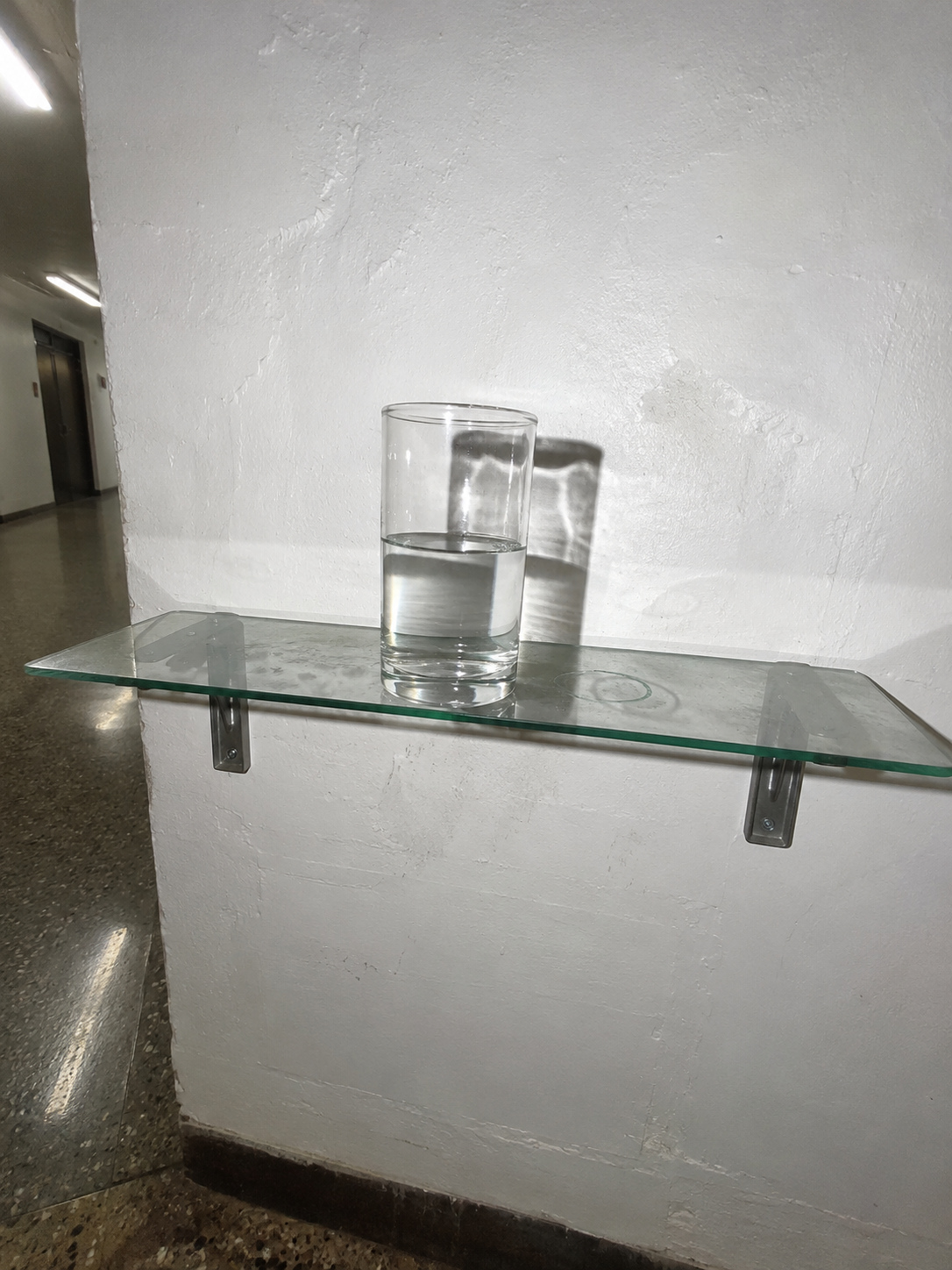
In 1973, British conceptual artist Michael Craig-Martin created one of the most elegantly absurd works in contemporary art: a glass of water placed on a transparent shelf, accompanied by a text explaining that the object had been transformed into a fully grown oak tree. Nothing about the glass had physically changed. The water remained water, the glass remained glass, and there was no visible tree anywhere in the installation.
Yet Craig-Martin insisted that an actual transformation had occurred, one that could not be verified through ordinary perception. Rather than presenting a conventional illusion or representation, the artist challenged viewers to confront the relationship between language, belief, and physical reality. The work relies on an apparently ridiculous proposition: that something can become something entirely different simply through the artist’s declaration.
This deceptively simple gesture exposes the authority through which art institutions, artists, and audiences collectively determine meaning. (…)
THE ART OF USELESS EFFORT: TOM FRIEDMAN, FRANCIS ALŸS, AND ERWIN WURM
What happens when the time and effort invested in creating an artwork bear almost no relationship to its visible result? Throughout the 1990s, several artists explored this contradiction by transforming apparently unproductive activities into deliberate artistic procedures. Rather than eliminating effort from artistic production, they exaggerated its presence while reducing, destabilizing, or entirely removing its material outcome. The resulting works challenged one of the most persistent assumptions surrounding human activity: that the significance of an action can be measured through what it produces.
Between 1992 and 1997, American artist Tom Friedman devoted approximately one thousand hours to staring at a blank sheet of paper. The resulting work, 1000 Hours of Staring, appears almost indistinguishable from the material with which he began. No recognizable image was produced, no intentional marks were added, and the paper offers virtually no visible indication of the extraordinary amount of time supposedly invested in its creation.
The absurdity becomes apparent when the work is considered in relation to conventional artistic labor. One thousand hours might ordinarily be associated with an exceptionally detailed drawing, a complex sculpture, or an extensive research project. In Friedman’s case, this substantial investment of time produced an object whose appearance seems to deny that any work has taken place. The disparity between effort and evidence is so extreme that the artwork cannot be fully understood through its physical characteristics alone.
Friedman effectively separated the act of creation from the production of a visible result. The paper did not function as a surface upon which the artist deposited an image. Instead, it became the recipient of sustained attention, an activity that left almost no material trace. The Museum of Modern Art, which holds the work in its collection, identifies its medium as stare on paper, a classification that treats an immaterial action as though it were a conventional artistic technique.
This unusual description reveals a significant shift in the definition of artistic materials. If drawing traditionally involves applying something to a surface, Friedman proposed an activity in which the artist contributes time and attention without necessarily changing the object. The creative process becomes inseparable from a private experience that the audience can never directly recover.
The problem of verification is central to the work. Nothing visible on the paper confirms that Friedman actually spent one thousand hours looking at it. The audience must rely on the artist’s account and the institutional documentation surrounding the object. Yet this uncertainty does not simply expose the possibility of deception. It demonstrates how artistic interpretation frequently depends upon information that cannot be independently established through observation.
There is also an implicit challenge to the relationship between time and value. In most systems of production, labor is expected to generate an identifiable transformation. Friedman’s activity consumes time without producing a corresponding material benefit. The artist has apparently accomplished nothing, but the amount of time dedicated to that nothing becomes the very substance of the artwork. What would ordinarily be regarded as wasted time is transformed into a cultural achievement.
A related contradiction appears in Paradox of Praxis 1 (Sometimes Making Something Leads to Nothing), performed by Belgian-born artist Francis Alÿs in Mexico City in 1997. For more than nine hours, Alÿs pushed a large block of ice through the streets, gradually reducing it through friction and melting until nothing remained. The action was documented on video, but the physical object that motivated the entire undertaking disappeared.
Unlike Friedman’s almost motionless activity, Alÿs’s performance involved considerable physical exertion. The artist struggled with an initially heavy block of ice, maneuvering it through an urban environment while its dimensions continuously diminished. As the ice became smaller, the effort required to move it decreased, until the original burden was reduced to a fragment and finally to water evaporating from the pavement.
The work reversed the conventional logic of sculpture. Instead of transforming raw material into a stable form, Alÿs subjected an existing form to a process of progressive elimination. The action did not produce a sculpture but consumed one. Its completion coincided with the disappearance of the object, making the achievement of the task indistinguishable from the destruction of its material premise.
Yet the significance of this gesture extends beyond its formal paradox. Mexico City was not an incidental backdrop. Alÿs’s practice has repeatedly examined the relationship between everyday movement, informal economies, and the social conditions of urban life. The prolonged effort required to transport an object toward its own disappearance evokes forms of labor in which enormous physical investment produces little lasting economic improvement.
In this context, the apparent futility of the performance acquires a political dimension. The disproportion between effort and result becomes a way of examining systems in which work does not necessarily lead to progress. The artist’s voluntary and purposeless activity resembles, without being equivalent to, the exhausting routines through which individuals attempt to sustain themselves under precarious economic conditions.
The distinction matters. Alÿs could transform his activity into art precisely because he had chosen to perform it. For many urban workers, comparable expenditures of effort are not aesthetic propositions but economic necessities. The work derives part of its critical force from placing these two circumstances in uncomfortable proximity, using an absurd artistic action to expose a contradiction already embedded in ordinary social life.
The title, Sometimes Making Something Leads to Nothing, also complicates the assumption that artistic production must introduce something new into the world. Alÿs did not create a lasting object, but he did generate an event, a narrative, and a record of an action whose material outcome was disappearance. The ice vanished, yet the performance continued to circulate through its documentation. What was lost physically acquired another form of persistence through images and collective interpretation.
Where Friedman transformed duration into an invisible artistic material and Alÿs used physical labor to eliminate an object, Austrian artist Erwin Wurm approached the relationship between action and artistic production from a different direction. Beginning in the 1990s, his ongoing series One Minute Sculptures invited participants to perform brief, frequently ridiculous actions using their own bodies and ordinary objects.
The instructions might require someone to balance an object in an improbable position, adopt an awkward posture, or establish a temporary physical relationship with a chair, a piece of fruit, or an item of clothing. These arrangements serve no practical purpose and often appear deliberately uncomfortable or comical. Nevertheless, for the brief period in which the participant maintains the prescribed position, the arrangement becomes a sculpture.
Wurm’s intervention relocates sculpture from the creation of a permanent object to the temporary organization of bodies and materials. A sculpture no longer needs to survive its own performance. It can exist through a specific physical configuration that disappears the moment its participants return to their ordinary positions.
The transformation is particularly significant because Wurm does not abandon the traditional concerns of sculpture entirely. Volume, balance, proportion, spatial relationships, and the interaction between objects remain essential. What changes is the duration for which these relationships must exist and the identity of the person responsible for producing them.
The participant becomes both the creator and the material of the work, while the artist assumes the role of proposing the conditions under which it can occur. Authorship is therefore distributed across several distinct functions: the artist devises the instruction, the participant realizes it, and the resulting arrangement exists only through their temporary cooperation.
This structure also introduces an unusual relationship between seriousness and humor. Wurm’s sculptures often provoke laughter because they transform familiar bodies and objects into arrangements that contradict their ordinary functions. Yet the ridiculous appearance of the action does not eliminate its formal precision. The instructions establish specific conditions, and the sculpture exists only while those conditions are maintained. What appears to be arbitrary behavior is therefore governed by a recognizable artistic system.
The importance of this distinction becomes clearer when considering the role of documentation. Photographs and videos allow the temporary sculptures to circulate beyond the moment of their realization, but they do not fully reproduce the experience of performing them. A photograph can preserve the appearance of an absurd posture without preserving the physical discomfort, uncertainty, or concentration required to maintain it. The image records the outcome of an action whose essential conditions were temporal and bodily.
Across these three practices, the relationship between artistic labor and material production is progressively dismantled. Friedman invests an extraordinary quantity of time in an object that remains almost unchanged. Alÿs undertakes an exhausting physical task that eliminates its own material. Wurm constructs sculptural situations whose existence depends upon their temporary performance and inevitable disappearance.
Their differences are as revealing as their similarities. Friedman’s work concerns the invisibility of attention and the impossibility of verifying artistic effort through its result. Alÿs transforms the disproportion between labor and achievement into an investigation of economic and social conditions. Wurm questions the boundaries of sculpture by converting ordinary behavior into a temporary artistic form.
What unites them is not a simple celebration of inactivity. None of these artists is literally doing nothing. On the contrary, each work requires an unusually explicit commitment to an action that appears disconnected from conventional productivity. The apparent absence of a useful result makes the activity itself more conspicuous.
This suggests a distinction between uselessness and insignificance. An action may fail to produce anything useful while remaining intellectually, socially, or aesthetically consequential. In these works, the lack of practical achievement is not an accidental deficiency but a deliberately constructed condition through which the meaning of effort can be examined.
The relationship between art and productivity becomes especially revealing when the same actions are considered outside their artistic contexts. Staring at paper for hours, pushing ice through a city until it melts, or balancing household objects in uncomfortable positions would ordinarily be interpreted as irrational behavior, wasted labor, or simple amusement. Their designation as artworks does not alter what physically occurs. It changes the framework through which those actions are understood.
This transformation exposes a broader contradiction in the cultural valuation of work. Society frequently measures productive activity according to efficiency, permanence, and tangible results, while simultaneously granting exceptional significance to artistic gestures that reject those criteria. The same apparent inefficiency that might be condemned in an ordinary working environment can become a source of intellectual and economic value within an artistic institution.
The contradiction is not resolved by these works, nor is it necessarily their purpose to resolve it. Instead, they make visible the assumptions through which activities are classified as productive, wasteful, meaningful, or absurd.
Ultimately, Friedman, Alÿs, and Wurm demonstrate that artistic production need not be defined by the accumulation of objects or the permanence of results. An artwork can consist of time that leaves no trace, labor that destroys its own object, or a temporary arrangement that disappears almost as soon as it is created.
Their most consequential achievement lies in transforming the apparent failure to produce something into a means of examining why production is considered valuable in the first place. By separating effort from utility, these artists reveal that the meaning of an action cannot always be located in what remains after it has been completed.
THE CONDITIONS OF VALUE: MARTIN CREED AND MAURIZIO CATTELAN
In 2000, British artist Martin Creed created Work No. 227: The Lights Going On and Off, an installation consisting of an otherwise empty gallery in which the lights alternately switched on and off at five-second intervals. There were no paintings, sculptures, or objects arranged for contemplation. The only intervention was a timer controlling the existing lighting system. The result was so elementary that it seemed to contradict the very notion of artistic production. Yet the work earned Creed the prestigious Turner Prize in 2001, provoking widespread debate about whether such a negligible gesture could legitimately constitute an artistic achievement.
The simplicity of the installation concealed a precise alteration of the conditions through which art is ordinarily encountered. Gallery lighting normally serves an instrumental function: it makes artworks visible while remaining largely unnoticed itself. Creed reversed this relationship. By interrupting the light at regular intervals, he transformed an invisible support mechanism into the central subject of the exhibition. The room was no longer a neutral environment containing art. Its ordinary operation had become the artwork.
The distinction was subtle but consequential. Creed did not introduce an unfamiliar object or radically modify the architecture. Instead, he manipulated a condition that visitors ordinarily take for granted. Darkness interrupted perception, light restored it, and the repetition made both states increasingly conspicuous. After several cycles, the viewer could no longer experience the gallery as an uninterrupted space. Every five seconds, its visual continuity was suspended.
Unlike an image or a sculpture, the installation offered no fixed composition that could be examined indefinitely. Its defining characteristic was a sequence unfolding through time. The work existed in the alternation between two ordinary conditions, neither of which possessed any particular artistic quality independently. Light and darkness acquired significance through their relationship, their duration, and the decision to organize them into a continuous structure.
Creed’s intervention also changed the position of the spectator. In a conventional exhibition, visitors usually determine how long to observe an object. Here, an external mechanism imposed its own rhythm upon the experience. The viewer could choose where to look but could not prevent the periodic disappearance of whatever was being observed. The gallery’s infrastructure temporarily assumed control over the conditions of attention.
The installation was therefore less concerned with producing something to see than with exposing the circumstances that make seeing possible. Its material economy was extreme, but its effect on the experience of the gallery was immediate. A basic electrical operation, repeated without variation, was sufficient to transform an architectural environment into a perceptual event.
The controversy surrounding Work No. 227 revealed another aspect of the experiment. Many objections focused on the apparent absence of skill, labor, and technical accomplishment. Switching lights on and off seemed like an activity anyone could perform. The criticism assumed that artistic importance should correspond, at least partly, to the difficulty of producing an artwork.
Creed’s installation made that expectation difficult to sustain. The physical procedure could indeed be replicated with minimal effort. But the artwork’s significance did not depend on the complexity of its execution. It depended on the decision to isolate an ordinary phenomenon and expose its capacity to reorganize perception within an artistic context.
There is an important difference between claiming that every ordinary action is automatically art and demonstrating that an ordinary action can acquire artistic significance under particular conditions. Creed’s work operates within that distinction. The lights are not exceptional. Their deliberate organization, presentation, and relationship to the audience turn an otherwise unremarkable mechanism into a structured experience.
Almost two decades later, Maurizio Cattelan would push a related question into a far more public and economically charged territory.
In December 2019, Cattelan presented Comedian at Art Basel Miami Beach. The work consisted of an ordinary banana attached to a gallery wall with a strip of silver duct tape. Nothing about the arrangement suggested exceptional craftsmanship or technical sophistication. Its materials were inexpensive, widely available, and easily replaceable. Nevertheless, editions were initially sold for substantial sums, reportedly between $120,000 and $150,000, and the installation rapidly became an international cultural phenomenon.
The response was immediate and unusually polarized. For some observers, Comedian represented an intelligent continuation of conceptual art’s interrogation of authorship and value. For others, it seemed to confirm the absurdity of a contemporary art market willing to assign extraordinary prices to almost anything bearing the name of an established artist.
Both reactions contributed to the work’s public identity. The banana became an instantly recognizable image, reproduced across newspapers, television, and social media, where its simplicity made it particularly suitable for circulation. Unlike artworks requiring sustained observation or specialized knowledge, Comedian could be understood visually within seconds. Its apparent absurdity needed almost no explanation.
Yet this accessibility also produced a peculiar problem. The more widely the image circulated, the more the discussion concentrated on the discrepancy between its material cost and commercial price. The banana became a convenient symbol of art-world excess, while the mechanisms responsible for establishing its identity as an artwork received comparatively little attention.
The distinction is essential. A collector purchasing Comedian was not simply acquiring a particular banana or an irreplaceable strip of tape. The work’s identity was established through a certificate of authenticity and specific instructions governing its installation. The banana itself could be replaced without destroying the artwork. Its physical continuity was not the condition upon which its authenticity depended.
This arrangement made the relationship between the artwork and its material manifestation unusually explicit. The banana was necessary for the work to appear, but no individual banana was necessary for it to continue existing. Its authenticity resided in an authorized conceptual and procedural framework rather than in the preservation of a specific physical object.
That principle became particularly visible when, during Art Basel Miami Beach, the artist David Datuna removed the banana from the wall and ate it. The action generated another wave of publicity, but the artwork itself was not considered destroyed. The banana could simply be replaced according to the established instructions.
The incident created an almost perfect confrontation between two definitions of artistic existence. From a material perspective, the original object had been consumed. From the perspective of the work’s authorized identity, almost nothing had changed. The banana was replaceable because its individual physical existence was never the principal source of the artwork’s value.
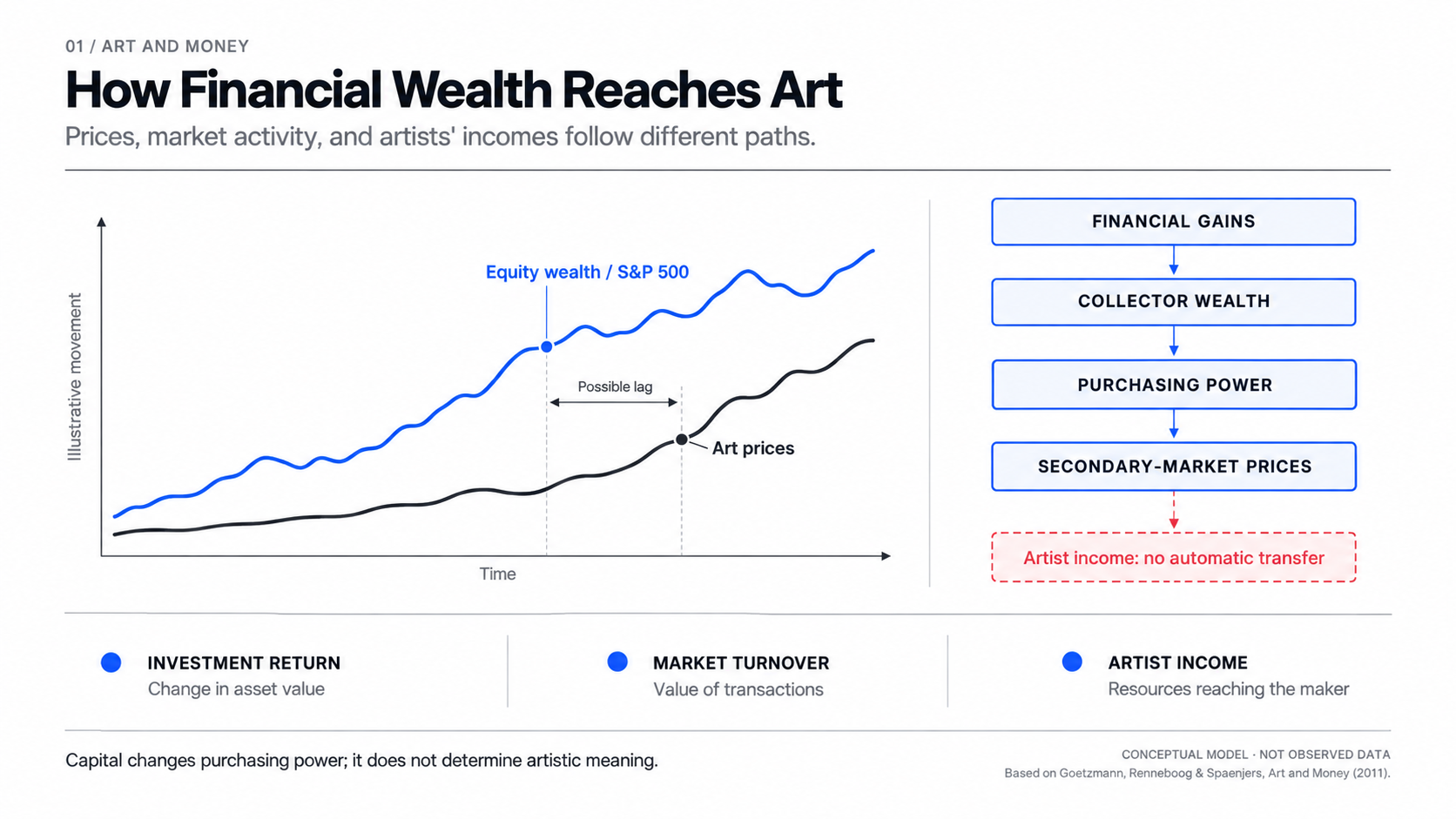
The distinction became still more striking in November 2024, when an edition of Comedian sold at Sotheby’s New York for $6.24 million, including fees. The sale transformed an already notorious work into a remarkable example of the relationship between conceptual art, institutional authority, publicity, and market valuation.
The amount was undeniably extraordinary, but interpreting it solely as the price of a banana would misunderstand the nature of the transaction. What changed hands was an authenticated artwork, its ownership rights, and the possibility of realizing it according to the artist’s instructions. The purchaser acquired something that could be materially reconstructed using ordinary commodities while retaining its recognized artistic identity.
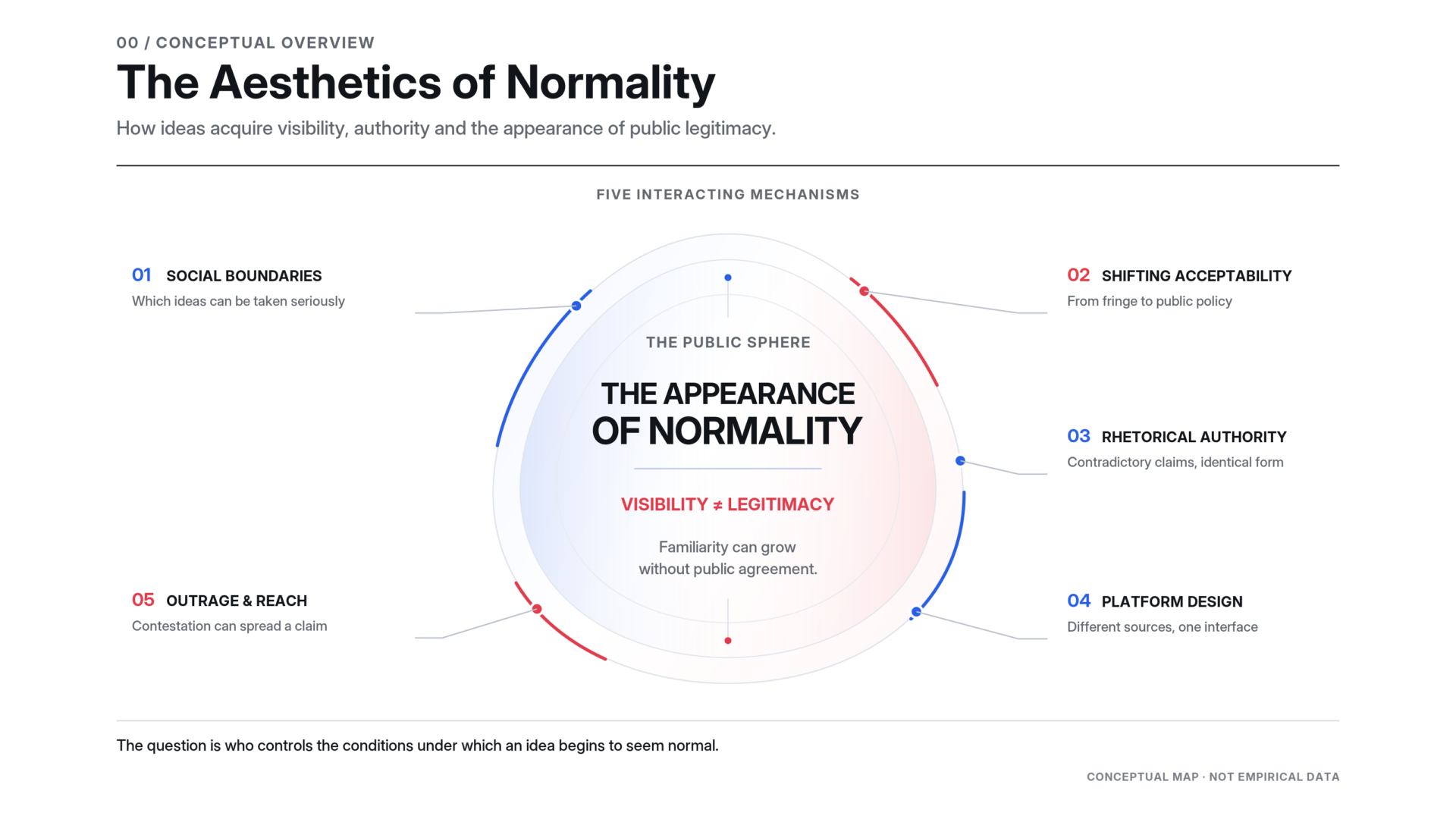
This does not make the price inherently reasonable or unreasonable. It reveals that the art market operates through systems of value that cannot be reduced to the physical characteristics of the objects it exchanges. Authorship, provenance, institutional recognition, historical context, scarcity, and public visibility all contribute to determining what a work can command. In Comedian, the enormous distance between material cost and market value makes these mechanisms impossible to ignore.
There is also a more uncomfortable dimension to Cattelan’s intervention. The work appears to satirize the financial and cultural structures that simultaneously sustain its legitimacy. Its success depends upon the very market dynamics that make it appear ridiculous. The banana can function as an apparent criticism of artistic commodification while becoming an exceptionally successful commodity itself.
This contradiction does not necessarily undermine the work. It is among its most revealing characteristics. Comedian does not occupy a position outside the art market from which it can deliver an impartial judgment. It participates directly in the system it exposes, allowing the extraordinary economic consequences of its own existence to become part of the discussion.
The role of public attention is equally significant. By the time of the Sotheby’s sale, the image of the banana had already circulated through years of commentary, parody, and controversy. Its public recognition contributed to its historical identity, while its exceptional price generated another cycle of attention. Cultural visibility and economic valuation reinforced one another, making it increasingly difficult to separate the artwork from the reactions surrounding it.
This dynamic distinguishes Cattelan’s intervention from earlier conceptual experiments that investigated the disappearance or reduction of the artistic object. With Comedian, the physical object remains highly visible, instantly recognizable, and deliberately ordinary. What disappears is not the object itself but any convincing correspondence between its material properties and the extraordinary significance assigned to it.
Placed alongside Creed’s installation, the work reveals two different mechanisms through which minimal artistic interventions can produce disproportionate consequences.
Creed transforms an ordinary technical operation into an examination of perception. Cattelan transforms an ordinary commercial object into an examination of cultural and economic value. One exposes the conditions that allow an audience to experience an artwork; the other exposes the conditions that allow an artwork to become an exceptionally valuable commodity.
Neither intervention requires elaborate craftsmanship, and neither can be adequately explained through the physical characteristics of its materials. Their importance emerges from the specific relationships they establish between an action, an object, an artist, an institution, and an audience.
Yet reducing these practices to the familiar assertion that anything can be art would miss the more substantial question they raise. The issue is not whether a banana, an empty room, or a switching light can receive artistic status. The more interesting problem concerns the mechanisms through which such a status becomes credible, contested, and eventually capable of producing cultural consequences.
This question connects the final two works to the wider history examined throughout this article.
From Duchamp’s enclosed air to Klein’s empty gallery, from Manzoni’s disappearing breath to Barry’s invisible gases, artistic production repeatedly moved away from the creation of exceptional objects. Craig-Martin challenged the relationship between declaration and physical identity, while Friedman, Alÿs, and Wurm reconsidered the significance of labor, duration, and temporary action.
These experiments were not simply successive attempts to reduce art to increasingly insignificant gestures. Each identified a different convention through which artistic meaning is established and made that convention available for examination. Material permanence, perceptual evidence, technical execution, authorship, institutional authority, and economic value ceased to function as unquestioned characteristics of art. They became subjects of artistic investigation.
The apparent uselessness of these works is therefore not an argument against their significance. It is the condition that allows their underlying questions to emerge with unusual clarity. When an artwork offers little material complexity, practical function, or visible achievement, the surrounding structures of interpretation become more exposed.
The result is not a definitive liberation of art from objects, markets, or institutions. On the contrary, many of these works demonstrate how deeply artistic identity depends upon those structures, even when the artist appears to reject them. An empty room still requires a context in which its emptiness can be recognized. An invisible action still depends upon documentation. An ordinary commodity acquires artistic value through systems of authentication and recognition.
What these works ultimately challenge is the assumption that significance must originate in something materially exceptional.
A light switches on and off. A banana is attached to a wall. Neither event is remarkable in itself. Yet through the particular conditions of their presentation, both become instruments for investigating how attention, meaning, and value are produced.
The lasting provocation of these ten works lies not in their ability to make almost nothing appear extraordinary, but in their capacity to expose the conventions through which we decide what deserves to be considered extraordinary at all.