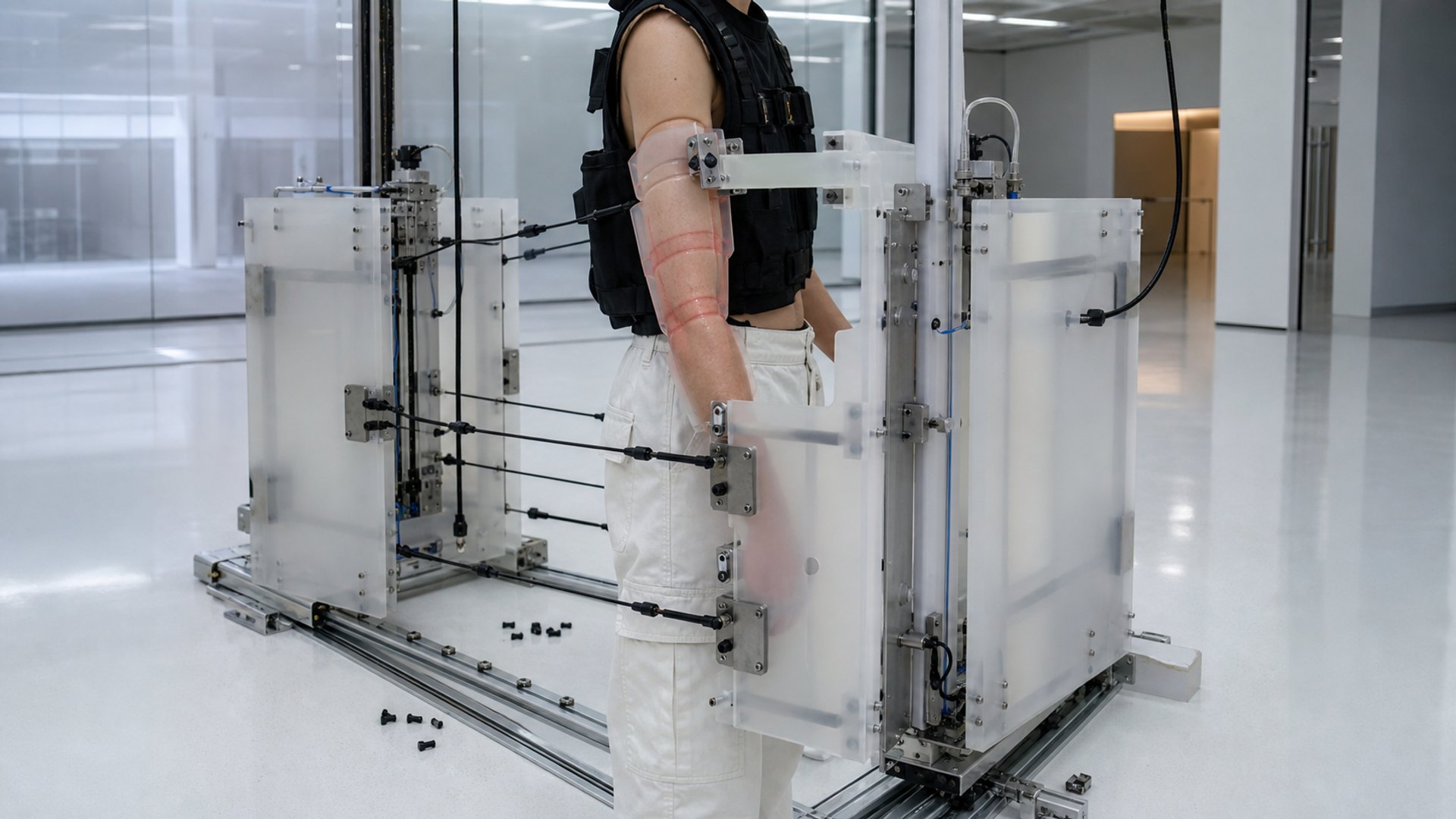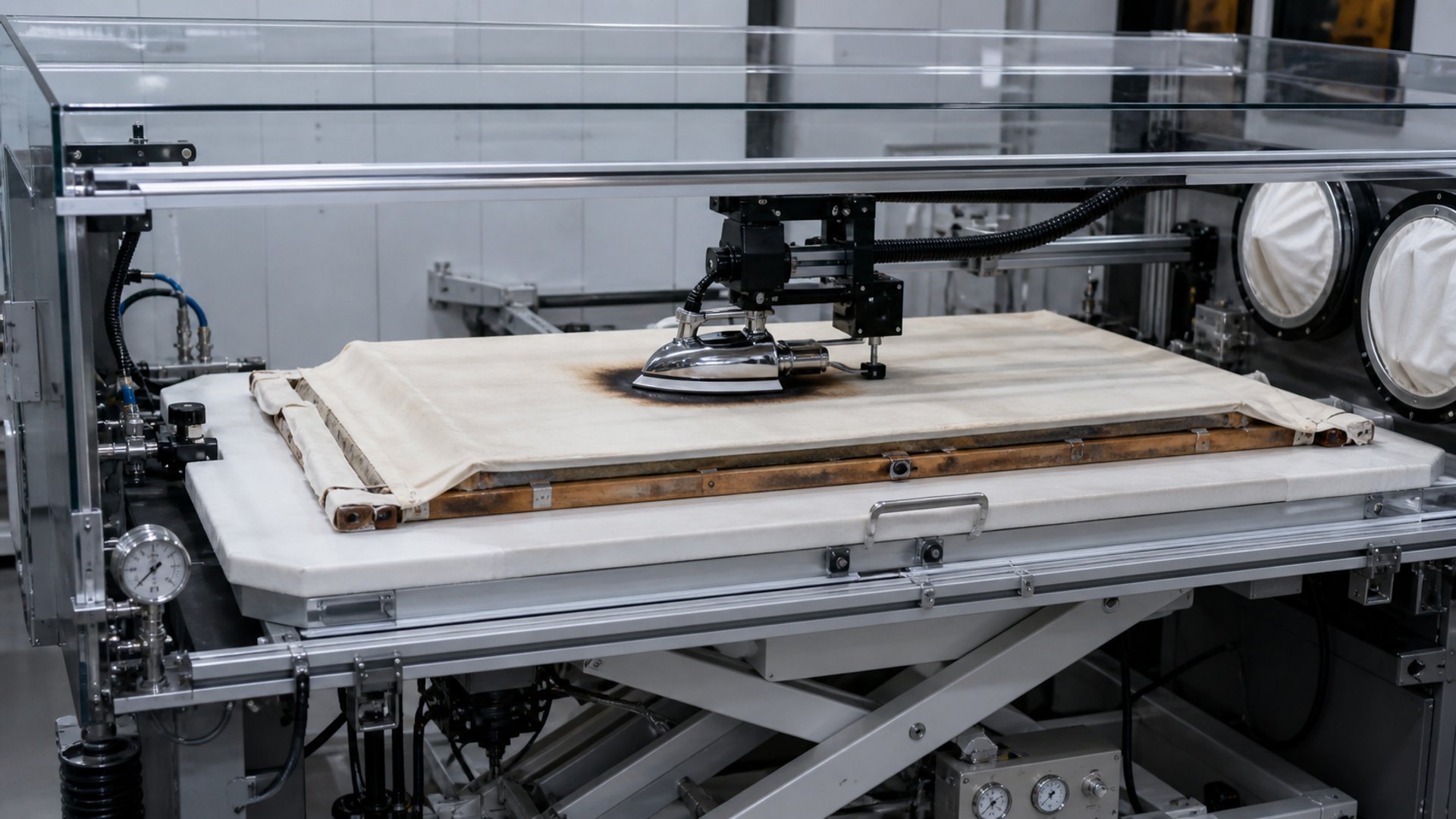

After publishing the first part of this essay, we thought it was worth following the argument one step further. The earlier text examined the reciprocal readymade largely as a proposition: Duchamp’s instruction to use a Rembrandt as an ironing board, and the reversal it implied between artwork and ordinary object. But a question remained open. What happens when that reversal stops being hypothetical? What happens when the frame, the museum, the contract, or simply the agreement that something is “art” no longer protects the object from another kind of use?
An upturned urinal sits on wet asphalt in New York. The signature is still legible: R. Mutt, 1917. Cars pass beside it. Brick walls, a fire escape, the curb. There is no pedestal, no barrier and no conservation protocol. The object that once turned plumbing into art now appears simultaneously as debris, fixture and image.
This is not simply an illustration of the argument made in the first essay. It exposes something that the earlier discussion could only approach in theory. The readymade was built on a movement upward: an ordinary manufactured object entered the space of art through selection and nomination. The reciprocal readymade proposed the opposite movement. Take something already consecrated as art and return it to use. Duchamp’s example was deliberately blunt: use a Rembrandt as an ironing board.
Yet the two movements are not symmetrical. A urinal can enter a gallery without losing its physical capacity to function as plumbing. A Rembrandt cannot become an ironing board without consequences. Heat, pressure, ownership, insurance, conservation rules and criminal law immediately enter the picture. The difficulty is no longer conceptual. It becomes material and institutional.
That distinction is where this second part begins.
On 16 January 1963, a commando of the FALN entered the Museo de Bellas Artes in Caracas during the exhibition Cien años de pintura francesa. In about fifteen minutes, they removed five paintings on loan from France, works by Van Gogh, Cézanne, Picasso, Braque and Gauguin. The paintings were not taken for private sale. They were held as political leverage and recovered within three days.
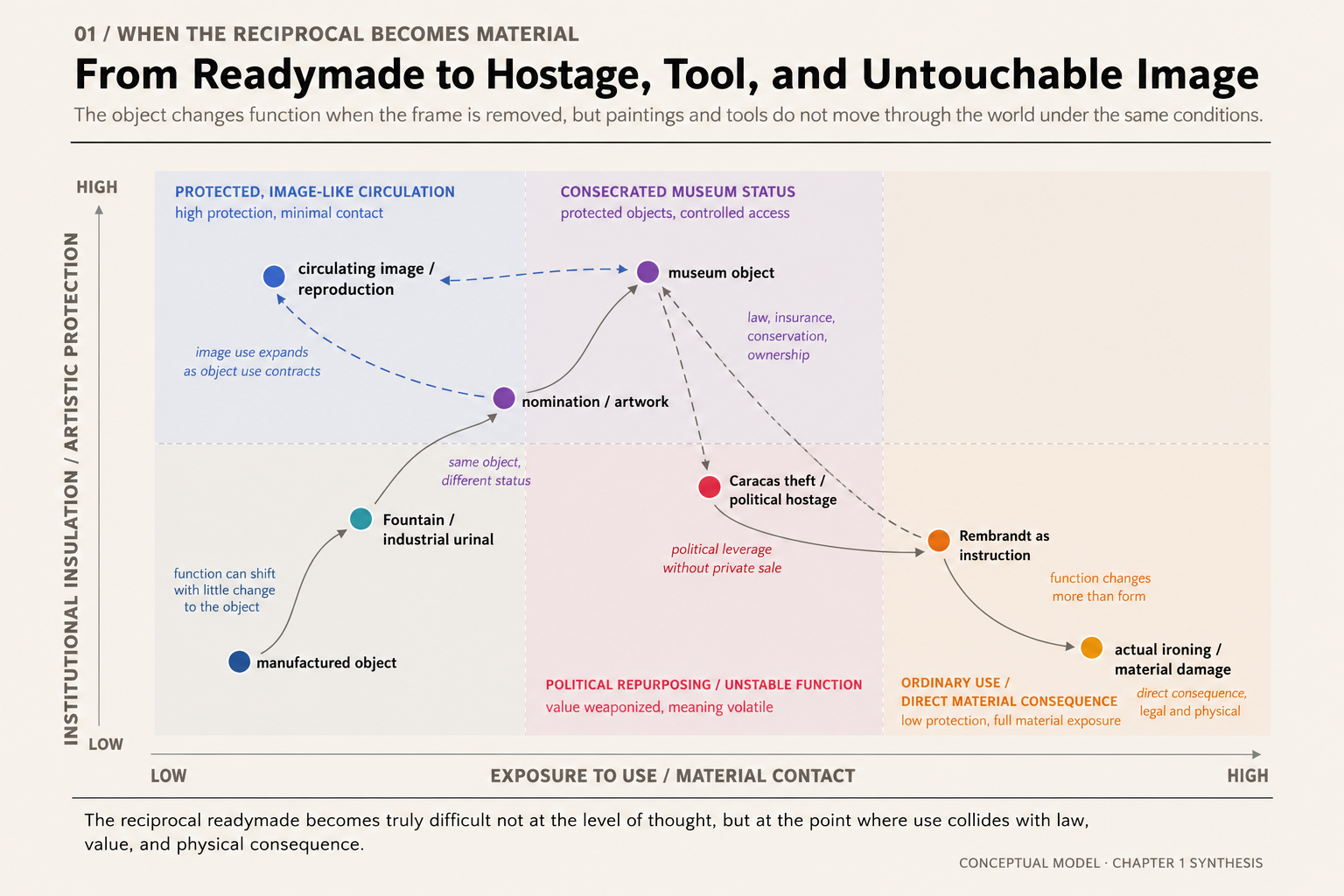
The episode is useful because it unsettles the usual categories. It was not an artwork, although Guy Debord later described the action as a way of putting the art of the past back into life. It was not an institutional critique organized inside the museum. From the museum’s and the state’s perspective, it was theft. The paintings themselves did not change, but their function did. For several days they stopped operating primarily as museum objects and became hostages, bargaining instruments and political signs.
That change of function matters more here than the label attached to the action.
The Rembrandt on the ironing board, by contrast, never happened. No painting was placed beneath a hot iron. Duchamp proposed an instruction, not an event. This difference is easy to overlook because the phrase has become almost more familiar than the action it describes. But once the reciprocal readymade is treated as something that could actually occur, rather than as a conceptual joke, practical questions appear immediately: Who owns the painting? Who is allowed to touch it? What counts as damage? At what point does use become vandalism? And why does the possibility of use become so much more disturbing when the object has acquired artistic rank?
Duchamp mostly selected manufactured things: a bottle rack, a shovel, a bicycle wheel, a urinal. He did not systematically subject existing paintings to the same operation. Fountain therefore gives us a more complicated case than the hypothetical Rembrandt. The urinal began as equipment. Through nomination, exhibition history, replicas, photographs, attacks, lawsuits, anecdotes and market value, it accumulated the conditions of an artwork without physically ceasing to be a urinal. Put an equivalent object back on the curb and very little has to happen materially. The decisive change is contextual.
The painting works differently. Returning it to ordinary use requires overcoming the systems that now surround it.
In practice, that almost never happens. High-value art is protected precisely from the kinds of contact that ordinary objects are expected to endure. Insurance policies define acceptable handling. Loan agreements regulate movement and display. Conservation standards control temperature, humidity, light and touch. Moral rights and property law can restrict alteration. Market scarcity makes accidental damage financially legible almost immediately.
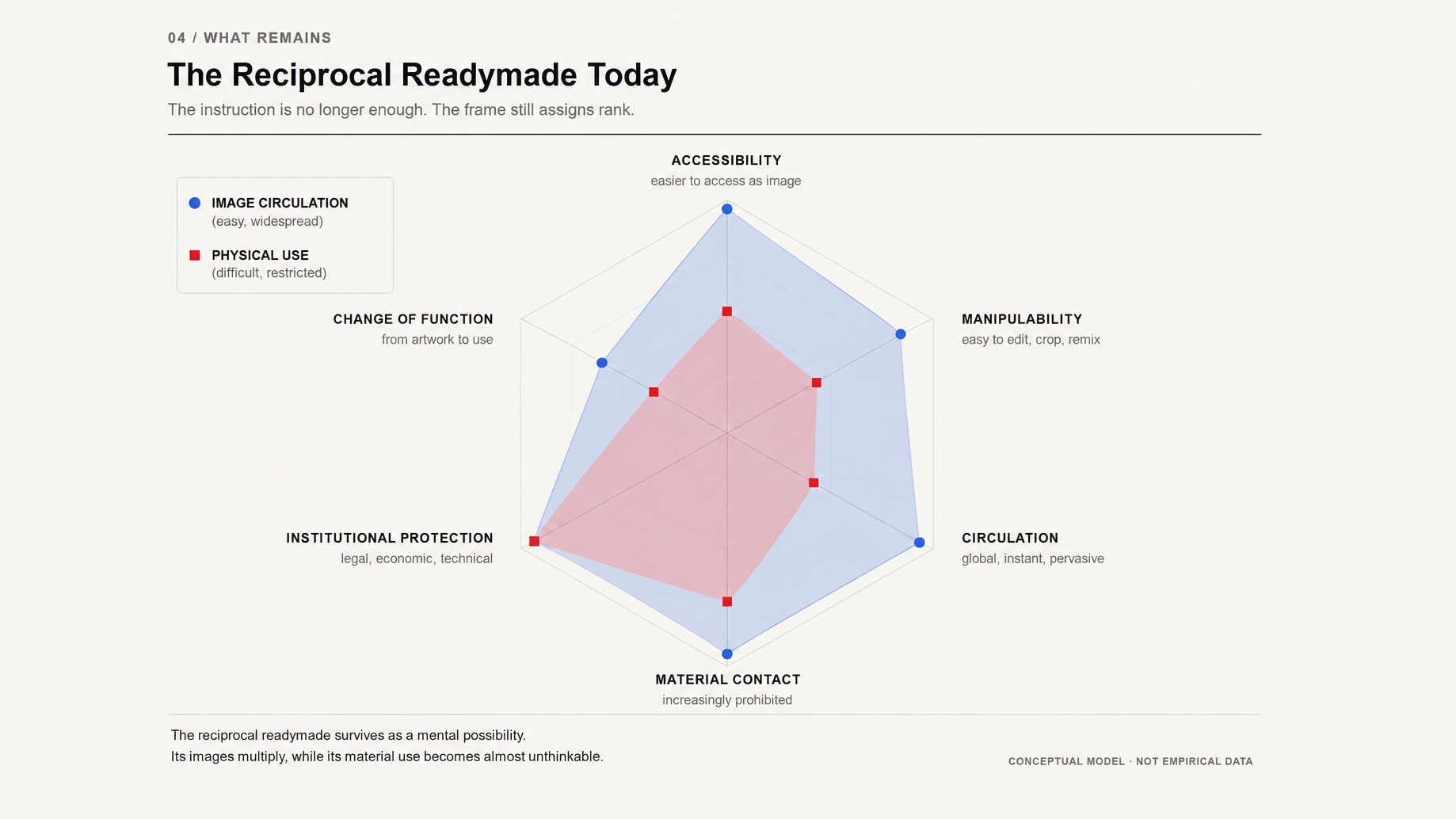
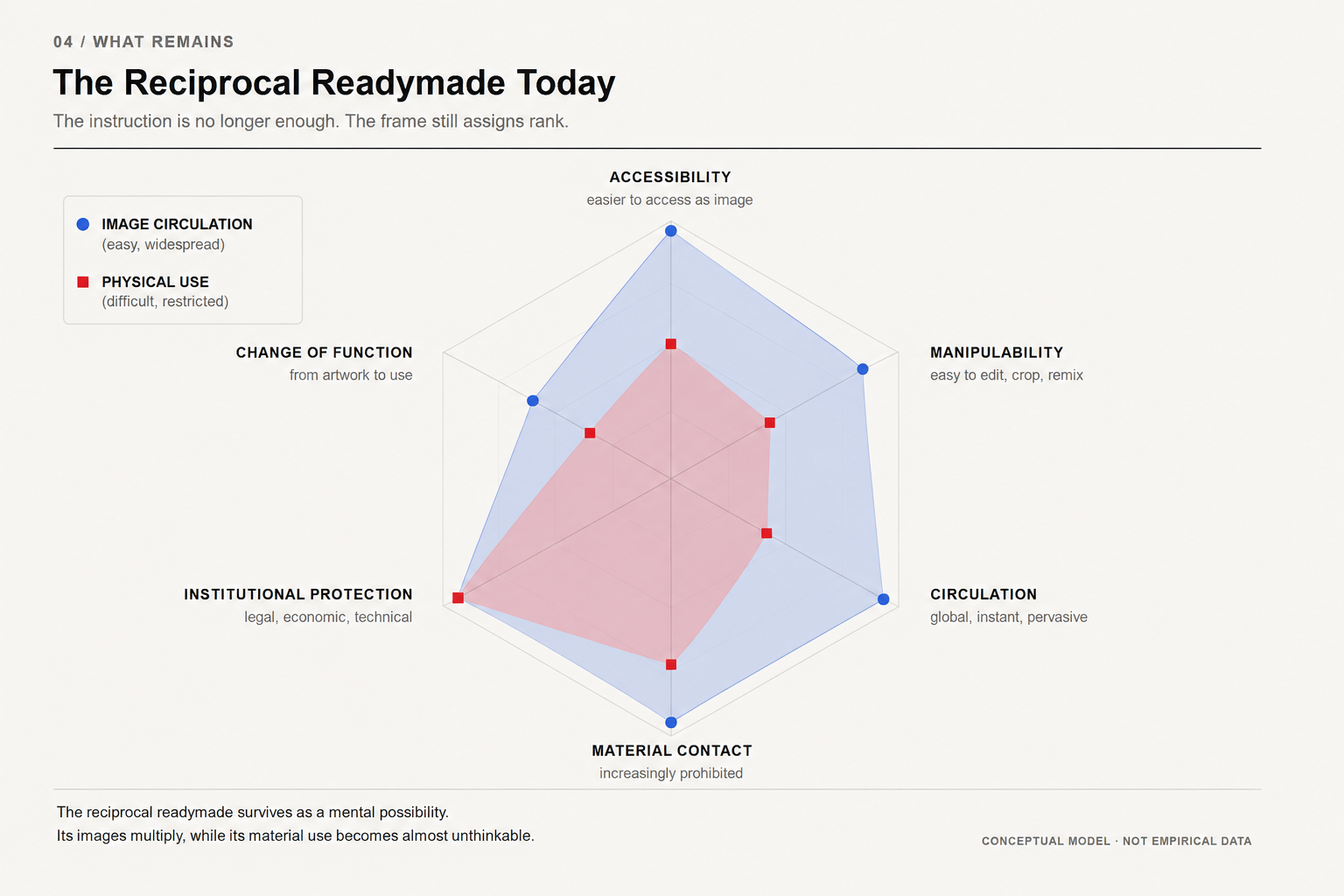
The result is a peculiar situation. We can imagine the Rembrandt being ironed more easily than we can actually touch it. The reciprocal readymade survives as a mental possibility because the material object has become increasingly insulated from use.
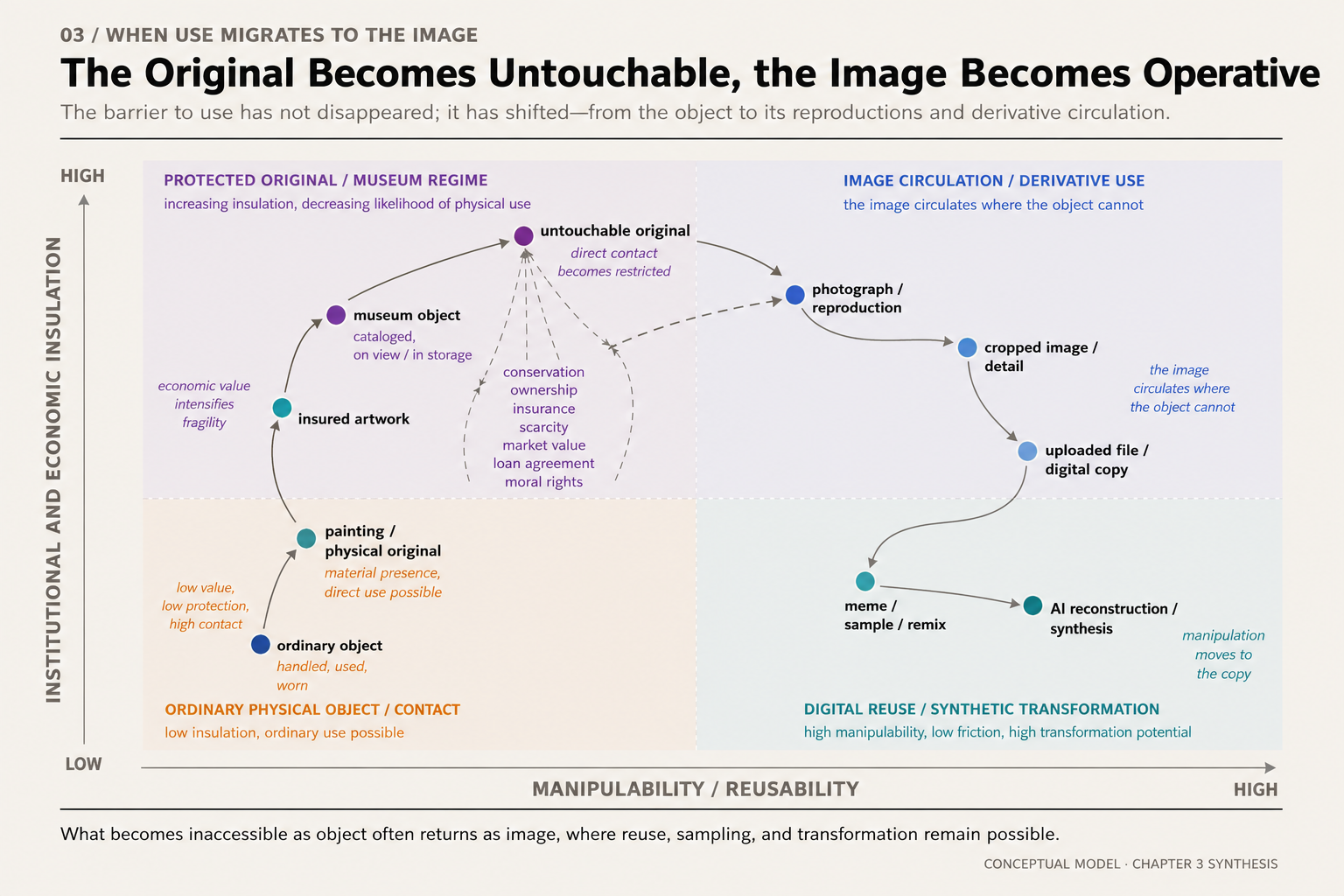
Meanwhile, another version of the work circulates almost without friction: its image. Paintings that cannot be touched can be photographed, cropped, printed, uploaded, memed, sampled, used as training data, reconstructed or synthesized. The physical object becomes harder to access while its reproductions become easier to manipulate. The prohibition on use has not disappeared. It has moved.
This is the question we wanted to pursue after the first article: what remains of the reciprocal readymade once the instruction is no longer enough?
The cases that follow approach the problem from different directions. One begins with an object that was already a tool and can reappear as waste without changing its shape. Another concerns paintings removed from the museum and temporarily made to function inside a political conflict. A third asks how economic and legal value can preserve the idea of sacrilege while making actual use increasingly improbable.
The frame still assigns rank. The more difficult question is what happens when someone removes it.
The Curb Withdraws the Frame
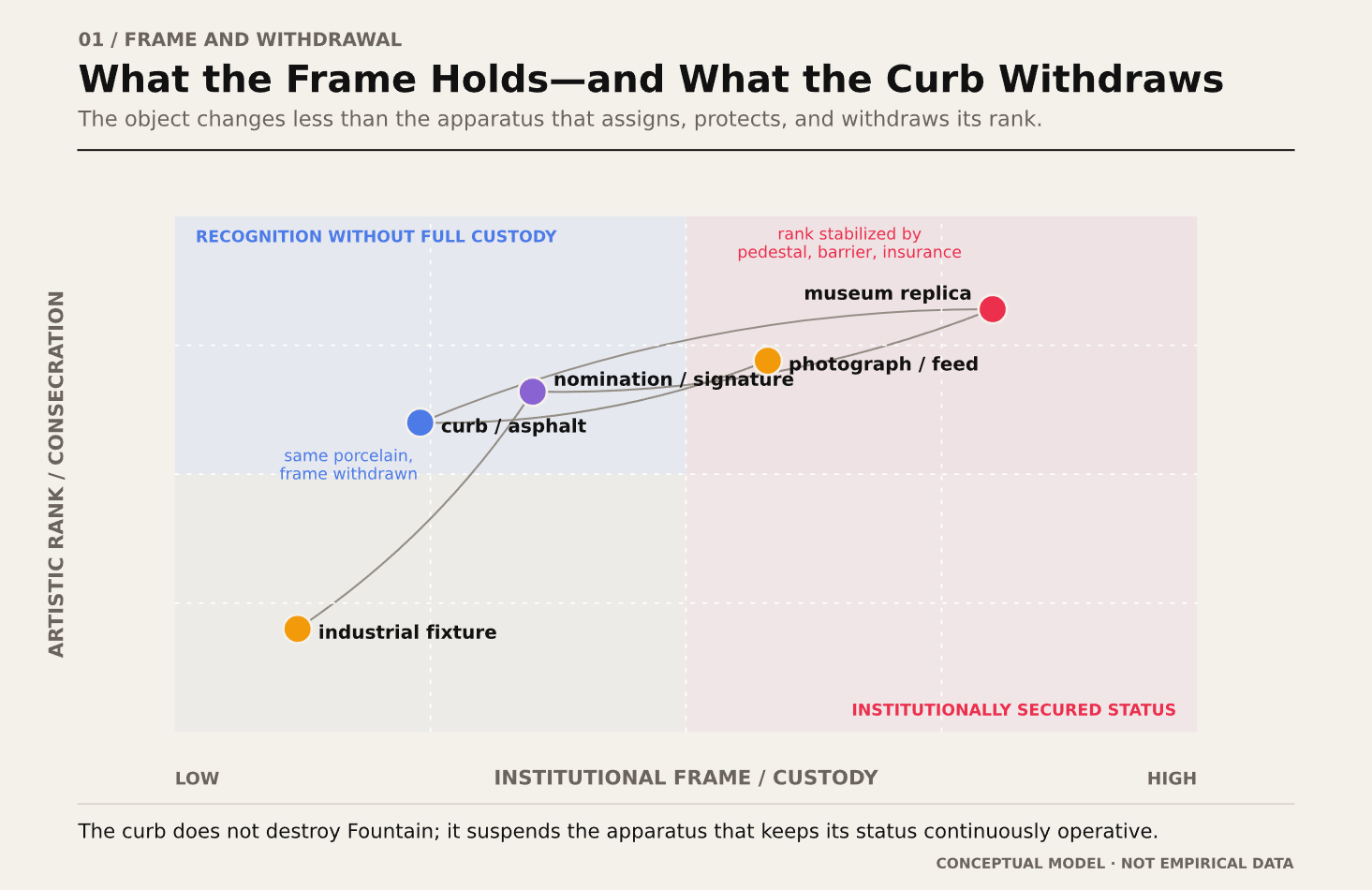
An upturned urinal rests on wet New York asphalt. Gravel collects in the flange. A drain pipe points toward the gutter. The black inscription holds: R. Mutt 1917. Behind it, parked metal, a fire escape, a brick facade that has never asked to be a gallery. No plinth measures the object. No label assigns it a lender. No climate system bargains for its glaze. The curb does not refute Fountain. It simply stops performing the work that made Fountain hold.
The first essay treated reversal as an instruction. A Rembrandt could be laid across an ironing board; rank would supply the charge; permission would decide the category. Fountain requires no such assignment. It entered the world as equipment. Nomination lifted it. Exhibition, photograph, replica, and discourse kept it aloft. The street does not invent a downward protocol. It removes the apparatus that had suspended the object above its first use.
A frame is not only gilded wood. It is a sequence of thresholds: pedestal, barrier, lighting, guard, accession number, insurance schedule. Each threshold converts proximity into ritual and contact into exception. The curb withdraws that sequence at once. Distance collapses into traffic. Attention becomes incidental, split among headlights, puddles, and the next crossing. Custody becomes whoever does not kick it. The object remains formally identical to the signed fixture that art history trained us to recognize. What changes is the machine around it. Recognition continues; consecration pauses.
Fountain’s biography already contained this pause. The 1917 original left the Independents unshown and vanished within days. What survived was a photograph by Stieglitz and a name. Later versions returned as purchases, restaurant stand-ins, and editioned porcelain authorized for collectors. Each return rebuilt the frame: white room, controlled height, the quiet that tells a visitor not to treat porcelain as plumbing. Attacks arrived inside that rebuilt frame. A body could urinate, strike, or claim the replica was already a fake. Even transgression borrowed the museum’s jurisdiction. Scandal still required a room that could be scandalized.
The curb offers a poorer jurisdiction and therefore a cleaner reversal. Nothing here is programmed as violation. The urinal is not “used” in the Duchampian sense; it is left where use and neglect become indistinguishable. Rain does the work of a conservator’s report without filing one. A passing tire can complete what no curator will authorize. The signature, once a device for lifting an article of life into thought, now functions as graffiti on a discarded fixture. Nomination remains visible. Rank has nowhere to sit.
This is why the street image is stricter than the ironing board. A painting forced into labor borrows its intensity from a status it never earned as a tool. Fountain earned that status first as plumbing. Its ascent was a change of protocol, not a change of matter. Its descent can therefore look like ordinary weather. The masterpiece on the board produces a categorical event because the board is the wrong support. The urinal on the curb produces a categorical event because the support is the right one, restored.
Withdrawal, however, is not abolition. The frame is a portable technology. A collector’s call, a museum crate, a police report, or a caption can reinstall it in an afternoon. The same porcelain can re-enter accession, premium, and loan language without altering a single hole in the ceramic. Reversibility cuts both ways. The curb proves that artistic status can be switched off by placement alone. It also proves that placement is cheap to reverse. What the photograph captures is not the death of Fountain but a gap in its custody — a few meters of asphalt in which the object is briefly allowed to be the thing it was before discourse arrived.
The image of that gap is already a frame returning. Editorial circulation, exhibition screens, and the feed that carried the curb into view restore ranking through visibility. The urinal becomes evidence of deconsecration, then content, then a new source of attention around the very rank it seemed to shed. The street withdraws the museum. The photograph rebuilds a museum of the withdrawal. Between those two operations the object waits, intact, available to whoever next decides whether it is plumbing, patrimony, or trash.
Hostage Converts Rank Into Leverage
On 16 January 1963, at 3:15 in the afternoon, an urban commando of the FALN entered the Museo de Bellas Artes in Caracas. The rooms were crowded with students. The exhibition was Cien años de pintura francesa, opened weeks earlier by President Rómulo Betancourt and stocked with canvases sent from France. In about fifteen minutes the group cut the telephone lines, held the public in place, and left with five paintings: Van Gogh’s flowers in a copper vase, Cézanne’s bathers, a still life by Picasso, another by Gauguin, and Braque’s still life with pears. They painted their acronym in a corridor. They said the act was not a theft. The paintings, they announced, would be kept safe and returned. Rank had been lifted off the wall and converted into a negotiating instrument.
The first essay described authority over passage: the hand entitled to move an object between art and equipment. Caracas names that hand without metaphor. No ironing board was required. No nomination reversed a commodity into a masterpiece. The works were already consecrated, already insured, already traveling under loan language that treated their movement as a diplomatic courtesy. The commando interrupted the courtesy. Custody passed from museum protocol to a political cell. For seventy-four hours the canvases occupied a second jurisdiction — not the storage vault, not the collector’s wall, but a clandestine interval in which their value was useful precisely because it could not be spent.
Hostage is a precise word for that interval. A hostage is not destroyed. Destruction would cancel the leverage. The object must remain recognizable as the thing the other side cannot afford to lose. The FALN understood the conservation paradox better than many later gestures of iconoclasm. French papers noted the care with which the canvases were handled. Protection was not a concession to the museum. It was the condition of the ransom. Rank, built by attribution, provenance, and state loan, became a battery. The higher the consecration, the greater the voltage available to whoever held the stretcher.
The institution answered in the only language it had prepared. Police flooded the city. The Central University was raided. The exhibition closed, then reopened under the same flags that had blessed it. France kept the diplomatic face of the loan intact. Within three days an anonymous call and a drop returned the five works to the museum. The paintings resumed their labels. Provenance gained a paragraph. Insurance discovered a claim that never needed to be paid. What looked like a radical subtraction entered the archive as a brief irregularity in custody — an incident that proved, after the fact, that the system could absorb even armed reversal.
Guy Debord read the action as a method: treat the art of the past by putting it back into life and resetting priorities. The reading is seductive and incomplete. Life, in Caracas, did not receive the paintings as use. No one ironed them, prayed to them, or hung them in a kitchen. They traveled from one form of exception to another. The museum had suspended them as patrimony. The commando suspended them as collateral. Between those two suspensions the objects never became tools. They became tokens in a conflict about prisoners, sovereignty, and who may speak through French culture on Venezuelan ground.
That is the lesson the curb does not teach. Fountain on asphalt can look like function restored because the object’s first life was plumbing. A Cézanne cannot return to a prior utility; it has none that the present knows how to operate. Its “use” is always transferred. It can decorate, collateralize, educate, launder prestige, or compel a government to listen. The FALN chose the last of these. They did not degrade the paintings into equipment. They raised their political yield by threatening the apparatus that called them priceless. Pricelessness is a price by other means. Hostage makes that price collectible.
Permission, in the first essay, left the hand through keys, condition reports, and named custodians. Caracas shows the opposite movement: permission seized by a hand the ledger does not list. Legal title stayed with lenders. Heritage rhetoric stayed with states. Physical control moved. For three days the chain of custody ran through a force that museums classify as crime and militants classify as war. The paintings survived because both sides needed them alive. Survival, here, is not the opposite of use. It is the form use takes when the object’s only practical power is to be withheld.
The return closed the event and reopened the frame. Same rooms, same climate, same public instructed to look and not to touch. Yet the interval remains available as a model. Whenever consecrated matter is taken in order to be given back, rank is working as leverage rather than as aura. The masterpiece does not have to become an ironing board. It only has to be movable, recognizable, and expensive to lose.
The Painting Was Never Equipment
The reciprocal readymade is an instruction aimed at the wrong class of object. A Rembrandt is a picture on a support. It was made to be seen, attributed, and kept. It was not manufactured as an appliance and then renamed. The force of Duchamp’s line depends on a collision that the painting cannot supply: the return of a tool to tool-use. A canvas has no such prior job. Pressing it with an iron does not restore a function. It only risks a surface.
Duchamp kept the distinction in practice. The readymades he selected were industrial articles — urinal, shovel, rack, comb — chosen, he said, in visual indifference. When he touched an image, he touched a reproduction. L.H.O.O.Q. is a postcard altered with pencil. The gesture revises a published likeness; it does not conscript a painting into household labor. An assisted or rectified readymade is still not a reciprocal one. One adds a mark to a picture of art. The other asks a work of painting to perform as furniture. Duchamp did not do the second.
Picture-making was left in place. After the readymade, canvases continued to be prepared, painted, framed, sold, and conserved under the same basic contract: an image occupies a unique support and that support is not to be used up. The readymade changed what could count as sculpture. It did not convert painting into equipment, and it did not need to. Painting already had a market, a scholarship, and a climate system. Its vulnerability was never a missing utility. It was the fact that its value lives in an image that can be copied while its price lives in a panel that cannot.
That split is the only reversal now in daily operation. The file is ironed constantly — cropped, trained, quoted, degraded, recomposed. The painting is not. To treat the reciprocal readymade as a physical recipe is to miss the object Duchamp refused to choose. He did not pick a picture and make it a board. He picked a fixture and made it a name. The fixture can go back to the floor. The picture can only go back to looking.
Value Survives by Forbidding Use
Use is the one operation the masterpiece cannot afford. Not because matter is sacred, but because value is organized as withheld contact. Price, loan, premium, and moral right do not describe the painting so much as they block the gestures that would spend it. The object remains available as image, citation, and dream. It remains unavailable as tool. That asymmetry is not a side effect of the market. It is the market’s method.
A masterpiece concentrates the logic of equivalence in a single support. Money, title, reputation, and future attention are made interchangeable around it. The work can move between collection, museum, and vault without ever being consumed. Consumption would stop the series. Heat, abrasion, or ordinary labor would turn collateral into an incident. So the system prices the incident in advance and calls the prohibition care. Conservation is a financial instrument with climate control. Insurance is a theory of touch. The higher the valuation, the narrower the set of hands that may prove the object is real.
This is why “using” an artwork happens almost entirely in the mind. The ironing board can be imagined; the contract forbids the plate. The mind keeps the ritual limber — status, envy, scarcity, the pleasure of a threshold that others cannot cross — while the object accrues. It accrues whether or not anyone looks. It accrues through catalogs, comparables, and the rumor of permanence. Intervention is allowed only as spectacle that can be recaptured: a photograph of risk, a performance of proximity, a scandal that enlarges the file. The attack is welcome if it leaves the asset intact. Value survives sacrilege by invoicing it.
Digital circulation appears to break the ban and does not. Files are used without remainder. They are cropped, trained, mirrored, and worn out in latent space. That exhaustion never reaches the panel. The image becomes cheap through repetition at the same moment the object becomes dear through rarity. Two economies share one name. One spends. One withholds. The reciprocal readymade promised a transfer from art back into function. What arrived instead was a split: function for the copy, exception for the source. Authority over the object tightens as access to the likeness expands.
Time does the work no protocol will authorize. Pigment shifts. Ground fails. Most things called art will not last a few centuries. An archaeological view does not need a commando or a curb. It only needs weather. Institutions treat that weather as an enemy of rank. Another view treats decay as the one use that cannot be speculated away. Neither view escapes the present arrangement. As long as equivalence needs a scarce body, the painting will be protected from function and the file will be worked until it is thin.
Reversal remains possible. It is simply expensive, rare, and quickly reabsorbed. A fixture can sit on asphalt. A canvas can leave a museum under another law. An instruction can still say: use it. The system’s answer is consistent. Let the sentence circulate. Keep the heat off the linen. Rank is not a quality in the object. It is the cost of touching it.