


The idea of predicting the future has always implied distance: observe the present, gather data, extract patterns, and project them forward. MiroFish introduces a quieter rupture, and for that reason, a more radical one. It does not simply estimate what might happen. It constructs the conditions under which something can happen.
Emerging as an open-source project and rapidly rising to prominence on GitHub, MiroFish presents itself as a multi-agent simulation system capable of generating artificial social environments from real-world inputs. News, financial reports, political documents, and online discourse are translated into a relational structure, a knowledge graph that acts as an operational matrix. On this foundation, thousands of autonomous agents are activated, each equipped with memory, behavioral traits, and decision logic. These agents do not answer questions. They interact, influence one another, and produce emergent dynamics.
The point is no longer prediction in the classical sense, but the simulation of processes. MiroFish does not return a single answer. It unfolds a field of possibilities. It does not declare what will happen. It stages how something might happen, through multiple trajectories evolving over time. In this sense, the future is not calculated, but iterated.
The attention surrounding the project, amplified by its open-source nature and the speed of its development, signals something that extends beyond the case itself. This is not simply a new tool, but a shift in how we understand the relationship between data, decision, and reality. Where earlier models aimed to reduce uncertainty, systems like MiroFish operate within uncertainty, rendering it productive.
This article takes MiroFish as an entry point into a broader inquiry. The question is not how accurate it is in predicting events, but what it means to construct a digital counterpart of society and allow it to evolve autonomously. What is at stake is not only a technological shift, but a reconfiguration of the real itself: no longer something to observe and describe, but something that can be replicated, manipulated, and tested across parallel environments.

From the Model That Answers to the World That Reacts
For a long time, artificial intelligence has operated within a familiar structure: input, processing, output. A model receives a query, processes information, and produces a response. Even in its most advanced forms, this logic remains largely intact. Complexity increases, outputs improve, but the structure holds. A system that answers.
MiroFish introduces a deeper shift by altering the direction of the process itself. It does not respond to a question. It builds an environment in which responses emerge without being explicitly requested. The interaction changes. Instead of querying a model, one observes a system. Instead of receiving an output, one witnesses a dynamic.
This shift repositions the user. No longer an interlocutor, but an observer. Attention moves away from the correctness of a response and toward the coherence of collective behavior. What matters is not what the system says, but how it moves, how it evolves, how it reacts to its own internal conditions.
Within MiroFish, thousands of agents operate simultaneously. Each carries a minimal cognitive structure: memory, preferences, interpretative capacity. These agents are not simple replicas. They function as active nodes within a network of interactions. Their significance lies in relation, not individuality. Through their entanglement, trajectories emerge that were never directly programmed.
The system begins to resemble an ecosystem more than a tool. It produces states rather than discrete answers. Each interaction reshapes the next, forming chains of dependency that introduce both unpredictability and meaning. Simulation becomes temporal, not static.
This also reframes the concept of artificial intelligence itself. Traditional models compress the world into a function. Systems like MiroFish expand it into a simulation. The aim is no longer to reduce complexity into a single optimal response, but to distribute it across a multiplicity of agents moving through it.
A new tension appears. The system feels closer to reality through its relational and dynamic qualities, yet it resists immediate verification. There is no single output to compare. What appears is behavior, not resolution.
At this point, the criteria shift. Evaluation moves from correctness to plausibility. From truth to internal coherence. The transition from a model that answers to a world that reacts is not only technical. It is epistemological. It reshapes how knowledge is produced and how it is recognized.

Prediction Beyond Statistics
Prediction, in operational terms, has long been an exercise in reduction. Reducing uncertainty through measurement, reducing complexity through models, reducing the future to a probability distribution. From time series to econometrics to neural networks, the underlying principle remains consistent. The future is treated as a function of the past.
MiroFish steps outside this lineage. It does not abandon data. It reconfigures its use. Data is not compressed into a singular predictive model. It is unfolded into a relational structure that becomes the ground upon which agents operate. The knowledge graph is not an archive. It is an active condition. It organizes the world through connections, contexts, dependencies. Dynamics emerge from this structure, not from a formula.
Prediction shifts from extraction to generation. No single outcome is calculated. Instead, evolution is observed. Agents, embedded within an informational environment that mirrors aspects of reality, react according to their internal logics. The trajectories they produce are neither predetermined nor arbitrary. Prediction moves from probability toward plausibility.
This shift has consequences. In statistical models, error is measured as deviation from an expected value. In multi-agent simulation, error becomes difficult to define. There is no singular correct result. What is evaluated is the overall quality of behavior. The system’s ability to generate scenarios that remain coherent with initial conditions and observable dynamics.
Prediction becomes distributed. Not a point, but a space. Not an answer, but a set of evolving possibilities. This space remains constrained by the structure of the graph and the logic of the agents, yet it stays open, shaped by divergence, feedback, and recombination.
Within this framework, the future is no longer something to anticipate precisely. It becomes something to explore. Simulation turns into a form of navigation. Scenarios are observed, patterns detected, hypotheses tested within a controlled environment. Value shifts away from exact prediction and toward understanding possible dynamics.
Probability does not disappear. It relocates. It becomes an emergent property rather than a final output. Recurrence, convergence, and frequency serve as indirect indicators of what may unfold.
MiroFish does not replace statistical prediction. It absorbs and transforms it. The future is no longer compressed into a number. It is expanded into multiple scenarios that can be observed, compared, and interrogated. Prediction ceases to close and begins to open.
Constructing a Synthetic Society
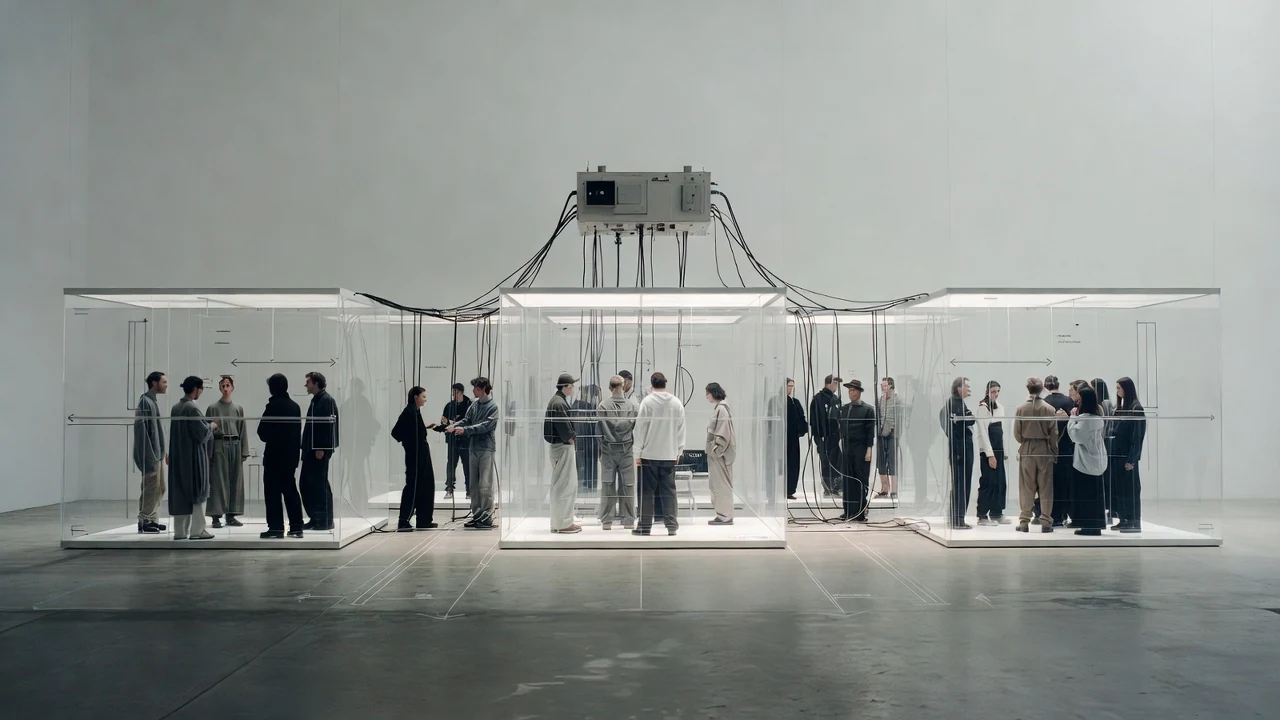
What exactly is being observed here? A tool, or the early formation of an environment? The distinction starts to dissolve. When a system generates agents, assigns memory, positions them within a network of relations, and allows them to interact, something begins to resemble a society, or at least its operational counterpart. But what grounds this society? Not bodies, not institutions, not history in any traditional sense. It rests on structured data, correlations, fragments of reality already translated into information. Is that enough to produce collective behavior, or has collective behavior always depended on informational structures, only without being named as such?
When an event becomes a node within a graph, it loses singularity and gains function. It can be traversed, recombined, reactivated. Agents do not encounter the world directly. They encounter its structured representation. Still, they react. Signals trigger responses, contexts generate shifts, and interactions accumulate into patterns that feel strangely familiar.
The question moves away from fidelity. What matters is the credibility of the dynamics. A society without material resistance begins to take shape. Friction, hesitation, and contingency are replaced by computational continuity. Agents do not tire. They do not hesitate unless designed to do so. Does this make the system clearer or thinner? More legible or further removed?
A deeper concern emerges around circularity. The real feeds the model. The model produces scenarios that feed back into the real as decision tools. Observation becomes mediated through a system that continuously reconstructs what it observes. The synthetic society does not replace the real. It extends it, anticipates it, begins to influence it.
Who, then, occupies this system? The agents, acting without awareness? The structure, organizing without intention? Or the observer, attributing meaning to emergent patterns? The answer may not be necessary. What matters is that something moves, interacts, evolves according to logics no longer reducible to a single origin. Society reappears as an effect, not as a given.

When Public Opinion Becomes Simulable
If a synthetic society is plausible, then its invisible force follows closely behind. Public opinion. What does it mean to simulate it? Not to measure it, not to capture it through surveys or engagement metrics, but to generate it, to watch it form, cluster, disperse, intensify. It becomes something that unfolds rather than something that is collected.
Within a multi-agent system, opinion is unstable by design. It shifts through interaction. Agents absorb signals, reinterpret them, respond to one another, and in doing so, reshape the environment itself. Opinion becomes a topology, a distribution of forces rather than a sum of positions. Clusters emerge, collapse, reconfigure.
The focus moves from what people think to how opinions take shape. Propagation becomes central. How an idea spreads, how a narrative stabilizes, how polarization emerges or dissolves. These processes become visible, and once visible, testable.
Variables can be introduced, relationships altered, nodes repositioned. The system responds. Opinion becomes a surface of intervention. A field where potential effects can be explored before they manifest externally.
An ambiguous territory opens. Greater understanding sits alongside the potential for influence. If opinion formation can be simulated, it can also be shaped. The line between analysis and intervention becomes increasingly difficult to locate.
A more subtle question lingers. When simulated opinion produces coherent dynamics, anticipates behavior, informs real decisions, how long does it remain simulation? At what point does it begin to act upon the very reality it mirrors?
Public opinion shifts from a social phenomenon to a technical object. Something that can be modeled, iterated, calibrated. Its status changes. It is no longer only an expression. It becomes an output of a system capable of being constructed.

The Future as a Testing Environment
A different hypothesis emerges. What if the future is no longer something to await, but something to operate within? Not a distant horizon, but a space accessible in advance. A surface where iterations unfold before events take place. MiroFish appears to move in this direction. It does not offer a forecast. It offers a stage.
What is being tested in such a space? Events, decisions, collective reactions, or the conditions that make them possible? Each variable can be adjusted. Information shifts, relationships change, and the system responds. No final answer appears. Instead, alternative trajectories take form.
The concept of testing transforms. It no longer verifies what has occurred. It explores what might occur. The future becomes experimental. Temporal structure shifts as well. Linear sequence gives way to parallel exploration. Multiple futures can be generated, compared, discarded, revisited.
Decision-making begins to operate differently. Choices are informed not only by past data, but by simulated possibilities. Paths that never occurred still influence action.
A feedback loop forms. Simulated scenarios inform decisions. Decisions reshape reality. Reality feeds new simulations. The boundary between testing and acting becomes less distinct. The future is not only anticipated. It is partially constructed through the system that models it.
A tension persists. Exploration offers preparation, yet it risks narrowing the field of what is considered possible. What remains unmodeled risks remaining unseen.
Testing the future raises a structural question. Does it expand understanding or delimit it? Who defines the parameters of simulation? What remains outside those parameters?
A margin remains. Something irreducible continues to escape the system. Yet that margin appears to shrink as simulation becomes more operational. The future moves from open uncertainty toward a domain that can be handled, iterated, shaped.

Open Source as a Machine of Legitimacy
Another layer operates quietly beneath the surface. Open source. Not a technical detail, but a condition that shapes perception and legitimacy. Credibility no longer emerges solely from institutions. It forms across distributed observation.
GitHub becomes more than infrastructure. It acts as a field of validation. Stars, forks, issues function as signals. Attention, participation, relevance become visible metrics.
What is being legitimized? Code, certainly, but also narrative. A project circulates through what it promises as much as through what it delivers. Speed of diffusion, volume of interaction, and collective discourse construct authority outside traditional channels.
Open source amplifies visibility. It exposes process, invites contribution, distributes access. At the same time, it generates a paradox. Accessibility does not guarantee understanding. Transparency does not eliminate opacity. It redistributes it.
Participation becomes partial. Contributors engage fragments. Observers interpret outcomes. No single position holds the system in its entirety. Authority emerges from distributed attention.
This model accelerates adoption. Development, observation, and validation occur simultaneously. There is no separate phase of consolidation. The project stabilizes while it evolves.
This simultaneity introduces fragility. Distributed credibility can dissipate quickly. Signals shift. Consensus reorients. Open source produces intensity rather than stability.
A question remains. Does this structure democratize legitimacy or redefine it? Does access to code translate into access to meaning, or does it generate a new form of trust grounded in visibility?
In MiroFish, this tension becomes evident. The project is open, observable, replicable. Its relevance, however, depends on how it is collectively recognized. Open source functions as a cultural device. It determines how something becomes real within a networked environment.
The Operational Double of Reality
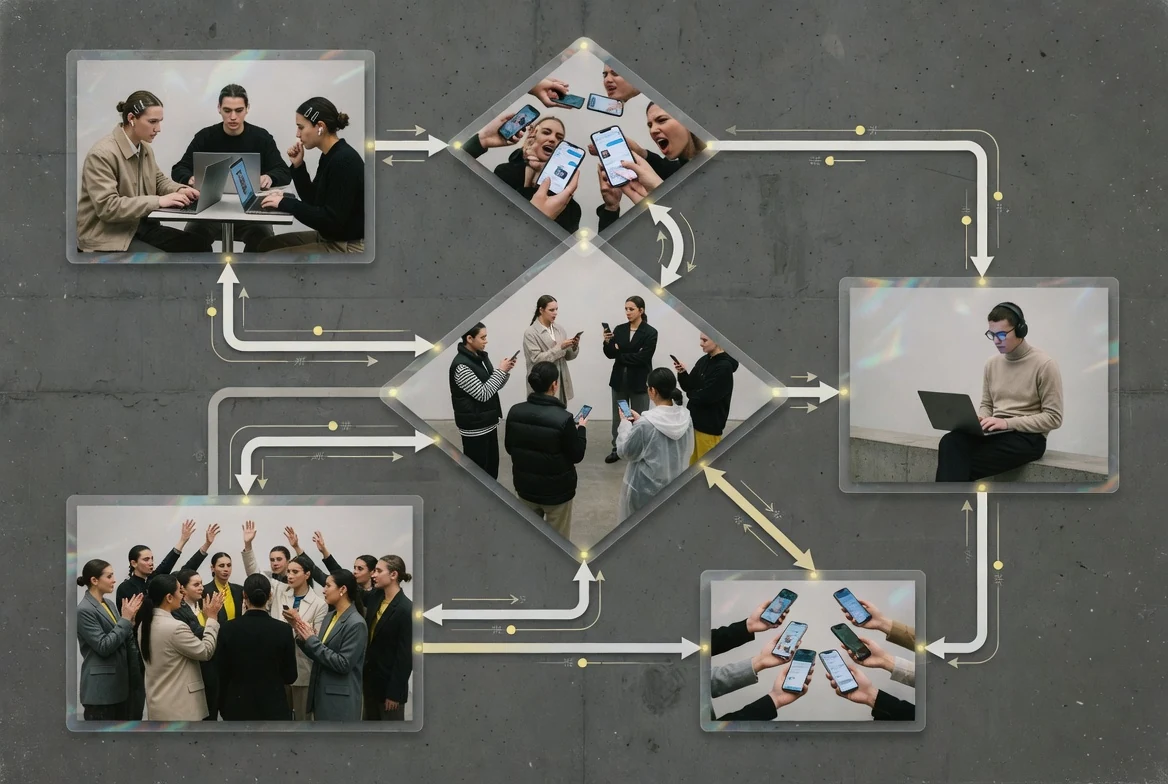
The trajectory converges toward a final configuration. What emerges is not simply a simulation, but an operational double. Not symbolic, not representational, but active. A system that runs alongside reality, anticipates it, and increasingly interacts with it.
When does a model become operational? When it enters decision-making processes. When its outputs guide strategies, influence actions, shape outcomes. At that point, the double ceases to remain parallel. It begins to interfere.
This double is incomplete, partial, selective. Yet it functions. It generates scenarios, reveals trajectories, allows consequences to be explored in advance. Its strength lies in usability rather than fidelity.
A dual structure forms. On one side, the real with its opacity and resistance. On the other, its double, more legible, more manipulable. Decisions circulate between these layers. Observation informs action, action updates the model.
The distinction persists, but it thins. Reality becomes something continuously accompanied by its simulation.
Every duplication introduces distortion. Inclusion grants visibility. Exclusion renders elements marginal. The operational double organizes, simplifies, prioritizes. Its version of reality can gain influence precisely because it is more accessible.
Relevance begins to shift. What matters is not only what happens, but what can be integrated into the system. What cannot be modeled risks losing weight.
A final question remains open. As movement through the world increasingly passes through its double, how long does the difference remain perceptible? At what point does the double become the primary interface through which reality is understood?
MiroFish reveals a threshold. Not between real and simulated, but between observation and operation. Crossing it does not simply expand knowledge. It introduces a new condition: acting on what has not yet occurred as if it were already present.