

The transition of aesthetic perception from the static plane of museum contemplation to the frenetic verticality of the digital feed in recent years represents not a mere variation in medium, but an ontological mutation of the act of looking.
If the work of art once occupied a space of phenomenological silence, isolated from the world’s noise to allow a singular truth to emerge, today it is immersed in an undifferentiated current where the icon’s sacredness coexists with the banality of commercial data. In this architecture of simultaneity, the eye does not rest but slides, trained by an ergonomics of distraction that has transformed the search for beauty into information traffic management. The collapse of visual hierarchies produces a semantic short circuit where a fragment of Greek statuary, a hyper-realistic AI-generated render, and a grainy photograph of a brutalist interior appear frictionless alongside each other. Critical distance between objects no longer exists, as the algorithm’s logic tends to level every contextual rough edge in favor of a fluidity that encourages platform retention. In this scenario, art ceases to be a pinnacle of meaning and becomes the weave of an infinite fabric, a pixel among pixels that must negotiate its relevance in fractions of a second. This condition of fragmented perception has inevitably informed contemporary artistic production, which has renounced the claim of a linear avant-garde or a collective manifesto. Thus, the figure of the artist is transforming into that of an archivist of chaos, a selector of stimuli who no longer seeks to engrave a lasting trace in time, but to generate a momentary echo in a system that devours its content with entropic voracity.
The result is an aesthetics of constant mixing, where citationism is no longer an act of historical devotion, but a necessity for survival in an ecosystem dominated by overabundance. In the following analysis, we intend to explore the consequences of this ‘feed logic,’ investigating how the loss of a teleological direction in art is not a sign of decline, but an adaptation to a new ecology of the mind. If the world presents itself to us as an incoherent mosaic of visual stimuli, art can only become a mirror of this shattering, renouncing stylistic coherence to embrace the polyphony of white noise. The challenge is no longer to create the exception, but to understand the rules of a flow that has made the exception the daily norm.

The End of Stylistic Teleology
Let us begin by stating that the idea of a linear progress in art history has definitively vanished under the weight of algorithmic accumulation. In the twentieth century, every movement arose as a dialectical overcoming of the previous one, in a chain of ruptures that defined the sense of contemporaneity through the exclusion of the recent past.
Today, this driving force has been replaced by an absolute horizontality, where every style, era, and technique coexist in an atemporal dimension, ready to be retrieved and reassembled without any of them being able to claim hegemony over the present. The feed does not permit succession, only juxtaposition, transforming art history into a warehouse of low-resolution textures. The contemporary artist no longer feels compelled to take a stand under the banner of an ‘ism,’ knowing that their work will be consumed alongside diametrically opposed visual references. This lack of friction between eras produces a sort of positive aesthetic amnesia, where novelty no longer resides in the radical gesture, but in the ability to simultaneously inhabit multiple linguistic registers without appearing contradictory.
The disappearance of the collective manifesto marks the transition from a culture of the project to a culture of the visual event. While the manifesto was a commitment to the future, the Instagram post is an affirmation of the here and now that requires no continuity with tomorrow. Artists now operate as isolated entities intercepting ephemeral currents of taste, moving with a fluidity that makes the formation of solid schools of thought or trends lasting more than a digital season impossible. This fragmentation of critical discourse reflects the atomized structure of our attention, constantly solicited by divergent inputs that prevent the sedimentation of a unitary aesthetic. It is no longer possible to speak of a ‘style of our time’ except in terms of the pulverization of styles into a mosaic of visual micro-identities.
The work of art thus becomes a minimal information unit, a signal that must distinguish itself not through speculative depth, but through its ability to capture the thumb scrolling across the screen. The final insight is that stylistic coherence has become a commercial limitation rather than an intellectual value. In the age of the feed, the stasis of a single vision is perceived as a lack of responsiveness, while unbridled eclecticism is often rewarded as a sign of synthetic vitality that perfectly reflects the modern user’s cognitive structure.

The Hegemony of the Miniature
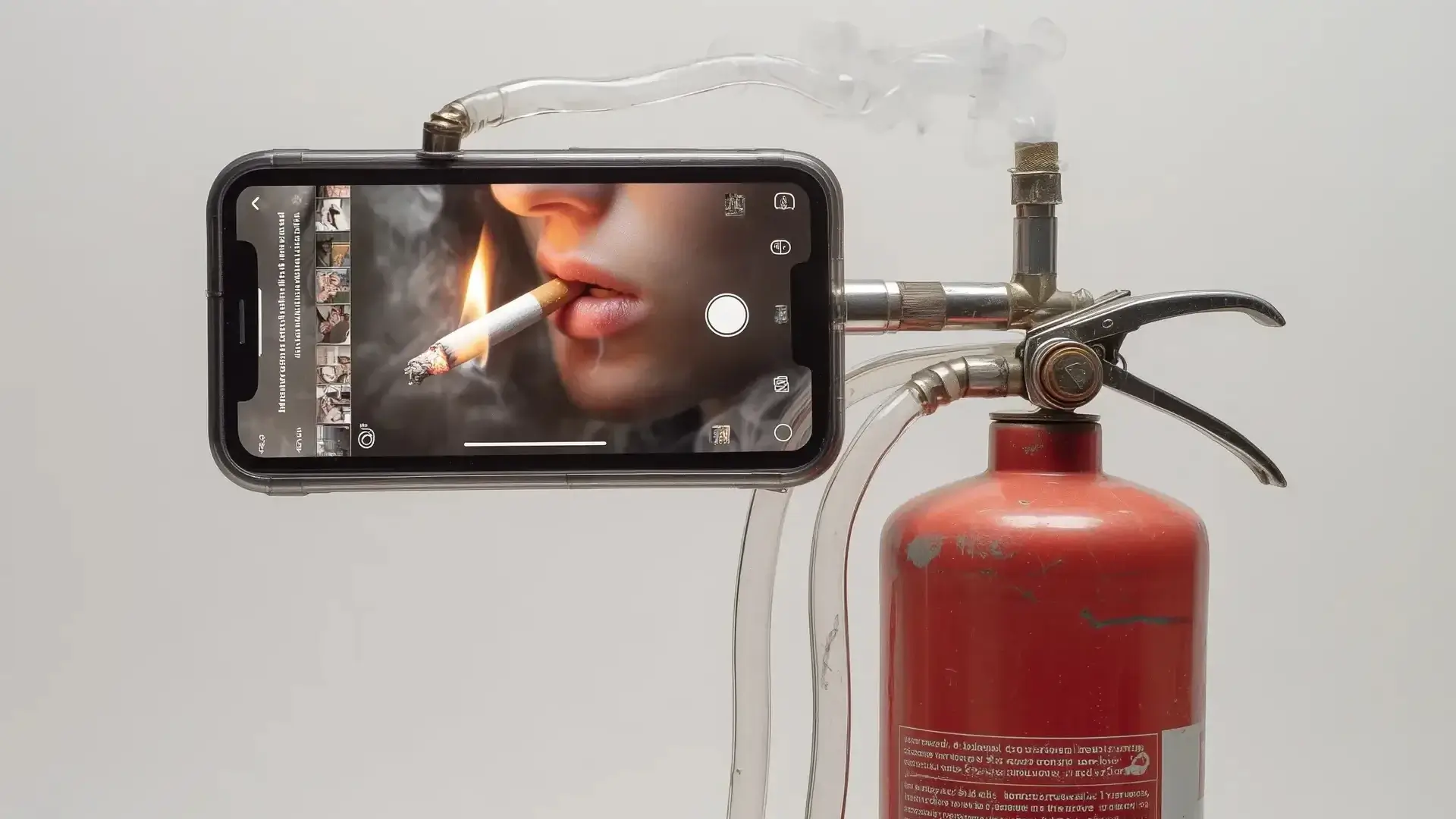
Today, the perception of art is largely mediated for all of us, as new digital spectators, by the restrictive format of the portable display, a frame that imposes strict laws on image composition and readability. The shift from the 1:1 scale of physical experience to the digital miniature has forced a simplification of visual language, prioritizing violent color contrasts and centralized geometries that can survive data compression. A work that requires time to be deciphered or that plays on subtle tonal variations risks invisibility in the incessant flow of online search. This dictatorship of the ‘thumbnail’ has generated, to some extent, what we call an aesthetics of immediate impact, where conceptual complexity must be sacrificed at the altar of instant recognizability.
The digital eye does not seek detail, but pattern; it does not seek narrative, but visual branding. Many artists, aware of this perceptual filter, have begun producing works that are born already optimized for small-format reproduction, reversing the traditional process of artistic creation. The result is a production that favors surface over depth, where texture must be ‘tactile’ even through smartphone glass.
Material painting, monumental sculpture, and environmental installations are flattened into a luminous bidimensionality that radically alters their phenomenological weight. The work is no longer an object occupying a space, but an image occupying a position in an infinite list, losing its aura in favor of maximum circularity. Furthermore, the search algorithm tends to reward stylistic redundancy, pushing creators to obsessively replicate the elements that have guaranteed success in terms of engagement.
This creates a sort of involuntary canon, dictated not by traditional criticism or the market, but by a metric of popularity that uniforms artistic offerings within a narrow range of formal possibilities. Originality is thus mediated by a constant negotiation with the platform’s visibility parameters. The emerging insight is that technology does not merely transmit art but reshapes it in its own image. The logic of the feed has transformed the act of looking into a rapid scanning operation, making art a visual consumer good that must be, first and foremost, perfectly compatible with the interface hosting it.

Without Hierarchy
The feed operates as a great axiological leveler, where the distinction between high and low culture vanishes in a fog of undifferentiated stimuli. Online search logic does not distinguish between a Renaissance masterpiece and an amateur illustration, between luxury design and glitch aesthetics, provided these elements generate similar algorithmic interest. This erosion of boundaries has allowed for the birth of a radical syncretism, in which artists draw freely from a universal catalog of signs without caring for their provenance or original meaning. This condition of ‘hyper-availability’ of cultural references has led to the end of authenticity understood as a link to a specific tradition. The contemporary artist is a sampler, a remixer of codes who assembles fragments of disparate realities to create hybrid objects that reflect the incoherence of our media landscape. It is not simple eclecticism, but a new form of realism: that of a mind constantly exposed to a collage of global images. Art produced under this visibility regime no longer follows a unitary trend but fragments into a myriad of subcultures dialoguing through the network’s common code.
The lack of a stable hierarchy allows for aesthetic explorations that once would have been considered heretical or in poor taste, but today find legitimacy in their ability to resonate within specific digital niches.
The work’s value is thus shifted from its intrinsic content to its function as a connector between different sensibilities. In this context, the ‘meaning’ of the work becomes a variable dependent on the viewing context, the set of images that precede and follow it in the user’s feed.
A minimalist work takes on different meanings if seen after a political meme or a cosmetics advertisement. The artist loses control over the final reception of their work, accepting that it becomes part of a collective and disordered discourse that escapes any attempt at traditional curation.
The fundamental insight is that in the feed, a work’s identity is defined by its temporary neighbors. Beauty no longer resides in the isolated object, but in the quality of its integration into a flow of stimuli that continually rewrites its function and symbolic value.

The Collapse of Critical Distance
The feed’s interface annuls the physical and temporal distance that has historically separated the viewer from the work of art. While a visit to a gallery required movement through space and a psychological predisposition for reception, digital scrolling occurs in a condition of domestic or mobile passivity, where art is inextricably mixed with daily life.
This forced proximity eliminates the ‘time of reverberation’ necessary for critical processing, replacing it with an immediate and superficial emotional reaction. Art criticism, traditionally tasked with mediating between the work and the public, finds itself displaced by a system that rewards speed over depth. When an image disappears from view in a few seconds to be replaced by another, textual analysis becomes an obsolete exercise, almost an anachronism. Critical discourse is thus absorbed by the logic of the short comment and the ‘like’, forms of validation that do not interrogate the work but simply confirm its existence within the circuit of attention. This contraction of critical time influences how art is conceived: many artists now tend to produce works that already contain self-explanatory elements or are designed to be immediately ‘Instagrammable.’ The work no longer needs to ask difficult questions; it must offer gratifying aesthetic answers that do not interrupt the flow of visual consumption. The risk is a standardization of artistic thought at elementary levels of readability. Furthermore, the logic of the feed favors the creation of taste bubbles in which the user is exposed only to what the algorithm presumes they might like.
This self-confirmation mechanism eliminates confrontation with alterity and the uncanny, essential elements of any radical artistic experience. Art in the feed thus tends to become reassuring, a pleasant visual background that decorates our navigation without ever shaking its ideological foundations. The insight is that extreme proximity to the image has produced a new form of blindness. We are so immersed in the visible that we can no longer see the work as a distinct object, but only as a variation of our own subjectivity projected onto the screen.

The Algorithm as Shadow Curator
Despite the illusion of total freedom in online searching, our experience of the visible is rigidly structured by software architectures acting as invisible curators. These systems do not operate according to aesthetic or historical criteria, but based on logic designed to maximize engagement and user retention. Art, in this scenario, ceases to be a free expression of the spirit and becomes a variable in a mathematical equation that decides what deserves to be seen and what must remain in the shadows. The effect of this algorithmic curation is the creation of ‘ghost trends’, styles that appear to dominate the global landscape only because they are favored by platform distribution mechanisms. Artists, often unconsciously, adapt their chromatic, formal, and thematic choices to these invisible standards, giving rise to a homogeneous aesthetic that self-reproduces through data feedback. Creativity is thus channeled into predefined paths that limit the possibility of true innovative departure.
The loss of the human curator’s role, understood as a figure capable of building complex narratives and proposing bold juxtapositions, has left a vacuum that the algorithm fills with the logic of similarity. If art once pushed us toward the unknown, today it keeps us within the known, proposing slightly altered versions of what we have already appreciated. This loop of aesthetic repetition empties the work of art of its capacity for surprise, reducing it to a visual comfort good. Parallelly, the speed of online search imposes a programmed obsolescence on artistic proposals. A work that does not generate an immediate peak of interactions is quickly buried in digital archives, depriving it of the possibility of slow rediscovery or long-term evaluation. The pressure to constantly produce ‘new content’ pushes artists into a productive frenzy that often comes at the expense of research quality and consistency.
The final insight is that cultural authority has shifted from the institution to the code. It is no longer the museum that validates what is worthy of memory, but the search engine, transforming the value of art into a function of its computational findability.

The Erosion of Context
Ultimately, the supreme condition of perception in the feed is the absolute decontextualization of the artistic object. Extracted from its original environment, detached from its history, and deprived of its physicality, the work of art in the digital flow becomes a pure floating sign. This uprooting allows for unprecedented and potentially fertile juxtapositions, but simultaneously empties the image of its political, social, or religious charge, reducing it to a mere decorative texture for the user interface.
The fact that multiple images from different fields appear in the same feed without any continuity destroys the notion of art’s ‘sacred space.’ There is no longer a clear boundary between the sacred and the profane, between the public and the private, as everything is brought back to the dimension of the backlit pixel. This erosion of context influences not only consumption but also the genesis of the work, which is born already orphaned of a physical place, destined for a ubiquity that dilutes its intensity. In response to this dispersal, some artists attempt to reintroduce complexity through excessive layering or deliberately obscure languages, trying to create friction that slows down the scrolling of the feed.
However, even these attempts at resistance are often reabsorbed by the logic of flow, which transforms them into new ‘aesthetics of complexity’ ready to be consumed like any other. The system possesses an almost unlimited capacity to neutralize subversion by transforming it into style. ‘Feed-style’ perception has thus changed our very cognitive structure, making us incapable of sustaining a prolonged gaze on a single object. We have become navigators of an infinite surface, where depth is perceived as an obstacle to cruising speed. In this scenario, art no longer follows continuous threads because continuity itself has become a foreign concept to our daily experience of digital reality. So?
The feed is not just a way of seeing art; it has become art itself: a collective, involuntary, and incessant work that reflects our condition of permanent fragmentation. The single work is now just a frame in an infinite film that has no plot, only rhythm, and whose only meaning lies in its perpetual variation.