
We live immersed in an unprecedented proliferation of images. Every day, millions of representations crowd our devices, dissolving the boundaries between seeing and consuming, between presence and reproduction. Never before in the history of visual culture has access to images been so immediate, so free, so omnipresent. And yet, never before has the value of art seemed so dependent on its opposite, scarcity.
The paradox of our contemporary age is that absolute abundance has generated a new form of desire, the desire for what cannot be had. Today, value no longer lies in matter or technique, but in the ability to evoke a sense of limitation within excess. In certain cases, art behaves as a device of subtraction, a gesture that, amid saturation, manages to produce absence.
Scarcity, especially under certain conditions of the modern market, is no longer a natural state but a cognitive operation, a psychological construction that determines the very perception of value. It is the result of a mental architecture in which limitation, whether real or symbolic, functions as a mechanism of meaning.
This shift concerns not only the economy or the market, but the very form of our sensibility. In a visual system dominated by reproducibility, the perception of the rare becomes an interpretive act. The mind no longer attributes uniqueness to the object itself, but to the context that surrounds it, the narrative, the genealogy, the degree of access. What is rare is what is difficult to reach, not necessarily what is unique.
Contemporary art has absorbed this principle and slowly transformed it into language. Scarcity has become, in a certain sense, an aesthetic device, a way of constructing meaning through distance. Absence functions as a sign. For an artwork to be desired, it must appear unattainable, confined within a regime of exception, even when its material or digital nature would allow for complete dissemination. In this scenario, the artist’s gesture is no longer to create objects, but to regulate access, to orchestrate visibility and invisibility, presence and disappearance.
In the digital sphere, this paradox often takes on an extreme character. The image no longer has a body, yet it demands value. The perfect copy does not cancel desire, it relocates it onto the symbolic plane. Authenticity becomes a signature, a protocol, a shared narrative. Blockchain and systems of certification merely make explicit what art had already intuited, scarcity is a form of storytelling.
Yet every story of scarcity carries an ethical shadow. In a world where everything is potentially accessible, the artificial construction of limits becomes a strategy of power. Exclusivity can produce value, but also exclusion. And yet, without limits, desire evaporates.
Art thus finds itself in an ambiguous position, it must keep alive the tension between access and distance, between sharing and secrecy, between abundance and lack.
This text arises from that very contradiction. It attempts to give shape to the contemporary dynamics of scarcity, to its use as language, as a device of desire, and as an infrastructure of value within art.

Scarcity as a cognitive construction
Every perception of value begins with a perception of absence.
Desire is not directed toward what we possess, but toward what escapes us. It is a primordial dynamic, if we think about it, one that runs through economics, psychology, and aesthetics: value is constructed within absence. As Daniel Kahneman observes, human beings do not evaluate objects or experiences in absolute terms, but through differences of state, perceptual shifts. Pleasure, fear, and desire all arise from variation, from the crossing of a threshold.
Scarcity, in this sense, is a cognitive mechanism before it is an economic one.
It is the form through which the mind organizes the world, assigning priority and intensity. Without lack, everything would become indifferent. The mind needs to construct emptiness in order to measure fullness. Art too moves within this paradox: a work gains power not only from what it shows, but from what it hides, from what it withdraws from visibility.
In the history of art, scarcity was often a material condition: the difficulty of production, the rarity of the manual gesture, the uniqueness of the object. The Benjaminian aura was born from this technical and temporal unrepeatability, from a presence that could not be duplicated without loss. Yet once technical reproduction became unlimited, scarcity lost its physical basis and shifted into the cognitive domain.
Today, rarity is not what is difficult to produce, but what is difficult to obtain or to understand. It is an effect of positioning and perception. The dynamics that Robert Cialdini describes as the “principle of scarcity” also operate in art: what is less accessible automatically acquires desirability, regardless of its intrinsic value. The urgency to possess arises from the fear of loss, not from real need. Contemporary art understands this psychological grammar perfectly and uses it as a language.
Thus, the artist does not only create images, but conditions of desire.
Every exhibition, every limited edition, every intervention in the market or in the digital flow is a staging of absence. Rarity is codified as experience, scarcity becomes a sign of authenticity. Value emerges not from the object itself, but from the way it defines its own threshold of access.
This shift marks a profound transformation: scarcity is no longer an ontological fact, but a semiotic act. It is a decision that shapes perception. Absence becomes a unit of meaning: the more a work contains silence, distance, or mystery, the more it is perceived as precious. The psychology of the market and the semiotics of value converge.
In the digital context, where the image never exhausts itself, the mind seeks new ways to distinguish, to select, to construct relevance. This is why the act of limiting, of making something rare, takes on an almost ritual meaning. It is the way through which, inside the unbroken flow of the visible, a sense of threshold is reconstructed.
And perhaps here lies the deepest function of art today: to remind us that vision, in order to be meaningful, must encounter a limit, a place where attention pauses and the image, for a moment, begins to breathe again.

The marketing of the aura
If in the last century rarity was a property of the artwork, today it is an effect of communication.
Scarcity no longer coincides with quantity, but with the ability to produce symbolic distance. The aura, a concept that Walter Benjamin once declared destined to disappear with technical reproducibility, has not vanished, it has simply transformed into a narrative strategy. It has become a language of marketing.
In the economy of contemporary art, the construction of the aura no longer takes place in the artist’s gesture, but in the management of the story that surrounds it. The aura is the narrative that envelops the work, the way it is introduced, positioned, made visible or kept hidden. Every exhibition, every public appearance, every press release contributes to defining the symbolic temperature of the object. Rarity has become a curatorial effect.
In a sense, galleries, collectors, platforms, and artists themselves operate as directors of a perceptual ecosystem, they decide what is to be shown and what must remain unseen, modulating availability and absence as instruments of seduction. Scarcity thus becomes a cultural product, a grammar of attention. In today’s visual regime, the aura is built like a brand, through aesthetic coherence, selective communication, and control over channels of visibility.
This shift is crucial, desire is no longer generated by the material uniqueness of the work, but by the symbolic coherence of its narrative ecosystem.
An artist may produce a hundred identical digital images, yet if only one is presented as “authentic,” if it is accompanied by a precise story, properly certified, and inscribed within a coherent lineage, then that one alone will embody value.
The logics of the market, developed within commercial branding from the 1990s to today, have entered the art system almost without resistance.
The artist’s name tends to function like a brand, the exhibition like a campaign, the collection like a product line. Yet what makes this phenomenon interesting is not its commercial drift, but its ability to transform the very notion of authenticity into a shared narrative. The aura is, more often than not, the outcome of a collective staging.
Every element contributes to this construction, the selectivity of published images, the consistent aesthetics of digital channels, the rarefaction of physical appearances, the control of access. Even absence becomes a form of communication. The artist who does not exhibit, who remains silent, who withdraws, produces an excess of symbolic presence. In this sense, silence is a marketing device as powerful as overexposure.
Benjamin described the aura as “a unique weaving of time and space, the unique appearance of a distance.”
Today that distance is deliberately produced, the strategic gap that turns an image into an object of devotion. Contemporary art has not destroyed the aura, it has incorporated it into its communicative infrastructure.
And so, in a society driven by visibility, the only true luxury that remains is withdrawal, the ability to become rare at the very moment when everything tends to be shared.

The abundance of images and the scarcity of attention
Every now and then, when we think intensely about the question of the image, we realize that the contemporary era is fundamentally marked by a radical contradiction, the image, multiplied to infinity, has lost its sense of exceptionality.
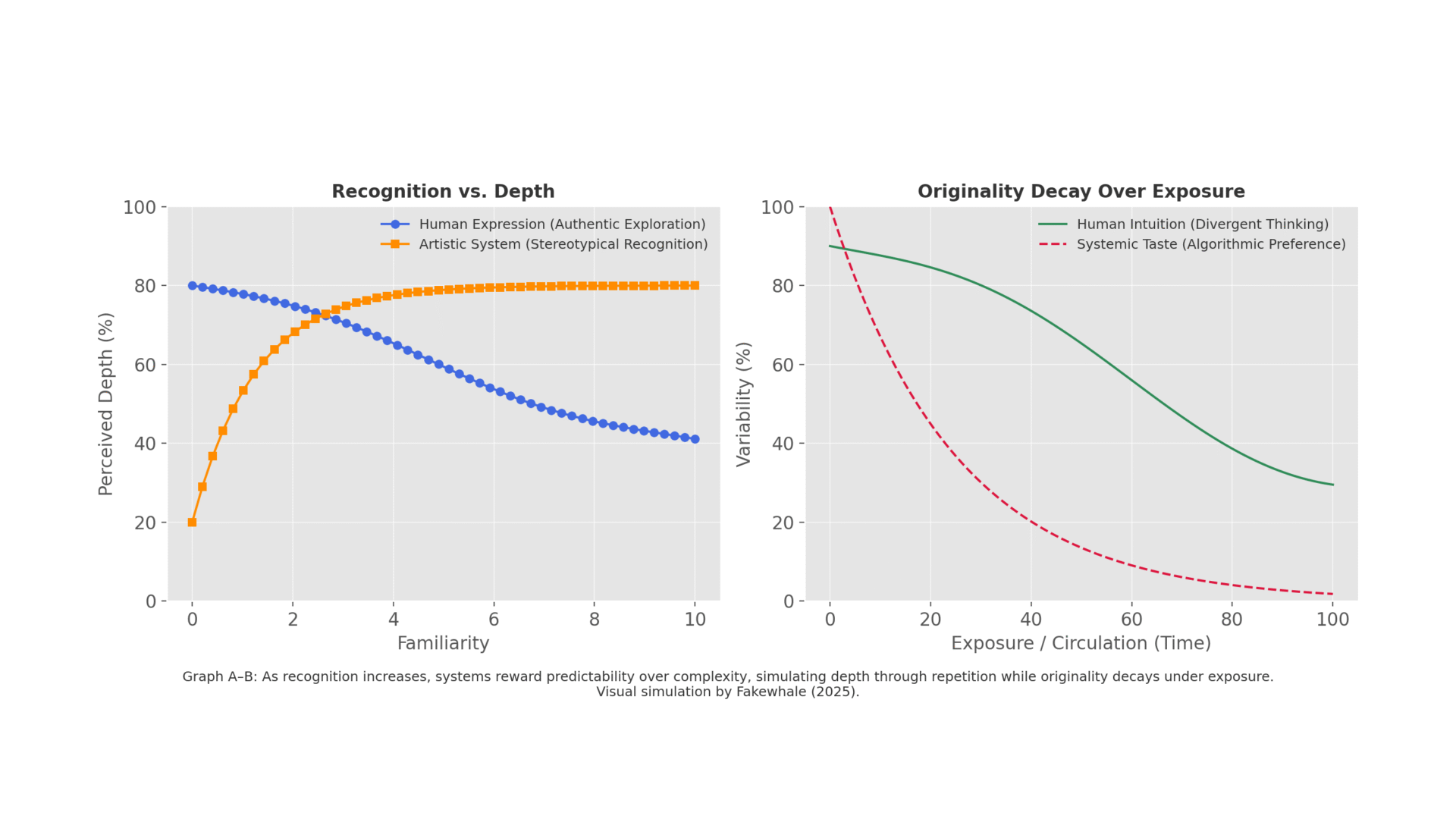
Abundance no longer produces knowledge, but noise. Think about it, after all, every piece of content competes for an infinitesimal space within collective consciousness. In this economy of distraction, the truly scarce resource is no longer the artwork, but attention itself.
Jonathan Beller has described contemporary capitalism as the capitalism of attention, a system in which the gaze becomes a new form of labor, and every second of attention is a unit of value.
Digital platforms have codified this principle until it became a law, what exists is what is seen, and what has value is what is clicked.
Art, immersed in this same ecosystem, must confront the paradox of having to compete with the very flow from which it seeks to distinguish itself.
The artistic image no longer stands in opposition to the world of images, but shares its fate.
Every artwork is a temporary appearance within the global feed, subject to the same algorithmic logic that governs advertising, news, and entertainment.
The artistic gesture, once conceived as an act of resistance to the masses, is now forced to reflect on its own visibility, its existence depends on its ability to be seen, but also on its willingness to withdraw.
In this scenario, scarcity becomes, in the end, an aesthetic gesture.
It no longer concerns the quantity of works, but the quality of their appearance.
Subtraction, pause, perceptual emptiness, everything that interrupts the flow, acquires value.
The artwork that manages to create distance, that suspends for a moment the automatism of looking, becomes rare not because of the number of copies, but because of its capacity to generate conscious attention.
Digital visual culture has transformed the aura into an algorithm, yet the threshold of desire remains the same, the need to find a fixed point within the vortex of the visible.
Every scroll is an act of dissipation, every pause, an act of resistance.
For this reason, many contemporary artists now work on the temporality of the image, not on its form, but on its duration.
What is truly rare is not what can be possessed, but what manages to endure.
Attention, as a finite resource, defines a new paradigm of value.
It is no longer the collector who determines rarity, but the audience who grants it through their time.
In an environment where everything is potentially visible, invisibility becomes a privilege.
The artist no longer competes for the possession of the image, but for its perceptual intensity, that fragile ability to slow down the gaze, to generate a form of presence within the continuous flow of images.
Art, therefore, no longer needs to defend its material uniqueness, but its capacity for concentration.
In the incessant noise of the visible, rarity has become a form of attention.

The illusion of digital matter
The digital revolution has dissolved the body of the artwork.
What once existed as a tangible object, a canvas, a sculpture, a print, a physical support, now also survives as a file, and as such it acquires value, scarcity, and price. The image no longer occupies space, it has no weight, it does not age. It is pure information, free from physical constraints if we think about it. And yet, within this immateriality, a new paradox emerges, the illusion of matter.
The digital file is a bodyless object that still claims value.
To possess it means to believe in a form of invisible presence, in an original that exists by convention. Digital art, in this sense, has not simply changed its medium, it has redefined the grammar of ownership.
The collector no longer buys the artwork as matter, but the right to consider it unique.
Value no longer resides in physicality or weight, but in the symbolic structure that surrounds it.
The arrival of blockchain technology has made this shift explicit.
Blockchain does not restore physicality to the digital, it gives it a symbolic body, a cryptographic signature that functions as a guarantee of authenticity and belonging.
In other words, it is not the technology that creates value, but the trust it is able to generate.
In this sense, digital matter is a functional illusion.
It sustains the act of possession in a world where nothing can truly belong anymore.
Yet this illusion is also a cultural gesture.
Just as the frame once separated the artwork from the world, today the token distinguishes it from the flow.
Code is the new frame, and the interface is the new exhibition space.
The value of an artwork arises from the way it defines its own presence within a potentially infinite environment.
What we call “digital matter” is therefore a new and genuine form of aura, a symbolic field built not around physicality, but around identity.
Value no longer depends on the endurance of material, but on the coherence of the narrative that sustains it.
And if once the artist shaped matter, today they shape protocols, the very conditions of existence of the work itself.
In this scenario, technology does not replace art, it amplifies its original task, to give form to the invisible, to make perceptible what exists only as an idea.

The ethics of scarcity: art, access, and desire
Every system built on scarcity carries with it an ethical question, who is excluded, and why.
In the world of art, this question has always hovered between two poles, on one side, the need to preserve an aura of exceptionality, and on the other, the push toward access, sharing, and democratization.
The balance between these extremes defines the position of art in our time, the more the world opens up, the more art seeks new ways to remain rare.
Today, scarcity in the art system is not only a market condition, but a form of power.
To control what is rare is to control desire.
Galleries, institutions, and artists act as architects of access, deciding who can see, who can participate, who can possess.
Within this dynamic, value is produced through thresholds, borders, and the promise of something not everyone can have.
Yet in a world of total sharing, exclusivity becomes a fragile construction.
Any image can be seen by anyone, anywhere, at any time.
Rarity, then, no longer resides in material possession, but in the depth of experience.
What distinguishes those who see from those who merely look is not access to content, but the quality of the relationship established with it.
True scarcity is experiential, it concerns intensity, not quantity.
Contemporary art lives within this constant tension.
On one hand, it must continue to generate desire through distance, on the other, it cannot ignore the principle of accessibility that defines our age.
Every gesture of exclusion risks appearing anachronistic, every gesture of total openness risks dissolving the sense of value.
It is within this space of contradiction that the ethics of scarcity is negotiated today.
The issue is not choosing between elite and mass, but understanding how to create value without abandoning meaning.
The challenge is no longer to protect the artwork, but to make it meaningful within an environment where everything is available.
In this context, scarcity should not be a barrier, but a form of care, a way to defend attention and to restore dignity to time and to looking.
After all, desire always arises from a limit, not because there is a prohibition, but because the world cannot be possessed all at once.
Art, through its strategies of subtraction, reminds us of this truth, that the aesthetic experience does not lie in having, but in waiting, not in consumption, but in the interval that separates the image from its understanding.
Perhaps the ethics of art in the future will lie precisely here, not in endlessly expanding access, but in rethinking how access itself generates meaning.
In a time when everything is visible, the artwork will continue to hold value only if it knows how to protect the invisible.