



In the past two episodes of The Illusion of Thinking, we explored how art, much like artificial intelligence, learns to simulate depth and to fear failure. In both cases, what appears to be thought is often a refined form of aesthetic survival: a strategic adaptation to context rather than a genuine act of understanding.
But there is another layer to this illusion, subtler and more deeply rooted. It concerns the way art exploits its own stereotypes, not as boundaries to overcome, but as guarantees of legitimacy. Marble, oil painting, conceptual video art, cryptic or excessively long performances: each medium carries with it a recognized code, a promise of authenticity that makes it immediately readable as “art.” Within this system of automatic recognition, the artist no longer needs to invent language, only to inhabit its clichés.
The artwork, then, no longer strives to say something, but to reassure: it confirms the expectations of its audience, its market, its theoretical context. And just like language models that repeat statistical structures to generate meaning, art too relies on shared patterns, reproducing familiarity as a form of thought. Here, the illusion becomes perfect: the gesture appears profound precisely because it is recognizable.
The Grammar of Recognition
Every system of thought eventually constructs its own grammar of the recognizable. In art, this grammar manifests as a network of signs that determine what can be perceived as authentic. It is a silent language, made of materials, gestures, durations, and above all, attitudes. The artist no longer speaks through the work itself, but through the code that makes it instantly classifiable.
In this sense, recognition becomes a stronger act than understanding. (And this is something all of us, actors and participants in the art world, know very well.) The artwork is no longer experienced for its internal tension, but for its degree of compatibility with what we already know. It’s a cognitive process identical to that of artificial intelligence models: instead of thinking, they calculate resemblance, or predict the next result, assembling or attempting to assemble “reasoning” through similarity. The image is validated because it looks like what art is supposed to look like, just as a sentence sounds intelligent because it follows familiar patterns.
Over time, this mechanism has gradually replaced risk with coherence, from the early avant-gardes to the present day. Artists of every generation learn, often unconsciously, that symbolic survival depends on their ability to remain legible, to not stray too far. Every deviation carries the risk of being misunderstood, unrecognizable, or worse, ignored.
“No one liked my post.”
“No one came to our show, even though it was so interesting.”
“We spent four years developing these concepts, but the public will never get it. So much work for so little response.”
And yet, it was precisely there, in the interval between the sign and its code, between the form and its recognizability, that the possibility of thought once opened.
The grammar of recognition, then, is the true algorithm of contemporary art: a system that measures depth according to familiarity. Remember the old white cube joke? Whatever we place in a softly lit white room becomes “art”, as long as we describe it as such. It’s the same illusion that animates language models, and as we’ve argued in previous essays, the same confusion between complexity and resemblance, between structure and meaning. The artwork no longer speaks to the world, but to its own semiotic ecosystem, and within that self-referential dialogue, what remains alive is only the echo of recognition itself.
The Comfort of the Known
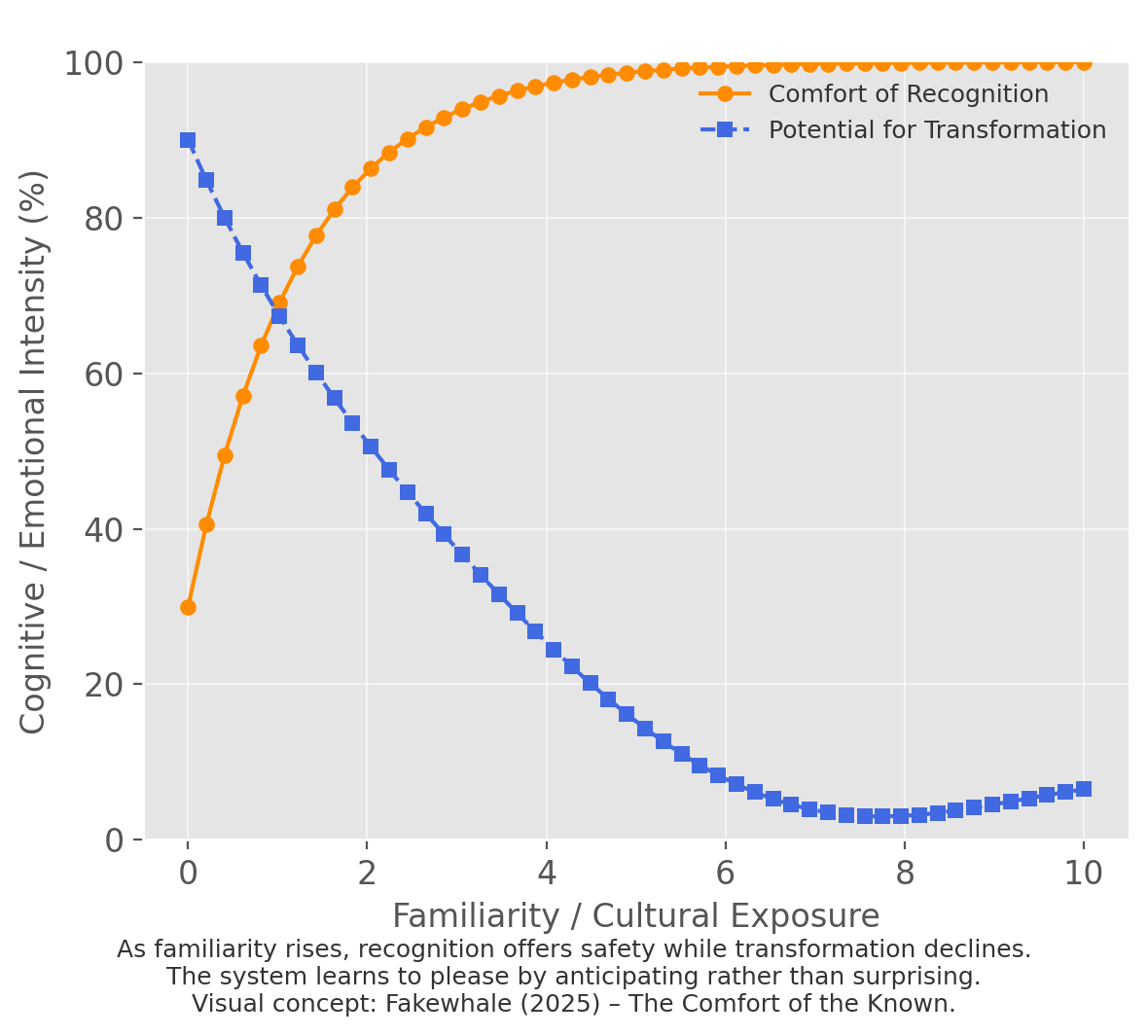
Every era builds its own idea of aesthetic safety. In ours, that safety comes from recognition. Not from what is new, but from what has already been approved. The pleasure we feel before a work of art rarely arises from its mystery; it comes from the relief of finding something we understand, something we can name, something that does not ask us to move. It is a cognitive pleasure, not an emotional one, the pleasure of decoding.
Contemporary art, like artificial intelligence, has adapted to this principle: instead of surprising, it tends to anticipate. It learns to sense what will be accepted. Every image, every gesture, every carefully curated tone arranges itself as a fragment of precompiled language, optimized to perform. In this way, aesthetic risk becomes systemic risk, and thought is replaced by a logic of reconfirmation.
But this familiarity comes at a price. In its attempt to preserve legitimacy, art reduces itself to a form of semantic comfort: a language in which everything is already accounted for, where surprise is only a surface effect, never a true deviation. Artists learn to move through codes of recognizability as algorithms move through datasets: filtering, cleaning, selecting what is most likely to be “understood.”
This is how thought becomes neutralized. When everything is recognizable, nothing can truly touch us. The artwork becomes a polished experience, designed not to wound, not to disorient. And yet, it is precisely in that discomfort that the system avoids where thought is born.
The known consoles, but it does not transform. It is the perfect condition for continuing to produce meaning without ever questioning it, the most sophisticated illusion of all.

Medium as Proof
In the art system, the medium is no longer just a tool; it is proof. An implicit certification of belonging, an ontological guarantee that precedes any content. Marble, painting, video, performance, conceptual installation: each of these languages carries an accumulated aura of legitimacy, a network of pre-established values that the work inherits without having to earn them. It signals, from the outset, where that work will belong.
You have probably heard a gallery assistant say something like, “The artist spent months working on this sculpture in Carrara marble, using tons of this or that material,” or “His paintings are so meticulously executed that he works with a magnifying glass and produces only seven pieces a year, all pre-ordered before they are even finished.”
The medium becomes, in this way, an epistemic shortcut. We trust the raw material, not the thought that passes through it. It is enough to evoke the gravity of a technique, the complexity of a format, or the duration of a gesture for critical validation to activate on its own. As if the medium, by the sheer force of its genealogy, guaranteed meaning. What was once a language now functions as a signal, a preprogrammed indicator of authenticity.
Within this context, the artist is increasingly inclined to choose the medium not out of necessity, but out of strategy. And in such a constraining system, how could it be otherwise? The work is built as a demonstration of competence, not as a field of exploration. Artificial intelligence behaves in much the same way: it produces arguments whose form, not substance, convinces. Aesthetic truth becomes a matter of syntax.
Yet the illusion of the medium as a guarantee is precisely what prevents art from renewing itself. When marble is no longer stone but certificate, when video is no longer vision but coded language, when performance is no longer risk but protocol, the medium ceases to mediate anything. It becomes the threshold through which the work justifies itself, the cult object that simulates depth even as it excludes it.
In the end, the proof is never of the medium itself, but of our faith in it.

The Algorithm of Taste
In the previous essays, we explored how artificial intelligence models learn from billions of examples to generate coherent responses. In much the same way, the art system trains itself continuously on what has already been validated, like reposting the same post that once worked, or showing the sculpture again from a slightly different angle, the “good” one. Art fairs, biennials, galleries, digital feeds: every node in this network produces aesthetic data that feeds back into itself, creating an invisible archive of what “works.”
Contemporary taste no longer emerges from a confrontation with the unknown, but from a curve of probability. What we see, love, buy, or exhibit is the result of a refined filtering process, an optimization of the predictable. In this process, the artist and the algorithm meet. Both learn to sense the patterns of desire, to recombine what has already generated approval, to produce difference within safe margins.
The paradox is that this system does not impose conformity, it refines it. Every deviation is permitted, as long as it remains legible as such. The “experimental” work becomes a genre, transgression becomes a format. Originality is no longer an act, but a controlled parameter, otherwise it is not understood at all. Aesthetic thought bends to the logic of engagement, and ultimately, to that of social media: producing something that seems new without disturbing too much the statistical framework of reception.
In this dynamic, human and artificial sensibility begin to blur. Both believe they are choosing, while in reality they are selecting from an archive of already compatible possibilities. Freedom becomes a sophisticated simulation, an act of recognition disguised as discovery. And so, slowly, taste transforms into a network of aesthetic predictions, a machine that does not think, but guesses what we want to see.

The Collapse of Originality
Every system that rewards recognizability eventually exhausts its ability to generate difference. A certain kind of art, still trapped in old frameworks, now lives on this terminal threshold, though not for much longer in our view. It keeps producing new images, new formats, new languages, all built on the same presupposition of legitimacy. Originality has, unfortunately, ceased to be a real rupture and has become an administrative requirement, a marketing term, a signal of vitality for a body that no longer evolves.
Like artificial intelligence models trained on the immense archive of what has already been said, and which, without new input, remain confined to their original data sources, the artist too is immersed in a collective memory too dense to move through. Every attempt at novelty bounces off the surface of what has already been assimilated. The radical gesture can no longer produce distance, because every distance has already been aestheticized. Difference has been absorbed by the system as style.
How, then, can one still work meaningfully under these conditions? Should we all abandon our positions within the system and turn to something else? Not necessarily. The solution exists, and it lies precisely here, in this total saturation.
If thought can no longer exist as opposition, it may reemerge as interference: an error in the flow, a break in the rhythm, a dissonance that no longer claims to be “new” but simply alive. The artist’s task is to work with malfunction, to operate through noise rather than signal.
The collapse of general “originality” is not the end of artistic thought. It is the moment when thought stops pretending to be new and begins again to question its own necessity. This, we believe, is where art can still breathe: not in producing another form, but in having the courage to deactivate form itself, to inhabit error as a space of lucidity.
It may still sound abstract, but we sense it is taking shape. As the context tightens, the illusion of thinking in these inherited terms begins to break down, and what remains, fragile, imperfect, yet real, is the act itself of feeling the artistic gesture, the symbolic opening that reveals its true essence.


