
In Herwig Scherabon’s work, the body is not a stable unit but a constellation of fragments, matter, and infrastructures. Bones, algorithms, and technical devices coexist as sedimentations of biological and computational processes, dissolving the distinction between human and nonhuman.
In this interview, we spoke with Scherabon about empathy without a subject, care entangled with control, and technology as an integral part of our evolution, proposing the body as a relational field rather than a fixed identity.
Fakewhale: Your work challenges a linear, centralized notion of bodily identity, offering instead disassembled, partial forms distributed across material, memory, and network. What does it mean for you to speak about “the body” today? And what role does the non-human play in this reflection?
Herwig Scherabon: The idea of a singular, self-regulating body feels increasingly outdated. Modern science gives us almost magical insights into a reality that is far more fragmented and collaborative than we once believed. Most of what we call “our body” is composed of non-human organisms that work with us rather than for us, such as bacteria, fungi or single-celled organisms. In this case we could say bone operates as indexed memory, and the metal frames as infrastructural logic as much as we can say that bacteria acts as outsourced metabolism in “our body”. So basically when you look closely, the body reveals itself more as a temporary alliance rather than a sovereign subject.
In my practice as well as in my teachings at our master programme “Postdigital Ecologies” at Digital Media & Experiment at HSBI Bielefeld, where I have taken on a professorship, I try to stay close to this expanded sense of embodiment. I often use the term Material Magic as a way to acknowledge this quiet intelligence of matter. Bone, resin, metal, algorithmic processes each carry its own stories and histories. I am not so much interested in using the term Material Magic as a metaphor or in illustrating theory but rather in working with these materials until they disclose something about themselves. It is an Object-oriented process and OOO theory has helped me a lot to articulate this, not because it gives answers, but because it refuses to reduce the world to human-only, and therefore identity driven, categories.
The distinction between human and non-human has always felt too narrow to describe the realities I encounter in the studio. It produces a hierarchy that doesn’t hold. For me, this very distinction has become an essentially deprecated model of describing reality. It is a conceptual and very abstract division that no longer makes sense, given what we know from modern biology and ecology. Posthuman perspectives only sharpen this. It is a starting point but never sufficient, in order to break through binary ideas of “the body”.
Working with bones, especially fragmented ones, becomes a way to loosen these inherited boundaries. A body is not a form but a constellation of functions, residues, and negotiations. Identity starts to look less like an inner truth and more like a convenient fiction, a story we tell to keep complexity manageable. What interests me is what remains once this fiction dissolves: a field of materials coexisting, sometimes harmoniously, sometimes not, but always with a kind of quiet insistence on their own agency. But I feel like or at least my hope is in this reduced and focused way of telling material stories that they may become more tangible to us.
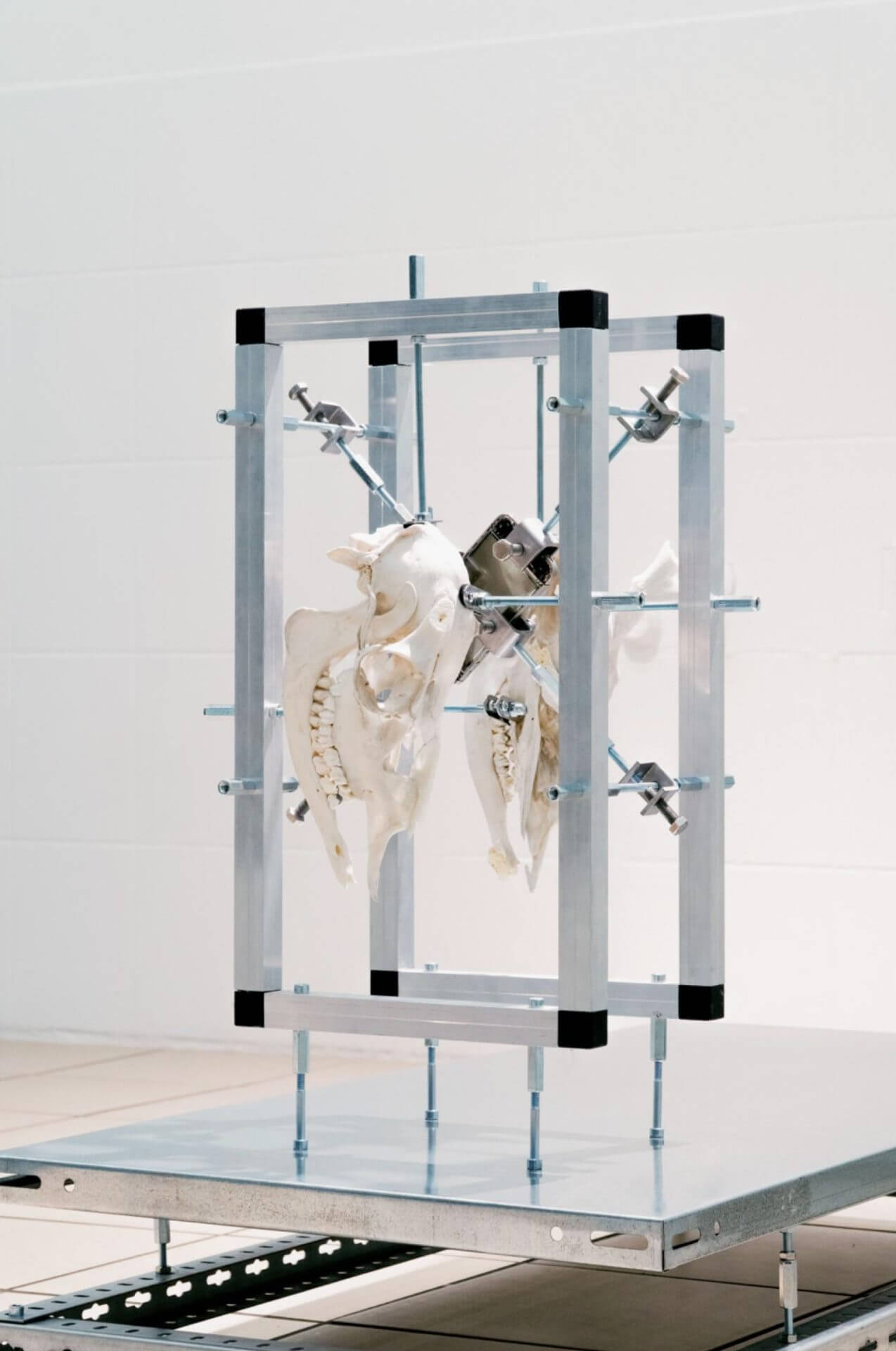
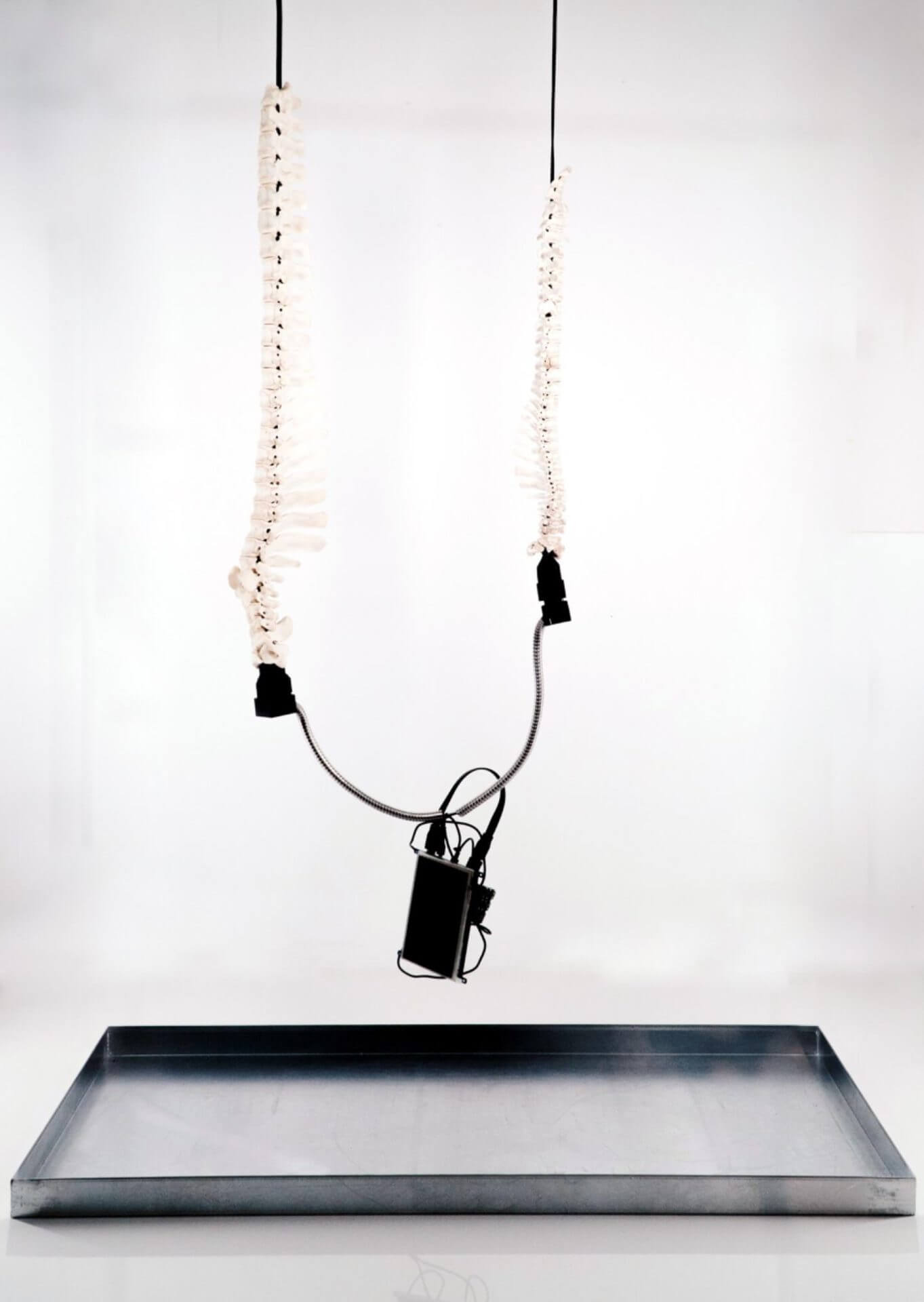
United in Signals stages an emotional bond between two pig spines, fragmented, yet still faintly perceptible. The piece seems to speak of love in the absence of subjectivity, or more precisely, in the absence of subjects. How can one construct an aesthetics of empathy that avoids falling into anthropocentrism?
Empathy is often imagined as a sentiment exchanged between subjects; a movement from one self to another. Politically this model has been indispensable, especially for communities who have had to fight for recognition and survival. But ontologically it feels as if it is not moving far enough away from binary systems. It reduces a vast field of relations to a narrow human transaction. In other words, this conventional model of empathy remains anthropocentric confined to human-to-human terms, rather than truly expanding beyond them. By contrast, the empathy envisioned in the artwork tries to dissolve this divide altogether: the subjects here are mere empty vessels for relatability. Emotions are not just personal, they are also always political. They exceed the individual and circulate through materials, histories, and infrastructures long before they arrive in us.
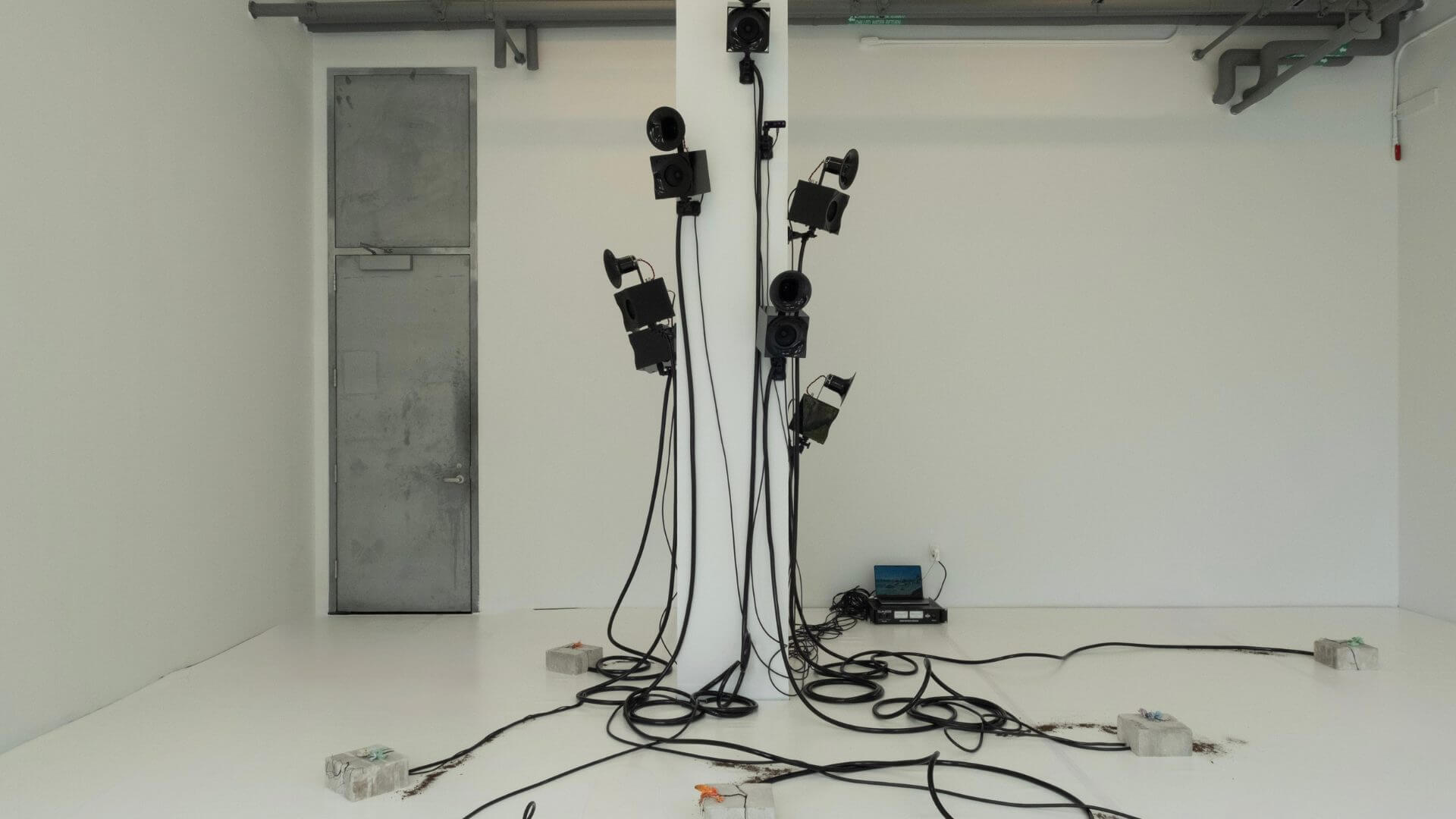
In my work I try to think of empathy and care without subjects. The subject-object hierarchy is too small to hold the complexity of what happens between bodies, especially once we acknowledge that bodies themselves are assemblages of many agencies. United in Signals works exactly within this expanded field. Two spines, a pig and a piglet, are linked through a minimal circuit of signals. Signals of a story whose sadness is not sentimental but structural. These are fragments of neurological pathways, stripped of identity yet still carrying a residue of relation. The material knowledge of death is present, but so is the tenderness that persists even when the bodies that produced it are gone. Love does not vanish with the subject, it rather survives in form, in matter, in signal.
The Clinic of The Unbodied in general takes this further by removing nearly all traces of personhood. Everything is reduced to components. Nothing is allowed the comfort of wholeness. This only seems to be an aesthetic of coldness on the surface but it is meant to be an invitation to perceive empathy differently: removed from its subjects. When subjectivity is absent, the human-non-human divide begins to dissolve. What remains is relation itself, unanchored, open, and strangely familiar. Pigs are anatomically close to us, but it is the gestures of care and dependency that resonate most. My hope is that the installation allows for an empathy that does not rely on projection or identification. Instead it becomes a shared field of life, something that moves through us rather than belonging to us. It is Oneness to put it very bluntly. United not just between mother pig and piglet but with us entangled in it.
Many of your works resemble diagnostic units more than artworks in the traditional sense. Rather than presenting aesthetics, they seem to reveal hidden infrastructures—genetic selection, veterinary control, algorithmic memory. Do you see your practice as a diagnostic tool?
The Clinic of The Unbodied did not start as an exhibition in the traditional sense. It started as an artistic research environment developed within my work at the University of Applied Sciences and Arts Bielefeld, where teaching and experimentation intersect. The aim was never to present finished objects. And since it is not a market oriented gallery exhibition, where aesthetically complete objects have ever been the goal, it can work pretty well as a system for revealing hidden infrastructures. Power dynamics, linguistic biases, and ontological defaults lie open on the dissection table. In that sense it is a clinic that examines the clinic itself, a counter-clinic that turns diagnosis outward. This is where I feel the Clinic can serve as a laboratory for artistic research.
I am far more interested in diagnosing the systems that classify bodies than in diagnosing bodies themselves. To diagnose a body artistically would mean to measure, compare, optimise, or imagine some perfected version of it. This easily slips into a transhumanist fantasy of improvement, which relies on hyper-capitalist ideals of productivity and value. I reject that logic. More so, I resent it and find it highly toxic. I prefer to remain with the unfinished, with the incomplete status quo, where bodies are not corrected but encountered, because I think in this way we can look at the body as a field of meaning rather than a specific patient with an identity, a diagnosis and a suggested improvement. I also don’t want to distinguish between human or animal ‘patients’ here. All bodies should remain purposefully ambiguous and under examination.
This openness allows the Clinic’s patients to stay ambiguous while the systems around them become more visible. Violence often hides inside these systems. Genetic selection, breeding technologies, the engineering of lifeforms: these are extreme forms of corporeal violence that operate under the disguise of optimisation. And let’s not forget bureaucracy as the outermost form of violence. There are softer forms as well, embedded in classification, diagnosis, and control. These forms reveal themselves only when we shift our perspective. They reveal themselves when we look at something as if it had never been seen before. For me the diagnostic act in art is not about identifying what a body is, but rather about exposing what has been done to it.
Many of your pieces reveal a tension between biological and computational time. What role do generative technologies, AI, growth algorithms, synthetic voice, play in your research? Are they tools, agents, or subjects in their own right?
In Manuel DeLanda’s work material is understood as sediment, shaped by the pressures and events that accumulate over time. I follow this line of thought by treating 3D printing as a way of hardening resin through machine memory. Here the growth that occurs in code operates in analogy to tissue growth and bone sedimentation. The machine follows its own logic, whether it processes 3D scans of skeletal remains or simulates differential growth. Since this is an ontological exercise rather than material research, the biological and the computational form a unit and are meant to be read interchangeably. To me it seems like a logical consequence in this case to distinguish by process rather than material and molecular composition. AI and growth algorithms are mimicry but also on this level of exploration this does not really make much difference. Again what matters to me is, what processes form these materials. In other words: what’s the code? Not, what’s the program?
More generally my practice has always tried to defuse tensions rather than illustrate them. Technology becomes an extension of human evolution, not in the transhumanist sense of improvement but as part of the human phenotype, as Richard Dawkins describes it. In fact, tools from fire to smartphones exemplify this “extended phenotype” (a concept by Dawkins describing how tools become part of an organism’s evolutionary expression) as integral parts of how humans adapt and survive. In that way of thinking your smartphone becomes a part of your body as much as the beaver dam is a part of being-beaver. In the Clinic I needed this non-binarity in order to present the individuals as much as possible as entangled in structures and infrastructures and not mere subjects. I am interested in the tension where tools and agents are indistinguishable from one another. This is the area where biological and computational time are less in friction and instead build their own cosmos of meaning.
The exhibition reflects this ontological continuity: bones and algorithms grow side by side, neither purely tool nor purely subject. The smartphones in our hands are evidence of this continuity. For better or worse they are simply the result of humans doing human things. We could say the same about artificial intelligence, with the slight difference that it may already be smarter than us. Technology is not external. It is folded into our agency, our memory, our gestures.
In the Clinic the encounter between bones and computation is not a metaphor. Each is formed through its own sedimentation and carries the trace of its making. Their role in the exhibition is not fixed. They are neither tools nor agents nor subjects, yet they can become any of these depending on the assemblage they enter. Prosthetics and augmentation seem less and less accurate terms to describe these coalitions we enter with technology. The tools and the bodies exist in an entanglement and not as extensions.
The Clinic of The Unbodied is set within a former veterinary clinic, an inherently ambivalent space where healing and euthanasia coexist. How did this tension shape the project, not just conceptually but also in terms of its spatial and material construction?
When we were scouting for locations we found this former veterinary clinic and immediately felt the charged atmosphere in the space. My curator and exhibition designer, María Basantes, who also came up with the title, did an incredible job translating the work into this environment. The room already had a strong personality and we needed a display system that could speak to it without dramatising it. We were careful not to turn it into a stage, a haunted house for speculative art. We absolutely did not want a Disneyland for body horror.
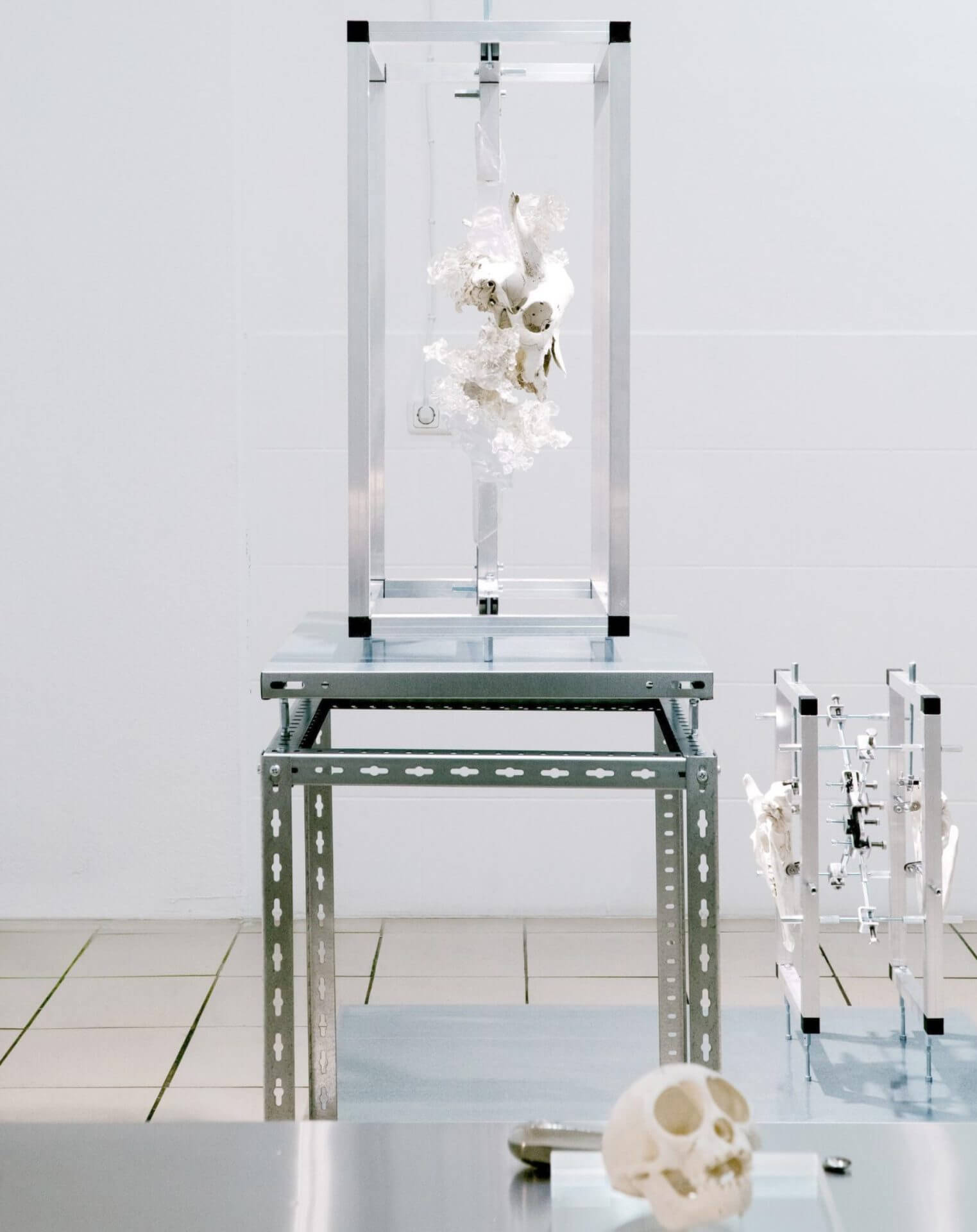
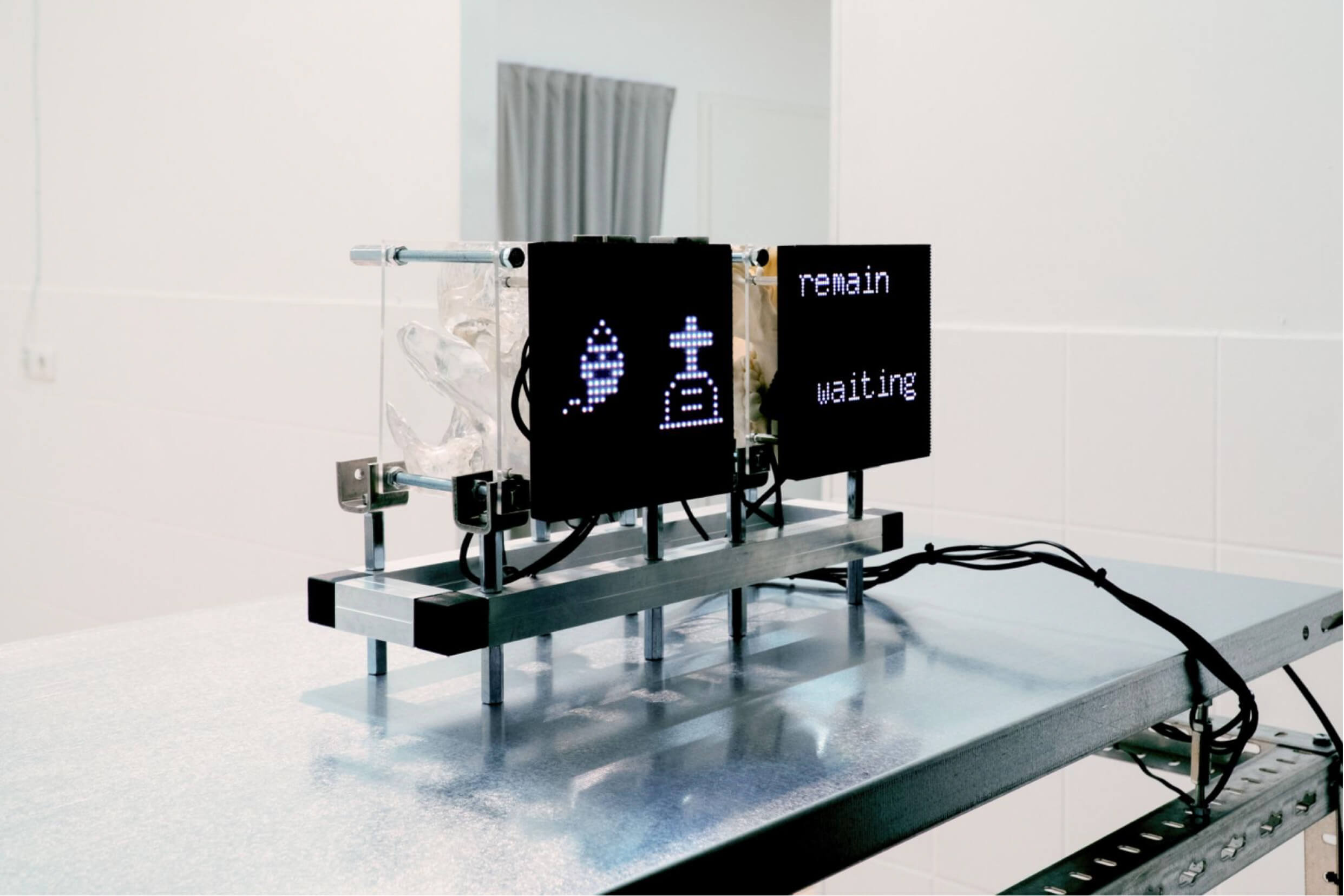
In the sculptures I was interested in dissolving familiar dichotomies like organic and technological or human and non-human. In the exhibition architecture we applied a similar logic by reducing our interventions as much as possible. This pushed processes, diagrams, and relationships into the foreground, while aesthetics became secondary. The violence of a clinic lies exactly in this grey area between care and control. In the works this materialises as the monochrome austerity of bone fragments suspended in engineered frames. Spatially this became the stripped surfaces and cold materiality of the display system. We needed an environment where bodies are treated as specimens, cases, and data where imposed narratives are stripped away, allowing the stories embedded in the material itself to come forward.
The Clinic extends a way of working that I also explore in my research and teaching: stripping phenomena to their operational components to see where meaning, care, or violence resurface. The exhibition space became a site where methodology could be tested in real time. In that sense the clinic is not just a setting but a stage for ontological rupture, where categories like organic and mechanic or care and violence begin to flicker. Ultimately, the clinic’s atmosphere itself embodies that ambivalence between care and control. It is a place of healing that can just as easily become a site of domination or even death. To be quite frank this is a rather cynical showcase more than a proposal for a utopia.
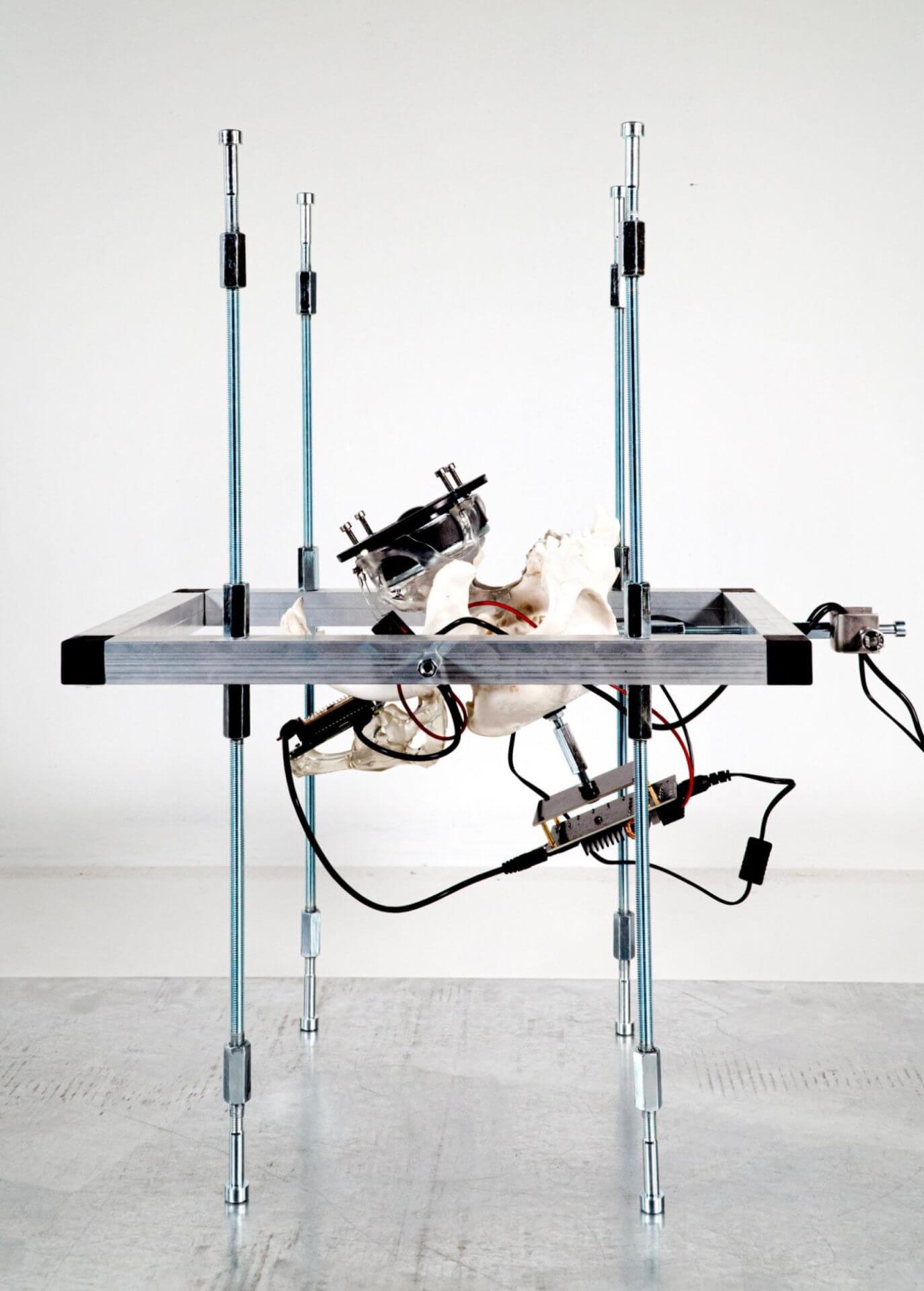
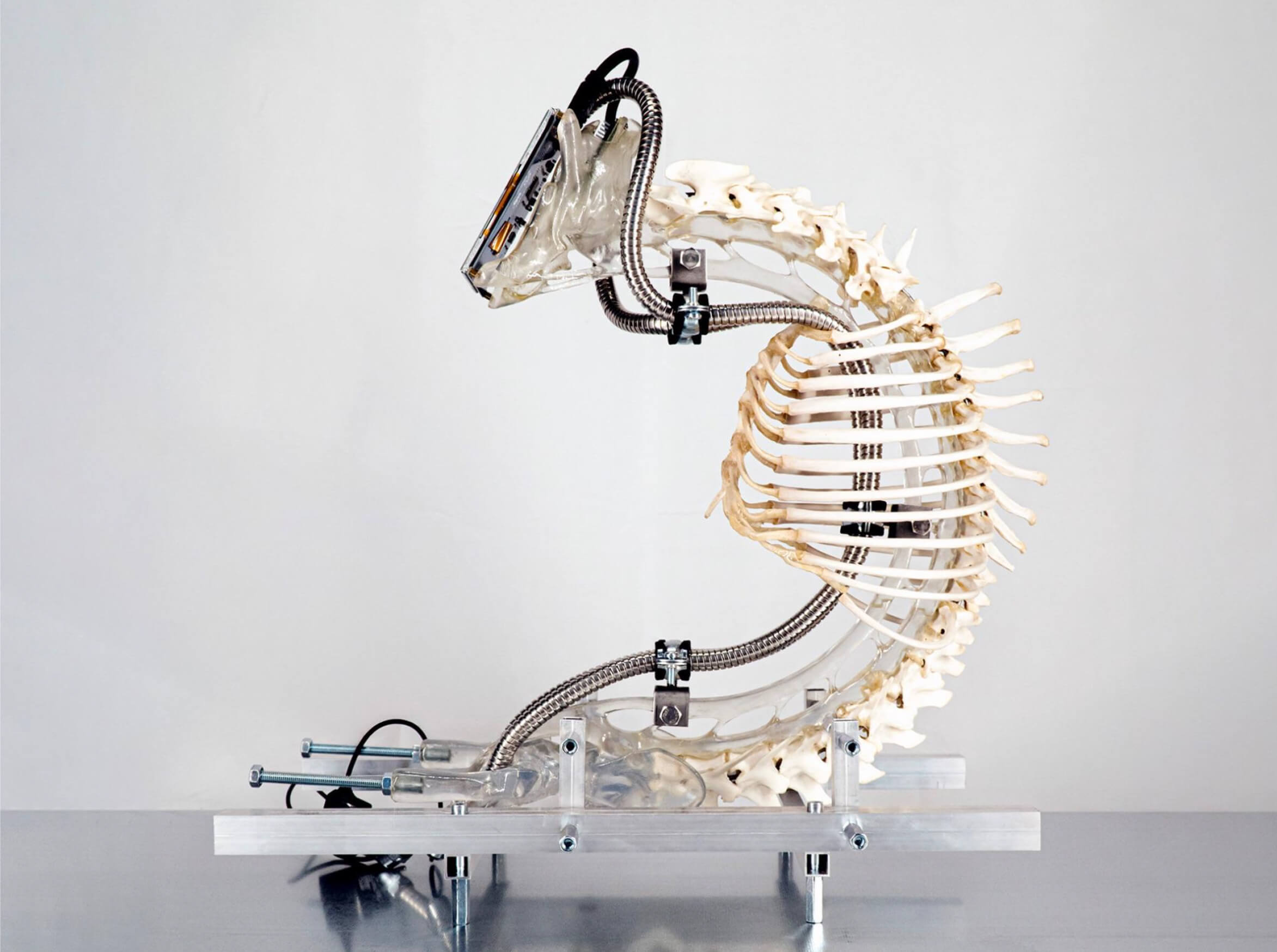
In I Wish This Would Be the Shape of You, a dog’s spine is forced into a closed, idealized circular posture. The tenderness toward the animal collides with a formal imposition. How do you navigate the ambivalence between care and domination, particularly in relation to companion species?
I Wish This Would Be the Shape of You” was the first work in this series, and in many ways it contains the code for everything that followed. I spent a long time breaking each vertebra of the dog’s spine and realigning them into a perfect circle. What fascinated me about this process was how close it felt to the way we engineer animal bodies more broadly. There is first the organic, irregular reality of a living form. Then we break it, reorganise it, and turn it into what we wish it would be. Something complete. Something cute. Something useful. Like any object of desire, bodies become sites of fetishism. We shape them in accordance with our needs. The circular spine is a diagram of this gesture.
In the installation a small video flickers onto the structure where the head once was. It shows fragments of a memory, a kind of emotional residue from a bond between a dog and his owner. On the surface the relationship appears caring, attentive, even loving. There is a moment of reconnection that feels almost devastating in its sexual explicitly. But underneath this tenderness is another logic. The story reveals a care built on domination, projection, desire and, eventually, euthanasia. The aesthetics of tenderness are misguiding us here, because what looks like affection often rests on control. In fact, this overlap of tenderness and domination reflects a broader truth about pet-keeping: human affection for “pets” is often inseparable from dominance.
From the beginning the idea was to use prosthetics for the dead as a way of giving form to creatures we claim to care about but do not really hear. Instead we secretly want to engineer them to our fetish desires. The spine makes the quiet proposition that affection and violence are not opposites, but that they often coexist in the same gesture, and that our relationships with companion species flicker constantly between nurture and domination. The work tries to make that complexity visible without moralising it, simply by allowing the body to speak through the shape we have imposed on it.
Stolen Bodies introduces the theme of familial memory and archival inheritance, weaving your personal history with animal remains linked to colonial and scientific networks. What responsibilities arise, in your view, when working with materials so densely charged with history and power?
For me this work was both the easiest and the most difficult at the same time. On one level the prompt was very clear. The primate skulls were almost impossible to ignore. At the same time I was personally implicated in their history. Unlike other materials in the Clinic, I could not approach them from a position of distance. They come from my great-granduncle’s collection. He was convicted after the war as a member of the SA, as far as I could reconstruct from an inconsistent and fragmented family archive. Added to this is the fact that the skulls belong to primates and not to any species endemic to Austria. I can only assume that their extraction followed violent logistics. The Vienna Zoo would already be the least troubling version I can imagine.
As with other works in the Clinic, these materials arrive already coded. They carry systems of extraction, classification, and authority that exceed my authorship. Bones, instruments, and archival traces don’t just become neutral through time. We remain entangled in their histories, even when we adopt the posture of scientific or aesthetic distance. This work does not allow me that distance, and I see this as a necessity. Responsibility, for me, does not mean speaking on behalf of the bodies involved, nor does it mean attempting to correct or redeem their histories.
Instead responsibility means carrying something through one’s own position and staying with the tension it produces. It means to “stay with the trouble”! The task is not to resolve these contradictions but to hold them. As an artist there is an additional responsibility to remain faithful to the material itself. What I have earlier called material magic only works if the narratives embedded in the material stay in the foreground. In this case the display logic used for the other works failed. Frames and supports would have imposed a false sense of order. The primate skulls needed to remain exposed, with minimal intervention: skulls, clinical instruments of violence, and archival notes describing the specimens and their cause of death..
To summarise, responsibility here operates on twofold. First, through decisions of material assembly, display, and deliberate restraint. Second, through the refusal to distance myself or to construct abstract barriers between my own history and the histories embedded in the material. The work insists on proximity. It does not offer resolution, only the demand to remain implicated with it. As Donna Haraway urges, we must “stay with the trouble”. That means remain with these difficult entanglements rather than seek an easy resolution.
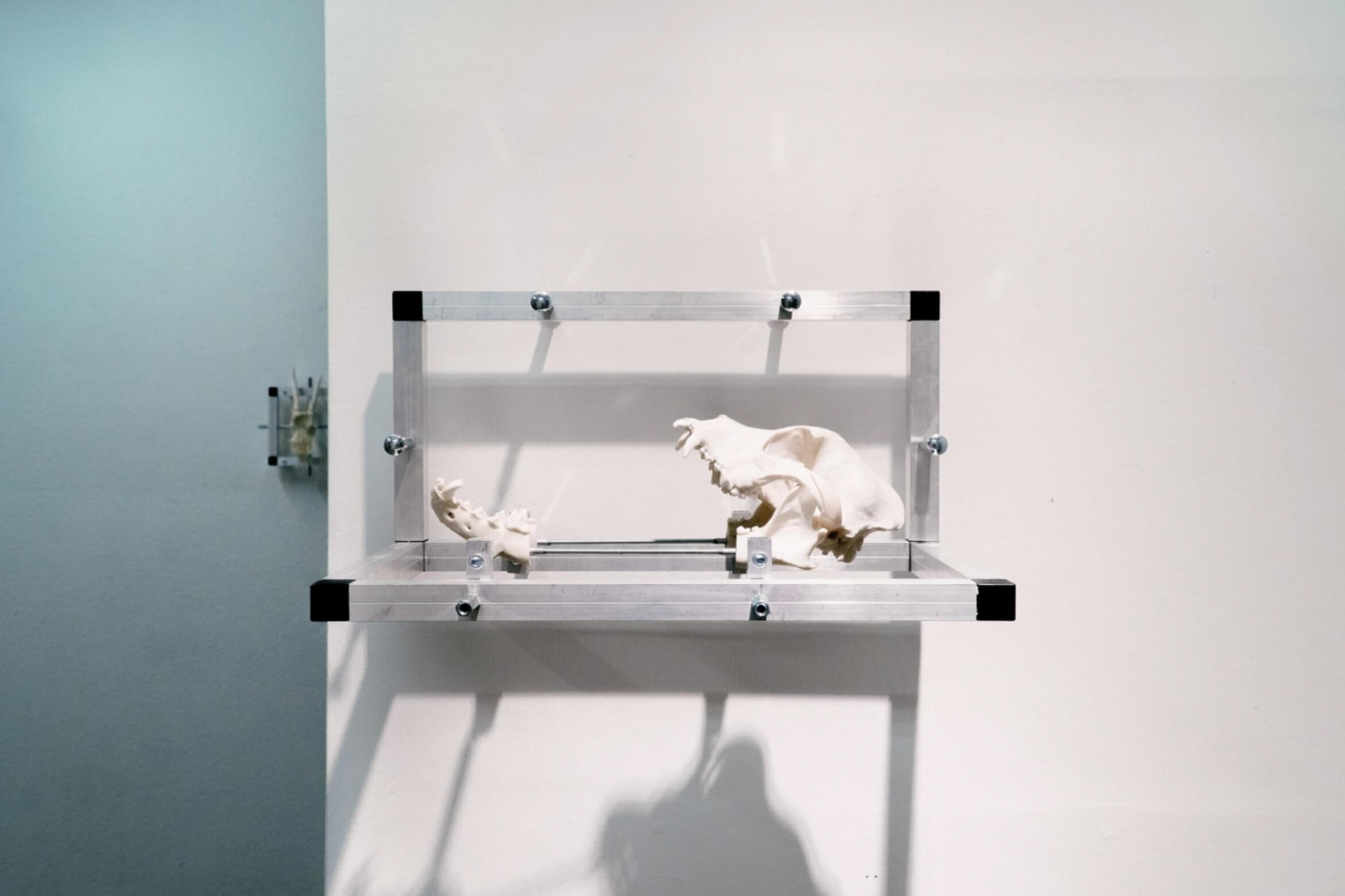
Agrilogistic Unit evokes Timothy Morton’s concept of “agrilogistics,” portraying a failed system attempting to contain the animal body. How does your work reflect, or resist, the idea of nature as something calculable, measurable, and manageable?
Agrilogistic Unit began with the image of a machine that is already broken. Skewed, misaligned, unable to fully stratify what it is meant to contain. The form came to me during an audiovisual performance by Rival Consoles, where structures were constantly fragmented, interrupted, and reassembled. That logic felt appropriate and clicked with me. Starting from a breed-farm specimen meant carrying a considerable weight, and deconstruction became the only possible response. It had to be a broken machine.
In that sense the work treats the machine and its failure as inseparable. Timothy Morton’s term agrilogistics captures the militarised ambition behind this logic: the idea that life should be fully legible, optimised, and manageable. Morton describes agrilogistics as an ambition to eliminate uncertainty by enforcing “thin rigid boundaries” between human and non-human worlds and reducing existence to sheer quantity. Reducing this ambition to a single unit was a way of draining it of its authority. An agrilogistic unit is no longer untouchable. It can, and it will, fail.
Agrilogistics describes a way of thinking that wants bodies measured, behaviours predicted, environments stabilised. Nature becomes something that can be governed through calculation. The artwork here starts where this ambition begins to break down. The system is present, but it no longer functions as intended.
I am not interested in opposing calculation in a romantic way. Measurement and optimisation are already deeply embedded in how we live. What interests me are the moments where these systems produce strain. Where bodies do not fit. Where behaviour exceeds the model. Where matter refuses to remain inside the grid designed for it. In the work the animal body is confronted with a structure meant to contain it, but containment remains incomplete. I wanted to materialise that pressure, that strain that makes bodies crack into pieces.
The work does not offer an alternative image of nature, but rather stays with the damaged landscape produced by agrilogistic thinking. Failure becomes informative. It reveals that life continues to operate beyond what can be calculated or managed, even when the apparatus appears total. Bodies here function as units within an infrastructure that has grown larger than any single intention. I am not interested in criticising the machine. I am interested in locating the points where it hurts.