Lilian Kreutzberger constructs an unstable landscape where surfaces think, screens feel, and architecture becomes inseparable from the digital systems that shape everyday life. Moving between sculpture, moving image, text, and installation, the exhibition reflects on grief, perception, technological control, and the fragile boundary between public and private space. In this conversation, Kreutzberger discusses the influence of Constant Nieuwenhuys and Superstudio, the role of EMDR therapy and collective testimony in Aftersun, and her ongoing exploration of materiality in an increasingly immaterial world.
Fakewhale: RAUHFASER seems to begin with a broad yet urgent question: what happens to our perception when every surface, from domestic objects to urban infrastructure, can become a screen, an electronic skin, an interface? How did this line of thought first emerge, and how did it shape the exhibition as a whole?
Lilian Kreutzberger: It’s has been a some time since I started thinking of the screen as surrounding. I believe it started when I was reading the manifest New Babylon by Constant Nieuwenhuys. Just as an experiment, I tried replacing the words New Babylon by the internet. Most sentences and content of those sentences still made sense. New Babylon is a project in which Constant imagines a world consisting of a layered architectural structure spread like a honeycomb over the globe, in which the Homo Ludens, lived as nomads. Due to automation, people are freed of labor and therefor did not have to live in one place. He describes the architecture organized as a network instead of cities and villages. The comparison between New Babylon and the internet, made me think of both the internet and the digital screen as surroundings, as architecture, as objects.
Superstudio and Constant merged architecture and furniture and humans, as separated from nature. In a world in which everything becomes screen, even nature could visually manipulated. Imagine watching Netflix on your plants.
But also I made me think about the very untransparant infrastructure that the internet is. While I perceive working my computer in my living room as being in a private space, I simultaneously am exposed to commercials, my behavior is tracked and my attention is constantly manipulated. Access is regulated and there are rules to online behavior, but it all stays very opaque.
So thinking about private and public space, going back and forth between the analogue and the digital, between material and pixels and between having agency as a person, or being manipulated, became key elements in thinking about making new artworks.
The title RAUHFASER refers to woodchip wallpaper, but phonetically it also echoes the Dutch word rouwfase, meaning a phase of mourning. This ambiguity opens up both a material and psychological reading of the exhibition. What role did grief play in the development of this project: personal grief, collective grief, or perhaps grief for a certain idea of the future?
All of the above. One night I was thinking about the period of grief I just had gone through. Rouw fase (period of grief), in Dutch, sounded like the wood chip wallpaper Rauhfaser. Growing up my dad used to praise rauhfaser for its quality to patch up walls that weren’t plastered nicely. It als speaks to the domestic private domain, which I liked in the context of thinking about the public and the private sphere. I knew this would be the best title for the show.
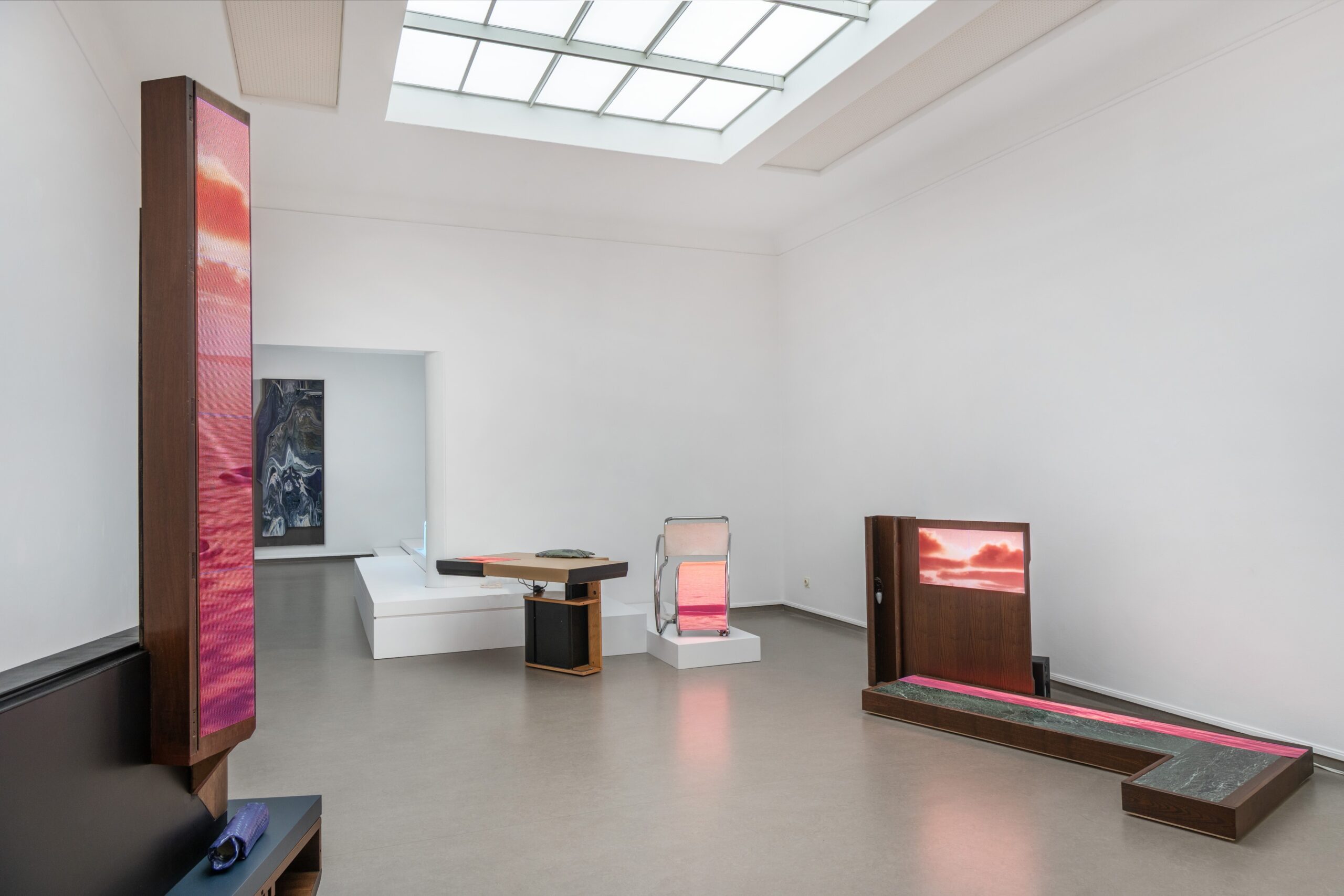
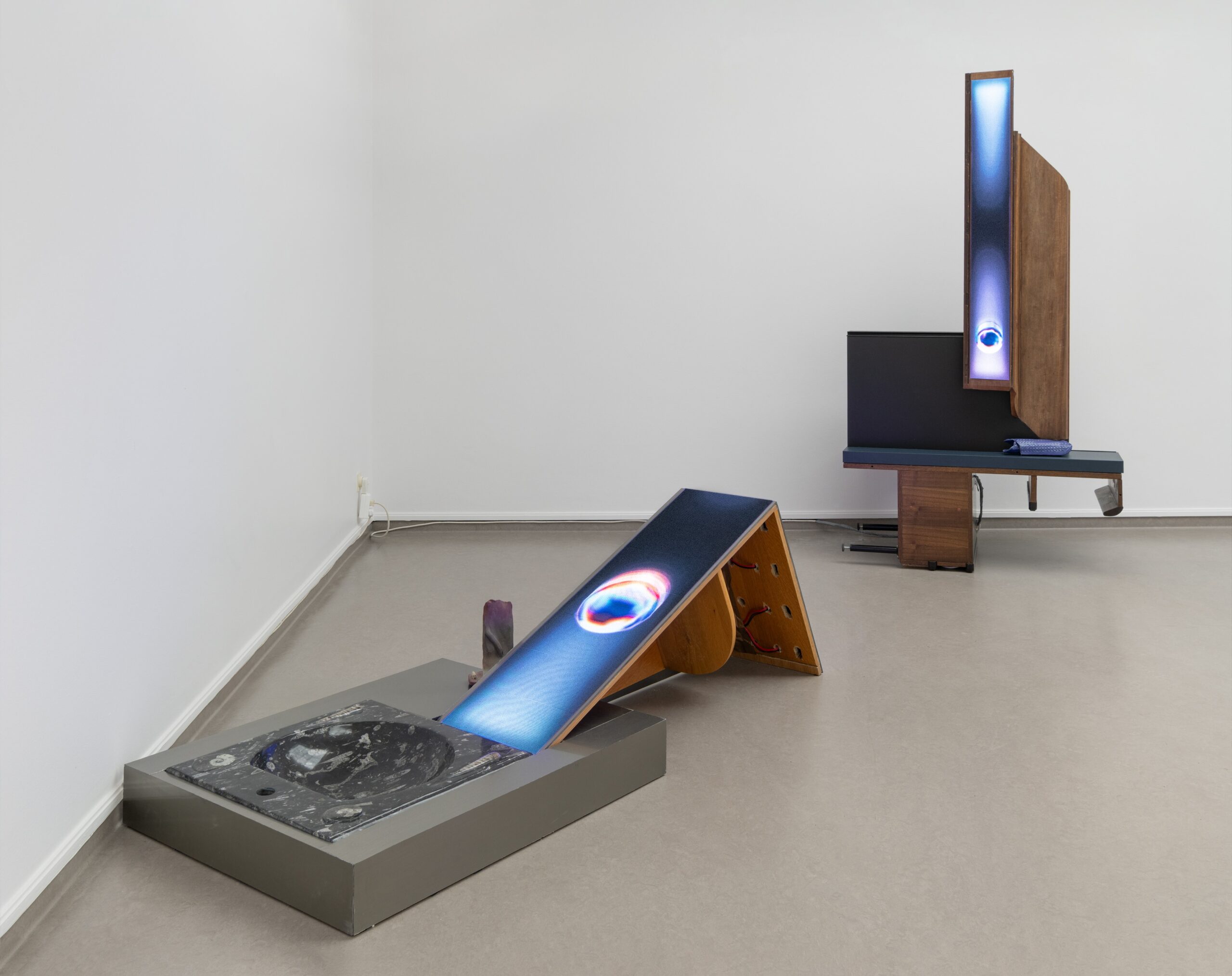
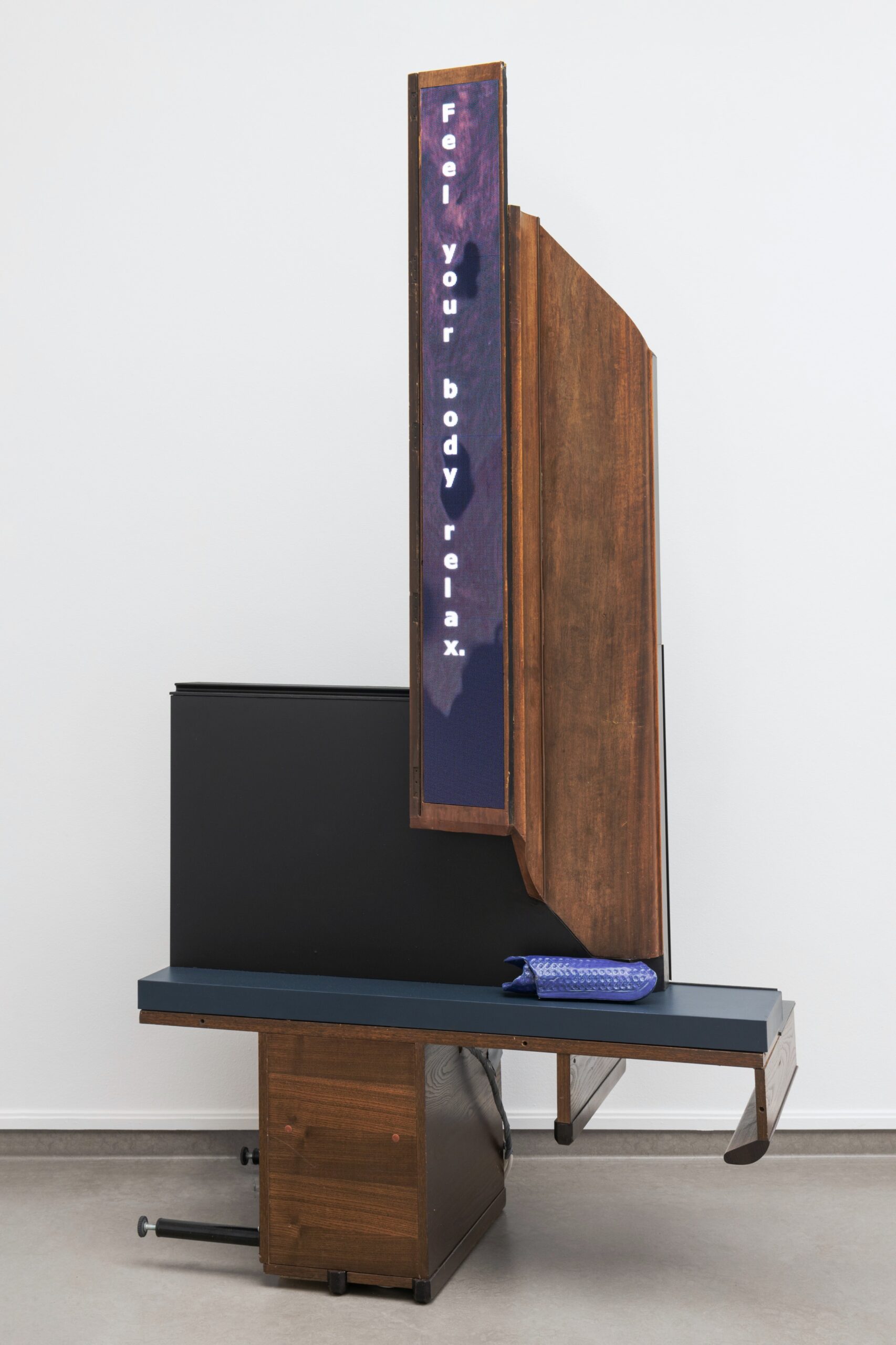
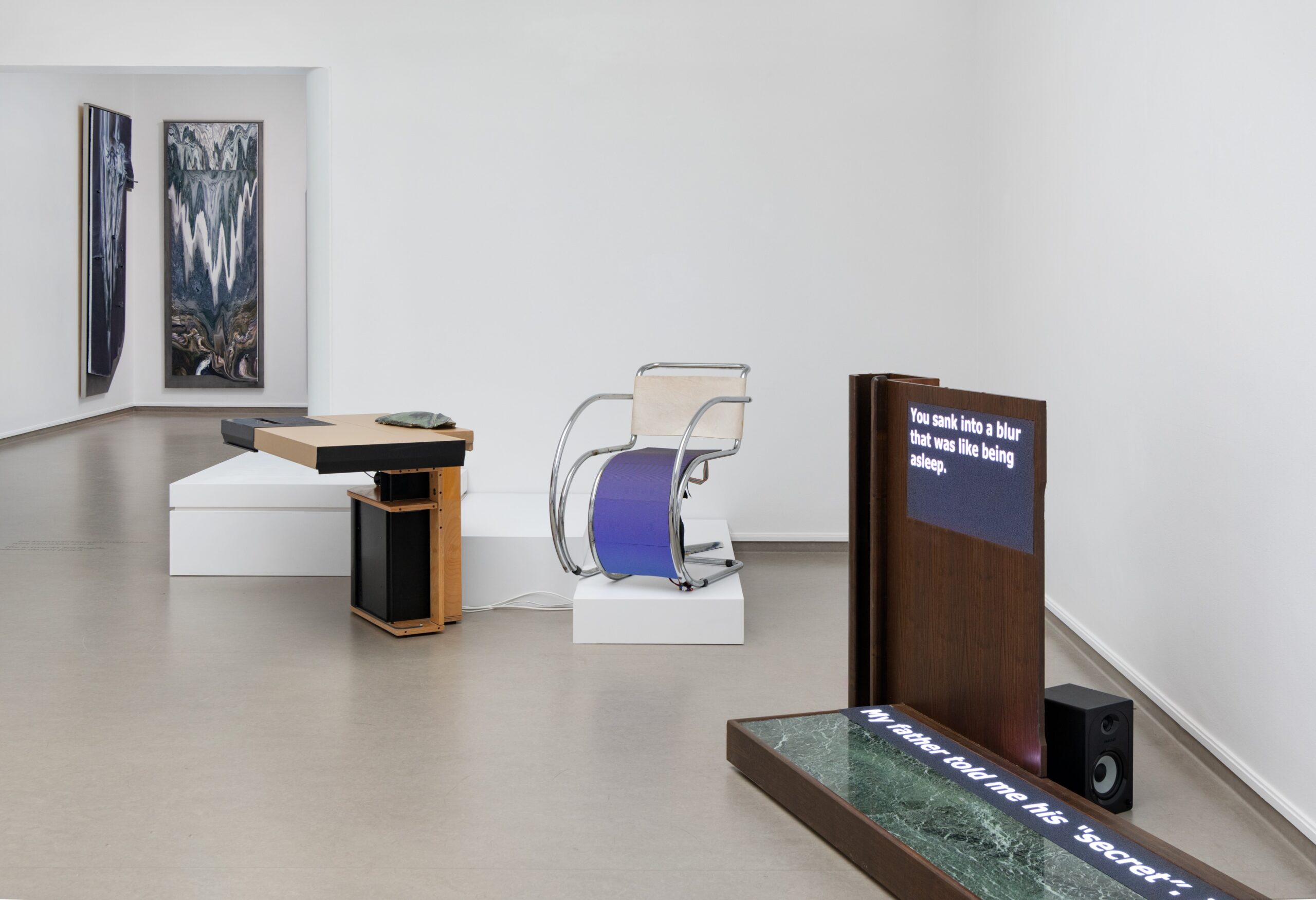
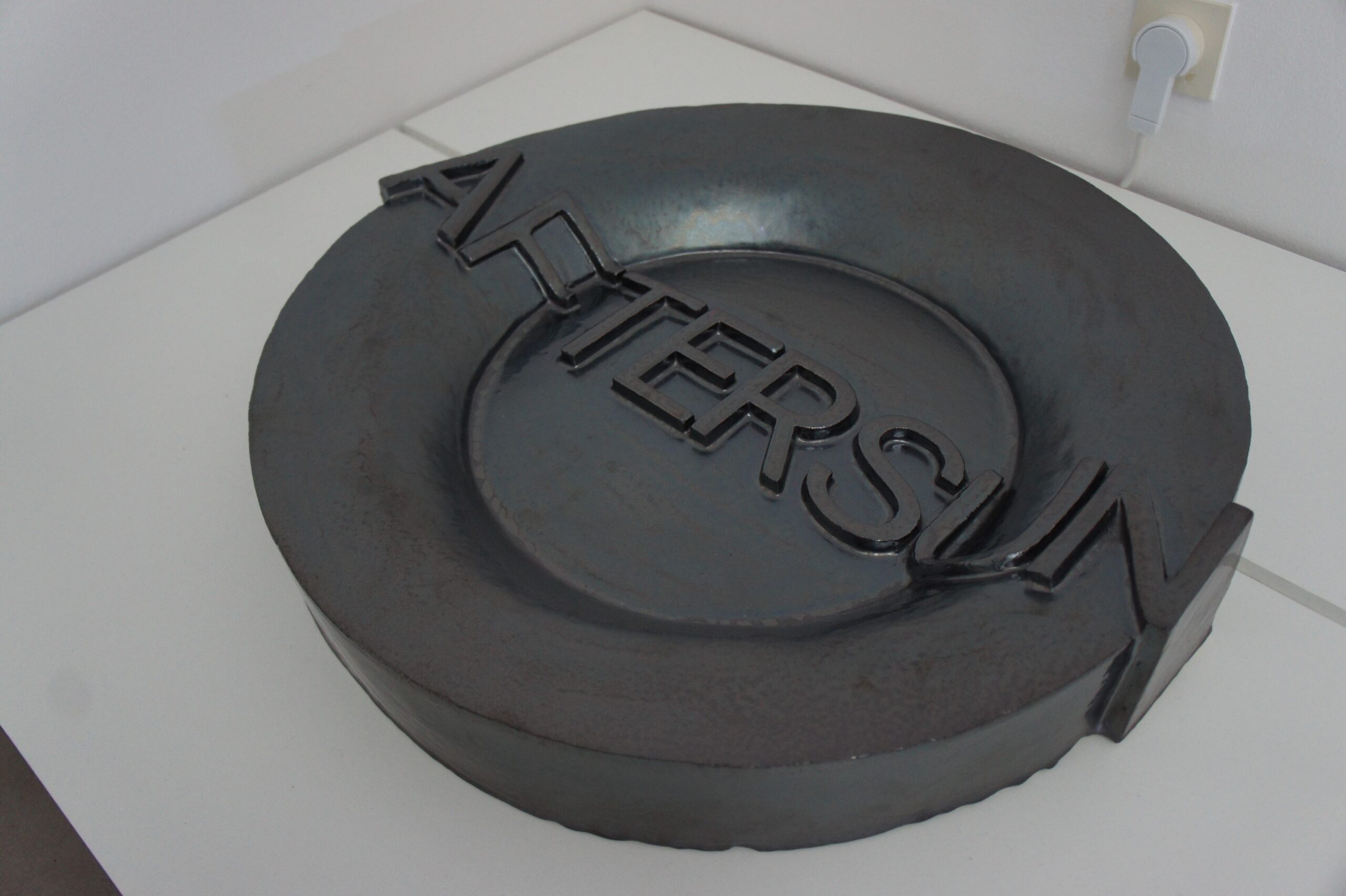
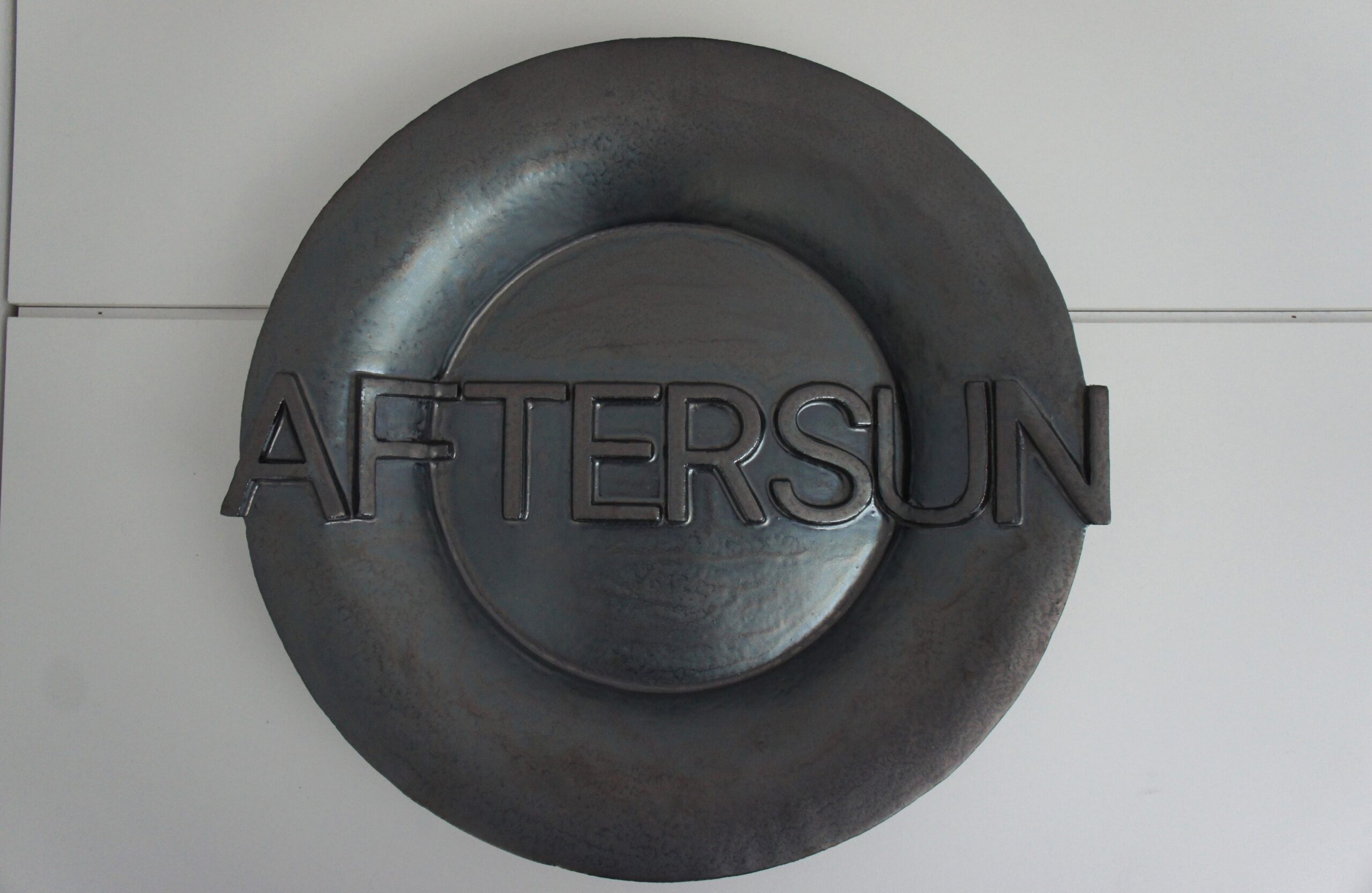
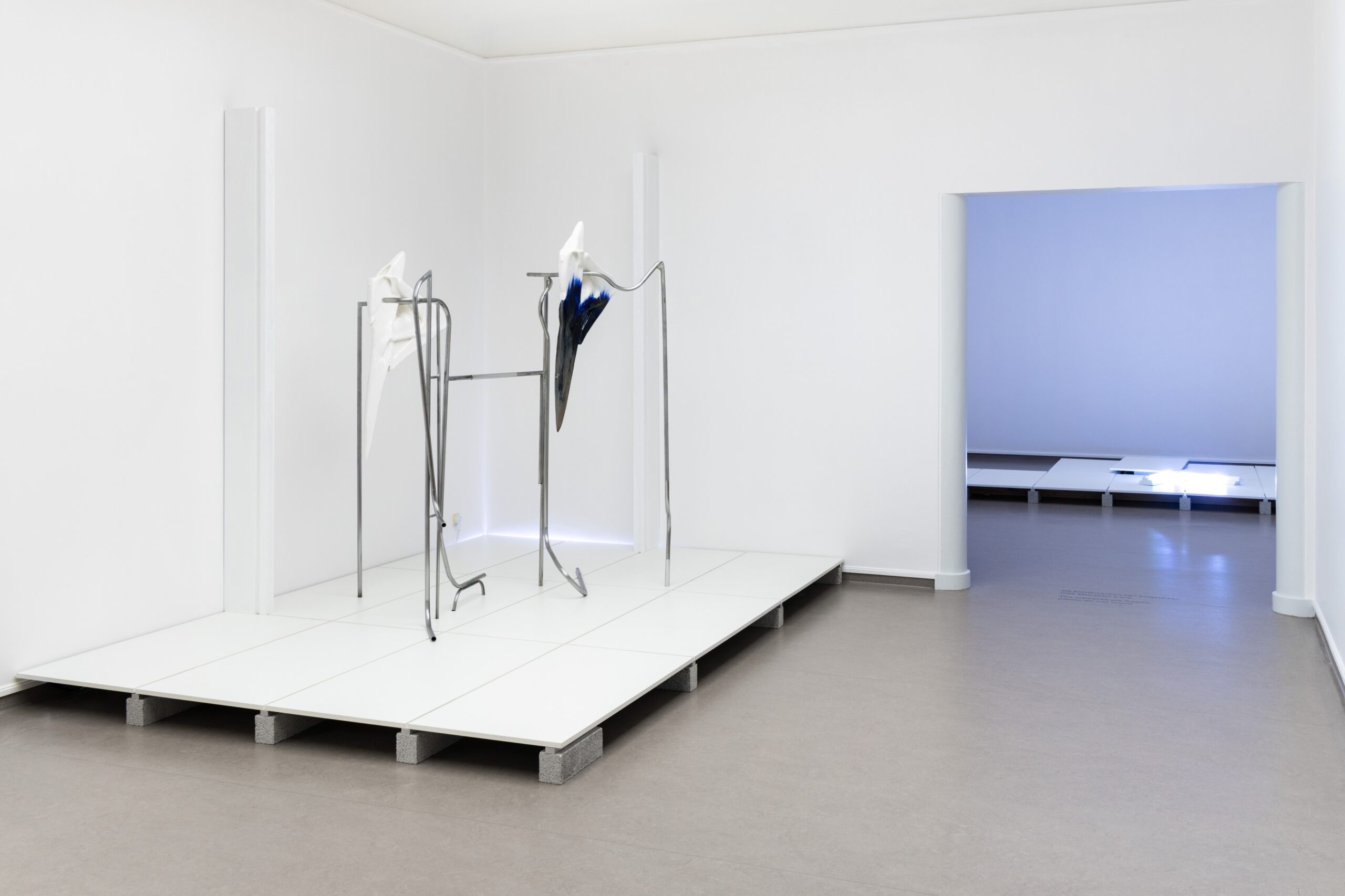
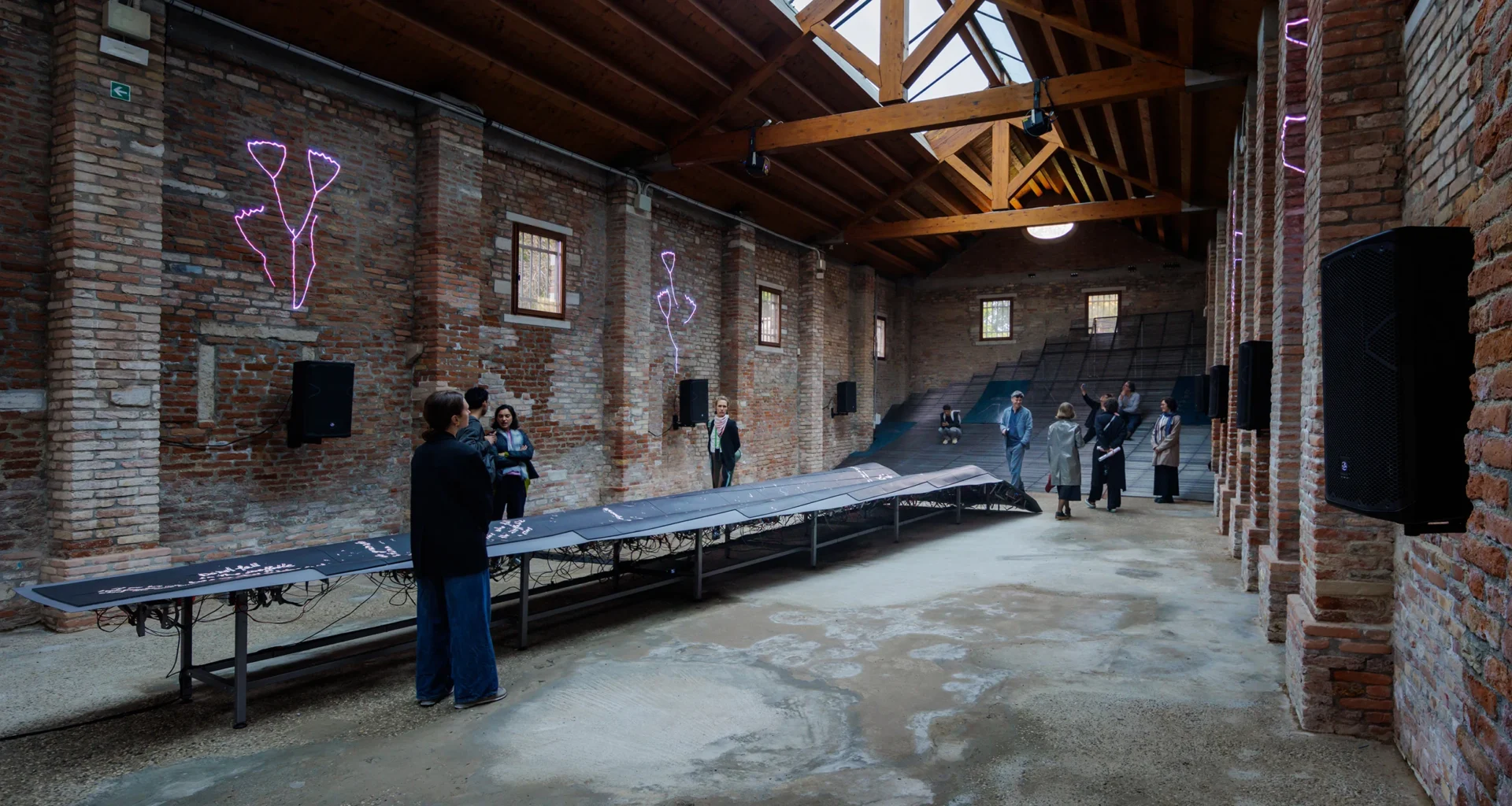
So yes, personal grief which occupied a good three to four years of my life, and will stay with me for the rest of my life. I wanted to, very quietly, use the exhibition as a ceremony to acknowledge this period in my life. Around the same time thinking about this, I came up with the idea of having the surface of furniture pieces giving EMDR therapy (imagine waking up, making your breakfast while the surface of you refrigerator gives you therapy). This had to partially, be text-based. I invited writer Lize Spit, who then decided to interview people on their experience with trauma therapy and grief, to which twenty people were invited to be interviewed. I build multiple sculptures from reclaimed furniture and imbedded modular LED screens in the surface. Visitors, in the exhibition, are invited by the text on the sculpture to also think about their emotions, memories and their own body. The installation tells a combined story of multiple people while also allowing a collectively experienced trauma’therapy’ in a semi-public space. Lastly I really liked that the title allows the interpretation of grieving the lost of materiality in the digital age. There are multiple references to lost in the exhibition. The table top displaying a text about the six stages of grief, looks like a gravestone. Color, functions or form leaving objects, like the ceramic hanging sculptures which originate from 3d models of an iron.
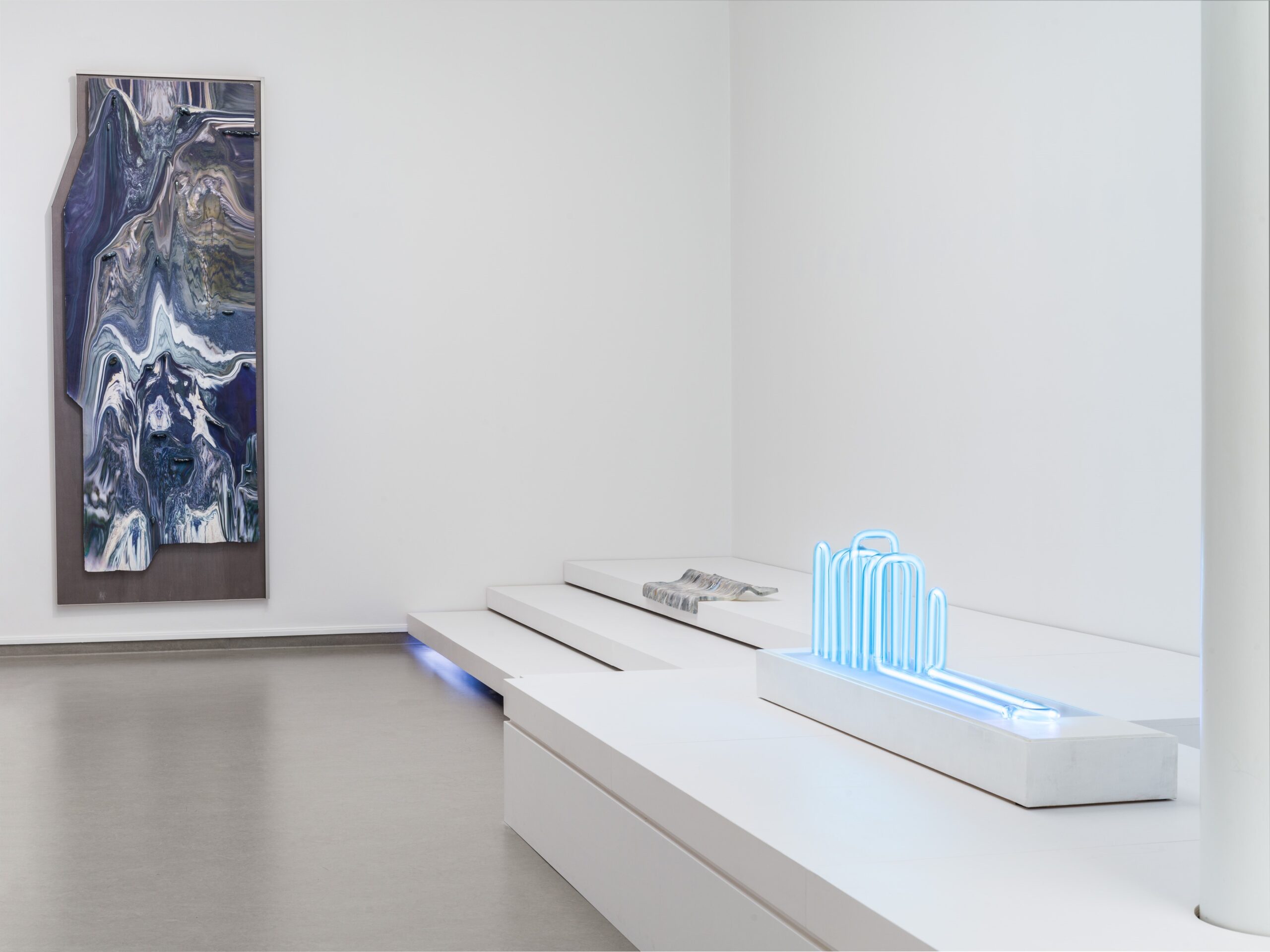
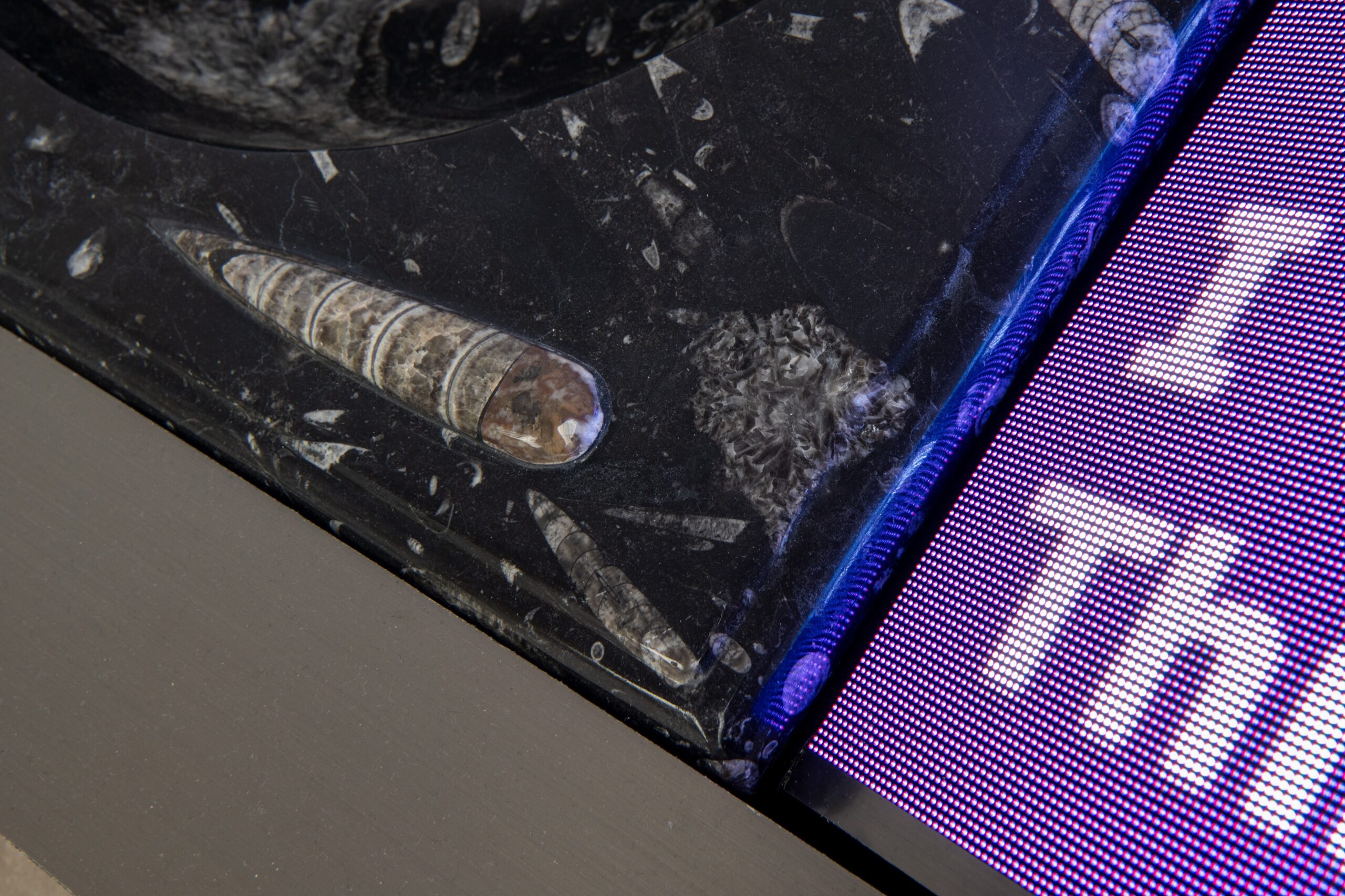
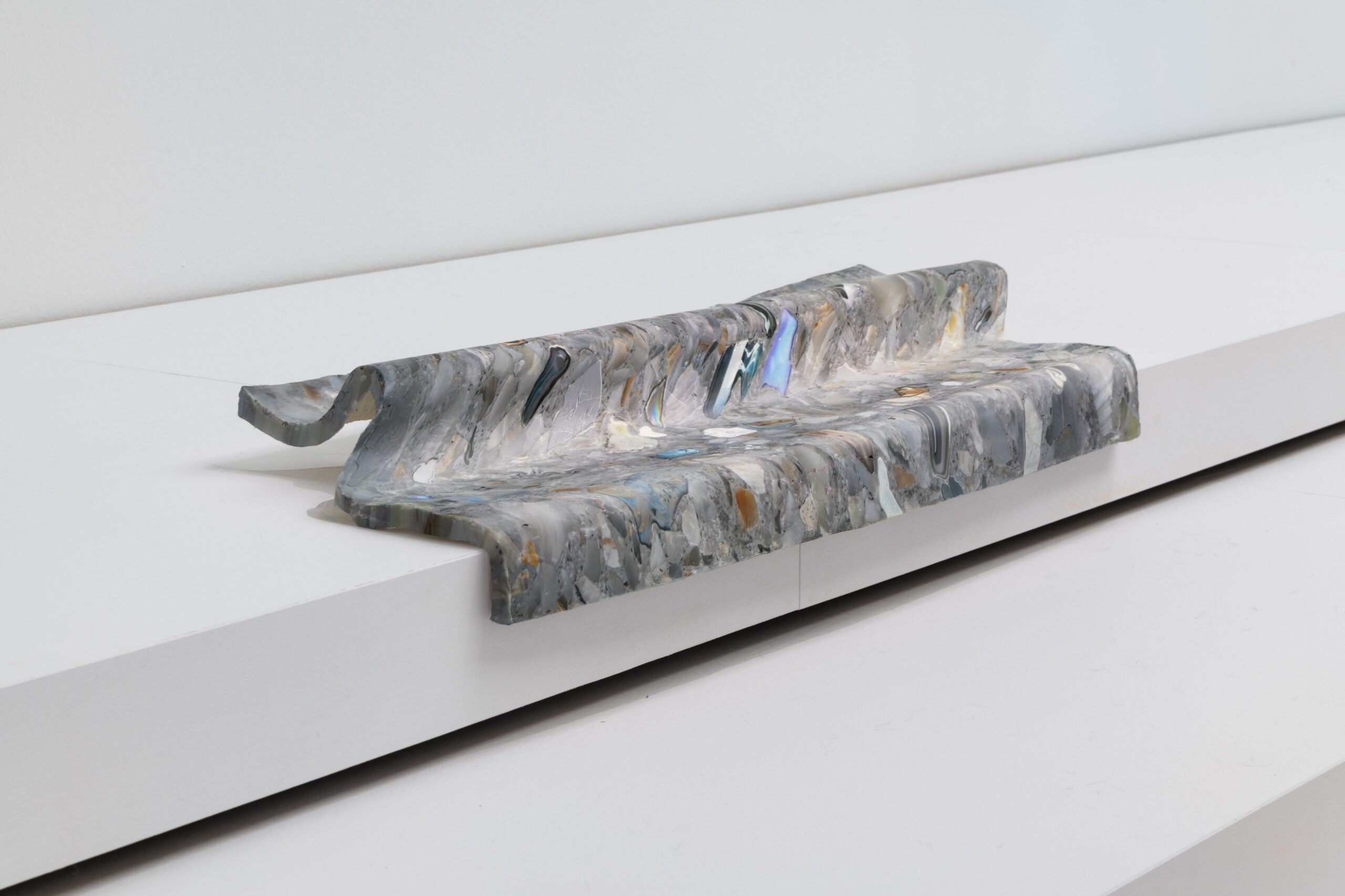
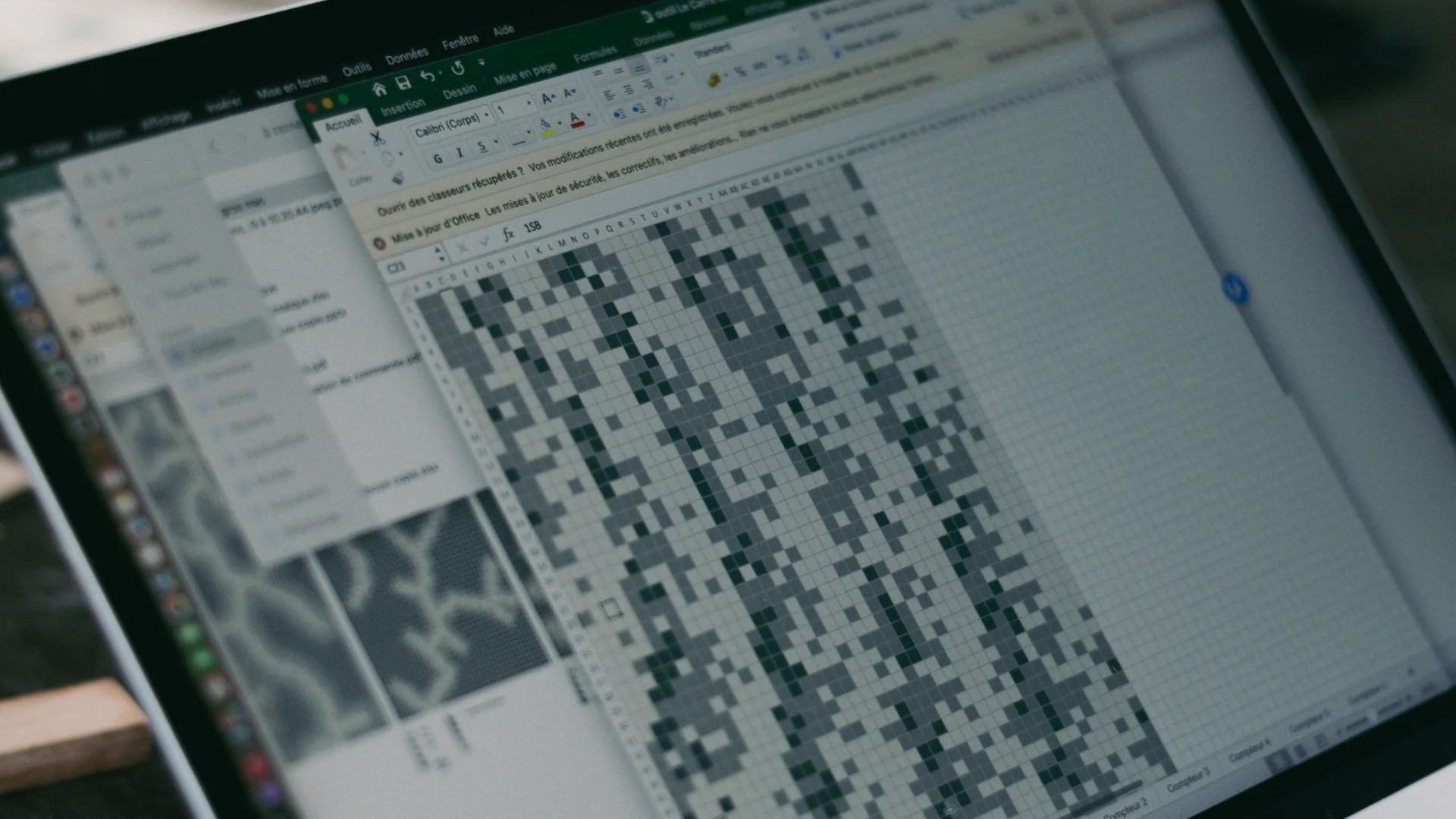
The sculpture, that looks like a remainder of a window molding, shows a video-documentation of how I clean a facade sculpture, laid down flat on the floor at Socrates Sculpture. So a functionless, obsolete, remainder of an object, on its surface, shows video of a architecture facade (also without function) being cleaned. This artwork is placed at the ‘end’ of the exhibition. The Led’s, custom made, are individually visible. Instead of only seeing a screen as aw whole, individual led pixels are very visible, looking like a digital screen that falls apart into pixel LED’s, pointing out that a digital screen too, is material.
Your works often create a tension between what feels familiar and what suddenly becomes unstable: marble that is in fact a printed skin, flat surfaces that appear three-dimensional, real materials placed alongside digital simulations of those same materials. Are you more interested in seducing the eye, or in unsettling it?
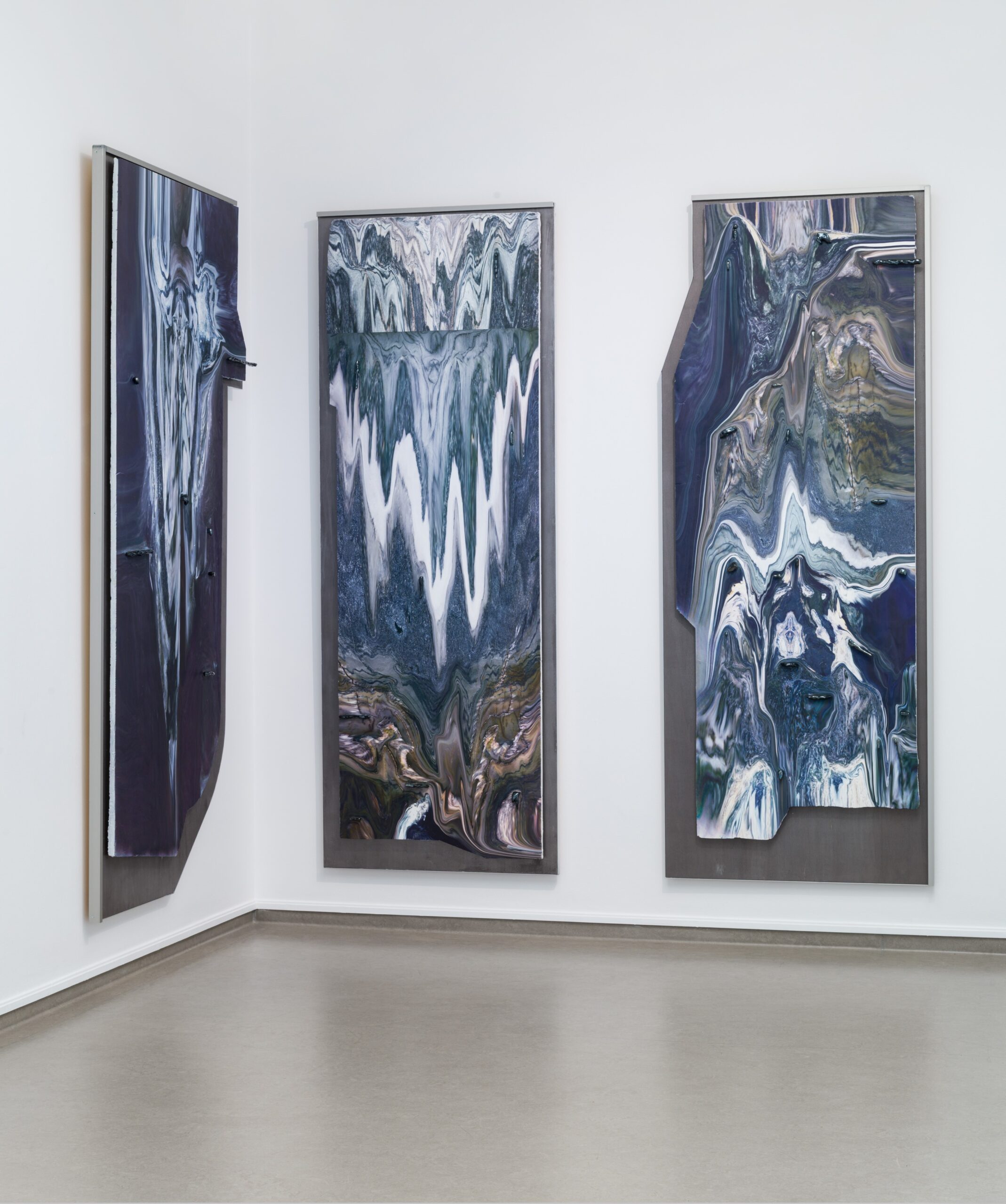
Since we, as artist, work in the visual medium, I always want to seduce the eye. One has to first interest the viewer before you can unsettle. In art one is allowed to, without judgement, settle or unsettle, upset or question. The challenge is to find the most effective way of doing so. Aside from aesthetically loving marble, it is also an extreme solid and hard material, carries a multiple historic meanings and is also used as decorative element, often in spaces where public space chances into private space (like a lobby). Visually liquifying the marble and what people expect of the material, was a conscious choice of very tangibly playing with this idea, that, if everything is digital, new material possibilities open up.
In RAUHFASER, Modernism does not appear as a nostalgic reference, but rather as something dismantled, contaminated, and almost reanimated. References to buildings such as the Seagram Building, the Time-Life Building, and Union Carbide seem to become fragments of a post-urban landscape. What does the Modernist legacy represent to you today: a failed promise, a language that is still active, or a material to be transformed?
It is fascinating to me to look at attempts made to create a grid of conditions in which outcomes can be controlled. It’s a language whose original promise has perhaps eroded, yet whose forms and systems still structure how we build, think, and imagine. This belief in the malleability and control is still there except in the digital, these structures are opaque. In RAUHFASER I try to examine ways in which behavior in the built environment can stand as analogy to understand the invisible ways in which the digital environments control conditions such as attention a sense of wellbeing or for example feeling part of a community or a peergroup.
The exhibition reflects deeply on the overlap between public and private space, particularly through the reference to New York’s POPS, privately owned public spaces. How did this urban typology help you think about the relationship between physical architecture and the digital realm, where even our intimacy seems to be continuously managed, tracked, and monetized?
The video on the previous mentioned remainders of window-molding shows a video-documentation of an artwork I made in 2014, The City of Tomorrow at Socrates Sculpture Park in Queens. following an experience in a POPS: being prohibited from lying on a bench placed on the side walk on Fifth Avenue, what turned out to be a privately owned public space. It consists of a horizontal façade based on the Manhattan grid. The grid-like structure appears to have recently collapsed from across the river and is stripped of all detail. The white, expansive installation reproduces the twentieth-century “wonder” of the modernist skyscraper Time & Life by architect Wallace Harrison. POPS function as an analogy for reflecting on the opaque nature of the public-private domain within the digital world, where our online behavior is tracked and unsolicited advertisements are presented to us. It raises the question: who ultimately determines how we should behave and what we cognitively and sensorially experience? In RAUHFASER I took a first step in spatially engaging with notions of POPS. A staircase was placed in the space without instructions for visitors. The choice of whether one could walk or sit on it was left to the visitor. But also the choice to make the EMDR installations, something highly personal, and place it in the museum, and using remainders of buildings as props to exhibit artworks on.
Aftersun, the installation based on EMDR, introduces a therapeutic dimension into an artistic and architectural environment. What interested you in EMDR as a visual, narrative, and sensory structure? And how did you approach the boundary between evoking a process of healing and transforming it into an aesthetic experience?
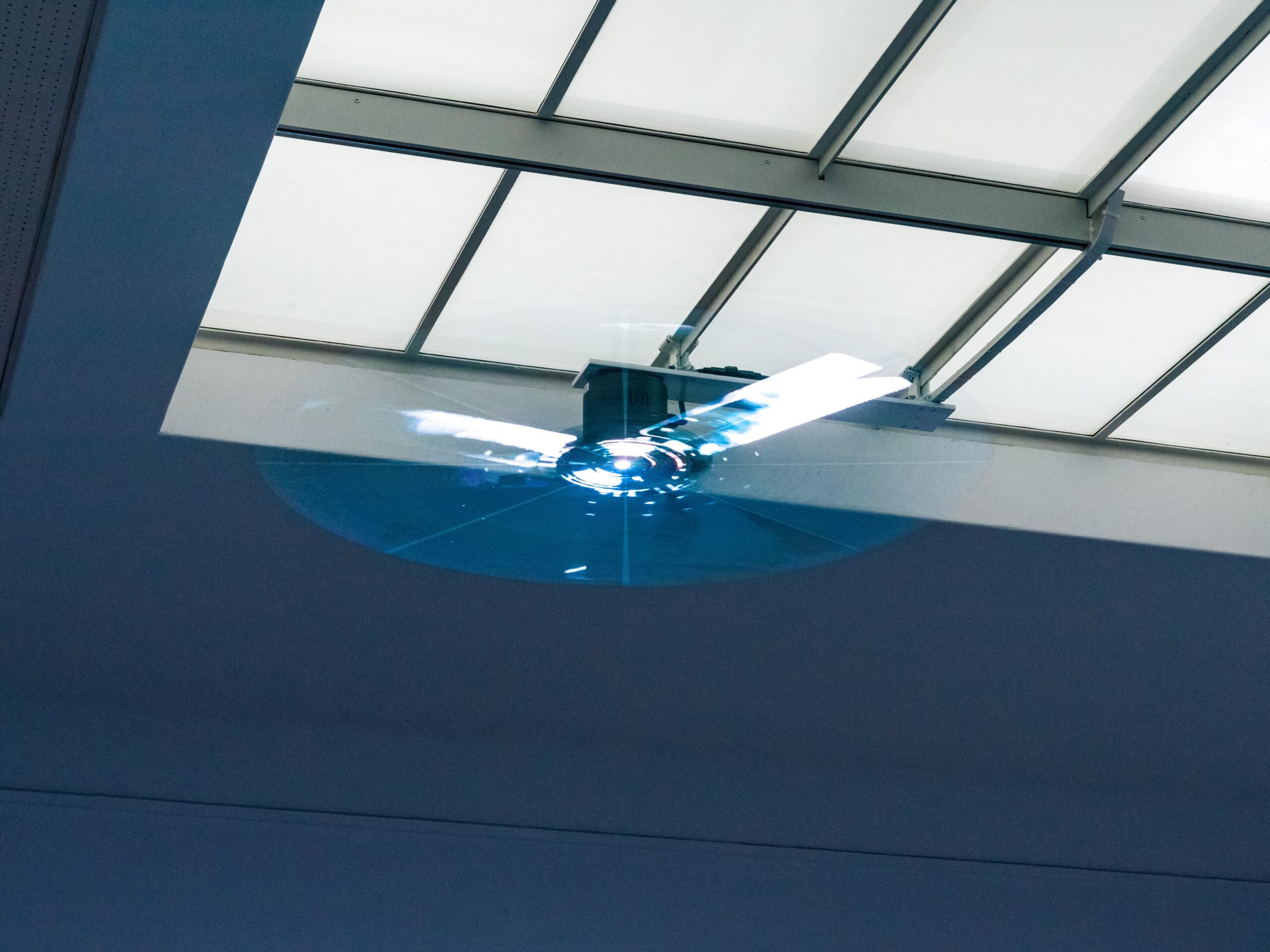
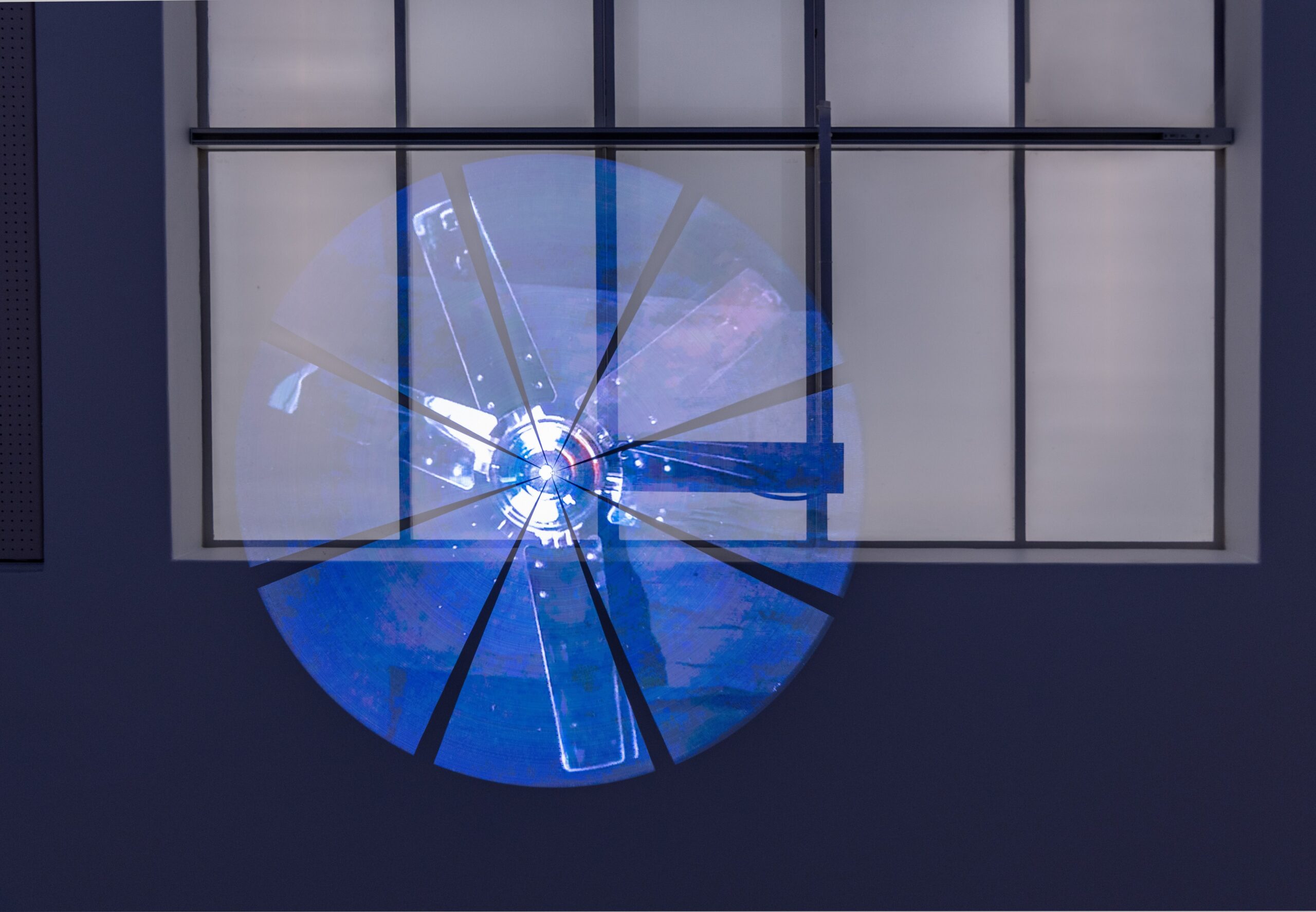
In the installation Aftersun, the visitor participates in trauma therapy within the semi-public setting of the museum. A video with text and animation guides visitors through the traumas of different individuals, while the voice of the psychologist simultaneously addresses the viewer. This experience further blurs the boundary between the public and private domain.
The video starts with a still of the materials in which the LED Screens are imbedded. After a couple of minutes the materials start to chance, move and liquify into each other, for example the wood en the green marble start to mix. The visitor is then, through different chapters, asked different questions, from thinking of a memory or trauma, where in the body one feels this and then to fictional mental spaces, where one can store memories or thoughts, or that serve as a place of refuge. This moment in the video is followed up by an animation in which four suns rise from the ocean, hover in the sky, and then sink into the water, leaving black holes. A soundscape guides the visitor though the whole experience. Obviously it’s an attempt of a therapy installation, which I don’t actually imagine to work like therapy does. What I hope I achieved with the work is to explore both possibilities and risk of surface and how it can affect our senses and even our mental state. To point out and give shape to the agency screens have in our daily lives.
In Aftersun, therapy does not take place in a clinical setting, but through sculptures, screens, text, movement, light, and sound. This choice seems to suggest that, in a near future, care itself might be embedded in the objects and surfaces around us. Do you see this possibility as liberating, unsettling, or both?
Again both. Looking at the amount of time I personally spent behind my screen and the possibilities and services it now offers, including receiving (previous) therapy online, finding information in peergroups, one wishes it only expands. On the other hand having coffee with a friend or experiencing a forrest including information for all senses is irreplaceable.
But I do think about the internet and the digital also as an unsettling place. Many services that are mandatory have become digital, so access to things or places are controlled by an untransparant infrastructure often with no customer service. The right to be a anonymous person online is disappearing which I find more unsettling than whether you have a right to privacy. I can also imagine large digital surfaces to be abused. For example to make someone feel uncomfortable by imitating great heights or displaying fast moving, flashing or blurred images to literally distorted someones visual sense. In so many ways our brain and behavior can be manipulated in the online digital world while simultaneously its still mostly unregulated.
For the installation’s texts, you worked with Lize Spit, who interviewed people with direct experience of EMDR, and combined this writing with material generated with the help of artificial intelligence, drawing on references such as Superstudio’s Ceremonia and relaxation audio. How did you negotiate the relationship between human testimony, literary fiction, and an artificial voice?
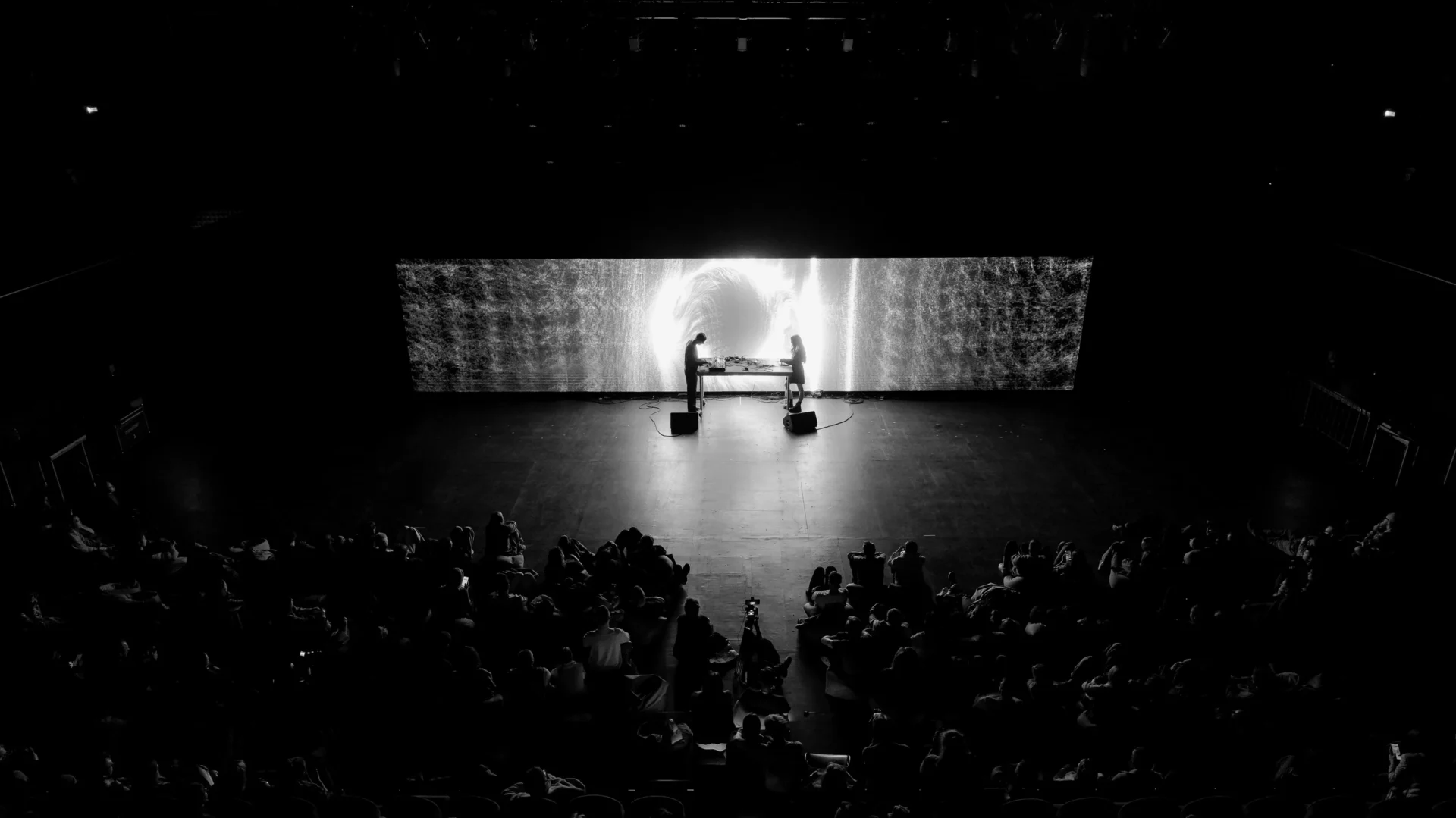
In the year of making the work, I visited the music festival Rewire in my hometown, the Hague. Many of the performances combine experimental music and audiovisuals. I paid special attention on how to make a video without a direct narrative or with people as subject. I wanted to imbed the testimonies in a text with a more poetic approach to objects, architecture and the human body. I found a fitting video by Super Studio, Ceremonia, in which they describe the material world, filled with ornamentation etc, as the old world, while emphasizing the current fictive world in which it’s more about rituals and human connections. I asked Chatgpt to merge both a body scan/hypnosis with the transcript of Super Studio, and then took words and sentences from the text.
Lize took all the interviews and wrote it as all being part of one story. She focused on writing about the physicality of the experiences and memories. I wanted it to be both personal and specific while at the same time open and general. The sculptures are somewhat appointed the role of the narrator, psychologist and sometimes all sculptures at once become a body pointing out where they hurt.
At the end one hopes people are moved and picked up the undertone in the installation and of the installation in relation to the exhibition as a whole.
What I think worked really well is the different screens displaying text almost as a choreography, which makes de installation not only a EMDR therapy with sums, spelling words and following a ball with you eyes. It uses the whole body, as the visitor is trying to read the text on the spatially placed sculptures.
RAUHFASER is the result of a dense network of collaborations, with Lize Spit, Carolien Schippers, Nils van Lingen, Anna Chocoli, Roderik Patijn, TU Delft, and several other technical and artistic contributors. How does your role as an artist shift when the work becomes an ecosystem of different forms of expertise, languages, and sensitivities?
In such a collaborative way of working, making art shifts from making to coordinating. Communication is key; what’s inside my head does not communicate easily to someone else understanding of what you imagine. It was at some times difficult to navigate not knowing yourself what it is you envision, leaving enough space for the other makers to apply their expertise, and to figure out a new form in between those forces. It turned out, that, even if I didn’t know exactly how things would have to look like at first, I still had a very strong idea on what something should or not should be.
Half of the time during production, I was in meetings instead of actually working in my studio. Which at times felt stressful as my mind felt like I didn’t work, even while I knew by working this way I multiplied the possibilities and quality of the exhibition. For example, while I was working on building the sculptures, I knew someone was, at the same time working on the animation (a video I can imagine, but could not make myself).
Not unimportant to mention is that this was all made possible by the various funds. For example with the project grant of the Mondriaan Fund, Stimulering fund and in collaboration with TUDelft I was able to pay people for their work. In this way a great the opportunity to make an exhibition at Kröller Müller Museum was extended in a way to other makers.
Looking at RAUHFASER as a possible turning point in your research, which questions do you feel most compelled to continue exploring? Are you interested in moving further towards immersive and technologically integrated environments, or do you imagine a return, perhaps in a different form, to materiality, painting, or the physical object?
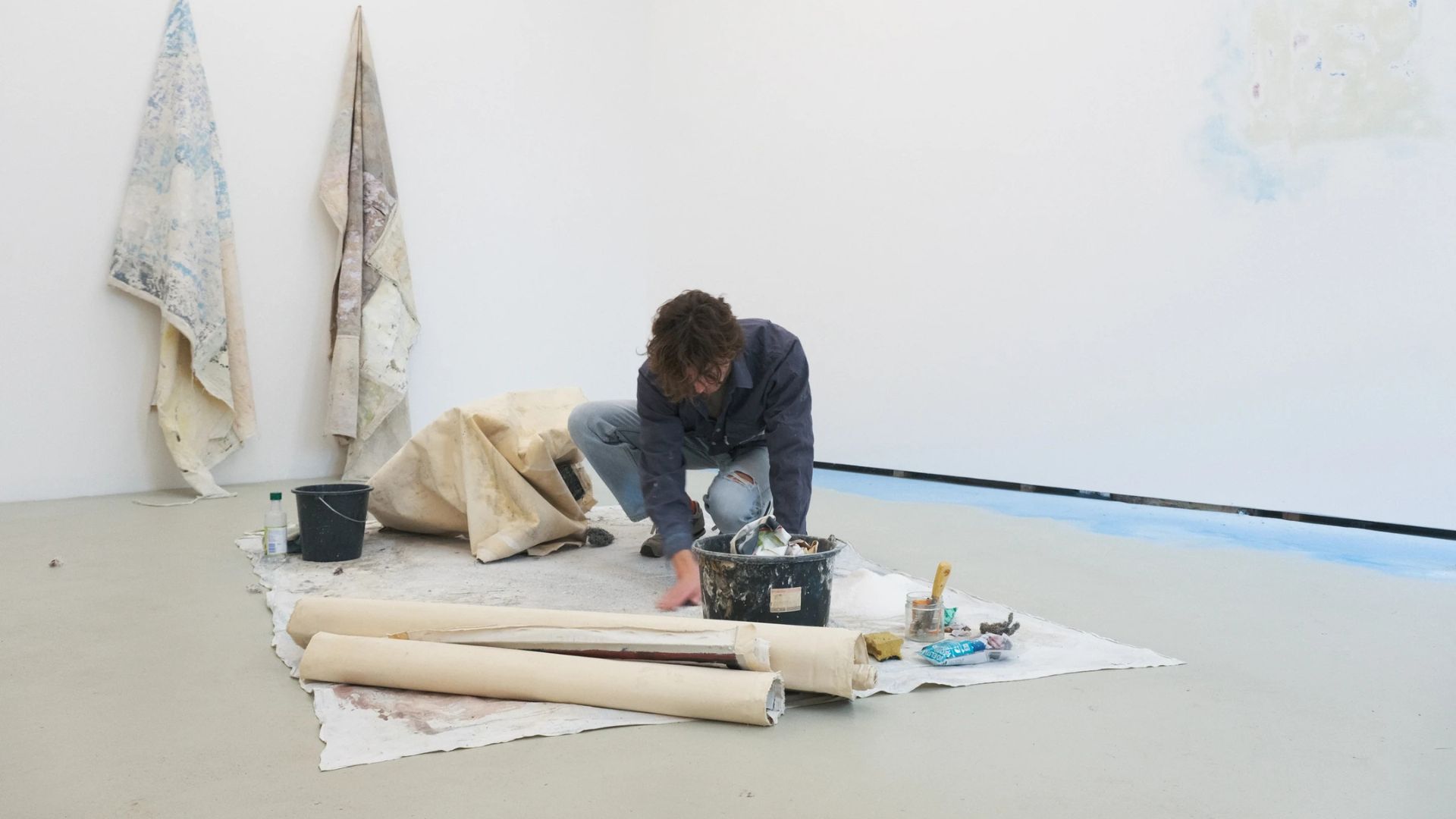
Making evocative objects in any capacity, that at times, affect your senses in a way that the object has agency over you, is something I am very excited about. Also bringing balance between conceptual, tactile, aestethic and poetic artworks when bringing them together in an exhibition is rewarding. And also questioning authenticity and authorship more explicitly. But all of this can come together when working around a couple of big ideas, in different mediums and materials. One does not have to pick between directions. Painting is always present in any work when thinking of surface, I do however miss working with my hands and material when artworks become either more photoshop or technological based.