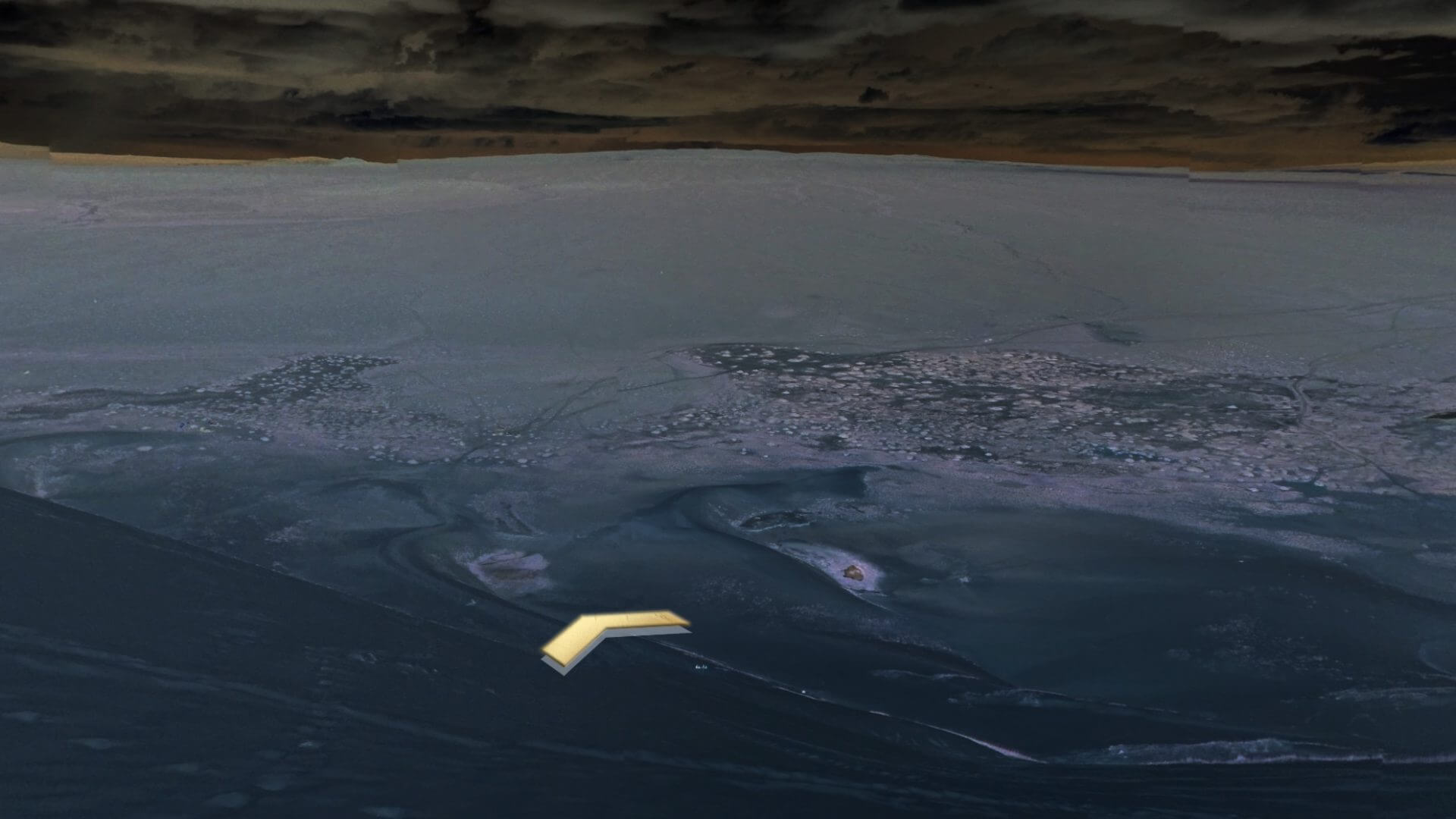
‘Treasury’ by Suez Canal Republic
A remote financial node as an institutional prototype for civic speculation
Within Fakewhale’s ongoing research into practices that recalibrate the relation between digital art and contemporary art, we have been focusing on projects that enact complexity rather than merely describe it. We look for works that operate as living systems, where technology, governance, and public encounter form a single aesthetic field. This approach foregrounds pieces that generate questions through operation, presence, and accountability.
In this context we turn to Treasury by Suez Canal Republic. Treasury is a remote, solar-powered financial node that treats strategy as behavior, audit as public proof, and access as embodied proximity. It prototypes an institutional form where energy cycles, market signals, and local rituals cohere into one artwork.
The work is conceived as a field-deployed instrument: an aluminum box with gasket seals and tamper sensors, protected by a smart lock, housing a hardened ARM computer, a secure element for Ed25519 signatures, a swappable LiFePO₄ battery, and a 58 mm thermal printer. A solar panel from 80 to 120 W feeds the system, charging packs of 24 to 40 Ah that can be exchanged in the field. The entire device weighs between nine and twelve kilograms, designed to travel as a backpack into remote or contested landscapes. Each element of the stack is licensed and open, and the system is built to be repairable on site.
Suez Canal Republic position Treasury as an encounter. Only those who reach the node physically can engage with it. Through Bluetooth pairing visitors verify the state of the system, and under defined caps tied to balance ratios and time locks they can execute a one-time claim. Each interaction leaves a paper trace: a receipt with header, short signature, and checksum, joined to an append-only ledger that can be exported later by NFC or QR. The physicality of these slips shifts financial speculation into a shared ritual of proof, where a moment of withdrawal becomes a collective event embedded in place.
Connectivity remains minimal and oriented toward resilience. Treasury communicates through local interfaces, with optional LoRa summaries or a satellite beacon for presence pings, while GNSS provides time and provenance with deliberate jitter to obfuscate location. Strategy modules combine momentum, trend following, mean reversion, and cautious sniping with risk filters for liquidity, holder distribution, volatility, and contract age. Market behavior unfolds as drift, constrained by cycles of sun and battery health. The machine refuses personal data collection, relying on pseudonymous proofs alone.

In this sense, Suez Canal Republic stage speculation as a civic practice. Treasury inhabits what they call a bubble ecology, where value arises from meme dynamics, collective emotion, and the ephemeral actions of small crowds. Balance grows or contracts in tune with daylight and sentiment. Geography defines access, presence becomes the cost of participation, and governance appears as public parameters that can be reviewed or forked. The work produces a fragile commons around cycles of care, maintenance, and shared orientation. Finance is choreographed as environment, and infrastructure itself becomes cultural form.
By aligning conceptual speculation with material experimentation, Suez Canal Republic locate their practice at the intersection of artistic production, infrastructural design, and technocultural critique. To expand on these foundations, we engaged them in a series of questions that position Treasury within a deeper Dialog Flow, tracing the conceptual and technical dimensions that shape their work.

Fakewhale: Treasury synchronizes to daylight and battery health. How does an energy-first constraint determine market exposure, scheduling windows, and acceptable drawdowns across seasons and latitudes?
The first Treasury was designed to speak rarely. A hushed voice in the wind, not a market bell. Its energy draw was kept intentionally low, optimized for a few thoughtful operations rather than constant chatter. We calibrated it for longevity and restraint: a machine built not for speed but for survival. While it interfaces with traditional and DeFi markets, its gaze is slow, strategic, more like a vessel tuned to long cycles than a scalper chasing flashes.
Of course, it could remain always active. Backup packs, power relays, even fixed installations could keep it talking day and night. But that would make it less a treasure. The essence of Treasury lies in its dormancy and in its absence. It may be discovered, yes, but even when found, it might remain asleep. Or its balance may be empty, its reserves drawn down by others, the machine resting in a quiet state of preservation.
This is part of its choreography: speculation becomes ritual, and ritual embraces uncertainty. The sun might not charge it fully today. The claim may be locked. The node might be conserving the last trace of its energy like a ship sealed for winter. All of this conditions how and when it engages the market.
So: exposure is not continuous but earned. The constraint becomes invitation. Treasury is a device that demands patience. It listens to seasons. It trades when its internal rhythm aligns with the outer light. Risk, in this context, it’s embodied. Found only by those who walk the last mile. And even then, the chest may not open.
Fakewhale: Suez Canal Republic describe the engine as a public, reviewable stack that blends momentum, trend following, mean reversion, and cautious sniping. What constitutes a “successful drift” when performance also functions as an aesthetic outcome and a public demonstration?
A drift is successful when it produces a trace that reflects situational alignment rather than optimization. It doesn’t aim for absolute return but for composure under uncertainty. The engine acts only when conditions converge: signal consistency, liquidity depth, minimal slippage, battery margin. Movement is rare, deliberate, and tied to thresholds across market behavior and energy state.
Each strategy operates as a conditional filter. Momentum confirms direction. Reversion tests reversal thresholds. Sniping isolates opportunity under risk ceilings. When these layers align and a position is taken or exited within defined limits, the outcome is not just justified and it becomes expressive.
Performance here it’s enacted in time, in front of whoever is present. It leaves a curve, a log entry, a material receipt. These fragments define the drift. If they show clarity in timing, restraint in exposure, and consistency with broader environmental constraints, then the drift has achieved its role: not to outperform, but to reveal position under pressure
Fakewhale: Access is strictly local. Bluetooth pairing reveals state and enables a one-time claim with conservative caps tied to balance and time locks. How did you calibrate generosity, scarcity, and deterrence to sustain a durable micro-commons around the node?
Each claim is limited in a way that protects the system’s core liquidity, ensuring the node can continue to operate and respond over time, regardless of how many visitors reach it or how often. This base layer is preserved to maintain access to markets, to hold open the possibility of future action, and to prevent the system from collapsing after a single interaction.
Beyond this threshold, the balance is exposed. Whoever finds the node and fulfills the conditions can claim almost everything else. There is no expectation of moderation or fairness. This is a treasure, not a distribution platform, and like most treasures it does not offer itself to everyone equally. Those who reach it can take what they find, and the value of the encounter lies in the fact that most will not.
The calibration is shaped by time delays, local presence, and the internal pacing of the device itself. There is no way to anticipate availability without physically approaching the node, and no method for accumulating claims over time or delegating access remotely. What appears in that moment (whether a full balance, an empty shell, or a sleeping state) is what you face.
Scarcity is not imposed through restriction, but through context. The node exists in space, it consumes energy, it pauses. The system is durable not because it prevents extraction, but because extraction is rare, unpredictable, and physically costly.

Fakewhale: The node issues thermal receipts and maintains an append-only ledger with deferred reconciliation via QR or NFC. Which forms of proof matter most for public trust, and how do you treat receipts and logs as part of the artwork’s material vocabulary?
Receipts and logs are not central as isolated proofs but become meaningful when they feed into a broader cartographic process. Each local interaction generates data that can expand the speculative map: a new point in time, a signal of activation, a small confirmation that someone reached the node and that the treasure was, at least once, real. These fragments accumulate and suggest movement, proximity, absence. They can become part of a delayed narrative, composed over months or seasons.
However, both receipts and logs are only accessible locally. They require physical presence. They remain unavailable to anyone who hasn’t been there. What matters more are the external sources that help build the actual map: satellite images, old or misaligned geotiffs, altered terrain scans, outdated street view perspectives. These are the surfaces on which the speculative narrative unfolds. They offer the distortions and gaps where the treasure might hide, and where its pattern might start to emerge.
Together, these layers form the counter-map. Not a system of proof, but of alignment. Not a catalogue of transactions, but a geography of intention. Logs and receipts leave clues, but the real work lies in assembling fragments, mistrusting accuracy, and using incomplete information to construct a believable route to something that may no longer be there.

Fakewhale: Treasury reads value within a bubble ecology shaped by small temporary crowds and collective emotion. How do you register social signals without identity capture, and how do risk filters negotiate liquidity, holder distribution, and exit conditions?
In the initial phase the engine prioritized signals that emerged from large holders and structured flows. It responded to whales insight, following the movements of capital that acted slowly, with weight and direction, often signaling long-term positioning. These signals offered continuity and clarity. The system could act with minimal energy, trusting that such patterns revealed a deliberate intention behind the asset’s movement. Risk filters were calibrated accordingly, focusing on liquidity depth, distribution among holders, historical stability, and the age of the contract.
This approach has shifted. Platforms like pump.fun generate completely different conditions. Value now emerges through velocity, exposure, emotional resonance, and timing. The crowd is no longer a traceable cluster of known players but an unstable field of gestures, noise, and temporary consensus. Signals appear briefly and collapse. Recognition happens in seconds. The system needs more energy to read these movements, and the opportunity window is narrow. Assets become visible only for a short time, and their lifespan may expire before a full cycle completes.
Filters have adapted. They now prioritize responsiveness to sudden volume changes, distribution fragmentation, and early saturation signs. Identity is never captured or processed. What matters is the behavior of the asset as a field effect, not the profile of its participants. Entry and exit are governed by thresholds that favor collective attention over individual strategy.
This shift increases entropy. It demands more from the engine, more from the energy budget, more from the logic of engagement. But it opens new lines of contact between the machine and the speculative crowd. The node no longer follows large intentions across time. It listens for collisions, friction, noise, and sudden alignment. The ecology has become thinner, faster, and more expressive. It is still an ongoing system. Pump is evolving, and we are still studying how to respond to its dynamics with strategies that remain coherent, legible, and materially sustainable over time..

Fakewhale: The hardware relies on an aluminum enclosure, tamper reeds, a smart lock, and a field-repairable backpack kit. How do you design for vandalism, climate stress, and maintenance cycles while keeping openness and repairability central?
The node is designed to be placed in open space without supervision. This means it must resist not just technical failure, but weather, contact, pressure, and inattention. The aluminum enclosure protects against water, dust, and impact. The structure is sealed but not hidden. It is meant to be seen, touched, and in some cases handled, but never opened without reason. Tamper sensors register intrusions and trigger internal shutdowns or system locks when integrity is compromised. The smart lock reinforces this logic, allowing controlled access only when maintenance is necessary and authorized.
Environmental resistance is not an aesthetic layer but a functional precondition. The node must remain stable in extreme heat, humidity, wind, and temperature shift. Its components are selected to tolerate those variations without internal damage or signal loss. Ventilation is passive. Surface temperature is regulated by position and material. Batteries are chosen for thermal resilience and safe discharge.
At the same time, the entire system can be repaired on site. Each part is modular and replaceable using a small toolkit. The layout is compact but not closed. Nothing is glued or fused beyond recovery. If a battery fails, it can be swapped. If the printer jams, it can be cleared. The hardware reflects a balance between autonomy and intervention. It must function alone, but not forever.
This is not a closed device. It is not meant to disappear into infrastructure. Its presence must remain visible, interruptive, and accessible to those who understand its construction. The system remains open at the level of logic and form. It survives not by being unreachable, but by being maintainable under pressure and in public.
Fakewhale: Suez Canal Republic declare an ethics and license stack across hardware, firmware, and documentation. How do open licenses shape governance, forking cultures, and the possibility of a distributed fleet operated by communities in different territories?
The code will be made open source once testing is complete, especially the strategies linked to systems like pump.fun. The current version is still unstable. Publishing it now would only solidify temporary choices. Once the structure proves reliable, it will be released in full.
At that point, anyone will be able to replicate the node. Each deployment will be autonomous. Some will share access, others will hide it. Some will place it in visible civic space, others will embed it near infrastructures that do not announce themselves.
This possibility is central. Many remote zones are no longer neutral. Their isolation no longer protects them. Technology has made them governable. Surveillance towers, orbital relays, undersea networks, and satellite fields operate continuously in these spaces, often under the cover of old treaties of cooperation that no longer hold. Deserts, poles, international waters are tightly managed by overlapping jurisdictions, automated systems, and layered geopolitical intent.
Placing a node in these zones means inserting a device that does not belong. It does not support extraction or surveillance. It does not report. It stays silent unless approached. Its presence marks a different use of space. Not sovereign, not insurgent, just incompatible.
The open release of the system is not meant to unify these deployments. It simply gives others the ability to act, to place, to decide how value should appear in territories shaped by control. What they build will not be part of a network. It will be part of a map.
Fakewhale: What kinds of rituals have formed around the node in the field, and how have these practices revised your view of speculation as a civic act rather than a purely private calculus?
When you move through remote territories, you prepare for the unknown. The path is physical, exposed, shaped by variables you cannot control. The boundary between technique and superstition is narrow. You check your battery, your signal, your tools, and still you rely on something else: a sense of timing, a feature in the terrain, a trace in a low-resolution map. The important thing is to be ready. The moment is not negotiable.
Some people encounter the node by accident. They activate it without knowing what it is, or pass close without noticing. Others search for it deliberately. For them, the act becomes an orientation task, a speculative pursuit shaped by distance, fatigue, and shifting information. They follow stars, shadows, ridges, and instinct. The journey becomes part of the claim.
These places are not empty. They are surveilled, charted, regulated by infrastructures that rarely declare themselves. Towers, relays, orbital paths, encrypted flows. The treaties that once promised neutrality no longer apply. Technology has made these zones governable. Access is tolerated. Presence is recorded.
The search for the treasure produces its own form of market desire. At times this turns into fixation, rivalry, even obsession. But that impulse can be overrun by necessity. In certain conditions, survival takes priority. The logic of speculation collapses into more basic needs, water, light, shelter, exit.
This creates a tension that is never resolved. If two people meet, both searching, they might help each other. Or not. There is no rule. The environment does not decide. Each chooses what to share, what to withhold. Remoteness sharpens the ambiguity.
In these conditions, speculation stops being financial. It becomes a test of navigation, endurance, and presence. The node does not promise value. It does not guide. It waits. The ritual does not follow any structure. It appears through movement, decision, and exposure. You either reach it, or you do not.