



For nearly two decades, the ‘like’ has served as both a micro-currency and a definitive gesture: a sign nearly insignificant in its expression, yet sufficient to organize hierarchies of desirability and measure the moral temperature of an audience. It also provided users with a rudimentary grammar of recognition.
Today, as platforms like Instagram recalibrate the weight of views, redefine engagement metrics, and push the ecosystem toward more opaque and composite parameters, that gesture is not disappearing; it is changing its status. From public evidence, it becomes a trace. From a sovereign symbol, it turns into one symptom among many.
This transition concerns not only platform architecture but the very form of social experience online.
For a long time, we viewed social networks as places where identity was negotiated through rapid and cumulative signals, and the ‘like’ was the most readable among them: a form of approval poor enough to be universal, visible enough to invite comparison, and cheap enough to become incessant.
Yet, its very simplicity made it vulnerable. When a sign is too easy to produce, it loses value as proof of attention. When it is too exposed, it becomes captured by comparative logic. When it turns too strategic, it ceases to feel spontaneous, even when it appears sincere.
The question, then, is not whether the ‘like’ is dead, but whether its dominant function has dispersed into a constellation of other indicators: dwell time, quality of interactions, depth of saves, circulation in private messages, and the ability to hold a saturated eye.
It would be easy to read this transition as linear progress, almost moralizing, from the realm of vanity to the realm of content. But that would be a naive reading. Platforms never replace a metric with truth; they replace one form of readability with another, often less democratic, sometimes more sophisticated, and almost always harder to contest.
Psychologically, the decisive point is that humans do not seek the ‘like’ as such, but what the ‘like’ promised in condensed form: confirmation, presence, and proof of relational existence. If the symbol changes, the need does not evaporate; it translates.
However, the transformation is real, as the quest for approval increasingly intertwines with a less spectacular and more ambiguous aspiration: the desire to be held, remembered, and chosen by an attention that is not instantaneous.
In an environment saturated with stimuli, being seen is no longer enough; one wants to be dwelled upon. This is no minor difference, as it shifts the axis of self-esteem from the quantity of reaction to the duration of the impression.

The Disappearance of the Visible Signal
The ‘like’ is no longer the symbolic sovereign of social media, though it would be premature to treat it as a relic.
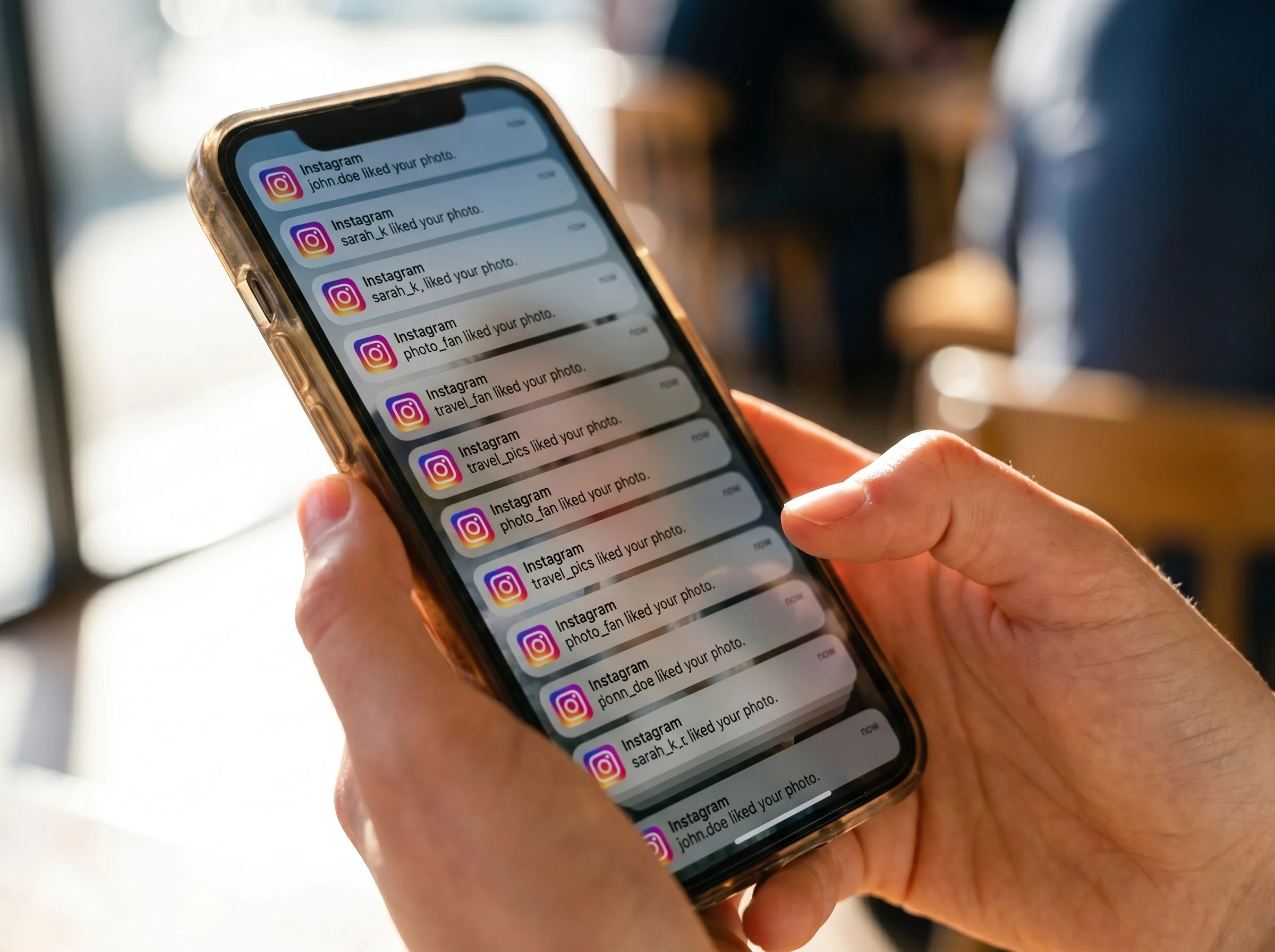
Recent changes on Instagram, with increasing emphasis on views, content distribution, and engagement metrics that are less immediately readable to the average user, have progressively eroded the ‘like’ as an intuitive measure of success. “Posts don’t get likes like they used to” is now a common refrain. Once, a glance at the counter was enough to understand, or believe one understood, a post’s position in the order of visibility.
Today, the picture is more fragmented, and this fragmentation itself weakens the theatrical power of the ‘like’.
Yet, losing centrality does not mean losing effectiveness. Many social signals become more influential precisely when they cease to appear absolute, entering a regime of subtler interpretation that is harder to dismantle.
From a sociological standpoint, the ‘like’ functioned for years as a “low unit value currency” with very high circulation. It was a minimal gesture used to distribute belonging, courtesy, proximity, and the desire to maintain a bond without investing too much time.
In this sense, its potential devaluation should be read not simply as a crisis of approval, but as a crisis in the public grammar of recognition.
When Instagram suggests that the success of content depends on other variables, it is not merely rewarding quality; it is redefining how social interaction is quantified. This redefinition may appear as a refinement of the system, but it also introduces a new level of opacity. Users lose a simple indicator and are handed over to a more complex, less verifiable interpretive structure.
Psychologically, the reduction of the ‘like’s symbolic power produces a dual effect. On one hand, it can mitigate a specific form of comparative anxiety generated by the immediate comparison of public numbers, especially among younger users.
On the other hand, the erosion of a clear parameter can intensify uncertainty. If I no longer know which signal truly matters, I may become more dependent on the continuous interpretation of all available signals: views, shares, comments, reach fluctuations, and even silences.
Anxiety does not disappear; it becomes more diffuse and harder to name.
The Cost of Holding Attention
We believe that today, true scarcity is not consent, but the human time available to grant it.
This statement gains new significance within the current platform ecosystem, where the view is no longer a mere prelude to interaction but often the very ground upon which the fate of content is decided. Instagram and similar platforms have taught creators, brands, and users alike that the primary victory is not obtaining a reaction, but winning those first few seconds of attention.
In this sense, value shifts: not so much from the social to the aesthetic, but from declared approval to measurable retention.
Yet, it would be hasty to assume that attention time is a nobler metric than the ‘like’. Time does not automatically coincide with quality, nor does the duration of a view guarantee intensity, understanding, or adherence.
Content can hold attention because it irritates, confuses, promises a deferred reward, or simply optimizes editing and suspense without offering anything lasting.
The contemporary rhetoric of attention risks replacing one superficiality with another: the cult of the short number with the cult of retained time.
Behaviorally, this shift produces a reconfiguration of the user. If the ‘like’ belonged to the repertoire of immediate response, the new environment incentivizes the design of content as a threshold device: built to avoid abandonment, generate micro-curiosity, and stimulate completion.
The author becomes a director of attention, and the audience becomes a testing lab.
There is a manipulative component here, as every optimized medium studies perceptual vulnerabilities. But there is also an emancipatory aspect: the demand to hold a gaze forces a more conscious reflection on form and structure.
Emotionally, the difference between being appreciated and being followed to the end is deep. The ‘like’ offered instant, almost tactile recognition.
Attention, conversely, produces a more ambiguous satisfaction, as it is less visible and less personal. Knowing someone watched a video for a long time is not the same as feeling they approved of you.
For some, this is liberating; for others, it is frustrating, introducing a colder, more statistical form of success that translates less clearly into human closeness.

Distributed Signals of Recognition
Users still seek approval, but they do so in less overt and more disseminated ways.
The temptation to contrast a past dominated by the ‘like’ with a present driven by “content value” oversimplifies a psychological reality that is far less linear. Humans do not stop desiring signals of recognition just because a platform modifies its metric hierarchy; rather, they learn to read other clues as proof of legitimacy.
A competent comment, a private share, a save, or the slow but steady growth of a loyal audience become new vectors of approval. The need remains; only its semantics change.
This does not mean the ‘like’ has been internally outgrown. In emotional terms, it retains an advantage that sophisticated metrics struggle to replicate: clarity. It is immediate and intuitively translated into a “yes.” Views can be high while comments are few; dwell time can be good without the subject feeling truly seen.
The ‘like’, however rudimentary, still possesses a peculiar affective density because it reduces interpretive ambiguity. This explains why many users continue to track it, even when they rationally know it is no longer the primary measure of value.
Conversely, the semantic poverty of the ‘like’ makes it a signal often too generic to support more mature identities or ambitious creative practices.
Many authors in niche territories have long known that content can have a real impact despite low ‘like’ counts and high subterranean circulation. A shared idea in chats or a post that changes a community’s behavior can exert more influence than a numerically flashy public reaction.
In this sense, the decentralization of the ‘like’ may correct a historical distortion: the illusion that social value always coincides with exhibited value.
Sociologically, this produces a shift from a culture of explicit confirmation to a culture of distributed resonance. The former had the advantage of collective legibility; the latter favors less conspicuous and more situated forms of prestige, harder to map from the outside but potentially more intense.

The Discipline of Retention
Metrics do not only measure content: they train bodies, mental rhythms, and the expectations with which we present ourselves to others.
For years, the ‘like’ acted as a small machine for emotional discipline, teaching us when to post, how to crop an image, and which parts of the self to exhibit. Its power lay in its ability to anticipate behavior. We learned to feel in function of the potential reaction of others, transforming spontaneity into a hypothesis of reception.
If that center of gravity now shifts toward views, watch time, and composite engagement, the discipline does not disappear; it merely changes its object.
The user is no longer just called to be likable or approvable, but structurally “retaining.” This means the digital self tends to organize itself as a narrative device: it must introduce, suspend, promise, maintain, and relaunch.
While this can make online expression more formally sophisticated, it can also push toward a more totalizing performativity where being liked is no longer enough; one must remain continuously interesting. The old anxiety of pleasing gives way to a new anxiety of holding attention.
Emotionally, the transition is delicate. The culture of the ‘like’ produced rapid reward peaks and equally rapid voids. The culture of attention, however, offers less distinct discharges; it often produces a colder form of self-surveillance, less dependent on the moment of feedback and more oriented toward the constant reading of trends.
For some, this is a relief, reducing the theatricality of immediate judgment; for others, it becomes a subtler burden, requiring a permanent and almost managerial self-analysis.
We must, however, avoid an overly harsh conclusion. Platforms do not mold passive and indistinct users; people develop tactics, ironies, and zones of resistance.
Many learn to use the ‘like’ as a pure signal of courtesy without narcissistic investment, or to read views with detachment. Discipline is never absolute; it always encounters interpretation, adaptation, and forms of desertion.
Prestige Beyond Visibility
Digital culture is entering a phase where prestige no longer always coincides with visible applause. This thesis is particularly clear in the more mature segments of platforms, where reputation is increasingly built on the ability to generate trust, memory, and indirect citation rather than raw numbers.
In this scenario, the ‘like’ remains a useful but secondary signal, often unable to distinguish between ephemeral popularity and sedimented influence. Content that produces a high number of immediate approvals may evaporate in hours, while content that receives slower or private responses can continue to act in minds and conversations long after its apparent algorithmic life.
However, it would be wrong to turn this into an automatic celebration of “value content.” There is a romanticism of depth that mistakes low visibility for authenticity. Not everything with few likes is undervalued; sometimes it is simply ineffective or poorly constructed.
Similarly, not everything that circulates widely is superficial. Some widely appreciated content succeeds in holding together accessibility and density. The old opposition between consensus and quality, if used carelessly, becomes a cliché.
From a sociological perspective, the structure of cultural recognition is changing. In an environment dominated by public likes, status was visible and scenic. Today, we observe a growing bifurcation between manifest popularity and diffused authority.
Some maintain great exposure but less power to orient behaviors; others have smaller and quieter audiences but exercise much more consistent influence. This bifurcation does not eliminate hierarchies but makes them more porous, less readable, and sometimes more invisible.
Culturally, content begins to be valued for what it leaves behind after consumption. Here, attention time takes on a non-technical meaning: not just seconds held, but memory produced and symbolic reuse.
It is a higher threshold, harder to measure, and one that leads to an insoluble tension between the desire to quantify value and the excessive nature of value itself.

Beyond Visible Approval
From a psychological perspective, the most significant change consists of a redistribution of anxiety. The ‘like’ culture concentrated unease into a recognizable moment: the wait for feedback. The new culture of attention spreads that same unease along a longer and less spectacular arc, while offering different margins for processing.
Users can learn to seek stable signals of resonance rather than instant confirmation. While compulsive logics will remain active, the transformation of metrics opens a space for a different pedagogy of digital self-esteem.
Sociologically, the point is ambivalent. On one hand, losing the centrality of the ‘like’ may weaken conformity dynamics, making alignment with already consecrated content less automatic. On the other hand, the complexity of distribution criteria can strengthen the power of platforms, which become even more decisive arbiters of what emerges through behavioral inferences.
A culture less obsessed with likes is not automatically a freer one; it could be more mature, but also more governed by opaque mechanisms.
Culturally, however, something important is moving. The increasing focus on perceived quality and the ability to be saved and remembered suggests that audiences no longer respond only to the logic of reflex, but also to the logic of permanence.
It would be naive to think this coincides with a triumph of slow thought, yet it would be equally myopic to ignore that a significant portion of users is beginning to reward what resists dissipation.
In other words, value has not ceased to be social, but it is becoming less reducible to the visibility of its approval.
Perhaps the most honest formula is this: likes still count, but they no longer decide alone what it means to count. They remain important for their affective power and clarity, yet they coexist with a more demanding question regarding how much content remains with and accompanies the user.
The challenge for users and platforms will not be to abolish the desire for recognition, but to build environments where recognition is not the only possible name for attention.