


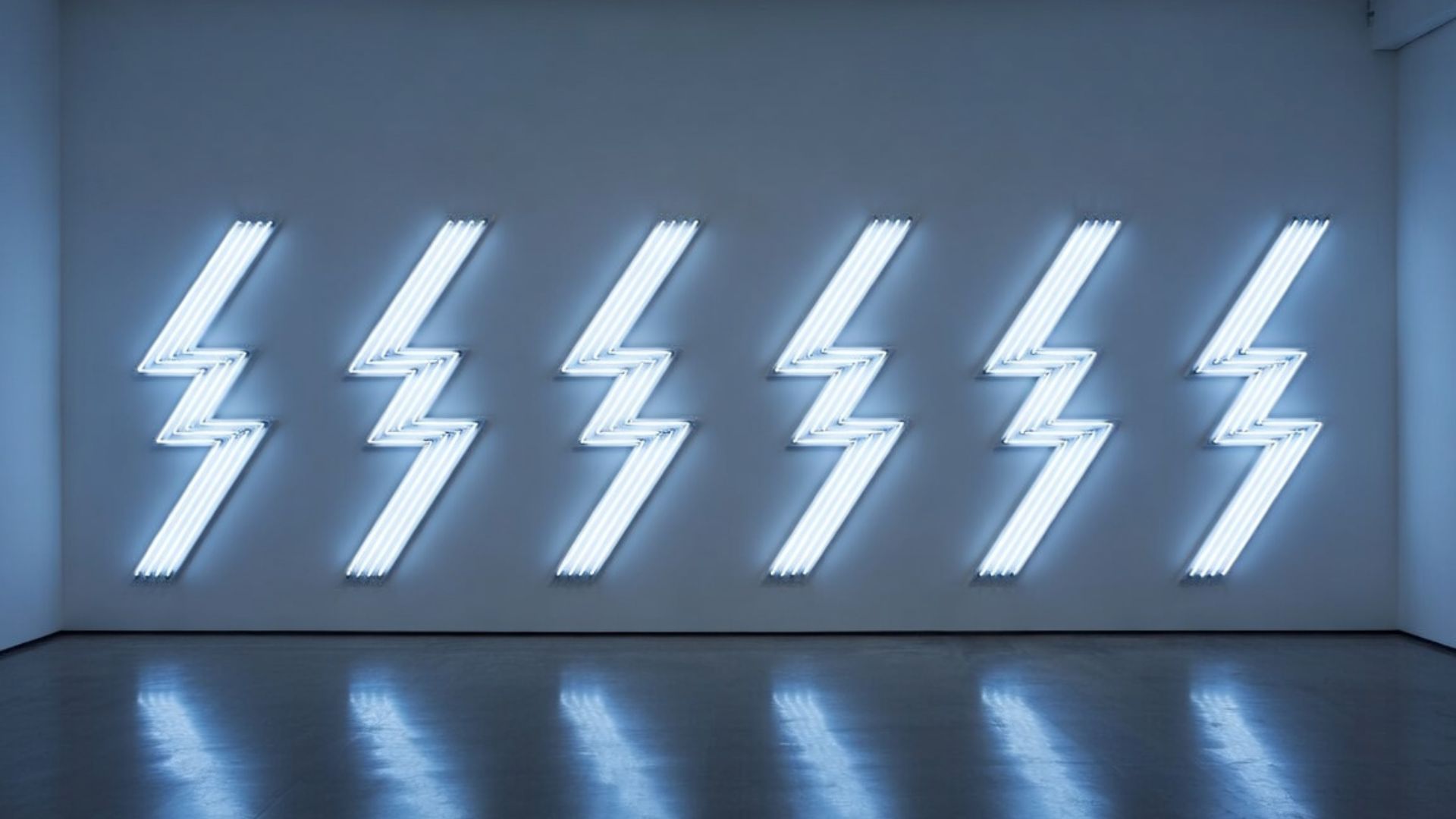
The Western obsession with visibility has historically relegated light to the role of a handmaid to form, a transparent medium intended solely to make the object intelligible. At the moment when pictorial matter disintegrates under the pressure of modernity, a contrary need emerges: no longer to illuminate the thing, but to make light itself a ‘thing’.
This epistemological transition finds its definitive breaking point in the cuts of Lucio Fontana, where the wound on the canvas is not a nihilistic void, but an opening toward a dimension in which luminous energy becomes real, tangible, and commandingly physical space.
The shift from the concept of representation to that of pure presence has redefined the boundaries of aesthetic experience, transforming the viewer from a detached observer into an integral part of a radiant ecosystem.
While Renaissance perspective sought to capture light within a solid geometry, the avant-gardes of the second half of the 20th century performed a radical reversal, extracting luminosity from the support and projecting it into the volume of the environment. In this view, the artwork ceases to be an artifact for contemplation and becomes an atmospheric condition that envelops the body and alters sensory perception.
The trajectory connecting early Spatialist experiments to today’s immersive installations is not linear but follows a logic of progressive dematerialization of the artistic idol in favor of a phenomenology of the visible. Light ceases to be the tool that allows vision to transform into the object of the gaze itself, a substance occupying the void with a paradoxical density.
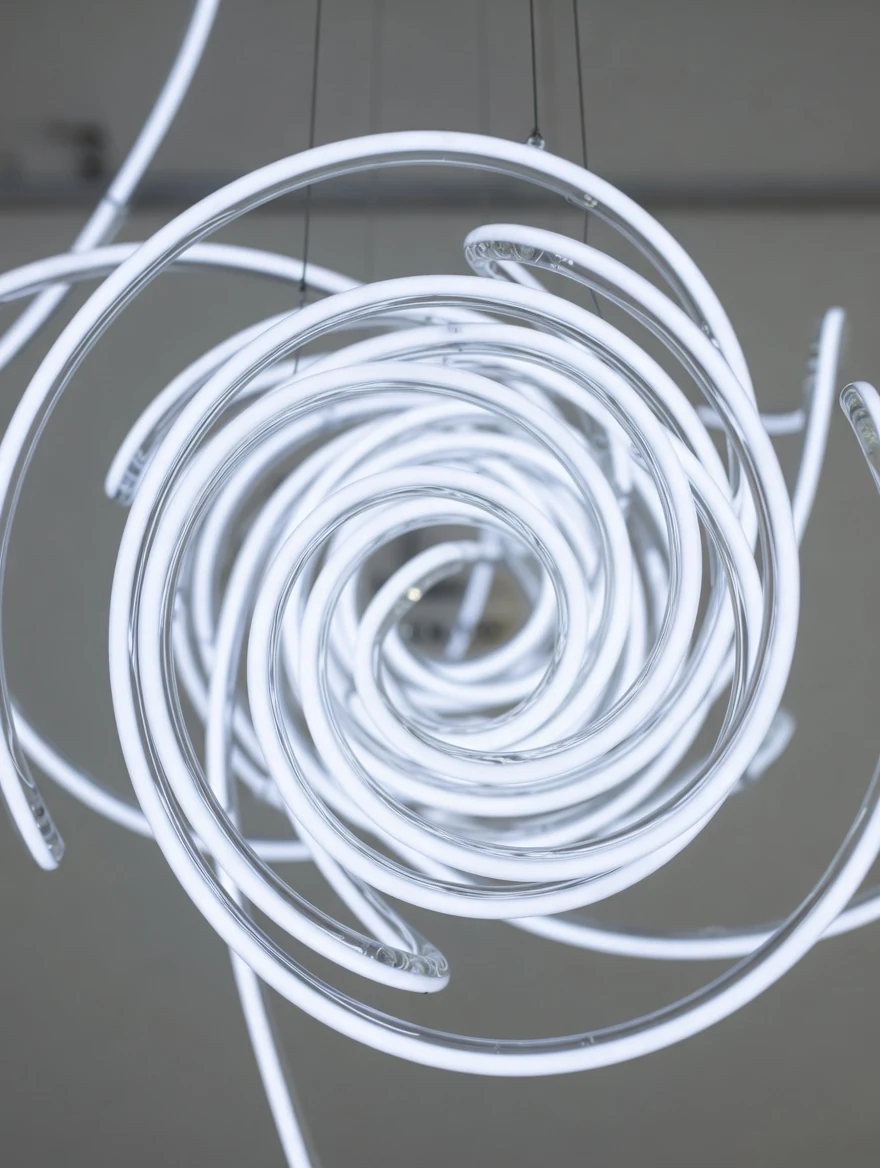
This metamorphosis raises profound questions about the nature of art in the age of technical reproducibility and digital simulation, where the boundary between physical reality and optical perception appears increasingly blurred. Curatorial intervention has played a decisive role in this renegotiation of power relations between light and space, elevating light installation to a paradigm of contemporaneity.
Figures like Harald Szeemann understood that the exhibition is no longer a sequence of hanging objects, but a choreography of energies requiring total involvement of the subject. In this context, the work of light stands as the final frontier of an ontological search that aims to capture the very essence of reality in its purest and most unstable manifestation. In an era saturated with screens and simulacra, reflecting on light as active matter means returning to the origin of perception, questioning the very structures of our being in the world.
From the austerity of minimalist neon to the seduction of immersive environments, light continues to operate as a critical device capable of dismantling the certainties of the visible. The work of art is no longer something that stands ‘before’ us, but is the light itself in which we are immersed, a radiation that constantly redefines the perimeter of our sensory horizon.
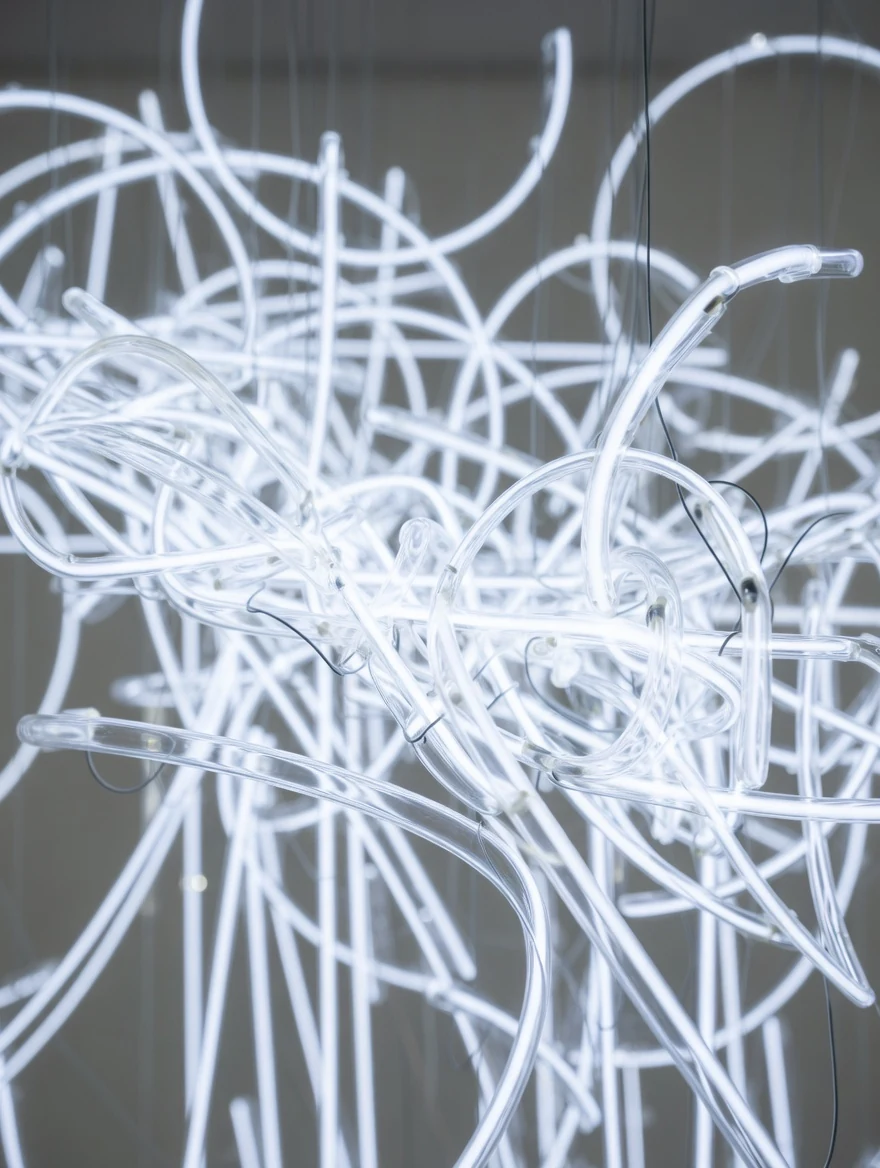
The Gash of the Absolute
Lucio Fontana’s revolution lies not in the destruction of the canvas, but in the discovery of a spatiality that precedes and surpasses painting itself through the introduction of light as an architectural and philosophical element. With the neon for the IX Milan Triennale in 1951, the Italian-Argentine artist performed a radical act of liberation, transforming an electrified gas into a graphic sign that floats in the void, devoid of any material support.
This luminous arabesque is not a decoration but the manifestation of a space that becomes active matter, an energy that invades the environment and forces the eye to confront a new and unsettling tridimensionality. Light ceases to be an external attribute of form to become the very substance of the work, a presence that does not simply occupy space but generates it at the very moment it is perceived. Fontana’s Spatialist intuition shifts the axis of aesthetic inquiry toward a dimension where the concept of the limit is systematically eroded by the fluidity of radiation.
In the ‘Spatial Environments’, light stops being a vector of visual information and becomes a haptic experience, something the viewer can almost touch with their own skin while moving through rooms saturated with pure color. This operation marks the end of the painting as a window onto the world and the beginning of the environment as a world in itself, a reality in which light is no longer a means of representation but a phenomenological agent of transformation. The work becomes a field of forces in which the observer loses their gravitational references to find themselves immersed in a totality that precedes and surrounds them. The radicality of this position lies in the awareness that light possesses an intrinsically architectural quality, capable of modeling the void with a precision that no solid material could ever match. Fontana understands that neon, though a product of industrial modernity, possesses a metaphysical charge that allows for the overcoming of the duality between spirit and matter. In this sense, the use of light is not a technological whim but an ontological necessity dictated by the need to find a language suitable for the discoveries of contemporary physics and the new perception of the cosmos. Space is no longer an empty container but a plenum of vibrating energies that the artist has the task of making visible through the luminous gesture. Fontana’s work acts as a catalyst that allows for the rethinking of the entire history of art as a tension toward the immaterial, a flight from the heaviness of the object toward the lightness of the photon.
His influence reverberates through all subsequent research, establishing a primacy of perception over description that would become the cornerstone of conceptual art and minimalism. Through his gashes and cathode tubes, Fontana opened a breach in the compactness of reality, allowing light to infiltrate the cracks of Western thought and dismantle the hierarchies between interior and exterior. Every subsequent light installation is, ultimately, an extension of that first, blinding electric sign that tore through the darkness of tradition. Fontana’s light is never neutral, but is charged with a dramatic tension arising from the confrontation between human finitude and the infinity of the surrounding space. It does not reassure but disturbs, because it reveals the fundamental instability of what we call reality, showing how the solidity of things is merely a surface effect of light itself. In this sense, the Spatialist act is not just an artistic event but a political gesture of reclaiming vision in a world that was beginning to be mediated by electronic images.
Light, as real space and active matter, becomes the quintessential tool for investigating the ultimate structure of the universe and the role of humanity within it. Fontana’s neon is the point of no return where art stops pretending to be an object to accept the challenge of being a pure luminous event.
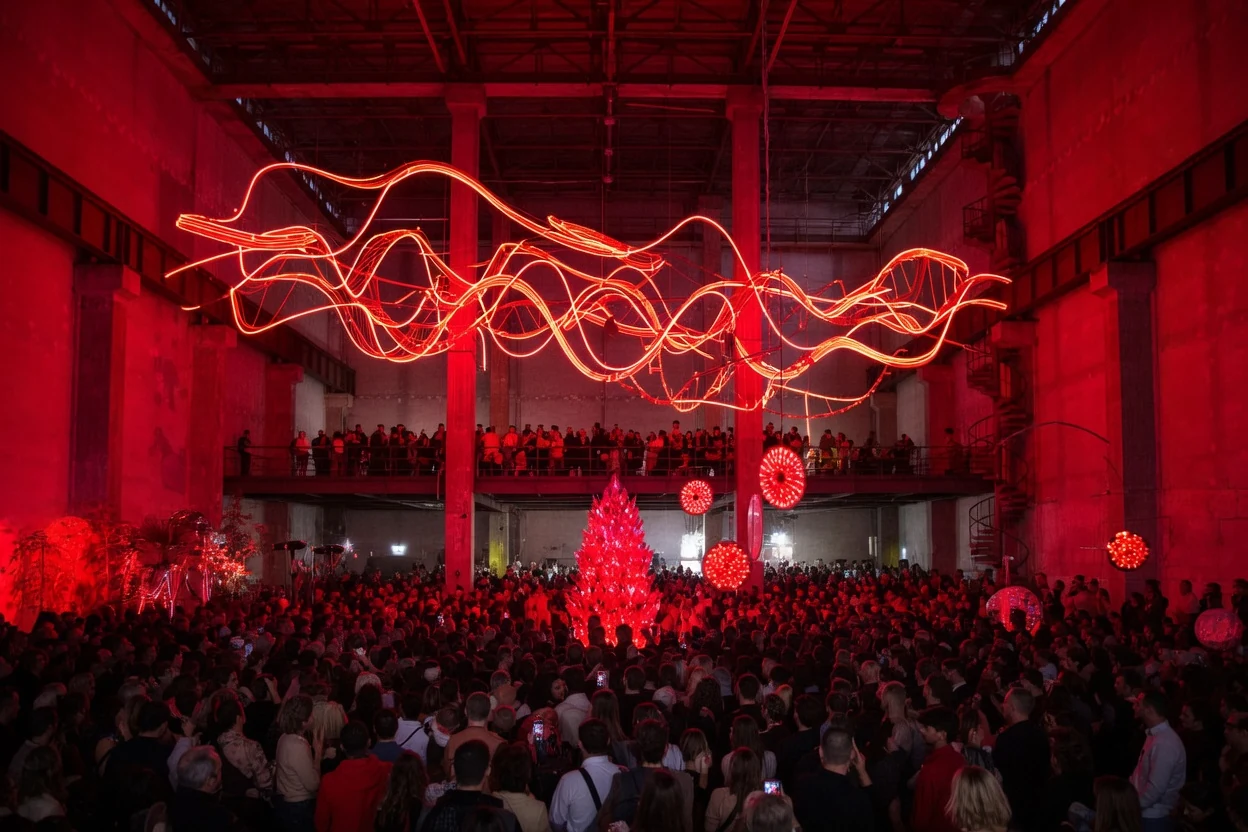
Geometries of the Ether
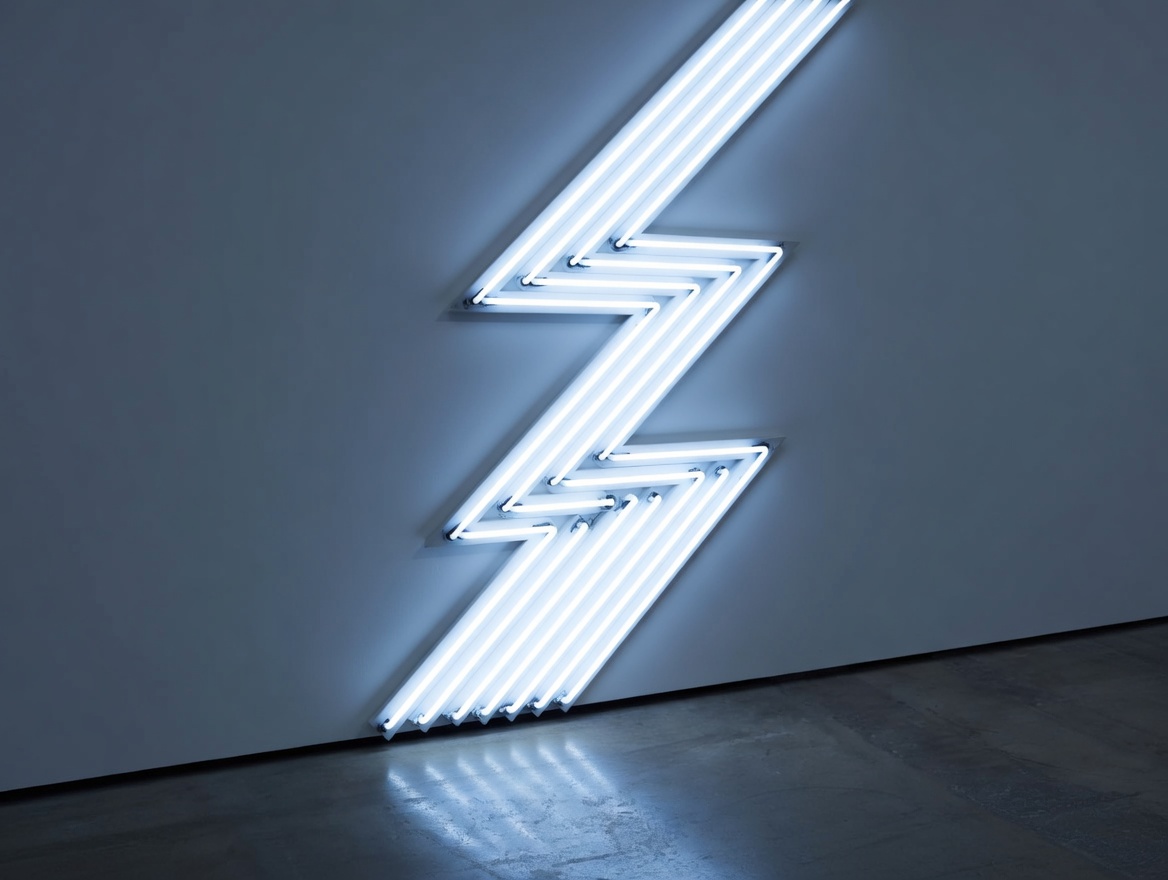
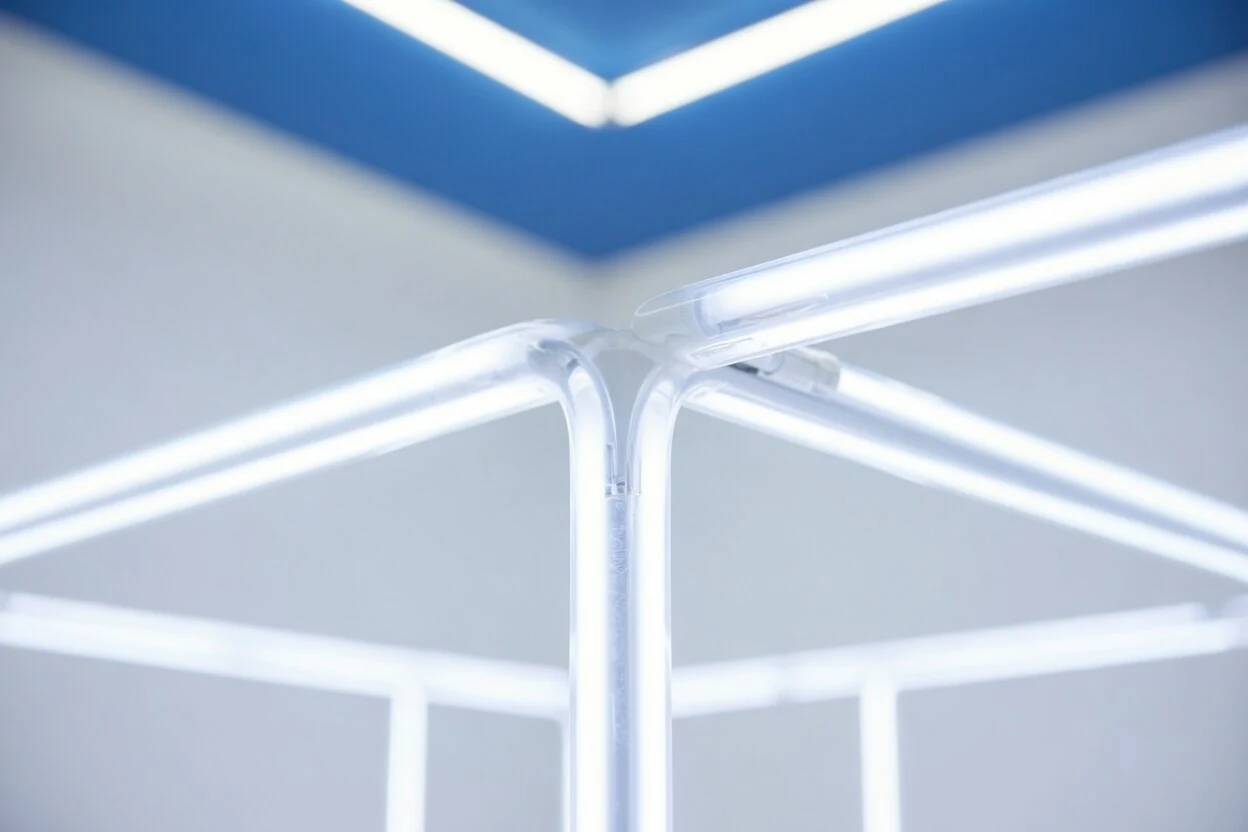
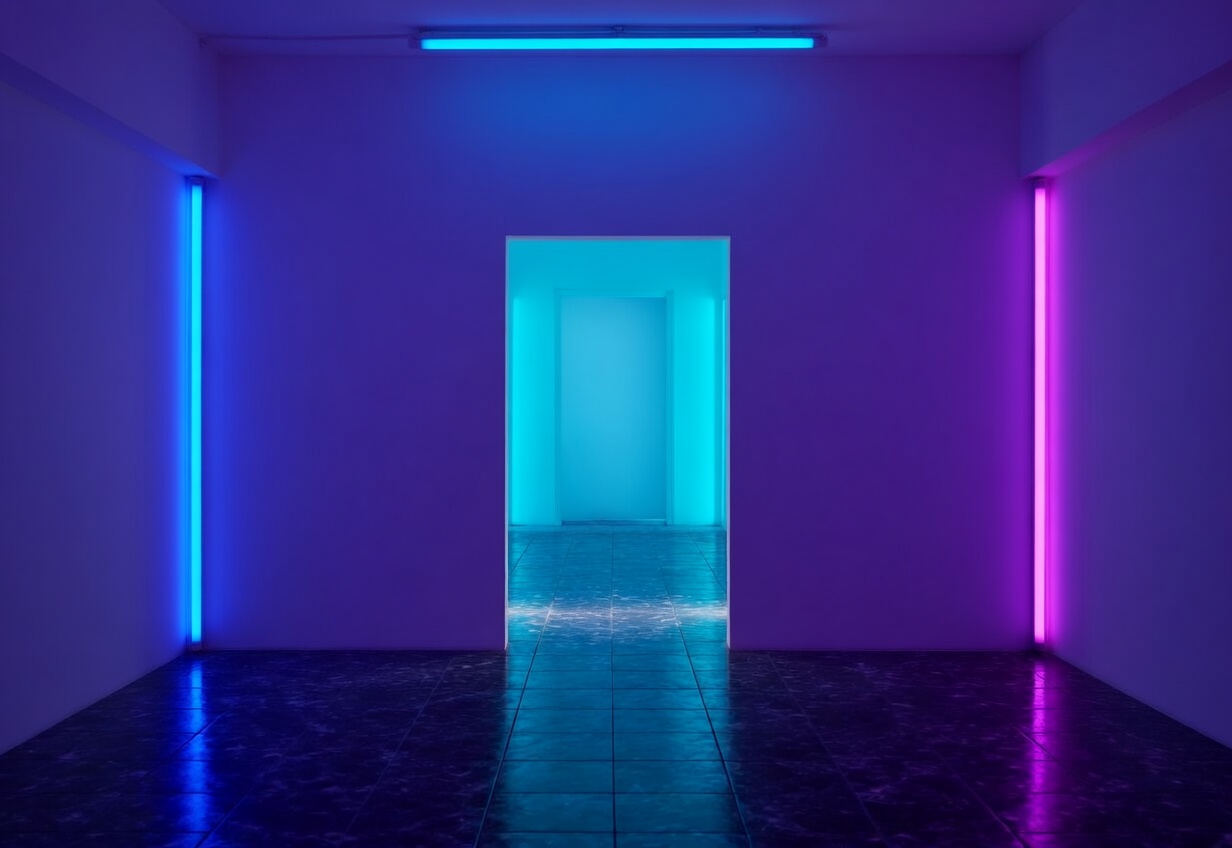
With the advent of minimalism, light takes on a serial and impersonal dimension aimed at purifying the aesthetic experience of any residue of expressionism or subjective narrative. Dan Flavin, using exclusively commercially available neon tubes, transforms the exhibition space into a field of colored radiation where the light source and the effect it produces perfectly coincide.
There is no longer any secret behind the work: the electric structure is exposed in its naked functionality, yet its emanation completely transfigures the surrounding architecture, neutralizing the solidity of corners and volumes. Flavin’s work is not the glass tube itself, but the glow it projects onto the floor and walls, a light that ‘happens’ and defines the time of its own perception. James Turrell pushes this research to an even more extreme level, working not with the light source, but with the pure perception of light as a volumetric presence. In his ‘Ganzfelds’ or his ‘Skyspaces’, light is isolated in such a way that it loses all connection to the physical source, becoming a dense substance that seems as though it could almost be cut or molded by hand. Turrell forces the viewer into a direct confrontation with the limits of their own visual system, creating situations of sensory deprivation or saturation in which the eye begins to ‘see itself’ in the act of seeing.
Here, light is not an object of inquiry but the subject investigating our capacity to inhabit a world devoid of solidity, transforming observation into a meditative and nearly mystical practice. The difference between Flavin’s and Turrell’s approaches lies in how light interacts with the concept of aura: while Flavin demystifies it through the industrialization of the medium, Turrell reconstitutes it through a phenomenology of the absolute. Both, however, converge on the idea that art should no longer produce icons but spatial situations governed by precise physical and optical laws. In these geometries of the ether, color is no longer a property of surfaces but a vibration of the air, an atmospheric quality that alters the perception of time and bodily weight. The exhibition space ceases to be a neutral container to become a protagonist, a vibrating body shaped by electromagnetic radiation. This manipulation of light as a building material allows for the traditional distinction between painting and sculpture to be overcome, giving life to a form of art that is intrinsically relational and situated. The work exists only as long as there is light and an eye to receive it, making explicit the indissoluble link between physical phenomenon and cognitive act. There is no objectivity of light outside our experience of it, and luminous minimalism exasperates this awareness, taking it to its extreme logical consequences. The architecture of the invisible is thus revealed not as a void, but as a complex structure of luminous gradients that determine our orientation in the world. The legacy of Flavin and Turrell consists in having transformed light from a means of illumination to a means of ontological definition of the surrounding reality.
They demonstrated that light can be used to deconstruct architecture, to manipulate the psychology of space, and to question the very nature of visual truth. In a world dominated by the solidity of commodities, light art proposes a resistance based on transparency and vibration, reminding us that our perception is always a creative act and never a simple passive recording. Light thus becomes the paradigm of an art that does not want to possess reality, but to inhabit its most fleeting and luminous essence.
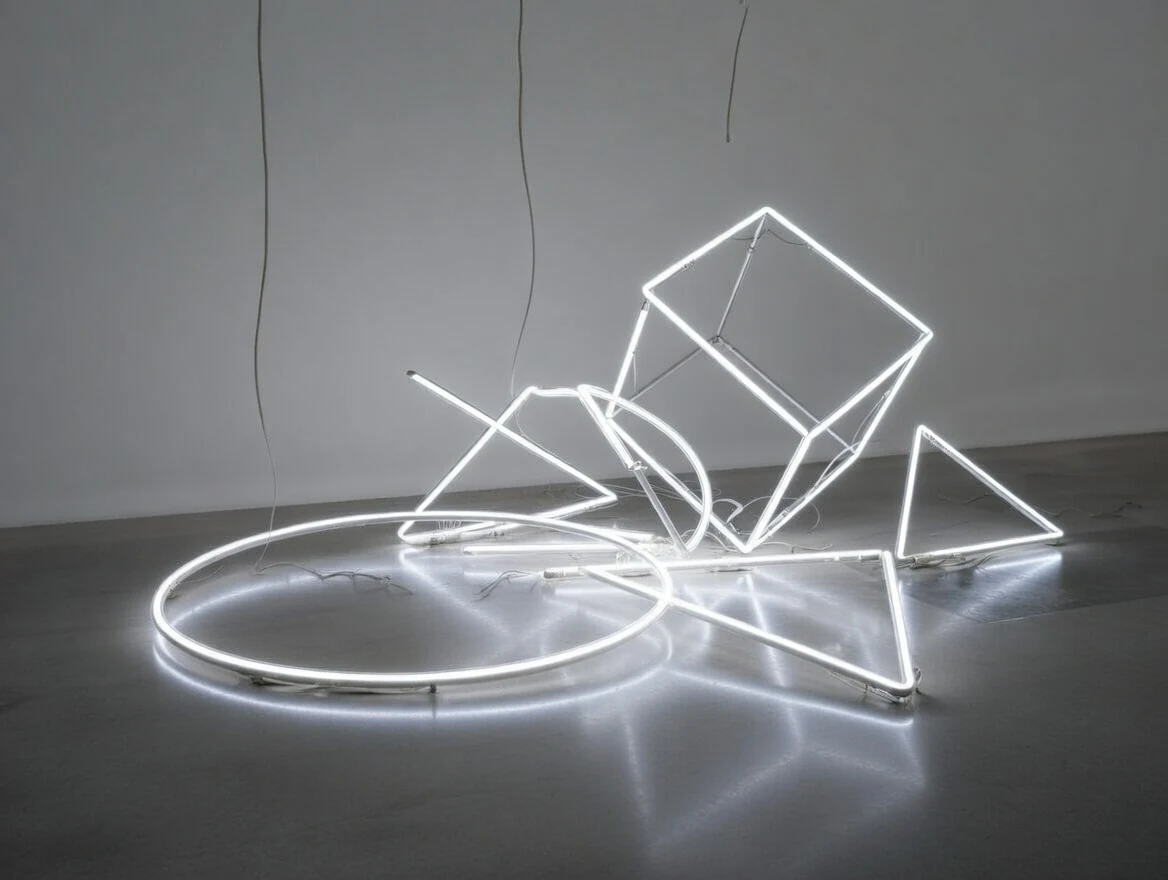
The Incandescent Word
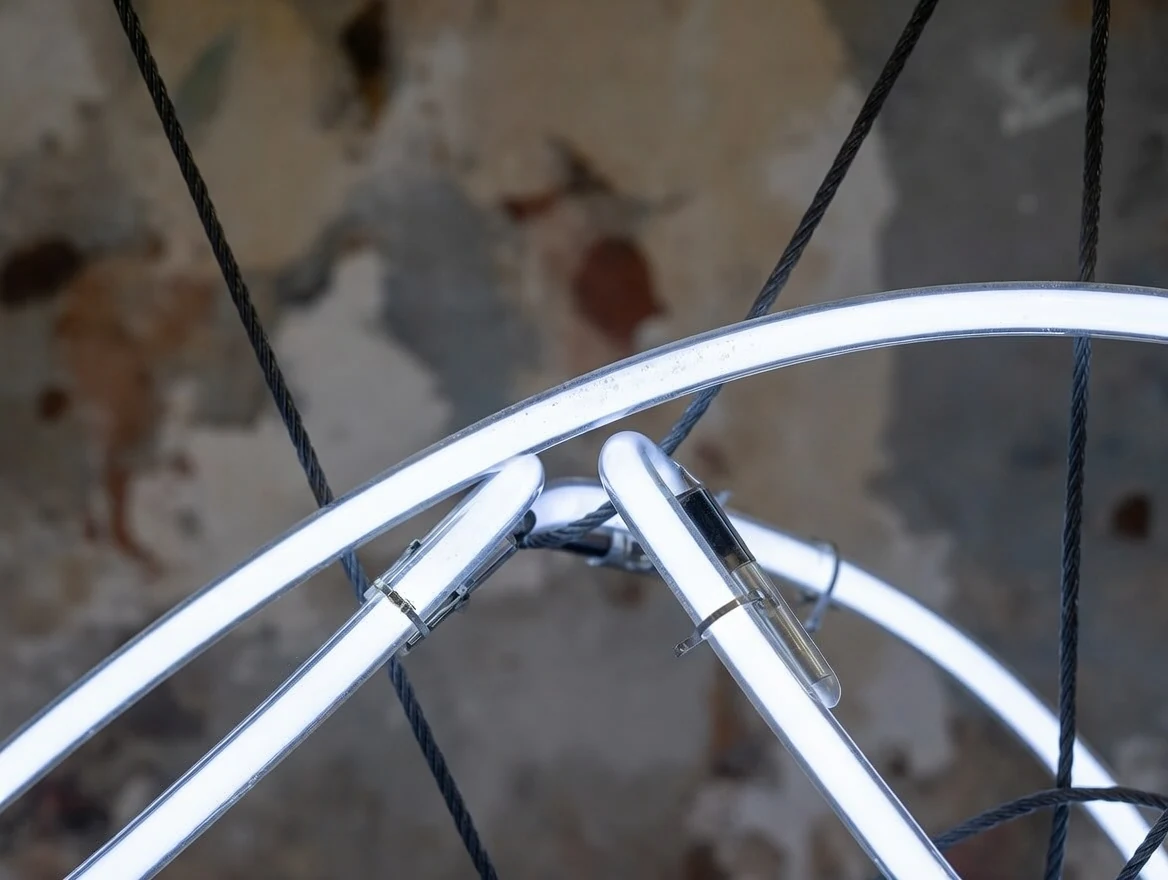
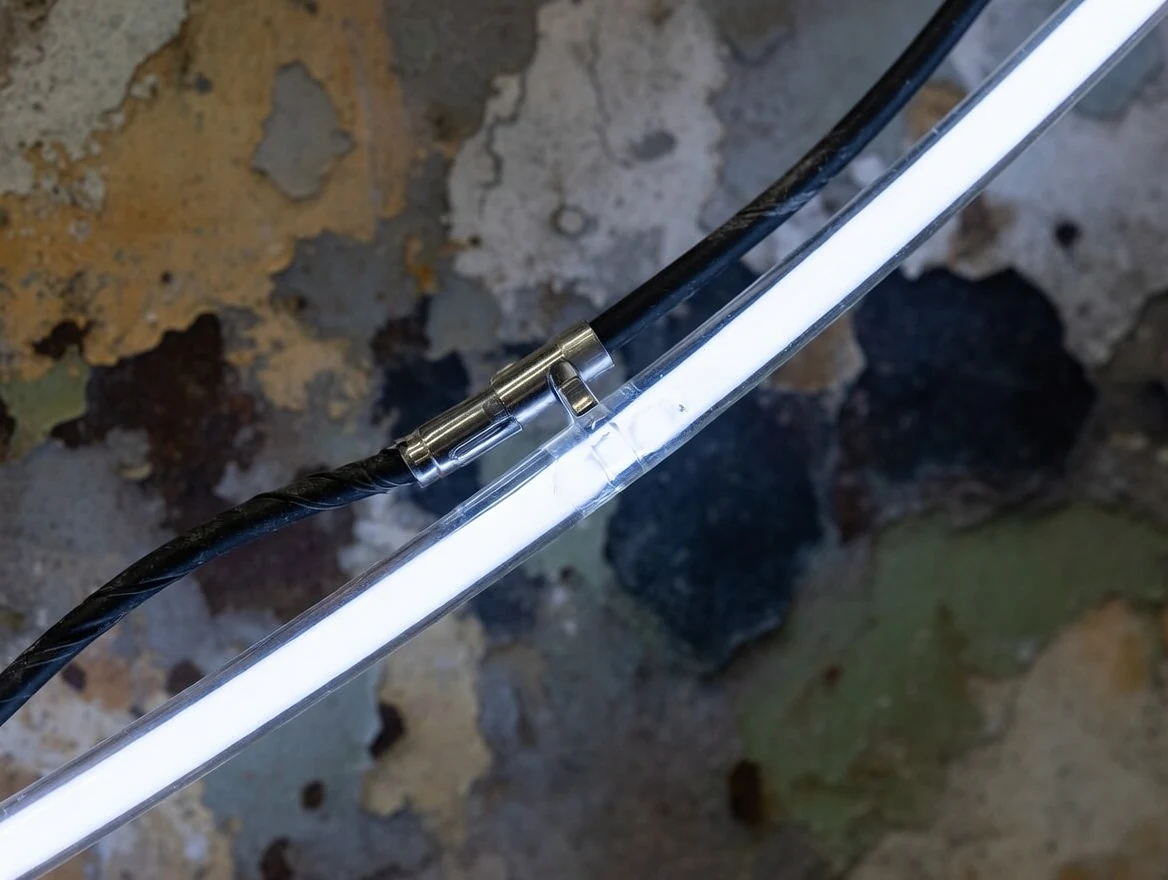
The introduction of light into the perimeter of conceptual art and Arte Povera marks the moment when electric radiation becomes a vehicle for linguistic and political significance. For Bruce Nauman, neon is not a tool for creating chromatic harmonies, but a device to force language into its darkest corners, transforming words and phrases into pulsing signals that assault the viewer’s psyche.
His luminous signs, often repetitive and obsessive, expose the violence inherent in communication and the precariousness of human identity through a medium that recalls the aggressive aesthetics of urban centers and sex shops. In Nauman, light is heat, tension, and urgency, a form of energy that makes thought visible in its rawest and least reassuring nakedness. In an apparently opposite direction, Mario Merz uses neon to trace a continuity between the organic and technological worlds, integrating the cold light of cathode tubes with ‘poor’ materials like stones, earth, or branches. The Fibonacci sequence, rendered in neon and often placed on glass igloos or bundles of wood, becomes the symbol of vital growth that traverses every form of existence, from number to matter, from light to flesh. For Merz, neon is the vital spark that animates the inert, a primordial energy connecting the mathematical structure of the universe to its most elementary physical manifestation. Light is not an abstract concept, but a biotherapeutic force that warms and transforms the art object into a living organism. Joseph Kosuth, by contrast, uses light to investigate the tautology of language and the purely mental nature of the work of art, where neon serves to state its own definition or the process of its creation. In his works, light is a pure verbal act made incandescent, an erasure of aesthetics in favor of a rigorous logic that admits no sentimental interpretations. Neon becomes the ideal support for a reflection that seeks to be both self-referential and universal, eliminating any trace of the artist’s hand to focus on the purity of the idea. Here, light is information in its purest state, an electric bit manifesting in space without ever becoming a solid body, maintaining the transparency of thought. The use of neon by these artists demonstrates how light can act as a bridge between the intellectual and sensory dimensions, between the rigor of logic and the power of the symbol.
Electric light, far from being just an industrial product, is rediscovered as a medium capable of conveying complex messages, emotional tensions, and metaphysical reflections on the structure of reality. It allows the interiority of thought to be made public, transforming private observation into a collective experience saturated with chromatic and energetic intensity. Neon thus becomes the lingua franca of an art that is not afraid to confront technological modernity, but which simultaneously seeks its limits and shadows. In this phase, light definitively ceases to be ‘natural’ to become a cultural construct, a material that the artist can bend, program, and force according to their expressive needs. Its paradoxical nature, being simultaneously wave and particle, information and heat, makes it the perfect tool for an era discovering the immaterial nature of power and communication.
Neon no longer illuminates reality, but comments on, critiques, or celebrates it, becoming the luminous sign of a human presence trying to leave a trace in the darkness of meaning. Light is now the word made electric flesh, a technological epiphany revealing the hidden structures of our existence within language and history.
The Grammar of the Trace
The transition toward contemporary practices sees light transform into a tool for sociopolitical investigation and intimate confession, where LED technology and luminous handwriting become new alphabets of the self and the world. Jenny Holzer has elevated the use of luminous displays to a form of cultural guerrilla warfare, infiltrating mainstream information circuits with messages that oscillate between folk wisdom and radical critiques of power.
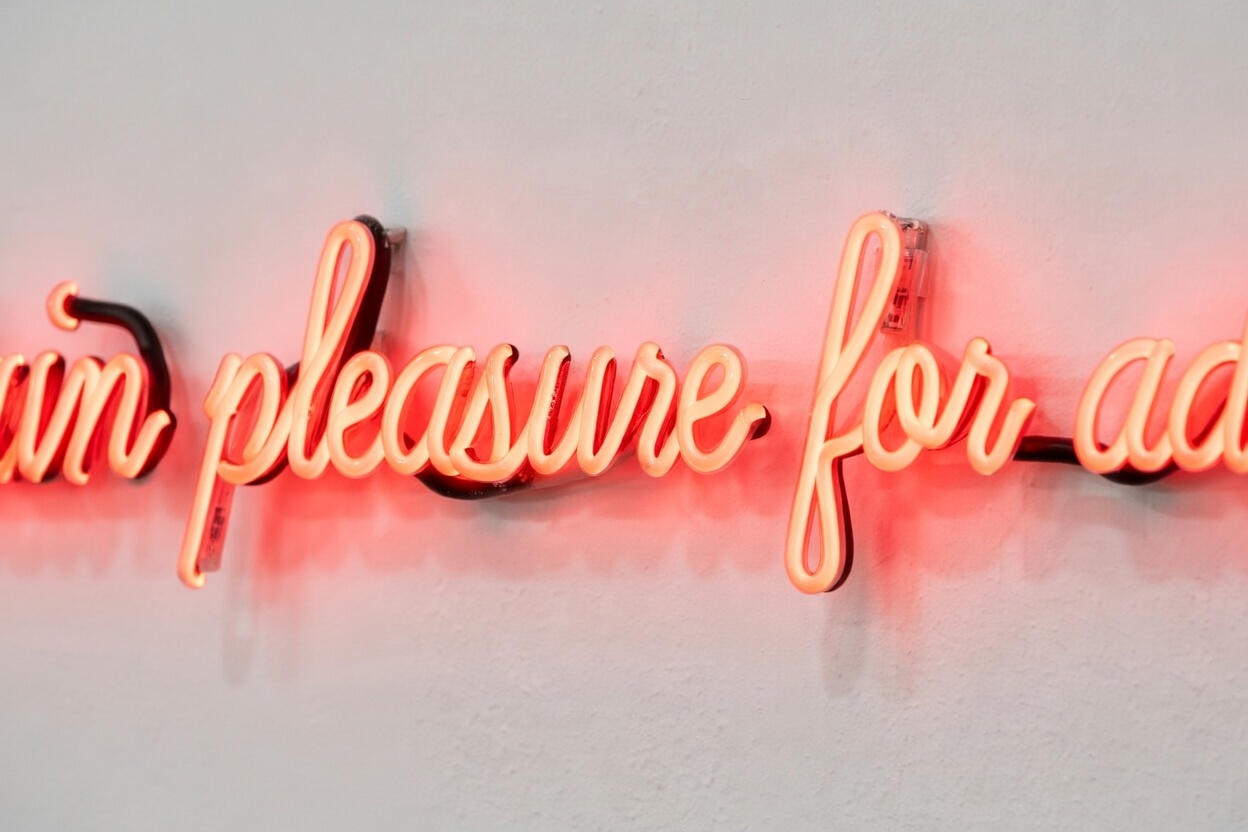
Her rapidly scrolling LEDs are not just supports for text, but become metaphors for the speed of information and its ability to saturate our consciousness to the point of anesthesia. In Holzer, light is a kinetic surface that bombards the viewer, making reading an act of physical resistance against the unstoppable flow of propaganda and consumption. At the opposite end of luminous sensitivity sits Tracey Emin, who uses neon to translate her own calligraphy into a luminous trace of a pained and autobiographical intimacy. Her messages, handwritten and then transformed into colored glass tubes, maintain the urgency of a stolen note or a whispered secret, but acquire a fragile monumentality through the irradiation of light. Emin’s neon does not speak to the masses but to the individual, using the coldness of electrified gas to warm deep emotions such as love, pain, and desire. In this case, light acts as an emotional amplifier, making the ephemeral nature of feeling something visible and persistent, a luminous scar glowing in the darkness of the gallery.
These practices demonstrate how light can be charged with a narrative density that goes beyond the pure spatial phenomenology of the 1960s, becoming a medium that dialogues with memory and identity. The grammar of the luminous trace allows for the overlapping of the public and private, the political and the poetic, in a single image that is both ephemeral and pervasive. Light is no longer an abstract element but a conductor of stories, an electric archive that preserves and projects the instances of a humanity seeking to define itself through the brilliance of the sign. The work of art thus becomes a sort of existential signage, a luminous guide in the labyrinths of contemporaneity. The shift from neon to LED also reflects a change in the nature of the luminous image itself, which becomes increasingly granular, programmable, and integrated into urban architecture. While neon maintains a link to the physicality of blown glass and gas, the LED represents the digital dematerialization of light into pixels of pure energy, ready to be recombined into infinite messages. This technological evolution allows artists to interact with public space on monumental scales, transforming entire building facades into narrative screens that dialogue with the crowd. Light thus becomes the supreme interface between the individual and the metropolis, a field of negotiation where new forms of social visibility are played out. In this perspective, light is the medium that best embodies the fluidity of our age, capable of passing instantly from the hardness of political denunciation to the softness of an amorous confession. It is no longer a static substance, but a dynamic force that adapts to the contours of our time, revealing its deepest contradictions and aspirations.
The artists of the luminous trace have managed to transform electric energy into a form of poetic resistance, proving that even at the heart of the coldest technology, a core of human warmth can pulse. Light becomes the testimony of a presence that refuses to be extinguished, a luminous cry defying the oblivion and indifference of the digital world.
Ecosystems of Vision
Contemporary art has recently embraced the creation of complex luminous ecosystems, where technology is not just a means but the supporting architecture of totalizing sensory experiences that mimic or challenge nature.
Olafur Eliasson represents the pinnacle of this research, transforming museums and public spaces into climatic laboratories where light is used to simulate atmospheric phenomena such as the sun, fog, or rainbows. In his ‘The Weather Project’, the saturated yellow light of an artificial turbine transformed the Tate Modern’s Turbine Hall into a post-industrial landscape of collective sublimity, forcing thousands of people into a primordial confrontation with their own shadows. Eliasson does not merely exhibit light; he puts it to work to deconstruct our perception of natural cycles, highlighting the mediated nature of our relationship with the environment. In these contexts, the viewer ceases to be a passive receiver of images to become an active element of a dynamic system in which their own movement alters the luminous field. The use of sensors, algorithms, and advanced projection technologies allows for the creation of installations that respond in real-time to human presence, transforming the work into an interactive organism living in symbiosis with the user. Light thus becomes a relational medium, a connective tissue linking the body, technology, and space in a single web of energetic fluctuations.
It is no longer about seeing a work, but about ‘being’ inside the work, inhabiting a condition of visibility that is constantly renegotiated by our physical presence. Contemporary research goes beyond simulation to explore the frontiers of biotechnology and augmented reality, where light becomes the vehicle for new forms of hybrid life and expanded perception. Artists working with bioluminescent light or large-scale interactive installations are redefining the very concept of ‘natural’, suggesting that our experience of the world is increasingly a technological construction. In this sense, the ecosystem of vision is not just a physical space but an epistemological field in which the boundary between the biological and the synthetic, between the light of the sun and that of the screen, is questioned. The work of art becomes an anticipation of a future in which reality will be indistinguishable from its luminous projection. This total immersion raises critical questions about the nature of control and surveillance in a society dominated by absolute visibility, where our every move can be tracked and translated into luminous data. While the experiential environment offers an escape from the banality of the everyday, it also acts as a sensory capture device that can be used to manipulate our emotional responses.
The most conscious artists use the seduction of light to reveal these very mechanisms of power, transforming the immersive installation into a space of critical awareness rather than simple entertainment. Light, therefore, is both the veil that hides reality and the force that can tear it open to reveal its hidden structures.
The evolution toward ecosystems of vision marks the final move beyond the art object in favor of an ontological condition where the work coincides with its perception. Light is no longer an attribute of beauty, but a parameter of being, a force that shapes not only the space around us but also the way we think and feel. In this scenario, art becomes a practice of perceptual ecology, an attempt to find a balance between the overwhelming power of technology and the fragility of our biology. The luminous work is no longer a fixed point in space, but a continuous flow of energy inviting us to radically rethink our position within a universe in perpetual irradiation.
The Consecration of Light as an Autonomous Medium
The consecration of light as an autonomous and central medium in artistic practices was made possible by a radical curatorial shift that legitimized immateriality as the supreme value of contemporary aesthetics.
Figures like Harald Szeemann dismantled the paradigm of the museum as a repository of objects to propose it as a theater of events, where energy, concept, and atmosphere weigh as much as marble or canvas.
Through seminal exhibitions, Szeemann elevated light to a tool of metaphysical narrative, understanding that the true avant-garde consisted in making the invisible visible, in giving body to that which, by definition, has no weight. This vision paved the way for a generation of curators who treated exhibition space not as a series of walls, but as a volume of air to be sculpted through radiation and shadow. Hans Ulrich Obrist continued this trajectory by bringing light installation to the heart of global curatorial culture, emphasizing the processual, performative, and relational aspects of art.
The exhibition is no longer a static display but an evolving organism, a ‘project’ that uses light as a universal connector between different disciplines and sensibilities. For Obrist, light is the medium of speed and connection, the element that allows us to inhabit the present time in its electric immediacy. The curator’s intervention thus becomes a form of luminous direction, a choreography of stimuli transforming the visitor into an active participant in an infinite spatial conversation. This transition from the care of objects to the care of energies has redefined the very role of artistic institutions, which have become power plants of meaning rather than temples of conservation.
Light, as a work in itself, imposes a logistical and ontological challenge on museums, forcing them to rethink their structures to house something that cannot be possessed except at the moment of its activation. The architecture of the invisible requires a renunciation of material possession in favor of an experience consumed in the time of vision, shifting focus from the work’s exchange value to its experiential use value. The exhibition becomes an unrepeatable event, a flash of consciousness shining in the institutional void. The final synthesis of this millennial parabola returns us to an art that has gone back to its solar and ritual roots, but with the means of the most advanced technology. If Fontana tore the veil to show space, contemporary artists and curators have filled that space with a light that no longer needs to justify itself through form, because it is form itself. Light is not a tool in the service of art; it is art that has become light to escape the prison of matter and the commodification of the object. In this radical transparency, the work finds its ultimate freedom, becoming a presence that inhabits the gaze before even occupying the room.
The legacy of this journey lies not only in the works produced, but in a new way of understanding our relationship with the visible, where light acts as a bridge between the self and the other, between the body and the universe. From Eliasson’s monumental installations to Emin’s luminous whispers, light continues to operate as a transformative force forcing us to constantly redefine the boundaries of our reality. It no longer illuminates the world for us; it reveals that we ourselves are made of the same substance as light, a conscious vibration in an ocean of radiation. The art of light is, ultimately, the celebration of this primordial unity, a luminous testimony of our inexhaustible tension toward the infinite.


