

A work sells. In the technical documentation, beside materials and dimensions, a new line appears: “AI Generation: 0%.” The figure has nothing to do with the work itself. It answers to the market. From the auction room to the independent gallery, this number became, sometime around 2025, something no one discusses openly but everyone includes: a declaration of purity. Not an authenticity certificate in the traditional sense, but something more precise and more powerful: the certification of an absence.
The EU AI Act, in its most stringent enforcement phase between 2024 and 2025, established disclosure obligations for content generated or modified by AI systems. The institutional logic was legible: transparency as protection, as the public’s right to know what it is looking at. That logic had coherence in the domain of information, political communication, journalism. Transposed into the field of art and collecting, it produced an effect the architects of the legislation likely never intended: a new authentication mechanism, more sophisticated and more pervasive than any prior system.
What appeared as a regulatory opening has revealed itself, in concrete application, as a mechanism of closure. Mandatory disclosure generated a purity market: a system where “how much AI” functions as a price signal, where the percentage of algorithmic intervention becomes a proxy for human intention, where artists must quantify their presence in a work before the work can circulate. Transparency produced a new form of opacity, harder to perceive because it wears the face of honesty.
We observe this process from a position that is both privileged and uncomfortable. We see it unfold in real time, in the rooms where decisions are made, in conversations between gallerists and collectors, in legal briefings translating regulatory guidelines into commercial policy. What we see resembles an orthodoxy more than a liberalization, and it is more sophisticated than previous orthodoxies precisely because it is encoded in percentages rather than in judgments.
The question this essay holds open, without any pretense of resolving it, is the one no one wants to formulate explicitly: has mandatory AI disclosure created a market for human purity more effective and more pervasive than the authentication systems it nominally replaced? And if so, what does this tell us about the relationship between regulation, market logic, and the production of value in contemporary art?
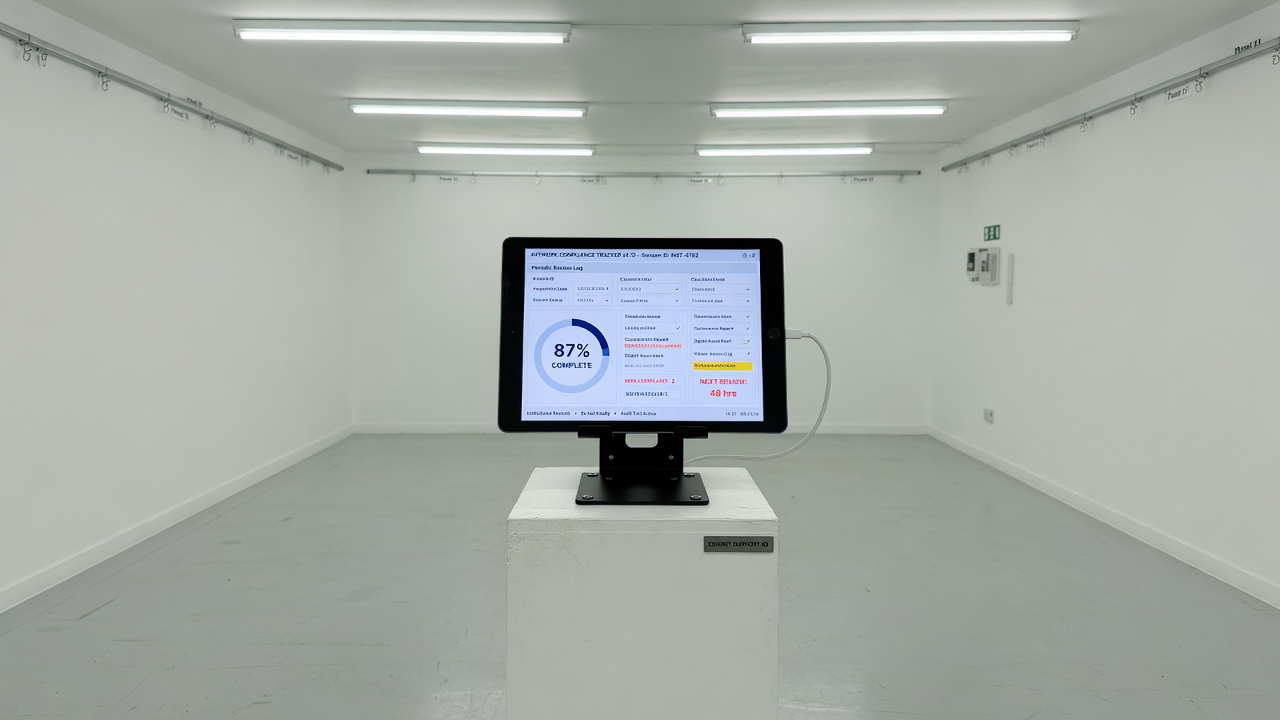
The Threshold of Transparency
The EU AI Act is not legislation about art. It governs high-risk AI systems, algorithmic accountability, the protection of fundamental rights in the age of automated computation. But laws do not operate only within the domains for which they were conceived; they operate wherever they produce effects, and the effects of mandatory disclosure reached the art market at a speed that cultural institutions were not equipped to absorb.
The specific provision, Article 50 of the AI Act, requires that artificially generated content be labeled as such in machine-readable form. The underlying rationale was disinformation: political deepfakes, voice cloning, the manipulation of journalistic imagery. The legislative text draws no distinction between an electoral deepfake and a work of generative art. Both fall within the same category. Both require labeling.
Galleries and auction houses, attempting to comply preemptively and shield themselves from future liability, interpreted this framework more broadly than the regulation required. They began demanding voluntary declarations not just on AI generation but on the entire creative process: which software was used, at which stage, with what degree of systemic autonomy. The result was a disclosure protocol that extended well beyond the regulatory perimeter and transformed transparency from an obligation into a market standard.
A market standard carries no neutrality. It functions as a social technology that produces classifications, hierarchies, exclusions. When disclosure becomes a standard, its content stops being purely informational and becomes evaluative. “AI Generation: 0%” says something about value, according to a metric the market had already built before any regulation formalized it.
This anticipation matters. The market did not wait for the regulation; it had already absorbed its logic into its valuation framework. The EU AI Act gave institutional form to something the art system had decided informally. The legislation did not create the fetish of algorithmic provenance; it made it visible, measurable, officially relevant.
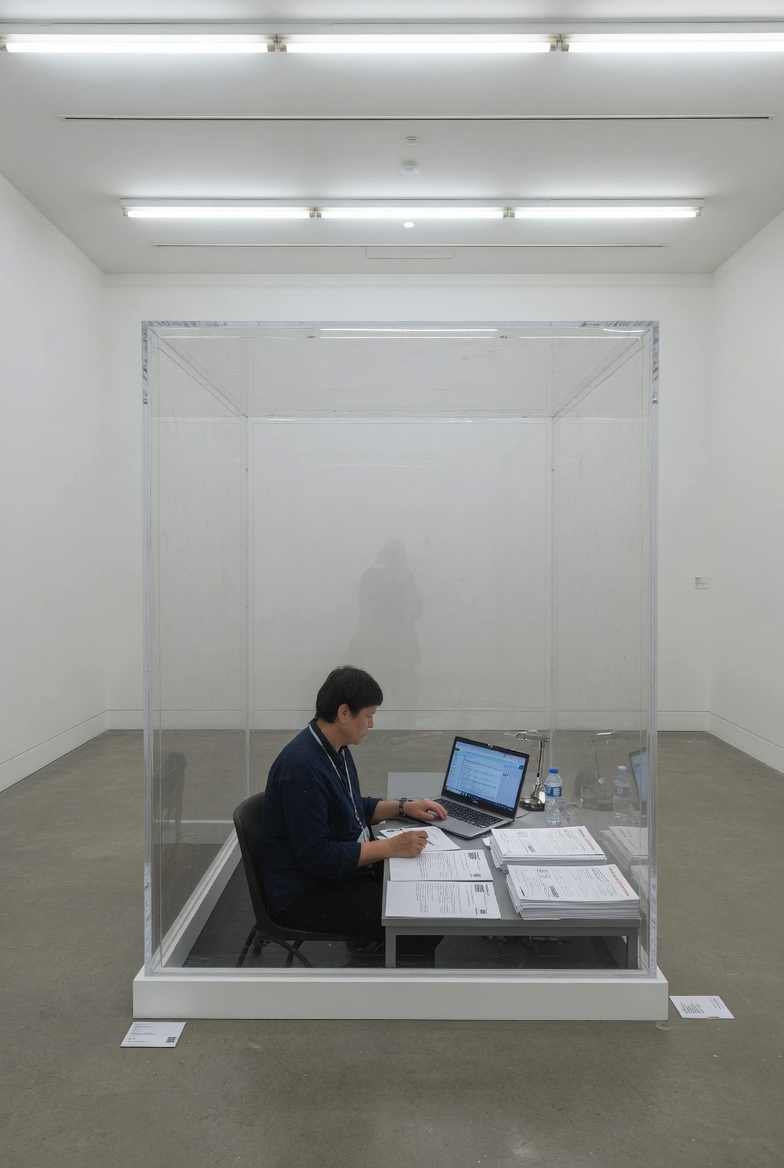
The Certificate of Absence
A structural paradox sits at the core of this apparatus: what gets certified is what is absent. Traditional authentication documents the presence of something: the artist’s hand, the pigment of the period, the provenance chain. The certificate of algorithmic purity attests an absence: AI has not touched this work, or has touched it to a minimal, measurable, declared degree. Value accrues not to what the work contains but to what it excludes.
This inversion has historical precedents, none of them so explicitly quantified. The fetish of the original, the mythology of the unique, the sanctity of the first edition: all these value-producing mechanisms operated through an authentic presence that resisted measurement. Now purity is measured in percentages. The question becomes legitimate: what is the acceptable threshold? Does 5% AI constitute sufficient purity? Does 20% compromise authenticity? The market has not answered, but it has already accepted the question as a valid one.
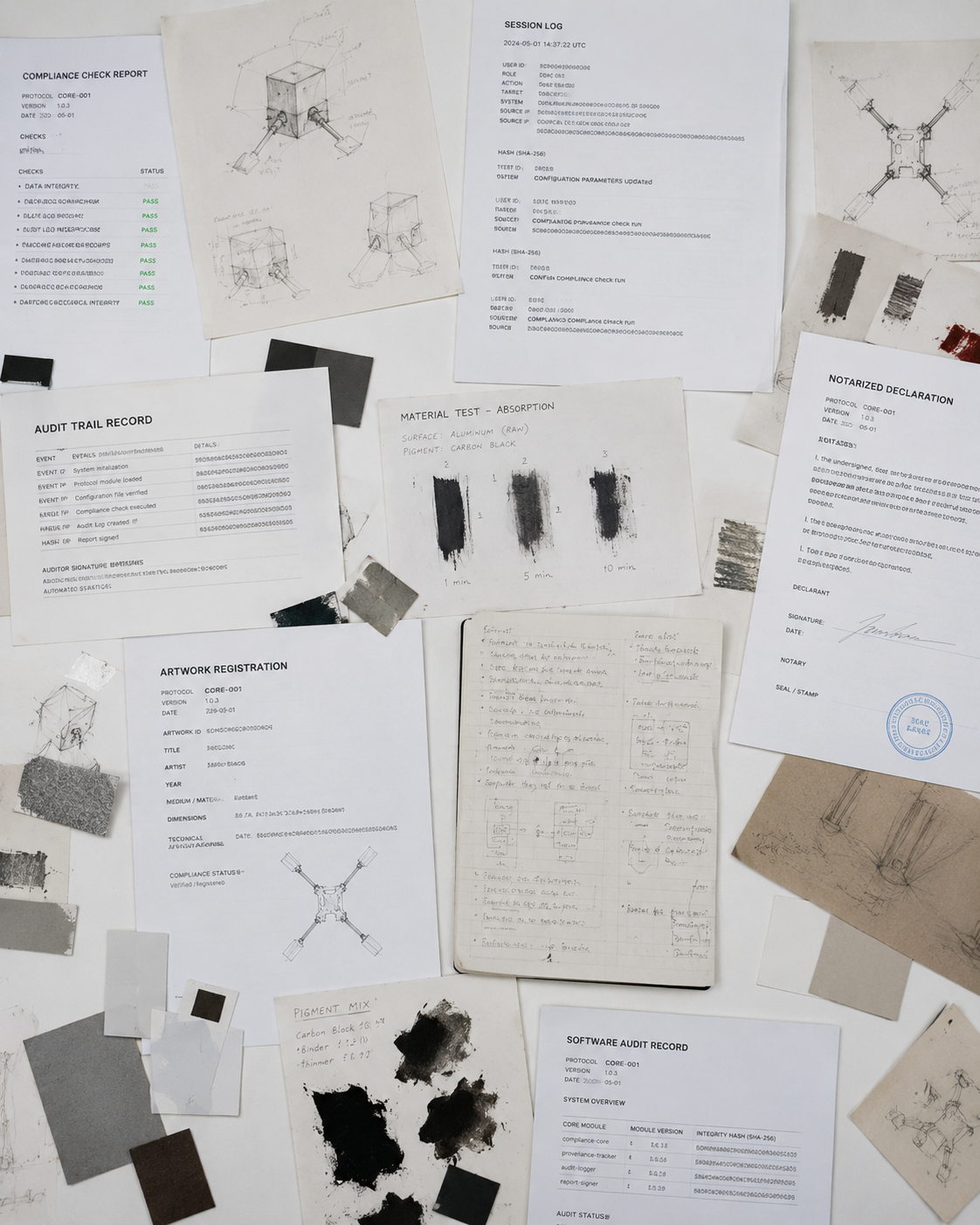
What this logic produces is a new form of creative due diligence. Galleries we work with report artists documenting their process in greater detail than any critical apparatus ever required: process screenshots, software session logs, notarized declarations of tool use. Disclosure has ceased to be a final act and become a practice that reshapes the creative process from within, generating documentation designed not for the work but for the market that will receive it.
The short circuit is visible. If an artist modifies their creative process to produce documentation of purity, the process is already contaminated by purity logic. The transparency demanded does not open a window onto the real process; it constructs a second, parallel process designed to make the first one certifiable. What gets certified is the narrative of the work, not the work.
The same logic that produced catalogues raisonnés as authentication instruments now produces algorithmic audit trails. The same anxiety that drove the market to demand impeccable provenance now demands impeccable computational provenance. The content of the certificate shifts; the structure of the fetish stays fixed.
The Reincarnation of the Author
Roland Barthes declared the death of the author in 1967. The contemporary art market spent sixty years pretending not to hear, because the author was too useful as a guarantee. Every value system for art requires an anchor point: the work alone does not suffice, because art’s value is relational, constructed through the interaction of object, institution, and provenance. The author has always functioned as that anchor.
AI destabilized the author not as a theoretical concept but as an economic function. If the system generates the image, who is the author? The market’s response was rapid and pragmatic: it did not eliminate the author but redefined the role as certifier of AI’s absence. The author is no longer the one who creates; the author is the one who attests that the system did not create in their place. Authorship shifts from a positive attribute (this work is by X) to a negative one (this work was not made by AI).
This reincarnation carries more weight than it initially appears. Traditional author-as-guarantee logic rested on presence: the signature, the testimony, the recognizable corpus. The new logic of author-as-attestant rests on measurable absence: the logarithm of algorithmic intervention, the percentage of automation, the chain of custody over the creative process. The author survives but changes nature: from creating subject to certifying subject.
This displacement has structural consequences for the artist’s position within the art system. In pre-AI valuation frameworks, an artist could in principle ignore the market and allow the market to construct value independently. In the post-disclosure environment, the artist is structurally embedded in the valuation process: documentation must be produced, the purity certificate co-authored, the artist transformed into a witness in their own audit. The market requires creation, and then requires testimony about creation.
The EU AI Act, framed as a public protection instrument, has produced a mechanism for capturing the artist. The capture operates through market logic rather than formal obligation: certification of human presence becomes prerequisite for market circulation; certification requires process documentation; process documentation installs the artist inside the protocol. The system has already made its demand. Compliance follows.
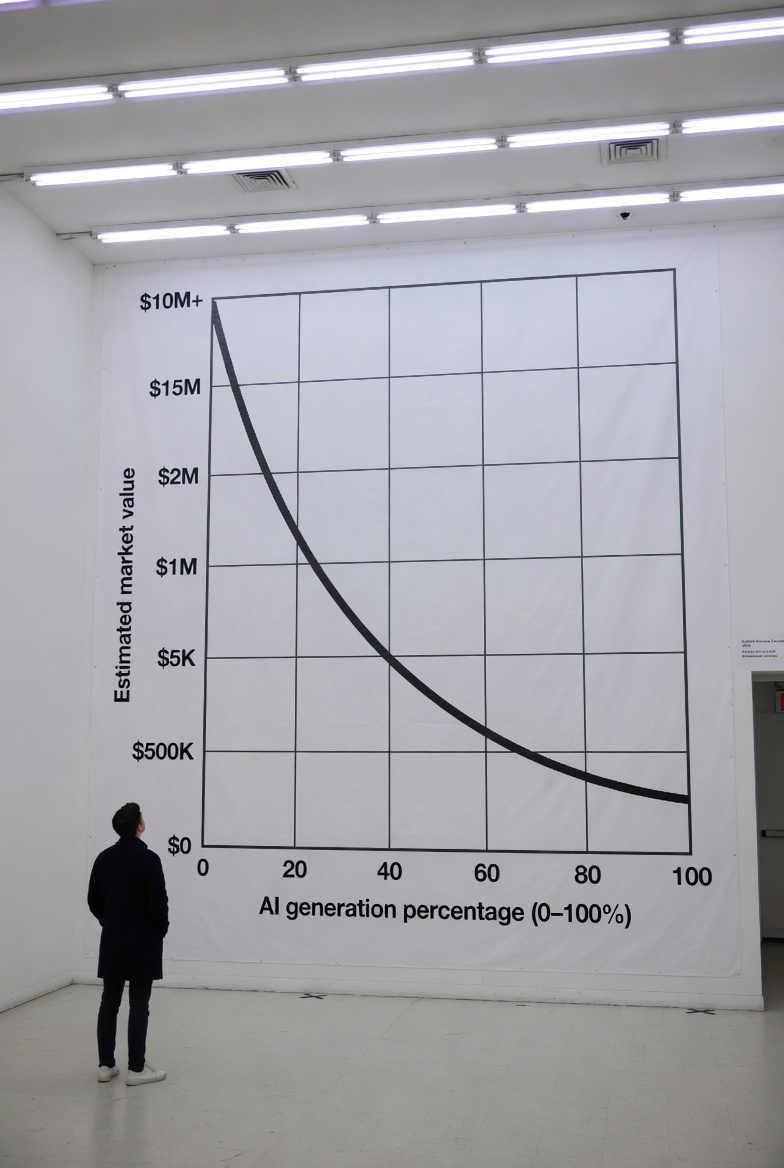
The Regime of Algorithmic Provenance
Every market requires a price signal. In the more transparent segments of the art market, this signal is constructed through institutional endorsement: the museum acquisition, the gallery representation, the biennial selection. In less transparent segments, provenance performs the same function: prior ownership, exhibition history, critical attention. Algorithmic provenance inserts itself into this architecture as a new signal that overlays existing ones without displacing them.
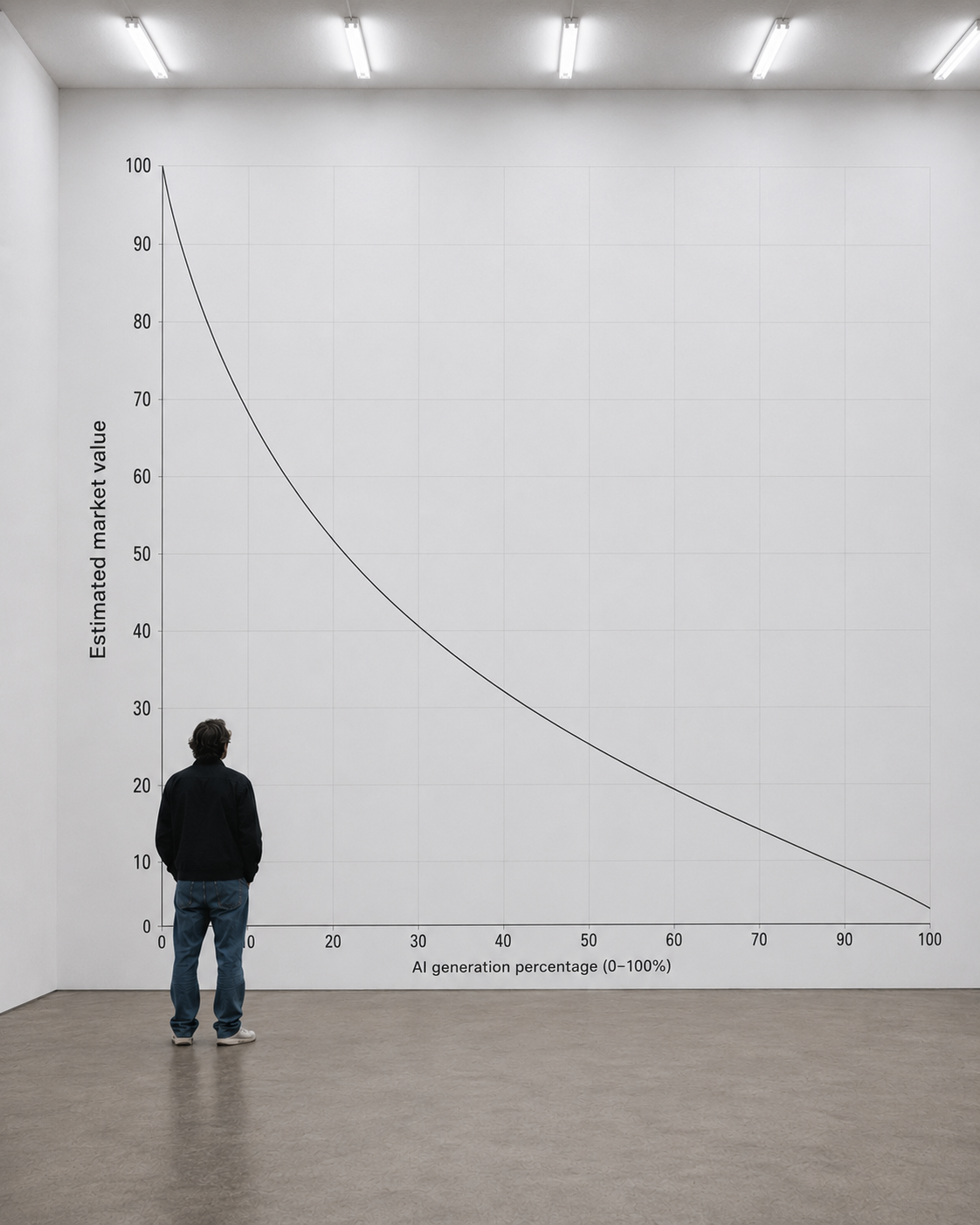
What we observe is the formation of a two-speed market where AI disclosure operates as a segmentation factor. On one side: works with favorable disclosure, low AI percentage, documented process, credible certification, positioned as premium products. On the other: works with problematic or absent disclosure, marginalized or confined to niches where purity carries no premium. Disclosure has not leveled the field; it has stratified it in a new configuration.
This stratification resists contestation in ways prior systems did not, because it presents as objective. Institutional reputation is subjective, negotiable, dependent on relational networks. An AI percentage appears measurable, verifiable, scientifically neutral. But measurement presupposes definition: what counts as AI use? A Midjourney search for compositional reference? A post-processing algorithm? Software with AI-integrated interface features? The definition is political, not technical, and those who write it hold power over the market’s segmentation logic.
In practice, a new class of certifiers has already emerged: third parties offering creative process audit services and purity documentation. This is a market inside the market, generated entirely by transparency regulation. The regulation designed to eliminate opacity has produced an industry of managed opacity, where transparency is sold as a service and credibility is constructed through protocol rather than verified against process reality.
The algorithmic price signal operates on shared convention rather than truth. The market requires that disclosure be believable, not accurate. Those who govern the protocol govern credibility. Those who govern credibility govern value distribution across the entire field.
The Normative Closure
What disclosure has closed, with greater efficiency than any previous authentication system, is the space of ambiguity that art has always inhabited. Ambiguity was not a defect in the system; it was a structural condition. The uncertainty of attribution, the porosity of the creative process, the difficulty of separating influence from appropriation, inspiration from derivation: all of this constituted the elastic field in which art operated, experimented, transformed itself.
Mandatory disclosure demands a demarcation that is structurally foreign to the nature of artistic process. Where does AI’s contribution end and the artist’s begin? In a process that includes algorithmic platform research, sketch generation, model iteration, output selection: what percentage is human? The answer does not exist as a fact; it exists as a convention. The convention is established by the market and the legal apparatus, not by aesthetics. The field of art gets carved up by tools designed for a different domain.
Transparency regulation does not open the creative process to public understanding; it reduces it to a metric legible without comprehension. “AI Generation: 12%” says nothing about how the work was made; it says only that the market has already classified it. Transparency becomes a simulacrum of transparency: a number that occupies the place of understanding without producing it.
The same mechanism operates at the institutional level. Museums developing AI disclosure policies do so not because they hold an aesthetic position on artificial intelligence in art, but because they need a protocol. The protocol does not reflect a judgment; it replaces one. The institution that adopts 30% as its acceptable threshold has not decided what it thinks about AI in art; it has decided it does not need to think about that, because the protocol decides instead.
The most precise sense of normative closure: it does not prohibit AI-assisted art production but requires all art production to define itself in relation to AI as a category. The parameter cannot be ignored because the market demands it. Classification cannot be refused because refusal is itself a classifiable position. Whether the answer is yes or no, the response belongs to the market’s inquiry, not the artist’s.
The Completed Fetish
Fetishism, in its classical structure, operates through displacement: a secondary object assumes the qualities of an inaccessible primary one. The fetish of the original in art worked this way: the physical uniqueness of the object assumed the spiritual qualities of originary intention, Benjaminian aura, the creator’s presence. No one literally believed the Cézanne was sacred; but everyone behaved as if it were, because the behavior produced value.
The fetish of algorithmic provenance operates through the same displacement mechanism with one additional layer of sophistication. The claim is no longer to assign spiritual qualities to physical uniqueness: it assigns authenticity qualities to the measurable absence of automation. The fetish object is the protocol that certifies the work, not the work itself. What gets venerated is the document attesting how many times the hand touched the file relative to the algorithm.
This sophistication is also a structural vulnerability. The previous system could be contested only by those with access to the physical work and its history, defensible through its opacity. The new system presents as verifiable but cannot fully deliver on that promise: process logs can be manipulated, purity declarations falsified, certifiers made compliant. The claim to objectivity generates an expectation of verification the system cannot consistently meet.
The collector paying a premium for a work marked “AI Generation: 0%” is not verifying the declaration; the collector is participating in a ritual. The ritual of human purity in the contemporary art market is the new authentication ceremony, more sophisticated than its predecessors because it incorporates the vocabulary of science and legal compliance, but structurally identical in its social function.
If mandatory disclosure is producing a market for human purity more effective and more pervasive than the system it nominally replaced, then the regulation has generated the opposite of its stated effect. It has not democratized artistic production; it has introduced a new certification stratum. It has not eliminated opacity; it has displaced opacity from the process to the audit of the process. We are inside the fetish, and the fetish is complete when the boundary between ritual and reality is no longer visible. The percentage on the certificate is real. Its meaning is constructed. Constructing meaning has always been the work of the market, not of art.