

Over the past decade, NONOTAK Studio has redefined the relationship between light, sound, and space, transforming architectural environments into kinetic organisms that breathe, react, and multiply perceptually. From their early audiovisual performances to their most recent monumental installations, their work crosses the threshold between the material and the immaterial, exploring how light becomes time and movement becomes language.
At Fakewhale, we had the pleasure of speaking with them, delving into the principles that animate projects such as SORA, SATELLITES, NARCISSE, SAKURA STAGE SHIBUYA, SHIRO, and COORDINATES, and reflecting on how their poetics continue to expand the boundaries of perceptual experience.
Fakewhale:Your work seems to constantly oscillate between order and chaos, as if light were a force trying to organize space while simultaneously dissolving it. How do you conceive this dynamic balance between technical control and perceptual loss of control?
NONOTAK Studio: Light is a big inspiration in our work and the reason we like this medium that much is its immaterial aspect and also its influence on its own environment. It can completely change the perception you have of a space and this is what interests us. We like to disrupt a space and give it a soul through motion and sound.
When we are working on the narration of a piece, we really like to play with contrast and have dynamic, violent moments as well as more dreamy and emotional moments. We like to have our audience feel different emotions when they experience one of our installations.
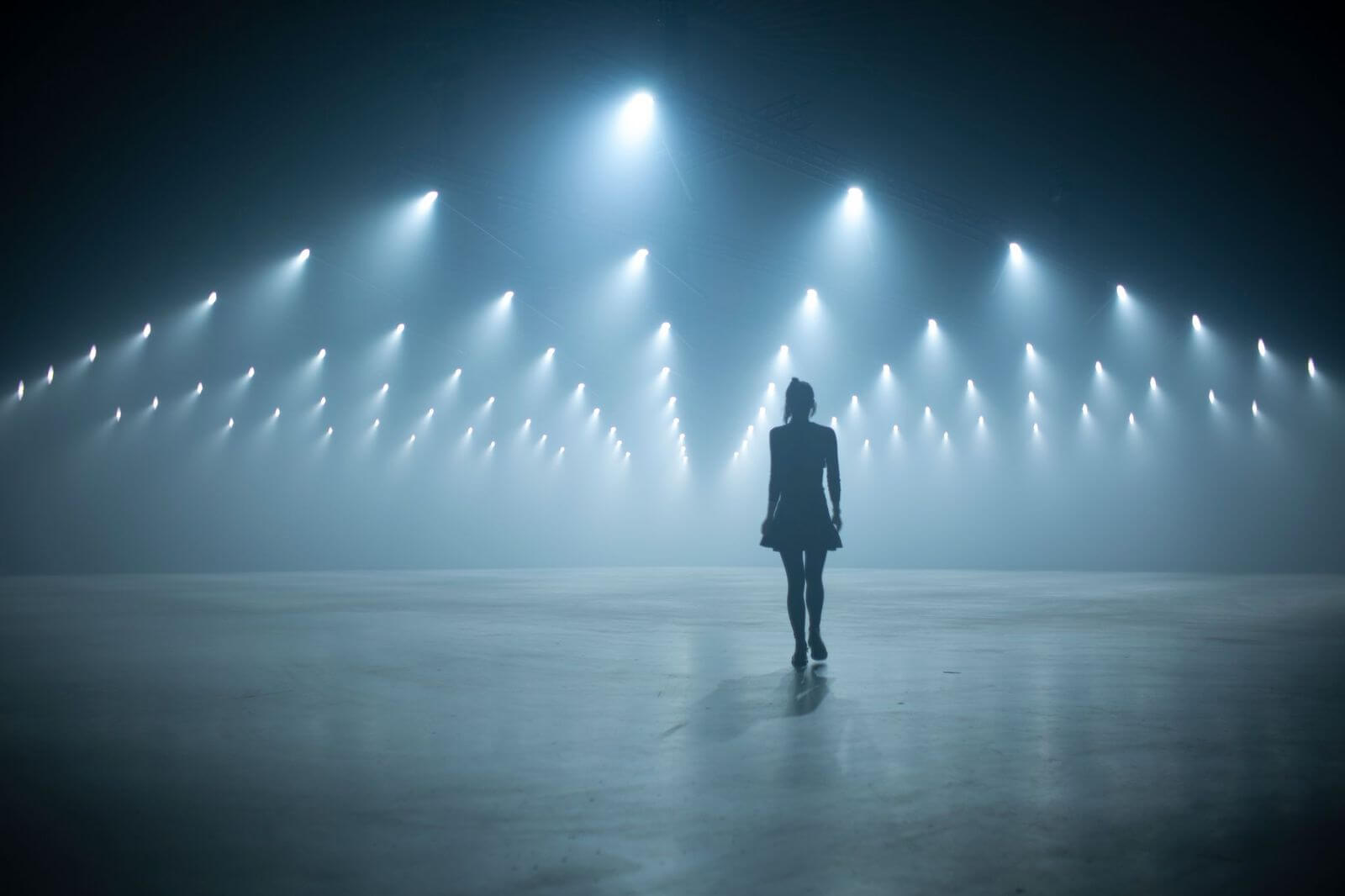
In many of your works, time is not just a technical parameter but a sensory element that structures perception. How do you define it within your creative process? Is it closer to a musical score, a natural cycle, or an algorithm?
The Sound component is inseparable in our work so I think it is closer to a musical score. All our works are driven by a precise narration we design and we like to control the Lights, visuals and sound in a really highly synchronised way. When we program the piece, it feels like the Lights are dancers and we create choreography with them. We want the lights to look like they have a soul and Sound helps a lot to achieve that. It gives the mood and intention of the different motions.
Playing with visual perception is a key in our work and Time as rhythms define how we narrate and bring the different steps of the journey we want people to see and feel with our installations.
Your installations share a strong sense of choreography, where light and sound movements appear to dance with the viewer. To what extent do you see the audience as part of the system itself, and to what extent as an immersed observer?
For most of our work we took complete control of the piece and the viewer is an immersed observer. Sometimes we focus the piece on one main point of vue, sometimes the piece is 360 and the viewer can freely cross it and enjoy different perspectives of it. Depending on the scale and the setup of the piece, having human silhouettes passing through the Lights creates a really interesting depth that adds a lot to the visual perception and illusion of the piece.
This is also a reason why we decided pretty early in our career to work on live performance as well where our silhouettes would be completely part of the visual effects.
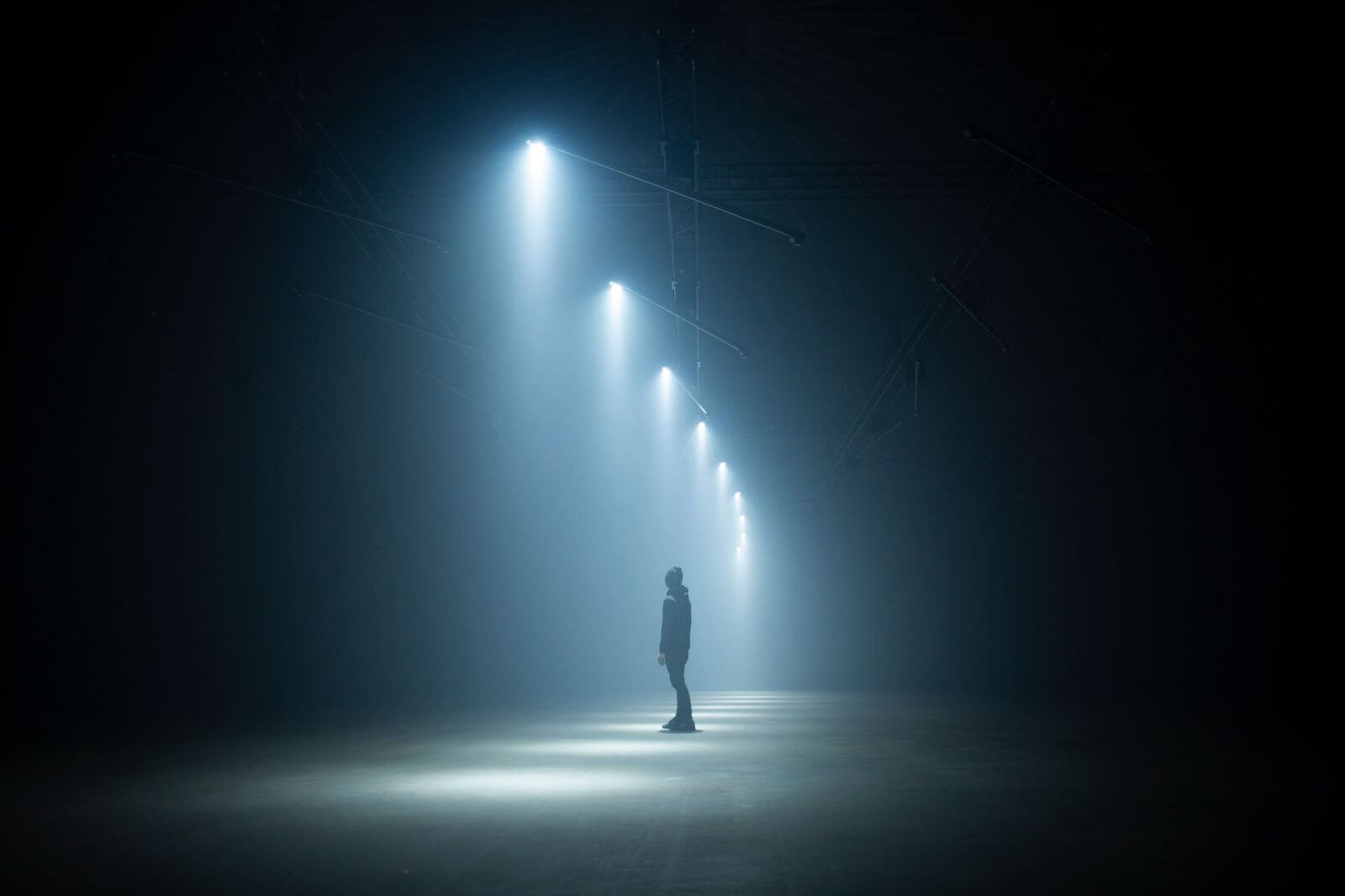
In SORA, light behaves like an artificial sky, alternating between calm and storm. Is there a symbolic connection between the atmospheric dimension of the work and a broader idea of inner or emotional landscape?
SORA is one of our biggest installations to date in terms of scale and complexity and it also marks a new direction for the works we would like to develop in the future.
We conceptualised this piece directly inspired by the gas Houlder in Amsterdam where the first exhibition was happening, and the impressive volume of it made us want to disrupt the space with a layer of lights that would cut the height in two. Our goal was to be above the audience so they can freely move all around the space but bring this ceiling close enough so they can heavily feel the weight of the lights crossing the space.
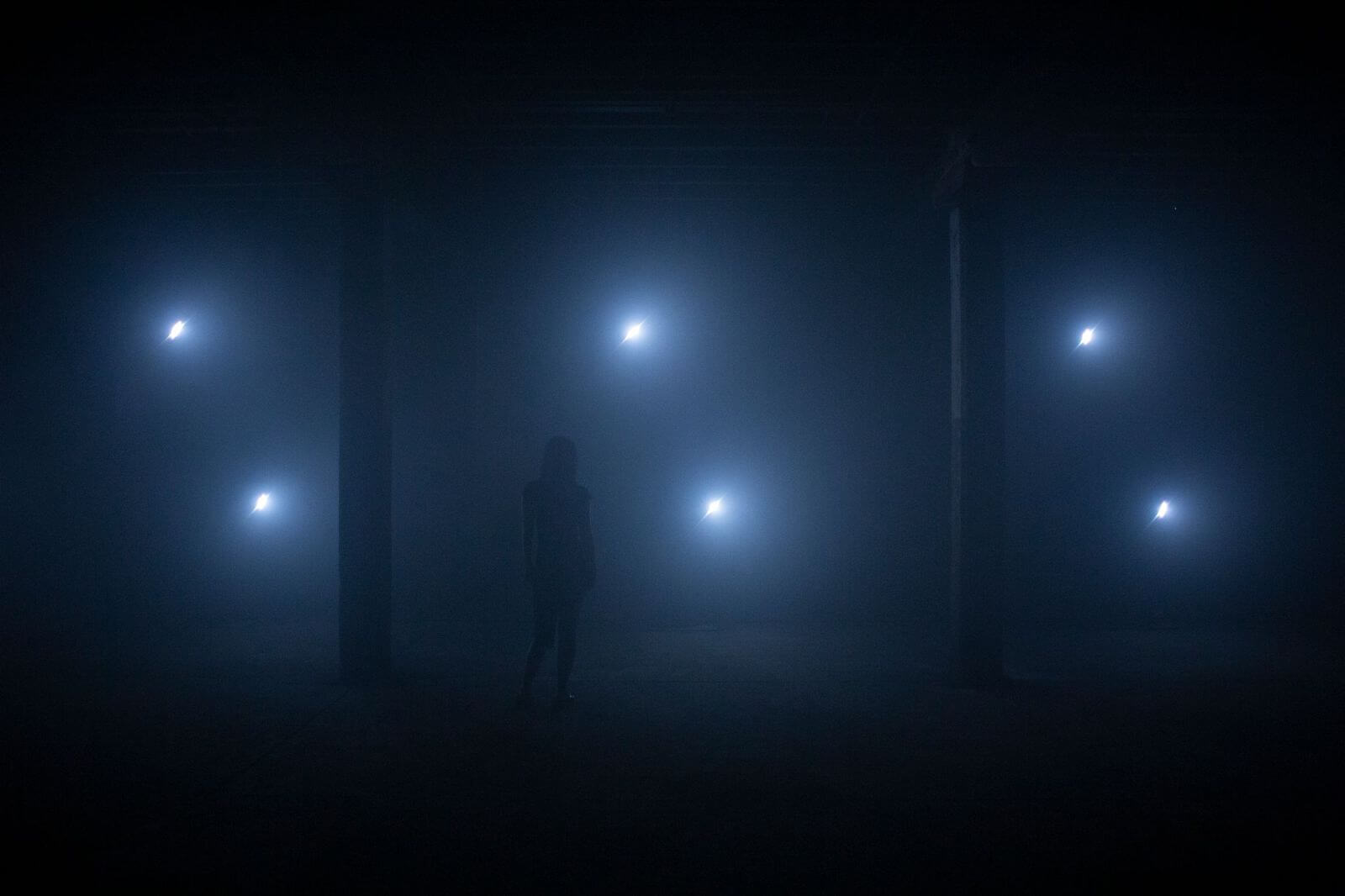
Inspired by the sky and astral elements, infinite rotation is the central movement of SORA. The main challenge was to have this infinite rotation motion physically, and control them all synchronised together but individually at the same time. Our intentions for this piece was to experiment with that endless motion to put the audience into a contemplative and hypnotic experience.
In terms of lights design, we wanted to have two contrasted looks, one with points looking at different directions that would remind stars and one with lines that is our signature shape and that would highlight the kinetic parts of the installation as if it is moving through winds.
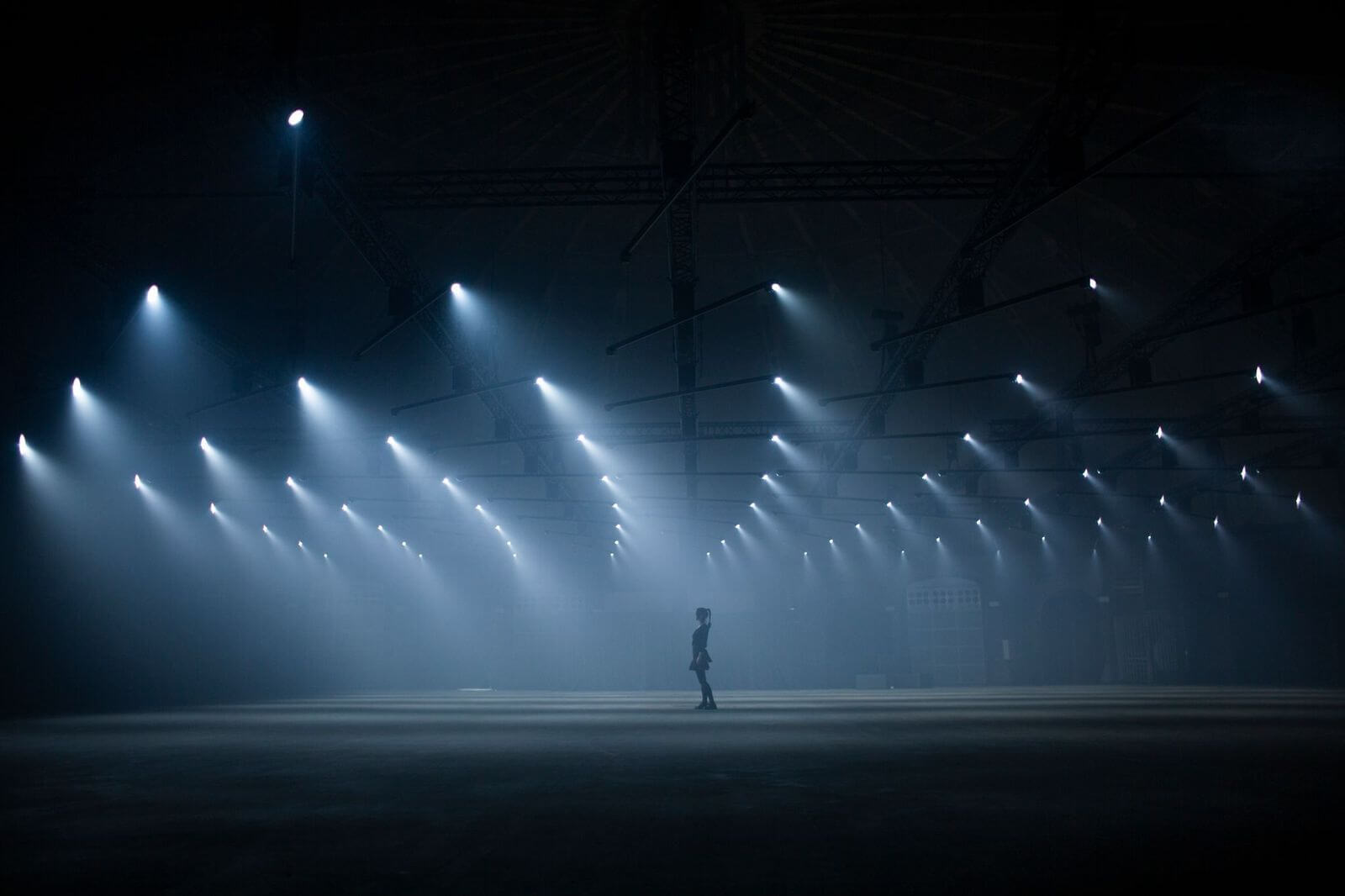
SATELLITES V.1 introduces an almost warlike tension in the dynamics of light, a “battle” rhythm that generates hypnotic geometries. How did you approach the duality in this piece, conflict and harmony, precision and unpredictability?
SATELLITES was designed in the continuity of SORA, using the infinite rotation components, but this time on a human standing level to scan the space with volumetric lights on the sight height.
The viewers can get much closer to the kinetic units and appreciate this elegant skeleton that looks like a robotic presence.
We are exploring the sense of duality with SATELLITES where 2 forces coexist harmoniously when opposing at the same time, creating patterns by getting attracted to each other or taking distance from one another. In the continuous rotative motion, we want the patterns to shift smoothly almost in an imperceptible way.
The lines alternate between being parallel to perpendicular which give the illusion of having a folding and unfolding structure, like a giant origami.
With NARCISSE V.2, reflection and visual multiplication become metaphors for self-perception and infinity. Are you interested in exploring space as a mirror of the self, or more as an optical phenomenon emptied of subjective meaning?
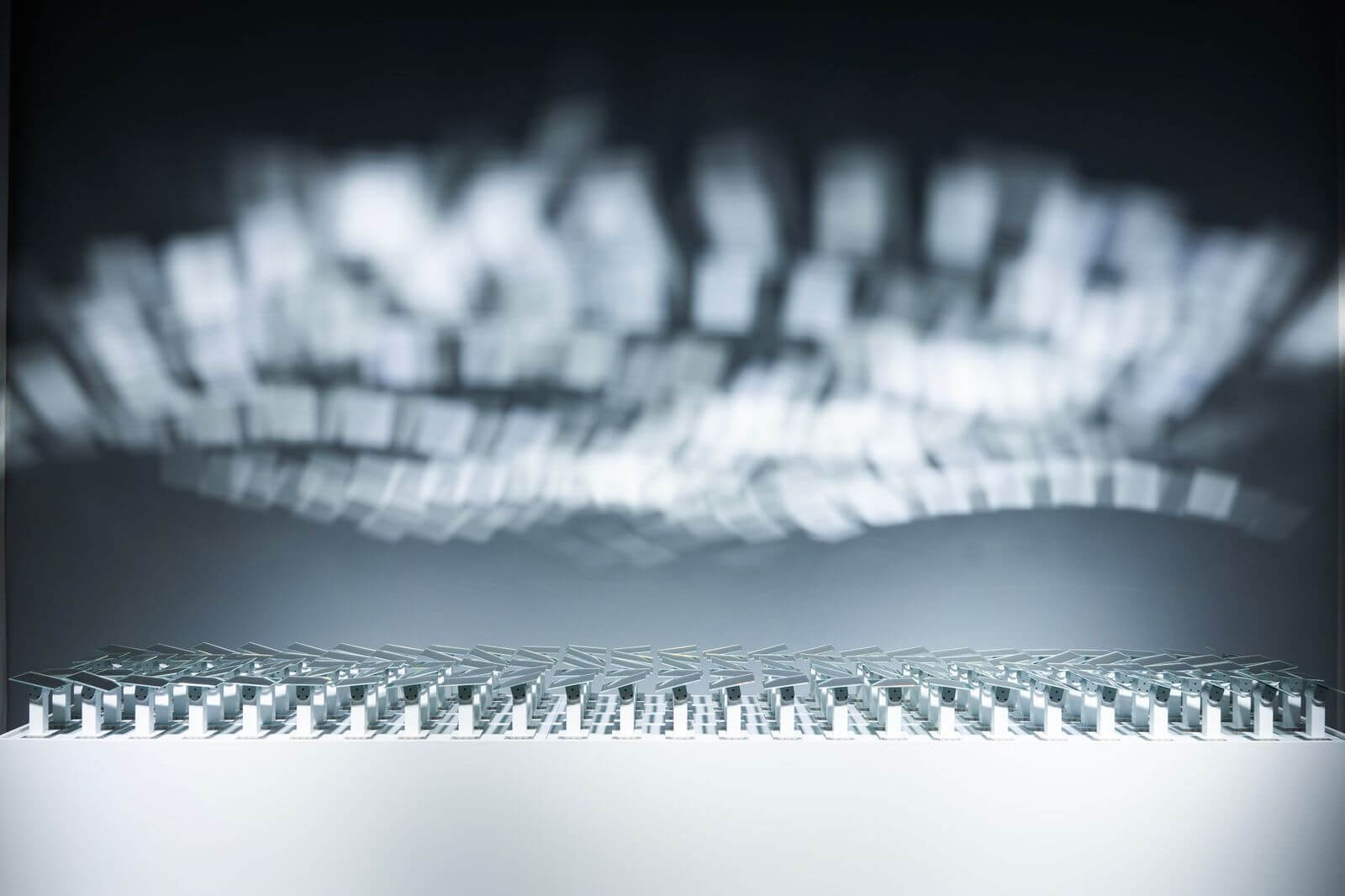
NARCISSE is a kinetic light and sound installation playing with reflection.
Composed by a series of square mirrors in motion, they are choreographed to an original soundscape generating patterns and shapes.
Using lights in 3 different ways, the piece will be performing different looks, highlighting its moving silhouettes from time to time, or the light leaks coming out of its own reflection.
Organic patterns of caustics are created out of parallel geometries and simple rotations, which suggest a different perspective from the mechanical and perfectly aligned motions.
Inspired by the famous mythological character who fell in love with his own reflection, NARCISSE, through the power of lights and abstraction, explores the complexity of human emotions and the duality between inner perception and outer projection about ourselves.
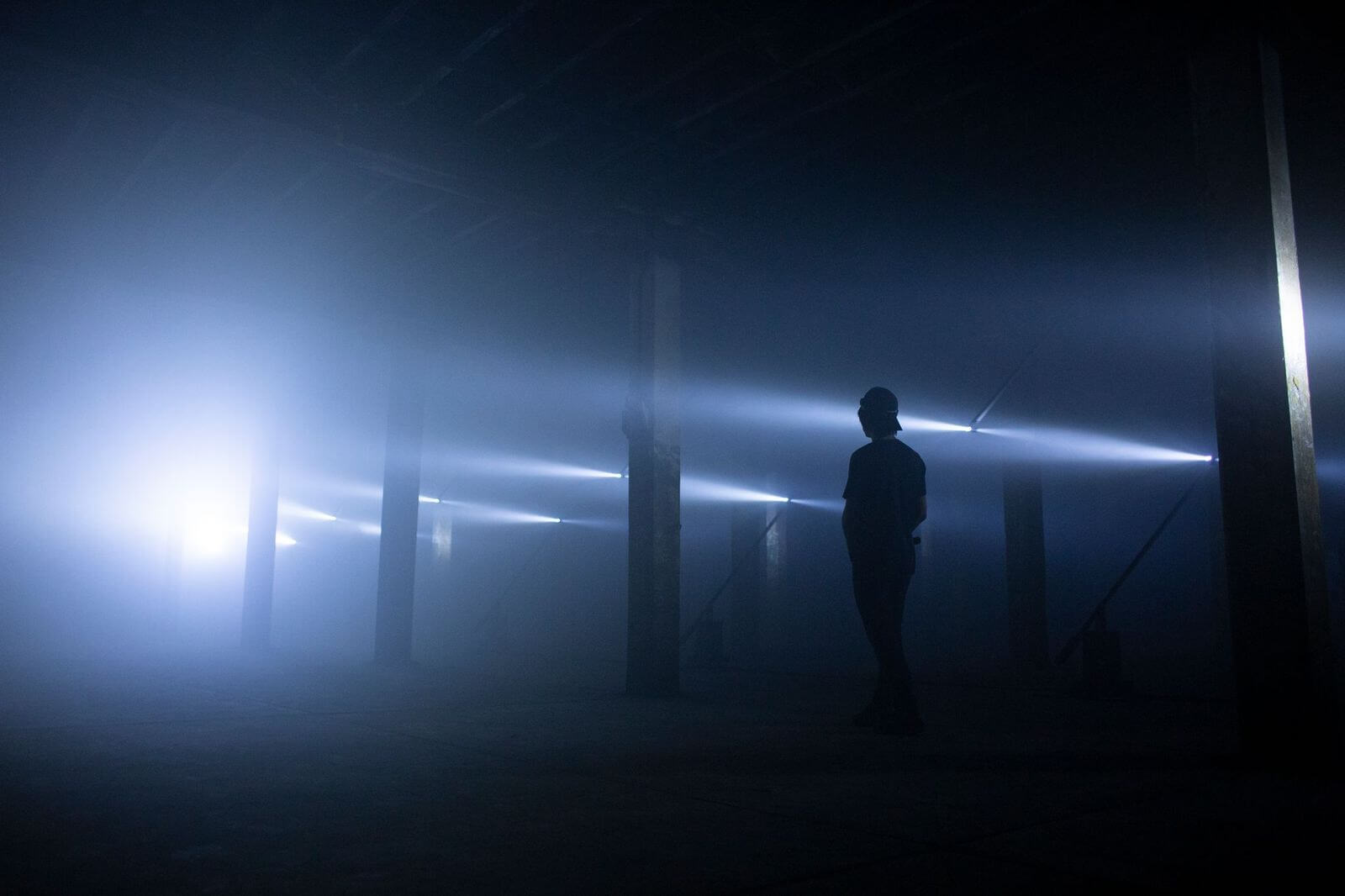
SAKURA STAGE SHIBUYA marks a particular chapter in your research, a permanent project embedded within Tokyo’s urban flow. How does your ephemeral sensibility translate into a public context that lives through continuity and routine?
Permanent public art installations are a new chapter in our career and something that we are more and more interested in. It is really exciting to create something that will last in time and in a place where not only people who want to see art will be able to enjoy/discover art. It allows us to reach a wide range of people with different backgrounds, different ages. Both of us having Japanese origin, it was a particular honour to have a piece in a place as central and iconic as Shibuya.
The main adaptation we worked on for this context compared to an ephemeral exhibition set up is about the rhythms of the piece. We structure the narration of the piece to evolve during the different phases of the day ( Morning, afternoon and evening ) and also each day of the week ( Monday, Tuesday, Wednesday, Thursday, Friday and weekends ), so depending when the people will pass by, the programming is different.
During the day the piece evolves in intensity, with more calm and slower motion in the morning, to more dynamic and electronic when it comes to evening. During the week, the programming evolves in its patterns, to unfold the complexity and variations we could explore with a minimal and geometric set up.
In SHIRO, the direct interplay between sound and image feels more performative and instantaneous compared to your static installations. How does your creative dialogue evolve when live presence replaces automated programming?
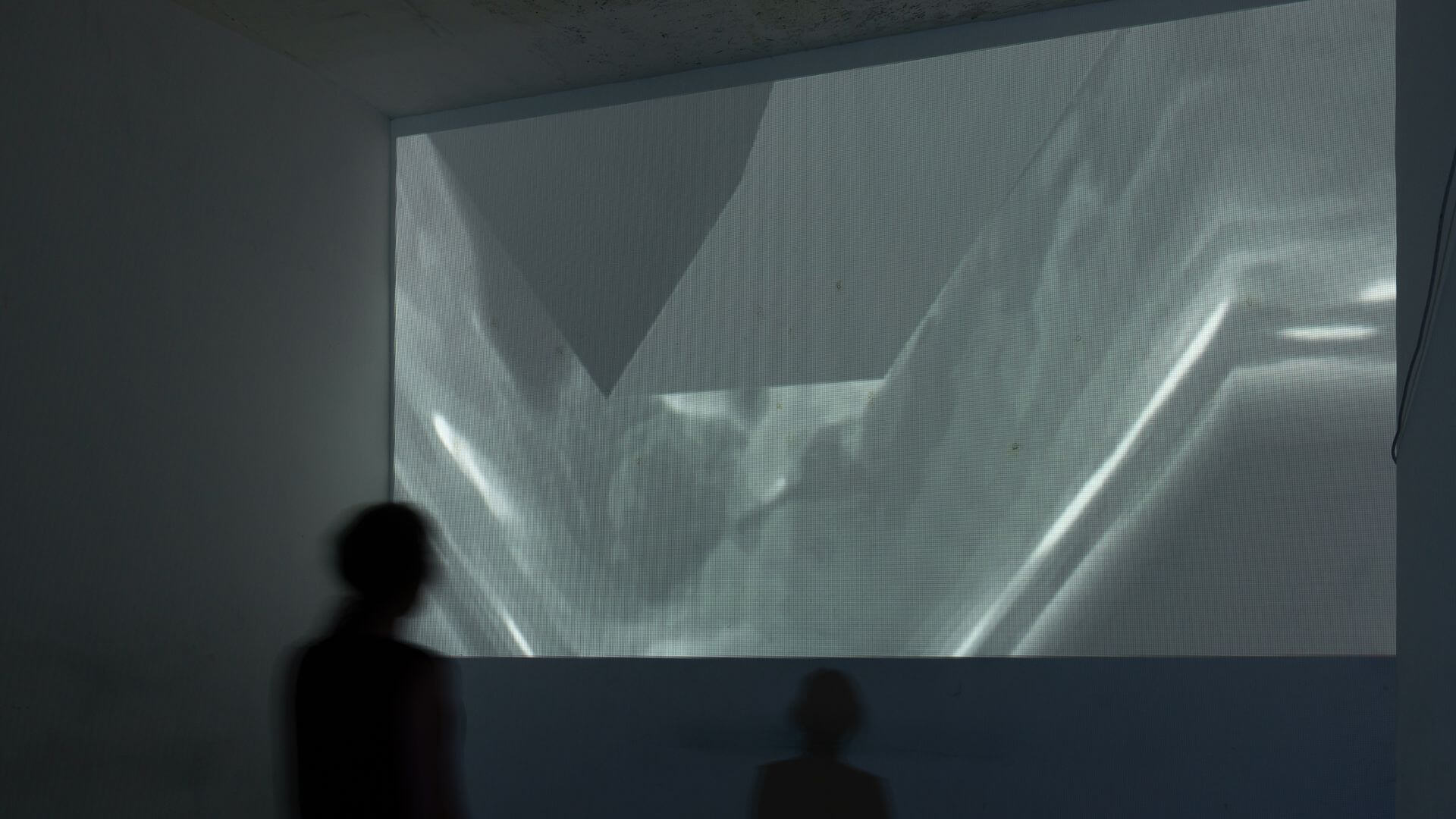
From an early stage, we start working on live performances. The main idea of our performance project is to incorporate our silhouettes in the installation and have it as part of the visual effect. By using a specific placement of the projectors, from front and from rear, it allows us to have our silhouettes appearing and disappearing from the screens. In our first performance LATE SPECULATION, we were both inside the same structure, while in SHIRO we decided to be in separate areas in order to be able to appear and disappear separately and accentuate this illusion.
Live performance is different in how we approach our work, we want to showcase a more dynamic and musical aspect of our work as it is a concert and we are sharing the moment directly with our audience. Takami has a background as a guitar player in his previous band DOYLE Airence, so performing on stage was pretty natural for him.
When we work on a live performance, the music comes first and is the lead of the visuals, compared to when we work on a stand alone installation, the visual/light intentions come first and the music, sound is here to accentuate the experience and give the emotion to the piece.
Many of your works, such as COORDINATES V.1, seem to pursue a form of geometric purity that never feels cold. Is there an underlying search for empathy within structure, a desire to evoke emotion through precision?
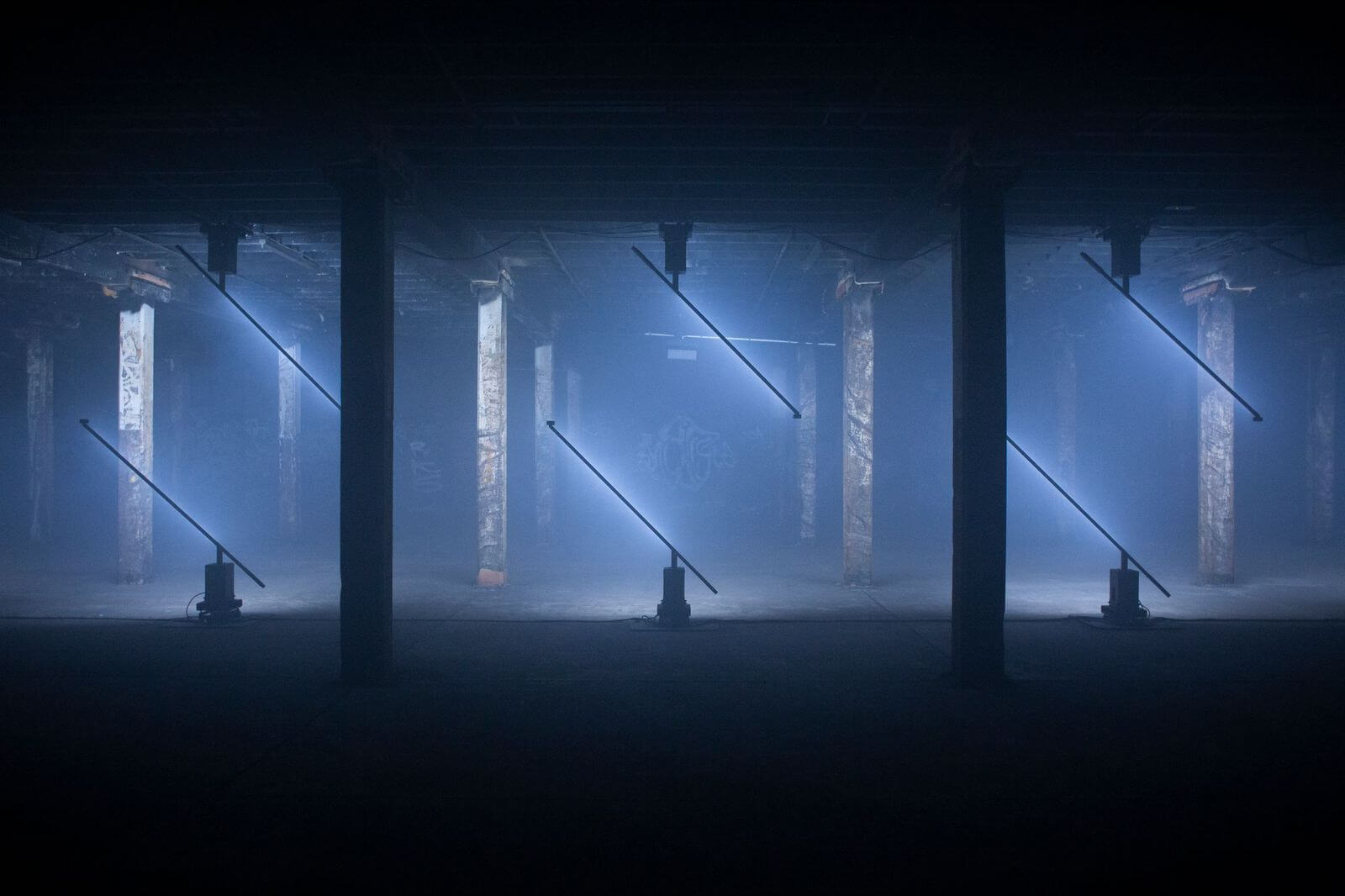
COORDINATES is a kinetic light installation that explores motion in two axes, vertical and horizontal.
For all of our work, we like to use one simple concept and try to find a way to express complexity out of it and create perception illusion. COORDINATES is born with the will to explore motion not only through lights programming, but with actual physical movement. The lights are static full on but the different effects and animations are created through movement and perspective. The physicality of it pushes us to explore slowness and delicate motion.
The duplication of those two simple paths in one row allows us to recreate shifting space from one perspective and a huge evolving sculpture from another point of view.
Looking back at your journey, it seems that each project represents a step toward an increasingly autonomous and sensory visual language. What are your current directions of research? Are you exploring new forms of interaction, or perhaps returning to live performance?
We want to continue to extend our work and artistic identity in different domains and contexts. We want to develop more kinetic art works as installations, while continuing exploring live performance projects with more focus on Music and animation visuals.
Solo exhibitions are also something we are more and more interested in, as long as it allows us to think about the experience as an entire journey where we can showcase different aspects of our work and different characteristics about our love for Light.
Another challenge we want to face in the future is having art pieces that can be enjoyable in a daylight environment while staying faithful to our artistic identity.