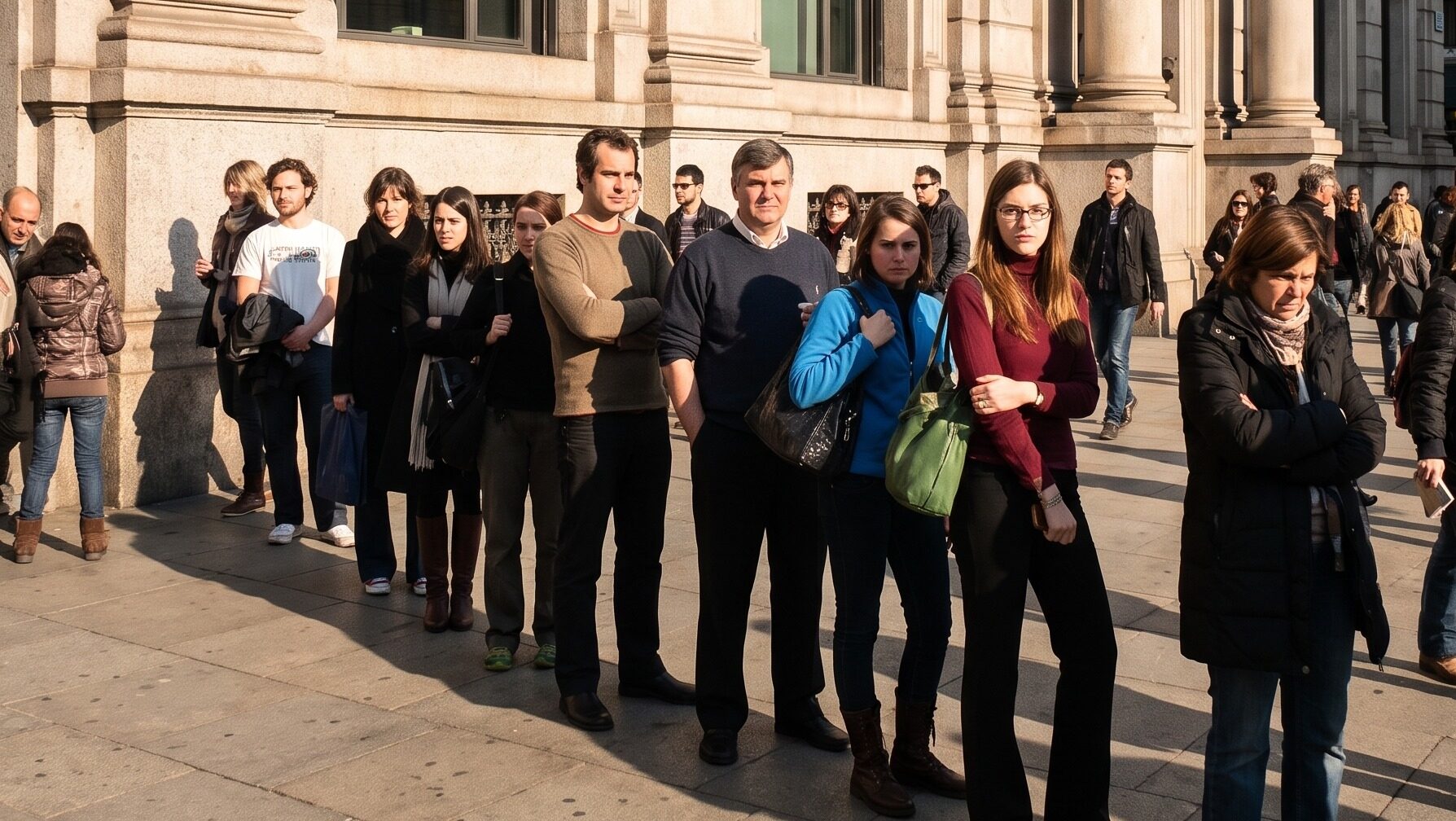
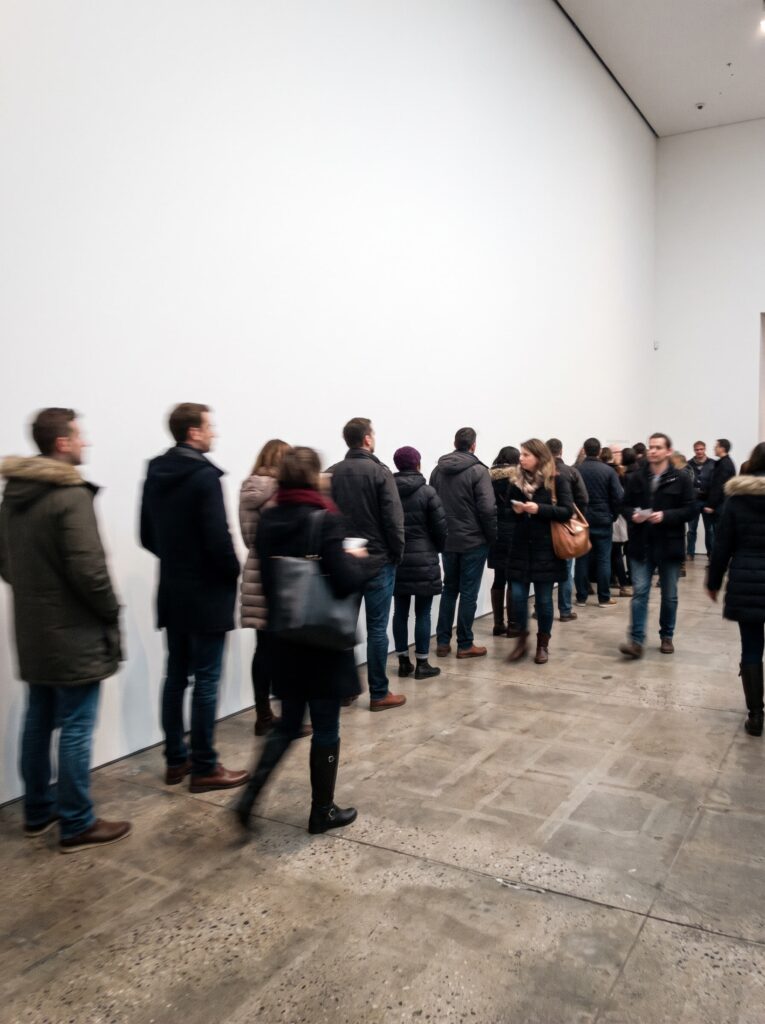
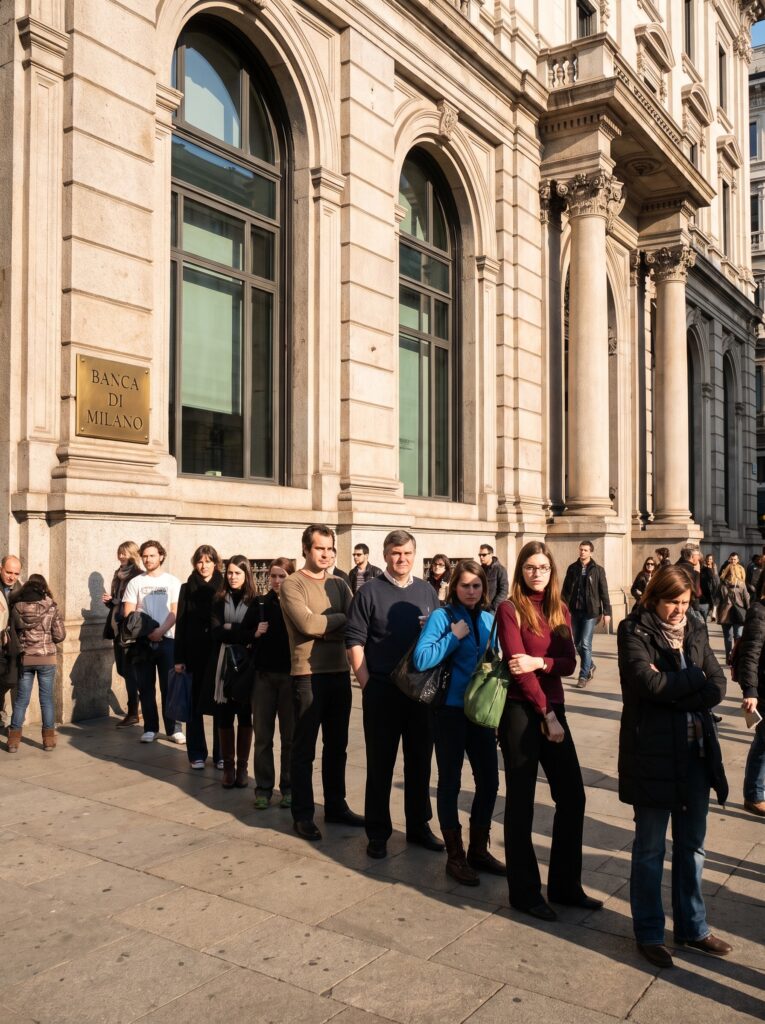
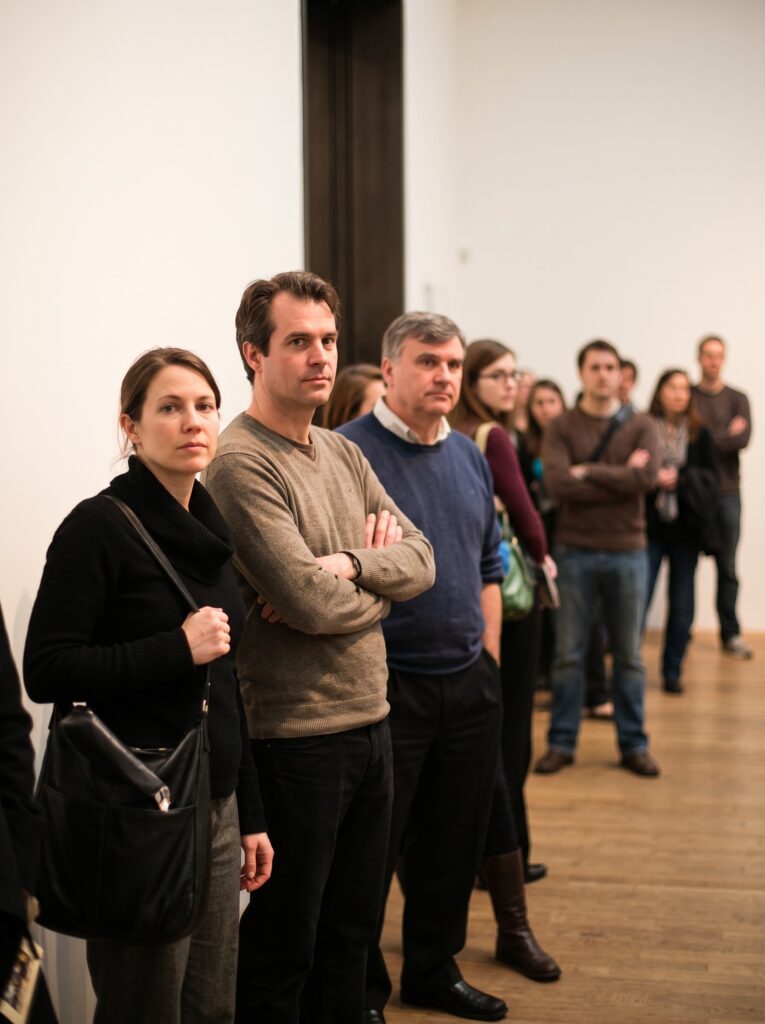
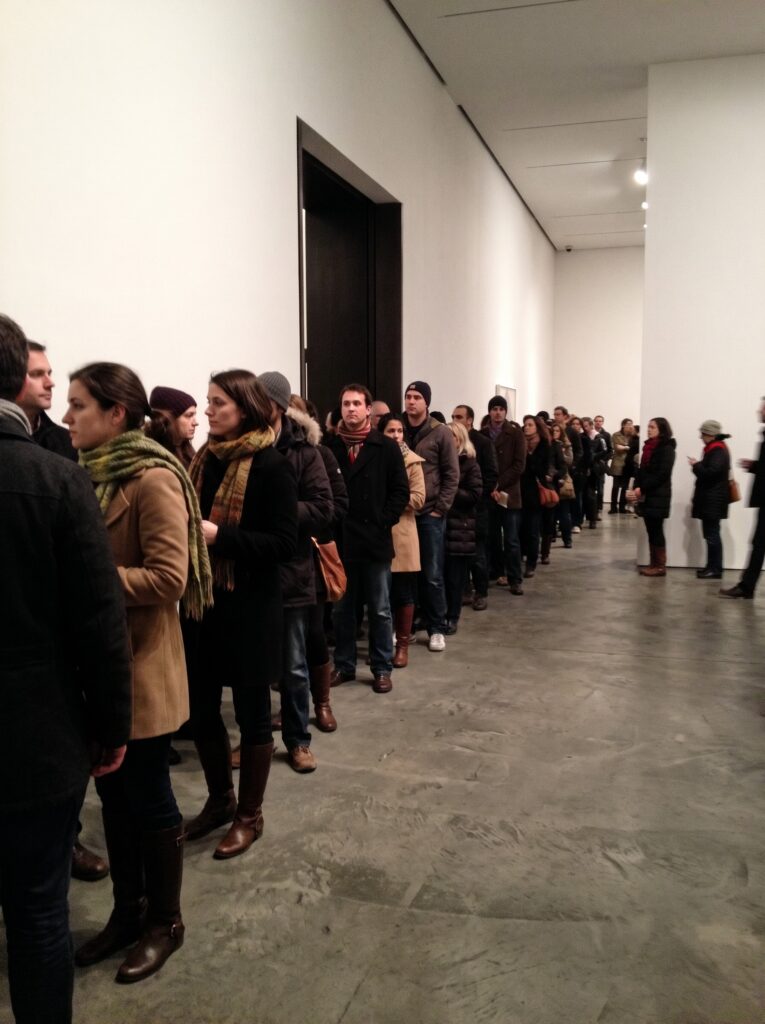
In 2003, Slovak artist Roman Ondák presented Good Feelings in Good Times, a performance built around a gesture as ordinary as it is enigmatic: standing in line. A group of people forms a queue outside a particular place, as though they were waiting to enter, buy something, or attend an event.
Yet there is nothing at the end of the line. No object, no ticket, no reward. Only more people waiting. Anyone passing by might stop, observe the queue, and wonder what is happening. Some might even join it, trusting the behaviour of others before knowing what has brought them there in the first place.
Ondák removes the object of anticipation and leaves the mechanism itself exposed: we continue to wait even when we no longer know exactly what we are waiting for. His work can therefore become the starting point for a broader inquiry. Why does so much of our lives seem to be organised around something that has yet to happen? What happens to the present when it is experienced primarily as an antechamber to the future?
And, above all, do we still know how to distinguish between what we genuinely desire and what we have simply become accustomed to waiting for?
The Queue: When Other People Tell Us Something Is About to Happen
A queue contains an implicit promise. If many people are standing in the same place, we assume there must be something waiting at the end of it: an entrance, an opportunity, a reward. The presence of others becomes evidence enough. This automatic response is precisely what makes Ondák’s work so unsettling. We do not need to know the purpose of the queue in order to give it meaning. We see people waiting and immediately assume that they must have a reason. The same thing happens far beyond the walls of a gallery. We are constantly joining invisible queues. We wait to reach a certain professional position, to own something, to be recognised, to arrive at a point where we will finally be able to consider ourselves satisfied. Sometimes these desires genuinely belong to us. At other times, we encounter them already arranged in front of us, like a line that somehow feels natural to join. Waiting can therefore become a social behaviour. We look at the people ahead of us to understand where we are supposed to be going. If everyone appears to be moving towards something, surely it must be worth reaching. But Ondák’s work introduces a suspicion: what if, at the end of the queue, there is nothing resembling what we imagined?
The Present as a Waiting Room
To wait is to live in two different times at once. The body remains in the present while the mind continually moves forward. We wait for a reply, a phone call, a meeting, a departure. We wait for the weekend, for summer, for a promotion, for something to change.
These are concrete forms of waiting, and often necessary ones. But there is also a subtler kind of anticipation, one in which we are no longer waiting for any particular event. We are simply waiting for life itself to become different. That is when the present risks turning into a permanent waiting room. We tell ourselves that we will begin when we have more time. We will be calm when a problem has been solved. We will allow ourselves something once we have reached a certain goal. Yet every milestone can quickly produce another one.
The promise of the future simply moves a few steps further ahead. Waiting is therefore more than an interval between two events. It can become a mental structure: a way of interpreting our entire existence.
Perhaps this is the real paradox. We imagine that we are waiting because something has not yet begun, while in the meantime what we call waiting has already become a substantial part of life itself.
Wanting Something, or Wanting Something to Happen?
There is a difference between desire and waiting, even though the two are often confused. Desire has an object. We know, at least to some extent, what we are moving towards.
Waiting, by contrast, can survive even after that object has become uncertain. What remains is a tension, a sense that something must eventually arrive to complete what exists now. This may be one reason why we are so sensitive to notifications, updates, deliveries, results, and unanswered messages.
Every small signal contains the possibility that a period of suspended time might finally come to an end. And yet the end of one period of waiting often produces a curious effect: within minutes, hours, or days, something new appears for us to anticipate. Satisfaction is brief; the structure remains. This raises another question. In some cases, perhaps what we truly desire is not the object at the end of the wait, but the promise contained within waiting itself.
As long as something has yet to happen, the future remains open. We are free to imagine it as better, more surprising, more complete, or simply different. Waiting generates narratives. We fill what we do not know with possibilities, hopes, fears, and projections.
Before an event even takes place, we may already have lived through countless versions of it in our minds. Perhaps this is why the nothingness at the end of Ondák’s queue is not really empty at all. It is filled with everything each person imagines might be waiting there.
What Remains When We Stop Waiting?
The final question is not whether it is possible to live without waiting. It probably is not. The future inevitably forms part of the way we think about and construct our lives. The real question is when waiting stops being a temporary space and becomes a habit. Some forms of waiting are part of preparing for something: studying before an exam, working on a project, waiting for someone who is on their way.
In these cases, time has a direction. But there are also indefinite forms of waiting, in which the present is repeatedly sacrificed to some future version of ourselves. “I’ll be happy when…” It may be one of the most common formulas through which we organise our relationship with time. Almost anything can come after those words. When I have more money. When I change jobs. When I meet someone. When I leave. When I come back. When everything is finally sorted out. The problem is not wanting these things to happen.
The problem begins when the possibility of living fully is endlessly postponed until they do.
And this is where Roman Ondák’s queue returns. At first, the work may seem almost like a conceptual joke: a group of people waiting for something that does not exist. But the longer we look at it, the less absurd the scene becomes and the more familiar it feels.
We may begin to recognise something of ourselves in those people standing one behind another. At that point, the work changes its question. It no longer asks only, “What are they waiting for?”
It asks us: what are we waiting for? And, perhaps more importantly:
who told us that we had to wait for it?