The number sits cleanly on the screen: 9,460,730,472,580.8 kilometres. It names the distance light travels through a vacuum during one Julian year, yet the interface cadence makes this immensity look as manageable as an invoice total. We can copy it, convert it, compress it into scientific notation. The figure remains available while its magnitude withdraws, exposing the perceptual threshold at which quantity ceases to become experience.
One second appears more intimate. It belongs to a blink, a notification rhythm, the nearly imperceptible interval between a gesture and an interface response. During that second, light covers 299,792.458 kilometres, approximately seven and a half circuits of Earth’s equator. The sentence reaches us through ordinary bandwidth; the image it promises never fully arrives.
Measurement reveals a double operation. It establishes a shared precision through which science, architecture, and infrastructure coordinate incompatible realities; it also compresses phenomena radically foreign to the body into units designed for handling. The kilometre retains the memory of steps, journeys, and territory. The light-year drives that terrestrial memory past the limits of its parameter space.
Artworks operate along the same divide. Every work institutes a measure, even when it refuses the ruler: exposure time, viewing distance, bodily access, and the institutional device ecology through which visibility is granted. A miniature and an immersive environment organise different worlds because each calibrates the viewer’s presence at a different perceptual threshold.
This divide has been addressed directly by artists who transform measurement into a material or perceptual problem. Marcel Duchamp subjected the standard metre to chance in 3 Standard Stoppages; Walter De Maria made a precisely measured kilometre almost entirely inaccessible to vision in The Vertical Earth Kilometer; and Stanley Brouwn returned measurement to the proportions and movements of the individual body. Their works do not merely represent scale: they expose the distance between a unit that can be stated and a magnitude that can be experienced.
Asking how many kilometres a light-year really contains places pressure on the word really. The mathematical answer possesses full operational precision; the corresponding experience exceeds our sensory bandwidth. Science renders the interval calculable, while art gives form to its residue. We inhabit that difference whenever seeing begins.
The Figure beyond the Body
Within the International System of Units, the speed of light in a vacuum has an exact value: 299,792,458 metres per second. Exactness usually suggests an improved measurement of an independently given world, but the operational mechanism runs deeper in this case. The metre is defined by fixing the numerical value of light speed. Every canvas, wall, and table receives its measurable length from a constant whose velocity lies beyond the body’s perceptual threshold.
A light-year multiplies that velocity by the 31,557,600 seconds in a Julian year of 365.25 days. The resulting 9,460,730,472,580.8 kilometres delivers precision while withholding proportion. Even a comparison with Earth, roughly 236 million equatorial circuits, adds another layer of compression instead of producing an inhabitable image.
Educational visualisations often treat this imaginative failure as a design problem. A smoother zoom, an interactive scale, or a better metaphor promises to restore access through bandwidth and interface cadence. Each translation merely adds rungs to a ladder that remains structurally shorter than the phenomenon. Scale moves; incommensurability survives the conversion.
Large numbers make the separation visible. Human cognition associates one, ten, and one hundred with groups, objects, and durations, then crosses a perceptual threshold where quantity becomes graphic form: digits, exponents, typographic surface. The number stops enlarging the world and begins to screen it. Operational precision continues after intuition has yielded.
Knowing the measure and sensing the magnitude therefore belong to different architectures. The first depends on a shared protocol and stable parameter space; the second emerges from a situated body, stored memory, and a finite horizon. Their interval is the actual abyss. The figure crosses it through compression, while the viewer remains at its edge.
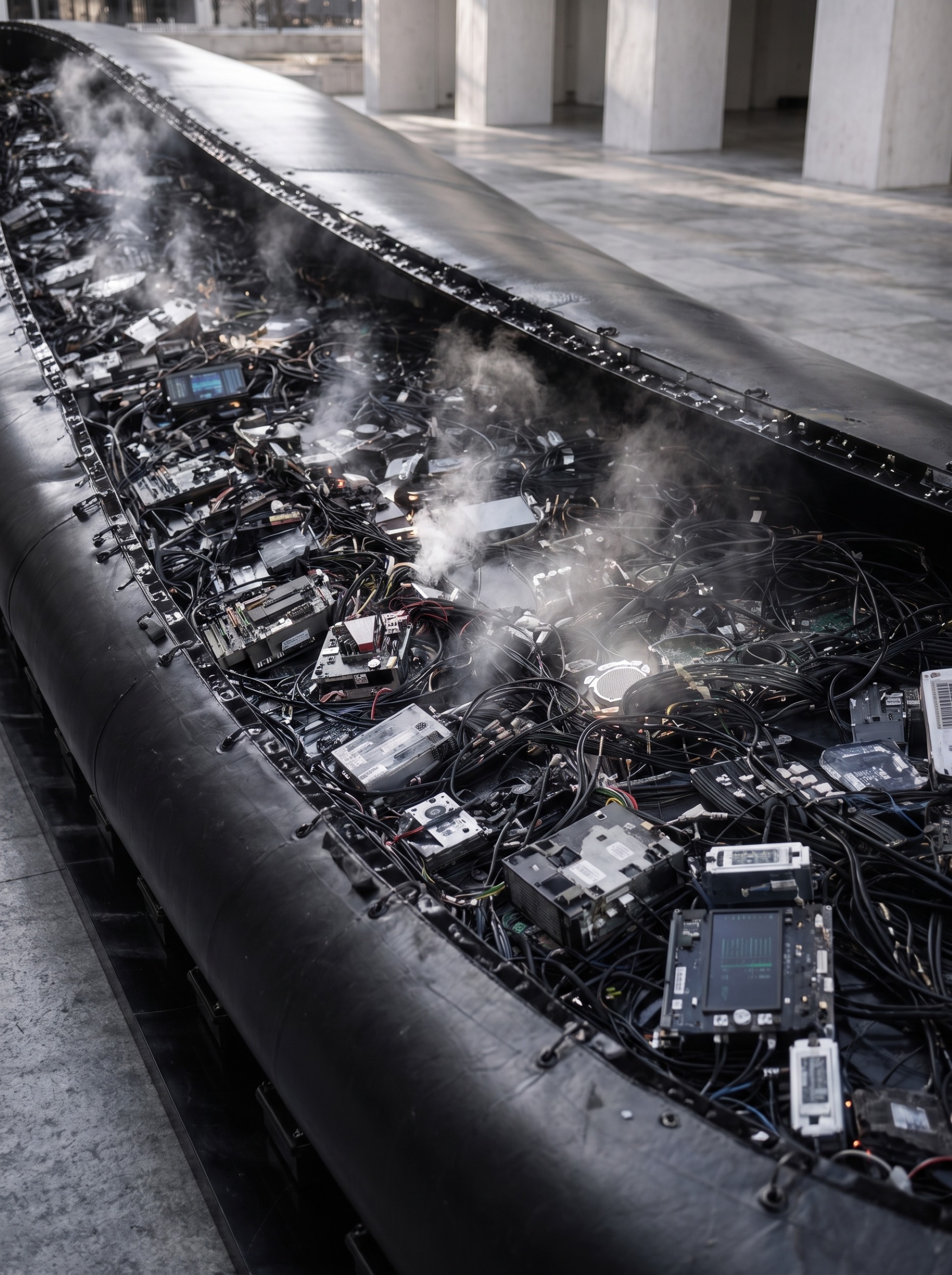
The World as Unit
Every metrological system contains an image of the human who produced it. Feet, palms, cubits, and paces kept the body inside the unit and accepted local variation as part of measurement. A length emerged by placing part of oneself beside a thing. Error, authority, and access were already embedded in this early device ecology.
The metre announced a different ambition: to detach measure from contingent bodies and attach it to a common terrestrial order. Modern metrology sought universality in the planet’s geometry, then transferred authority to material prototypes, wavelengths, and fundamental constants. Each transition expanded reproducibility and bandwidth while moving the unit farther from the hand.
The resulting paradox is exact. Greater certainty about what we touch now depends on what surpasses us. Since 1983, vacuum light speed has secured the metre; since 2019, the International System has defined every base unit through constants of nature. Daily dimensions have become the visible terminals of an infrastructure built from atomic frequency, energy management, vacuum conditions, and calibration apparatus.
Convention persists inside this infrastructure at a deeper level. Nature supplies regularities, while institutions decide how those regularities enter units, standards, and practical distribution protocols. A constant provides coherence; collective agreement establishes the regime in which coherence becomes authoritative. Laboratories, treaties, calibration chains, and trust form the device ecology of every universal measure.
Art shares this ambivalence. Canvas dimensions, plinth height, wall colour, and performance duration appear as immediate properties, yet each carries sedimented standards of exposure time and bodily access. Every centimetre of exhibition space belongs to a history of prestige and legibility. Measuring a room already distributes the bodies permitted to occupy it.
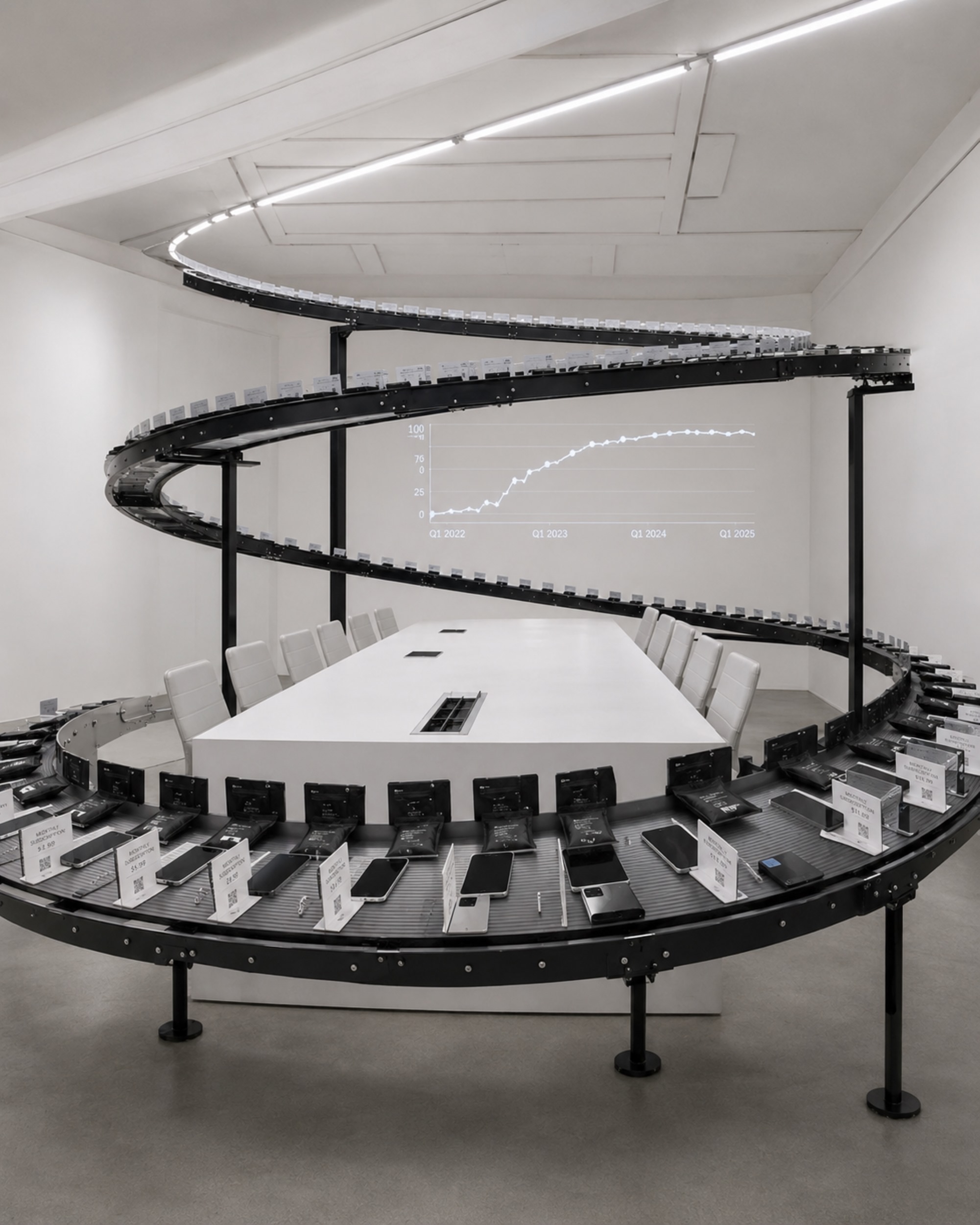
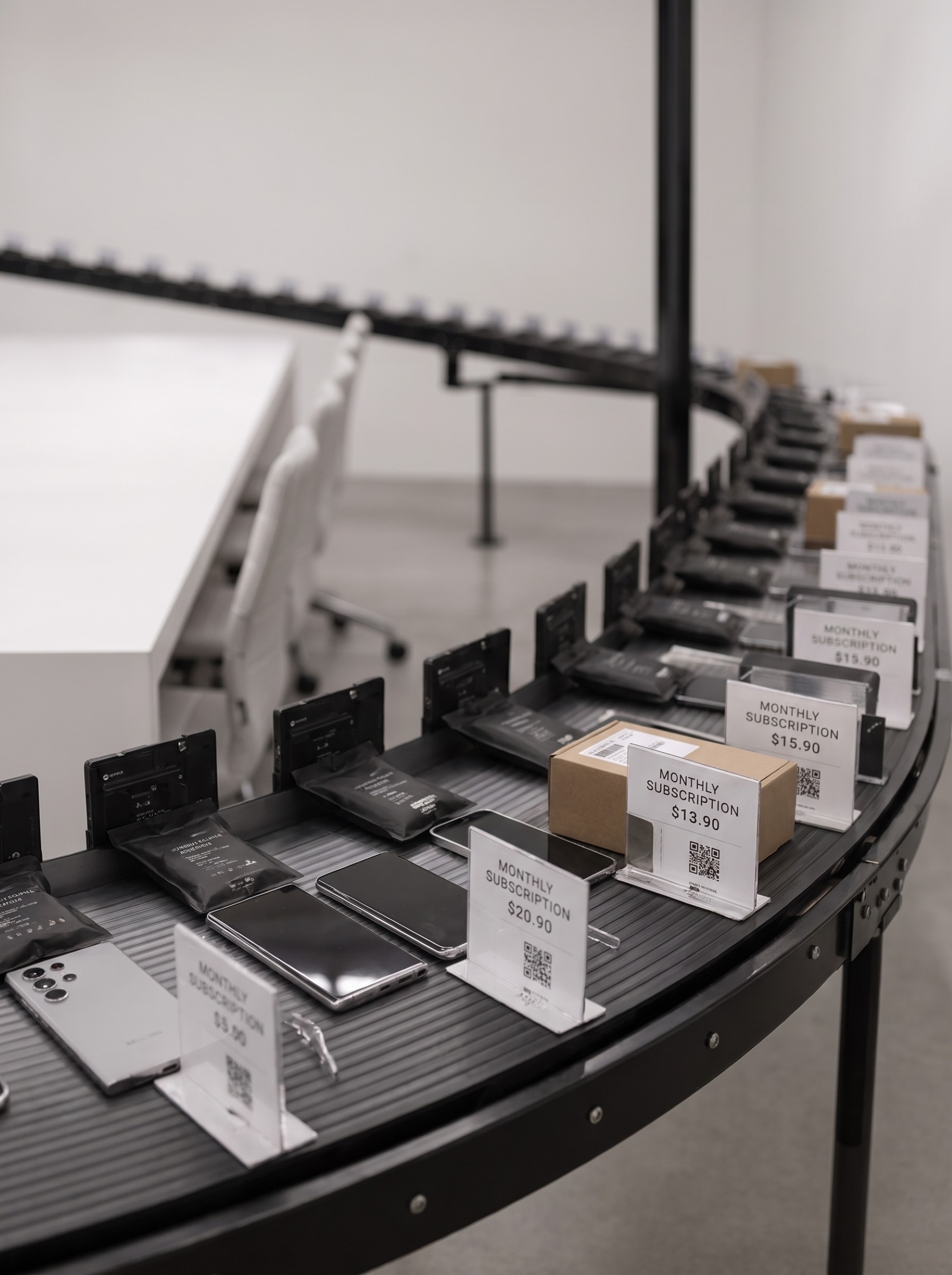
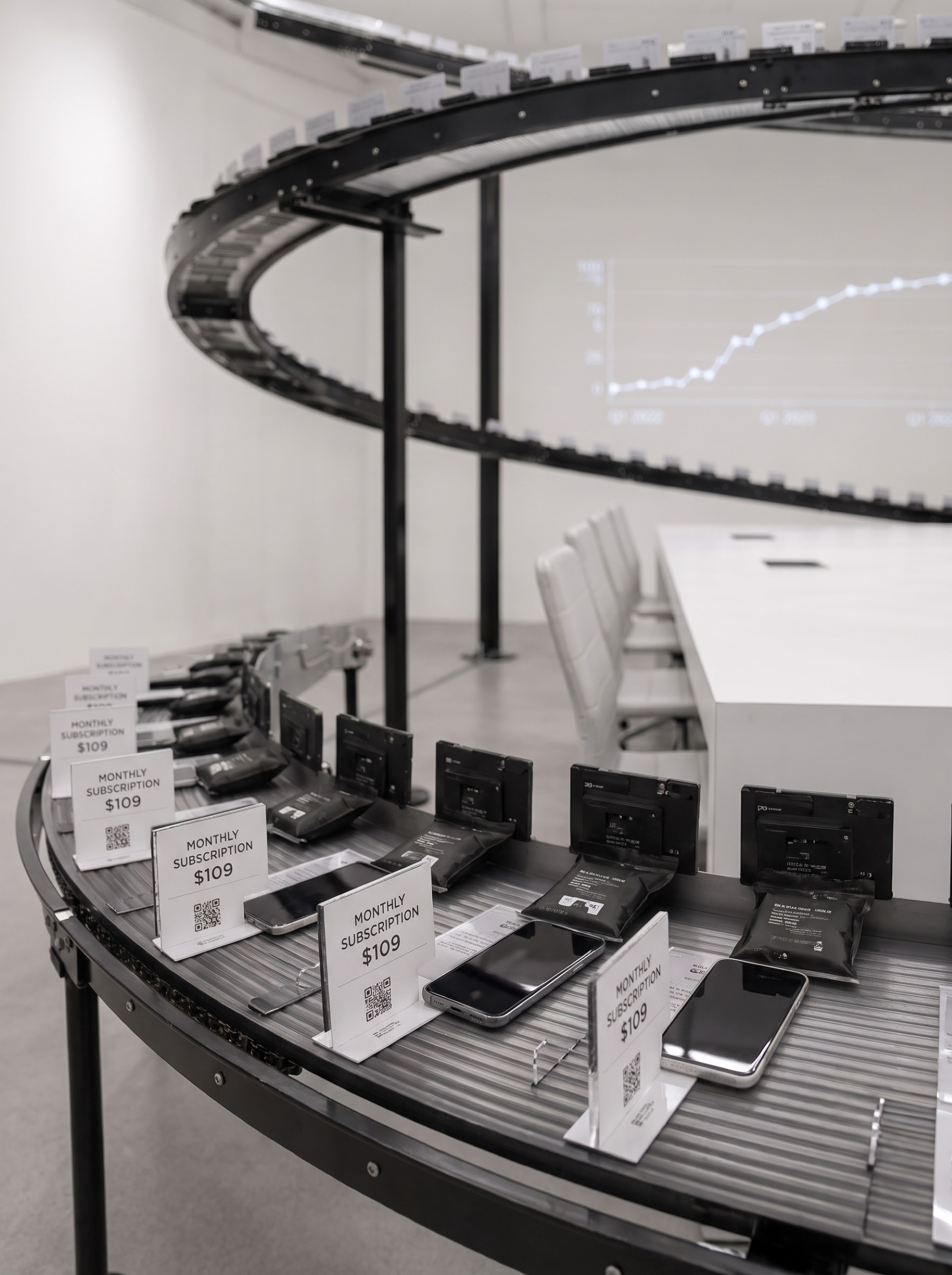
Light as Delay
Light makes the world visible by delivering it late. Across ordinary distances, transmission falls beneath our perceptual threshold and the delay disappears from experience. Astronomy turns that interval into the structure of observation: roughly eight minutes from the Sun, years from nearby stars, and millions or billions of years from remote galaxies.
Distance consequently becomes time. A light-year measures space through duration, linking signal travel to the history of its source. The night sky appears simultaneous because vision edits distinct epochs into one field, a form of cosmic ranking sequencing in which every star occupies the eye’s present and its own past.
An artwork also arrives as something that has already happened. Matter retains production time, a photograph retains exposure time, a museum retains acquisition history, and spectators bring habits shaped by previous images. A historical photograph and an image generated seconds ago enter the present through different distribution protocols. The work becomes a surface of imperfect synchronisation.
Practices organised around light make this mechanism explicit. James Turrell reduces objects until the act of seeing becomes perceptible; Hiroshi Sugimoto uses extended exposure time to condense duration onto a single surface; Olafur Eliasson constructs atmospheric systems in which visitors observe their own collective behaviour. In each case, light moves from neutral medium to temporal infrastructure.
We always arrive after the event. This condition describes the operational mechanics of vision more accurately than immediacy ever could. Transmission time, exposure, neural processing, and cultural recognition assemble the visible within a device ecology. Immediacy is delay rendered seamless.
The Artwork as Scale Device
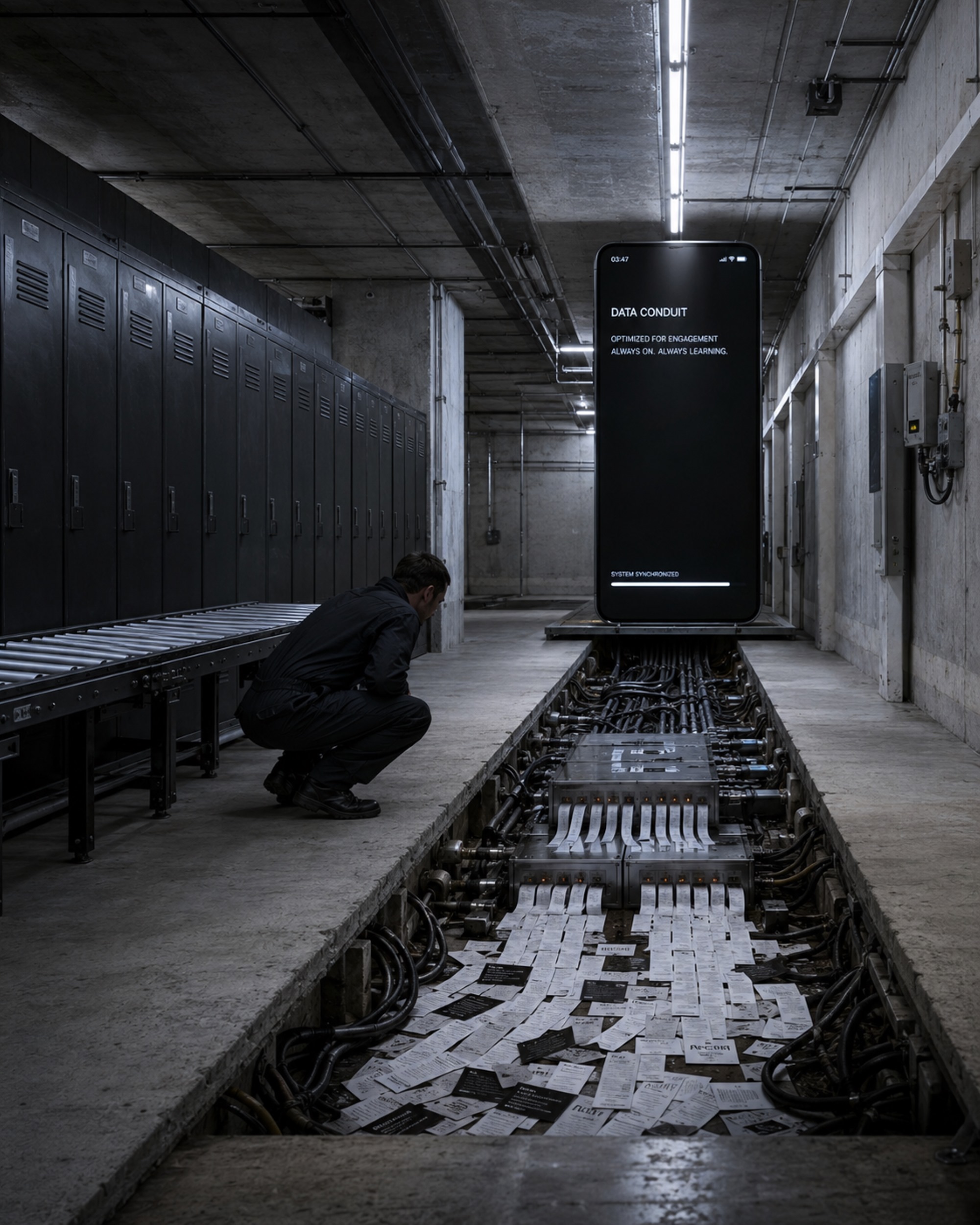
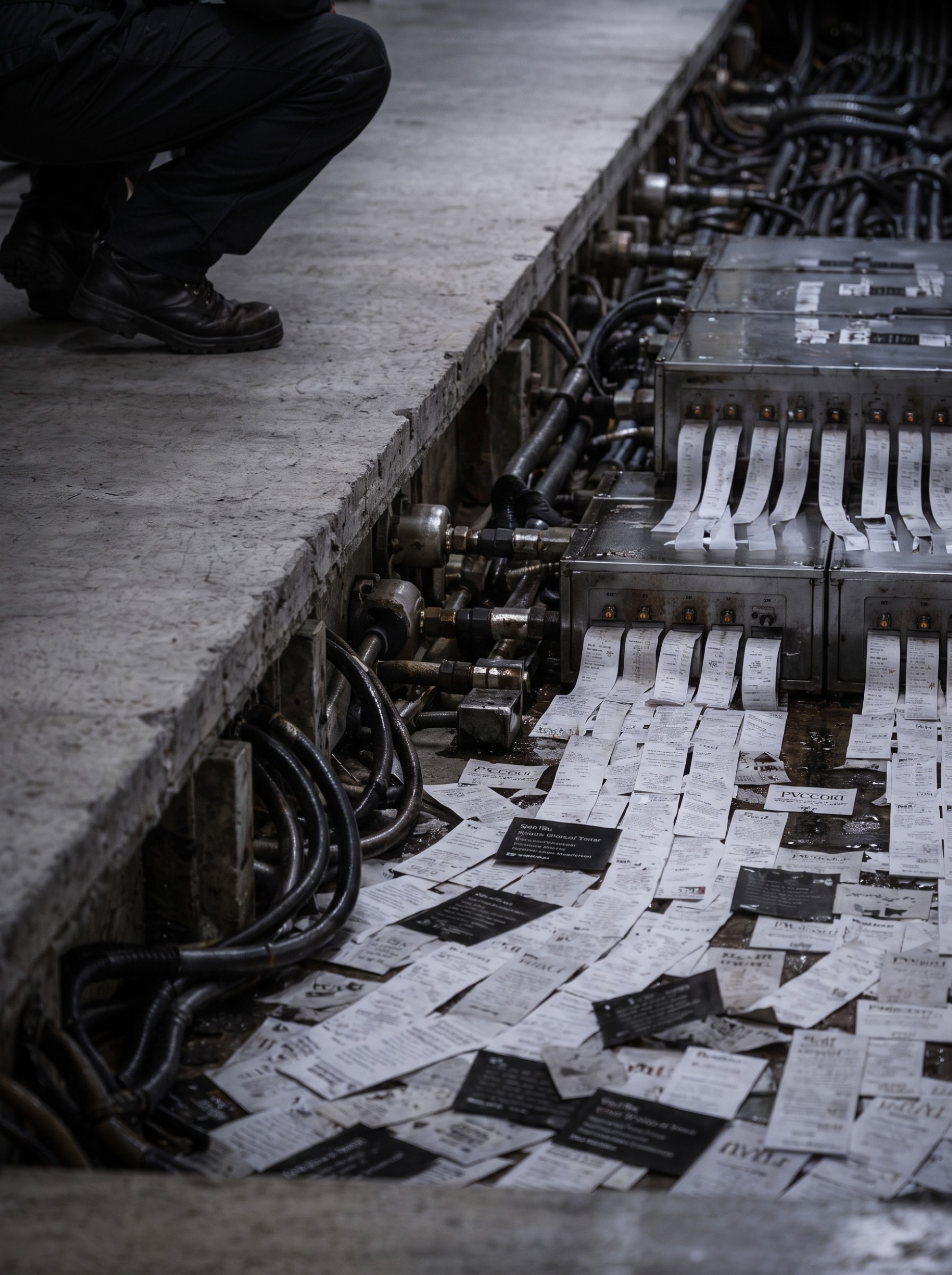
An artwork sets the scale at which a world becomes legible. Physical dimensions provide only one variable. A small screen can host a war, a planetary archive, or an enlarged stranger’s face; a monumental installation can become the backdrop of a thumbnail. Large and small now pass through distribution protocols, file compression, and attention metrics.
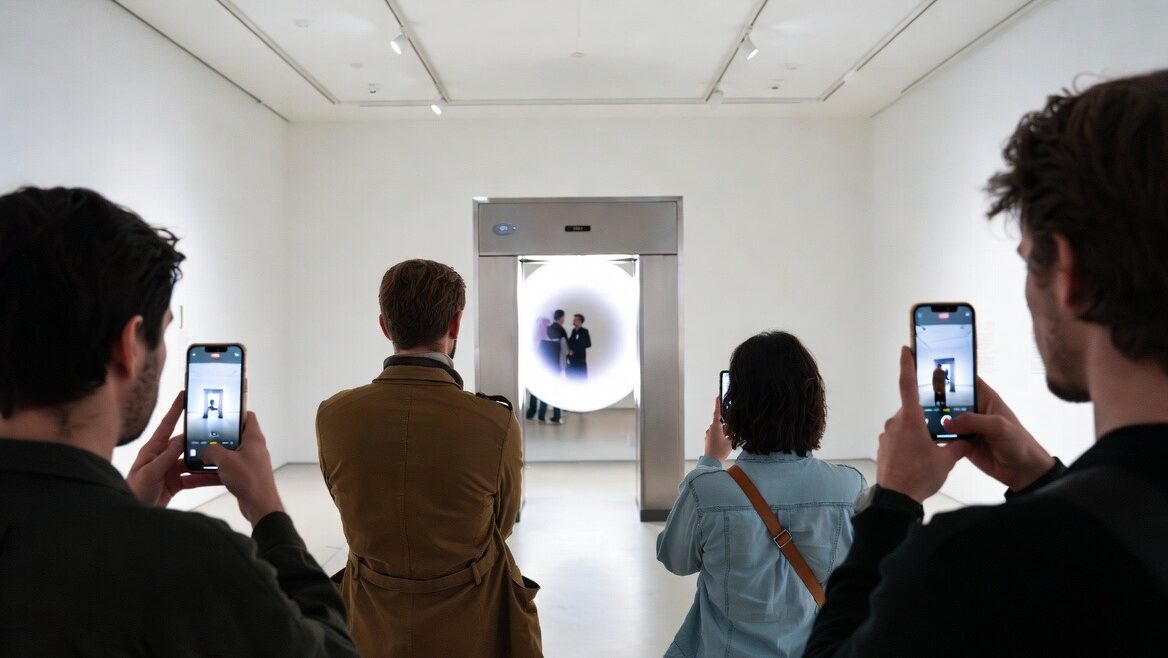
The classical museum built a precise choreography of measure. Safety distance, sightline, median hanging height, and gallery sequence calibrate the body before interpretation begins. The white cube generates the appearance of a world held at bay, although every proportion governs dwell time and visibility. Visitors move through a metric apparatus whose most effective feature is silence.
Installation practices brought that apparatus into view. Once a work occupies an entire room, redirects circulation, or forces a body to bend, measurement becomes experience. The spectator gives up the fiction of a disembodied eye and encounters weight, duration, proximity, and fatigue. Knowledge moves through joints, muscles, and perceptual thresholds.
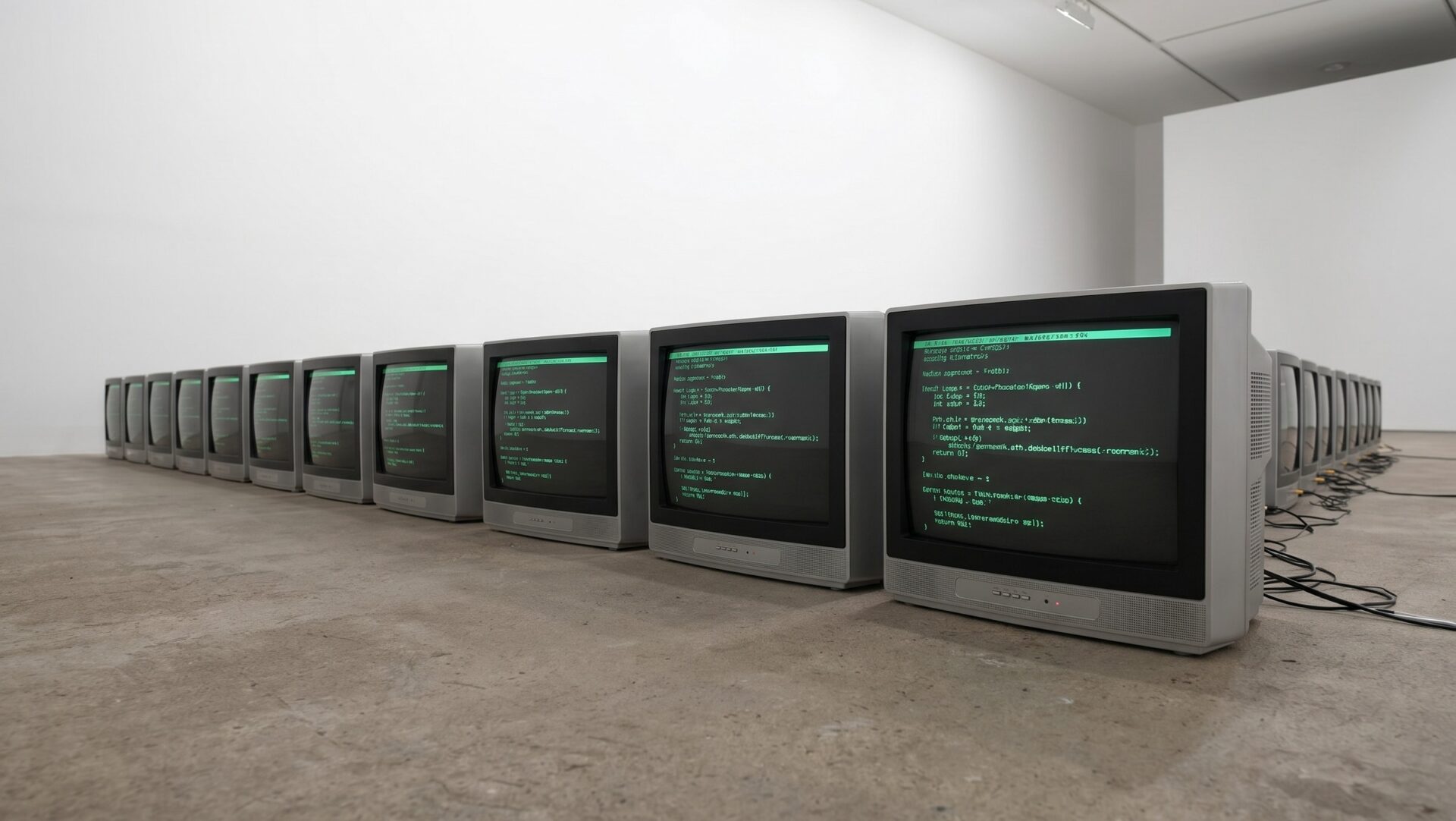
The screen offers an inverse calibration. Works with incompatible dimensions, materials, and contexts are normalised on the same luminous surface. A painting detail and an orbital image of Earth may occupy identical display space. Interface cadence converts scale into zoom, resolution, dwell time, and file availability, replacing tactile measure with operational measure.
The light-year presents the same problem at maximum intensity. Visualisation compresses the immeasurable into a screen image, just as sculpture photography converts volume into surface. Access expands as resistance recedes. Every successful representation makes the world approachable by determining which part of its scale will be removed through compression.
From Aura to Frame
The concept of art changes with the conditions of observation. A medieval icon organised presence, devotion, and community; Renaissance perspective constructed a situated viewer before ordered space; the modern museum separated objects from use and inserted them into comparative history. Each period produced artworks alongside the perceptual threshold required to recognise them as art.
Photography introduced a new mobility of vision. The work could travel as an image, circulate through books, support remote comparison, and enter a rapidly expanding archive. Reproduction altered aura while extending the bandwidth of recognition. Encountering an artwork increasingly included meeting its copy in advance.
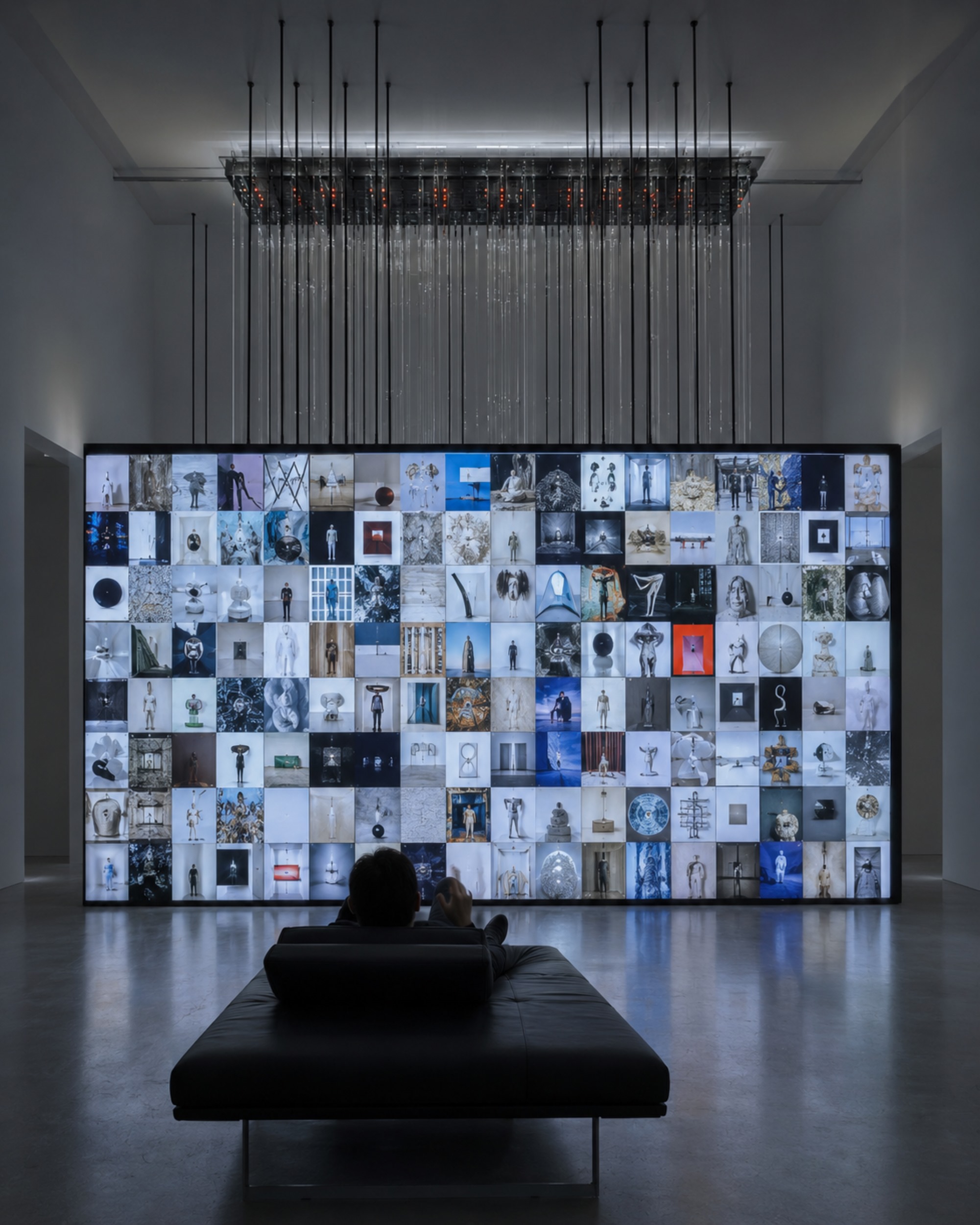
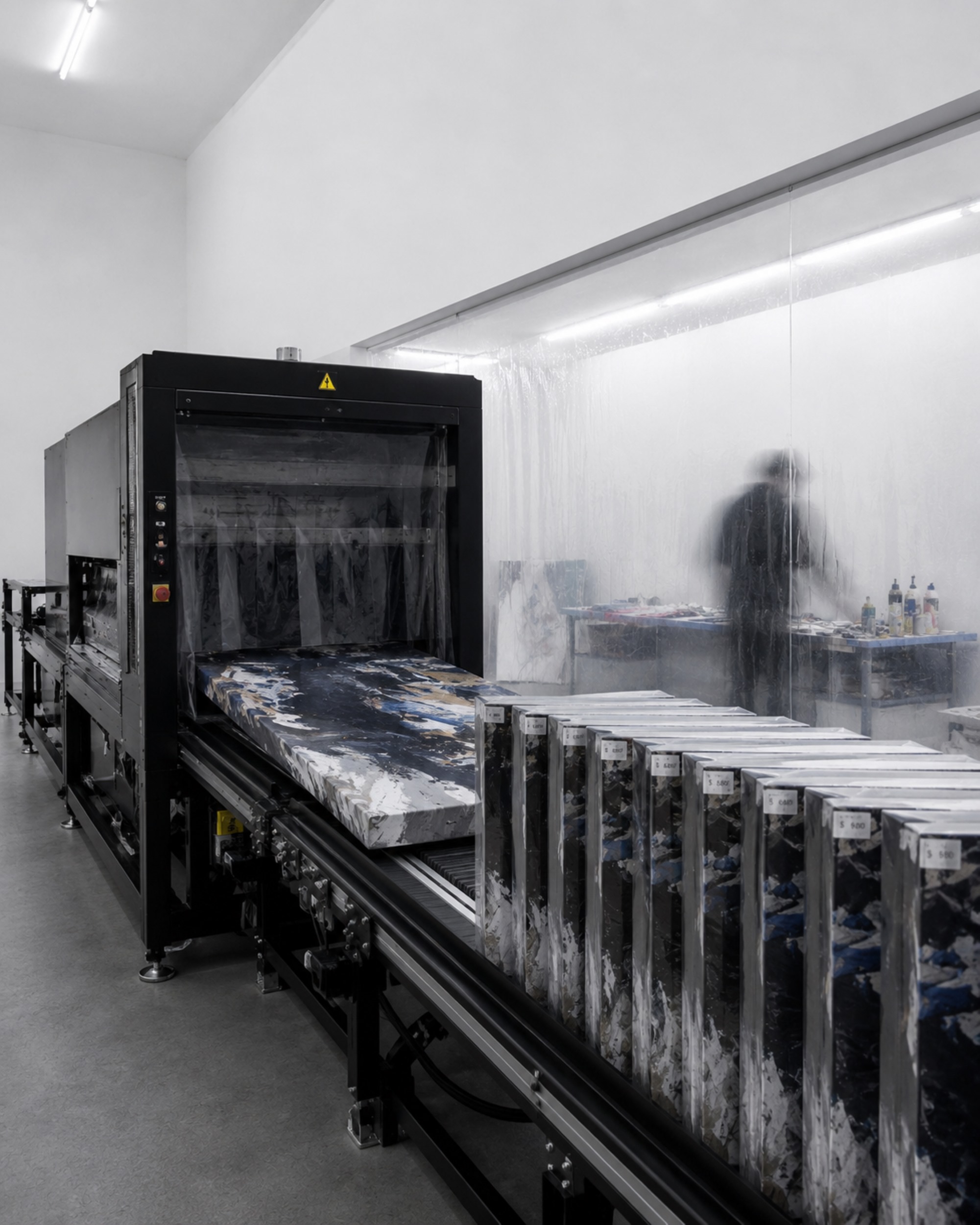
Networks converted mobility into regime. Many works now reach their publics first as thumbnails, sequences, and compressed fragments. Algorithmic sorting replaces the curatorial route with personalised ranking sequencing, where painting, advertising, protest, and synthetic imagery compete for the same second of attention. The frame becomes the practical unit of an art history under continuous montage.
Judgement changes under these conditions. Digital surfaces train rapid recognition of style, signature, and affiliation; the work’s required duration is negotiated against feed logic and attention metrics. Some practices accommodate this threshold, while others introduce slowness, opacity, or physical presence. Even refusal returns as photography, metadata, and algorithmic sorting.
Art changes whenever the conditions of encounter change. Pilgrimage, frontal contemplation, museum visiting, and scrolling coexist through different units: devotion, distance, dwell time, click. Their distribution protocols remain irreducible to one another. Art history is also the history of the invisible metres applied to vision.
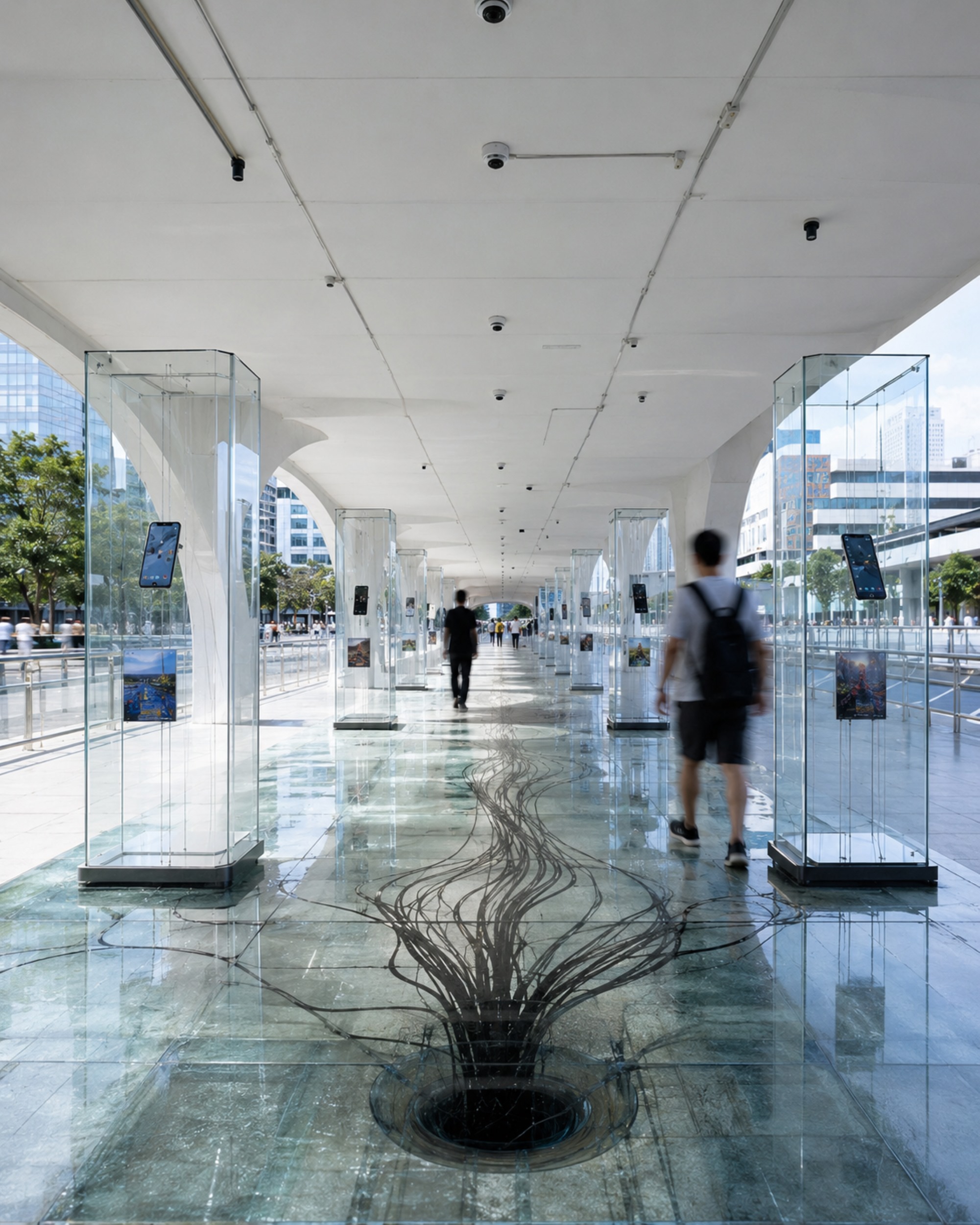
Calibrating the Incommensurable
The opening question now carries two answers. A light-year measures approximately 9.46 trillion kilometres, yet the conversion yields no equivalent experience. The kilometre enables calculation, navigation, and comparison; at cosmic scale it functions as a coordination signal among minds, instruments, and archives. Measurement reaches what imagination cannot contain through operational bandwidth.
Art works inside the residue left by that operation. A darkened room can make a few photons alter bodily awareness; an extended exposure can turn duration into surface; an ordinary object can be placed against a scale that renders it strange. Such gestures avoid consoling metaphor and reorganise the perceptual threshold at which limitation becomes sensible.
That threshold is political. Whoever establishes units also determines what enters comparison, registration, and governance. Museums express this through conservation criteria and insurance formats; platforms through views, engagement, dwell time, and ranking systems; science through instrument thresholds and parameter space. Measurement selects reality before it describes it.
We can approach artworks with a different calibration. Every encounter carries at least three scales: the material dimensions of the object, the infrastructural dimensions of its medium or location, and the historical dimensions of the categories that make it legible as art. Vision moves among them as light moves across unequal distances, assembling presents from divergent exposure times.
Seven and a half circuits of the world in one second. The sentence remains impossible to see, which is precisely why it continues to work. Measurement traces the edge of perception; art extends our dwell time along that edge.