

THE POSITION FROM WHICH WE CANNOT SEE
An artist spends years developing a language. They learn to recognize the forms that belong to them, defend the decisions that distinguish their work, and give their practice a legible shape. When this process succeeds, something ambiguous happens: the language becomes recognizable to its maker, too. Before beginning a new piece, the artist already knows which decisions will appear consistent with their trajectory. They may even anticipate how the work will be interpreted.
This familiarity is an achievement. It can also become a constraint.
Artistic culture often assigns an almost moral value to total immersion: being an artist at all times, with no separation between life, sensibility, and production. Yet someone who remains inside a position indefinitely comes to know its interior better than anything else. They may no longer see the conditions that sustain it, or the alternatives it rules out.
This suggests a counterintuitive possibility. At certain moments, understanding one’s work may require suspending precisely what defines one as an artist. Not abandoning the practice, but questioning the assumption that the author’s identity provides the best vantage point from which to judge it. Is such a suspension possible? And if so, what position might the artist occupy instead?
THE IDENTITY THAT PRESERVES ITSELF
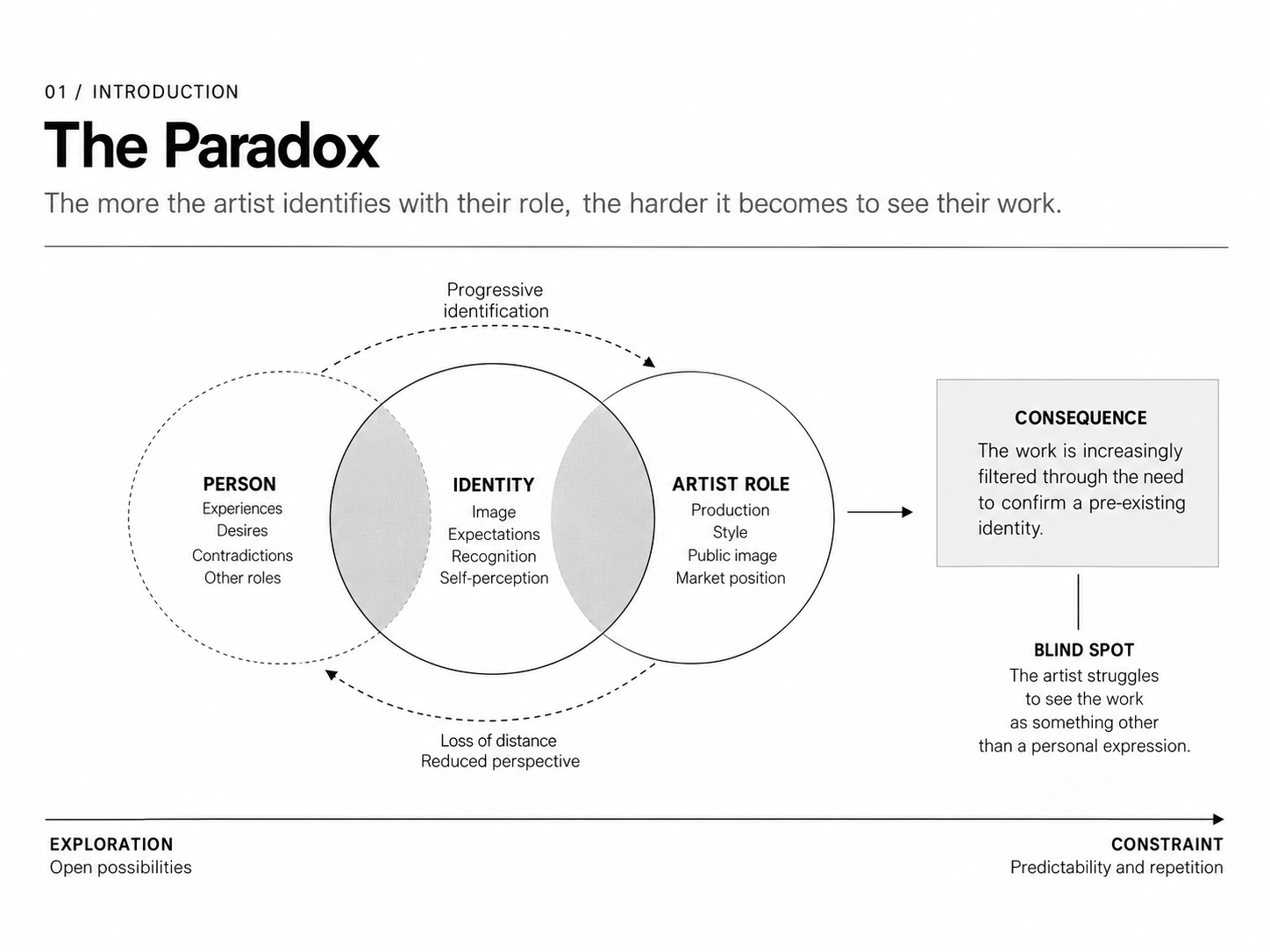
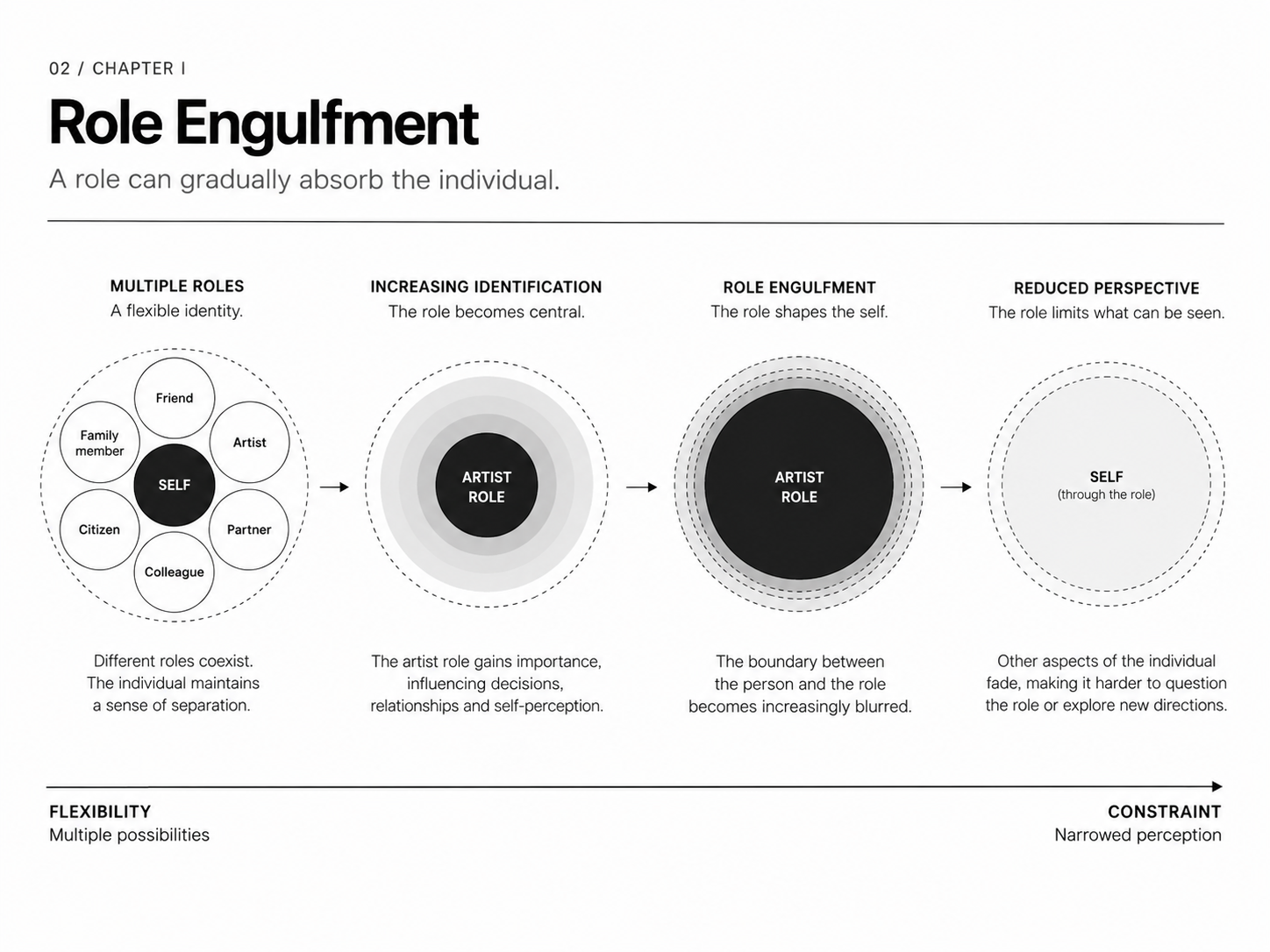
A role is not a costume we put on in the morning and take off at night. Through habits, recognition, and expectations, it enters the account we give of ourselves. In sociology, the term role engulfment describes a situation in which a dominant role comes to absorb a person’s identity. It is a useful concept, provided we do not turn it into a diagnosis indiscriminately applied to every profession.
For artists, at least three distinct pressures are at work. The first is internal: loyalty to one’s own history. Someone who has spent ten years developing a method may experience any departure from it as a betrayal. The second is relational: critics, galleries, collectors, and audiences learn to recognize certain qualities and may expect to encounter them again. The third is institutional: archives, exhibitions, catalogues, and the market stabilize a narrative that makes the work easier to place, but does not always accommodate its evolution.
These pressures are not inherently harmful. Formal continuity can allow for a depth of exploration that the relentless pursuit of novelty would prevent. Recognition can fund experiments that are less immediately accessible. The discipline associated with a role can also produce knowledge that is difficult to acquire in any other way. The problem begins when continuity ceases to be a choice and becomes an unspoken obligation.
Consider a painter who, after years of work, arrives at a formal solution that attracts attention. Subsequent paintings might become increasingly sophisticated without departing from that language. Or they might repeat the initial discovery with ever greater technical skill. From the outside, the two trajectories may look alike; from the inside, even more so. Public recognition cannot tell them apart. Neither can the pleasure of making the work.
Here, role engulfment takes a particular form. It does not prevent the artist from working. It may even encourage intense production. What it narrows is the range of questions the artist is able to ask. Rather than considering what the work itself demands, the artist begins, often without realizing it, to ask what someone like them would do.
Research on self-presentation, associated among others with psychologist Mark Leary, helps explain how a social image can shape behavior. It does not, however, justify the claim that every artist is captive to the gaze of others, or that escaping it is enough to uncover an authentic self. Audience expectations can be internalized, but their strength and consequences must be considered case by case.
The issue is not to expose a false identity in order to recover a true one. An artistic identity is real in its effects. The more precise question is how to recognize the point at which a structure that once supported a practice begins to preserve itself at that practice’s expense.
A DISTANCE THAT DOES NOT PROMISE OBJECTIVITY
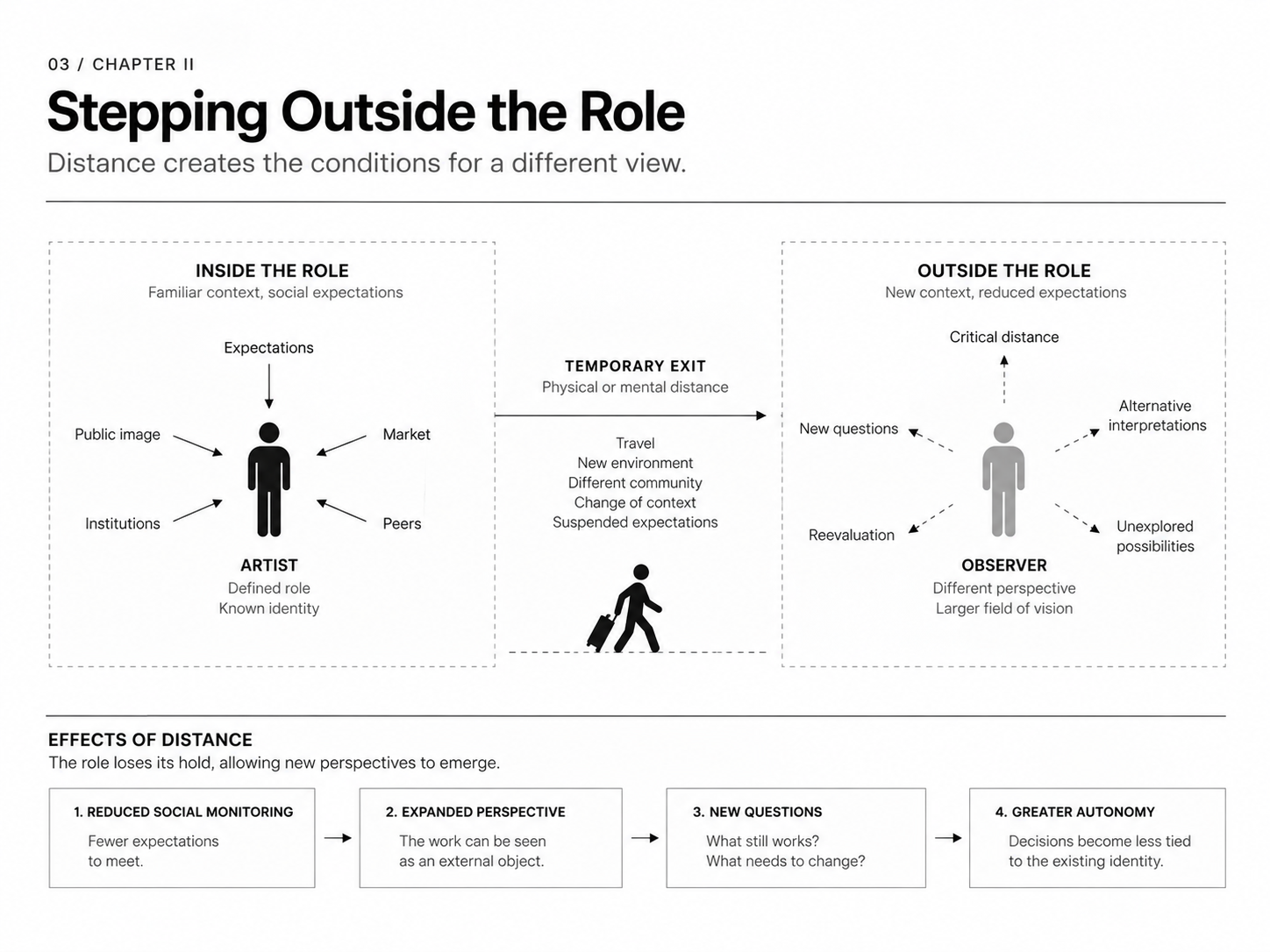
Travel offers an intuitive analogy. Away from familiar places, many people experience some relief from everyday expectations. Their interlocutors change, their schedules change, and different behaviors become possible. This does not prove that travel reveals our true selves. A new setting simply creates different conditions, different roles, and sometimes different performances.
In Becoming an Ex (1988), sociologist Helen Rose Fuchs Ebaugh examines how people leave significant social roles. Her account of role exit concerns biographical transitions, not a technique for taking temporary breaks from one’s identity. Applying it to artistic practice therefore requires an explicit analogy: we can imagine a deliberate suspension of the role without attributing to Ebaugh a theory of creativity she never proposed.
What, exactly, would be suspended? Not the artist’s skills, which cannot be switched off at will, but the interpretive privilege they grant to their own experience. During production, a decision may make sense because it resolves a problem the artist has lived through, completes an intuition, or emerges from a productive accident. Once the work is finished, those reasons are not necessarily perceptible. The making of a work and what the work makes available to others are two different objects of inquiry.
A practical exercise might begin after a period of production. The artist arranges the works without following the order in which they were made and approaches them as an unfamiliar body of material. They record what is actually visible before reconstructing what they intended. They compare the pieces they consider most successful with those an informed observer finds most significant. They identify repetitions they never planned and departures they may have underestimated. Such a procedure cannot certify artistic value. Its purpose is to expose the differences between intention, outcome, and reception.
The reference to Husserl’s epoché is useful only within clear limits. Phenomenological suspension is not the same as looking at a painting dispassionately, and it would be misleading to present it as a ready-made protocol for artistic self-assessment. The affinity lies in the initial gesture: placing certain habitual assumptions in brackets in order to examine what those assumptions had made seem self-evident.
A serious objection remains. Someone looking at their own work from the outside is never truly outside it. They carry their memories, interests, ambitions, and resentments with them. Detachment can even become another way of confirming what they already believe. Distance should therefore not be confused with objectivity. It is better understood as a change in the conditions of judgment, one that becomes more useful when tested against independent perspectives and when its revisions leave a trace that can be examined.
There is also a wrong time to step back. In the middle of a still-fragile investigation, constant scrutiny may interrupt associations that need time to develop. Not every stage calls for the same degree of administrative clarity. Immersion makes room for tacit learning, mistakes, and discovery; review allows the artist to compare what was made with what they thought they were making. Separating these moments does not mean ranking one above the other.
Suspending the role, then, does not reveal a more authentic artist. It produces an artist who is less compelled to believe the first account they give of their work.
GOVERNING WITHOUT REDUCING
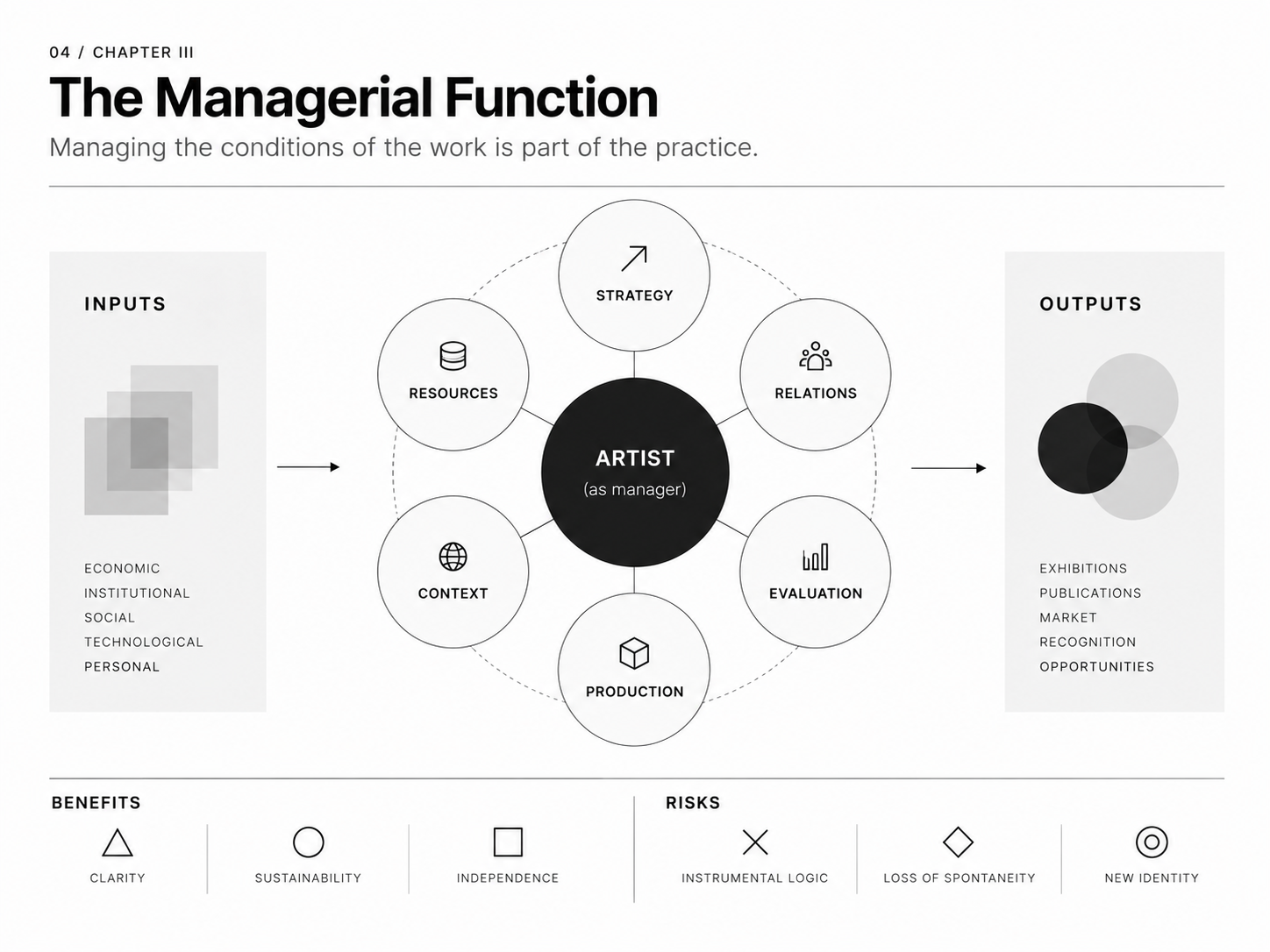
Suggest that an artist take on a managerial function and the suspicion is immediate: the practice will be subordinated to targets, metrics, and sales. The suspicion is not groundless. There is a form of management that measures everything against demand and ends up selecting works before they have even been conceived. But rejecting that model does not make the material conditions of artistic practice disappear.
A studio costs money. An exhibition requires decisions. A project takes up months that cannot be spent on something else. Working with a gallery changes how the work circulates; an archive influences how it will be read; a production choice may create lasting technical or financial dependencies. Even artists who say they do not concern themselves with such matters still make decisions about them, often by leaving them to urgency or to other people.
To avoid importing a corporate model wholesale, we should distinguish three functions. Operational management concerns schedules, contracts, resources, and organization. Strategic direction concerns the conditions under which a practice develops: which projects to support, which opportunities to decline, which skills or collaborations to cultivate. Critical evaluation concerns the work itself and cannot be settled by a balance sheet. These functions interact, but they are not interchangeable.
An artist might turn down a financially attractive exhibition because it would demand a kind of production incompatible with the current stage of their research. That is a strategic decision, not a rejection of management. Alternatively, they might accept a commercial commission to finance an experimental project while maintaining different standards for judging the two outcomes. This, too, is a way of directing a practice.
The phrase managing oneself is nevertheless inadequate. A conventional manager generally operates within objectives set by someone else. The artist must often decide whether those objectives deserve to exist in the first place. They are not merely allocating resources; they are determining which constraints can be accepted and which would alter the meaning of the work. At times they act as a director, at others as a demanding editor of their own archive, and at others as the person responsible for the studio’s material continuity.
Art history offers precedents that complicate the ideal of the wholly immersed author. Andy Warhol’s Factory makes the organizational and collaborative dimensions of production unmistakable. In certain works, Sol LeWitt’s instructions separate conception from execution in radical ways. Marcel Duchamp demonstrates how selection, framing, and context can be central to the constitution of an artwork. These are not examples of artists subscribing to a single managerial theory. They show, rather, that artistic work does not always coincide with an individual’s act of making.
The hardest question remains: how can an artist understand where a practice is going without imposing a destination on it in advance? Counting works, exhibitions, or sales is not enough. What matters is the trajectory of decisions. Which problems were abandoned too soon? Which intuitions keep resurfacing in different forms? What did the resources invested actually make possible? Which outcomes could not have been anticipated by the original plan?
Such questions do not yield a universal measure of quality. They do, however, produce a critical memory. They help distinguish a practice that is changing from one that is merely growing in volume. They clarify when limited resources call for restraint and when the work itself calls for a transformation.
Management can therefore protect artistic freedom, but it cannot guarantee it. An impeccably organized artist may become thoroughly predictable. An economically sustainable project may lose its ability to challenge its own premises. The test of good management is not maximum efficiency. It is whether the artist retains a genuine capacity to make decisions that are not already dictated by survival or approval.
THE RISK OF A SECOND IDENTITY
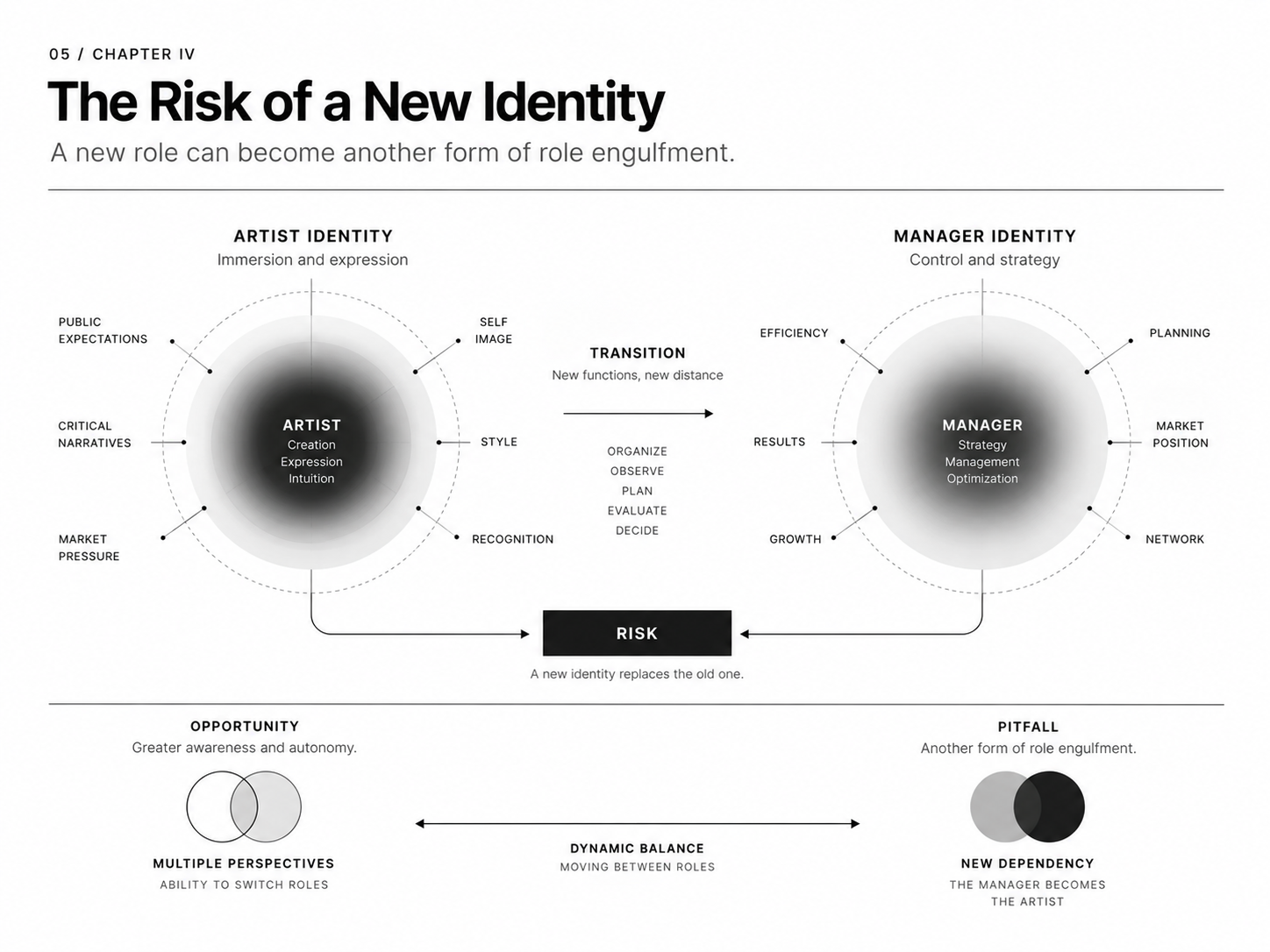
At this point, the argument encounters its own contradiction. If the artist is to resist being absorbed by a role, why take on another? The manager, the curator, or the director of one’s own practice can become just as rigid an identity. Someone who constantly measures trajectories and consequences may eventually lose patience with anything they cannot yet justify.
The mistake would be to confuse replacing one role with becoming free of roles. It is possible to leave behind the romantic image of the artist only to enter the contemporary image of the strategic professional: always self-aware, always able to narrate a coherent trajectory, always ready to turn an intuition into a plan. What looks like clarity may conceal a new obligation to remain consistent.
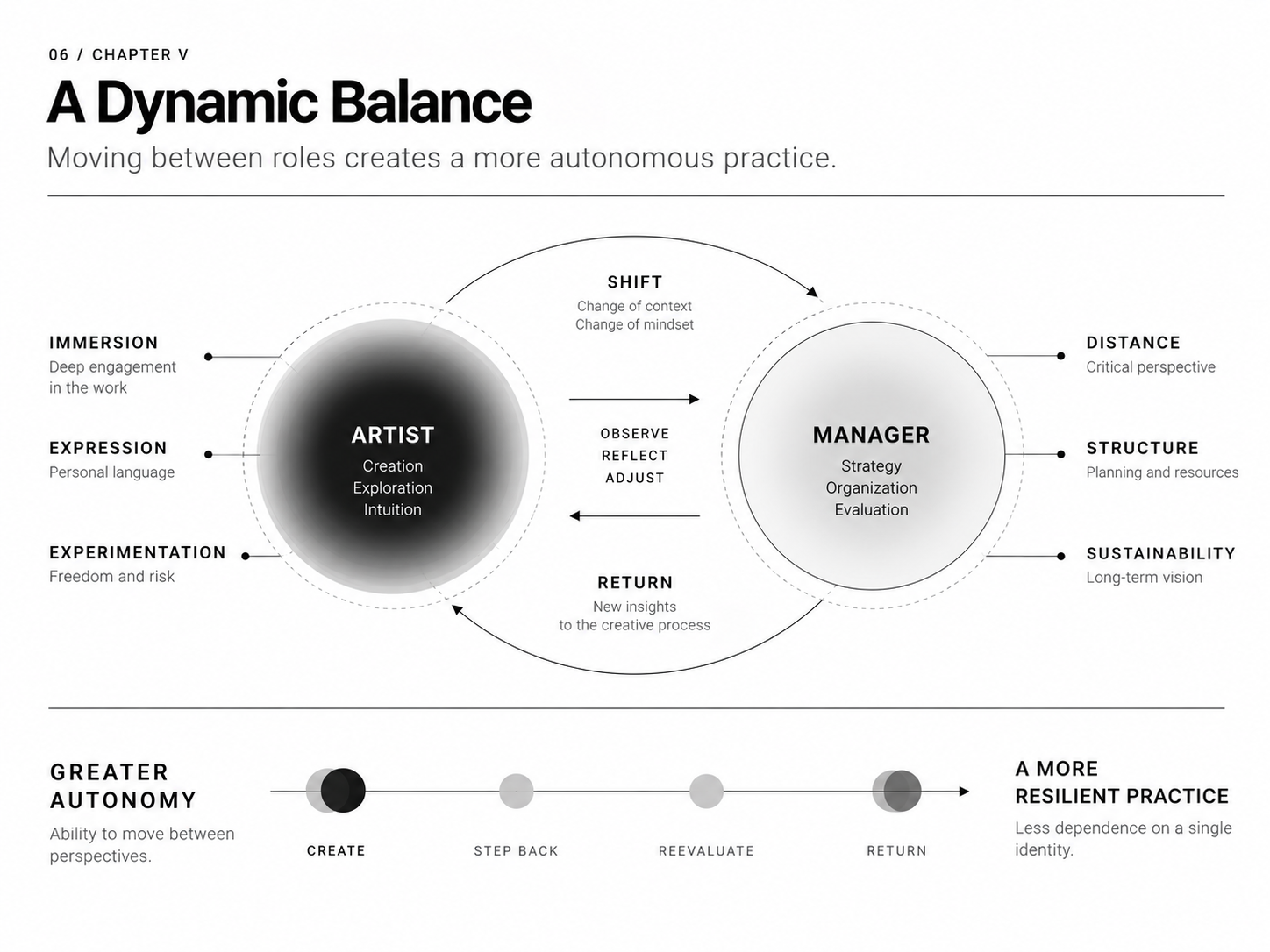
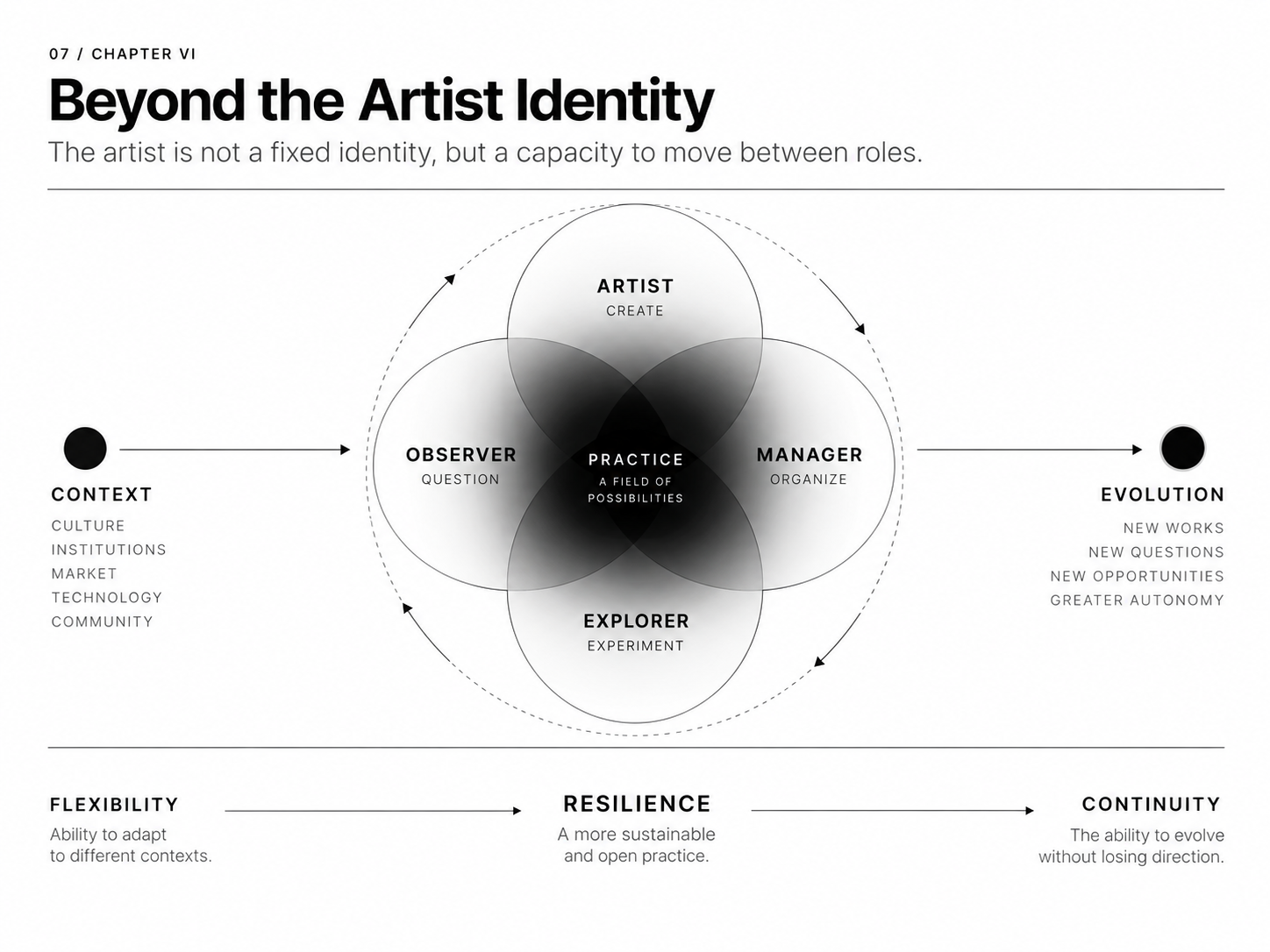
The initial proposition therefore needs to be revised. The point is not to stop being an artist in order to become a manager. It is to prevent any single function from monopolizing one’s relationship with the work. Autonomy does not reside in a privileged role, but in the ability to move between positions, knowing that each reveals something and obscures something else.
These shifts need not happen within the same day. There are periods when immersion deserves protection and judgment should be postponed. Others call for an unsparing assessment: after a major exhibition, before investing in a new series, when the market begins to recognize a formula, or when production increases while the research seems to stand still. Distance is most useful when it answers an identifiable need, not when it becomes a ritual of self-surveillance.
This model has at least two limitations. The first is material: not every artist has the time, money, or collaborators required to separate these functions. For some, management is already a burden that takes hours away from making work. The second is psychological: the capacity to inhabit multiple perspectives is not equally available to everyone and may depend on trusted interlocutors, responsible institutions, or shared structures. Presenting it as a simple matter of individual choice would erase the inequalities within which artistic work takes place.
There is also room for legitimate disagreement. Some artists may argue that their work exists precisely in the indistinction between life, gesture, and artwork, and that introducing a managerial observer would betray its underlying principle. It would not be enough to tell them they are wrong. The relevant question is whether that indistinction is a method consciously chosen and continually examined, or a formula that no longer permits scrutiny. The difference is not automatically visible from the outside.
What emerges is a less heroic conception of artistic autonomy. Artists are not free simply because they remain faithful to a supposed creative essence. Nor do they become free by controlling every aspect of their activity. Their autonomy is always relative: it grows when they can recognize the constraints shaping their work, negotiate them, sometimes accept them, and sometimes act against them. Freedom is not the absence of conditions, but a greater capacity to intervene in those conditions.
Distance, finally, is not the opposite of commitment. It may be one of its most demanding forms. It requires giving up the protection offered by intention, acknowledging that a beloved work may be weak and that a piece made almost by accident may open an unforeseen path. It also requires accepting that a decision sound in economic terms may be wrong for the practice, and vice versa.
CONCLUSION. A PRACTICE THAT DOES NOT HAVE TO RESEMBLE US
The title of this essay is deliberately excessive. Artists cannot erase their histories, skills, or social positions at will. Nor would that be desirable. The point is different: the work should not be required to confirm the image of the person who makes it.
Artistic identity is a necessary construction, enabling recognition and giving continuity to a body of work. But no construction, however productive, should become untouchable. Critical distance allows us to question what immersion tends to make seem natural; managerial competence makes the material conditions of choice more visible; engagement with other perspectives helps prevent self-evaluation from closing into a private loop.
None of these approaches offers a definitive vantage point. Every perspective has its limits. That is precisely why it matters to be able to change position.
The question, then, is not whether an artist should be less of an artist. It is whether they can recognize when the identity that brought them this far begins to demand that the work stop moving with it. At that moment, stepping out of the role does not mean stepping away from art. It means allowing the work to move in a direction its author, preoccupied with remaining themselves, might never have been able to see.