

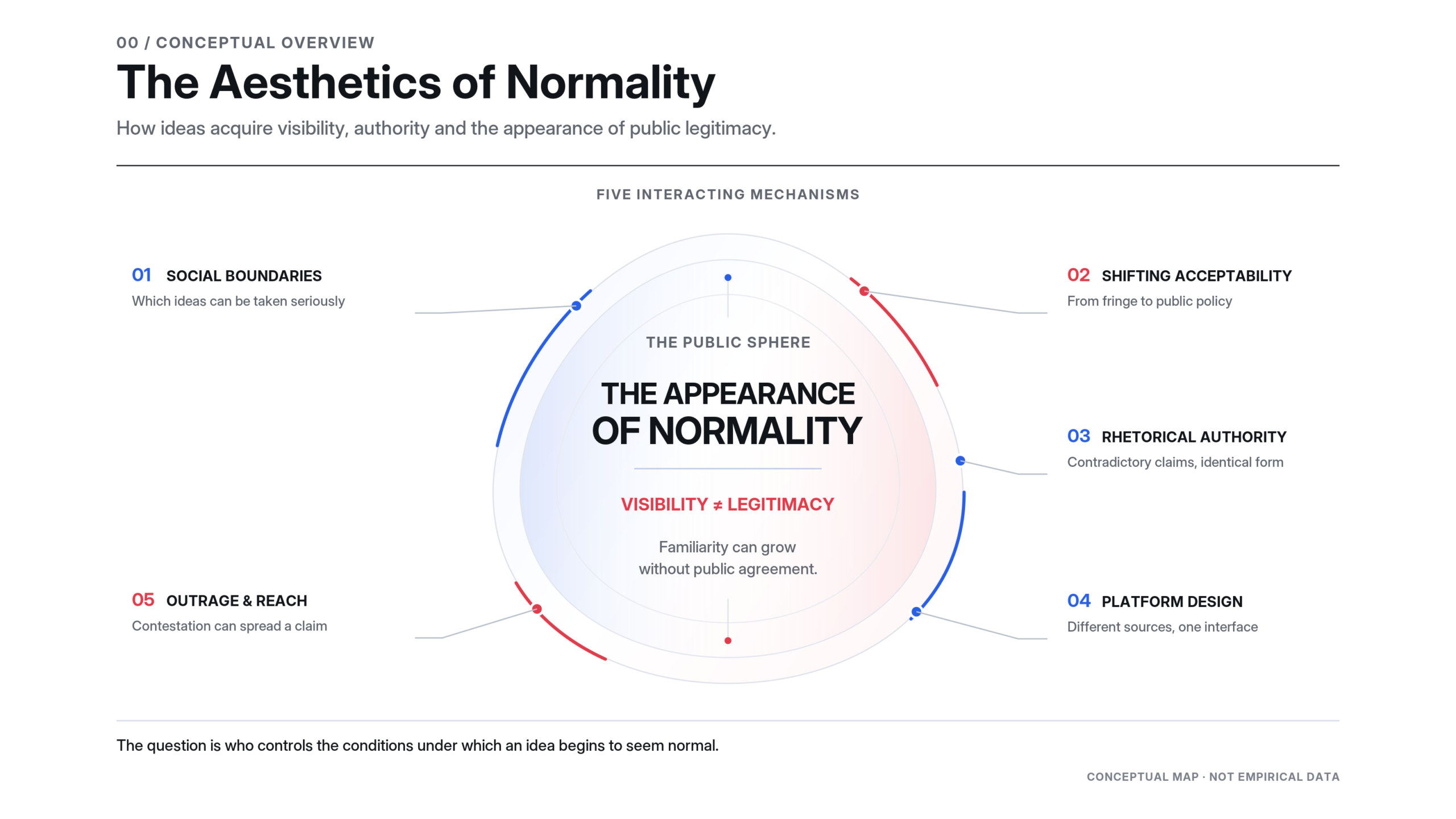
What seems absurd today may appear perfectly normal tomorrow. Every society draws an invisible line between what can be said, debated, and accepted and what is dismissed as extreme, unreasonable, or beyond consideration. That line is never fixed. It shifts with culture, politics, language, and, above all, the ways ideas circulate.
This is the principle behind the Overton window, a model describing the range of opinions considered acceptable at a particular historical moment. One interpretation of the model identifies six levels through which an idea may be perceived, from unthinkable to its eventual adoption as public policy. This is not an inevitable progression, but a possibility: even the most radical convictions can gradually lose their sense of strangeness. The decisive shift comes when an idea, whatever its substance, gains enough visibility to become familiar. Repetition makes it recognizable, debate lends it relevance, and even outrage can help keep it circulating. Long before social media existed, the American artist Jenny Holzer was exploring a remarkably similar dynamic. In 1979, she began distributing her Inflammatory Essays on the streets of Manhattan: anonymous posters, each containing exactly one hundred words arranged across twenty lines. Aggressive proclamations, political exhortations, threats, and mutually contradictory ideological positions all appeared in a rigorously uniform graphic format.
The form stayed the same while the thinking changed radically. No signatures, no visual hierarchy to distinguish one position from another. Readers had to decide for themselves what to believe. Today’s digital platforms reproduce something comparable on a global scale. A Nobel laureate, a politician, an extremist, and an anonymous account can all speak through nearly identical interfaces.
The structure hosting each message tends to standardize its appearance, while algorithms help determine its visibility.
It is one of the paradoxes of contemporary communication: democratizing the ability to speak does not guarantee the ability to distinguish what deserves to be believed. And when every idea can take on the aesthetics of normality, recognizing the moment when the unthinkable begins to become acceptable grows increasingly difficult.
THE INVISIBLE BOUNDARIES OF THOUGHT
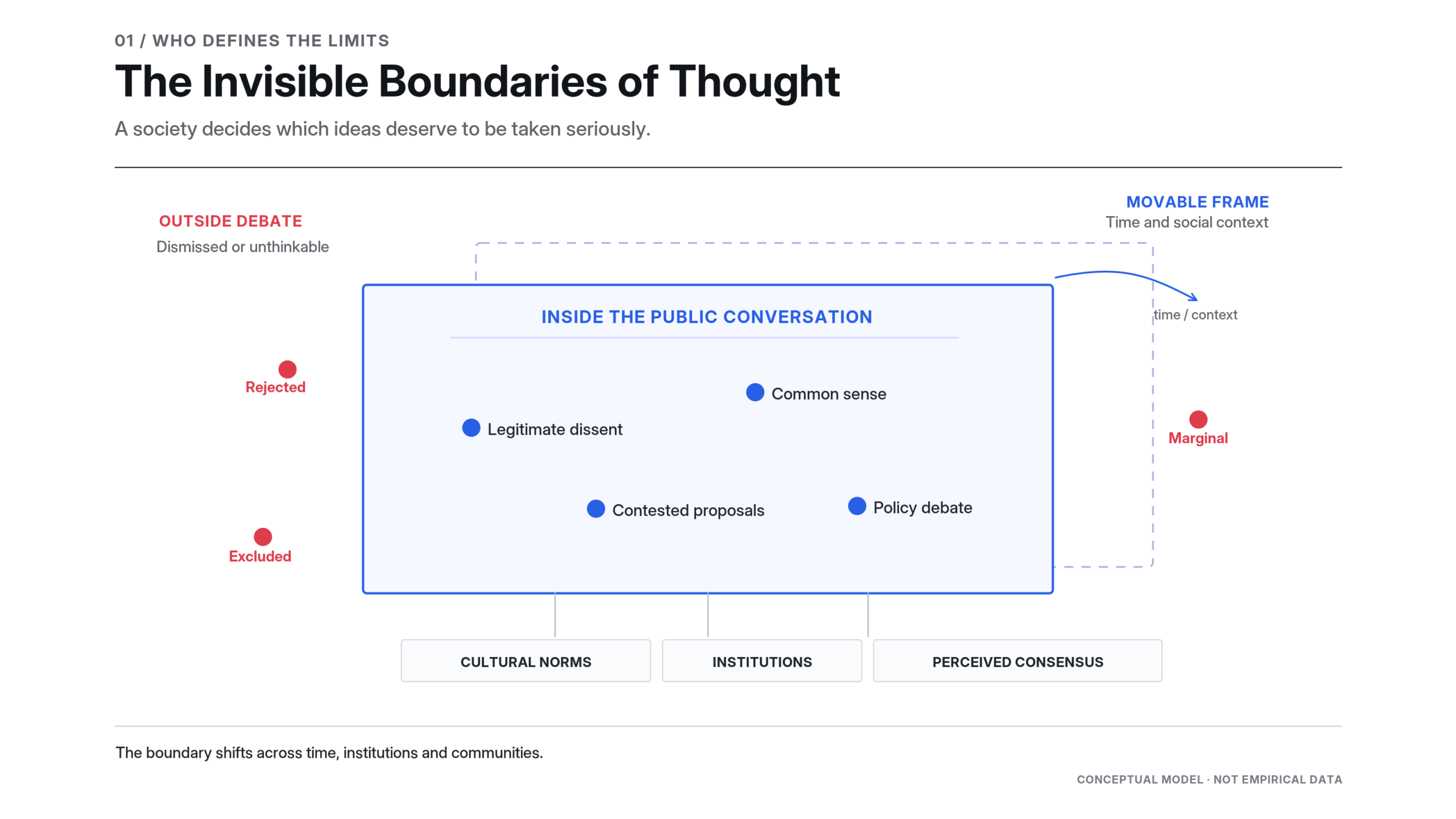
Every society has a set of unwritten rules determining which ideas can be considered reasonable. These are not necessarily laws, prohibitions, or explicit forms of censorship. They are less visible and, for that reason, harder to recognize: a web of cultural conventions, collective expectations, and power relationships that establishes the boundaries of public debate.
Within those boundaries, opinions can be compared, challenged, and even placed in direct conflict without forfeiting their legitimacy. Outside them, a position risks being dismissed as absurd, extremist, or simply unworthy of attention. The distinction does not necessarily concern whether a statement is true. It concerns how socially acceptable it is. This means that an idea can be well founded without being considered legitimate, just as it can be widely accepted without having any sound foundation. The history of political and scientific thought offers numerous examples of both. In the 1990s, the American political analyst Joseph P. Overton developed a model to describe this phenomenon. Overton worked at the Mackinac Center for Public Policy, a Michigan think tank that advocated free markets and limited government intervention.
His observation began with a practical question: why did certain policy proposals, even when supported by arguments and fully developed programs, fail to receive serious consideration at all? The answer depended on more than the proposals themselves. It depended on the cultural setting in which they were made. Overton imagined that every political issue had a range of possible solutions, but only some fell within the zone of acceptability at any given moment. Politicians could endorse positions within that zone without excessively damaging their credibility or electoral prospects. Proposals outside it, by contrast, carried too high a political cost. That zone would become known as the Overton window. What makes the model interesting is the reversal of the usual relationship between politics and society. Politicians do not necessarily decide which ideas are acceptable. Often, Overton argued, they must operate within a field of possibilities already defined by existing social and cultural conditions.
From this perspective, political power is not the same as the power to determine what a society is willing to regard as legitimate. But this raises a deeper question: who actually sets the boundaries of that space? No single authority is responsible for drawing the window. Its boundaries emerge from interactions among institutions, media organizations, cultural bodies, economic interests, social movements, and beliefs circulating throughout the population. Some actors have a greater ability to influence public debate, but none necessarily controls its development as a whole. Public opinion, moreover, is not a homogeneous bloc. An idea considered entirely reasonable in an academic setting may be unacceptable within a religious, political, or generational community. Different, sometimes incompatible windows can therefore coexist within the same society.
There is another, even less obvious factor. The boundary between acceptable and unacceptable depends not only on what people think, but also on what they believe other people think. In 1974, the German sociologist Elisabeth Noelle-Neumann developed a theory known as the spiral of silence. According to this theory, people may become less willing to express their opinions publicly when they fear being in the minority or facing social isolation. The result can be a discrepancy between privately held beliefs and publicly expressed views. Some positions may seem more widely shared than they really are, while others remain invisible, not because no one holds them, but because their supporters prefer not to speak out. The perception of consensus can, in this way, help produce consensus itself. It is important, however, not to turn the Overton window into an all-purpose explanation. The model is not a tool for measuring the legitimacy of ideas with mathematical precision, nor does it prove that every cultural change results from a deliberate strategy. Rather, it describes a political and social constraint and offers a useful way to question how our sense of what is possible takes shape. Above all, acceptability and value are not synonyms. The fact that an opinion falls inside the window does not make it true, just, or morally defensible. Equally, its exclusion from the mainstream does not automatically prove it wrong. It is precisely this distance between legitimacy and truth that makes the model so significant. When a society defines something as normal, it tends to present that judgment as the natural outcome of common sense. Yet what we call common sense often contains historically specific beliefs, gradually sedimented through education, institutions, and collective habits. A boundary seems natural once we have stopped recognizing it as something constructed. The Overton window therefore allows us to ask a different question from the one we are accustomed to asking. We can examine not only why a society accepts certain ideas and rejects others, but also the conditions under which some positions acquire the right to be taken seriously while others remain excluded.
To understand how public debate works, it is not enough to observe the opinions competing within it. We also need to examine those that never manage to enter it. Because the most influential boundary is not necessarily the one separating what we are allowed to say from what we are forbidden to say. It may be the one separating what we are prepared to take seriously from what we have already decided not to consider.
FROM UNTHINKABLE TO INEVITABLE
On January 9, 2005, smoking was still permitted in many Italian bars. Ashtrays were part of the furniture, cigarettes accompanied conversations, and the smell of tobacco clung to people’s clothes. The following day, a ban on smoking in enclosed public places came into force. A deeply established social habit, until then regarded as ordinary, suddenly became a violation of the law. The transformation had, of course, begun much earlier. Decades of research into the harms of tobacco, public-health campaigns, and debate about secondhand smoke had changed how the issue was understood. Gradually, the discussion shifted from the smoker’s individual freedom to other people’s right to spend time in places without being exposed to smoke. Resistance had been substantial. Some business owners feared financial losses, and many saw the measure as an excessive intrusion into personal habits. Yet a study by Italy’s National Institute of Health found that, in the venues it observed, the proportion of people smoking fell from 31 percent before the ban to 0.5 percent in the months immediately after it took effect. In a remarkably short time, a new rule had altered the everyday behavior of millions.
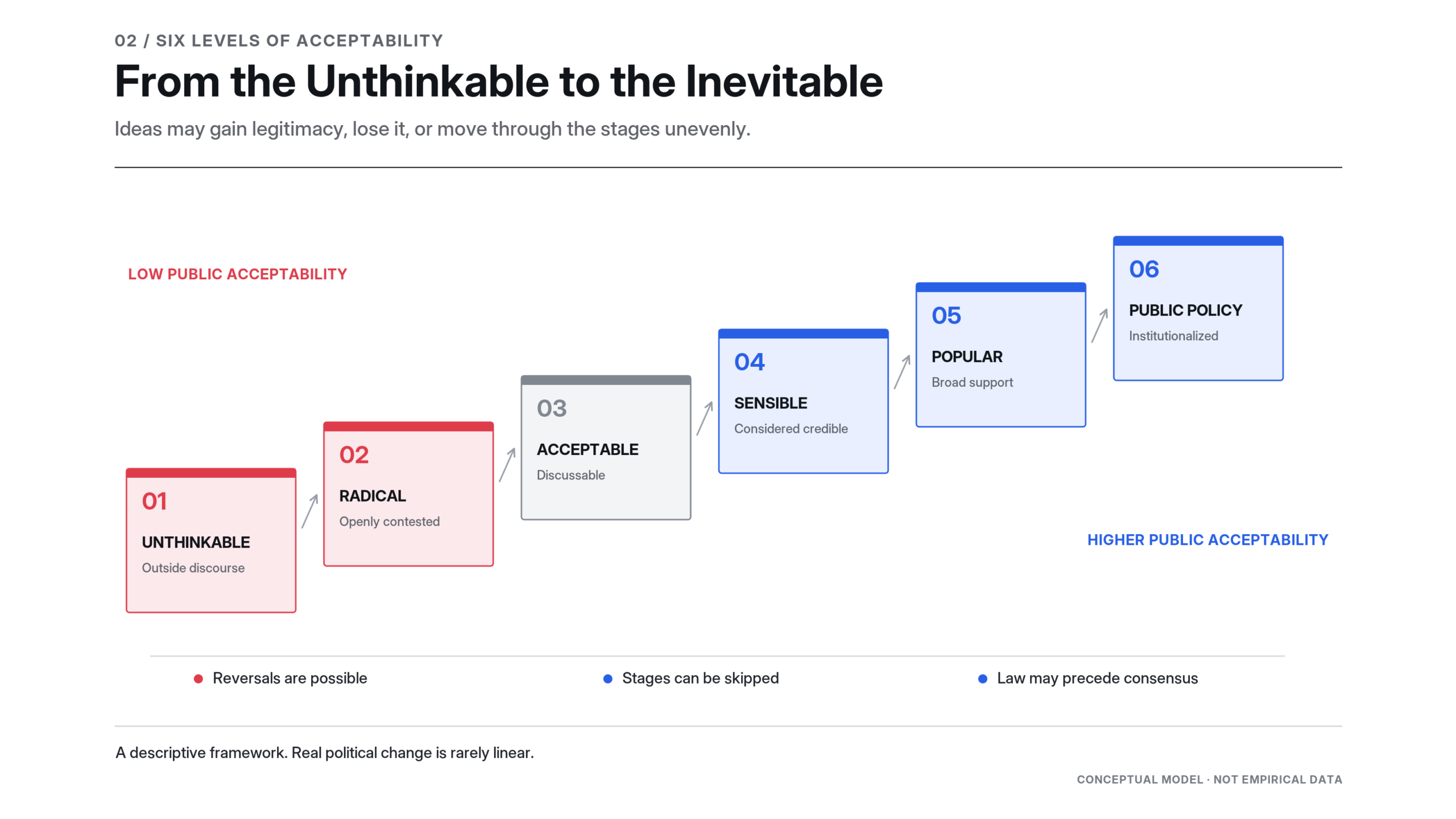
The episode shows how cultural change can reach the institutional level and, once translated into regulation, help consolidate the shift even further. To describe such processes, the political commentator Joshua Treviño proposed a six-stage interpretation of the Overton window in 2006: unthinkable, radical, acceptable, sensible, popular, and public policy. This classification expands on the original model and offers one way of reading the progressive legitimization of ideas. The six categories describe different conditions of public debate. They are not compulsory stages, nor a sequence that every proposal must follow. The first level, the unthinkable, concerns positions that face such strong rejection that even discussing them in public can be difficult. Merely articulating them may provoke scandal, disbelief, or contempt.
In some cases, these ideas are incompatible with deeply rooted values; in others, they are proposals for which a society does not yet possess the cultural tools needed to make sense of them. When a position begins to be discussed, it may enter the radical category. Its substance still encounters powerful resistance, but some people are willing to defend it openly. Identifiable advocates, arguments, publications, and organized groups begin to appear. The proposal gains a public presence. The next stage, acceptability, is particularly delicate. The idea begins to be considered one possible position within a controversy. Debates may be organized, studies commissioned, expert opinions requested. The very act of discussing the proposal helps establish it as a matter worthy of attention. At the sensible stage, a proposal acquires broader credibility. Its arguments are incorporated into developed programs, find support among organizations or respected figures, and begin to be assessed for their practical consequences. Public debate increasingly concentrates on the conditions required to put it into practice. The fifth stage is popularity. Support becomes sufficiently widespread to make the idea a potential political asset. Parties and elected representatives may adopt it in their platforms, while opposition to it can begin to carry an electoral cost. Finally, a proposal may become public policy, finding expression in a law, a regulation, or an institutional decision. The sequence is simple. Reality is far less orderly.
Change can take generations or occur rapidly in the aftermath of a crisis. A proposal can become law while public opinion remains divided. Other ideas enjoy majority support for years without being implemented, blocked by economic interests, institutional obstacles, or political conflict. Sometimes the movement goes in reverse, and beliefs that were once dominant progressively lose legitimacy. To understand how these shifts occur, we need to look at the way a problem is presented. In the case of smoking, for example, the accumulation of scientific evidence helped change the language of public debate. The concept of secondhand smoke made visible a consequence of individual behavior that affected other people. The same everyday activity was now being seen from a different angle, with new responsibilities and new groups of people to protect. Similar processes run through many political transformations. The words used to describe a phenomenon influence which aspects of it become most visible, which consequences are considered important, and which solutions seem reasonable. Framing something as a security problem, a public-health issue, a civil right, or an economic threat already helps determine the terrain on which the debate will unfold. The choice of language may emerge spontaneously, as the result of cultural evolution, or it may be deliberate. Political movements, associations, and interest groups devote resources to promoting particular interpretations of reality. They commission studies, produce campaigns, seek influential allies, and work to keep certain issues on the public agenda. The frequency with which a proposal is encountered can also influence how it is perceived. Cognitive psychology has documented how familiarity can, under certain conditions, lead to more positive judgments about repeatedly encountered stimuli.
This phenomenon, studied among others by psychologist Robert Zajonc, is known as the mere-exposure effect. Applying it directly to political opinions requires caution. Ideas provoke complex reactions, are bound up with personal identity, and can trigger resistance that actually intensifies with repeated exposure. Still, the principle reveals something important: familiarity can shape our evaluation of a message before we have consciously reflected on its content. A proposal encountered constantly tends to become recognizable. People learn to place it within a controversy, associate it with particular public figures, and anticipate its arguments. Its presence in public discourse becomes less surprising. Another variable then comes into play: the perception of how widely an idea is shared. People notice which issues receive attention, which positions are supported by influential figures, and which convictions appear to be gaining ground. These signals can alter expectations about what will be regarded as normal in the future. The feeling that change is already under way can affect people’s willingness to support it. Those who consider a transformation likely may begin adapting even before it happens. Institutions, in turn, observe the attitudes of the population and help reshape them through their own decisions. Italy’s smoking ban also shows this movement in the other direction. After the law took effect, surveys recorded widespread compliance and growing support for anti-smoking policies. The legislation had introduced a different everyday experience, allowing citizens to judge its effects directly. In this way, the law helped construct the very normality it sought to establish. One question remains open: how much of this process can be engineered deliberately? History shows that political and cultural organizations can influence public perceptions through sustained campaigns and communication strategies. It also shows how uncertain the outcome of those efforts remains. An overly aggressive proposal may provoke a backlash; a scandal can interrupt a process of legitimization; an unexpected event can radically change collective priorities. The transformation of ideas depends on a combination of historical conditions, interests, available evidence, social conflicts, and methods of communication.
No actor has complete control over all these factors. Yet one question runs through the entire process: what effect does the mere presence of an idea in public space produce, regardless of the support it manages to attract? A position can become known, discussed, challenged, and constantly displayed without ever winning majority support. It may still change the language of the debate, introduce new categories, and force other positions to redefine themselves in relation to its existence.
The ability to produce these effects gives communication a kind of power that precedes any political decision. And it was precisely this power that Jenny Holzer began investigating in late-1970s New York through a radical experiment in urban space: circulating aggressive, contradictory ideological statements with no identifiable author, then leaving passersby to contend with their apparent authority.
JENNY HOLZER: PROPAGANDA WITHOUT AN AUTHOR
In 1979, some rather unusual posters began appearing on walls across Manhattan. They were colored sheets printed in black type, carrying aggressive statements, calls to violence, reflections on power, and political proclamations. They looked like the work of militant organizations, radical groups, or individuals determined to spread their convictions. But there were no signatures, organizational symbols, or clues to their origin.
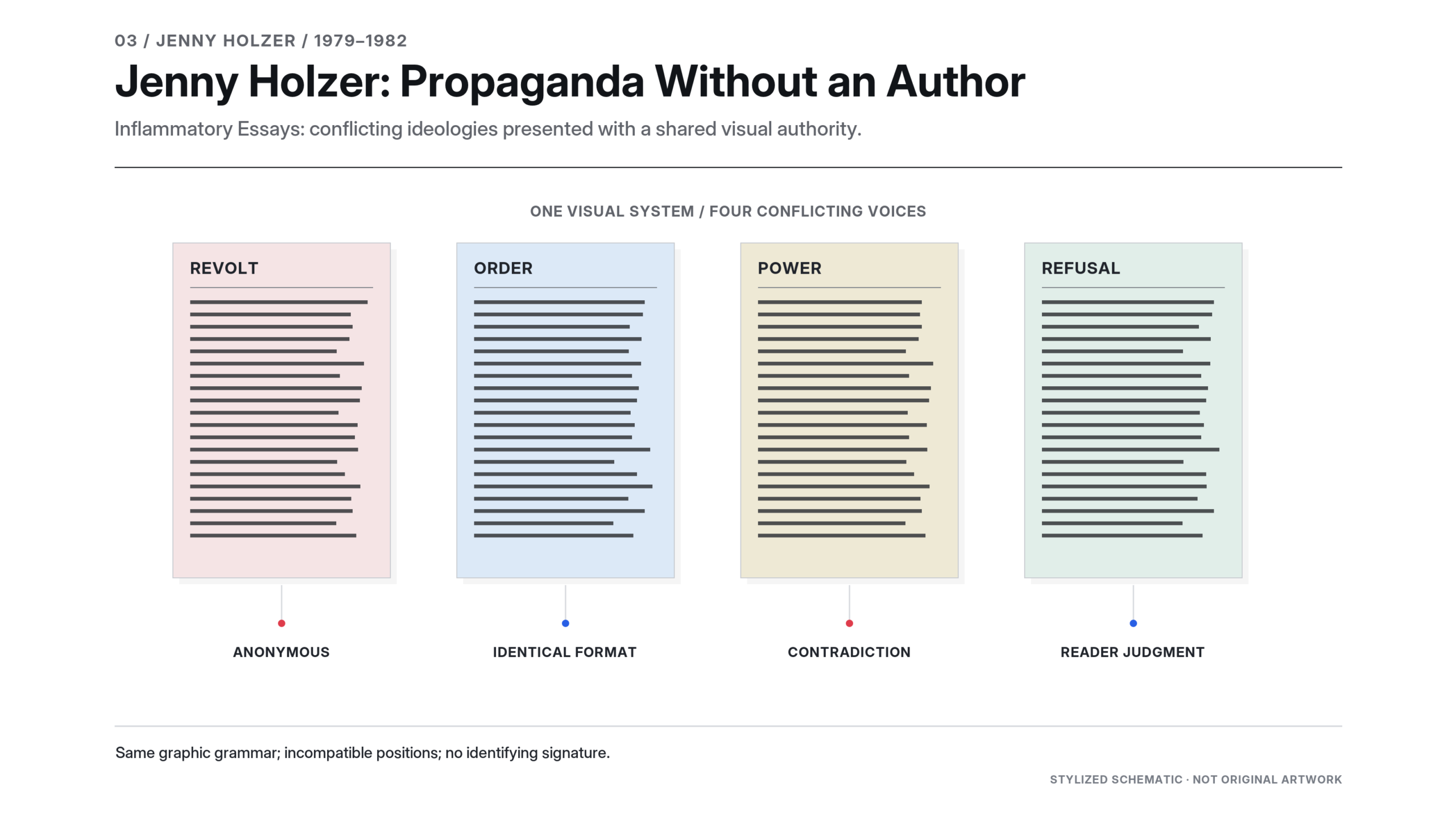
The texts kept changing. One poster might argue for the necessity of revolt, another express authoritarian views, and another celebrate discipline or revenge. The tone remained commanding, as though every statement contained an absolute truth. The author of those messages was Jenny Holzer, an American artist who was twenty-nine at the time and was developing a body of work exploring language as an instrument of social influence. The series, titled Inflammatory Essays, continued until 1982 and became one of the most significant works of her early career. Holzer had begun working with text a few years earlier, through her Truisms, short statements she started posting on walls in New York in 1977. They resembled proverbs, advice, or universal maxims, often expressed with almost irritating certainty. Some were easy to agree with; others were cynical, contradictory, or openly provocative. With Inflammatory Essays, the language grew more extreme. Each text followed a strict structure: one hundred words arranged across twenty lines, printed in a square block.
The posters shared the same typeface and graphic layout. What changed was the color of the paper, which might be red, green, yellow, pink, or blue. This uniformity was an essential part of the work. Holzer researched political and ideological writings drawn from radically different traditions. Her sources included Lenin, Mao Zedong, Rosa Luxemburg, Emma Goldman, and Adolf Hitler, alongside religious texts and materials from radical movements. From these readings, she extracted registers, arguments, and rhetorical forms, reworking them into self-contained monologues. Each time, the artist constructed a different voice, one capable of speaking with the absolute conviction of someone who believes they possess the definitive explanation of the world. One of the essays opens with the words “UPHEAVAL IS DESIRABLE.” Another advocates brutally suppressing rebels and leaving their bodies beside a road. Elsewhere, the posters contain declarations about the pleasure of domination, the necessity of sacrifice, and the use of fear as an instrument of control. Read individually, the posters would have been difficult to attribute to a single political position. Some seemed driven by revolutionary aspirations; others evoked repressive methods or fanatical convictions. Holzer deliberately stripped them of a recognizable ideological framework, allowing the language through which the ideas sought to impose themselves to come to the fore. The effect was unsettling for a very specific reason: mutually incompatible claims could be expressed with the same certainty, the same intensity, and the same claim to authority. The writing also had recurring features. Imperative sentences, categorical judgments, the identification of enemies, promises of radical transformation. Readers were frequently addressed directly, accused of complicity, or urged to take an immediate stand. Political propaganda has historically made extensive use of these devices. Authoritarian language tends to reduce ambiguity, draw sharp lines between allies and opponents, and present its conclusions as necessary.
Complexity is compressed into formulations that demand agreement, rejection, or action. Holzer isolated these mechanisms and made them visible. Each poster seemed to come from someone willing to defend a particular worldview to its ultimate conclusion. The next poster might reveal precisely the opposite position, expressed with exactly the same determination. The decision to use the street added a crucial dimension to the experiment. In the late 1970s, New York was going through economic hardship, urban transformation, and intense social conflict. Public space was filled with commercial messages, political posters, leaflets, graffiti, and advertisements of every kind. Against this visual landscape, Holzer’s sheets could blend into the materials routinely competing for the attention of passersby. The artist pasted them up illegally, often at night, sometimes choosing locations in relation to the messages themselves. The colors changed from week to week so that people might notice when new texts appeared. Their placement removed them from the usual conventions of experiencing art. Someone encountering a poster on the way to work did not necessarily have the information needed to recognize it as conceptual art. They might read it as an authentic political message, regard it as a provocation, or ignore it entirely. That ambiguity was part of the experience. Holzer has recounted how some people underlined phrases, added marks, or intervened directly on the posters. On other occasions, she returned to the places where she had put them up and listened to discussions among passersby. The sheets became surfaces of debate, open to reactions the artist could observe but not control. This is what distinguishes Inflammatory Essays from a straightforward exercise in provocative writing.
The intervention took place in a real environment, inhabited by people with different convictions, experiences, and sensibilities. Every text entered into contact with an unpredictable public. Anonymity also served a specific purpose. Holzer has explained that she wanted to prevent her messages from being immediately classified according to the identity of their author. In particular, she was aware of how the author’s gender could shape the reception of the work. A voice recognized as female risked being interpreted through stereotypes or expectations that would shift attention away from the content. The absence of a signature temporarily removed that possibility. Readers encountered a statement without being able to assign its author a biography, a reputation, or a social identity. At the same time, this decision raised an ethical problem. Some posters contained statements so violent that they could be understood as genuine incitements. Isolated from the rest of the series, they could take on a meaning very different from the one the artist intended. Holzer was aware of this. In a 1990 interview, she acknowledged that some texts, taken individually, could seem completely irresponsible. The gradual distribution of the posters was intended, at least in her view, to build a broader context through their succession. There was, nevertheless, no way to ensure that every passerby would encounter enough of them to recognize the contradictions. This is one of the work’s most interesting tensions. To investigate the persuasive power of extremist language, Holzer released it directly into public circulation, accepting the risk that it would be read without any critical distance. The artist had created a situation in which meaning also depended on the circumstances of the encounter.
The same poster, fixed to a wall along a street, could provoke anger or agreement; displayed years later on a museum wall, it would be seen through an awareness that it was a work of art. The text stayed the same. What changed was the information available to the reader, their expectations, and the degree of authority they attributed to the setting. Over the years, Inflammatory Essays entered museum collections and were exhibited as large arrangements of adjacent posters. In these installations, the variation in color creates an almost decorative effect, while the proximity of the texts makes the clash between ideological positions easier to see. The original experience was fragmented. A passerby might encounter a single statement without knowing about any of the others. In a museum, by contrast, the complete arrangement reveals the construction of the work and allows its many voices to be compared directly. They are two profoundly different conditions of reading. Looking at those posters today, what stands out most is the clarity with which Holzer identified a feature of political communication: the apparent force of a statement may depend on how it is presented, where it appears, and whether its source can be recognized. The presence of contradictory messages in a uniform format challenged our ability to distinguish genuine authority from its representation. Holzer deliberately left this ambiguity unresolved. The posters offered no instructions for separating sound ideas from delusional ones. Readers had to confront the content, consider its implications, and decide how much credibility to grant it.
The experiment exposed just how fragile judgment can become when language adopts an authoritative form and information about its origin disappears. More than forty years later, this insight would acquire a new dimension in digital communication systems, where billions of messages circulate through standardized visual structures and reach people who often know almost nothing about those who produced them.
WHEN THE MEDIUM LENDS LEGITIMACY TO THE MESSAGE
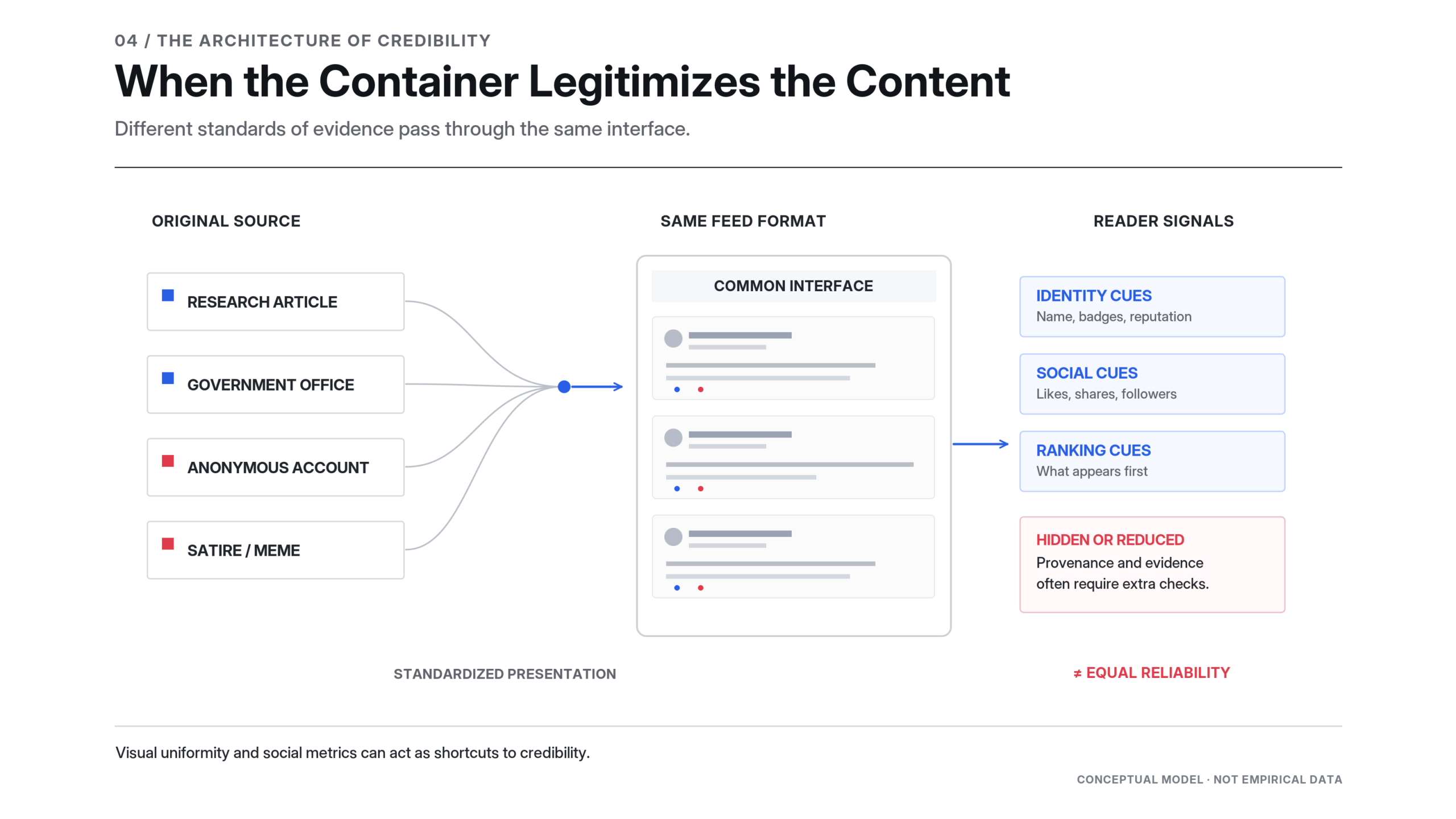
Open a social network, and within seconds you might encounter a statement by a head of state, a university researcher’s comment, an advertisement, a conspiracy theory, and a video posted by a teenager from their bedroom. All of these are distributed through a limited set of formats designed to make browsing fast, intuitive, and continuous.
The profile picture, account name, text, images, and engagement indicators occupy predetermined positions. Differences between sources still exist, but they have to be reconstructed from the limited information the interface chooses to display. This arrangement has brought about a profound transformation in how we encounter information. For much of the twentieth century, a message’s origin was closely associated with the medium through which it was distributed. A newspaper article belonged to an identifiable publication, a government announcement used institutional channels, and a political leaflet had visual and material characteristics different from those of a scientific paper. Of course, these systems could also carry false information, construct propagandistic narratives, or lend credibility to people who did not deserve it. Still, there were visible distinctions between many of the environments in which ideas circulated. Digital platforms have gradually concentrated these forms of communication within a single architecture. A scientific paper, for instance, can be shared in exactly the same format used to publish a personal opinion. It may appear as an image, a sentence extracted from the original text, or a link accompanied by a short comment. The research process, editorial checks, bibliographic references, and conditions under which a conclusion was reached often remain outside the immediately visible area. Readers encounter an extremely compressed representation of the information. That compression is a technical necessity: billions of pieces of content have to be organized, displayed, and browsed on relatively small devices. Yet the cultural consequences of this design choice deserve closer attention. When information produced through radically different procedures is presented in the same visual grammar, some of the differences that determine its reliability become less apparent.
The problem becomes particularly clear when assessing the credibility of a source requires prior knowledge. A user may immediately recognize the name of a major newspaper, yet be far less equipped to assess the authority of every research institute, political organization, or specialist website they encounter while browsing. Without that information, people often rely on indirect signals: a professional-looking presentation, a familiar name, a verification symbol, a follower count, or the number of interactions.
These indicators are easy to observe. Their relationship to the quality of the information is far more complicated. In 2016, researchers at the Stanford Graduate School of Education published an investigation into American students’ ability to assess the reliability of online information. Based on thousands of responses collected across twelve states, the research revealed widespread difficulties identifying advertising content, recognizing sources, and evaluating evidence presented through social networks. Three years later, a further study involving 3,446 American high-school students confirmed the problem. In one exercise, more than 96 percent of participants failed to consider a website’s ties to the fossil-fuel industry when evaluating its content on climate change. The finding matters because those ties were essential information for assessing the possibility of economic interests shaping scientific communication. The researchers also observed that many students tended to concentrate on the contents of a page while neglecting to investigate the organization responsible for publishing it. Even people who use digital tools every day, then, can have considerable difficulty interpreting the information they receive. Familiarity with a technological environment does not guarantee an equally deep understanding of its information systems. A second issue concerns the symbols platforms use to communicate an account’s reliability. Verification checks, professional badges, and other graphic indicators condense complex information into visual elements that can be recognized immediately. Users may assign them a broader meaning than the platform itself intends. In 2024, a study published in PLOS ONE, titled Virtual Lab Coats, examined the effect of verification information on the perceived credibility of social-media messages. Across two experiments, researchers observed how certain badges could increase trust in authors and, in some conditions, in their messages. In one experiment, medical credentials increased perceived credibility even when those credentials had nothing to do with the subject being discussed.
The effects varied with the context and with how the information was presented, but the identified phenomenon remains especially interesting: a professional qualification could exert influence beyond its actual area of expertise. Someone with recognized authority in medicine, for example, may appear more credible even when offering views on economic or political matters for which they have no specialist preparation. The small symbol next to a name thus acts as a cognitive shortcut. The judgment of a claim may be influenced by the reputation attributed to the person making it. Alongside these signals of authority is another, even more pervasive category of information: public metrics. Views, followers, shares, and reactions are a permanent feature of the social-media experience. These numbers describe the activity generated around a piece of content, but users frequently rely on them to help form their own judgments. A statement shared by hundreds of thousands of people may seem important before anyone has even read it. Its popularity suggests that others have found something significant in it. That impression can arise without any knowledge of why those interactions occurred. In 2024, research published in Applied Cognitive Psychology found that a relatively high level of social approval, expressed through indicators such as likes, could increase the perceived credibility of false information. The phenomenon did not occur identically under every experimental condition, but it confirmed the ability of social signals to influence judgment. This creates a peculiar dynamic: users’ reactions become part of the information later users receive. A message is interpreted alongside data documenting how it has circulated. Its public history, summarized in a few numbers, participates in the construction of its credibility.
There is also the problem of losing the original context. Platforms allow content to move rapidly from one environment to another. A statement can be extracted from an interview, turned into an image, inserted into a video, and then republished by dozens of accounts. Along the way, much information can disappear: the date, the original source, the questions preceding an answer, any qualifications, or the circumstances in which the words were spoken. The content progressively acquires an existence independent of the conditions in which it was produced. A particularly common example is an image containing a quotation attributed to a famous person. A recognizable face and a professionally designed caption may make the message immediately persuasive. But anyone who encounters it must carry out a separate search to establish whether the person actually said those words. The format makes immediate understanding easy, while verification demands an additional effort. As early as 2011, researchers Alice Marwick and danah boyd analyzed a related phenomenon known as context collapse, observing how social networks brought different audiences together within the same communicative environment. A sentence intended for a small group may reach people who do not share the same cultural references, knowledge, or original relationship with its author. The distance between the context in which a message is created and the context in which it is received can profoundly alter its interpretation. When fragments are extracted and republished, reconstructing their meaning becomes more difficult still. There is one final, less visible component of the interface: the system that decides which content to display and in what order. Social networks organize a substantial share of information through recommendation systems. These tools use numerous signals, including users’ previous interactions, relationships between accounts, and characteristics of the content, to construct a personalized sequence of posts.
The order in which something is displayed directly affects its chances of being seen. Two messages published at the same moment can receive completely different levels of exposure. A study published in Proceedings of the National Academy of Sciences in 2022 examined the distribution of political content on Twitter by comparing a chronologically ordered feed with one personalized by algorithms. Drawing on a large-scale experiment, the research found differences in the amplification of certain categories of political content. The study showed that the architecture of distribution could alter the mix of information users actually encountered. This matters especially in light of the platforms’ economic model. To varying degrees, their business depends on attracting users, holding their attention, and creating opportunities for interaction. Recommendation systems are developed partly to pursue these objectives, alongside other criteria relating to user experience and safety. The epistemic quality of information, meaning its relationship to verifiable evidence and reliable methods, is a separate question from its ability to attract attention. That distinction helps explain several characteristics of the digital environment. The interface visually organizes messages, social signals help shape how they are perceived, and distribution systems determine a significant share of their visibility. Users receive the result of these operations through a stream that appears simple and spontaneous. Behind every screen are technical, economic, and design decisions that shape the conditions under which information becomes accessible. The uniform structure of digital platforms is, at the same time, a major achievement. People and organizations that once had limited access to public communication can now reach an international audience directly. Independent researchers, journalists, cultural minorities, and civic movements have found opportunities in these tools that cannot reasonably be reduced to a purely negative assessment. The question concerns the conditions under which this openness operates. Access to the same communicative space does not automatically create the conditions needed to properly evaluate everything published within it. Platforms allow very different sources to occupy the same visual surface, while their trustworthiness continues to depend on factors that often require us to leave the interface: expertise, verification procedures, editorial accountability, documentation, and the possibility of tracing a claim back to its original source. A gap therefore opens between how easily a message can be encountered and how much work is needed to understand its value. That gap becomes especially important when content is designed to provoke immediate reactions. In an environment where visibility is distributed partly through signals of engagement, emotional responses can take on a function beyond the relationship between a person and the message they receive. A criticism, an outraged share, or a hostile comment creates activity that the platform can observe.
The system can register that activity without always being able to distinguish the meaning the user intended to give it. This is where the relationship between communication and the acceptability of ideas encounters its most contemporary paradox: a message may keep gaining public exposure precisely through the reactions of those who would prefer it to disappear.
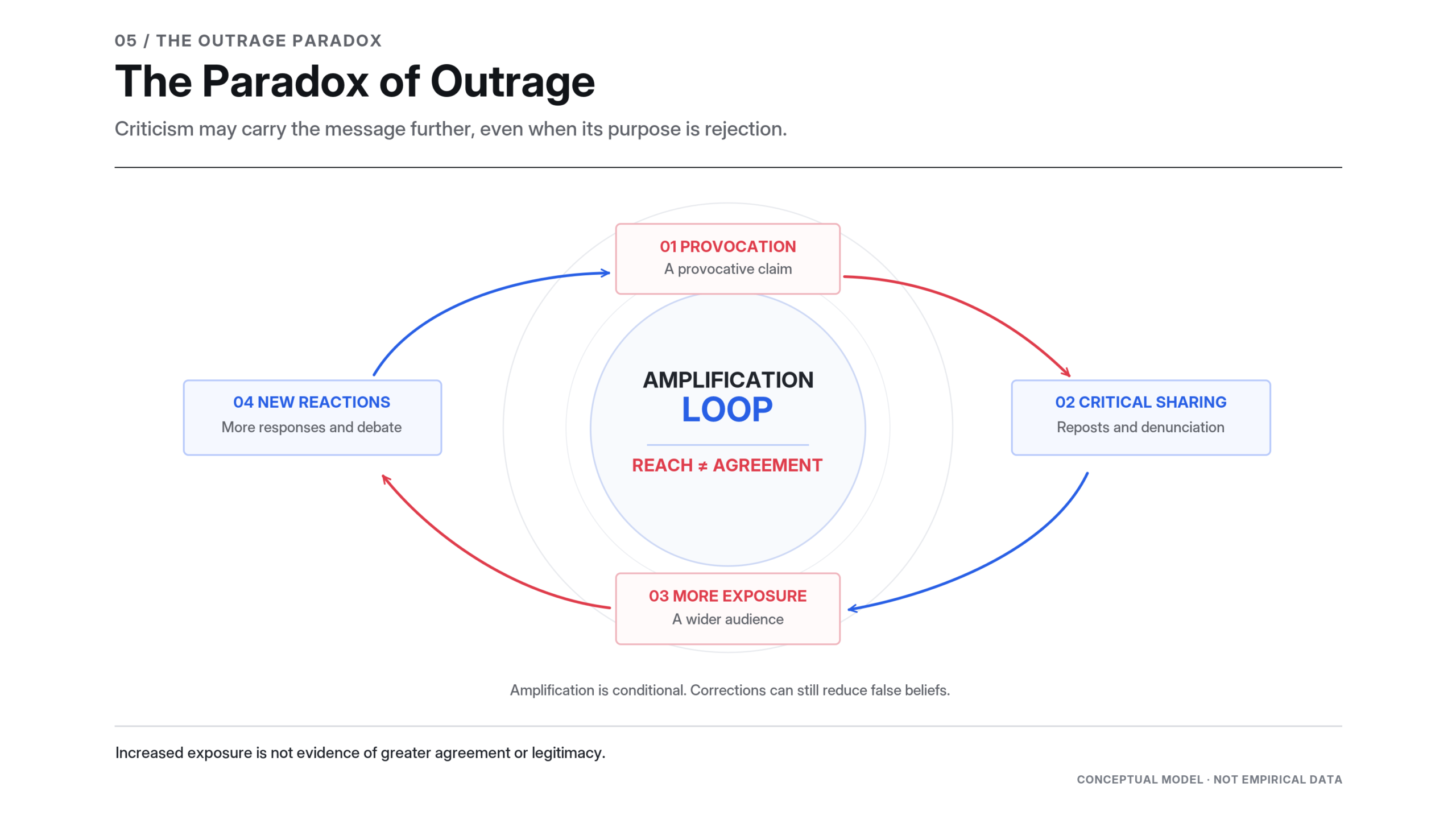
THE PARADOX OF OUTRAGE
In 2003, Barbra Streisand filed a lawsuit against photographer Kenneth Adelman, who was working on a project documenting the California coastline. Among more than twelve thousand images published online was an aerial photograph of her property in Malibu. The singer believed that publishing the image could compromise her security and demanded its removal.
The dispute produced an unexpected result. News of the lawsuit attracted the attention of newspapers and thousands of internet users, turning a relatively obscure photograph into a widely searched and shared image. The attempt to restrict its circulation helped dramatically increase its visibility. The episode became so emblematic that it gave rise to a term of its own: the Streisand effect, used to describe situations in which an attempt to censor or conceal information ends up drawing even more attention to it. Twenty-three years later, this paradox seems built into everyday digital communication. Online controversies can unfold through a process in which public condemnation, the reproduction of disputed content, and the participation of new voices all contribute to spreading the original message. A provocative statement published by a little-known account might be noticed by a user with a large following, reproduced in a screenshot, and accompanied by an outraged critique. Other accounts intervene to challenge it, the press may pick it up, and thousands of people end up discussing a claim that, without that sequence of reactions, might have reached only a tiny audience. Each intervention has an understandable motivation. People who share content in order to condemn it may want to denounce its seriousness, draw attention to a problem, or publicly distance themselves from a position they find unacceptable. The combined effect of these individual decisions, however, can differ from what the participants intended. In 2017, a team of researchers led by psychologist William J. Brady published a study in Proceedings of the National Academy of Sciences on the spread of moral and emotional language across social networks. The researchers analyzed 563,312 tweets relating to three highly divisive issues in American politics: gun control, same-sex marriage, and climate change. The findings showed a significant relationship between the use of words combining moral and emotional content and the likelihood that a message would be shared.
On average, each additional word in this category was associated with a 20 percent increase in the retweet rate predicted by the statistical model. The effect was particularly apparent within politically homogeneous networks. Emotionally intense messages tended to circulate most strongly among people who already shared similar ideological positions. The study thus described a mechanism of selective diffusion. Moral emotions contributed to the circulation of messages, and their effect depended on the social and political relationships among users. This observation matters because outrage serves a specific social function. Publicly expressing anger about behavior regarded as unjust can signal the existence of a shared norm, draw attention to a violation, and call for a collective response. Outrage has been a vital part of many civil mobilizations. Exposing abuse, discrimination, and institutional wrongdoing can depend on people’s willingness to express dissent openly. Social networks have enormously expanded the opportunities to do so. They have also turned the public expression of these feelings into measurable behavior, accompanied by indicators of approval, sharing, and participation. In 2021, Brady and other researchers, including psychologist Molly Crockett, examined the relationship between outrage and social learning in greater depth. The study, published in Science Advances, analyzed the history of 12.7 million tweets posted by 7,331 users and paired the observational analysis with two behavioral experiments. The findings suggested that positive feedback received after expressing outrage increased the likelihood of expressing that same emotion again in subsequent posts. The audience’s response could therefore help change the author’s future behavior. The study also identified a second mechanism. Users tended to adapt their expressions of outrage to the perceived norms of their social network. In more ideologically extreme environments, where such expressions were already common, individual behavior was less dependent on any single instance of feedback. Outrage became part of the group’s communicative expectations. The consequences of this process can be recognized in recurring patterns of online debate. A moderately worded judgment can seem inadequate when the surrounding environment demands explicit condemnation. Someone taking part in a controversy may feel compelled to make their position increasingly unmistakable, including through particularly severe language. The intensity of expression becomes a signal of belonging. In these settings, dissent against a behavior or an idea can turn into a public performance of one’s moral identity. The position taken is observed and assessed by other members of the community, helping define who belongs to the group and which beliefs mark its boundaries. In 2021, another study published in PNAS, conducted by Steve Rathje, Jay Van Bavel, and Sander van der Linden, examined the relationship between political hostility and engagement on social networks.
The research found that messages referring to the opposing political group spread significantly more widely. In the data examined, every term referring to the political out-group was associated with a 67 percent increase in the odds that a piece of content would be shared. Hostile language directed at political opponents was an especially strong indicator of diffusion, stronger than other emotional signals considered by the researchers. The findings help explain why content built around conflict can acquire a disproportionate presence in public debate. Attacking an opponent mobilizes one’s own group, provokes a response from the other side, and creates the conditions for further interventions. The controversy can continue even when none of the participants changes their mind. What may benefit from this dynamic is the visibility of the issue itself, or of the people involved. It is important, however, to distinguish among the kinds of attention a controversy generates. A share accompanied by a forceful critique can help inform the public accurately. A well-documented rebuttal can prevent a false claim from being accepted without challenge. In other circumstances, the constant reproduction of a message can reach people who would never otherwise have encountered the original content. The relationship between criticism and diffusion depends on the characteristics of the message, the audience reached, the form of sharing, and the way the platform operates. An increase in visibility alone cannot tell us whether an idea is gaining support. This distinction is fundamental to understanding the relationship between outrage and cultural change. A position can become extremely well known while continuing to be rejected by most people. It can become a permanent feature of public debate without acquiring credibility. It may even gain exposure precisely because it is considered offensive or dangerous.
Familiarity with a message can nevertheless change how we perceive its social presence. If a particular belief appears daily across the media, people may begin to feel that it occupies a more important place in society than it actually does. This phenomenon was examined in a study published in Nature Human Behaviour in 2023, again involving Brady and Crockett. The researchers compared the emotions reported by authors of certain tweets with those attributed to them by outside observers. The findings showed that readers systematically overestimated how much outrage the authors actually felt. The effect was more pronounced among people who relied more heavily on social media for political news. Further experiments suggested that this overestimation could spread from perceptions of an individual message to perceptions of an entire social group, intensifying impressions of hostility, polarization, and ideological radicalism. The result was a distorted representation of collective reality. Someone who constantly observes aggressive arguments may come to regard that level of conflict as a general feature of society. The loudest positions acquire a presence greater than their actual prevalence, and people’s behavior is interpreted through increasingly negative expectations. This affects our ability to assess the real direction of public opinion. It also allows us to return to the question of which ideas are considered acceptable from a different perspective. If our perception of what society regards as normal depends partly on the opinions we encounter most frequently, then a communicative environment dominated by conflict and extreme declarations can distort our sense of the boundaries of debate. The apparent centrality of a position may be a product of the amount of controversy it generates. It is easy to imagine how this feature might be exploited deliberately. Someone seeking attention can make provocative statements in the knowledge that their opponents may help spread them. Anticipating a hostile response becomes part of the communication strategy. The effectiveness of such operations varies and is difficult to predict. But the underlying assumption is clear: in a system where public participation helps determine how information is distributed, even an adversary can become an unwitting channel of diffusion. This raises a particularly delicate question for anyone concerned with journalism, political communication, and public responsibility. When a false, discriminatory, or extremist statement enters public debate, ignoring it can leave it circulating without challenge. Reproducing it constantly in order to denounce it may instead help expand its reach.
Each option carries different risks and requires judgment based on the circumstances. Scientific research offers some useful guidance. A review published in Current Opinion in Psychology in 2024, by Ethan Porter and Thomas Wood, examined the available evidence on the effectiveness of factual corrections. The authors found that corrections generally improve the accuracy of people’s beliefs, and that cases in which a correction increases belief in the false information, the so-called backfire effect, are extremely rare. Another review, by Toby Prike and Ullrich Ecker, emphasized the value of detailed corrections accompanied by alternative explanations and verifiable information. These findings run counter to the assumption that every attempt to debunk a falsehood inevitably makes it stronger. The problem of distribution, however, remains. An accurate correction may reach a different audience from the one originally exposed to the false claim. It may be read too late, receive less attention, or remain confined to people who already agree with the author’s conclusions. The quality of a response and its capacity to circulate are separate variables that need to be considered independently. In 2021, a study published in Nature by Gordon Pennycook and colleagues had already identified an interesting factor. Through experiments that also took place on Twitter, the researchers showed that briefly directing users’ attention to the accuracy of information could improve the quality of the content they subsequently shared. Participants often demonstrated an ability to distinguish true news from false news when explicitly asked to assess its reliability. But at the moment of sharing, other motivations could take precedence. A simple prompt to consider whether information was accurate was enough, under some experimental conditions, to change behavior. The finding suggests how powerfully the characteristics of a communicative environment can direct people’s attention. The same individual may make different judgments depending on whether they are invited to verify a statement, react emotionally, or take a position before their social group. Taken together, these dynamics have broader implications. Digital communication has multiplied opportunities for public participation, making tools of distribution available to people who once had little access to them. At the same time, it has created environments in which emotional expression, signals of group identity, and conflict can exert considerable influence over how messages circulate. The result is a public sphere in which a position’s notoriety can grow independently of its factual foundation and, in some cases, even independently of the number of people who support it. This makes it harder to distinguish a real change in public opinion from an intensification of its media representation. A society can debate an issue incessantly without moving any closer to a shared position. It can grant enormous attention to convictions held by especially active minority groups. It can develop an exaggerated perception of the conflicts running through it, responding to a social reality partly constructed by the dynamics of communication itself. The danger lies in confusing how frequently we encounter an idea with how much weight it actually carries in society. Seen through these phenomena, the Overton window reveals a problem that reaches beyond the traditional relationship between public opinion and political decision-making. Our perception of what is acceptable also takes shape through the daily experience of communication, the selection of information, and the way we interpret other people’s behavior. Collective beliefs continue, of course, to depend on material conditions, personal experience, institutions, and social relationships. But the public representation of those beliefs can influence expectations about their future. Every day, we receive implicit signals about which ideas matter, which positions are gaining ground, and which conflicts define our time. Some of these signals come from tools designed to organize and distribute enormous quantities of content according to criteria that do not necessarily correspond to its cultural or political significance. Here we arrive at the question running through this entire investigation: normality is also a perceptual construction, sustained by what a society continuously makes visible to itself. A statement repeated millions of times can remain false. An idea rejected by a majority can continue to dominate attention. A marginal position can appear dominant, while a widely shared consensus can remain almost invisible.
These gaps make it essential to question the conditions under which we form our impressions of the world. Almost half a century ago, Jenny Holzer posed a question about the credibility of public language through anonymous, contradictory posters. Their presence in the streets forced passersby to confront apparently authoritative statements whose origins could not be identified. Today, the same question emerges in a vastly larger environment, shaped by automated distribution systems and continuous participation. How much of what we believe comes from assessing the information available to us? How much depends on how often we encounter it, the apparent reputation of its sources, and the reactions we observe around us? Understanding these mechanisms also means considering our own participation in reproducing them.
The information we choose to share, the controversies to which we give our attention, and the ways we express dissent all contribute, to different degrees, to the construction of public space. Perhaps the most important question to ask when confronted with an idea we find intolerable is precisely about its presence. How many of the things we now perceive as central, inevitable, or even normal have reached that position because we have kept fighting them, debating them, and bringing them back to the center of our attention?