

You have cried for someone who never existed, and the strange part is not that it happened. It is that, while it was happening, it did not feel absurd at all. You close a novel devastated by the fate of a person made entirely of words. You watch a film and feel your throat tighten for someone with no body, no real past, no name beyond the story. You know perfectly well that it is fiction. You have not forgotten where you are, and for no moment have you mistaken what you are watching for reality. Yet the emotion still arrives—full, physical, sometimes even more intense than what many of the real people around you manage to provoke.
That is where things become interesting: knowing that something is not real does not stop us from feeling as though it matters. In 1975, philosopher Colin Radford framed the problem through a question that became central to the philosophy of art: how can we be moved by the fate of Anna Karenina when we know perfectly well that Anna Karenina never existed? This is what came to be known as the paradox of fiction. Ordinarily, we assume that fear, grief, compassion, or concern require at least some belief that their object is real. We do not run from a rubber snake once we know it is a toy, and we do not fear a fire painted on a canvas. Fiction behaves differently. We know it is invented, and still we feel.
Perhaps, then, the point is not that stories deceive us. Perhaps the opposite is true. Fiction works precisely because we know it is not real. It creates enough distance for us to approach emotions that, in ordinary life, may be too close, too painful, or too difficult to face directly. A character can become an intermediary: a safe address for something that actually belongs to us.
When you cry for Anna Karenina, for a character who dies, or for the dog in a film, perhaps you are not really crying only for them. You are crying through them. The story may not have created the pain at all. It may simply have given it a shape, a face, and a distance you could bear. The character becomes the fictional address to which you can finally send something real.
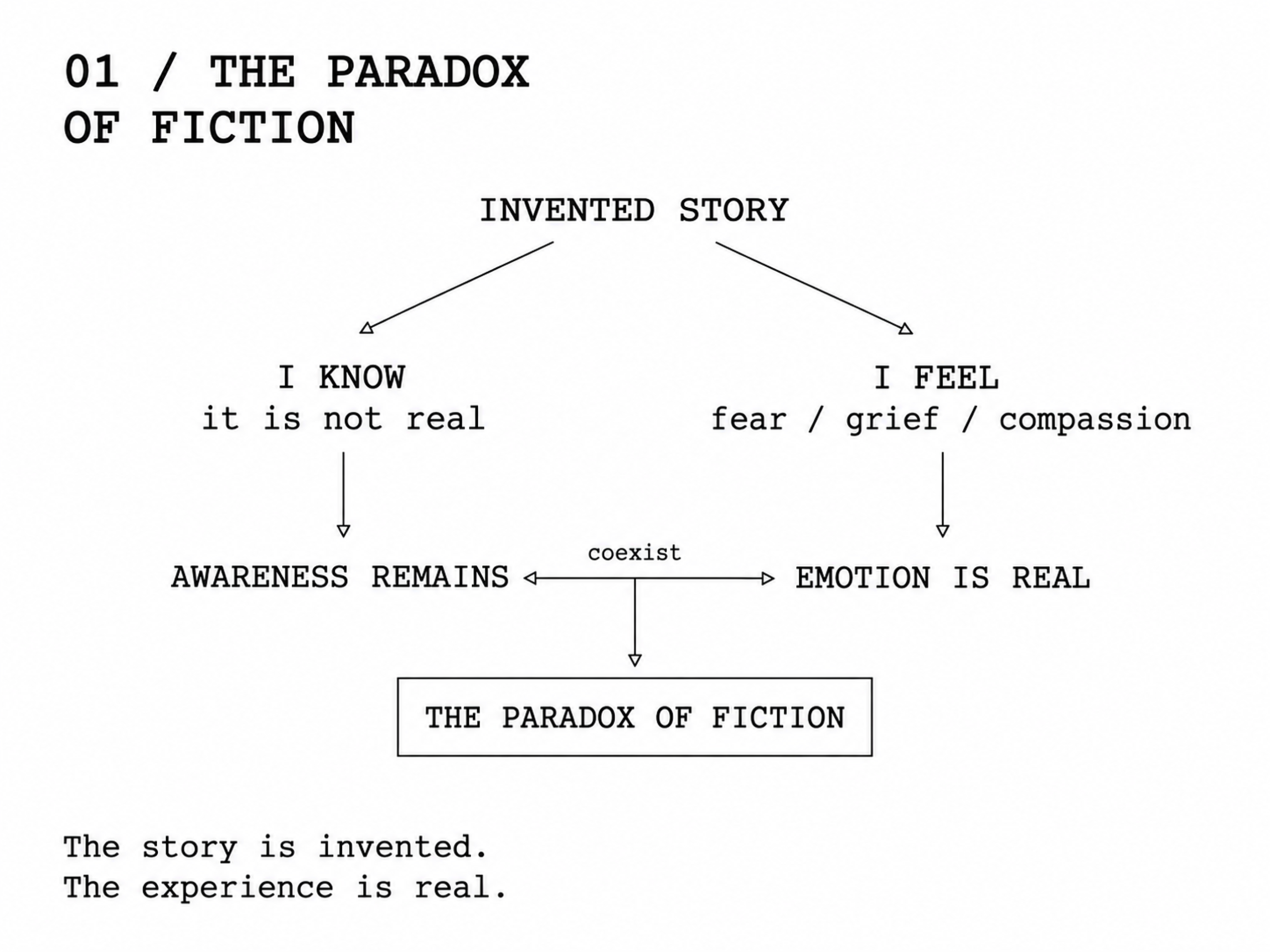
THE PARADOX OF FICTION
There is something logically strange about the way we respond to stories. We can know with absolute certainty that a person does not exist and, at the same time, care deeply about what happens to them. We can hope they survive, suffer when they are abandoned, feel anger at an injustice that never occurred. We do not need to believe that what we are watching is real. In fact, we often enter a story fully aware of its artificial construction: we know there is a script, we know someone decided how it will end, and we may even know that behind the character is an actor who will go home when the scene is over. None of that seems capable of cancelling what we feel.
This contradiction sits at the heart of the paradox of fiction. Radford’s question about Anna Karenina is unsettling because it challenges an intuitive model of emotion: the idea that, in order to feel something, we must in some sense believe that the object of that feeling exists.
In everyday life, belief matters. If someone tells us there is an armed man behind a door, we may become afraid. If we immediately learn it was a joke and there is nobody there, the fear changes or disappears. If we see an injured animal by the side of the road, we may be horrified; if we discover we are watching a staged scene, our reaction shifts. What we believe to be true appears to shape what we feel.
With stories, that rule becomes unstable.
When we read that a character is about to die, we do not actually believe that somewhere in the world a real person is in danger. When a relationship collapses on screen, we do not think two actual lives have just been destroyed. Yet we hope, fear, grieve, and sometimes physically react. Our body responds to something our mind identifies as invented. Tears can arrive while another part of us remains perfectly lucid, aware that someone wrote the scene months or years before.
The story does not even need to be realistic. We can be moved by impossible creatures, invented worlds, ghosts, artificial intelligences, talking animals, or beings that could never exist under any known law of nature. Our emotional response does not seem to ask fiction for proof of existence before it begins.
This is why the easy explanation—that we simply “forget” it is fictional—is not convincing. We do not forget. In a cinema, we still see the screen in front of us. While reading, we still feel the weight of the book in our hands. We can pause a scene, walk into another room, answer a message, and return to the exact moment where we left the character in danger. Our awareness of the fiction remains intact. Two ideas coexist without cancelling each other: this is not happening, and I care about what is happening.
The real mystery, then, is not why we confuse fiction with reality. Most of the time, we do not. The mystery is how we keep the two separate and still allow one to affect the other so deeply.
A story can be false without our experience of it being false.
The character is not actually suffering. We may suffer while watching.
The loss did not occur. The tightness in our chest did.
And it is in that gap between what we know and what we feel that fiction becomes much more interesting than a simple illusion.
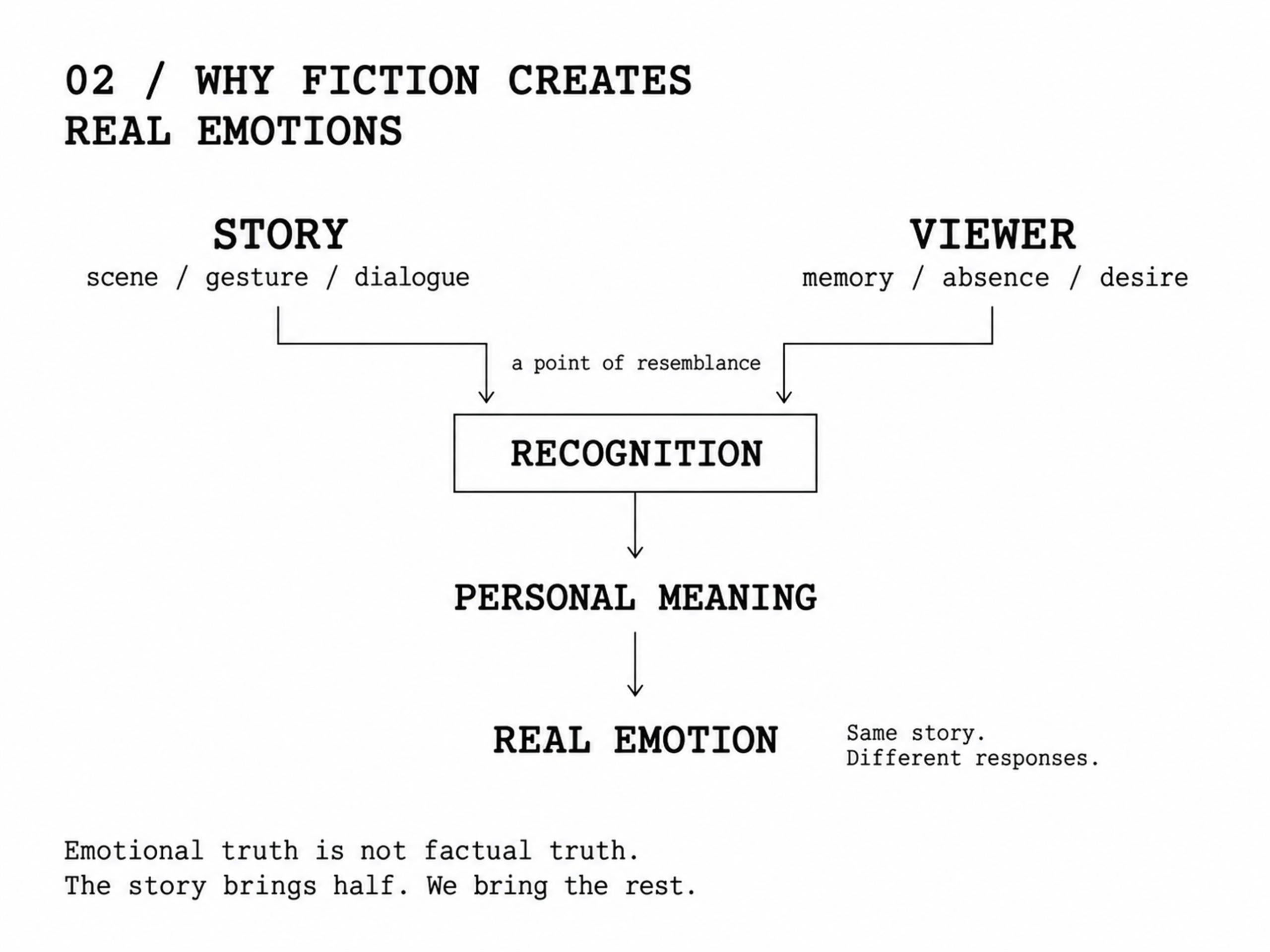
WHY FICTIONAL STORIES CREATE REAL EMOTIONS
Perhaps we keep asking the question in the wrong way. We ask how an invented story can create a real emotion, as though the emotion must somehow inherit the ontological status of whatever caused it. But emotions do not work like that. They are not faithful copies of the things in front of us. They are responses, interpretations, associations. A story may be invented. What we recognize inside it is not.
We do not need to have lived through exactly what a character is living through to understand loss. We do not need to have been abandoned in precisely the same way to recognize abandonment, or to have spoken the same words to know the weight of something said too late. Sometimes resemblance is enough, and the resemblance can be tiny: a gesture, an empty room, someone waiting for a call that will never come, two people sitting at the same table who have already stopped truly speaking to each other. It is remarkable how little a story needs. It does not have to reproduce our life. It only has to touch one point of it.
That may be why two people can watch the same film and leave with completely different experiences. A scene that barely registers for one person can become unforgettable for another. Why that scene? Why that moment? It is often impossible to say. This is what makes our relationship with fiction so personal: we do not respond only to what the story contains. We respond to what we bring with us when we enter it. We enter a film with a biography, a novel with absences, a song or an image with things we understand and others we have never managed to name.
The story meets all of that. Sometimes nothing happens. Sometimes it finds exactly the right place. Then something gives way—not because the story has persuaded us to believe a lie, but because it has constructed a situation in which we recognize an emotion before we are able to explain it. Perhaps this is what we really mean when we say that a work of art “understood” us. Of course a book cannot know us. Yet a sentence written decades before we were born can sometimes seem to know something about us that we have never told anyone. How?
Stories do not need the details of our lives. They work with more basic structures: desire, fear, shame, loss, jealousy, hope, loneliness. These experiences change from person to person, but their underlying shapes remain recognizable. Fiction becomes powerful not when it reproduces the world perfectly, but when it compresses an experience until we can finally see it.
An entire relationship can be condensed into a three-second look. A fear that took years to understand can appear in a single sentence. A vague feeling can suddenly acquire a precise shape because someone, by inventing a story, has managed to place it outside us. And we think: that was it. That is what I meant. I just did not know how to say it.
This is one of art’s strangest capacities: something that never happened can explain something that did. The distinction between “true” and “false” becomes less useful here. A scene can be factually false and emotionally exact. A character who was never born can reveal something true about the fear of being left. An imaginary city can resemble perfectly the place we have always wanted to escape. A scripted conversation can contain the sentence we needed to hear years ago.
None of this makes the story real. It reveals something else: emotional truth is not the same thing as factual truth. We already accept this distinction elsewhere. We say a dream felt true even though it never happened. We say a photograph tells the truth even though it captures only a fraction of a second. We say a song is “about us” even though the person who wrote it has no idea we exist.
We are not making a logical mistake. We are using another definition of truth: not what happened, but what something allows us to recognize.
So when a story devastates us, are we certain that the story itself did all the work? Or did it simply find something that was already prepared to respond? Why does one scene pass through us without leaving a trace while another remains for years? Why do certain characters stay with us long after we have forgotten the plot?
There is no universal answer, and that may be the point. Emotion does not exist only inside the work. It emerges in the space between the work and the person experiencing it.
The story brings half the material.
We bring the rest.
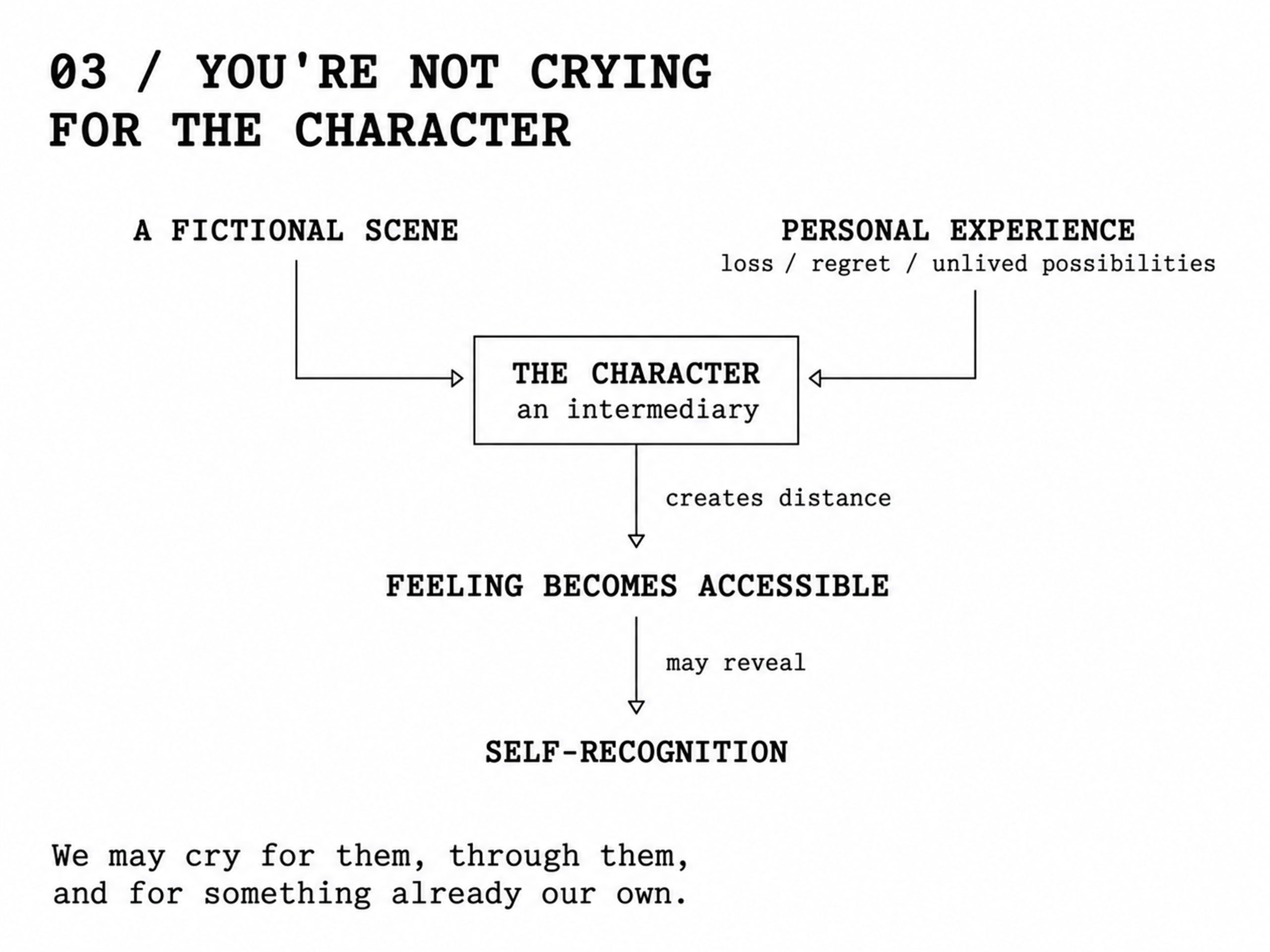
YOU’RE NOT CRYING FOR THE CHARACTER
There is a moment after certain scenes when we realize our reaction feels disproportionate. The character has lost someone, said goodbye, failed, or been left alone, and we are still sitting there more shaken than the scene itself seems to justify. That is when the question changes: are we really crying for them?
Perhaps not. Or not only for them.
Sometimes a character becomes a container. They allow us to feel something without having to call it by our own name. The pain appears to belong to the story, but while moving through it, it finds a route toward something more personal: a loss we minimized, a goodbye we never fully processed, a version of ourselves that no longer exists, a possibility we abandoned while pretending it did not matter very much.
It can be easier to cry when the pain has someone else’s face.
That may sound cynical, but it describes something deeply human. We are not always able to approach what has hurt us directly. Some experiences become too familiar; others remain too confused. We may have repeated a story to ourselves so many times that we can no longer feel it, or we may never have managed to tell it at all. We continue living, and continuing often means creating some distance from what we cannot resolve.
Then a scene arrives knowing nothing about us and touches exactly that place.
Why that scene? Why now?
We often cannot answer while it is happening. The most revealing reactions do not necessarily arrive in a rational order. You can speak calmly about something that happened years ago and feel almost nothing, then lose control over a scene in which two fictional people say goodbye at a railway station. You can remain composed at a funeral and cry months later while watching someone prepare two cups of coffee instead of one.
That does not mean the second event mattered more than the first. It may mean the feeling needed another form before it could finally move.
Emotions do not necessarily disappear when we stop consciously experiencing them. They can remain suspended, change language, attach themselves to different images. We do not always know where sadness comes from. Not every reaction has a neat, single cause. Perhaps we are too quick to demand explanations from every feeling.
Why am I crying?
As though there must be one answer.
Maybe you are crying for the character. Maybe for yourself. Maybe for someone they remind you of. Maybe for something you wish you had done differently. Or perhaps the scene has simply opened a door behind which unrelated things had been accumulating for years.
This is why certain emotions are so difficult to translate. They arrive mixed together. A love story can make us think about a lost friendship. A character’s death can make us feel the passage of time. A scene between a father and a child can make us cry not for our own father, but for the person we were when we still needed his approval. A separation can remind us of someone we left, and suddenly the pain is not about having been abandoned but about realizing that we may once have hurt someone else.
In this sense, fiction does not always return memories to us. Sometimes it returns interpretations.
It makes us reconsider.
Maybe that hurt more than I admitted. Maybe I really did miss them. Maybe I was not angry; maybe I was disappointed. Maybe I have been telling that story in a particular way because it was the only way to keep moving. Maybe some people I thought I had forgotten simply stopped having an obvious place in my daily life.
These thoughts rarely arrive as grand revelations. More often they appear afterward, almost awkwardly, when the film is over, the book is closed, and we find ourselves wondering why a particular scene keeps returning.
There may be nothing to solve. Not every emotion demands a conclusion. Some simply need to be experienced. We do not need to turn every tear into hidden trauma, every identification into diagnosis, every character into a perfect symbol of our lives. Sometimes a story affects us because human beings are permeable, because experience accumulates, and because feeling does not always obey the neat categories we use to describe it.
But sometimes the connection is impossible to ignore.
You recognize something.
Not the character. Yourself.
Or, more precisely, a part of yourself that everyday life allows you to avoid remarkably well.
This is where the title becomes less provocative than it first sounds. Saying that you are not crying for the character does not diminish the story. It recognizes that a character can do something more complex than simply invite sympathy: they can give you enough distance to observe your own experience without immediately defending yourself against it.
For a few minutes, the pain belongs to someone else. You can look at it. You can follow it to the end. You can even allow yourself to feel it completely.
Then the scene ends, and perhaps you realize that part of what you just felt never truly belonged to the screen.
It was yours before the story began.
The story simply gave it somewhere to appear.
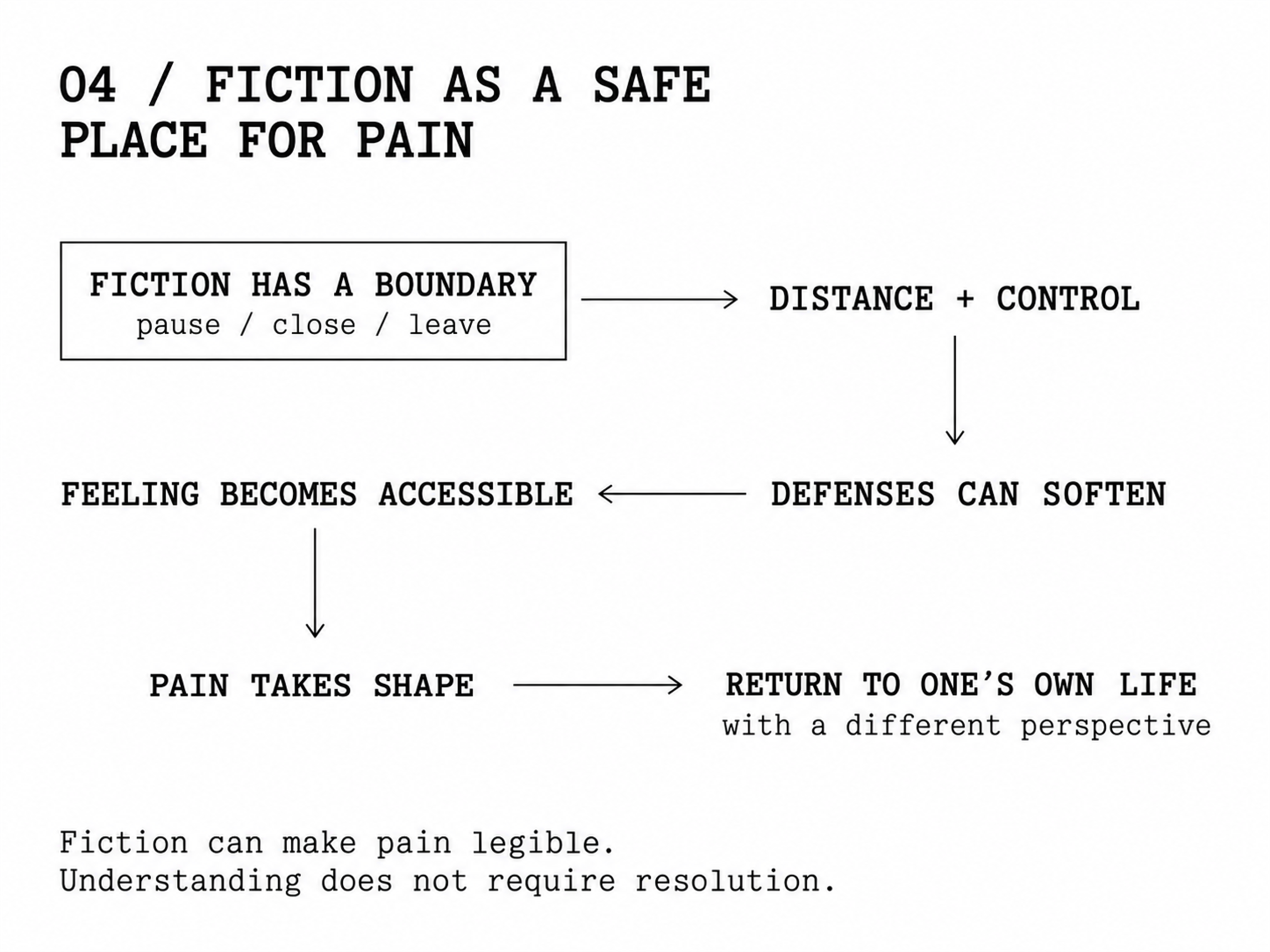
FICTION AS A SAFE PLACE FOR PAIN
There is another reason fiction can reach places ordinary life cannot: it gives pain a boundary.
Real pain rarely does. It interrupts schedules, changes relationships, follows us into rooms where it was not invited. It has consequences. There are calls to make, people to answer, decisions that cannot be postponed forever. Real grief does not end because the chapter does. Real fear cannot always be paused. Real loss does not disappear when the lights come back on.
Fiction changes the conditions without necessarily weakening the feeling. It creates an emotional space in which we can approach fear, grief, betrayal, jealousy, guilt, or abandonment while knowing that we can also leave. There is an exit. The film ends. The curtain falls. The book closes.
That limit matters more than it seems.
Aristotle understood something close to this more than two thousand years ago when he described tragedy in terms of pity, fear, and catharsis. The precise meaning of catharsis has been debated for centuries, but the underlying intuition remains powerful: we deliberately enter spaces designed to make us experience emotions we would normally avoid. We watch families collapse, lovers betray one another, children lose parents, cities burn, heroes fail. We pay for the privilege of being frightened, devastated, unsettled.
Why would anyone want that?
Perhaps because an emotion becomes different when we know it cannot destroy the world outside the story. We can approach the edge without having to fall from it. The experience is intense, but contained. We are given the unusual chance to feel something fully without being required, at that exact moment, to survive its real-world consequences.
This does not make fictional emotion shallow. It may make it accessible.
In ordinary life, self-protection often begins before feeling has a chance to become clear. We rationalize. We become practical. We tell ourselves that other people have it worse, that it was years ago, that it is not worth thinking about, that we have work in the morning. We make jokes. We open another tab. We keep moving.
Sometimes this is necessary. A human being could not function if every unresolved feeling demanded full attention the moment it appeared. But the defenses that allow us to continue can also become habits. Eventually, we may become very skilled at avoiding precisely the things we most need to understand.
Fiction slips past those defenses because it does not announce itself as our problem.
It says: this is about someone else.
This is another family. Another breakup. Another death. Another failure. Another life.
And so we lower our guard.
That may be one of fiction’s most extraordinary tricks. It does not always confront us. Sometimes it approaches from the side.
Fernando Pessoa wrote that the poet is a “faker,” someone capable of transforming even genuinely felt pain through the act of invention. The idea sounds paradoxical only if we assume that fabrication and truth are opposites. Art suggests they are not. Invention can become a method of access. A constructed scene can make an unconstructed feeling easier to face.
Maybe direct truth is sometimes simply too direct.
Tell someone, “You are afraid of losing your mother,” and every defense may rise at once. Give them a story about someone watching a parent grow old, and they may sit with the feeling for two hours without resisting it. Tell someone, “You regret the person you became in that relationship,” and they may reject the thought. Let them watch a character make the same compromises, and recognition can arrive before argument.
The fiction creates cover.
Under that cover, something honest can happen.
This may explain why we sometimes seek out art that we already know will hurt. We replay the song. We return to the novel. We watch the film again even though we know exactly which scene will break us. From the outside, the behavior seems irrational. Why voluntarily return to pain?
Because perhaps we are not returning to pain. We are returning to a place where pain becomes legible.
There is a difference.
In life, suffering can be shapeless. It arrives without structure, without symbolism, often without a satisfying ending. Fiction reorganizes experience. It gives beginnings and endings to things that, outside art, may have neither. It allows us to observe an emotion as part of a form. Not to solve it, necessarily, but to stay with it long enough to understand its contours.
This is why calling fiction “escapism” can be misleading. Sometimes it is escape, of course. But escape is not always movement away from reality. A detour can also be the only route back to something.
Perhaps we do not enter stories merely to leave our lives behind.
Perhaps we enter them to return to our lives from another direction.
And that changes the meaning of the phrase “it is only fiction.” The unreality of the story is not a weakness to be overcome. It may be the condition that makes certain forms of honesty possible. The distance is not an obstacle. It is protection.
Sometimes we need the invented person, the invented room, the invented disaster because reality in its unfiltered form is too close to look at for very long.
Sometimes a lie is not the opposite of the truth.
Sometimes it is the distance from which the truth finally becomes visible.