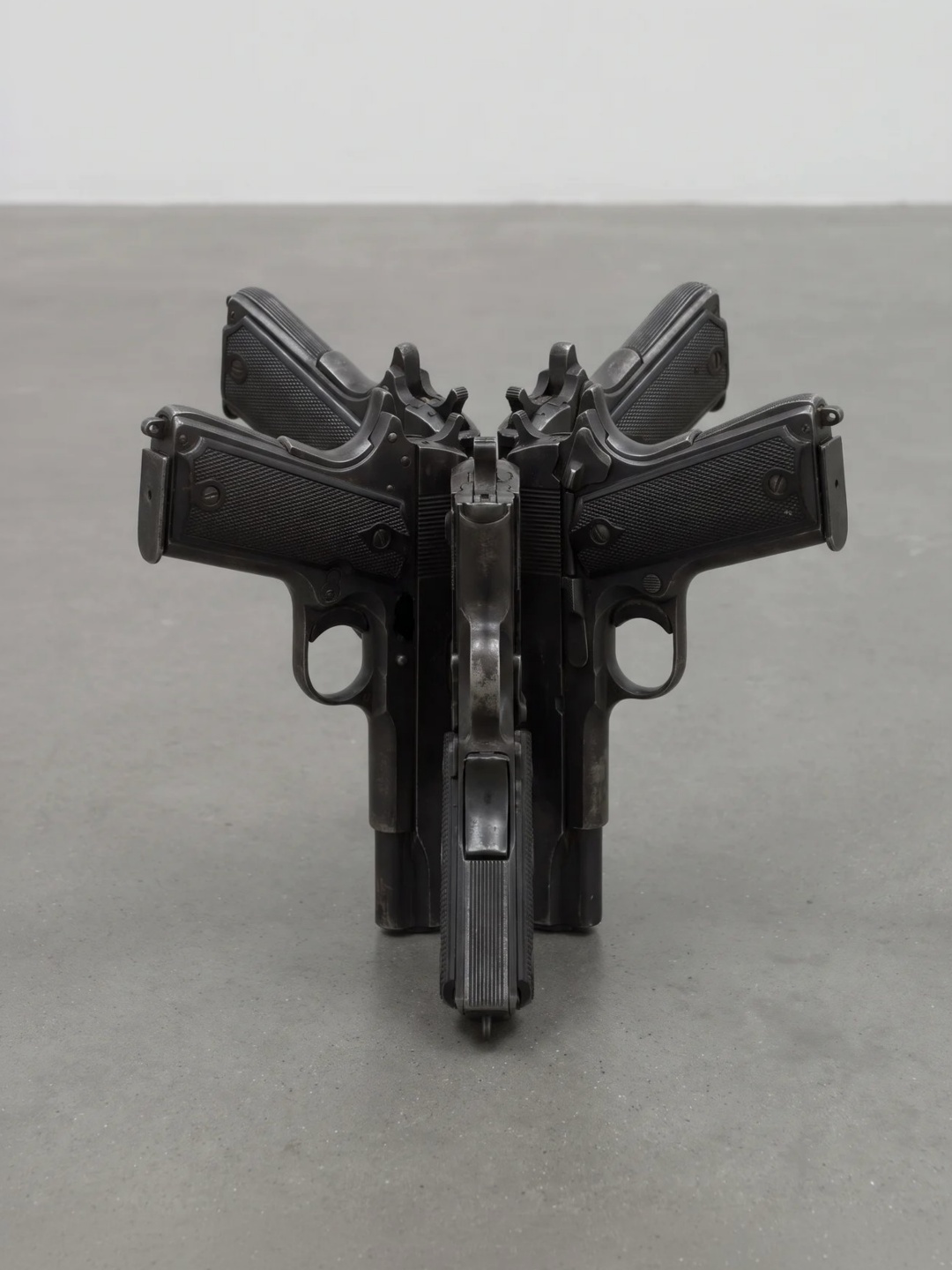

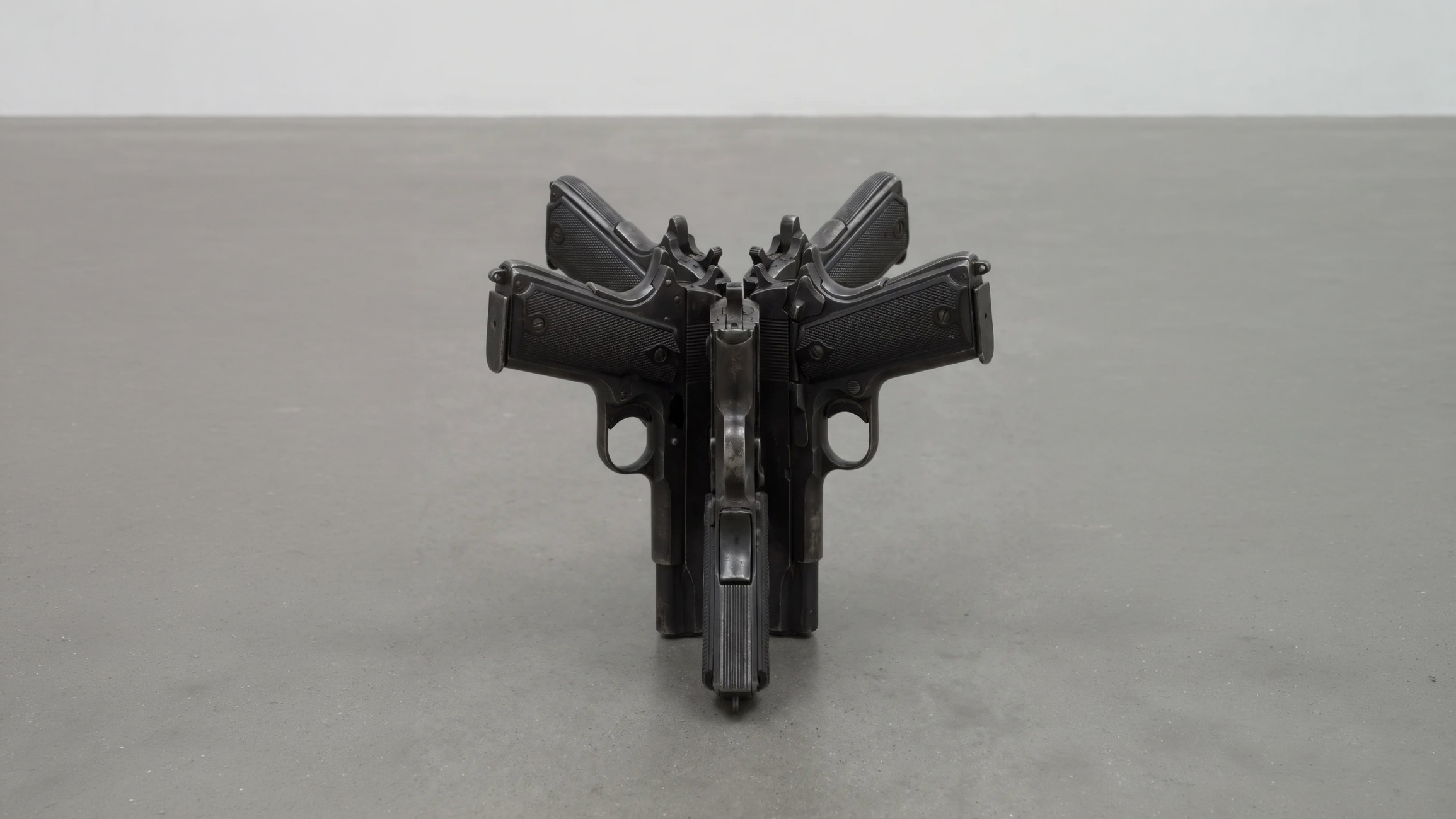
There is a zone of ambiguity in contemporary art where the critique of power begins to resemble the power it seeks to expose. Propaganda’s declarative voice, the authority of the slogan, the violence of the symbol, and the seductions of political imagery are detached from their original settings and reconfigured as artistic devices. This is not simply appropriation, nor is it provocation for its own sake. It is a more fundamental tension between form and ideology, one that unsettles our confidence in the ability to distinguish a critical image from an authoritarian one by appearance alone.
From Barbara Kruger and Cady Noland to Jenny Holzer and Hans Haacke, artists have made the languages of domination available for critical examination: commands, national emblems, disciplinary architectures, industrial materials, bureaucratic procedures, and the techniques of mass persuasion. What connects these practices is not a shared politics or even a shared aesthetic, but an understanding that power does more than issue orders or occupy institutions. It shapes visibility, arranges attention, distributes credibility, and teaches images how to appear authoritative.
Yet the decision to work within those languages raises a difficult question. Does appropriating the visual grammar of power interrupt its effects, or can it preserve—and sometimes intensify—the very fascination on which those effects depend? If propaganda’s formal devices can be mobilized against propaganda, and if visual aggression can serve emancipatory as well as reactionary ends, aesthetic radicalism cannot be treated as evidence of political radicalism in itself.
That uncertainty has become especially acute in a visual culture where the codes of transgression circulate among artists, brands, political movements, and online subcultures. Provocation is no longer the exclusive property of dissent. Nor does the adoption of an authoritarian-looking form necessarily signal an authoritarian commitment. An image’s political work depends on what it does, where it appears, who encounters it, and the historical associations it activates or contests.
The Aesthetics of Power begins from this instability rather than attempting to resolve it. The aim is neither to assign ideological ownership to visual forms nor to absolve every act of appropriation in the name of artistic freedom. It is to examine how images acquire authority, how artists redirect it, why political meanings remain contestable, and what happens when critique itself becomes a practice with material consequences. Perhaps the more consequential question is not simply how art depicts power, but how it learns to speak in power’s languages—and what new forms of perception that fluency makes possible.
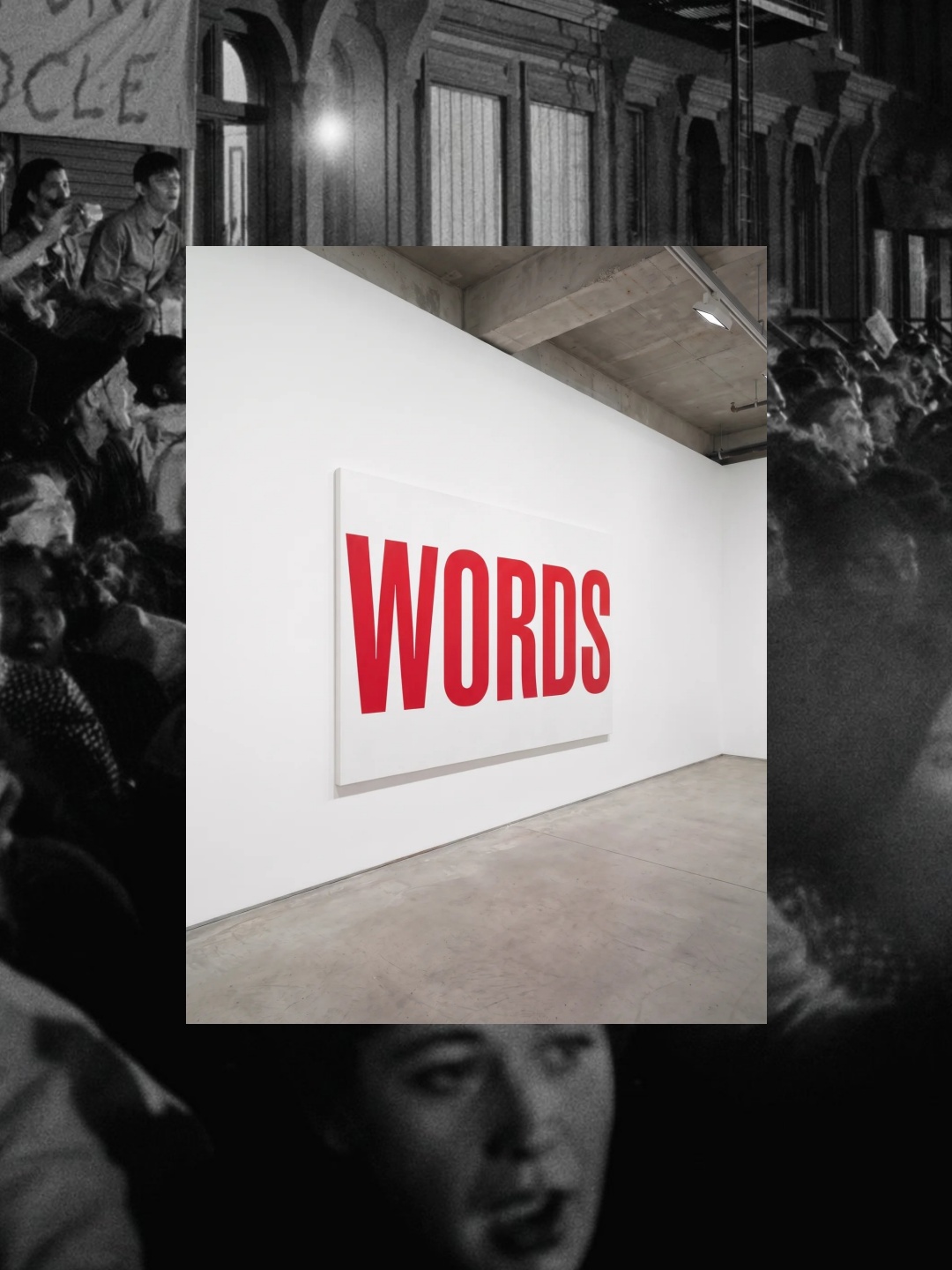
THE GRAMMAR OF AUTHORITY: A GENEALOGY OF VISUAL POWER
Before power becomes a political message, it is also an organization of visibility. It establishes what appears central or peripheral, commanding or subordinate, exceptional or ordinary. Monumental scale can place the viewer in a diminished position; repetition can turn an assertion into a familiar norm; a sharply directed composition can make conflict feel immediate. These devices do not carry fixed political meanings. Their effects depend on the institutions, audiences, and historical circumstances through which they operate.
Any genealogy of visual authority must therefore resist the temptation to identify a single authoritarian style. Red and black, symmetry, geometric abstraction, enlarged lettering, frontal bodies, and disciplined crowds are not ideological properties in themselves. They have served incompatible political projects. Their recurrence points less to the equivalence of those projects than to a shared practical problem: how to attract attention, coordinate feeling, and make collective claims legible at scale.
The early twentieth-century avant-gardes were decisive laboratories for this problem. In Russian Constructivism, artists including Aleksandr Rodchenko, El Lissitzky, Varvara Stepanova, and Gustav Klutsis pursued forms that could intervene in public life rather than remain confined to easel painting. Diagonals, photomontage, typographic contrasts, and stark spatial arrangements turned graphic design into a means of directing perception. In El Lissitzky’s Beat the Whites with the Red Wedge (1919), geometric shapes condense the conflict of the Russian Civil War into an instantly apprehensible visual action. The image does not narrate an event; it organizes an antagonism.
This compression of political struggle into visual force reveals both the ambition and the vulnerability of the avant-garde project. An image capable of mobilizing attention can also become an instrument of centralized authority. Klutsis’s subsequent production, including photomontages associated with Stalinist political culture, makes the issue especially visible. The same techniques of visual synthesis and mass address can operate within markedly different configurations of political power. To recognize this is not to collapse revolutionary experimentation into state propaganda; it is to distinguish the possibilities of a formal language from the institutions that come to direct its use.
Fascist regimes developed other, historically specific systems for making political authority appear natural and collective. National Socialist spectacle organized bodies, architecture, ceremony, and the leader’s image into choreographies of submission and belonging. Leni Riefenstahl’s Triumph of the Will (1935), made in the context of the 1934 Nazi Party rally at Nuremberg, did not simply record a political event. Through editing, scale, framing, and the orchestration of crowds, it helped transform a staged gathering into an image of apparently unified national destiny. The film’s aesthetic power cannot be separated from its propagandistic purpose.
In Fascinating Fascism (1975), Susan Sontag considered the troubling afterlife of such images: the possibility that representations of discipline, physical idealization, and submission remain aesthetically compelling after the political system that produced them has been discredited. Her argument remains important precisely because it does not allow formal admiration to erase the historical conditions of production. Yet the historical specificity of fascist imagery must also be preserved. Formal resemblance alone cannot make Soviet Constructivism, Nazi spectacle, and commercial advertising politically interchangeable.
An alternative use of mass-media technique appears in John Heartfield’s antifascist photomontages. In Adolf, the Superman: Swallows Gold and Spouts Junk (1932), the apparent evidentiary force of the photographic image is turned against Hitler’s public persona. Heartfield did not withdraw from mass communication to critique it; he entered its formats, redirecting their speed, reproducibility, and visual directness. The same modern technologies that could construct political myths could also puncture them.
After the Second World War, the question of visual authority became less exclusively tied to overt political symbols. Advertising, television, branding, and the culture of consumption developed forms of persuasion that often presented themselves not as commands but as invitations to desire. Commercial persuasion is not identical to state propaganda, and its operations should not be reduced to a single model of domination. Nevertheless, both illuminate how images can shape habits of attention and identification before viewers articulate a conscious judgment.
Michel Foucault’s account of power as productive and dispersed, rather than merely prohibitive, helps clarify this shift. Power can operate through the production of norms, knowledge, and recognizable subjects. In visual culture, this suggests that authority may reside not only in representations of rulers or institutions but in the conventions through which certain images become credible, desirable, or self-evident.
The history of visual power, then, is not a sequence of styles with stable ideological owners. It is a history of transfers, adaptations, and conflicts over techniques of visibility. An image can borrow the force of an established form while redirecting its meaning. That possibility opens the central terrain of artistic appropriation: authority can become not only something to depict or denounce, but something to handle, disassemble, and put to work differently.
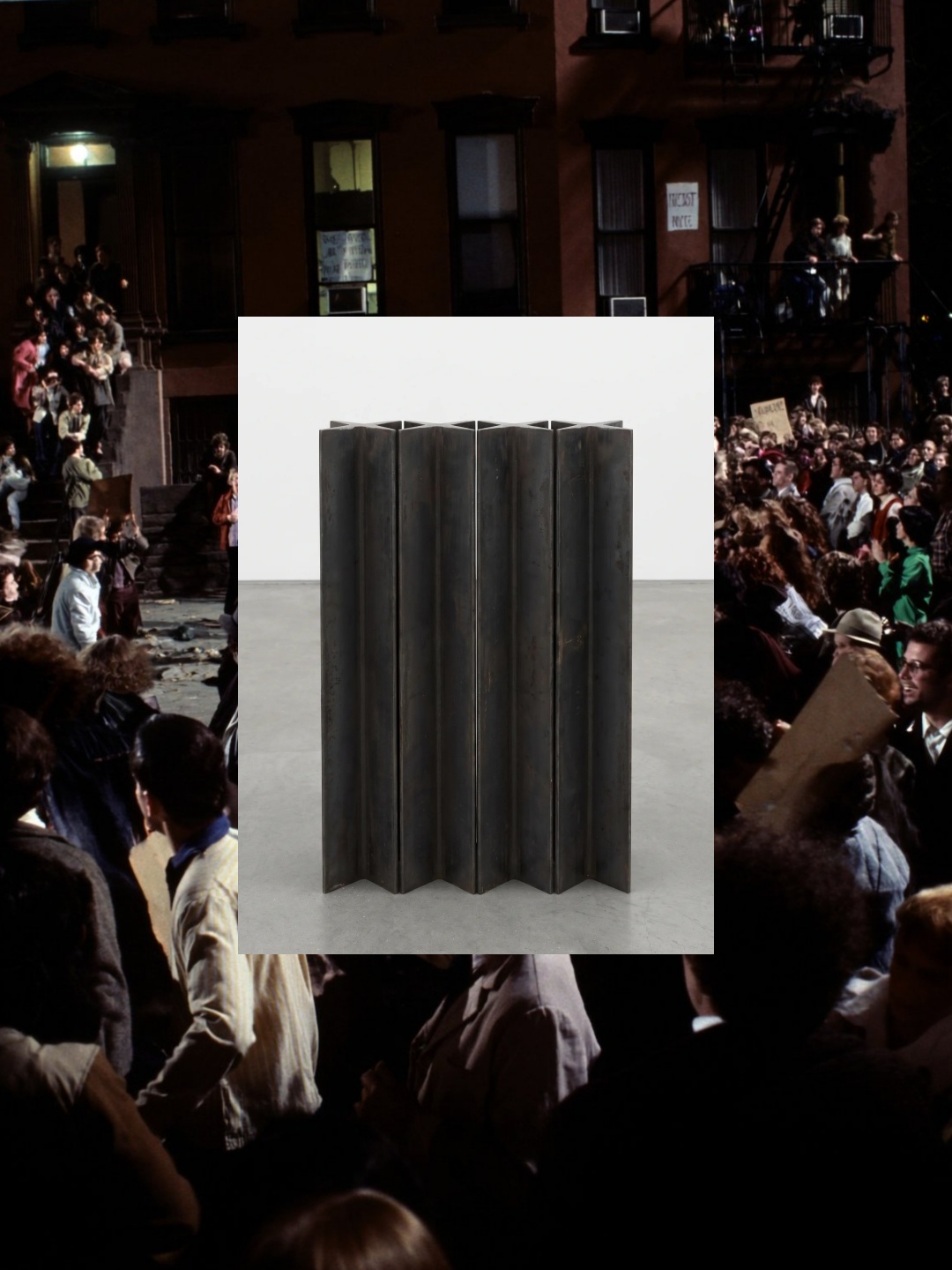
INHABITING THE DEVICE: APPROPRIATION AS SABOTAGE
If modern visual culture made images instruments of persuasion, much contemporary art has treated those very instruments as sites of intervention. Rather than claiming an uncontaminated position outside advertising, bureaucracy, or political communication, artists have entered their languages and altered the relationships those languages ordinarily establish. The artwork becomes less an alternative image than an experiment in how existing images acquire their force.
Barbara Kruger’s practice offers a particularly clear instance. Drawing on her experience in editorial design, Kruger combines appropriated photographs with sharply articulated text, often using pronouns and direct address to implicate the viewer. In Untitled (Your body is a battleground) (1989), initially produced in connection with a demonstration for reproductive rights in Washington, D.C., the split photographic face and emphatic statement transform a familiar advertising syntax into a confrontation over bodily autonomy. The work is effective not because it abandons persuasion but because it makes the mechanisms of address conspicuous.
Kruger’s language often sounds authoritative even when it questions authority. The viewer is named, positioned, and addressed before having time to respond. That tension is not an accidental compromise; it is one of the work’s critical resources. By adopting the certainty of commercial communication while unsettling the identities and desires it ordinarily stabilizes, Kruger exposes the ways a subject is formed through language. Her work does not promise an image purified of power. It asks whether power’s familiar forms of address can be made to turn back upon themselves.
Jenny Holzer’s Truisms, begun in the late 1970s, approach this problem through the voice of anonymous certainty. Brief statements appear to offer common wisdom, moral instruction, or institutional knowledge, yet they contradict one another and resist attribution to a single stable speaker. When Holzer places language on electronic signs or in monumental public settings, the medium lends the text a borrowed authority. A sentence presented in a format associated with official information may seem to demand belief even when its meaning is troubling or unresolved.
This is not merely a substitution of critical content for institutional content. Holzer makes the source of authority itself uncertain. The public display, usually treated as a neutral channel, becomes part of the artwork’s argument. A viewer must decide not only what a sentence means but why a particular technological form makes it sound credible. Ambiguity here is not a failure to communicate. It is a method for making the act of interpretation visible.
Cady Noland’s work shifts the inquiry from rhetorical address to the material culture of American power. Flags, metal barriers, chains, industrial structures, and images drawn from mass culture enter arrangements that bring national identity into contact with coercion, celebrity, and social violence. In works such as The American Trip (1988) and This Piece Has No Title Yet (1989), ordinary objects retain traces of their practical functions. A barrier still suggests restriction; a chain still evokes restraint. Their relocation does not erase these meanings but places them in a newly charged constellation.
Noland’s significance lies partly in her refusal to translate this material into a single declarative thesis. The American social landscape appears through objects that are familiar yet difficult to reconcile. The work allows the viewer to experience the proximity of spectacle and control without dictating a definitive political reading. Its aesthetic severity is not simply an imitation of institutional force. It is a way of making the force embedded in everyday material arrangements newly perceptible.
Hans Haacke pursues another route. His practice frequently appropriates the procedures of documentation, investigation, and institutional disclosure rather than the visual aggression of propaganda. In Shapolsky et al. Manhattan Real Estate Holdings, A Real-Time Social System, as of May 1, 1971, photographs and property information trace networks of real-estate ownership. The work became central to the controversy surrounding the cancellation of Haacke’s planned exhibition at the Guggenheim Museum in 1971. Here the authority of the document is mobilized to expose relations that the cultural institution might prefer to keep outside the exhibition frame.
These practices should not be treated as interchangeable. Kruger disrupts the rhetoric of persuasion; Holzer destabilizes the apparent neutrality of public address; Noland intensifies the material contradictions of national mythology; Haacke redirects administrative evidence toward institutional scrutiny. Their shared insight is methodological: an artistic language need not be external to a system to act upon it critically.
Appropriation nevertheless has no automatic political effect. A slogan can become a style; a critical composition can become a recognizable brand; a disturbing image can circulate without the context that once shaped its interpretation. Yet this does not mean that such works are defeated by their own visibility. Their capacity to move between contexts may also extend their critical life, producing new encounters and readings beyond the artist’s initial control.
The value of appropriation lies neither in the fantasy of fully neutralizing power nor in the certainty of remaining forever compromised by it. Its force emerges in the space between recognition and displacement. By preserving enough of a visual language to make its authority legible, while altering how that authority is encountered, the artwork can open a field of interpretation that the original device was designed to close.
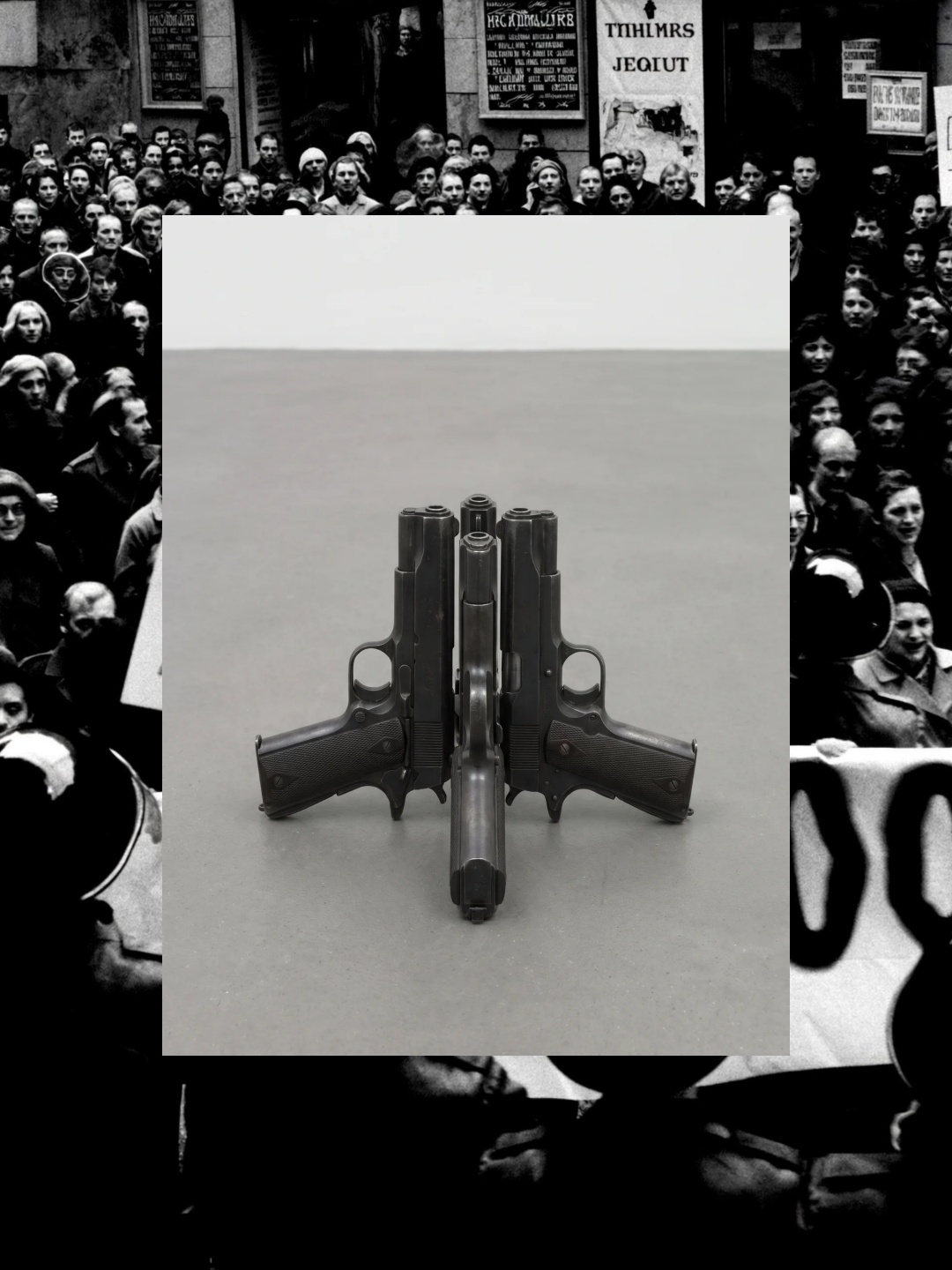
THE SEDUCTION OF AUTHORITARIANISM: WHEN TRANSGRESSION CHANGES SIDES
Aesthetic transgression has often been associated with political emancipation, particularly in narratives of the postwar avant-garde and counterculture. But the association has never been guaranteed. Formal rupture, irreverence, and hostility to convention describe attitudes toward an existing order; they do not, by themselves, tell us what kind of order is being proposed in its place.
Italian Futurism makes the distinction difficult to ignore. F. T. Marinetti’s 1909 founding manifesto celebrated speed, destruction, and war, coupling artistic innovation with a rhetoric of violence. Marinetti’s later commitment to Fascism cannot be projected backward as the single destiny of every Futurist experiment, whose participants and trajectories were varied. It does, however, demonstrate that the attack on inherited conventions can accompany profoundly anti-emancipatory politics. The new is not necessarily the free; rupture is not inherently democratic.
Sontag’s discussion of fascist aesthetics identifies another problem: the ability of authoritarian images to remain seductive beyond their original political setting. Their appeal may derive from rhythm, spectacle, bodily idealization, or the fantasy of perfect coordination. To study that appeal is not to endorse it. Nor does a contemporary artist’s engagement with compromised visual forms automatically reproduce the commitments of the historical regimes that used them. Aesthetic attraction and ideological allegiance must be distinguished, even as their possible intersections remain open to examination.
The Slovenian group Laibach, founded in 1980 and later associated with the Neue Slowenische Kunst collective established in 1984, provides an unusually productive case. Its industrial sound, disciplined staging, appropriated emblems, and severe public persona have frequently been discussed through the idea of overidentification: assuming the language of authority so intensely that its conventions become conspicuous. Rather than announcing a reassuring distance from ideological spectacle, the work makes viewers confront their own desire to identify, interpret, or recoil.
Such a strategy depends on uncertainty. One viewer may recognize a critique of ideological performance; another may be captivated by the performance itself. This instability does not invalidate the work. It is part of the work’s encounter with the viewer, and part of the reason its political meaning cannot be settled by formal resemblance. The question is not whether ambiguity should be prohibited but what kinds of critical attention it makes possible—and what historical knowledge it requires.
Christoph Schlingensief approached related tensions through the mechanisms of public spectacle. In Bitte liebt Österreich! (2000), staged in Vienna, he drew on reality-television conventions and the charged language of anti-immigration politics to create a public intervention around exclusion, media attention, and participation. The work placed spectators in an uncomfortable relationship with a system whose procedures appeared both absurd and disturbingly familiar. Its difficulty lies not in an easily extracted moral but in the way it makes the audience confront the pleasures and responsibilities of watching.
These artistic practices cannot be collapsed into the rhetoric of contemporary reactionary movements. Their histories, intentions, institutional positions, and modes of address differ. Yet the contemporary circulation of provocative imagery makes a broader cultural comparison necessary. Online political subcultures, including elements of the far right, have used irony, memes, irreverence, and the pose of anti-establishment rebellion to attract attention and evade stable interpretation. In such contexts, an assertion may be defended as a joke when challenged and embraced as conviction when affirmed. The ambiguity is strategic rather than necessarily reflective.
The distinction matters. Ambiguity in art can complicate the viewer’s relation to meaning; strategic ambiguity in political messaging can sometimes function to obscure accountability. Their outward similarities do not erase their different purposes. Nor should the fact that reactionary actors appropriate transgressive codes lead us to cede those codes to them. The historical ownership of a symbol does not determine every subsequent artistic use, and artistic inquiry must remain capable of examining even the most politically burdened imagery.
What has changed is the assumption that provocation naturally belongs to a progressive cultural position. An image may be confrontational without being emancipatory; it may be aesthetically restrained while articulating a radical critique. The question is therefore not how to classify forms once and for all, but how to read their specific operations: who is addressed, what is made desirable, what is normalized, what is disrupted, and which forms of identification are invited or refused.
This is where the seduction of authoritarianism becomes a serious art-historical and curatorial question rather than a moral label. The attraction of force can be exposed, staged, questioned, and transformed; it can also survive those operations. No single result follows automatically from the use of a charged aesthetic. The artistic significance of such work often lies in compelling us to examine the uncertain passage between attraction and judgment.
Transgression is not a political position. It is a relation to a boundary. Its meaning depends on the boundary crossed, the context of the crossing, and the possibilities opened—or foreclosed—on the other side.
THE VIOLENCE OF REPRESENTATION: WHEN CRITIQUE EXERCISES POWER
The instability of political imagery becomes more materially consequential when artists do not merely represent domination but construct situations in which unequal relations are enacted. The artwork then operates through bodies, labor, instructions, permissions, and risks. What matters is not only what a situation signifies but how it is organized, who can change its terms, and who bears its consequences.
This shift should not be treated as an ethical failure in advance. One of the most consequential ambitions of performance and socially engaged art has been to move beyond the safety of representation, making the work’s conditions part of what it investigates. Such practices can reveal dynamics that conventional images leave abstract. They also expose the artist’s own authority to scrutiny. When the work organizes a real situation, its critical claims and its procedures cannot be cleanly separated.
Santiago Sierra has made this tension a central material of his practice. In 160 cm Line Tattooed on 4 People (2000), four women were paid to receive a continuous line tattooed across their backs. The work foregrounds the relationship between economic need, consent, labor, and the treatment of the body as a site of exchange. Its unsettling force comes from the fact that the transaction is not simulated: the conditions being examined are also conditions through which the artwork comes into being.
A purely affirmative reading would overlook the asymmetry between artist and participants. A purely condemnatory reading, however, would risk refusing to engage with the work’s deliberately exposed contradiction. Sierra’s practice asks whether the social relations that usually remain dispersed or hidden become newly legible when concentrated in an artistic situation. It also asks whether visibility is sufficient, and who benefits when such visibility acquires cultural value. These are not objections external to the work; they are among the questions the work forces into view.
Artur Żmijewski’s Repetition (2005) similarly investigates the production of authority through an organized social experiment, restaging aspects of the Stanford prison experiment for a filmed artwork. Participants take on the roles of guards and prisoners within an environment structured by rules and observation. Yet the artist’s authority to devise, document, and edit the situation remains part of the conditions under examination. The work therefore operates on two levels: the power relations enacted within the experiment and the power relations involved in making those enactments into art.
Marina Abramović’s Rhythm 0 (1974) offers a contrasting distribution of vulnerability. The artist made her own body available to the audience alongside seventy-two objects, permitting participants to act upon her within the terms of the performance. The resulting encounters revealed a range of responses, from care to aggression. Unlike Sierra’s use of paid participants, Abramović placed herself at the center of the exposure. Still, the work was not without structure: the artist established the conditions through which the audience’s freedom could be tested. The comparison clarifies how different configurations of authorship and risk can produce very different ethical and aesthetic questions.
These works also complicate the assumption that participation is inherently democratic. To participate is not necessarily to possess equal power over the conditions of participation. Claire Bishop’s writing on participatory art and antagonism is useful here because it resists equating artistic value with harmonious collaboration. Conflict, discomfort, and disagreement may be integral to an artwork’s critical force. At the same time, the presence of conflict is not sufficient proof of that force. The decisive issue is what the work enables us to perceive about the relations it constructs.
An adequate reading must therefore hold several questions together without allowing any one of them to close the discussion. Does the work make a social relation newly intelligible? Does it reproduce that relation under different conditions? Are participants able to refuse or alter what is asked of them? How are risk, authorship, recognition, and material benefit distributed? And what happens when documentation carries the event into an audience far removed from the original participants?
The art institution matters here, but it does not function only as a mechanism of absolution. Exhibition can offer a space in which troubling actions are examined rather than normalized. It can also transform those actions into objects of prestige, exchange, and cultural distinction. These capacities coexist. The institution’s framing neither erases the material reality of an action nor determines its meaning once and for all.
This is why the strongest account of such practices is neither celebratory nor prosecutorial. To say that an artwork exercises power is not necessarily to discredit it. Every organized artistic situation involves decisions about form, access, and attention. The more demanding question is whether those decisions become available to critical perception, and whether the work allows its own conditions of authority to remain visible rather than disappearing behind a claim to moral superiority.
The artistic stakes are substantial. A work can be politically incisive while remaining ethically difficult; it can expose coercion without providing a model of liberation; it can place the viewer in an unresolved position that is more revealing than a clear instruction about what to think. Such difficulty should not be mistaken for immunity from criticism. It is a reason for more exacting interpretation.
At this point, the aesthetics of power can no longer be understood as a matter of harsh imagery, imposing symbols, or commanding language alone. Power may reside in the protocols of the work itself: in who organizes the encounter, who is visible, who speaks, who acts, and who is remembered. Art’s ability to make those protocols perceptible is among its most consequential critical possibilities.
The question is not whether art may depict or stage violence, nor whether every troubling encounter must be reconciled with a reassuring conclusion. It is how the work turns the conditions of its own making into something that can be thought about, contested, and understood. When critique becomes an exercise of power, it may reveal not the defeat of criticism but the impossibility of practicing it from a position of complete innocence.