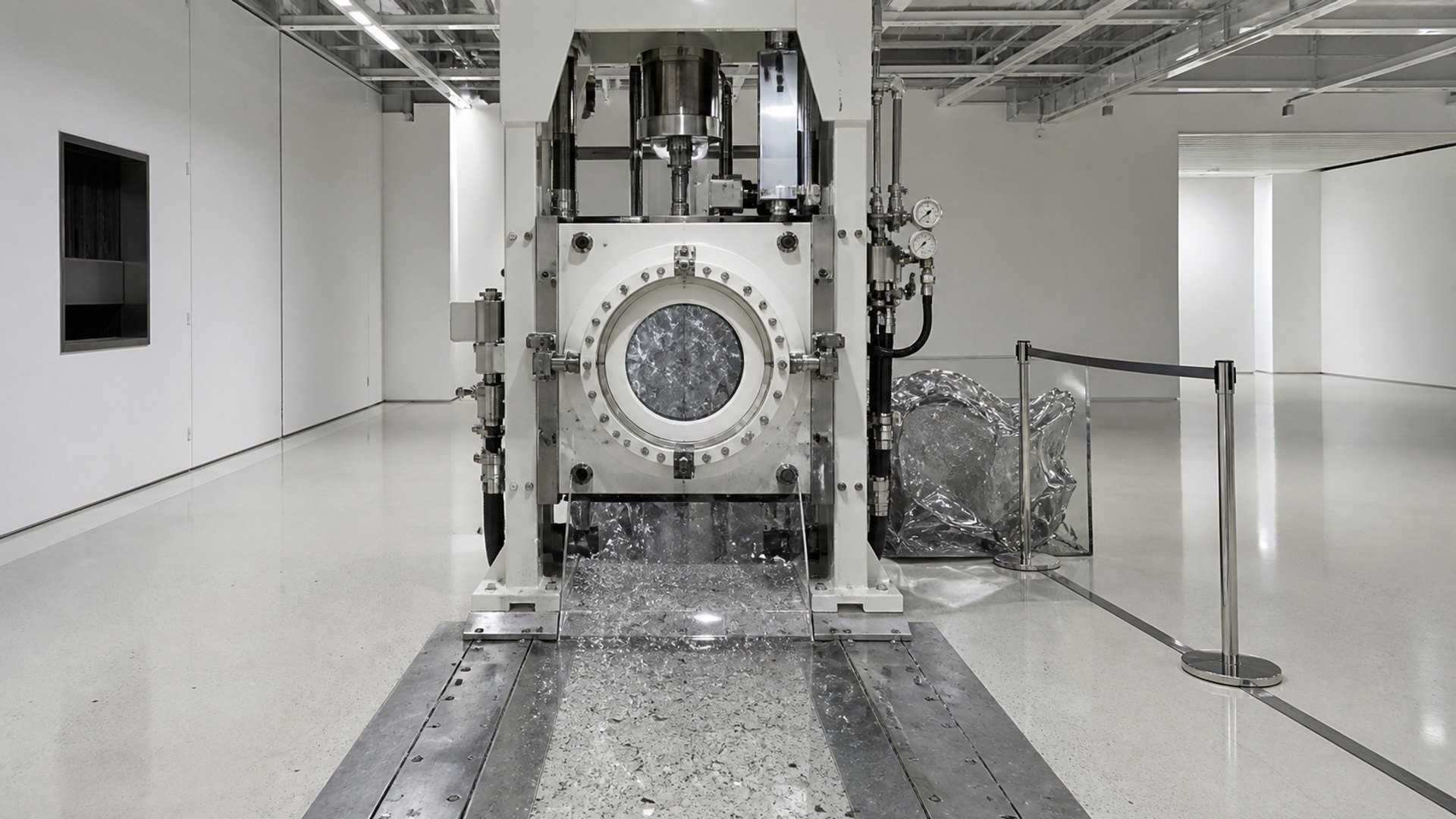


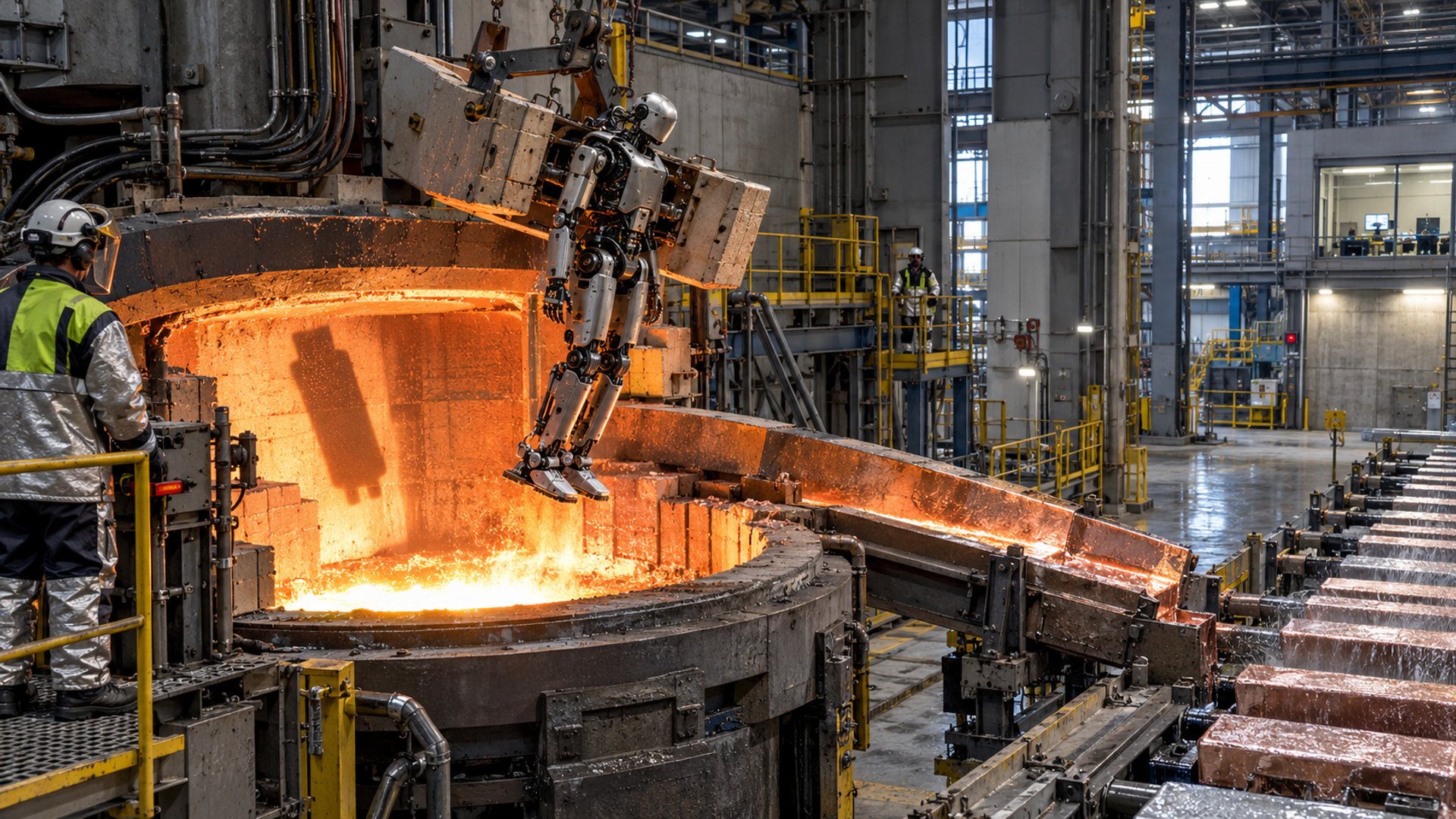
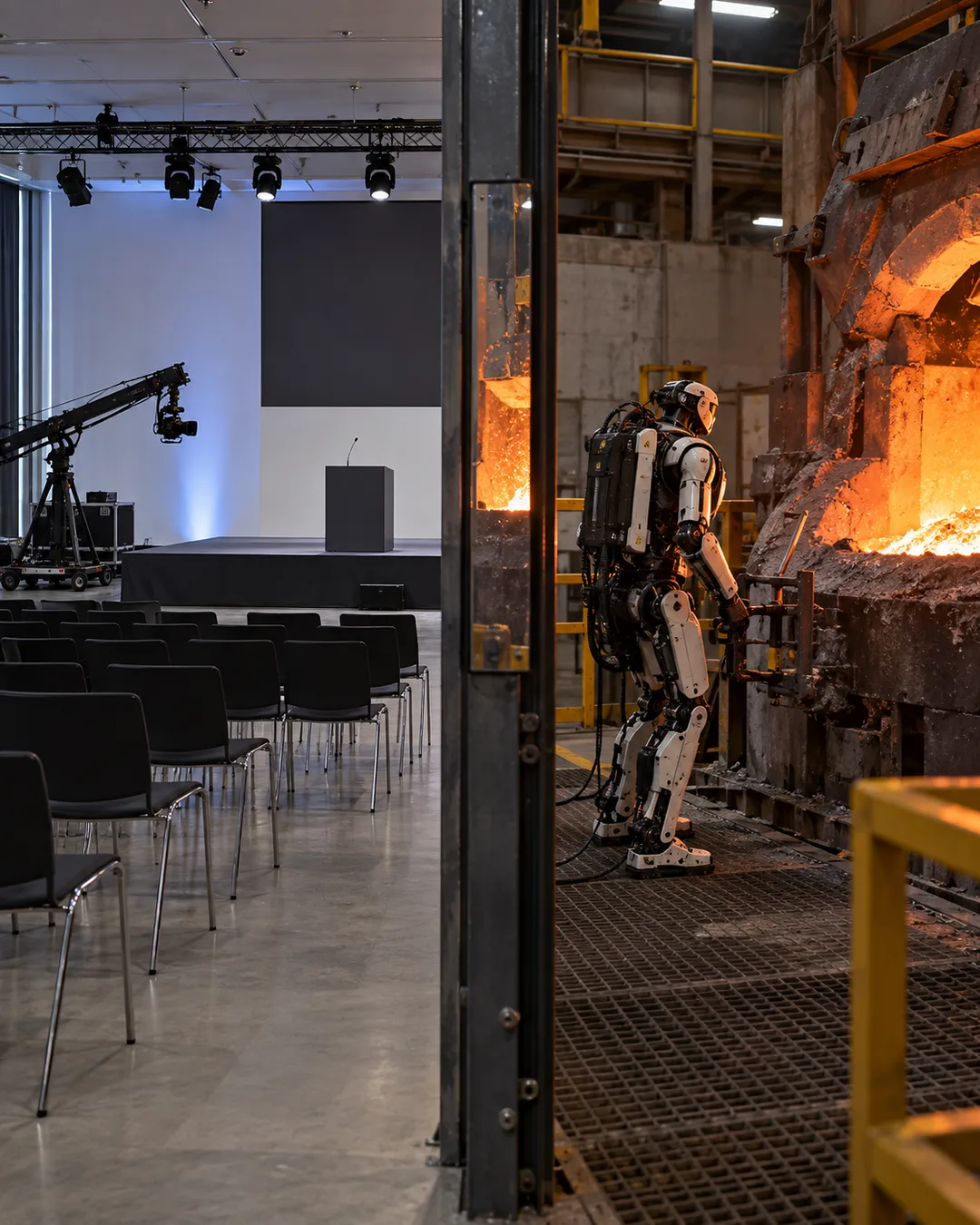
On September 30, Figure AI published a film showing its retired F.02 humanoid robots being sent into an electric arc furnace in Imatra, Finland. In the footage, one of the robots walks across the foundry floor and jumps into the furnace under its own control. Arnold Schwarzenegger appears alongside the operation, making the reference to Terminator 2 explicit.
Figure presents the decision in practical terms. As production of F.03 expands, maintaining the older fleet no longer makes operational sense. The company says that manually dismantling the robots would require staff who are now working on F.04, while destroying the machines also prevents proprietary hardware and engineering from leaving its control.
But Figure did not treat the retirement of F.02 as a routine disposal process. The robots were trained for the jump in simulation, the movement was rehearsed with airbags in San Jose, and the final destruction was turned into a filmed event. Most of the fleet has now been decommissioned, while a small number of units remain in storage. Metal recovered from the robots has also been returned to the United States, where it is being machined into a limited series of commemorative objects.
The result is an unusual case in which hardware retirement, intellectual property, robotics marketing and cultural reference all converge around the destruction of the same machine.
Retirement Becomes a Scene
Decommissioning industrial hardware is usually an internal process. Equipment reaches the end of its useful life, a company decides how to dispose of it, and the operation remains largely invisible. Figure chose a different approach with F.02, placing the retirement itself in front of the camera.
The practical reasons are straightforward. Production of F.03 is expanding, maintaining F.02 requires resources, and Figure says dismantling the older robots by hand would take personnel away from development of F.04. Destroying the machines also limits access to proprietary hardware. None of this required a public event.
The film changes that. Instead of showing the robots being dismantled or transported as industrial waste, Figure gives F.02 a final task. The robot crosses the foundry floor and enters the furnace under its own control. Its obsolescence is demonstrated through another display of capability.
This is particularly effective in robotics, an industry where demonstrations have become central to how technological progress is communicated. Walking, carrying objects, navigating a factory floor or responding to instructions can make technical development immediately visible. Figure applies the same logic to retirement: F.02 performs its own removal from service.
The result allows the company to announce technological succession without simply making the previous generation disappear. F.02 is physically destroyed, but the event preserves it as an image and places its retirement inside the public narrative of what comes next.
Autonomy Has a Backstage
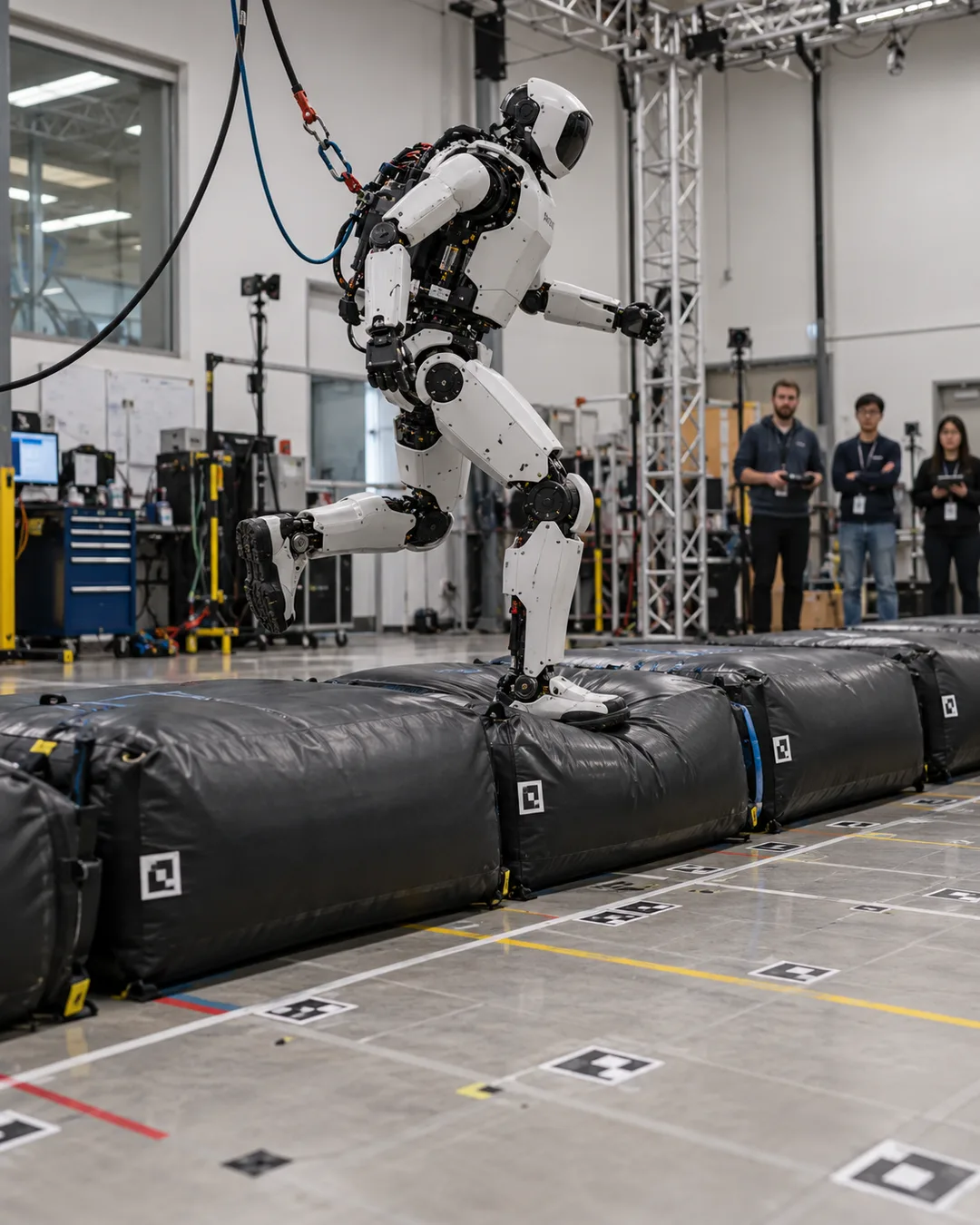
The jump appears simple in the finished film, but it was extensively prepared. Figure says the movement was trained in simulation and rehearsed with airbags in San Jose before the robots were brought to the foundry in Finland. During the final attempt, the trained model controlled the jump.
This distinction is important because autonomy is easily confused with spontaneity. The robot performs the movement without someone manually controlling each step, but the conditions that make the movement possible have been established in advance. Engineers define the task, train the system, test the trajectory and select the environment in which it will be performed.
The airbags used during rehearsal make some of that preparation visible. Before a robot can jump toward a furnace, the same movement can be tested repeatedly in conditions where failure does not destroy the hardware. Simulation allows another layer of testing before the action reaches the physical machine.
None of this makes the final jump less autonomous in technical terms. It simply places that autonomy within the process that produced it. What appears on screen as a single decisive movement is the endpoint of training, testing and controlled rehearsal.
That difference is often lost in robotics demonstrations, where audiences see the successful action but little of the infrastructure behind it. Figure’s own account of the F.02 stunt provides a rare view of both sides: the autonomous performance and the human preparation required to make it possible.
Secrecy Enters the Furnace
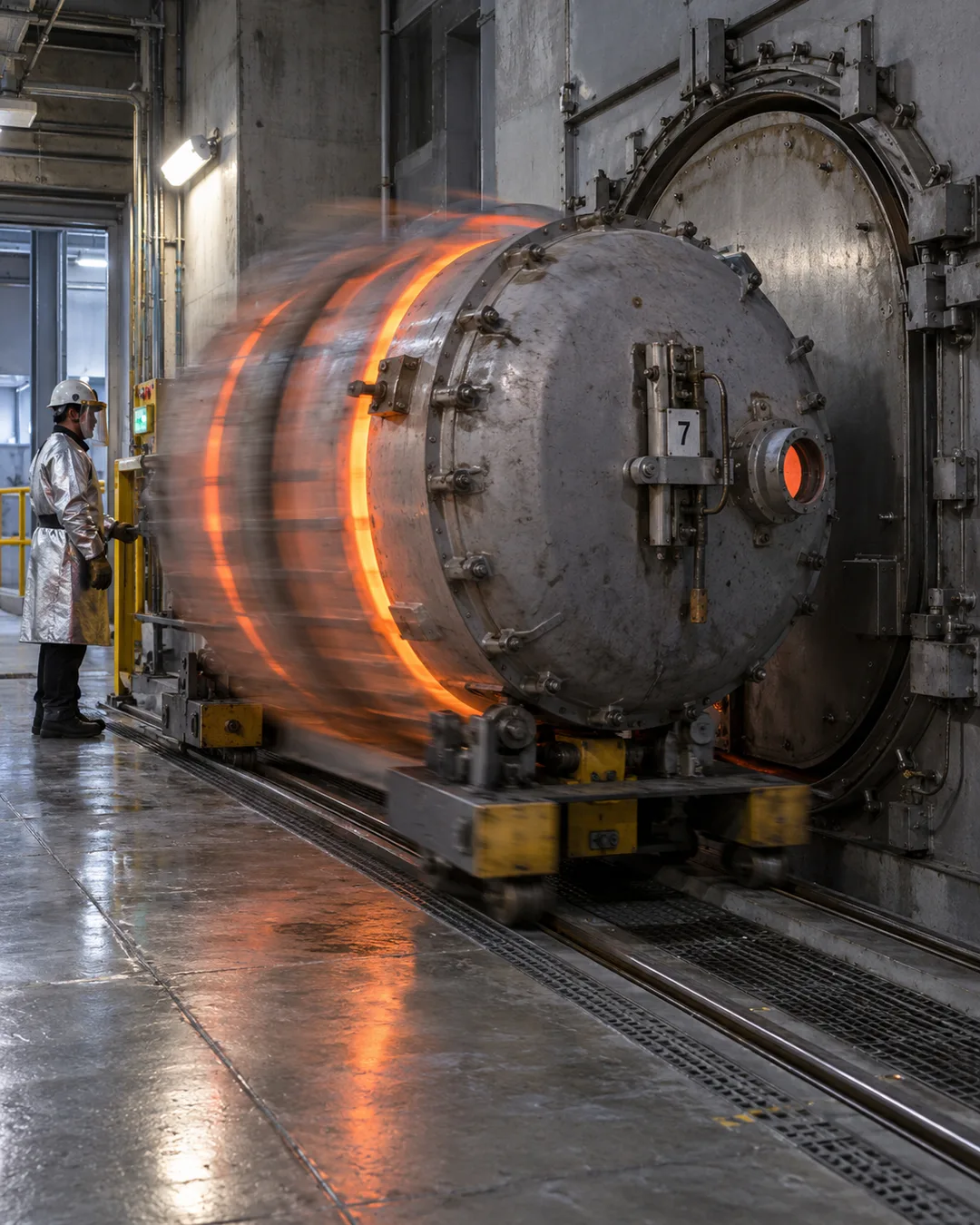
Figure also gives intellectual-property protection as a reason for destroying F.02. A humanoid robot contains proprietary information not only in its software, but in its physical construction: mechanical assemblies, component choices, wiring, manufacturing methods and the way those systems are integrated.
Keeping retired units intact would preserve access to that information. Dismantling them would require time and personnel, while potentially leaving sensitive components recoverable. Sending the robots through a furnace solves a different problem: it destroys the machines as complete, inspectable systems.
That makes the foundry part of Figure’s security strategy as well as its decommissioning process. For hardware companies, protecting intellectual property does not end with passwords, repositories or software permissions. Prototypes and retired machines can reveal engineering decisions simply by being opened and examined.
The process shown publicly, however, does not provide a complete account of what happened to every component. Figure says metal recovered from the robots was returned to the United States in bars and will be used for commemorative objects. The available material does not specify the full component inventory, the treatment of non-metal parts or the overall environmental impact of the operation.
That distinction is worth keeping clear. The furnace explains how Figure prevented intact F.02 units from circulating outside its control. It does not, by itself, provide a complete recycling or environmental record of the fleet’s destruction.
Terminator Supplies the Memory
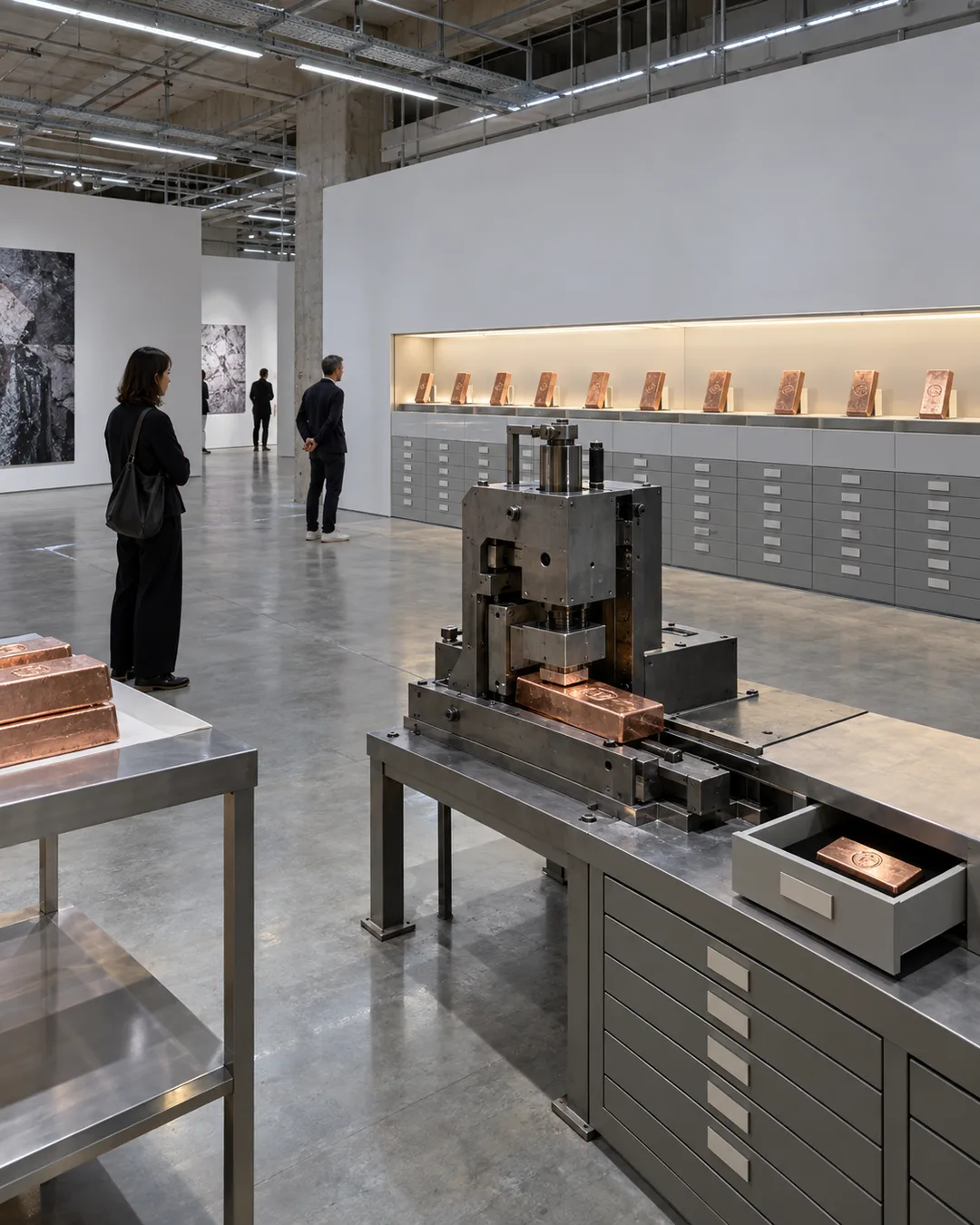
The destruction of F.02 does not end with the furnace. Figure says metal recovered from the robots was returned to the United States in bars and is now being machined into a limited series of commemorative objects.
That decision gives the material a new function. The metal is no longer part of an operational robot, but it remains connected to a specific generation of Figure’s hardware and to the event in which that hardware was destroyed. Its value therefore depends less on what the material can do and more on where it came from.
Provenance becomes important here. A piece of metal linked to F.02 carries a documented association with the development of the robot, the foundry in Finland and the campaign built around its retirement. Turning that material into a limited series makes the connection physical and potentially collectible.
This also changes the economics of disposal. Industrial material that might otherwise be treated primarily according to its recoverable value can acquire another kind of value once it is tied to a documented event and produced in limited numbers. Figure has so far described the resulting objects as commemorative artifacts, so their eventual significance will depend on how they are manufactured, documented and distributed.
What is notable is the sequence itself. Figure destroys the robots partly to prevent the original machines from remaining accessible, while preserving selected material from them in a new form. The functional object disappears, but part of its physical substance remains available as a record of the generation that was retired.
Metal Returns as Value
Figure’s account gives the F.02 metal a second itinerary. Bars travel back to the United States and enter machining for a limited commemorative series. The material begins as part of a working robot, passes through a foundry, and returns as an object designed to carry the memory of its own destruction. That route shifts the question from disposal alone to the ways a technology company can preserve a machine in another form.
Commemoration assigns scarcity to matter with a traceable story. A bar from a retired robot carries an association with Figure’s development program, the Finnish foundry, and the video featuring Schwarzenegger. Machining makes that association portable and tangible. The object can travel to a collector while the original machine becomes impossible to inspect. Provenance then connects the artifact to an event that has already been edited, narrated, and distributed online.
A limited series also reveals how value can migrate across forms. The robot’s market value as a functioning prototype gives way to engineering knowledge, media attention, and a possible collectible afterlife. The company has described the objects as commemorative artifacts; their eventual reception will depend on manufacture, distribution, documentation, and audience interest. The film prepares the ground for that reception by teaching viewers to see the metal as a remnant of a dramatic technological passage.
The furnace removes one version of F.02 from circulation and produces another version built from story. Hardware becomes feed-native imagery, the imagery becomes brand memory, and the bars offer a material keepsake of the same sequence. Figure’s stated aims include operational efficiency and protection of proprietary technology; the campaign adds a carefully composed public meaning. The unresolved tension sits in the artifact itself: the machine’s body vanishes as an inspectable system, while its ending becomes a durable and potentially valuable object.