Tiffany Sia: Phantasmatic Screens at Mudam Luxembourg, behind the veils of perception
“Remembering is never an innocent act. It is rewriting the past with hands steeped in the present.”
That’s what we told ourselves as we stepped into the rooms of Phantasmatic Screens, where a diffused white light fell on a rippled curtain, quivering like skin under a shiver. We wondered: is it truly possible to return to the places that marked us without disguising them, without assaulting them with nostalgia? What remains of a memory that has already rebuilt itself a thousand times? And how can we look at a landscape, knowing it has already been seen by other eyes, under different desires, with another story?
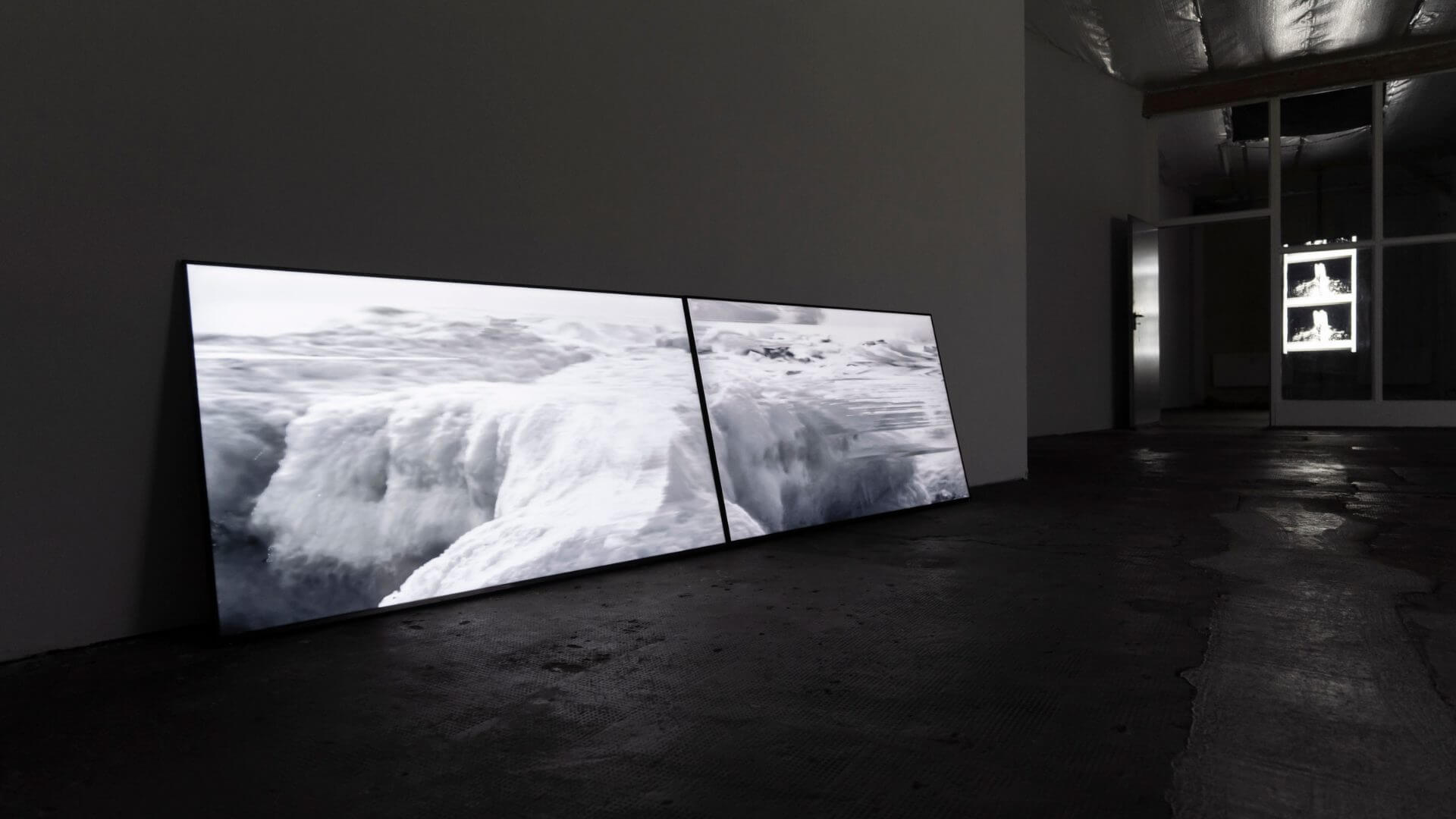
Tiffany Sia welcomes us into an ambiguous territory, where the boundaries between image, memory, and geography dissolve. Two video installations, The Sojourn (2023) and Antipodes III (2024), appear like restless apparitions, more than projected images, they are sculpturally embedded in space, slipping into a gesture that fragments and unsettles our gaze. These works do not ask to be understood, but to be experienced: they are fissures in the continuity of time, where the “there” and “then” infiltrate our “here” and now, only to refract and scatter.
The main gallery at Mudam, transformed by these filmic presences, pulses with a silence so deep it feels almost tactile. The projections do not dominate the space, they seep into it. In The Sojourn, the film plays across a wavy white polyester curtain, a soft, unstable surface where the image flickers and frays. We can never see it in its entirety, the fabric, like a rebellious memory, reveals and conceals at once. This is Sia’s journey with actor Shih Chun through the ghost-locations of King Hu’s Dragon Inn, a journey that is also a pilgrimage through the cultural sediments of a fractured identity. But here, cinema is no longer a window onto the world, it is a screen of smoke. The ruins we see are already interpretations of a place never truly reached.
Beside it, Antipodes III stands in stark contrast, a fixed image projected from a rearview mirror hanging mid-air, like a phone without a hand. We see Kinmen, the border island between Taiwan and China, a zone of silent tension. Nothing happens in the frame. It is the title that implies a political content, and this latency creates a subterranean tension, absence speaks louder than presence. In this, Sia flips the grammar of documentary, she does not inform, she interrogates.
The visual devices, curtains, mirrors, suspended frames, become integral to the artist’s language. Fabric that obscures, glass that reflects, the strategic omission of subtitles in key moments, each technical gesture is an epistemological stance. The visible is never neutral. The image is never whole. What remains hidden, forgotten Atayal languages, Sia’s family memories, the emotional topography of a 1960s cult film, resurfaces only to dissolve again.
Freud spoke of “screen memories,” fabricated recollections that shield us from trauma. Here, Sia seems to say that every screen is a wound. And that art can only gesture toward that wound, never heal it. Like cinema, memory is projection, cut, edited, often unstable.
As we leave the exhibition, one detail lingers in our senses, the wavy shadow of the screen that reflected The Sojourn, at one point trembling like skin under a hesitant touch. Perhaps the strength of this exhibition lies precisely there, in making the invisible visible without ever reducing it to meaning. Phantasmatic Screens offers no answers. But if we are willing to linger in the void between one image and the next, we might leave with a question: what makes us feel “at home,” if there’s no way back?
On view at Mudam Luxembourg until January 11, 2026.
fakewhale
Founded in 2021, Fakewhale advocates the digital art market's evolution. Viewing NFT technology as a container for art, and leveraging the expansive scope of digital culture, Fakewhale strives to shape a new ecosystem in which art and technology become the starting point, rather than the final destination.
You may also like
Viktor Frešo, “LAST 50” at Comma Gallery, Bratislava
“LAST 50” by Viktor Frešo, curated by Zuzana Danková, at Comma Gallery, Bratislava, 14
“Invisible Cities” at Frappant Galerie, Hamburg
“Invisible Cities” by Ilinca Fechete, Philip Nürnberger, Anna Raczyńska,
Ana Maria Caballero, Beyond the Page, WUF, Solo Press Showcase, Basel
“Beyond the Page” by Ana Maria Caballero, solo press showcase curated by Fakewhale, at W