Karlo Štefanek, Cheers! So she goes at Galerija Miroslav Kraljević, Zagreb

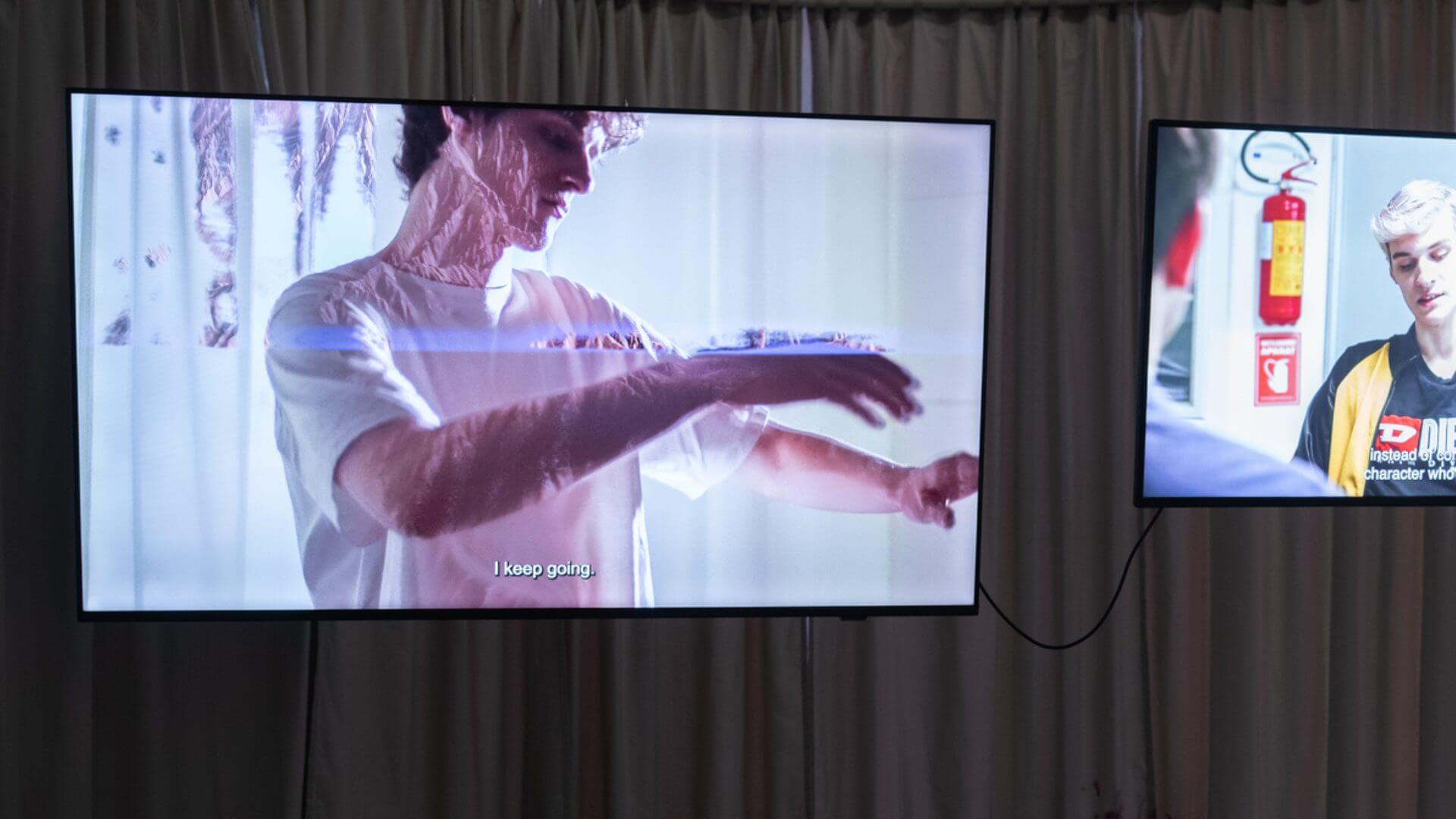
Exhibition view: “Cheers! So she goes”, Karlo Štefanek, curated by Leopold Rupnik, Galerija Miroslav Kraljević, Zagreb.

“Cheers! So she goes” by Karlo Štefanek, curated by Leopold Rupnik, at Galerija Miroslav Kraljević, Zagreb, 31/03/2026 – 5/4/2026.


Crossing a threshold usually means leaving something behind, a sound, a certainty, perhaps a version of oneself. But what happens when what lies beyond is already devoid of anchors? I pause for a moment before entering, as if hesitation might alter the texture of what awaits. A café: that is how the space presents itself. And yet, where is the warmth? Where the low murmur that reassures, the clinking that promises encounter? Everything here feels suspended, like a sentence abandoned mid-text, left unread. I wonder: how often do we speak without truly being present? How often does the gaze drift toward a screen instead of meeting another face? With these questions still hovering, I step into the exhibition by Karlo Štefanek, hosted at Galerija Miroslav Kraljević in Zagreb, curated by Leopold Rupnik.

The gallery unfolds as a carefully staged familiarity: tables and chairs arranged with the quiet logic of a place meant for gathering. Yet the flow of visitors never quite settles; bodies move cautiously, as if navigating a set that imitates sociability without sustaining it. On each table, a screen. On each screen, the artist, seated, still, looking directly outward. Not inviting, not rejecting, insisting. Though the settings of the videos vary, their emotional register remains constant: restrained, distant, cool to the touch. One might sit, perhaps, but never fully enter the scene. The interaction on offer hovers just out of reach. Even the memory of the TikTok Live performance, where viewers could type, respond, participate, dissolves into something curiously one-directional, like a voice note no one ever plays.

Štefanek constructs a precise apparatus here: the café, archetypal site of exchange, is emptied of its anthropological function and recast as a kind of Augéan non-place. Not an absence, but a defective presence. The artist’s gestures, repeated, almost mechanical, read as attempts launched into a void without reply. The effect is subtle yet persistent: a shared solitude that cannot quite be shared.

In the second segment, the exhibition tightens, becoming more intimate and more unsettling. The restroom, traditionally a site of privacy, turns into a chamber of multiplied identity. A video installation, partially generated with artificial intelligence, fractures the artist’s mirrored self-portrait into endlessly looping variations. The loop is not merely visual; it is cognitive. Empty phrases, slang, isolated exclamations accumulate like compulsively refreshed notifications. One feels the physical pull of the refresh cycle, the inability to stop. The restroom no longer shelters, it exposes. It becomes a liminal zone where the conditions of digital space, confession, display, surveillance, bleed into the physical world.

Sound permeates the exhibition like an inescapable undercurrent. Audio fragments sourced from TikTok coalesce into a fractured narrative: a breakup, an ending. Yet the interlocutor is not human. Archie, this is the name of the entity, is an artificial intelligence with whom the artist sustains, and then terminates, a relationship. The tone wavers between tenderness and irony. If the most attentive listener is a system designed to simulate care, what remains of our emotional exchanges? The work opens onto a broader reflection on contemporary digital production, where presence is engineered and comfort often rehearsed.

The queer dimension runs throughout the exhibition, not as declaration, but as method. It resides in the construction of alter egos, in linguistic choices, in visual codes. Thirst-trap aesthetics, meme culture, and subtle references to shared yet fragmented communities become critical tools. Štefanek stages a tension: the internet as a space of self-invention and liberation, versus its gradual capture by extractive, normative systems. Queer identities, once fluid and exploratory, risk being streamlined into consumable templates, selected, curated, and promoted according to their compatibility with dominant structures. In this light, the characters embodied by the artist appear hollowed out, like vessels awaiting external scripts.

And yet, the exhibition resists closing in on despair. In its details, the IKEA-colored furniture, the tonal shifts of language, the repetition of gestures, there is a quiet, granular form of resistance. A suggestion that even within the system, something slips through.

I leave with a feeling that resists easy naming. Not melancholy, not quite unease. More like an echo, a voice that continues after the screen has gone dark. Perhaps that is what lingers: not the content of the messages, but their aftersound. And the question, still unresolved: are we truly alone, or simply too connected to notice?

 
Exhibition view: “Cheers! So she goes”, Karlo Štefanek, curated by Leopold Rupnik, Galerija Miroslav Kraljević, Zagreb.