Capital cannot, by itself, explain artistic meaning. But it shapes the conditions in which art is produced, encountered, and remembered.
Art history is often narrated as a succession of movements, singular artists, and formal revolutions. That account is indispensable, but incomplete. An economic history runs alongside it, concerned not only with who could afford to make or commission art, but with who controlled its circulation, its public recognition, and ultimately its place in cultural memory. The surviving record is not a neutral inventory of everything that was created.
Why did the Renaissance flourish in cities built on trade and banking? How did the seventeenth-century Dutch Republic develop such an extensive market for painting? What allowed Paris to become the center of nineteenth-century modernity, and what conditions later enabled New York to assume a comparable position? Why can a painting command its highest price a century after its creator’s death?
These questions demand more than a comparison between economic prosperity and artistic achievement. Capital does not pass directly into innovation. It operates within systems of patronage, commerce, political authority, and institutional recognition, each governed by different interests and constraints. A powerful patron may support extraordinary work without granting its maker intellectual independence. An expanding market may create opportunities while exposing artists to greater competition and economic insecurity. Rising asset prices may generate considerable wealth for collectors without improving the material circumstances of those producing art.
The relationship between economic development and artistic production is therefore neither linear nor predictable. Prosperity does not guarantee innovation, just as financial crises do not necessarily extinguish experimentation. Artistic invention, commercial valuation, and historical recognition follow different trajectories, often unfolding across generations and under radically different economic conditions.
This essay examines how the accumulation and distribution of wealth have influenced artistic production across centuries, from ancient systems of patronage to contemporary financial markets. Particular attention is given to the material resources available to artists, the degree of independence afforded by different economic arrangements, the structures that facilitate recognition, and the institutions responsible for preserving and interpreting cultural production.
The central question is not whether capital creates great art, but how different configurations of economic power expand certain artistic possibilities, restrict others, and influence what subsequent generations come to recognize as historically significant.
ART AND MONEY: WHAT THE ECONOMIC EVIDENCE SHOWS
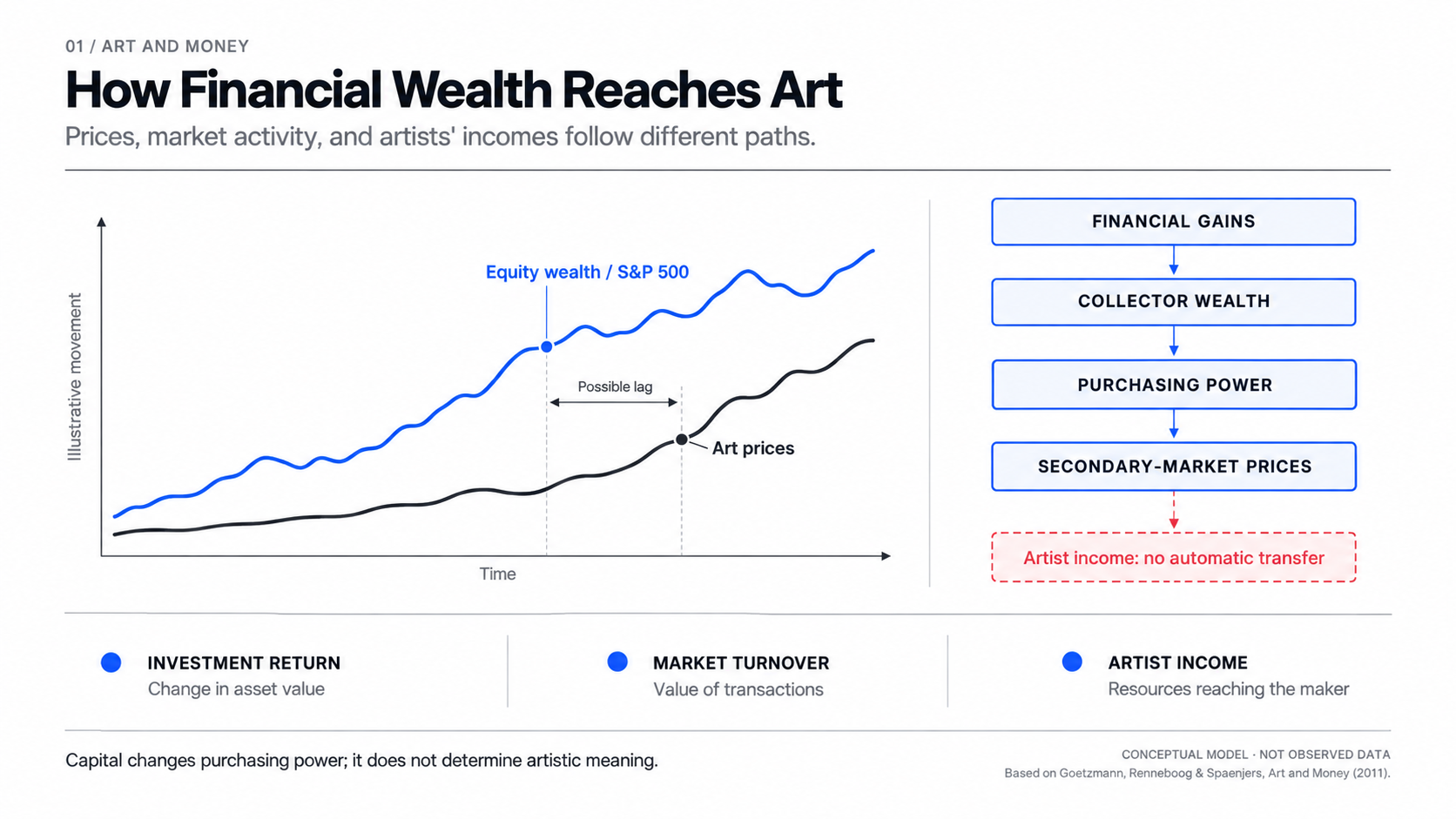
In their 2011 study Art and Money, William N. Goetzmann, Luc Renneboog, and Christophe Spaenjers examine the relationship between financial markets, income distribution, and art prices. Their findings identify significant associations between equity-market returns and art valuations, including effects that emerge with a delay. They also establish a long-run relationship between art prices and incomes at the upper end of the wealth distribution, suggesting that the concentration of purchasing power can be as consequential as broader economic growth.
This relationship reveals an important characteristic of the art economy. Demand for scarce and historically established artworks is disproportionately influenced by a relatively small population of wealthy buyers. Financial expansion can therefore increase competition for existing works without producing a corresponding improvement in the economic circumstances of practicing artists. The appreciation of an artwork may benefit its current owner while generating no direct income for its creator.
A subsequent study by Renneboog and Spaenjers, Buying Beauty (2013), examines more than one million auction transactions involving paintings and works on paper. Using a quality-adjusted price index, the authors estimate an average annual real appreciation of 3.97% between 1957 and 2007, alongside substantial volatility and differences across artistic categories. The figure describes the historical development of prices within the study’s sample, rather than a return uniformly available to collectors. Transaction costs, limited liquidity, and the selective visibility of successful auction sales further complicate any comparison with conventional financial assets.
These findings establish an economic relationship without providing a comprehensive explanation of artistic development. The price of an artwork reflects conditions of supply and demand, but it cannot independently measure artistic significance. Similarly, the aggregate turnover reported by auction houses and galleries describes market activity rather than the appreciation of individual works or the distribution of income among artists.
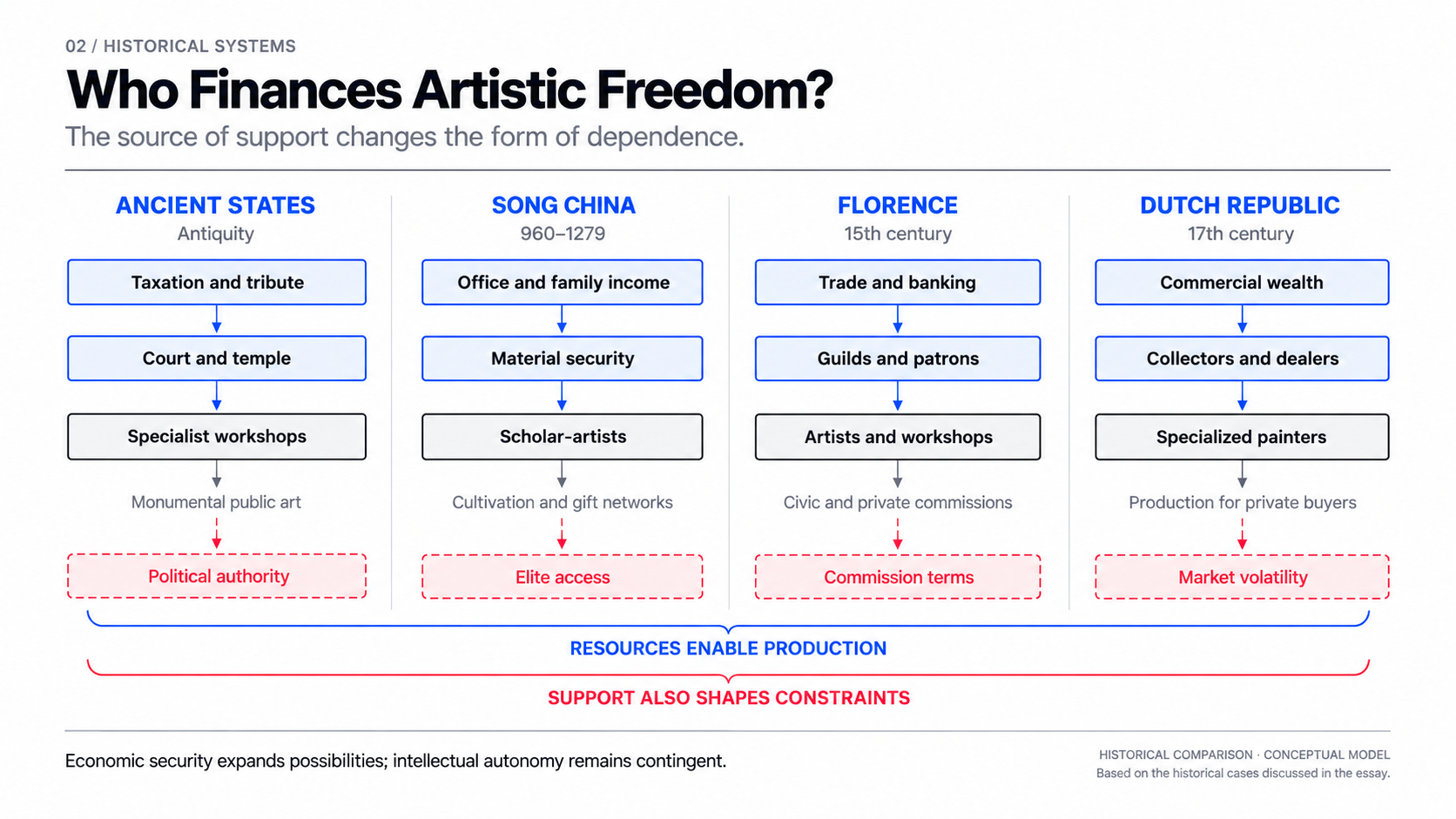
The distinction becomes particularly important when examining art across historical periods. Economic resources influence the capacity to produce, while markets and institutions affect the circulation, valuation, and preservation of what has been created. The mechanisms connecting these processes vary considerably. Understanding their differences requires looking beyond prices to the organization of artistic labor, the interests of patrons, and the structures of authority that determine how cultural production is sustained.
ANCIENT CIVILIZATIONS: WEALTH, POWER, AND ARTISTIC PRODUCTION
Long before the emergence of anything resembling a modern art market, monumental artistic production depended on the capacity of organized societies to mobilize resources beyond immediate subsistence. Temples, palaces, sculpture, and elaborate decorative programs required specialized labor, access to materials, technical knowledge, and administrative systems capable of sustaining complex projects over extended periods.
In Mesopotamia and ancient Egypt, these conditions were closely associated with the concentration of political and religious authority. Resources accumulated through agriculture, taxation, tribute, territorial expansion, and systems of compulsory labor could be directed toward constructions intended to embody the permanence and legitimacy of ruling institutions. The palace reliefs commissioned under Ashurnasirpal II at Nimrud offer a particularly revealing example. Their representations of military conquest, royal ceremony, and supernatural protection translated the authority of the Assyrian state into an extensive visual program. Economic resources financed their execution, while their imagery reinforced the political order responsible for mobilizing those resources.
The relationship between patronage and artistic production was nevertheless more complex than a straightforward exchange of wealth for objects. Egyptian craftsmen commonly worked within hierarchical workshops associated with royal, religious, or elite institutions. Their activities were governed by established conventions, functional requirements, and systems of supervision. Yet these constraints did not eliminate technical sophistication or the possibility of invention within inherited visual traditions. The modern conception of the artist as an autonomous individual pursuing an independent creative vision cannot be applied to such societies without qualification.
Classical Greece introduced different arrangements of patronage and artistic reputation. Civic commissions, religious sanctuaries, political rivalry, and the growing prestige of individual sculptors created opportunities for artistic distinction. The relationship between the maker and the commissioner also evolved over time, particularly as prominent artists acquired recognition beyond the authority of a single city or patron.
Roman expansion generated another configuration. Imperial wealth, private collecting, and demand for decorative sculpture supported extensive networks of workshops and specialized production. The reproduction and adaptation of celebrated Greek models became an important part of this economy. Such practices should not be understood simply as evidence of diminished artistic invention. Roman patrons and craftsmen frequently reinterpreted earlier forms according to new architectural settings, political purposes, and cultural expectations. The circulation of established models could itself become a means of producing new meanings.
These examples reveal that economic capacity alone offers little indication of the freedom available to those responsible for artistic production. Concentrated resources could sustain extraordinary technical and aesthetic achievements within restrictive political systems. Broader markets could create opportunities for specialization while introducing new forms of competition and dependence.
The historical relationship between wealth and art therefore begins with an important asymmetry. Those who controlled the resources necessary for production often exercised considerable influence over the purposes, subjects, and public visibility of the resulting works. Artistic achievement developed within these arrangements, sometimes reinforcing their authority and sometimes extending beyond their original intentions. Economic power shaped the possibilities of production, but the significance of what was produced cannot be reduced to the interests that financed it.
LEISURE AS CAPITAL: THE LITERATI OF SONG CHINA
During the Song dynasty (960–1279), China developed an influential culture of scholar-officials for whom painting, calligraphy, and poetry became integral to intellectual life. The expansion of education and the civil service examination system helped establish a class whose social standing depended substantially on scholarly achievement and administrative service. Unlike professional painters who relied on commissions or the sale of their work, members of this elite could pursue artistic activity while deriving their livelihood from official appointments, family resources, or inherited social position.
This distinction had significant consequences for the conception of artistic value. Among the Northern Song literati, particularly in the intellectual circle associated with Su Shi (1037–1101), painting increasingly became a means of expressing personal cultivation, intellectual judgment, and individual sensibility. The emphasis shifted away from technical resemblance as the principal measure of achievement. Brushwork, spontaneity, and the relationship between painting and calligraphy acquired importance as expressions of the maker’s cultivated mind. Artistic distinction could therefore be established according to criteria that extended beyond technical accomplishment or immediate commercial demand.
The relative freedom enjoyed by these scholar-artists was nevertheless inseparable from their position within a privileged social order. Their capacity to devote time to artistic inquiry depended on access to education, material security, and networks of political and cultural influence. Independence from commercial production did not imply independence from institutional authority or social expectations. The distinction between scholarly and professional painting also established hierarchies of prestige, elevating certain forms of cultural expression while potentially diminishing the recognition accorded to artists whose livelihoods depended on their craft.
Artistic activity consequently became a means of reinforcing social relationships and cultural authority. Paintings and calligraphic works circulated among scholars as gifts, expressions of friendship, and demonstrations of intellectual affinity. Their significance was not necessarily determined by a monetary transaction, yet their circulation could strengthen reputations and consolidate positions within influential networks. Economic capital had helped establish the conditions for artistic leisure, while cultural accomplishment could, in turn, become a source of social distinction.
These relationships evolved considerably during the Ming dynasty (1368–1644). Commercial expansion, particularly in prosperous urban centers such as Suzhou, encouraged the growth of private collecting and a more extensive market for painting and calligraphy. Wealthy merchants increasingly sought access to the cultural prestige associated with scholarly traditions, while artists connected to those traditions encountered new opportunities for patronage and commercial support. The boundaries between amateur cultivation and professional artistic production became increasingly permeable.
The career of Wen Zhengming (1470–1559) illustrates the complexity of this development. Although celebrated as an exemplar of literati culture, he also relied on artistic production for his livelihood. His position challenges any rigid separation between intellectual independence and economic participation, suggesting that the social identity of the scholar-artist could coexist with the practical demands of an expanding market.
The Chinese experience therefore complicates the assumption that artistic development follows commercial demand. Certain forms of artistic inquiry flourished within social groups whose economic security was established independently of art sales. Over time, the cultural prestige generated within those circles became increasingly attractive to collectors whose wealth originated elsewhere.
The more consequential distinction concerns the relationship between material security and intellectual autonomy. Freedom from immediate commercial pressure can create opportunities for sustained experimentation, but it does not eliminate dependence on the social structures that make such freedom possible. The conditions that allow an artistic language to develop may also determine who is entitled to practice it, whose work receives recognition, and how its value is subsequently understood
FLORENCE: WHEN BANKING FINANCES FORM
Fifteenth-century Florence developed one of the most influential artistic cultures of the Renaissance within an economy sustained by textile manufacturing, international commerce, and sophisticated banking networks. The accumulation of wealth among merchant families created substantial resources for artistic patronage, while the city’s political and religious institutions supported an extensive system of public commissions. The Medici became the most prominent expression of this relationship. Their financial power enabled them to support artists, architects, and humanist scholars, contributing to a cultural environment in which artistic achievement acquired considerable political and social significance.
Yet the Florentine Renaissance cannot be understood as the consequence of private wealth alone. Guilds, religious confraternities, civic authorities, and competing families participated in financing artistic production. Their commissions operated within an established network of workshops, apprenticeships, technical knowledge, and professional competition. The celebrated contest for the bronze doors of the Florence Baptistery in 1401, organized by the Arte di Calimala, illustrates how commercial institutions could become direct participants in the development of artistic culture. The rivalry between Lorenzo Ghiberti and Filippo Brunelleschi took place within a system in which collective resources supported public ambition and provided opportunities for individual distinction.
The economic function of patronage extended beyond the production of prestigious objects. For families such as the Medici, artistic commissions helped consolidate social authority within a republic where political influence was exercised through complex networks of personal allegiance and institutional relationships. Architecture, religious foundations, and public works could communicate civic devotion while strengthening the position of their benefactors. Cultural expenditure was therefore connected to the conversion of commercial wealth into forms of legitimacy that money alone could not automatically secure.
These arrangements also shaped the circumstances in which artists worked. A commission provided financial support and access to materials, specialized labor, and ambitious projects, but frequently imposed expectations concerning subject matter, function, and public presentation. The relationship between patron and artist involved negotiation rather than unrestricted creative freedom. Nevertheless, the concentration of commissions and the circulation of technical knowledge allowed exceptional innovations to develop within these constraints.
The experiments in linear perspective associated with Brunelleschi, the sculptural investigations of Donatello, and the pictorial achievements of Botticelli emerged from a culture in which artistic practice intersected with mathematics, humanist scholarship, classical antiquity, and evolving ideas about the status of the maker. These developments cannot be attributed directly to banking wealth. Their significance lies partly in the way individual invention transformed the possibilities offered by existing institutions. The growing intellectual recognition of artists, which became increasingly pronounced during the Renaissance, was neither an immediate nor an inevitable consequence of their patrons’ prosperity.
A comparison with the imperial workshops established under Akbar in sixteenth-century Mughal India reveals a different expression of concentrated economic power. Akbar’s court brought together painters trained in Persian, Indian, and other artistic traditions, supporting collaborative manuscript production and the development of a distinctive visual language. The resulting synthesis emerged from exchanges among artists operating within a highly organized imperial institution. Unlike Florence’s relatively distributed system of civic and private patronage, the Mughal atelier depended more directly on centralized royal authority. Both environments supported artistic innovation, but the organization of resources and the relationships between patrons and makers differed substantially.
Florence demonstrates how economic prosperity can sustain a complex artistic environment without determining the direction of its intellectual development. Banking and commerce provided resources, while institutions, professional networks, political competition, and individual experimentation shaped how those resources were used. Patronage could reinforce existing hierarchies even as the works it supported transformed artistic conventions.
The historical importance of this relationship lies in the interaction between economic capacity and artistic agency. Wealth could enlarge the scale of commissions and sustain the transmission of knowledge, but the emergence of new artistic forms depended on processes that exceeded the intentions of those who financed them.
AMSTERDAM: THE EMERGENCE OF A PRIVATE ART MARKET
During the seventeenth century, the Dutch Republic became one of Europe’s most prosperous commercial economies, supported by maritime trade, financial innovation, and an extensive network of international exchanges. Amsterdam emerged as a major financial center, with institutions such as the Dutch East India Company, established in 1602, contributing to the expansion of commercial capital. This prosperity was inseparable from colonial expansion and systems of exploitation that extended across Asia, Africa, and the Americas. Within the Republic, however, the distribution of purchasing power among merchants, professionals, and urban households created conditions for an unusually extensive market for paintings.
Unlike artistic economies dominated by royal courts or ecclesiastical institutions, the Dutch market increasingly accommodated works produced for buyers who were not known in advance. Portraits, landscapes, domestic interiors, still lifes, and genre scenes circulated among collectors whose interests reflected the culture of an expanding urban society. The growth of private demand altered the organization of artistic labor. Painters could pursue recognizable specializations, develop distinctive styles, and compete for customers without relying exclusively on individual commissions.
The scale of production was extraordinary. Historical estimates suggest that millions of paintings were produced in the Dutch Republic during the seventeenth century, although precise figures remain uncertain. Surviving inventories indicate that paintings appeared in households across a relatively broad social spectrum, with considerable differences in price, quality, and subject matter. The works preserved in major museums represent only a small and highly selective portion of this historical production. Much of the market consisted of inexpensive paintings intended for ordinary domestic consumption, revealing an artistic economy considerably more extensive than the achievements of its most celebrated figures might suggest.
Competition encouraged experimentation, but also created incentives for repetition and standardization. Artists sought recognizable subjects and commercially viable methods of production, while dealers and other intermediaries expanded the circulation of works. The concentration of painters, workshops, and customers in cities such as Amsterdam, Haarlem, and Leiden facilitated exchanges of technical knowledge and artistic ideas. Commercial specialization could support the development of distinctive visual languages, although responding to established demand could also discourage departures from familiar conventions.
The durability of paintings introduced a further economic complication. Unlike goods consumed or exhausted through use, artworks could remain in circulation for generations. As collections accumulated, existing paintings increasingly competed with newly produced works. Auctions, inheritance, and the resale of private collections contributed to an expanding secondary market. By the later seventeenth century, changes in consumer preferences, economic instability, and the growing availability of existing works placed additional pressure on painters. The decline in demand cannot be attributed to overproduction alone, since the changing priorities of Dutch consumers also influenced the market.
The careers of Rembrandt and Vermeer reveal different dimensions of this vulnerability. Rembrandt achieved considerable recognition and commercial success, maintained an active workshop, and participated in a sophisticated network of collectors and patrons. Nevertheless, substantial debts and financial difficulties culminated in the liquidation of his possessions in 1656. Vermeer followed a different trajectory. His relatively limited production attracted appreciation within a more restricted circle of buyers, while his activities as an art dealer provided an additional source of income. The economic crisis associated with the wars beginning in 1672 severely disrupted his circumstances, and he died in debt in 1675. Neither artistic achievement nor contemporary recognition provided reliable protection against financial instability.
A revealing comparison can be found in the commercial woodblock-print industry of Edo-period Japan, particularly during the eighteenth and nineteenth centuries. Publishers coordinated the work of designers, engravers, and printers, financing images intended for an expanding urban audience. Reproducible printing techniques enabled circulation on a scale fundamentally different from that of individual paintings. Yet this broader distribution placed considerable influence in the hands of publishers, whose decisions shaped subjects, production costs, and access to consumers. Commercial expansion created opportunities for artistic distinction while preserving significant inequalities in economic control.
The Dutch experience demonstrates that the expansion of an art market can transform both the possibilities and the constraints of artistic production. A broader population of buyers may reduce dependence on traditional patrons, but it introduces exposure to competition, fluctuating demand, and changing consumer preferences. Economic prosperity can sustain an exceptionally productive artistic culture without ensuring financial security for those working within it.
The emergence of a private market therefore represents more than a change in who purchased art. It marks a transformation in the relationship between artistic invention and economic uncertainty. As artists gained opportunities to produce beyond the instructions of individual patrons, they also confronted the unpredictable judgments of a market whose commercial priorities could differ substantially from their own artistic ambitions.
PARIS, MONET, AND THE MODERN ECONOMY OF RECOGNITION
During the nineteenth century, the expanding commercial art market gradually altered the relationship between artistic production and public recognition. The authority of official exhibitions and established institutions was increasingly challenged by private dealers capable of supporting artists whose work had not yet achieved widespread acceptance. These intermediaries provided more than access to buyers. By acquiring works, organizing exhibitions, cultivating collectors, and developing relationships with critics, they could help establish the conditions under which unfamiliar artistic approaches became commercially viable.
The emergence of this system changed the economics of artistic experimentation. A dealer willing to acquire works before a substantial market existed could absorb part of the financial uncertainty surrounding an artist’s practice. Such support could allow production to continue without immediate public approval. Yet the dealer also acquired considerable influence over the circulation, presentation, and pricing of those works. The development of an alternative to official patronage did not eliminate economic dependence. It introduced a different relationship between artistic ambition and commercial mediation.
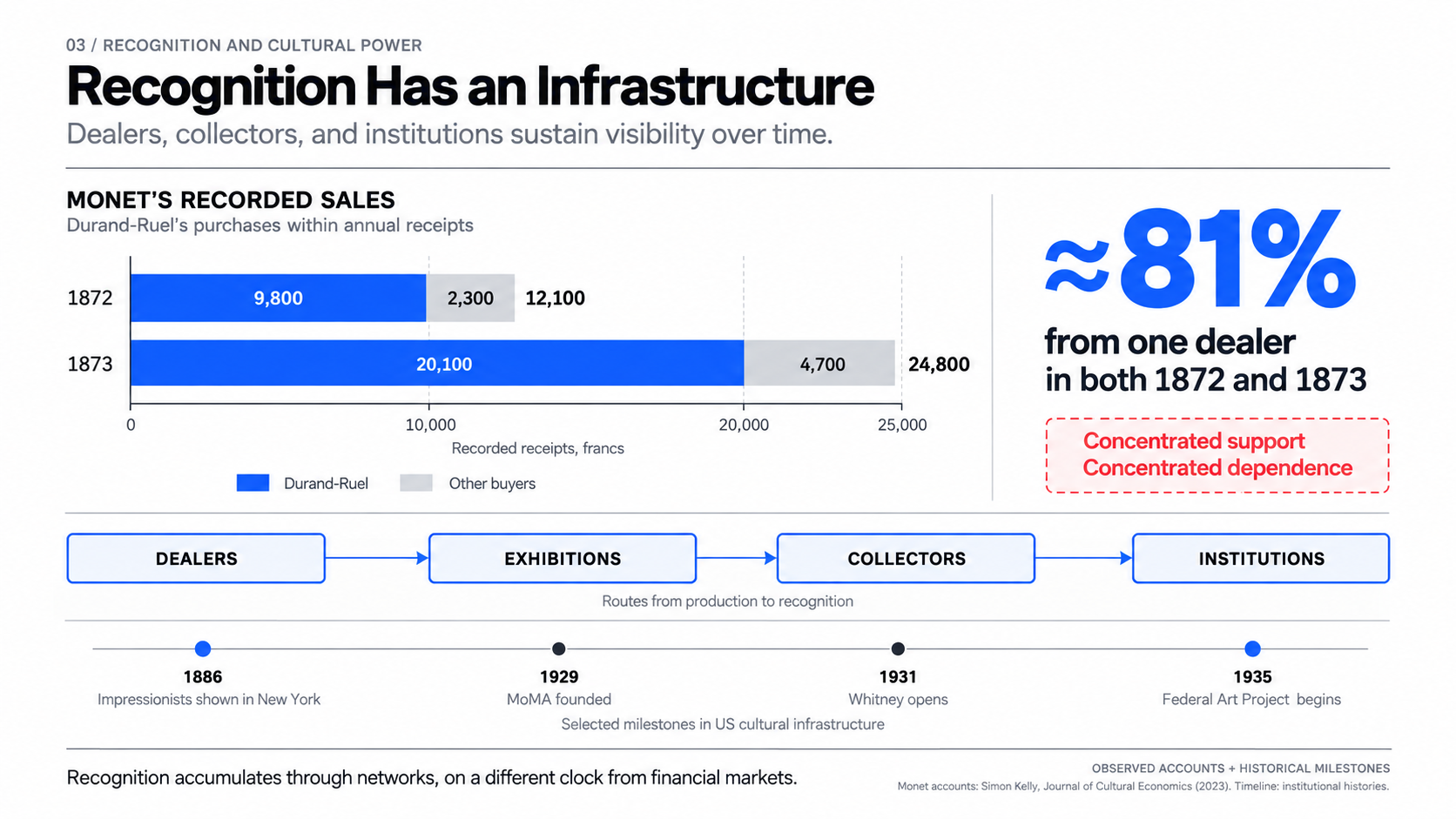
Claude Monet’s career provides unusually detailed evidence of this transformation. In a study published in the Journal of Cultural Economics in 2023, Simon Kelly examined the artist’s surviving account books, documenting his commercial development between 1872 and 1912. In 1872, Paul Durand-Ruel accounted for 9,800 francs of Monet’s recorded sales receipts, approximately 81% of the annual total of 12,100 francs. The following year, the dealer purchased works worth 20,100 francs out of 24,800, again representing approximately 81%.
These figures reveal the extent to which Monet’s early commercial position depended on a single intermediary. Durand-Ruel’s financial difficulties during the 1870s consequently exposed the artist to considerable instability. Monet continued to rely on a relatively small circle of supporters, frequently selling works at modest prices or accepting advances to meet immediate expenses.
From the 1880s onward, the relationship between artist and dealer became part of a broader commercial development. Durand-Ruel organized exhibitions dedicated to Monet and worked to establish an international clientele, particularly in the United States. His exhibition of Impressionist painting in New York in 1886 contributed to the expansion of American interest in the movement. The geographical diversification of demand gradually reduced the limitations of a market concentrated in Paris, allowing works that initially struggled for recognition to acquire value among a wider population of collectors.
Monet was not merely a passive beneficiary of this process. His correspondence and account books reveal an increasingly deliberate approach to the commercial organization of his career. He cultivated relationships with competing dealers, resisted arrangements that might leave him dependent on a single buyer, and negotiated the prices of his paintings with growing confidence. Commercial independence developed through the diversification of intermediaries rather than their disappearance.
His artistic practice also contributed directly to this development. Beginning in the 1890s, Monet’s systematic exploration of recurring subjects, including haystacks, poplars, and the façade of Rouen Cathedral, introduced a distinctive relationship between individual paintings and the larger body of work to which they belonged. Variations in light, atmosphere, and perception formed the basis of an artistic investigation that could also be presented and acquired as a coherent series.
The commercial importance of this approach was substantial. Kelly’s research indicates that Monet’s rising income depended primarily on increasing prices for individual paintings rather than a sustained expansion in the quantity sold. By the early twentieth century, the artist had achieved considerable wealth, supported by a sophisticated network of dealers and an international collecting public. His growing financial success accompanied an artistic practice whose distinctive methods had become central to its critical recognition.
The relationship between Monet and his market therefore resists a simple opposition between artistic autonomy and commercial influence. Dealers provided essential infrastructure, but the artist actively negotiated his position within that system. His formal innovations also affected the organization and valuation of his production, demonstrating that the relationship between artistic invention and economic development could operate in both directions.
Monet’s career reveals how recognition may develop through an extended interaction between artistic achievement, commercial strategy, and institutional change. The market did not invent Impressionism, but its emerging infrastructure helped transform an initially contested artistic position into an internationally established one. The financial value eventually attached to Monet’s paintings was the result of a prolonged historical process, shaped by circumstances that neither the artist nor his intermediaries could have entirely anticipated.
FROM PARIS TO NEW YORK: THE GEOGRAPHY OF CULTURAL POWER
The emergence of New York as a leading center of modern art during the twentieth century was closely connected to the changing distribution of economic and geopolitical power. Its ascent, however, cannot be reduced to the transfer of financial dominance from Europe to the United States. The development of a major artistic center required the gradual formation of institutions, collecting networks, professional relationships, and cultural ambitions capable of sustaining artistic production and recognition.
American industrial expansion during the late nineteenth and early twentieth centuries generated substantial private fortunes, some of which were directed toward collecting European art and establishing cultural institutions. New York’s growing financial importance supported an increasingly sophisticated art market, although Paris continued to occupy a central position in the development and international recognition of modern artistic movements.
Evidence from the commercial archives of the Knoedler gallery provides an important perspective on this transition. In research published online in 2025, Federico Etro and Elena Stepanova examined transactions recorded between 1870 and 1970, identifying a growing demand for American art beginning in the 1920s. This development preceded the international prominence of Abstract Expressionism and suggests that the commercial foundations of New York’s later cultural influence were established over several decades. The findings concern the activity of a particular gallery and do not independently establish a causal relationship between market demand and artistic innovation. They nevertheless reveal a significant change in the economic environment in which American artists operated.
Institutional development followed a related but distinct trajectory. The Museum of Modern Art was founded in 1929 through the initiative of patrons including Lillie P. Bliss, Mary Quinn Sullivan, and Abby Aldrich Rockefeller. The Whitney Museum of American Art, established by Gertrude Vanderbilt Whitney in 1930 and opened the following year, emerged from a commitment to supporting American artists who had struggled to gain recognition within established institutions.
Both institutions took shape during the economic upheaval surrounding the Great Depression. Their emergence illustrates an important temporal distinction: accumulated private wealth can continue to finance cultural infrastructure even when the economy enters a period of contraction. Institutional patronage may reflect resources and ambitions formed during earlier phases of prosperity rather than the immediate direction of financial markets.
The significance of these museums extended beyond their purchasing power. Their exhibitions, collections, publications, and curatorial decisions contributed to the construction of cultural authority. Financial resources supported organizations capable of influencing which artistic practices received sustained attention and how they were subsequently interpreted. The conversion of economic wealth into institutional influence was therefore an important component of New York’s growing cultural position.
The Second World War accelerated transformations already underway. The displacement of European artists and intellectuals brought new artistic experiences and theoretical perspectives into contact with an established American cultural environment. After 1945, the United States occupied a position of exceptional economic and geopolitical influence, while New York increasingly concentrated the galleries, museums, critics, and collectors associated with advanced artistic production.
The international recognition of Abstract Expressionism developed within this environment. Figures such as Jackson Pollock, Willem de Kooning, and Mark Rothko came to occupy increasingly prominent positions, although their individual careers followed different economic trajectories. Critical recognition did not immediately translate into comparable financial success, and the substantial posthumous appreciation of certain works belonged to a later phase of market development.
The international circulation of American art also acquired political significance during the Cold War. Exhibitions supported by institutions such as the Museum of Modern Art contributed to the presentation of Abstract Expressionism as an expression of cultural freedom. These geopolitical associations formed part of the movement’s international reception, but they cannot adequately explain its artistic invention or reduce the intentions of individual artists to the interests of the institutions promoting them.
New York’s rise was therefore neither an abrupt displacement of Paris nor an automatic consequence of American financial supremacy. Commercial demand, institutional investment, intellectual migration, and geopolitical influence developed according to different timelines, eventually reinforcing one another.
The broader historical implication concerns the geography of recognition itself. Artistic centers do not emerge solely where innovative works are produced. They develop where sufficient resources and institutional authority converge to sustain production, organize circulation, and establish forms of recognition that extend beyond local audiences. The ability to influence art history depends partly on the capacity to shape the institutions responsible for interpreting and preserving it.
ECONOMIC CRISIS DOES NOT END CULTURAL PRODUCTION
The financial collapse of 1929 disrupted the economic conditions supporting artistic production across the United States. Declining private wealth, widespread unemployment, and the contraction of commercial activity reduced opportunities for artists whose livelihoods depended on commissions, sales, or private patronage. The consequences were severe, but the crisis did not bring artistic experimentation to an end.
The New Deal introduced an alternative mechanism for sustaining cultural activity through public expenditure. Established in 1935 under the Works Progress Administration, the Federal Art Project employed artists in painting, sculpture, design, education, and documentary work. At its peak, the program supported more than 5,200 artists, providing income while directing artistic labor toward projects associated with public institutions and community life.
The program altered the relationship between artistic production and economic demand. Artists could receive compensation for work whose immediate justification did not depend on attracting private collectors. Schools, libraries, public buildings, and community facilities became sites of cultural production, expanding the social destinations of artistic labor beyond the commercial market.
This arrangement did not guarantee unrestricted artistic freedom. Public employment involved administrative requirements, professional expectations, and forms of institutional supervision. Nevertheless, it provided a degree of material stability at a time when private opportunities were severely limited.
Jackson Pollock’s participation offers a particularly important example. From 1935 into the early 1940s, he worked under the Federal Art Project, receiving income that allowed him to continue painting during a period of considerable financial uncertainty. His artistic development was also shaped by encounters with Mexican muralism, Surrealism, and experimental artistic environments in New York. Public employment supported the continuation of his practice, but it cannot be identified as the singular cause of the innovations for which he later became recognized.
The distinction is essential. Artistic achievements that occur during economic crises should not be interpreted as evidence that economic deprivation stimulates creativity. Innovation may continue despite worsening material conditions, often because artists retain access to resources, institutions, or networks capable of sustaining their work.
The Federal Art Project demonstrates that the relationship between economic cycles and cultural production depends partly on political decisions about the allocation of resources. When private demand contracts, public intervention may preserve productive capacity that would otherwise be lost. It can also create different opportunities for participation and establish new relationships between artistic labor and the wider public.
Not every crisis generates such institutional responses, and public support cannot be assumed to compensate fully for the destruction of private income. Economic downturns may permanently damage artistic careers, interrupt the transmission of knowledge, and weaken institutions responsible for cultural preservation. Their consequences are unevenly distributed, with less-established practitioners often facing particularly limited alternatives.
The history of the Great Depression therefore complicates any attempt to derive artistic development directly from economic expansion or contraction. The availability of resources remains fundamental, but their distribution depends on institutions that may respond differently to the same economic shock.
A crisis can interrupt an established commercial system without extinguishing the artistic activity occurring within it. Whether that activity survives, changes direction, or disappears depends substantially on the economic and political arrangements available to support its continuation.
1989–1990: JAPANESE WEALTH REPRICES EUROPEAN ART
During the late 1980s, Japan experienced an extraordinary expansion of financial and property valuations. Rising equity prices, abundant credit, and escalating real-estate values generated substantial increases in apparent wealth, while the strength of the yen enhanced the purchasing power of Japanese buyers in international markets. Art became one of several assets attracting capital during a period characterized by intense speculation and confidence in continued economic expansion.
The Nikkei 225 reached a closing high of 38,915.87 on December 29, 1989, a level that would not be surpassed until February 2024. By that point, Japanese collectors and corporations had already become prominent participants in international auctions, particularly within the market for Impressionist and Post-Impressionist painting.
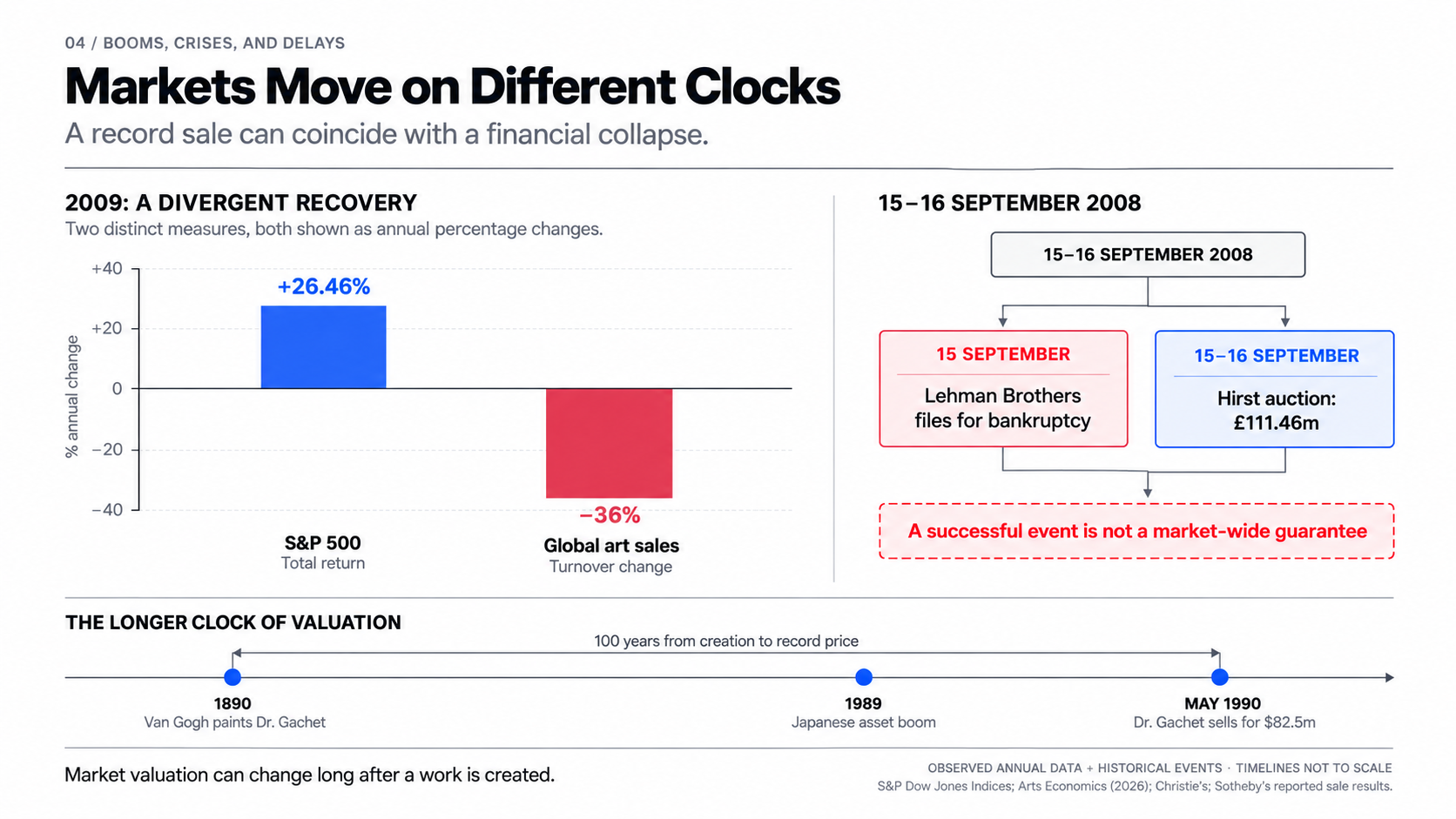
Two transactions in May 1990 captured the extraordinary scale of this demand. Japanese industrialist Ryoei Saito acquired Vincent van Gogh’s Portrait of Dr. Gachet for $82.5 million at Christie’s in New York. Two days later, he purchased Pierre-Auguste Renoir’s Au Moulin de la Galette for $78.1 million at Sotheby’s. The purchases established the two highest auction prices then recorded for paintings, with a combined expenditure of approximately $160.6 million.
The financial circumstances surrounding these acquisitions are especially revealing. Saito publicly acknowledged that he had borrowed money from a bank to finance the purchases. His ability to participate at such extraordinary price levels therefore depended not only on accumulated wealth, but also on access to credit.
This introduces an important distinction into the relationship between capital and art prices. Financial expansion can influence demand through rising disposable wealth, but also through the availability of borrowing. When asset valuations increase, the perceived strength of borrowers and the willingness of financial institutions to extend credit may expand accordingly. These mechanisms can amplify purchasing power without requiring an equivalent increase in immediately available income.
The Van Gogh transaction also reveals a profound separation between artistic production and subsequent economic valuation. Portrait of Dr. Gachet, painted in 1890, achieved its record price exactly a century later, under economic circumstances entirely different from those surrounding its creation. The Japanese financial boom had no role in producing the painting or establishing the artistic innovations associated with Van Gogh. It influenced the conditions under which an already historically recognized work could command an unprecedented sum.
The transaction transferred ownership of an existing artwork at a price determined by competition among contemporary buyers. Its financial magnitude was not evidence of a corresponding expansion in artistic production. Nor did it necessarily reflect a sudden transformation in the painting’s historical significance. A work whose cultural status had developed over decades became the object of an exceptionally concentrated expression of purchasing power.
The subsequent collapse of Japan’s asset-price bubble exposed the vulnerability of this market configuration. As financial conditions deteriorated, Japanese participation at the highest levels of international art collecting diminished, contributing to a broader contraction in demand. Prices and trading activity in affected segments declined, although the consequences varied across artists, categories, and regional markets.
The episode should not be interpreted as evidence that the established cultural value of Impressionist and Post-Impressionist painting disappeared when speculative demand receded. It illustrates the instability of the financial conditions governing particular transactions. Cultural recognition and market prices can develop in relation to one another without sharing the same degree of sensitivity to economic cycles.
The purchases made by Saito demonstrate how an artwork can acquire exceptional financial value within an economy far removed from the circumstances of its creation. Wealth concentration, currency movements, and access to credit can dramatically reshape what collectors are prepared to pay, even when the artistic object itself remains unchanged.
The historical significance of these transactions lies in their exposure of two different temporal systems. Artistic practices develop within particular cultural and material environments, while the financial valuation of their surviving works may be repeatedly transformed by economic forces operating decades or centuries later. The two histories intersect in the market, but neither can be understood as a simple extension of the other.
2008: DAMIEN HIRST AND THE FALL OF LEHMAN BROTHERS
On September 15, 2008, the day Lehman Brothers filed for bankruptcy, Sotheby’s opened Damien Hirst’s Beautiful Inside My Head Forever auction in London. Over two days, 218 of the 223 works offered were sold, generating approximately £111.46 million. The result was extraordinary, particularly given the financial turmoil unfolding beyond the auction room. It also represented an unusual departure from established commercial practice: Hirst had consigned newly produced works directly to an auction house, bypassing the conventional gallery structure responsible for placing an artist’s work with its first buyers.
The decision challenged an important distinction within the art economy. Galleries traditionally manage the primary market for living artists, cultivating collectors, establishing prices, and attempting to regulate the circulation of new works. Auction houses, by contrast, have historically played a greater role in the resale of existing objects. By introducing a substantial body of new production directly into a public auction, Hirst transferred the initial determination of prices to a competitive bidding environment.
This approach offered considerable financial advantages, but it also exposed the artist’s market to an unusually concentrated moment of public valuation. Prices that might otherwise have developed through negotiations with individual collectors were established simultaneously, under conditions of exceptional publicity. The auction became an event whose commercial significance extended beyond the works being sold, reinforcing the visibility of Hirst’s practice while testing the purchasing capacity of an international collecting audience.
Its timing has subsequently acquired almost symbolic significance. The collapse of Lehman Brothers marked a decisive moment in the global financial crisis, yet bidders continued to commit extraordinary sums to contemporary art. The apparent contradiction becomes less surprising when the different temporal structures of financial markets and art transactions are considered. The auction had been organized and promoted well before September 15. Collectors had encountered the works, formed expectations, and made purchasing decisions within a commercial environment shaped by the preceding years of market expansion.
The success of the sale therefore cannot be interpreted as evidence that the art market was insulated from the financial crisis. Equally, the coincidence with Lehman’s bankruptcy does not establish that the auction was directly affected by that day’s events. It demonstrates how an exceptional transaction can occur at the point when the economic conditions supporting its market are undergoing a fundamental transformation.
The subsequent performance of works acquired during the auction offers a more revealing perspective. A 2018 analysis by Artnet examined 19 lots that had returned to auction during the intervening decade. Seventeen achieved lower prices than at their original sale, with their combined resale value falling from approximately $8.1 million to $5.2 million. This sample represents only a small proportion of the original auction and cannot establish the subsequent performance of every work sold, much less the entirety of Hirst’s market. Nevertheless, it provides concrete evidence that the initial enthusiasm did not translate into sustained appreciation for every buyer.
The difference between the two moments of sale is economically significant. A successful initial placement demonstrates that buyers were willing to commit capital under a particular set of circumstances. It does not establish the liquidity or future resale value of the works acquired. The prices realized during a highly publicized event may reflect temporary concentrations of demand that cannot be reproduced when individual objects return to the market.
Hirst’s auction also complicates the relationship between artistic reputation and financial independence. By selling directly through Sotheby’s, he reduced his immediate dependence on established gallery intermediaries, but the transaction remained reliant on the auction house’s infrastructure, international clientele, and capacity to generate competition among buyers. Greater control over the route to market did not eliminate the influence of institutions on the formation of prices.
The episode reveals how artistic production, commercial positioning, and financial conditions can converge at a particular historical moment without sharing the same trajectory afterward. The extraordinary success of Beautiful Inside My Head Forever was real, as was the vulnerability subsequently exposed in parts of its resale market.
An exceptional transaction may represent the culmination of economic conditions already approaching their end. Its importance lies not only in the price achieved, but in the distinction it reveals between immediate market demand, the durability of commercial valuation, and the longer historical recognition of an artist’s work.
CHINA, TECHNOLOGY, AND NFTs: NEW FORTUNES, NEW MARKETS
The expansion of the Chinese art market during the early twenty-first century illustrates how changes in the geographical distribution of wealth can rapidly transform international cultural commerce. China’s economic development generated new concentrations of private capital, while the expansion of domestic auction houses and collecting networks created increasingly sophisticated channels for acquiring and exchanging artworks.
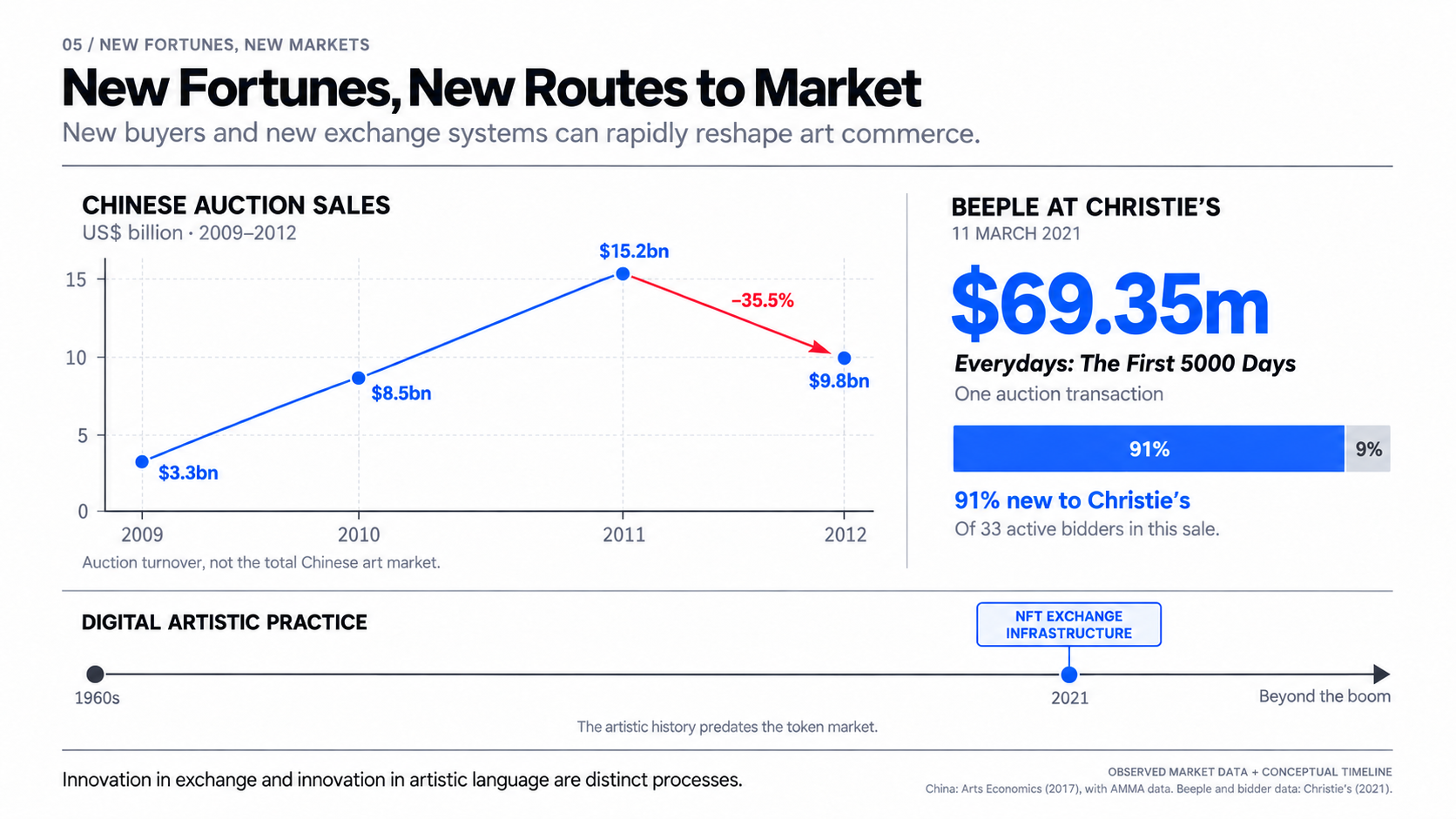
According to Arts Economics, Chinese auction sales increased from approximately $3.3 billion in 2009 to $15.2 billion in 2011, before contracting to around $9.8 billion in 2012. These figures refer to the Chinese auction market rather than the total value of all art transactions in the country. Nevertheless, the speed of the expansion was exceptional, demonstrating how a new concentration of purchasing power could alter the scale and international position of an established cultural market within a remarkably short period.
The development was not simply an extension of Western collecting practices into a new geographical territory. Chinese painting, calligraphy, ceramics, and other categories associated with the country’s cultural history occupied a substantial position within the market. The growth of private wealth interacted with established traditions of collecting, changing perceptions of cultural patrimony, and the emergence of powerful domestic commercial institutions.
The expansion also exposed the market to speculative behavior and financial instability. Rapid increases in auction turnover were accompanied by concerns about the reliability of reported transactions, including delayed payments and defaults among winning bidders. The subsequent contraction demonstrated that record prices and rising sales volumes could coexist with considerable uncertainty about the durability of demand.
The Chinese experience reveals how economic expansion may transform the commercial valuation of cultural objects without requiring a comparable transformation in the practices responsible for their original creation. New buyers, financial resources, and institutions can reorganize an existing market, sometimes at a pace far exceeding the development of the artistic traditions it represents.
A different configuration of economic and technological change emerged in the market for digital art. On March 11, 2021, Christie’s sold Beeple’s Everydays: The First 5000 Days for $69,346,250. The transaction brought an unprecedented level of financial attention to an artwork represented by a non-fungible token, demonstrating that digital production could command prices comparable to those associated with internationally established artists working in traditional media.
The sale did not mark the beginning of digital art. Artists had been experimenting with computational systems, algorithmic procedures, electronic images, and technological forms of expression since the middle of the twentieth century. By the 1960s, computer-generated works were already entering exhibitions and institutional collections. Subsequent developments in software, networks, interactive systems, and generative processes produced a substantial artistic history long before blockchain technology entered the cultural marketplace.
The innovation introduced by NFTs concerned the infrastructure of circulation and exchange. Blockchain systems made it possible to create transferable digital tokens associated with particular works, recording transactions and establishing publicly verifiable histories of token ownership. This mechanism offered collectors and artists a new framework for organizing the commercial exchange of digital production, including works whose underlying files could be copied and distributed without physical limitation.
The distinction between the artwork and its token remains fundamental. Ownership of an NFT does not automatically confer copyright, exclusive control over the associated digital image, or unrestricted rights of reproduction. Those rights depend on the applicable legal arrangements. Nor does the technical uniqueness of a token establish the artistic originality or historical significance of the work to which it refers.
What changed was the commercial infrastructure available to particular forms of digital production. Artists could distribute works through blockchain-based marketplaces, reach international collectors without relying exclusively on traditional gallery representation, and establish publicly accessible records of certain transactions. At the same time, the technology introduced new dependencies on platforms, blockchain networks, market liquidity, and the financial circumstances of participants.
The extraordinary expansion of the NFT market in 2021 cannot be separated from the wider cryptocurrency economy. Rising digital-asset valuations generated substantial purchasing power among participants whose wealth was often concentrated in cryptocurrencies. Speculative expectations encouraged rapid trading, while the accessibility of online marketplaces allowed new participants to enter a market that combined artistic collecting with financial risk.
The relationship between technological infrastructure and established cultural institutions was equally important. Christie’s participation in the Beeple sale connected collectors familiar with blockchain-based markets to the reputation and commercial authority of a major international auction house. According to the auction house, 91% of the active bidders in that sale were new to Christie’s. The figure illustrates the emergence of a substantially different collecting audience within that particular transaction, although it cannot be taken as representative of the entire NFT market.
The subsequent contraction of speculative demand exposed the vulnerability of valuations established during the boom. Prices and trading activity declined across significant portions of the NFT market as financial conditions and investor expectations changed. These developments affected the economic environment surrounding digital artworks, but they did not invalidate the artistic practices that had emerged before the speculative expansion or continued afterward.
The distinction is particularly important because innovation in the means of exchange does not necessarily coincide with innovation in artistic language. Blockchain technology introduced new possibilities for ownership records, distribution, and commercial organization, while certain artists also explored its technical and conceptual characteristics as material for artistic experimentation. These developments can reinforce one another, but they remain analytically distinct.
The Chinese art-market expansion and the NFT boom were different historical phenomena, involving different infrastructures, artistic traditions, and populations of buyers. Their comparison is useful because both reveal how rapidly newly accumulated wealth can reorganize the valuation and circulation of cultural objects. In China, expanding purchasing power intensified demand within established collecting traditions. In the NFT market, technological infrastructure enabled new forms of exchange for artistic practices whose histories were already well developed.
Both episodes demonstrate the importance of distinguishing the emergence of artistic value from the economic mechanisms responsible for its commercial recognition. Financial expansion can accelerate market development, attract new collectors, and establish extraordinary prices. The subsequent durability of those valuations depends on conditions that remain uncertain, while the historical significance of artistic production continues to develop beyond any individual period of market enthusiasm.
THE S&P 500 AND THE GLOBAL ART MARKET, 2009–2025
The relationship between financial markets and the art economy becomes more difficult to interpret when examined through aggregate data. Although stock-market performance and art sales are frequently discussed as indicators of the same economic environment, they measure fundamentally different phenomena. The S&P 500’s annual total return represents the performance of an equity index, including reinvested dividends. Global art-market turnover, by contrast, measures the estimated annual value of transactions involving art and antiques across dealers and auction houses. One describes investment performance; the other records commercial activity. A meaningful comparison must preserve this distinction rather than treating the two series as equivalent measures of financial appreciation.
The problem extends beyond methodology. Equity markets continuously reprice financial assets, while artworks change hands irregularly, often after years or decades of private ownership. An increase in art-market turnover may result from higher prices, a greater number of transactions, or the appearance of exceptionally valuable collections. Conversely, declining turnover may reflect a shortage of major consignments rather than a broad deterioration in the prices of individual works. The composition of what is sold can therefore influence aggregate results as much as changes in underlying demand.
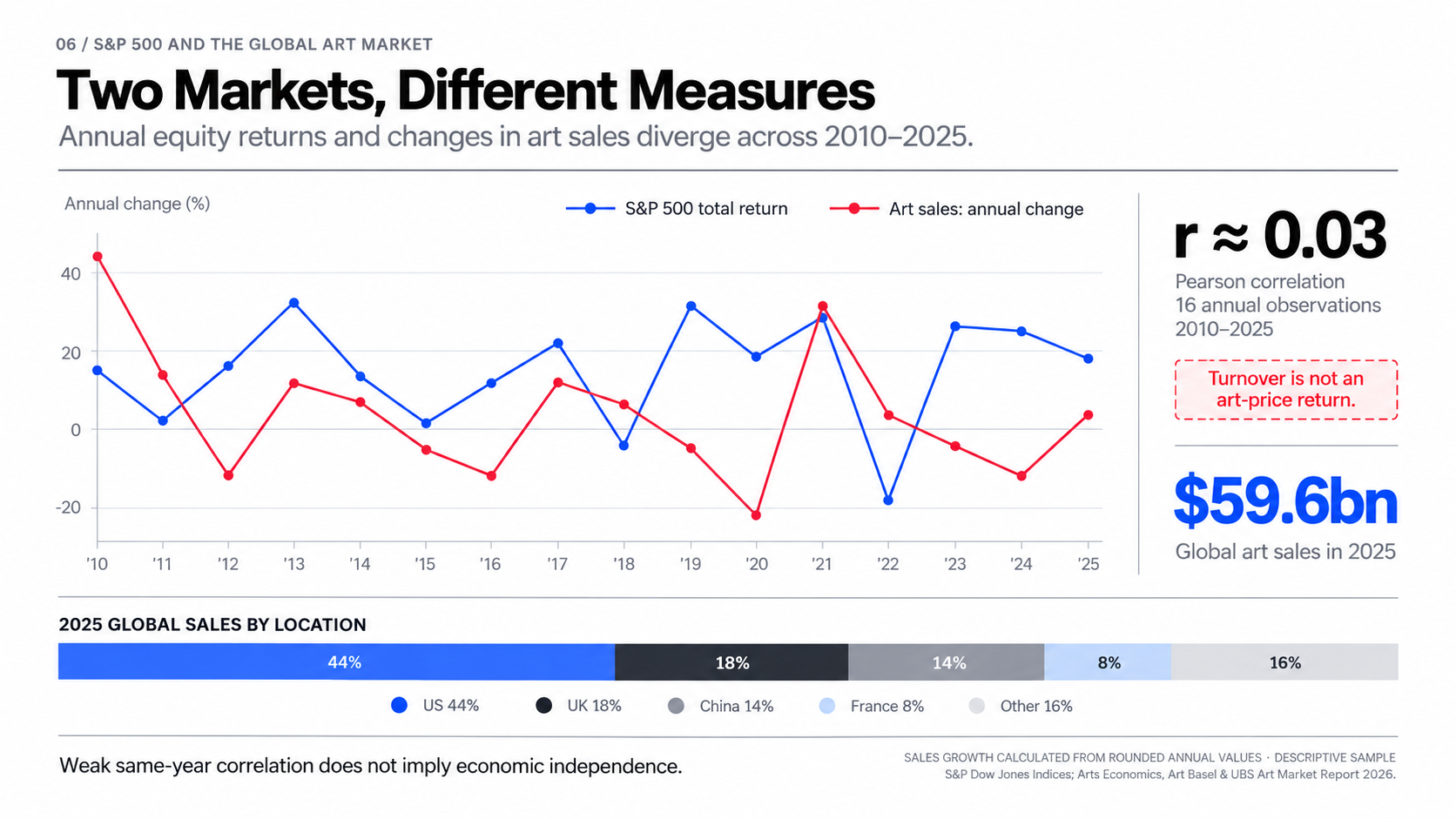
The historical figures illustrate this complexity. According to the Art Basel and UBS Global Art Market Report 2026, prepared by Arts Economics, worldwide sales of art and antiques were estimated at $39.5 billion in 2009, following the global financial crisis. Sales recovered to approximately $57.0 billion in 2010 and reached $67.7 billion in 2014. After further fluctuations, the market contracted to $50.3 billion in 2020, recovered to $66.1 billion in 2021, and reached $68.1 billion in 2022. Two consecutive years of declining sales followed, bringing the market to $57.5 billion in 2024 before a moderate recovery to $59.6 billion in 2025.
The trajectory differs considerably from that of American equities. The S&P 500 experienced a prolonged expansion after the financial crisis, interrupted by periodic corrections and the severe decline of 2022. Yet several of the strongest years for equities coincided with contractions in the global art market.
In 2020, the S&P 500 delivered a total return of 18.40%, despite the disruption caused by the pandemic. Global art sales, meanwhile, declined by approximately 22%. The closure of galleries, restrictions on international travel, and the interruption of major fairs and auctions reduced the market’s capacity to conduct transactions. Financial assets could continue trading through established electronic exchanges, while significant portions of the art economy depended on physical access, logistical coordination, and the confidence of collectors willing to undertake substantial acquisitions.
The divergence was equally visible in 2022, although in the opposite direction. The S&P 500 recorded a total return of -18.11%, while global art-market turnover increased by approximately 3%. Major collections and exceptional auction results contributed to aggregate sales at a time when financial markets were responding to inflation, monetary tightening, and deteriorating expectations for economic growth.
In 2023 and 2024, American equities again performed strongly, returning 26.29% and 25.02% respectively. Global art sales declined in both years, falling by approximately 4% in 2023 and 12% in 2024. The contraction was particularly pronounced at the high end of the market, where fewer exceptional consignments reduced aggregate values even as transaction activity in more accessible price segments remained comparatively resilient.
These observations challenge any assumption that rising equity prices produce an immediate and proportional increase in art-market activity. They do not, however, establish that the two markets are economically independent.
A simple Pearson correlation between annual S&P 500 total returns and annual percentage changes in global art-market turnover over 2010–2025 produces a coefficient of approximately 0.03, using the rounded annual sales figures published by Arts Economics in 2026. The result indicates an almost nonexistent contemporaneous linear relationship within this particular sample. It is based on only sixteen annual observations and should be interpreted as a descriptive calculation rather than a comprehensive statistical explanation.
Several limitations are important. The S&P 500 represents large American companies, while art-market turnover reflects transactions across multiple countries and currencies. Equity returns and changes in sales revenue respond differently to inflation, exchange rates, and shifts in market composition. Moreover, annual observations may conceal delayed relationships between financial gains and collecting activity. A rise in the value of financial portfolios may influence purchasing decisions over subsequent years rather than within the same calendar period.
The distribution of financial wealth introduces another complication. Art-market demand, particularly for rare and historically established works, is disproportionately influenced by individuals with substantial financial resources. The performance of a broad equity index does not necessarily capture changes in the wealth, liquidity, or investment decisions of this relatively narrow population. Private business valuations, real estate, borrowing conditions, and the availability of credit can also influence collecting activity independently of annual stock-market returns.
Interest rates deserve particular attention. Monetary tightening can alter the opportunity cost of holding relatively illiquid assets, while changes in lending conditions affect the capacity of collectors to finance acquisitions or borrow against existing holdings. These relationships may be especially significant at the highest price levels, where individual transactions represent substantial commitments of capital.
The development of the art market also depends on supply. Many of its most valuable objects cannot be produced again, and their owners are under no obligation to sell. A year characterized by few major consignments may generate lower turnover even if demand for comparable works remains strong. Unlike the regular issuance and continuous trading of many financial securities, the circulation of unique artworks depends on decisions taken by a limited number of owners.
A more rigorous investigation would therefore require quality-adjusted art-price indices, measures of wealth concentration, interest rates, lending conditions, and statistical models capable of testing delayed effects. It would also need to distinguish between market segments whose economic characteristics differ considerably, rather than assuming that the same financial mechanisms influence an emerging artist’s primary market and the international auction market for historically established masterpieces.
The evidence from 2009 to 2025 supports a narrower but important conclusion. Aggregate art-market activity does not consistently follow the annual performance of American equities. The relationship between capital and art operates through a more complex combination of accumulated wealth, individual purchasing decisions, institutional arrangements, and the availability of works for sale.
The absence of a strong contemporaneous correlation should not be confused with the absence of economic influence. Financial conditions may shape the purchasing power of collectors and the commercial opportunities available to artists without producing parallel annual movements in stock-market returns and aggregate art sales.
THE ART MARKET IN 2025: GEOGRAPHY AND CONCENTRATION
The Art Basel and UBS Global Art Market Report 2026 estimates worldwide art and antiques sales at $59.6 billion in 2025, an increase of approximately 4% from the previous year. The recovery followed two consecutive years of declining aggregate sales, but remained uneven across geographical regions, commercial sectors, and price categories.
The geographical distribution of transactions reveals a highly concentrated international market. The United States accounted for 44% of global sales by value, followed by the United Kingdom at 18%, China at 14%, and France at 8%. Together, these four markets represented approximately 84% of worldwide turnover.
Such concentration reflects more than differences in national wealth. Major auction houses, internationally connected galleries, established collecting communities, and financial and logistical infrastructure reinforce the commercial importance of particular locations. The geography of art transactions is therefore closely associated with the organization of international trade and the historical development of cultural institutions.
These figures should not be interpreted as measures of artistic production or cultural importance within individual countries. The location of a sale does not necessarily correspond to the nationality of the artist, the residence of the buyer, or the place where the work was created. International market centers frequently derive their influence from their capacity to facilitate transactions involving artworks originating elsewhere.
Concentration was also evident within the auction market. In 2025, the total value of fine art lots sold for more than $10 million increased by approximately 30%, accompanied by a 9% rise in the number of lots sold in that price category. At the opposite end, auction sales below $50,000 declined by 2% in both value and volume.
The contrast reveals the disproportionate influence of exceptional transactions on aggregate market performance. A relatively small number of high-value sales can substantially increase total revenue without indicating a comparable improvement across the wider population of artists, collectors, or commercial operators.
The United States occupied a particularly dominant position within this upper segment, accounting for 78% of the global value of fine art works sold at auction for more than $10 million. All ten of the highest-priced auction lots worldwide in 2025 were sold in New York. The concentration of transactions at this level demonstrates how a small number of commercial centers can exercise influence over international price formation.
Nevertheless, the recovery cannot be described simply as a redistribution of market activity toward the wealthiest collectors. Conditions within the dealer sector were more differentiated. Dealers with annual turnover below $500,000 reported double-digit increases in average sales, while businesses in certain intermediate revenue categories experienced modest declines. These developments suggest that different segments can move in opposite directions even within the same economic environment.
The distinction between revenue and profitability is equally important. Although aggregate dealer sales increased by approximately 2% in 2025, operating costs rose by an estimated 5% on average. Higher transaction values do not necessarily translate into improved financial conditions for galleries, particularly when expenses associated with exhibitions, personnel, transportation, and international participation increase more rapidly than sales.
Nor can the recovery of individual galleries be treated as direct evidence of higher incomes for the artists they represent. The division of revenue between artists and intermediaries, the proportion of secondary-market transactions, and differences in production costs all influence how commercial activity translates into economic security for artistic practitioners.
The figures reveal an art economy characterized by substantial inequalities in access to capital, buyers, and institutional visibility. Yet these inequalities do not operate uniformly. Some smaller businesses may experience growth while major auction categories contract, and exceptional sales can generate strong aggregate results without improving conditions elsewhere.
The global art market is therefore better understood as a collection of interconnected but economically distinct environments. Its most visible transactions reflect only a portion of the activity taking place across the wider artistic economy.
The significance of the 2025 recovery lies partly in this uneven distribution. Financial expansion can increase the value of transactions within particular segments without generating a corresponding improvement in the material conditions of artistic production. Understanding who benefits from market growth requires examining not only how much capital circulates, but where it becomes concentrated, who controls its distribution, and how much ultimately reaches the individuals responsible for creating new work.
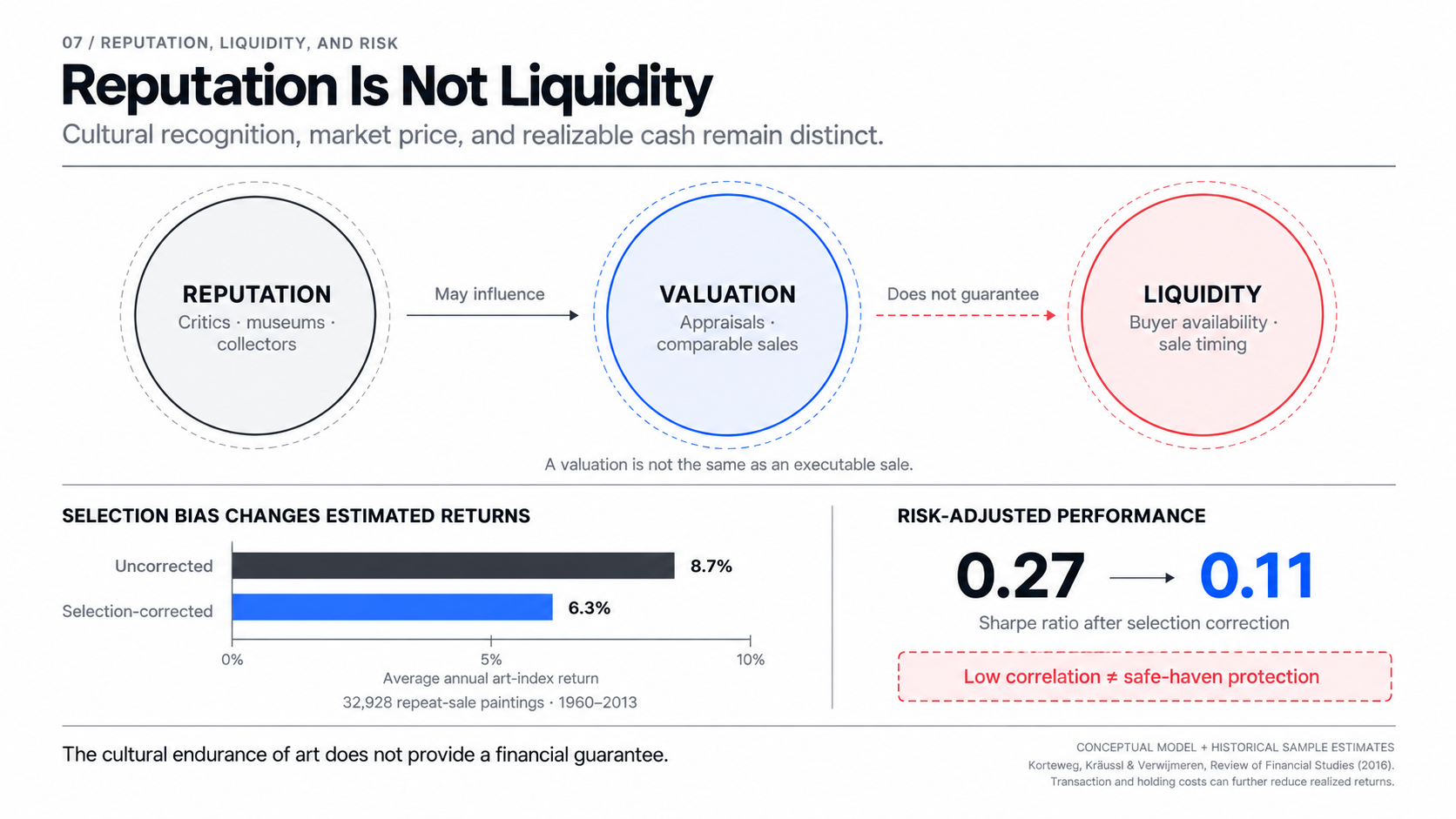
REPUTATION AS INTANGIBLE CAPITAL
As artworks become increasingly integrated into wealth-management strategies, the relationship between artistic reputation and financial value acquires additional complexity. Private collections are no longer understood exclusively as accumulations of cultural objects. They may also form part of inheritance planning, estate management, secured lending, and broader strategies for preserving and allocating wealth.
The expansion of art-backed lending provides a measurable indication of this development. In its Art & Finance Report 2025, Deloitte Private and ArtTactic projected that outstanding loans secured against art and collectibles could reach between $33.9 billion and $40 billion by the end of 2025. These figures represent industry estimates and projections rather than a comprehensive record of completed lending transactions. Much of this activity concerns private collectors seeking access to liquidity without selling their holdings, while galleries and dealers account for a smaller share of the lending market.
The increasing use of artworks as financial collateral reveals a significant transformation in their economic function. An object whose value was historically established through artistic production, collecting, and institutional recognition can subsequently support financial transactions unrelated to its original creation. Its estimated market value becomes a reference point for lending decisions, although an appraisal does not guarantee that the same amount could be realized through an immediate sale.
This development also exposes an important separation between the financial life of an artwork and the economic position of its creator. The owner of an established painting may obtain credit against its estimated value, while the artist responsible for its production receives no direct benefit from that transaction. Likewise, substantial appreciation in the secondary market does not necessarily generate additional income for the artist, except where particular contractual arrangements or resale-rights legislation provide otherwise.
Within this environment, artistic reputation operates as a form of intangible capital, although its characteristics differ fundamentally from those of a conventional financial asset.
An artist’s reputation develops through a prolonged accumulation of recognition, involving critical interpretation, exhibitions, collecting activity, institutional attention, and the subsequent reception of the work. These processes can influence the confidence of buyers and the willingness of institutions to commit resources to a particular artistic practice. Recognition acquired in one context may subsequently create opportunities in another, allowing cultural significance to generate commercial consequences.
This relationship recalls Pierre Bourdieu’s distinction between economic and symbolic capital. Cultural authority can acquire economic effects, but its conversion into financial value is neither automatic nor unlimited. The prestige associated with an artist’s work may facilitate higher prices, institutional access, or new commissions, yet the strength of these effects depends on the social and commercial environments in which recognition is established.
Reputation should not therefore be confused with intellectual property in its legal sense. Copyright and related rights may constitute identifiable and exploitable economic interests, depending on the applicable law and contractual arrangements. Reputation, by contrast, is not an exclusively owned or freely transferable asset. It exists within a network of relationships and interpretations that no individual artist can entirely control.
Nor can reputation be reduced to an artist’s latest auction result. A record price may attract considerable attention without establishing durable institutional recognition. Conversely, an artist may occupy an important position within cultural history while maintaining a comparatively limited commercial market. Financial valuation and cultural authority influence one another, but their relationship remains contingent.
The accumulation of reputation also introduces a problem of dependence. Commercial intermediaries, collectors, museums, critics, and other institutions participate in shaping the visibility and interpretation of artistic production. Their involvement may expand an artist’s opportunities while concentrating considerable influence over the conditions of recognition. The institutions that support an artistic career can also become structures on which its continued visibility depends.
For this reason, independence must be understood as a multidimensional condition rather than a simple consequence of financial success.
Material independence concerns the resources necessary to sustain production without continuous exposure to immediate economic necessity. Intellectual independence concerns the capacity to develop an artistic investigation without allowing external expectations to determine its direction. Contractual independence involves the ability to negotiate with intermediaries, retain meaningful control over professional decisions, and avoid excessive dependence on individual commercial relationships.
Reputational independence is more difficult to define. No artist can establish or preserve a public reputation entirely outside social recognition. What can develop, however, is a degree of resilience: an artistic position sufficiently established across different contexts that its continuity does not depend exclusively on a single gallery, patron, institution, or market.
These conditions may reinforce one another without necessarily developing together. Commercial success can provide resources for independent experimentation, but it may also increase pressure to reproduce familiar work. Institutional recognition can strengthen an artist’s position while introducing new expectations concerning professional conduct and artistic identity. Financial independence may permit greater freedom of inquiry without ensuring that the resulting work acquires historical significance.
The distinction becomes especially important across extended periods. Artistic reputations can survive the disappearance of their original commercial networks, while others decline when the institutions or markets supporting them lose influence. The persistence of cultural recognition depends partly on the capacity of an artistic practice to remain open to interpretation beyond the circumstances that initially brought it to public attention.
Reputation consequently occupies an unstable position between artistic achievement, social recognition, and economic valuation. It can generate opportunities and influence the distribution of resources, but it cannot be treated as a guarantee of future income or historical permanence.
The broader economic significance lies in the uneven distribution of benefits produced by cultural recognition. An artwork may acquire substantial value as a financial asset, an institution may strengthen its authority by collecting or exhibiting it, and an artist may gain visibility without receiving a corresponding increase in material security.
Understanding reputation as intangible capital therefore requires examining not only how recognition is established, but how its economic consequences are distributed among the different participants in the art economy.
IS ART A SAFE-HAVEN ASSET?
The increasing integration of artworks into financial portfolios raises a persistent question: can art provide protection against instability in conventional financial markets?
The answer requires a distinction between diversification and financial security. An asset whose returns exhibit a low average correlation with equities may contribute to portfolio diversification without necessarily preserving value during periods of severe market stress. In financial research, a safe haven is generally understood as an asset that remains uncorrelated or negatively correlated with other assets specifically during episodes of exceptional market decline.
This distinction is particularly important in the art market, where the apparent stability of prices may reflect the infrequency of transactions rather than the resilience of underlying demand.
Unlike publicly traded securities, individual artworks are not continuously priced in liquid markets. Their valuations depend on comparatively infrequent sales, private negotiations, expert assessments, and the availability of buyers whose preferences may be highly specific. When financial conditions deteriorate, owners may postpone selling rather than accept lower prices. A reduction in transactions can therefore obscure changes in market demand.
The absence of observable price declines should not automatically be interpreted as evidence that an artwork has preserved its realizable value. A painting that has not been offered for sale during a crisis provides little direct information about the price it could command under immediate liquidation conditions. Similarly, insurance valuations and estimates prepared for financial purposes do not necessarily correspond to prices achievable within a limited selling period.
The distinction between estimated value and available liquidity is fundamental. Even historically significant artworks may require extensive preparation, specialist mediation, and access to a relatively narrow population of qualified buyers. Auction results are uncertain, private negotiations can take considerable time, and unsuccessful attempts to sell are not always reflected in the datasets used to measure market performance.
Transaction costs introduce further complications. Auction commissions, dealer fees, insurance, storage, transportation, conservation, and applicable taxes can substantially reduce realized investment returns. These expenses vary according to the object, the market, and the duration of ownership, making broad comparisons with conventional financial instruments difficult.
Academic research has also demonstrated the importance of methodological choices in estimating art-market performance.
In their 2016 study Does It Pay to Invest in Art? A Selection-Corrected Returns Perspective, Arthur Korteweg, Roman Kräussl, and Patrick Verwijmeren examined 32,928 paintings that had sold repeatedly at auction between 1960 and 2013. After accounting for selection bias in the works returning to market, their estimated average annual index return declined from 8.7% to 6.3%. The corresponding Sharpe ratio, a measure of risk-adjusted performance, fell from 0.27 to 0.11.
The findings illustrate how the selective visibility of market transactions can influence conclusions about financial returns. Works appearing repeatedly at auction do not necessarily represent the broader population of artworks held in private collections. Decisions to sell may themselves be related to recent price movements, financial circumstances, or expectations about future demand.
These limitations become particularly consequential when assessing the behavior of art during financial crises. Evidence that art-market indices have historically moved differently from stock-market indices cannot establish that collectors would have been able to liquidate their holdings at favorable prices during those same periods. The ability to preserve estimated value and the ability to convert that value into cash are distinct financial characteristics.
Artworks also differ substantially from one another. Their commercial prospects depend on attribution, provenance, condition, rarity, historical recognition, and the depth of the relevant collecting market. The financial characteristics of a museum-quality painting by an internationally established artist cannot be assumed to resemble those of an emerging artist’s work, a contemporary digital edition, or an object with limited historical documentation.
Such differences make it difficult to describe art as a homogeneous investment category. The market encompasses objects with radically different levels of liquidity, price transparency, and exposure to changes in collector preferences. Even within a single artist’s production, particular works may command substantially different prices according to their quality, history, and significance within the larger body of work.
Nor should the financial assessment of art exclude its nonmonetary characteristics. Collectors may derive aesthetic, intellectual, or social benefits from ownership that are not captured by conventional investment calculations. These considerations can justify acquisition decisions independently of expected financial appreciation, but they should not be confused with evidence of superior risk-adjusted returns.
The classification of art as a safe haven must therefore be approached with considerable caution. Any credible assessment would need to consider the specific artwork, acquisition price, holding period, transaction costs, liquidity requirements, and the behavior of comparable sales during financial stress. It would also require evidence that the asset provides meaningful protection precisely when other components of a portfolio experience substantial losses.
Art can serve multiple economic purposes, including long-term collecting, wealth preservation, and the diversification of certain substantial portfolios. None of these functions establishes that artworks, considered collectively, constitute reliable protection against financial crises.
The distinction ultimately returns to the central argument of this investigation. Cultural significance, financial valuation, and economic security are related but separate phenomena. An artwork may retain historical importance while its market contracts, and it may command an extraordinary price without offering its owner any assurance of future liquidity.
The capacity of art to endure culturally should not be mistaken for a financial guarantee.
CONCLUSION: CAPITAL AND THE POSSIBILITY OF CREATION
Art history cannot be separated from the economic conditions in which it unfolds. Across different centuries and civilizations, the accumulation and distribution of wealth have influenced who could produce art, under what circumstances, and with what possibilities of recognition. Yet the relationship has never followed a single pattern. The same concentration of resources that enabled monumental commissions could reinforce rigid hierarchies, while the expansion of private markets could increase artistic opportunities without securing the economic independence of those participating in them.
The historical examples examined here reveal the limitations of any direct relationship between prosperity and artistic achievement. Florentine banking did not produce the Renaissance as an inevitable consequence of accumulated wealth. Dutch commercial expansion encouraged an extraordinary culture of painting while exposing its practitioners to competition and financial uncertainty. The emergence of New York as an international artistic center depended on economic power, but also on institutional development, intellectual migration, and geopolitical circumstances. More recently, the NFT boom demonstrated how technological and financial innovation could transform the commercial infrastructure surrounding artistic practices whose histories were already well established.
These developments suggest that the influence of capital is best understood through the structures that mediate its application. Patrons, markets, public institutions, and financial intermediaries allocate resources according to different priorities. Their decisions affect not only the material conditions of production, but also the visibility, circulation, and preservation of artworks. Economic power can therefore participate in determining which artistic positions enter the historical record, even when it cannot fully determine their significance.
The distinction between production and valuation is equally fundamental. An artwork may originate within conditions of financial uncertainty and acquire extraordinary commercial value generations later. Its subsequent appreciation may benefit collectors and institutions without materially affecting the artist or the circumstances in which the work was created. The economic history of an object can continue long after its production, responding to changes in wealth distribution, financial liquidity, and cultural recognition that belong to entirely different historical periods.
Artistic independence must also be considered within this changing environment. Material security can provide time for sustained investigation, but it does not guarantee intellectual autonomy. Commercial success can increase an artist’s negotiating power while creating new forms of dependence. Institutional recognition can preserve an artistic legacy while influencing how that legacy is interpreted. No single economic condition is sufficient to explain the freedom, significance, or eventual historical position of an artistic practice.
Nor should economic influence be understood as something that remains entirely external to artistic meaning. The conditions of patronage, ownership, production, and exchange can themselves become subjects of artistic investigation. Art may reproduce the values of the systems supporting it, negotiate their constraints, or critically examine their authority. The relationship between economic organization and artistic invention is therefore capable of becoming part of the work itself.
What emerges from this history is neither the primacy of capital over artistic creation nor the independence of art from material circumstances. Economic structures establish possibilities, distribute opportunities, and influence the processes of recognition, but their consequences remain contingent on cultural developments and individual artistic decisions that cannot be reduced to financial variables.
The enduring significance of an artwork is not established by its highest transaction price, just as its intellectual ambition cannot be inferred from the resources available to its creator. Markets may consolidate reputations, institutions may preserve them, and subsequent generations may transform their interpretation.
Capital shapes the conditions under which art becomes possible and historically visible. It cannot, by itself, determine what art will ultimately mean.