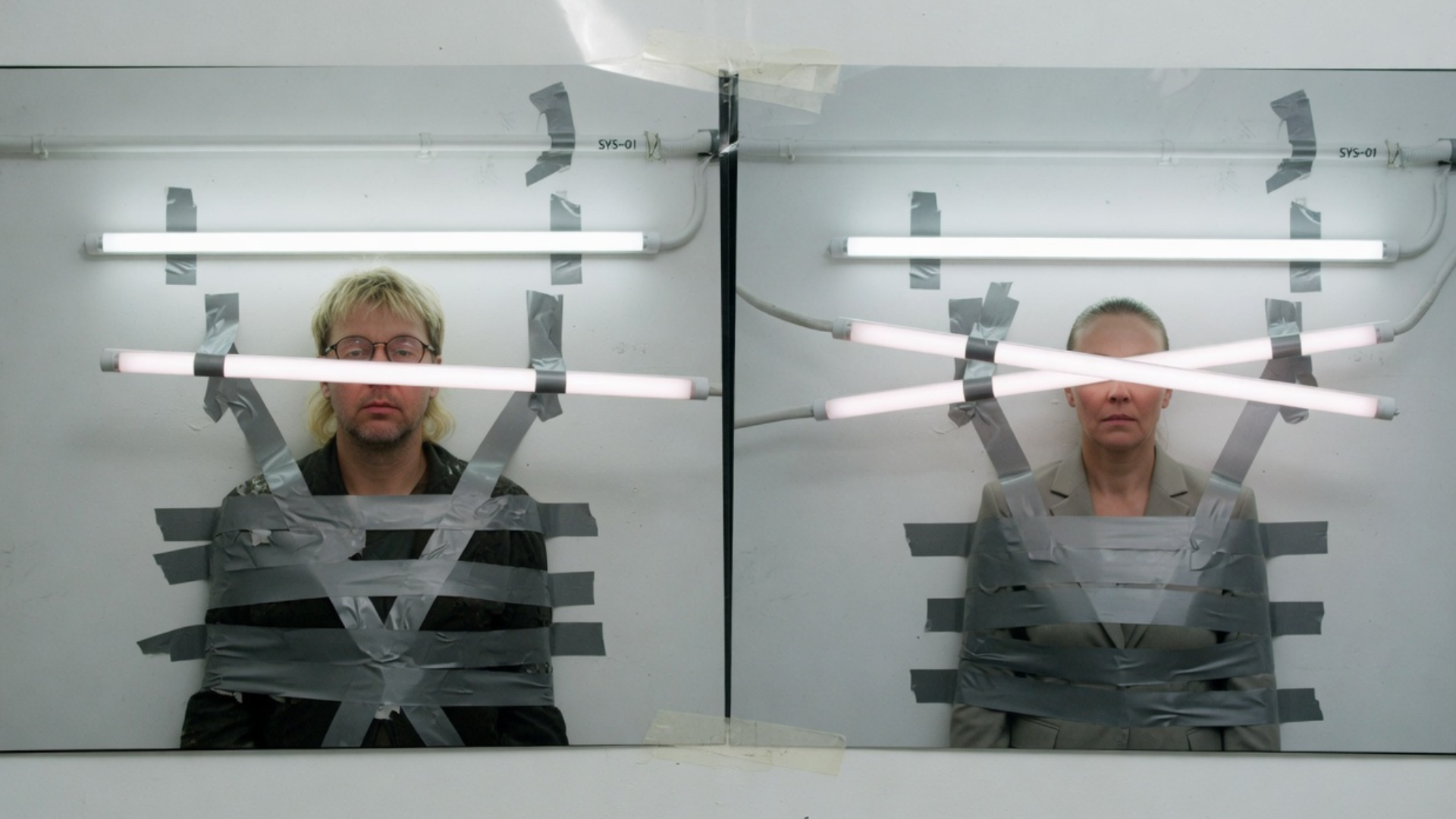



In the spring of 2026, as Neuralink announced plans for high-volume production of brain-computer interfaces, enabling early patients to play video games, browse the internet, and post on social media through thought alone, and as leading public health journals declared “dopamine-scrolling” a modern epidemic reshaping attention and mental wellbeing, the stakes of entertainment’s twenty-year metamorphosis have never been clearer. Twenty years ago, the domestic altar of the cathode-ray tube still commanded collective rituals of prime-time viewing, a vertical flow that synchronized families in moments of shared, if passive, attention. The individual stood before the image as if before a monolithic oracle, the screen’s physical frame preserving a critical distance between real space and representation.
Today, that distance has vanished. Ubiquitous connectivity and predictive algorithms have pulverized the boundary, transforming the spectator into an active node in a bio-computational network where entertainment is no longer content to be consumed but an environment to be inhabited, and one that inhabits us in return. As Jonathan Haidt’s The Anxious Generation (2024) and its 2026 World Happiness Report follow-up have starkly documented, this “great rewiring of childhood” has coincided with unprecedented surges in adolescent anxiety, depression, and attention fragmentation precisely as smartphones and algorithmic feeds became ubiquitous. The logic of the event has yielded to the logic of the flow; mediation has become invisible, adhering to our biological rhythms through tactile interfaces, variable rewards, and dopamine-optimizing loops that segment time into micro-impulses.
Post-mediality is thus configured as a condition of total immersion, in which the boundary between observer and observed vanishes in favor of incessant circularity of feedback and neurochemical responses. It is no longer a matter of analyzing the quality of content or the effectiveness of messages, but of deciphering the invisible infrastructures that engineer attention through instant gratification.
Television acted on the mass; the social network acts on the nerve fiber of the individual. This evolution has sanctioned the transition from centralized control of the narrative to the molecular management of desire, where every digital gesture is reprocessed to feed the engagement machine.
The result is a new form of subjectivity defined by its own interactions, in a regime of permanent visibility that transforms intimacy into aesthetic capital. Entertainment, once confined to precise time segments, has become the very fabric of daily life, an algorithmic fog enveloping every moment of emptiness. To explore this evolution is therefore to investigate the mechanisms of a capture that has paradoxically become our primary form of perceived freedom, as recent neuroscientific evidence on dopamine pathways and algorithmic design confirms (De, 2025; Sharpe et al., 2025; Roberts & David, 2025).

Spectral Legacies
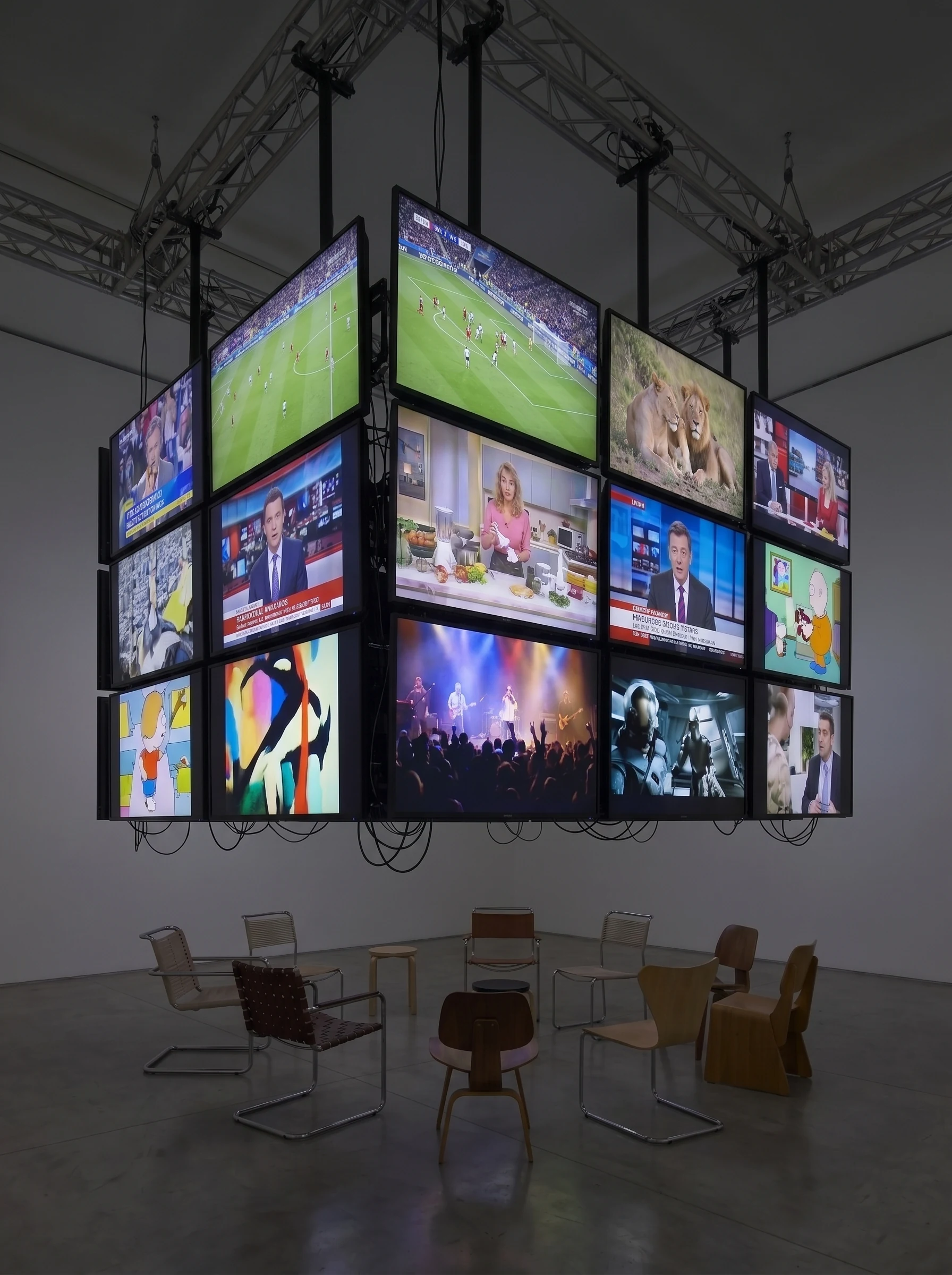
The television image possessed a material density and a static nature that still allowed for a form of critical detachment, as the device was clearly identifiable as an external object, an interface bounded by an insurmountable physical frame. With the progressive erosion of the television’s centrality—accelerated by the fragmentation of channels and the rise of video-on-demand services—we have witnessed the dismantling of the concept of ‘prime time,’ that moment of temporal convergence that once defined a community’s social identity. The first cracks appeared with the proliferation of cable and satellite offerings; they widened dramatically with Netflix’s 2013 global expansion and the subsequent streaming wars, which began to undermine the solidity of scheduled broadcasting and introduced the seed of personalization that would later find its ultimate fulfillment in social networks.
TV has not disappeared, but it has liquefied, losing its pedagogical authority to transform into background noise, a flow of images that no longer seeks to instruct but to accompany the individual in their connective isolation. This transition marked the passage from collective consumption to solitary navigation, where the act of watching was replaced by the act of scrolling—the gesture that best defines our era. While television required focused, albeit passive, attention, new media demand hyperactive but superficial vigilance, a sort of hypnotic state in which the user is constantly prompted to jump from one fragment to another. The stability of the schedule has been sacrificed on the altar of absolute availability, creating a paradox in which the excess of choice nullifies the quality of the experience itself.
The engineering of entertainment has thus begun to shift from content to structure, understanding that true value no longer resided in the broadcast program, but in the time spent in front of the screen. Post-media logics have inherited from television the desire for capture but have perfected it by eliminating the downtime and pauses that allowed thought to settle. The result is a form of visual bulimia that feeds on its own insatiability, transforming the spectator into a compulsive consumer of binary stimuli. In this new configuration, the residue of the old TV survives as an aesthetic nostalgia, a call back to a time when the image still had ontological weight and a spatial orientation function. The disappearance of the television frame marked the beginning of a vision without borders, where the image no longer occupies a space in the room but entirely invades the space of the mind. The fundamental insight of this phase is that the end of the television monopoly did not free the spectator but exposed them to a much more capillary and invisible form of control—one now amplified by engagement-optimization algorithms that prioritize retention over reflection (Bhargava, 2021; Humanetech resources on attention economy).


Algorithms of Desire
The algorithm is not a simple tool for selection, but the demiurge of a subjective reality built to measure the individual’s cognitive biases. Over the last twenty years, software engineering has ceased to be a technical discipline and has become a form of applied psychology, aimed at mapping and exploiting the vulnerabilities of the human dopaminergic system. Every interaction, every micro-scroll, and every pause of the gaze is translated into data that fuels increasingly refined predictive models, capable of anticipating desire before it even surfaces in consciousness. Entertainment has become an archaeological excavation into the user’s psyche, where the machine learns to feed the ‘I’ with what it already knows, reinforcing its inclinations in a bubble of mirrored identity. This process of engineering has eliminated serendipity and the encounter with otherness, replacing them with an infinite echo of previous preferences.
The algorithmic flow is not designed to expand horizons but to minimize the friction of consumption, creating a state of neurological comfort that inhibits criticism and intellectual friction. The complexity of the world is reduced to a sequence of relevant suggestions, where the unexpected is considered a system error and deviation a loss of efficiency. In this way, the architecture of social networks acts as a sort of digital womb, a protected and hyper-reactive environment that responds to every user stimulus with almost biological precision. The extractive logic of attention capital transforms every moment of leisure into an act of data production, nullifying the classic distinction between free time and labor time. While we entertain ourselves, we are actually training the machines that will govern us, providing them with the emotional maps necessary to perfect persuasion and behavioral marketing techniques.
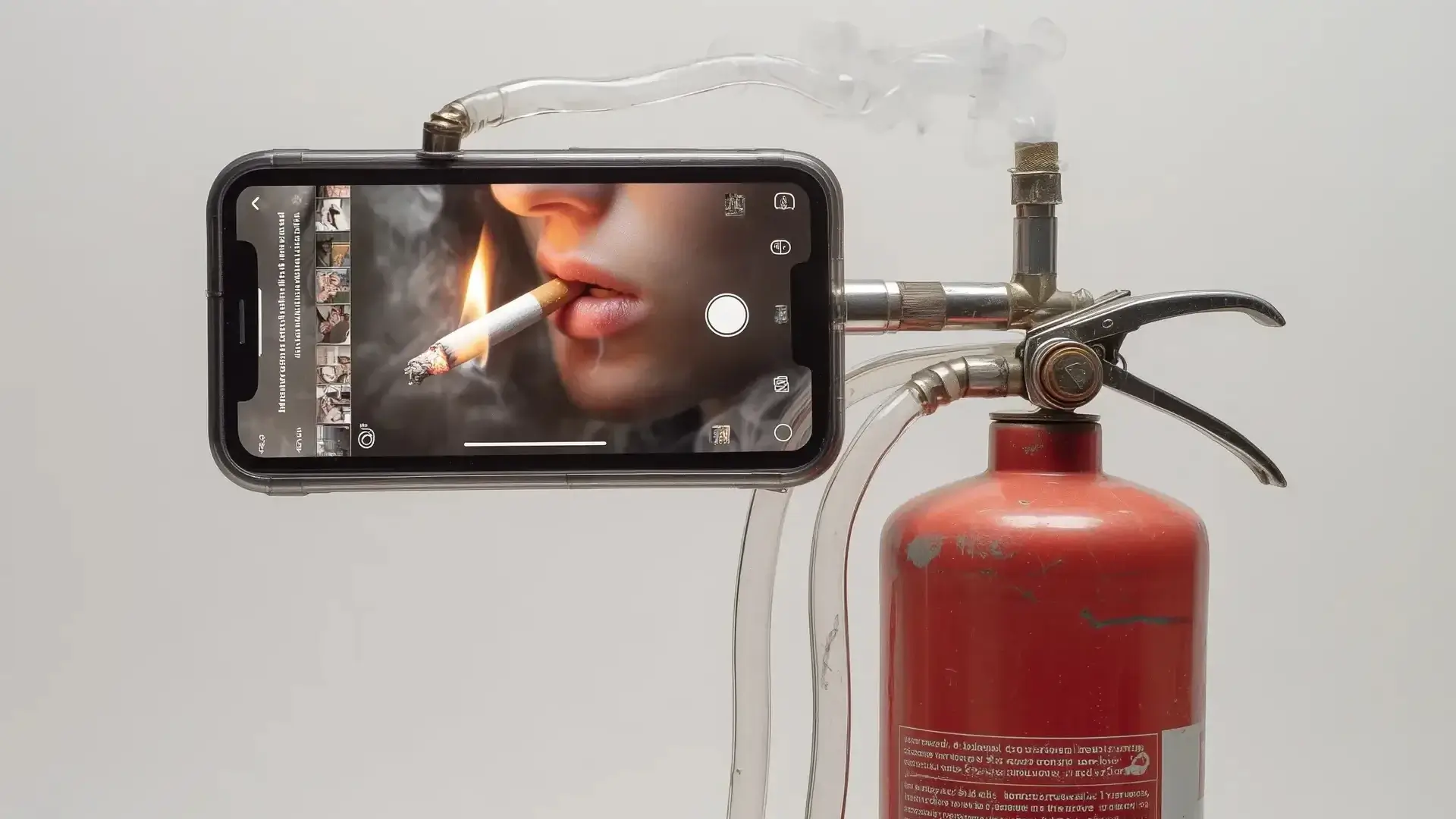
This is powerfully illustrated by 2025 neurophysiological studies demonstrating that frequent engagement with these algorithms alters dopamine pathways, fostering dependency analogous to substance addiction through variable reward schedules reminiscent of slot machines (De, 2025; phys.org summary of Frontiers in Psychology research; Cureus, 2025). Entertainment has become the lubricant of a surveillance economy that does not need brute force because it is based on our voluntary submission to mediated pleasure. Freedom of choice is thus reduced to a design option within a closed system, where the parameters of the possible have already been defined upstream by the developers. In this context, the concept of truth dissolves into that of relevance, as the algorithm does not distinguish between fact and fiction, but between what retains the user and what pushes them to leave the platform. The information architecture has been subordinated to engagement engineering, creating an ecosystem in which outrage and polarization are rewarded because they generate more intense interactions. The machine does not seek to make us happy, but to make us active, in a perpetual mobilization of the nervous system that excludes silence and stasis.
The insight that emerges from this analysis is that the algorithm is not simply mirroring our tastes but is actively shaping our psychic structure to make it conform to the needs of the digital market—a process Shoshana Zuboff has termed the core of surveillance capitalism, now evolving into AI-driven prediction as she detailed in her 2025-2026 reflections (Zuboff, 2019/updated analyses; Carr Center Harvard 2024-2025 program).
Self-Spectacularization
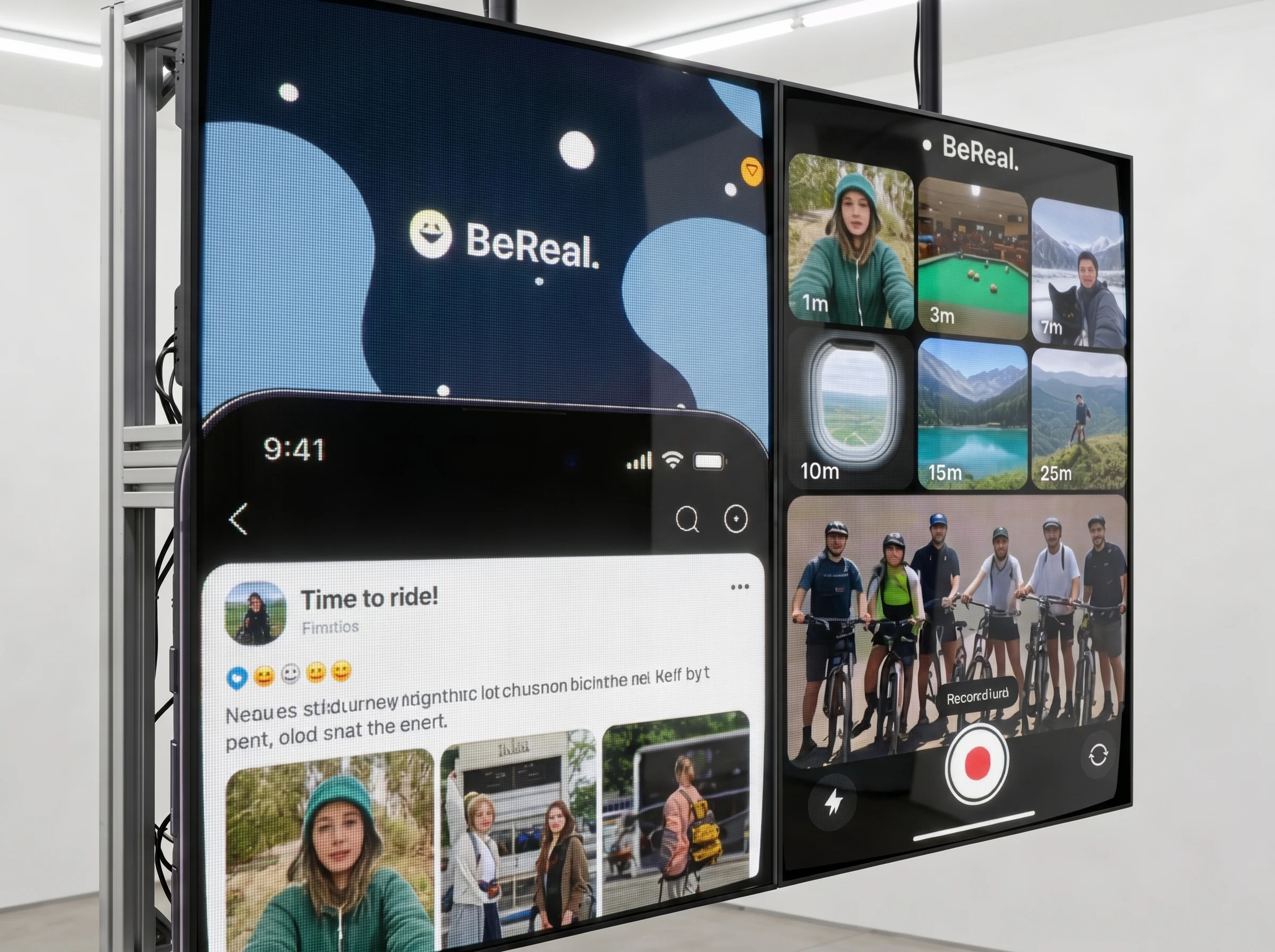
The shift from television to social networks has sanctioned the democratization of narcissism, transforming every individual into the producer, director, and protagonist of their own permanent reality show. If the Debordian society of the spectacle envisioned a distinction between the actors on stage and the anonymous mass in the audience, the post-media condition imposes the burden of performance on everyone. There is no longer an ‘off-camera’; private life has been colonized by the logic of publication, becoming a resource to be valued through the aesthetics of filters and instant editing. Identity is no longer an ontological fact but a project of continuous curation, an accumulation of visual evidence attesting to the subject’s existence in the theater of digital consensus. This engineering of the self has produced an unprecedented form of alienation, in which the individual constantly observes themselves through the eyes of their potential audience, mediating every experience through its future representation.
Authenticity becomes a performative genre like any other, a mask worn with calculated nonchalance to satisfy the demands of a market that paradoxically requires transparency and intimacy. The result is a standardization of desires and aesthetics, where the canons of beauty and lifestyle are dictated by globalized image flows that uniform local experiences into a single catalog of aspirational consumption. Subjectivity is reduced to a personal brand that must be constantly fed to avoid slipping into the oblivion of irrelevance. Entertainment has shifted from the observation of the other to the exhibition of the self, creating a dynamic of cross-voyeurism and self-exposure that saturates the social space. Every daily gesture, from a meal to a trip, is filtered by the need to be documented, emptying the action of its experiential density to reduce it to a digital icon.
Recent intercultural studies confirm that social media usage, self-presentation, and narcissistic traits are significant predictors of platform addiction, particularly among Gen Z users who leverage filters and curated feeds to manage self-image and seek validation (Nguyen et al., 2025; Daud, 2026 on face filters reshaping digital identities; Boursier et al., 2020 on pathological narcissism and selfie-engagement). The search for social validation through likes and shares becomes the primary driver of action, establishing a regime of emotional dependence on the network’s approval signals. In this vicious circle, self-esteem is externalized to an anonymous and fickle collective intelligence, which rewards conformity to trends and punishes deviation from the aesthetic norm. Technology has not only provided the tools for this narrative but has actively encouraged the fragmentation of the self into a series of digital avatars optimized for different platforms. This split produces a sense of existential emptiness that is filled only through further content production, in a flight forward that prevents any form of introspection. Life becomes a sequence of highlights, a tight edit that conceals the banality of the everyday and the pain of finitude, promising a digital immortality made of pixels and metadata.
The final paradox of this evolution is that, despite the apparent freedom of expression, the individual has never been so bound to external models of behavior. Surveillance is no longer a panoptic eye watching from above, but an infinity of small lateral gazes that judge and classify our every move. The decisive insight is that the transformation of the self into a spectacle has eliminated the very possibility of intimacy, making our every emotion a public good ready to be consumed and forgotten within twenty-four hours.
Time Without Waiting
The temporality of post-mediality is characterized by the systematic destruction of waiting, understood as a space of latency necessary for the formation of thought. While television operated on a chronological scan that included pauses, commercial breaks, and weekly appointments, social networks—particularly short-form video platforms—have introduced the regime of absolute instantaneity and real-time. The interface is designed to eliminate all temporal friction, offering an uninterrupted flow of stimuli that regenerate infinitely under the touch of a finger. This acceleration has atrophied our ability to tolerate boredom—that fertile void in which the mind is free to wander without a goal predetermined by the logic of profit.
The engineering of digital time is based on the fragmentation of attention into increasingly short micro-units, suitable for consumption in the interstices of daily life. The short video, the flash post, the push notification: these are all devices that fragment the continuity of experience, preventing the construction of complex narratives and articulated arguments. The present is transformed into an eternal ‘now’ devoid of historical depth, a plane of total immanence where the past is quickly archived and the future is reduced to the next imminent interaction. This temporal contraction produces a sort of collective amnesia, in which information overlaps without ever settling into knowledge.
Contemporary entertainment does not fill free time; it devours it, transforming every moment of pause into an opportunity for monitoring and consumption. Experimental studies from 2025 demonstrate that heavy TikTok users exhibit significant time distortion, overestimating both platform usage and time spent on unrelated tasks, with heavy users showing greater difficulty sustaining attention and blocking distractions (Jiang et al., 2025; Siehoff, 2023; Paltaratskaya, 2023). The disappearance of boundaries between human activities has led to a condition of permanent cognitive multitasking, in which attention is constantly divided between the physical world and its digital extension. This state of chronic alertness exhausts psychic resources, leading to forms of fatigue that are not cured by rest but, paradoxically, by further immersion in the media flow.
The entertainment machine has understood that the most precious resource is not money, but the duration of attention that can be extracted from every single hour of a user’s life. In this scenario, the linearity of historical time is replaced by the circularity of the algorithm, which cyclically re-proposes themes and formats under different guises, creating an illusion of novelty in a substantially static system. Repetition becomes the reassuring form of consumption, a visual litany that protects against the anguish of the unknown and complexity. The speed of the network does not serve to reach a destination but to keep the subject in a state of stationary agitation, preventing them from stopping and looking beyond the luminous perimeter of the screen. Technology has thus realized the negative utopia of a saturated time, where there is no longer room for the unexpected event or solitary reflection. The removal of waiting has emptied the experience of desire of its erotic component, understood as a tension toward what is not yet present. Digital immediacy satisfies the need even before it becomes desire, condemning the user to a condition of satiety without pleasure.
The final insight concerns the very nature of boredom: it was not a system defect but a protective mechanism of the human that entertainment engineering decided to eradicate to maximize our biological availability to the flow—as evidenced by the rise of “dopamine-scrolling” as a recognized public health pattern (Sharpe et al., 2025; Jiang et al., 2025).

Post-Truth Simulacra
Post-mediality has sanctioned the definitive triumph of the simulacrum over reality, bringing to completion the process of the total aestheticization of existence. In the last two decades, the distinction between the image and its referent has become increasingly blurred, until disappearing into a regime of hyper-reality where the sign has more value than the thing itself. Visual manipulation technologies, once reserved for specialized laboratories, are now integrated into every smartphone, allowing for a constant rewriting of the visible according to artificial canons of perfection. Entertainment does not limit itself to reflecting the world; it replaces it with an optimized version, more vivid, more intense, and infinitely more coherent than the messy data of material reality.
The engineering of post-truth does not only concern the spread of fake news but the creation of an entire perceptive ecosystem in which emotion prevails over logic and plausibility over veracity. In this space, social networks act as social engineering laboratories, where narratives are tested for their ability to generate visceral reactions rather than for their factual accuracy. The user no longer seeks truth but the confirmation of their own value system, immersing themselves in informative simulacra that isolate them from contact with what is uncomfortable or contradictory. Reality becomes a style choice, a filtering option among the many available in the navigation menu of digital existence.
The evolution of entertainment toward deepfakes and generative artificial intelligence represents the last frontier of this process of dematerialization. A 2024 cross-national study across eight countries found that social media news use significantly amplifies the illusory truth effect for viral deepfakes, with repeated exposure increasing perceived accuracy—particularly among frequent social media consumers (Ahmed et al., 2024). This effect has only intensified: by 2025-2026, AI-generative deepfakes have been deployed in information warfare during conflicts and elections, including 2026 US midterm campaigns where political deepfakes blurred reality and eroded voter trust (Singh, 2025; Reuters, March 2026). The image has detached itself from the human body and the laws of physics, becoming a pure product of computational calculation that can be shaped infinitely for ludic or manipulative purposes. The disappearance of the photographic index—the causal link between light and film—marks the entry into an era of radical skepticism, where nothing we see can be taken for certain, and yet everything is consumed with the same greed as before. Vision is no longer a proof of existence but an act of faith toward the power of simulation.
This condition of ontological uncertainty is compensated for by an aesthetics of hyper-presence, in which every image is saturated with unnatural details and colors to capture the gaze in an environment overloaded with stimuli. Entertainment becomes aggressive, predatory, seeking to fill the void of meaning with sensory excess. Post-truth is therefore the natural consequence of a media system that has prioritized engagement over understanding, transforming information into a byproduct of the game. The citizen has become a user, and the user is a player who accepts the rules of fiction just to avoid being excluded from the flow of social interactions. Power, in this phase, no longer resides in the possession of truth, but in the ability to generate simulations seductive enough to be inhabited by the masses. The critical insight is that the loss of truth was not an accident along the way, but the ultimate goal of an entertainment engineering that needed an entirely malleable world to be exploited without resistance.

The Final Envelope
We have entered the era of the total interface, where mediation is no longer a bridge between the subject and the object but the very environment of psychic life. The technological evolution of the last twenty years clearly points toward the progressive elimination of external hardware in favor of a somatic fusion between man and machine. Entertainment is evolving from an external spectacle into a direct neural experience, where the boundary between the self and the code becomes purely academic. In this post-media scenario, engineering no longer applies only to screens but to synapses, aiming for perfect synchronization between the impulses of the nervous system and the feedback cycles of artificial intelligence. The colonization of time and space by the media is complete: there is no longer a physical place that is not potentially augmented, nor a moment of life that cannot be captured and processed.
As Elon Musk’s Neuralink moves toward high-volume production and automated surgical procedures in 2026—with early human trial participants already using thought alone to control cursors, play games, browse the web, and engage socially—the vision of direct neural entertainment is transitioning from speculative fiction to clinical reality (Reuters, January 2026; Neuralink updates). Entertainment has become the final envelope of existence, an intelligent membrane that wraps around the subject, providing meaning, direction, and purpose in an otherwise chaotic world. This structural dependence transforms the human being into a biological terminal of a global network that breathes and evolves through our interactions. Freedom has become the possibility of choosing within a hyper-determined system, where our every move has been predicted and integrated into a profit optimization model.
The final stage of this evolution is the replacement of the real with a synthesis that is no longer its imitation, but its overcoming in terms of efficiency and emotionality. Virtual worlds and augmented realities are no longer simple games but prototypes of new forms of citizenship and sociality entirely mediated by technological capital. Here, the physical body is reduced to a necessary support for data processing, while identity migrates toward fluid and malleable configurations that respond to the logics of the market of desires. Entertainment is no longer an escape from reality, but reality itself, which has become entertainment to make itself bearable and manageable. Social control in this phase does not happen through repression but through saturation: a subject constantly entertained is a subject who has lost the ability to imagine an alternative to what exists. The attention machine has neutralized conflict by transforming it into content, making every form of dissent an ingredient of the algorithmic flow.
The true political challenge of the future will not be the conquest of power, but the recovery of sovereignty over one’s own mental time and perception of the world. In a universe where everything is engineered to be pleasant and engaging, resistance is configured as the ascetic exercise of refusal and silence. The final insight that closes this twenty-year reflection is that post-mediality is not a tool in our hands, but the condition in which we are immersed, a climatic mutation of the human intellect. We have built a mirror world that has ended up absorbing us, and the way out does not lie in an impossible return to a pre-digital purity, but in understanding the rules of the game in which we are prisoners. Entertainment, in its supreme form, has become the reassuring mask with which the technical system conceals its own incomprehensible and inhuman power—yet one that, as Zuboff warns in her evolving analysis of surveillance capitalism’s AI phase, demands democratic reclamation before the fusion is complete (Zuboff, 2025-2026 updates; Haidt & Rausch, 2026).
Bibliography:
Losing Track of Time on TikTok? An Experimental Study of Short Video Users’ Time Distortion Jiang, Y. et al. (2025). Behavioral Sciences, 15(7), 930. (doi:10.3390/bs15070930)
Dopamine-scrolling: a modern public health challenge Sharpe, B.T. et al. (2025). Perspectives in Public Health.
Social Media Algorithms and Teen Addiction: Neurophysiological Impact and Ethical Considerations De, D. (2025). Cureus / PMC.
Technology Affordances, Social Media Engagement, and Social Media Addiction: An Investigation of TikTok, Instagram Reels, and YouTube Shorts Roberts, J.A. & David, M.E. (2025). Cyberpsychology, Behavior and Social Networking, 28(5), 318–325.
Social Media News Use Amplifies the Illusory Truth Effects of Viral Deepfakes: A Cross-National Study of Eight Countries Ahmed, S. et al. (2024). Journal of Creative Communications.
Narcissism, Social Media Addiction, Self-Esteem, and Life Satisfaction among Generation Z Nguyen, T.N.D. et al. (2025). Psychology Research and Behavior Management.
The Impact of Face Filter Use on Self-Image and Digital Identity Formation Daud, R.F. (2026). Communications Journal.
Selfie-engagement on social media: Pathological narcissism, positive expectation, and body objectification Boursier, V. et al. (2020). Addictive Behaviors Reports, 11, 100263.
The Age of Surveillance Capitalism: The Fight for a Human Future at the New Frontier of Power (with 2025-2026 AI updates) Zuboff, S. (2019/2025-2026). Harvard Business School / PublicAffairs. Carr Center updates
The Anxious Generation: How the Great Rewiring of Childhood is Causing an Epidemic of Mental Illness (and 2026 World Happiness Report essay) Haidt, J. & Rausch, Z. (2024/2026). Penguin / World Happiness Report 2026. Full essay PDF
Ethics of the Attention Economy: The Problem of Social Media Addiction Bhargava, V. (2021/updated analyses). Academia.edu.
AI-generative deepfake content used as information war in the post-truth era Singh, K. (2025). International Journal of Advanced Mass Communication and Journalism, 6(2). (doi:10.22271/27084450.2025.v6.i2a.123)
AI deepfakes blur reality in 2026 US midterm campaigns (and related election studies) Ax, J. & Coster, H. (2026). Reuters.
Future-Proofing Elections Against Deepfake Disinformation (2025 report synthesizing 2024-2025 studies) CIVICUS DDI (2025).
The effect of TikTok exposure on young adults’ sustained attention span and the comprehension of information Siehoff, R.V. (2023). Radboud University thesis.
Striatal dopamine synthesis capacity reflects smartphone social activity (key neuroscientific evidence) Westbrook, A. et al. (2021). iScience, 24(5):102497.
The Cognitive Divergence: AI Context Windows, Human Attention, and Dopamine-Driven Feedback (2026 arXiv synthesis) Various authors (2026). arXiv.
Neuralink plans ‘high-volume’ brain implant production by 2026 (and clinical trial outcomes on entertainment/social use) Reuters / Neuralink (2025-2026). Official site
Is social media addictive? The science reveals what’s at stake (2026 synthesis of dopamine and design features) Scientific American (2026).
The Attention Economy in the Digital Age (policy and interface design analysis) French Ministry of Economy / related Humanetech analyses (updated 2025-2026). Humanetech overview