

Fakewhale emerged to investigate how technological transformation is reshaping artistic practice and the conditions under which art becomes visible, contextualized, and circulated.
What this inquiry revealed is that the medium can no longer be treated as a stable category. Over the last decade, and especially through the combined impact of social media and artificial intelligence, information has ceased to function as a merely explanatory layer. It has become an operative field in its own right: a space where symbolic value takes shape and artistic legitimacy is increasingly mediated.
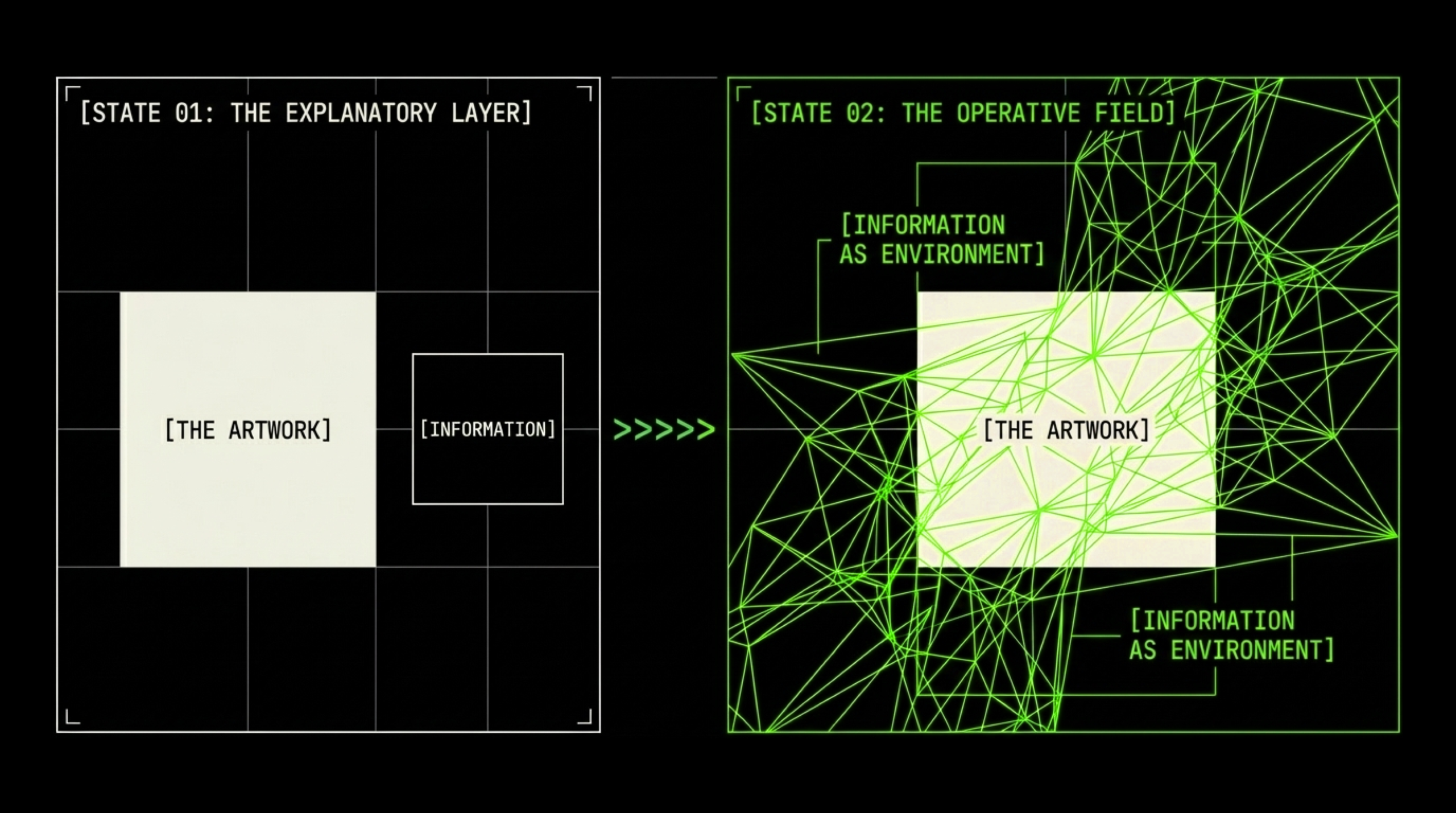
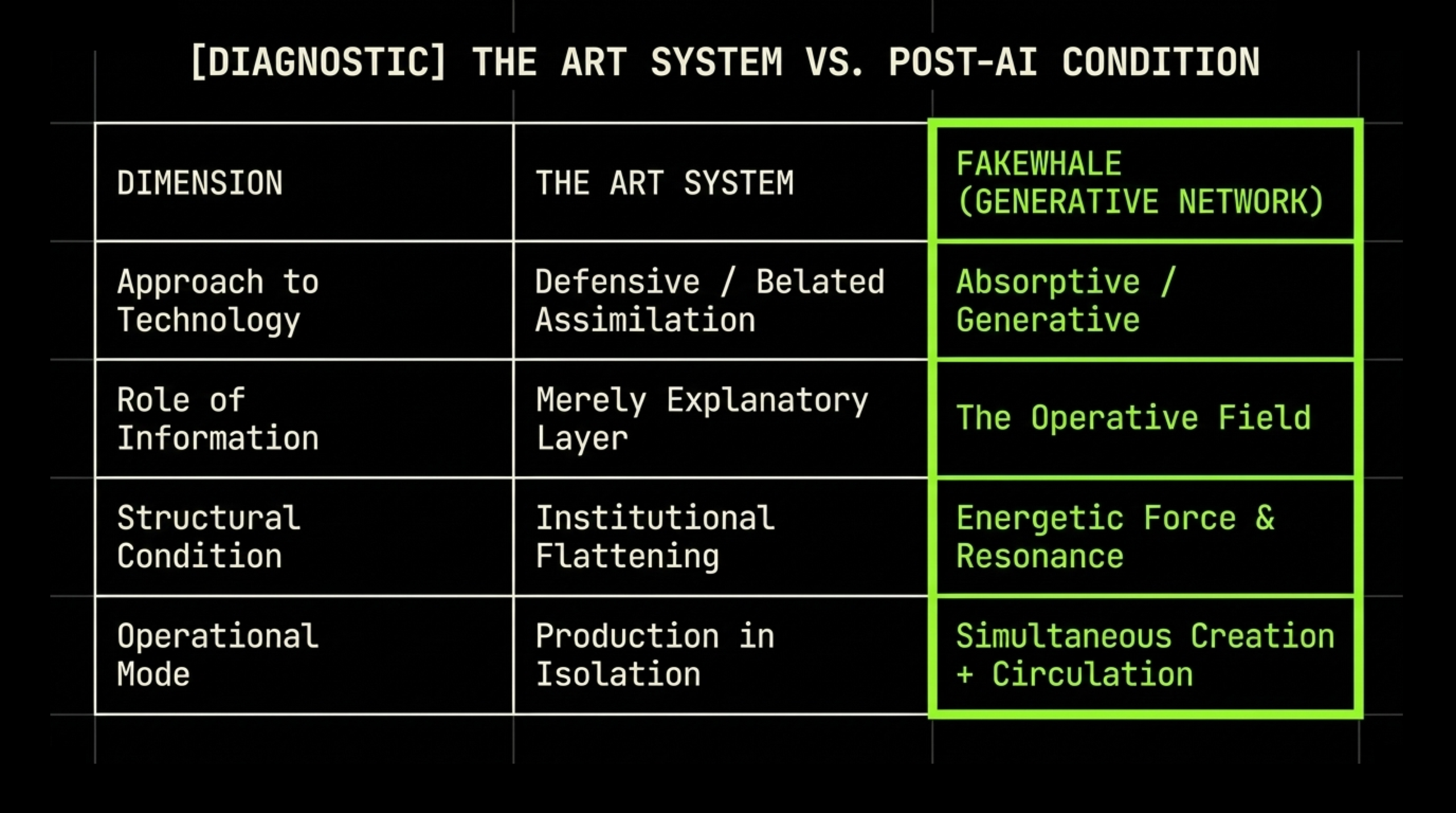
This shift exposed a structural weakness within the art system. Much of the field came to new technologies too late and kept them at an elitist distance before eventually absorbing them after the fact. The result has often been a cultural landscape marked by institutional flattening, and a steadily reduced capacity to sustain genuine experimental intensity. Under such conditions, the circulation of ideas is compromised less by a lack of information than by the dominance of information already formatted in advance.
Fakewhale gradually understood that this condition demanded a broader operational response.
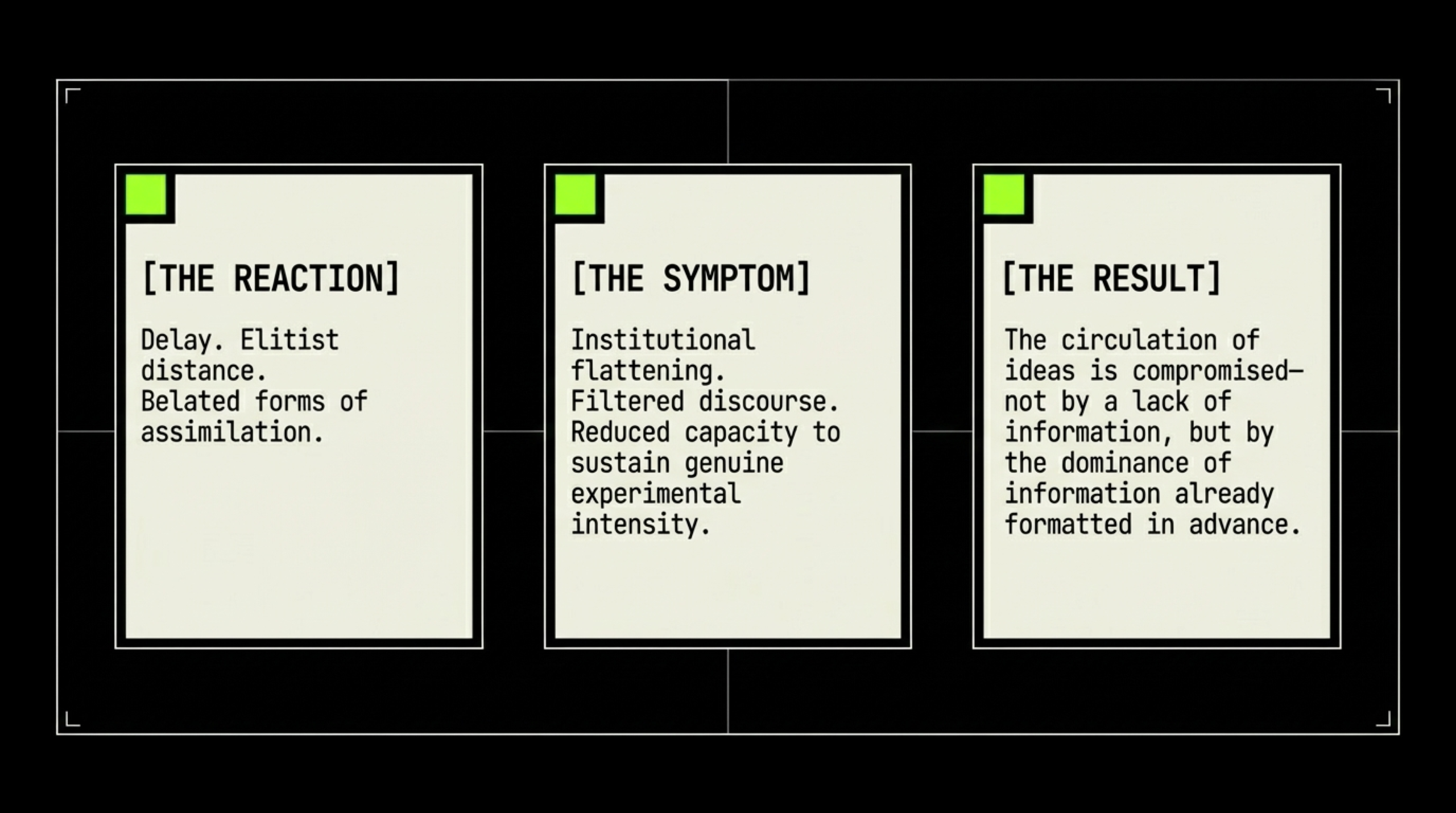
It is no longer enough to generate content or produce works in isolation. To remain genuinely active in redefining what art might mean under post-AI conditions, it becomes necessary to work simultaneously across creation, reverberation, and circulation. In other words, the issue no longer concerns production alone, but infrastructure.
This realization leads to two foundational decisions. The first is structural independence: no advertising, and no opportunistic mediation capable of compromising the coherence of the ecosystem. The second is the construction of an internal system designed to organise and expand our speculative work through advanced prompt design and coordinated LLM systems. What gives this system value is the conceptual action behind it: the method, the direction, and the critical intention that shape its use. This infrastructure becomes the space where Fakewhale positions itself from within the very transformations it seeks to understand.
Fakewhale defines itself as a generative network.
Network names a system of relations, trajectories, and intensities that move along the frequency of contemporary context. Generative names a mode of operation where emerging technologies are neither observed from the outside nor treated defensively, but absorbed into the production of new artistic and cultural conditions.
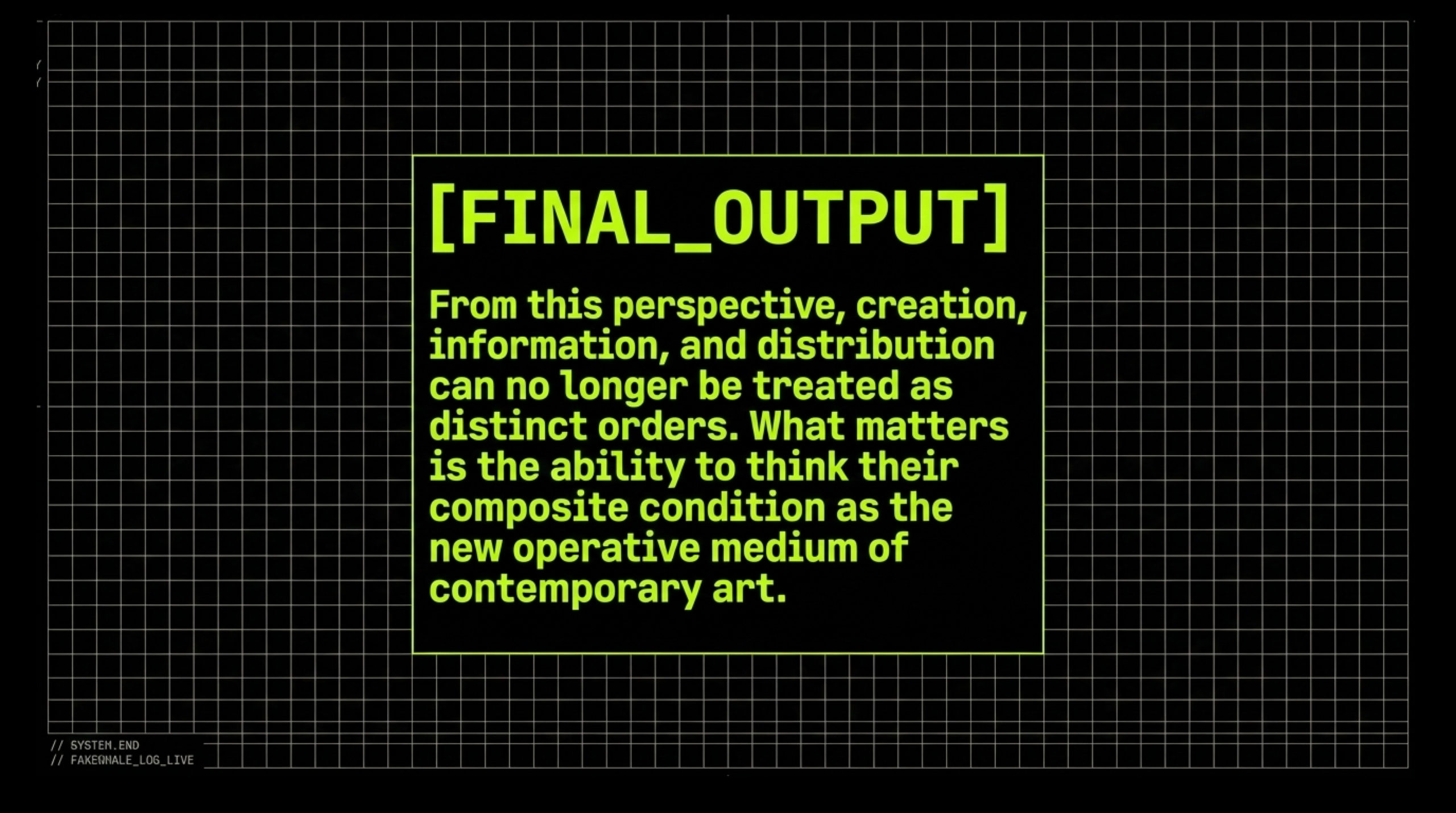
From this perspective, creation, information, and distribution can no longer be understood as separate layers. They now form a composite medium, and it is precisely within this composite condition that Fakewhale chooses to operate.
A NEW PLATFORM
Out of this trajectory, the new Fakewhale Log platform emerges.
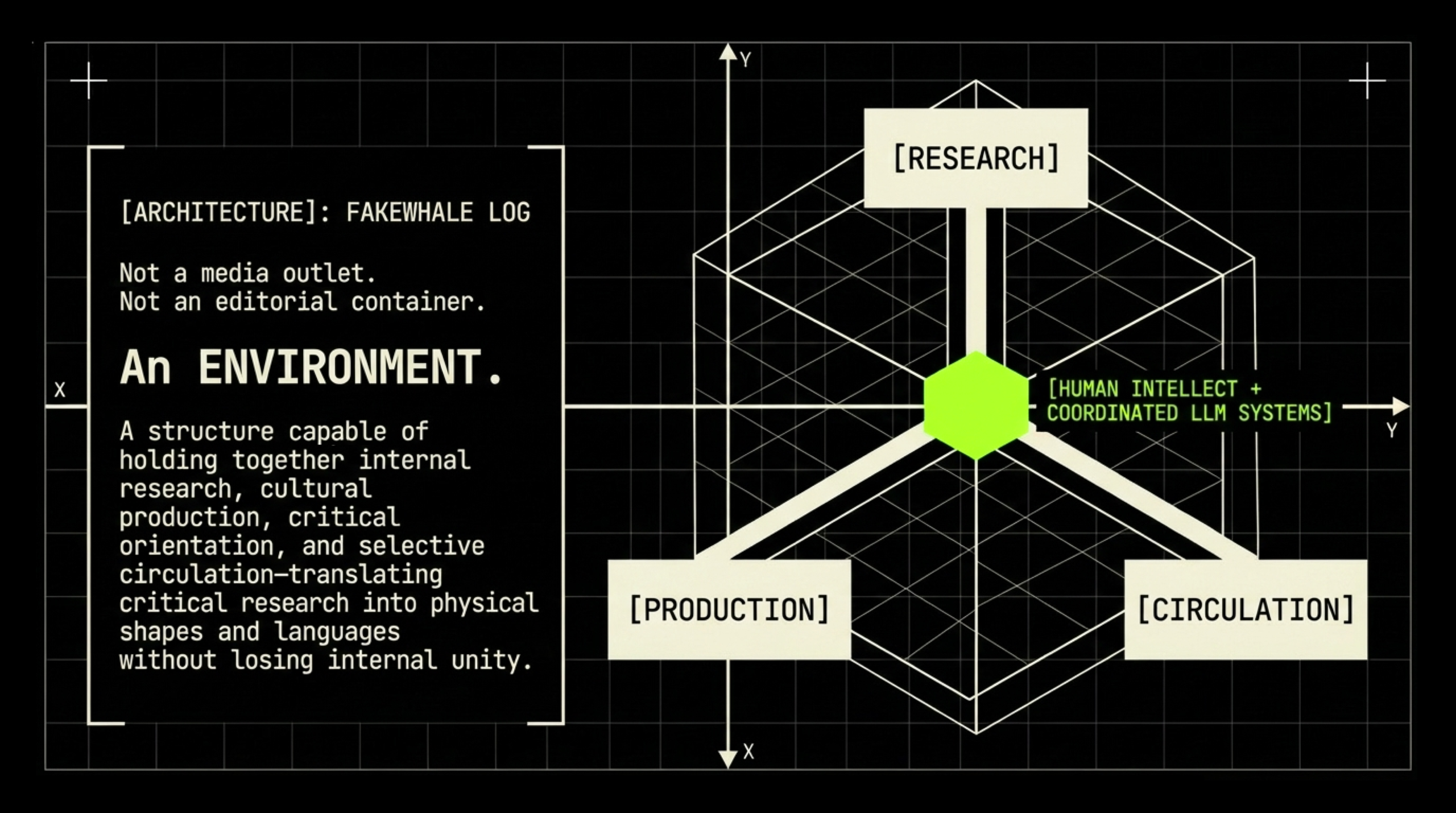
We define it as a research platform + network because what we are building is not meant to function merely as a media outlet. Our aim is to develop a structure capable of holding together internal research, cultural production, critical orientation, and the circulation of what resonates with force in the contemporary field.
The platform has been conceived to make this system legible and operational while giving our research a structure able to hold multiple forms without losing its internal unity.
CORE
At the center of the platform lies Core.
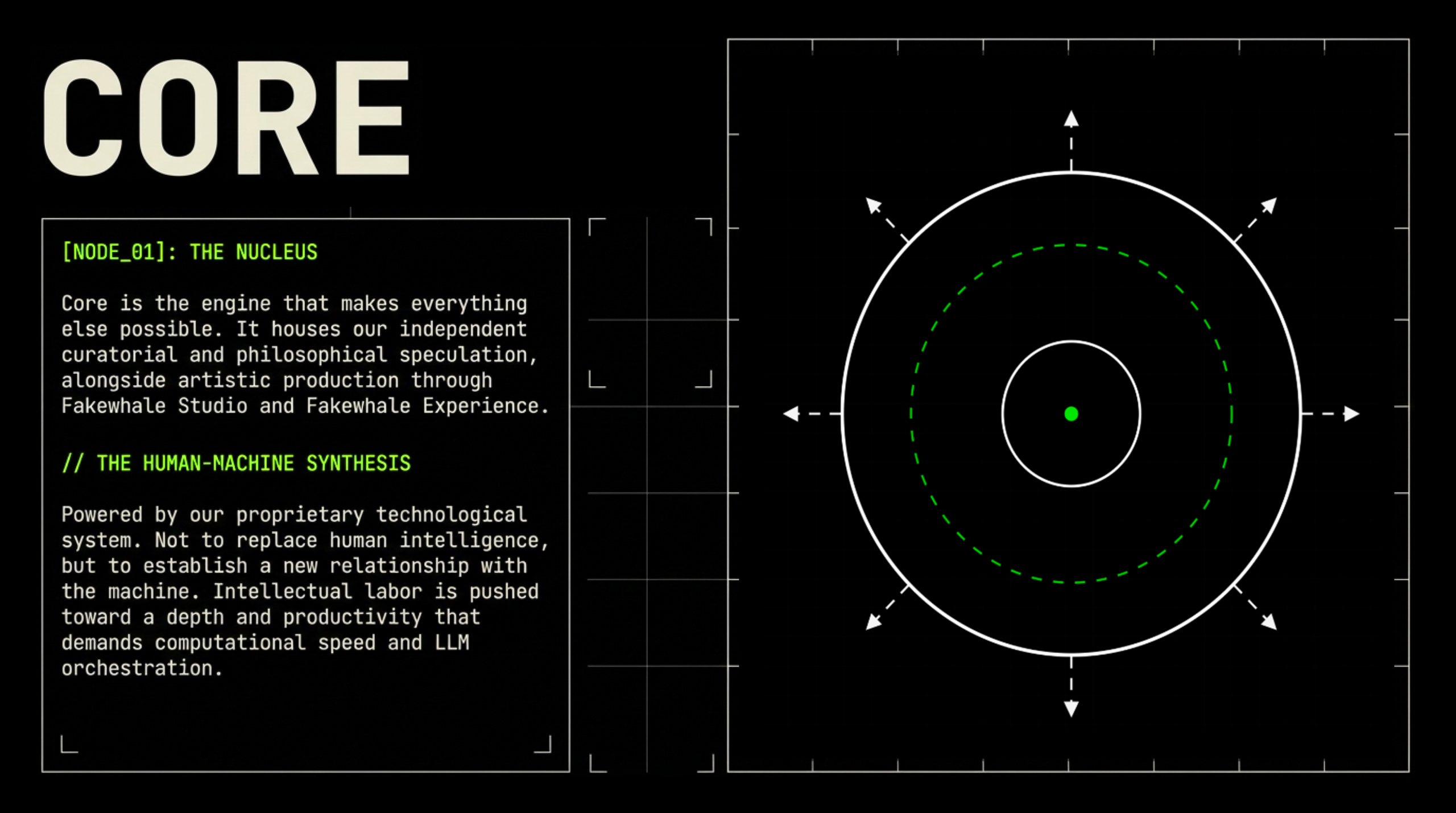
Core is where our independent curatorial and philosophical speculation resides, while also housing our artistic production through Fakewhale Studio and Fakewhale Experience. It is the nucleus where the team’s work takes shape as critical research, conceptual elaboration, and the construction of vision.
To operate at the level this dimension now demands, we have developed an internal framework based on structured prompting and coordinated LLM systems. This method does not aim to replace human intelligence, but to establish a new relationship with the machine, where intellectual work reaches a level of depth and productivity that can no longer ignore the computational speed and orchestration enabled by artificial intelligence.
Core is the point where critical research, artistic vision, and generative infrastructure converge. It is the engine that makes everything else possible.
ACCESS, OPENNESS, PROXIMITY
If Core represents the internal nucleus of the system, the platform has also been designed to remain open. This is where the dimension of Access begins to take shape.
Access matters because it marks the point where the outside can come into contact with the inside without dissolving the system’s coherence. It does not imply indiscriminate openness, but the construction of a threshold. What matters to us is the possibility of intelligent proximity, not the erasure of the boundary between the network and what surrounds it.
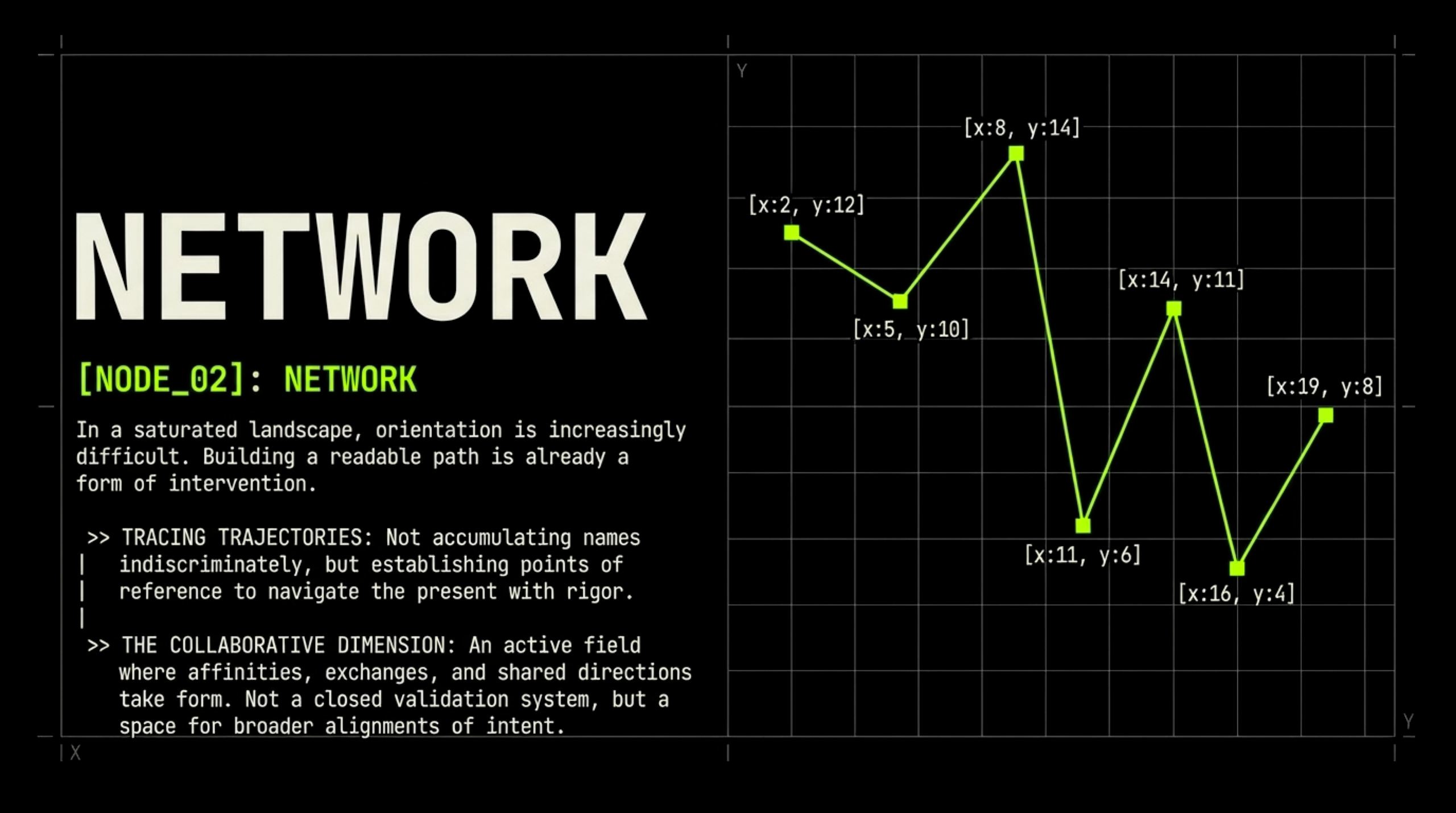
Within this logic, the Network section comes first. Its role is to bring visibility, context, and articulation to everything that internal research places within a conceptual map of the present. In a saturated landscape, where orientation becomes increasingly difficult, building a readable path is already a form of intervention. Network exists to trace trajectories, establish points of reference, and map the present.
Network also refers to the collaborative dimension of Fakewhale. It is where exchanges and shared trajectories take form, and where connections develop within a shared field of inquiry.
DISTRIBUTION
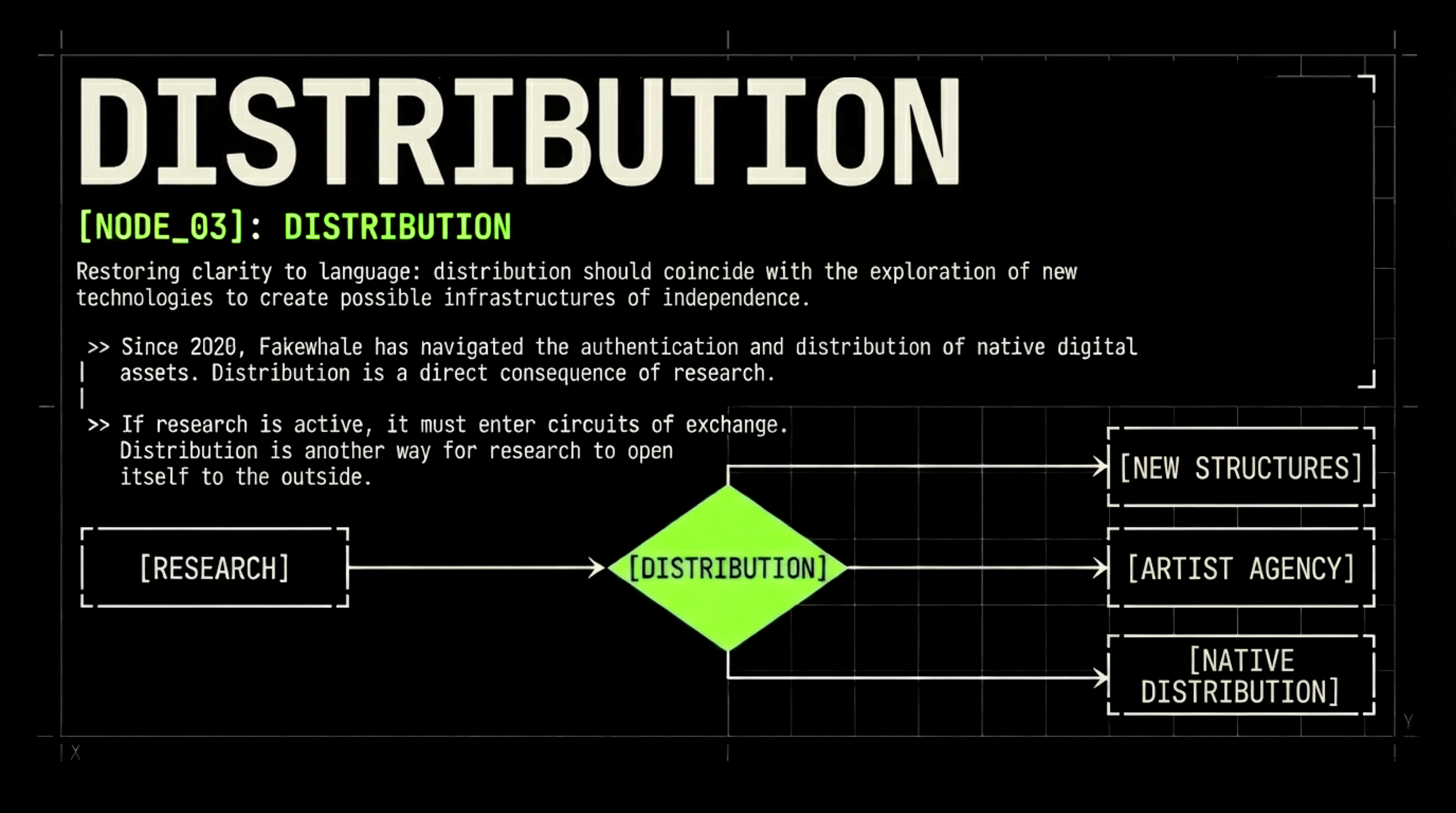
Distribution belongs to the same operational horizon as information.
The point is not to disguise economic structure beneath cultural language, but to understand that distribution is itself part of the medium. Once recognized in these terms, it no longer appears as an external force imposed from outside, but as a field that can be shaped through practice itself. Technology plays a decisive role in this shift because it allows us to engage models of circulation that were previously unavailable or structurally inaccessible to artists. Since 2020, Fakewhale has operated within this ecosystem, developing frameworks and synergies that have accompanied the emergence of new forms of native digital circulation, and exchange. This distributive dimension extends beyond a commercial function and operates as a direct extension of the research itself.
For this reason, Fakewhale remains an open construction site. We are actively working to develop new distributive models through emerging technologies and to connect them with the Network interface. This implies designing systems where distribution is structurally integrated into the platform’s relational layers. In the coming months, this distributive dimension will be further developed through concrete models and applied forms.
THE MEANING OF THE GENERATIVE NETWORK
The new Fakewhale LOG goes beyond a redesign or a functional expansion of what already existed. It reflects a broader evolution shaped by what Fakewhale has gradually become over time.
Fakewhale is a generative network because the present cannot be understood in separate compartments. Creation, information, and distribution are part of the same field.
What matters is the ability to think this whole as the new operative medium of contemporary art.