
The ability to generate an image has become increasingly detached from the conditions that once made its production possible. A visual language developed over decades can now be approximated in seconds. Complex compositions, material effects, and stylistic variations can be produced without direct engagement with the processes from which those forms originally emerged. This development has consequences for contemporary art that extend well beyond questions of authorship or technical execution. It changes the relationship between an artwork and the conditions necessary for its existence.
Generative systems have made a growing portion of visual culture available as something that can be anticipated. Their effectiveness depends on identifying relationships within existing information and using those relationships to produce plausible new configurations. This does not prevent them from generating unfamiliar or aesthetically compelling results. Statistical prediction can produce considerable variation, including combinations that have no obvious historical precedent. The important distinction lies elsewhere. An image can appear unfamiliar while remaining entirely accessible to the mechanisms responsible for generating it.
The expansion of these capabilities invites us to reconsider a dimension of artistic practice that has received relatively little attention in discussions surrounding artificial intelligence: the possibility that certain works cannot be meaningfully generated, even when their appearance can be convincingly reproduced.
Consider an artwork whose final state depends on the gradual deterioration of a material, an intervention whose meaning develops through its relationship with a particular location, or a process that unfolds over an extended period without producing a stable visual identity. In each case, documentation may offer an accurate representation of what occurred. A generative model might even produce an image indistinguishable from that documentation. Yet the resulting image would not necessarily reproduce the work itself, because the circumstances responsible for its existence are integral to what the work is.
The distinction is familiar in the history of conceptual, process-based, and site-specific art. What changes today is the technological environment in which it operates. When almost any recognizable aesthetic can be simulated, the relationship between an artwork’s appearance and the conditions of its production acquires a different significance. The capacity to reproduce an image no longer tells us very much about the capacity to reproduce the artistic operation it represents.
The term non-generability can help describe this distinction, provided it is understood as a condition rather than an artistic category. A work is not non-generable simply because it is unique, materially complex, or produced without computational assistance. Nor does resistance to generation imply greater artistic merit. The concept concerns the limits of prediction when confronted with processes whose defining conditions cannot be sufficiently specified, extracted, or reconstructed.
Those limits are necessarily provisional. What cannot be modeled today may become technically accessible tomorrow. A material process once considered unpredictable may eventually be simulated with considerable precision. Even artistic strategies developed to resist classification can acquire recognizable conventions and become available for reproduction. Non-generability therefore has no permanent aesthetic identity. It emerges within a particular relationship between artistic practice and the technological systems attempting to anticipate it.
This relationship also has economic consequences. Contemporary art circulates through institutions, markets, archives, and digital platforms that depend, to varying degrees, on recognition and classification. A practice that produces a consistent visual language can accumulate visibility through repetition. Its identity becomes easier to communicate, its works easier to associate with one another, and its position easier to establish within existing systems of valuation. The same characteristics can make that language increasingly accessible to generative reproduction.
Works that resist these mechanisms occupy a more uncertain position. Their resistance may create scarcity or strengthen the significance of direct experience. It may also limit their circulation, complicate their documentation, and make them difficult to accommodate within the structures that confer artistic recognition. There is no reason to assume that what escapes prediction will necessarily attract attention or acquire value. Some forms of resistance may remain almost entirely invisible.
The problem of non-generability consequently belongs as much to the organization of contemporary art as to the development of artificial intelligence. It concerns the conditions under which artistic practices become legible, the forms of experience that survive their conversion into information, and the extent to which systems built to anticipate cultural production also influence what artists choose to produce.
As prediction becomes an increasingly ordinary component of cultural infrastructure, the question of what cannot be generated becomes more precise. It requires examining the material, temporal, procedural, and institutional circumstances that continue to exceed the production of plausible outputs. These circumstances offer no guarantee of artistic significance. They do, however, expose the difference between generating a representation of something and bringing into existence the conditions that make it a work of art.
What Non-Generability Is (and Is Not)
The concept of non-generability requires a distinction between the possibility of reproducing an artwork’s appearance and the possibility of reproducing the conditions that constitute it. These operations are frequently treated as equivalent, particularly when the artwork is encountered primarily through photographic documentation or digital circulation. Yet the distance between them can be considerable. An image may preserve the visible characteristics of an object while excluding the circumstances responsible for its existence.
This distinction has a history that precedes generative artificial intelligence. Marcel Duchamp’s readymades demonstrated that the artistic status of an object could depend on decisions and institutional circumstances that were not discernible from its physical properties. The significance of Fountain cannot be reduced to the shape of a urinal, although that shape can be reproduced indefinitely. Its historical operation involved a particular act of selection, a specific institutional context, and the consequences of presenting an industrial object within an exhibition framework. A visually identical object produced today would enter a different historical situation. The original gesture cannot be repeated simply by reproducing its material form.
Non-generability shares something with this distinction, although it concerns a different problem. Duchamp exposed the inadequacy of formal properties as a complete explanation of artistic identity. Generative technologies make it necessary to examine how much of that identity can be anticipated through the information available to a predictive system. The question concerns the degree to which the conditions that constitute a work can be specified before the work takes place.
A process involving chemical reactions, for example, may be governed by well-understood physical principles while remaining sensitive to variations that are difficult to control in practice. Temperature, humidity, impurities, and interactions between materials can affect its development. Some outcomes may be modeled with considerable accuracy, while others depend on contingencies that only become apparent during execution. What matters artistically is not necessarily the unpredictability of the result. It may be the decision to allow those contingencies to participate in determining the work.
The same distinction applies to duration. A process that unfolds over several years can be represented through images, measurements, or a compressed simulation. Such representations may communicate its development without reproducing the temporal conditions under which it was experienced. Waiting can be integral to an artistic operation when the work depends on changes that cannot be accelerated without altering its meaning. A generated image of a deteriorated surface may resemble the result of prolonged exposure, but resemblance alone cannot account for the passage of time when that passage is part of the work’s constitution.
Non-generability should therefore not be confused with technical impossibility. Many processes that resist immediate generation can be simulated, reconstructed, or approximated under different conditions. The relevant question is whether such operations preserve what is essential to the particular artistic proposition. In some cases, they may. In others, the substitution changes the work sufficiently that the generated result becomes a separate object.
This also explains why materiality offers no automatic protection against generation. A painting executed by hand may follow a highly recognizable visual formula. Its surface may contain countless physical irregularities, but these irregularities do not necessarily prevent its aesthetic identity from being anticipated. Conversely, a work developed entirely through computational procedures may depend on external events, unpredictable interactions, or changing conditions that prevent its outcome from being determined in advance. The use of technology tells us relatively little about the degree of generability involved.
Originality presents a similar difficulty. A work may introduce an unprecedented combination of familiar elements while remaining readily reproducible once that combination has been established. Historical originality describes a relationship with what preceded the work. Non-generability concerns the relationship between a work and the systems capable of modeling its production. These relationships can overlap, but neither implies the other.
The idea of uniqueness is equally insufficient. Every physical object possesses properties that distinguish it from every other object, even when those differences are imperceptible or artistically irrelevant. Treating such singularity as evidence of non-generability would make the concept almost meaningless. The question is not whether an object can be duplicated with absolute physical accuracy, but whether the conditions that matter to its artistic identity can be generated through an available model.
There is also a more difficult problem involving information. Predictive systems depend on representations of existing phenomena, but artistic practices differ substantially in the kinds of traces they produce. Some generate extensive archives of images, descriptions, instructions, and repeated formal decisions. Others remain difficult to document because their effects are dispersed across situations, relationships, or experiences that do not produce stable records.
An intervention in public space may leave behind photographs while its consequences depend on interactions that were never recorded. A performance may be documented in detail without preserving the uncertainty experienced by those present. A conceptual operation may produce almost no distinctive visual material, making its significance dependent on knowledge of a particular sequence of decisions. In these cases, the available archive may be insufficient to reconstruct the work, even when it provides enough information to generate a convincing representation.
The absence of an extractable trace does not establish an absolute limit. More comprehensive documentation, different sensing technologies, or new modeling techniques may make previously inaccessible aspects available for prediction. Furthermore, a work can resist visual extraction while remaining highly predictable at the level of its procedure. A performance involving unpredictable audience participation, for instance, may still follow a recognizable artistic convention. Its individual occurrences can be contingent even when the general structure is familiar.
This suggests that non-generability is better understood in degrees and in relation to specific aspects of a work. Its appearance may be generable while its material development is not. Its procedure may be reproducible while its historical consequences remain open. Its conceptual structure may be easily described while its realization depends on conditions that cannot be established on demand.
The distinction becomes especially important when considering the role of intention. Artists can deliberately introduce randomness, procedural obstacles, or material instability into their practice, but these decisions do not necessarily produce meaningful resistance to prediction. Randomness itself is readily available to computational systems. An arbitrary result may be difficult to foresee individually while belonging to a distribution that can be modeled with considerable precision. The presence of chance is therefore insufficient. What matters is how uncertainty operates within the work and whether its consequences can be replaced without substantially changing the artistic proposition.
Nor should non-generability be treated as a form of authenticity reserved for human experience. Human decisions are frequently habitual, culturally conditioned, and statistically recognizable. Artistic production has always involved conventions, inherited procedures, and forms of repetition. The capacity to depart from these patterns is not guaranteed by the presence of an individual author. Likewise, computational systems can participate in processes whose outcomes depend on circumstances beyond their internal predictions.
The boundaries of non-generability are consequently unstable. They depend on the capabilities of particular systems, the information available to them, and the criteria used to determine whether a generated result constitutes an adequate reproduction. A change in any of these conditions can alter the status of a work without changing the work itself.
This instability is central to the concept. Non-generability identifies a limit within a given technological and cultural arrangement, rather than a permanent property of certain artistic media. It directs attention toward those aspects of production that remain dependent on circumstances not yet reducible to an executable description.
The implications become clearer when prediction is considered beyond the model itself. An artwork does not encounter generative technology in isolation. It enters an environment of archives, interfaces, classification systems, recommendation mechanisms, and economic incentives that influence which forms become available for recognition and reproduction. Understanding non-generability therefore requires examining the infrastructure that makes some artistic possibilities increasingly easy to anticipate while leaving others difficult to register at all.
The Infrastructure of Prediction
Prediction has become part of the ordinary infrastructure of cultural production. Its influence is not confined to the technical capabilities of generative models. It extends into the systems responsible for organizing archives, distributing images, measuring engagement, and establishing the conditions under which artistic work becomes recognizable. To understand the consequences of this development, it is necessary to examine how prediction operates across these different environments and how their functions increasingly intersect.
The training of a generative model begins with a transformation of cultural material into computationally usable information. Images, texts, and other forms of documentation are collected, processed, and incorporated into systems designed to identify relationships between their constituent elements. The resulting model does not function as a conventional archive from which individual objects are simply retrieved. It acquires parameters that encode statistical regularities across its training material, allowing it to produce new outputs in response to particular inputs.
This process introduces an important distinction between cultural history and the representation of that history within a model. The material available for training is never an exhaustive account of artistic production. It reflects the conditions under which works have been documented, digitized, described, distributed, and made accessible. An artwork extensively photographed, reproduced in publications, and discussed across digital platforms has a different informational presence from a practice that survives through limited documentation or fragmented institutional records.
These differences are not incidental. They influence which relationships can be learned and which forms of artistic activity remain difficult to represent. The historical archive becomes a technical resource, but its omissions and concentrations continue to operate within the resulting system.
The consequences are particularly visible in the treatment of artistic styles. A recognizable visual language provides a relatively coherent set of associations between formal characteristics, historical references, and descriptive categories. When such associations appear consistently across available data, they can become accessible through textual prompts. What was once understood primarily as the outcome of a sustained artistic practice can also function as a reproducible configuration of visual properties.
This does not mean that generative models possess a complete understanding of the artistic practices they approximate. Their ability to reproduce formal relationships may coexist with substantial limitations in their treatment of historical circumstances, material processes, or conceptual intentions. Nevertheless, the accessibility of those formal relationships changes how styles circulate. They become available for production outside the contexts in which they were developed, often without requiring knowledge of the decisions that originally gave them significance.
The prompt plays a central role in this transformation. It establishes an interface between human intention and a system of learned associations. Through language, users can request visual outcomes that correspond to recognizable aesthetic categories, material effects, compositional conventions, or combinations of historical references. The effectiveness of this interface depends partly on the availability of shared descriptors. An aesthetic that can be named, categorized, and associated with existing examples is generally easier to request than one whose defining characteristics have not yet acquired a stable description.
The prompt therefore does more than communicate an instruction. It participates in a process of translating cultural production into an operational vocabulary.
This translation has limitations that are not always apparent in the resulting images. Artistic categories are historically unstable, and their boundaries often emerge through critical disagreement rather than formal consistency. A movement, practice, or individual artistic position may contain contradictions that resist concise description. When such complexity enters a generative interface, it is often approached through the characteristics that can be most effectively associated with the requested term.
The result is not necessarily a simple average. Contemporary models can produce substantial variation and may generate unusual combinations of elements. Yet the relationship between a prompt and its likely outputs remains conditioned by the associations the system has learned and by the mechanisms used to guide generation. Some possibilities become easier to reach because they correspond to well-established relationships. Others require extensive intervention, external information, or a departure from the interface’s ordinary modes of operation.
This introduces a form of asymmetry into artistic production. The technical possibility of generating an image does not imply that all images are equally accessible. Certain aesthetic outcomes can be obtained through relatively simple instructions, while others demand complex sequences of adjustments or remain difficult to specify altogether.
The architecture of generative systems contributes to this asymmetry. Models are developed through training objectives that reward particular forms of statistical performance. Many contemporary image generators also incorporate additional stages of optimization intended to improve correspondence with user instructions, visual coherence, perceived quality, and compliance with platform requirements. These procedures do not establish a single universal aesthetic, but they influence the distribution of results users are likely to encounter.
An output that appears visually resolved may reflect several layers of selection. The model has learned from an uneven archive, the interface has translated an instruction into a computational process, and subsequent optimization may favor results that meet established criteria of acceptability or user preference. Each stage introduces conditions that shape the field of available outcomes.
The resulting tendency toward recognizable visual solutions is sometimes described as statistical smoothing. The expression is useful only with some qualification. Generative models do not simply eliminate unusual features or reduce all images to conventional averages. They can reproduce anomalies, intensify stylistic differences, and generate configurations that would be rare in ordinary visual culture. The more consequential effect concerns the organization of probability and accessibility. Even when unusual outcomes remain possible, the system establishes pathways that make certain forms easier to obtain, refine, and repeat.
These pathways matter because generative production increasingly takes place within commercial environments. The success of a model is evaluated through a combination of technical performance, user adoption, reliability, operating cost, and the perceived usefulness of its outputs. A system that consistently produces results users recognize as satisfactory has practical advantages over one whose behavior is difficult to anticipate or control.
Commercial incentives consequently favor forms of predictability that extend beyond the underlying statistical model. Users expect instructions to produce reasonably coherent results. Developers seek to reduce failures and improve consistency. Platforms benefit when production can be integrated into repeatable workflows. These priorities are understandable within the economics of software development, but they also influence the cultural possibilities that become most readily available.
The relationship between prediction and economic organization becomes more complex when generated material enters distribution platforms.
Digital circulation has long depended on systems that classify content and estimate its relevance to particular audiences. Search engines, social platforms, recommendation systems, and commercial marketplaces employ different technical methods, but they share an interest in making large quantities of information navigable through measurable signals. Categories, metadata, interaction histories, and patterns of user behavior help determine what becomes visible.
Generative models and recommendation systems should not be treated as identical technologies. Their objectives and architectures differ, and their outputs operate at different stages of cultural circulation. Nevertheless, they increasingly participate in a common environment in which production and distribution are informed by statistical relationships.
A generative system estimates how an output can be constructed from available information. A recommendation system estimates which existing output may be relevant to a particular user. When these operations become connected, the production of cultural material can be influenced by expectations about its subsequent circulation.
This connection does not require direct integration between the technologies. Artists, designers, and other cultural producers already encounter information about which visual formats, subjects, and presentation strategies receive attention. Generative tools make it easier to respond to those signals by producing variations at scale. The capacity to generate content rapidly can therefore reinforce an existing tendency to organize production around recognizable forms of demand.
The implications for contemporary art are not uniform. Artistic institutions operate according to criteria that cannot be reduced to platform engagement, and market valuation involves historical, social, and financial relationships that extend beyond digital visibility. Yet the influence of predictive distribution is difficult to isolate from the broader conditions of recognition. Artists increasingly encounter their own work through platforms that classify it, compare it with other material, and present it within environments shaped by continuous measurement.
The image acquires a second function in this setting. It remains a representation of an artwork, but it also becomes an informational unit whose characteristics influence its capacity to circulate. Composition, contrast, recognizable motifs, descriptive language, and consistency across a body of work may affect how effectively that work is indexed or encountered.
These characteristics do not necessarily determine artistic value. They can, however, affect the probability that a work reaches the institutions, audiences, and intermediaries through which value is subsequently negotiated.
This distinction between visibility and valuation is essential. A work may circulate extensively without acquiring significant artistic recognition. Another may remain relatively inaccessible while developing considerable importance within a restricted institutional or critical context. Predictive infrastructures do not abolish these differences. They introduce additional mechanisms that interact with them.
The effects become especially significant when considering the formation of artistic identity.
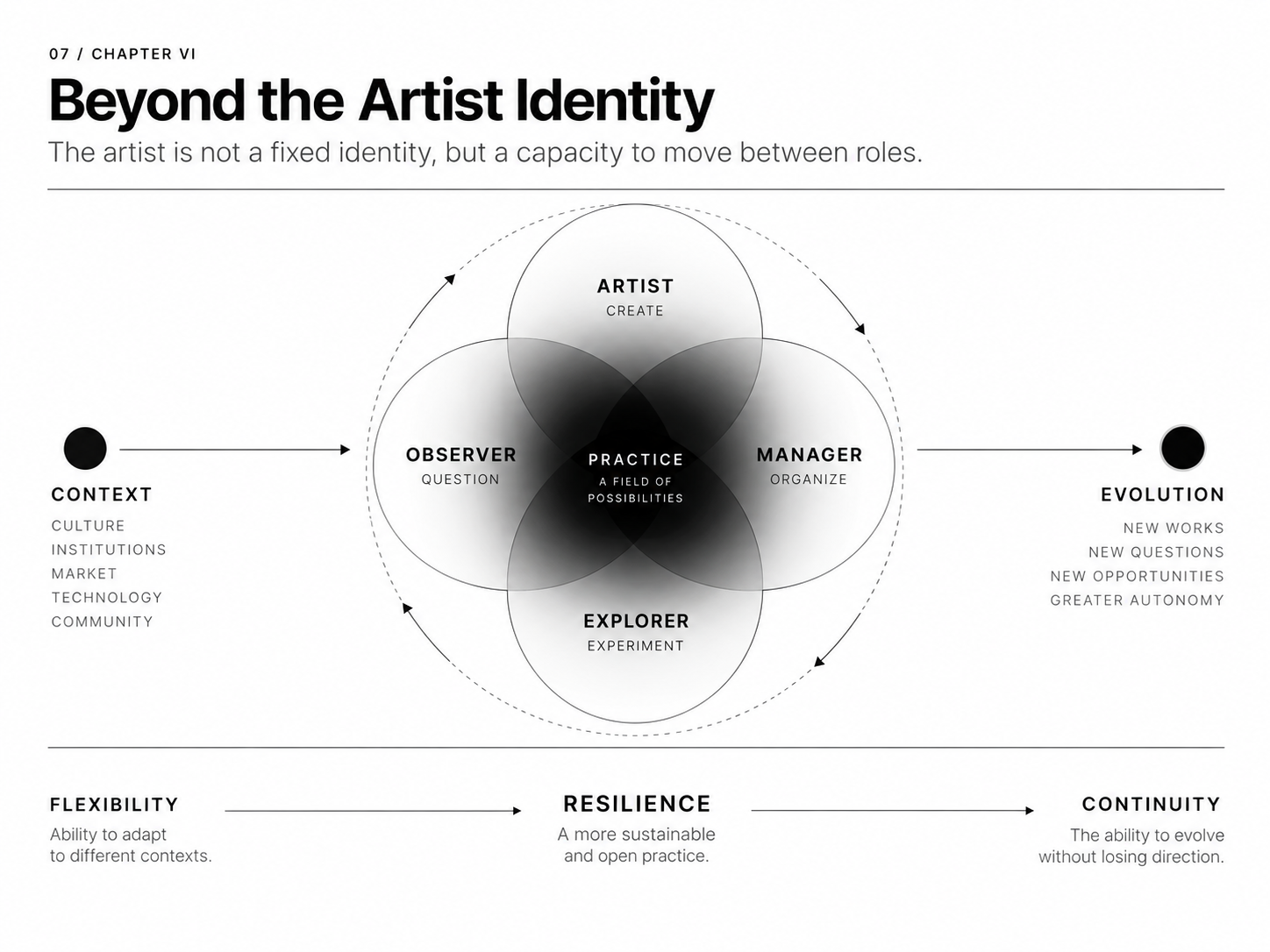
Historically, the recognition of an artist’s work has often depended on some degree of continuity. Recurring formal decisions, conceptual concerns, or procedural methods allow a practice to become identifiable across individual works. This continuity serves several functions. It supports critical interpretation, enables historical comparison, and provides collectors and institutions with a framework for understanding an artist’s development.
Within contemporary digital infrastructures, continuity also has an informational advantage. A practice with stable visual characteristics can be more readily associated with a recognizable identity. Its images can be grouped, described, and connected through repeated features. This can facilitate circulation, but it also makes the practice more accessible to systems trained to reproduce those characteristics.
An artist may therefore encounter an unusual tension between the development of a coherent language and the increasing generability of that language. The more successfully a practice establishes a recognizable formal identity, the more information becomes available for approximating its appearance.
There is no necessary contradiction between these developments. Recognition has always involved the possibility of imitation, and the reproduction of stylistic characteristics does not automatically reproduce the significance of an artistic position. What changes is the scale and accessibility of approximation. Generative systems reduce the technical resources required to produce plausible variations of an established visual language, making formal resemblance available to a much broader range of participants.
This transformation may affect the way artistic difference is perceived. When stylistic variation becomes inexpensive and abundant, the presence of a distinctive appearance may no longer provide the same evidence of a distinctive production process. Viewers can encounter images that suggest complex material techniques, elaborate construction, or prolonged experimentation without any corresponding process having taken place.
The problem is not that these images are necessarily deceptive. A generated image can be presented transparently and evaluated on its own terms. The difficulty arises when visual characteristics that previously implied particular conditions of production become detached from those conditions. The relationship between appearance and process becomes less reliable as a basis for interpretation.
This has consequences for the role of documentation. Museums, galleries, and archives increasingly maintain digital records that allow artworks to circulate independently of their physical presence. These records are indispensable for research, preservation, and public access. They also establish standardized forms of representation that can become inputs for computational systems.
An installation may be reduced to a selection of photographs and descriptive metadata. A performance may circulate primarily through a short video. A materially complex work may become recognizable through a single frontal image. Each form of documentation makes certain properties accessible while excluding others.
The problem is not simply that documentation is incomplete. All documentation involves selection. What matters is the increasing tendency for the documented version to become the principal form through which an artwork is encountered, compared, and potentially reproduced.
When this happens, the archive begins to influence the practical definition of the work. Features that survive documentation become available for circulation and computational analysis. Features that remain difficult to record may become less visible within the systems responsible for organizing cultural information.
Institutional practices can reinforce or complicate this tendency. Detailed provenance records, conservation reports, installation instructions, and historical documentation may preserve information that cannot be inferred from an image alone. Access restrictions, acquisition policies, and curatorial decisions can also influence how artistic material enters digital archives. These mechanisms establish different degrees of availability, although restricted access does not necessarily prevent the development of approximations from publicly circulating information.
The institution therefore occupies an ambivalent position. It can preserve the complexity of a work beyond its visible form, while simultaneously contributing to the standardized representations through which that work becomes computationally accessible.
A further consequence concerns the relationship between prediction and artistic decision-making. Once artists become familiar with the kinds of outputs generative systems produce effectively, that familiarity can influence their choices even when they do not use the systems directly. Certain visual solutions may appear exhausted because they can be generated so easily. Others may become attractive precisely because they are difficult to obtain through existing interfaces.
In this sense, predictive infrastructure can shape production indirectly. Its influence extends to the expectations artists develop about what constitutes a meaningful difference within an environment saturated with readily available images.
This does not establish a general movement away from digital production or toward physical complexity. Artists may respond by intensifying their use of generative tools, developing procedures that exploit their limitations, or abandoning the pursuit of stylistic distinction altogether. Others may place greater emphasis on the circumstances of presentation, the structure of participation, or the duration of a work’s development.
The relevant transformation lies in the changing conditions under which artistic decisions are made. The existence of a technology capable of producing a particular result alters the significance of choosing to produce that result through another process, even when the final appearance remains similar.
Prediction thus operates at several levels simultaneously. It informs the generation of images, influences their distribution, affects the formation of recognizable identities, and enters the expectations surrounding artistic production. These processes do not form a perfectly coordinated system, nor do they determine artistic outcomes in advance. Their effects emerge through interactions between technologies, institutions, markets, and individual practices.
The infrastructure of prediction is therefore better understood as an arrangement of capabilities and incentives than as a single technological apparatus. Its power lies partly in making certain operations ordinary: the immediate production of stylistic variations, the classification of cultural material, the estimation of audience preferences, and the conversion of documented practices into reusable information.
Within this arrangement, non-generability acquires a significance that cannot be explained by the limitations of image-generation software alone. It becomes a way of identifying where the mechanisms of anticipation encounter conditions they cannot adequately incorporate, and where the ease of producing a representation begins to diverge from the possibility of producing the work it represents.
The next question concerns how these limits operate within actual artistic practices. Their relevance cannot be established through a general preference for physical materials, unpredictability, or procedural complexity. It must be examined in relation to the specific circumstances in which a work is produced and the extent to which those circumstances remain consequential after its appearance has become reproducible.
Practices That Resist
The limits of generative prediction become more apparent when artistic production is examined as an activity that unfolds under specific conditions, rather than as the realization of a predetermined image. Certain practices make those conditions unusually consequential. Their outcomes depend on events that cannot be entirely controlled, delegated, or established in advance. This does not place them outside technological reproduction, but it complicates the assumption that an adequate description of the result is sufficient to produce the work.
The history of process art offers a useful starting point. In the late 1960s, artists such as Robert Morris and Richard Serra began investigating forms whose development depended on the behavior of materials rather than the execution of a fixed composition. Serra’s Splashing works, produced by throwing molten lead against architectural surfaces, involved decisions about location, force, and procedure, while allowing the physical behavior of the material to determine the resulting configurations. The artist established the circumstances of an event without prescribing its exact appearance.
What makes this approach relevant today is the distribution of agency within the production process. The material participates in determining the outcome, introducing variables that cannot be fully resolved through intention alone. Contemporary computational systems can model many physical interactions, sometimes with extraordinary precision. Yet a simulation remains dependent on the variables selected for inclusion and the assumptions governing their relationships. The actual event may introduce conditions that were never incorporated into the model.
The artistic significance of this difference depends on the work. In some practices, an approximate simulation may be entirely adequate. In others, the exposure to uncontrolled material behavior constitutes the central operation. The resulting object records an encounter between an established procedure and circumstances that were not completely known before execution.
A related problem emerges in works involving biological growth, corrosion, decomposition, or environmental exposure. Such processes can continue developing beyond the moment of artistic intervention. Their changing states complicate the idea of an artwork as a completed configuration, particularly when the artist accepts that its future appearance cannot be determined with certainty.
Hans Haacke’s early systems works provide a historical example of this approach. In Condensation Cube (1963–65), water condenses and evaporates within a transparent container in response to surrounding environmental conditions. The work does not require an unpredictable visual language to remain variable. Its operation depends on an ongoing exchange with the environment, making each state provisional.
A generated image could represent any number of possible configurations of condensation. It could even approximate their progression over time. The distinction lies in the actual dependence of the work on its surroundings. Its changing appearance is evidence of a process taking place, rather than the independent production of an image resembling that process.
This distinction becomes less straightforward when artistic practices deliberately incorporate simulation. A computational model connected to environmental sensors, for example, may establish a relationship with external conditions comparable to that of a physical installation. Non-generability cannot therefore be assigned exclusively to material objects. It depends on how the work establishes its relationship with events that remain open during its execution.
Site-specific practices introduce another form of dependency. Their significance may arise from architectural constraints, local histories, social relationships, or institutional circumstances that cannot be transferred without substantial alteration.
Michael Asher’s interventions frequently operated through modifications to the conditions of exhibition itself. By altering walls, circulation routes, or the relationship between institutional spaces, his works exposed structures that ordinarily remained unnoticed. Their meaning was inseparable from the particular environments in which they occurred.
The possibility of reconstructing such interventions raises questions that generative technologies make especially visible. A convincing image of an institutional modification can communicate its appearance, but the intervention originally operated on an existing situation. It changed how a particular space functioned and how visitors encountered it. A representation may preserve evidence of that change without reproducing its consequences.
The distinction also applies to works that depend on participation. A performance can establish a set of instructions while leaving the actual course of events dependent on those present. The artist may define the boundaries of an encounter without knowing how participants will respond, what relationships will emerge, or which consequences will acquire significance afterward.
Such practices are not necessarily resistant to prediction at the level of their general structure. Participatory art has its own conventions, and audience behavior can exhibit recognizable patterns. What remains difficult to generate is the particular social situation when the identities, decisions, and consequences of participation are constitutive of the work.
This introduces a form of non-generability that cannot be located in the artwork’s appearance. It emerges from relationships that exist only because an event actually takes place.
Other practices approach the problem through deliberate instability of method. Rather than developing a recognizable formal vocabulary, an artist may establish procedures that change from one work to another, making stylistic continuity an unreliable means of identifying the practice.
This strategy has precedents in conceptual art, where the significance of a work may reside in the formulation of an instruction, a decision, or an organizational system. Yet procedural variability does not automatically produce resistance. Once a method becomes recognizable, its apparent unpredictability may itself become a convention. An artist known for systematically changing media or refusing stylistic consistency can eventually be identified through that refusal.
The difficulty is structural. Any sufficiently documented artistic strategy can become the basis for further classification. Attempts to escape recognizable patterns may generate new patterns of their own.
For this reason, the most consequential forms of procedural resistance may be those that do not seek to establish non-generability as an identifiable aesthetic. Their operations emerge from the requirements of individual works rather than from a general commitment to producing outcomes that appear difficult to imitate.
Time introduces a further complication. Some artistic practices depend on intervals during which little or nothing is produced for immediate consumption. Their significance develops through postponement, accumulation, or the gradual transformation of circumstances.
Tehching Hsieh’s One Year Performances offer an especially demanding example. Their defining conditions involved commitments maintained over extended periods, including repeated actions, restrictions, and forms of exposure to everyday time. Documentation provides access to these works, but their artistic operation cannot be reduced to the information recorded. The duration was not simply a parameter describing the performance. It was the condition under which the performance existed.
The relevance of such practices to generative culture concerns the difference between representing duration and undergoing it. Computational systems can simulate extended processes or produce their anticipated results without waiting for the corresponding period to pass. For many purposes, this compression is useful. In an artistic practice where the passage of time constitutes the work, however, compression changes the operation being performed.
There is an important economic dimension to this distinction. Duration can introduce costs that are not easily eliminated through technical efficiency. Space must remain occupied, materials maintained, commitments sustained, and institutional resources allocated. These costs do not guarantee significance, but they establish conditions of production that cannot always be replaced by faster methods without changing what is being produced.
The same applies to certain forms of waiting and delayed disclosure. A work whose realization depends on a future event may remain incomplete or inaccessible for an extended period. Its eventual appearance can be anticipated in general terms while its actual circumstances remain unresolved.
Such practices expose a limitation in the assumption that cultural production should become increasingly immediate. Their temporality is not necessarily a rejection of technological acceleration. It may arise from the internal requirements of the work, which happen to conflict with systems organized around rapid production and continuous availability.
Across these examples, resistance emerges from different sources. Material processes introduce physical dependencies. Site-specific interventions operate within existing situations. Participatory works involve relationships whose consequences remain open. Procedural strategies complicate the extraction of a stable formal identity. Extended durations establish commitments that cannot always be compressed into a representation.
None of these conditions is sufficient, on its own, to establish artistic value. Material instability can become a decorative effect, participation can become predictable, and prolonged duration can remain conceptually empty. Their relevance lies in the way they distribute the production of a work across circumstances that exceed the immediate generation of an output.
They also reveal why non-generability cannot become a stable artistic program without encountering a contradiction. Once resistance to prediction is adopted as a recognizable objective, it can influence production according to its own conventions. What begins as an examination of technological limits risks becoming another category of cultural material available for identification and reproduction.
The more productive question concerns the consequences of maintaining practices whose defining conditions cannot be made fully available on demand. Such works may require different forms of documentation, institutional commitment, and interpretation. They may also struggle to circulate within environments where artistic recognition increasingly depends on accessible representations.
Their resistance is therefore inseparable from the conditions under which they become public. What cannot be readily generated may acquire a particular significance through that limitation, but it may equally remain difficult to encounter, understand, or support. The relationship between non-generability and artistic value begins precisely within this uncertainty.
Value, Visibility, and the Limits of Non-Generability
The economic implications of non-generability are less straightforward than its technical conditions might suggest. If generative systems make certain forms of cultural production increasingly accessible, it is tempting to assume that works resistant to those systems will acquire greater value through their relative scarcity. Yet scarcity has never been sufficient to establish artistic significance, and the difficulty of reproducing something does not necessarily produce a corresponding desire to possess or experience it.
The contemporary art market provides numerous examples of value emerging from conditions that extend beyond the physical or formal properties of an artwork. Provenance, institutional recognition, historical relevance, critical interpretation, and the relationships surrounding an artist’s practice all contribute to the formation of economic value. These mechanisms have developed independently of generative artificial intelligence, although the increasing availability of synthetic cultural material may alter their relative importance.
An artwork that cannot be readily generated may acquire value because its production depends on circumstances that cannot be reproduced at will. A particular event, an extended material process, or an intervention within a historically significant location may establish a form of scarcity that differs from the limited availability of an edition or object. In such cases, scarcity is a consequence of the work’s conditions of existence.
Whether this scarcity becomes economically meaningful depends on the systems responsible for recognizing it.
The art market has considerable experience transforming difficult, temporary, or materially unstable practices into objects of exchange. Performance documentation, installation certificates, contractual instructions, and archival materials can establish transferable relationships to works that do not exist as conventional commodities. These mechanisms allow institutions and collectors to support practices whose significance cannot be reduced to a permanent physical object.
They also introduce a complication. The economic circulation of a non-generable work may depend on producing a stable and recognizable representation of its identity. A certificate, a set of instructions, or a documented history can make the work legible within a market even when its original conditions cannot be reproduced.
The resistance of the artistic operation and the transferability of its economic identity can therefore coexist. Indeed, the market may depend on precisely this separation.
This suggests that non-generability does not necessarily operate against commodification. Under certain circumstances, it can become an attribute through which value is established. The inability to reproduce a historical occurrence may strengthen the importance of its surviving documentation or the authority of the institution responsible for preserving it.
There is, however, no guarantee that such a transformation will occur. Practices that resist standardized representation may also lack the institutional support necessary to establish continuity, provenance, or public recognition. Their difficulty of reproduction can become an obstacle to circulation rather than a source of distinction.
The difference is especially important in an environment where visibility is unevenly distributed. Works that produce immediately recognizable images can circulate through digital platforms with relatively little contextual information. Practices dependent on complex procedures or prolonged engagement often require explanation before their significance becomes apparent. Their reception may depend on exhibitions, critical writing, direct experience, or sustained institutional mediation.
These forms of mediation require resources. They involve time, expertise, physical infrastructure, and the willingness to support artistic propositions whose effects may not be immediately demonstrable.
Non-generability may consequently increase an artwork’s dependence on institutions even when the practice itself seeks to question established systems of recognition. The less a work can communicate through readily circulating representations, the more consequential the structures capable of presenting its conditions may become.
This dependence creates an important distinction between aesthetic resistance and institutional autonomy. A work can remain difficult to generate while being entirely dependent on conventional mechanisms of validation. Conversely, an easily reproducible image may circulate outside established institutions and acquire significance through alternative networks of interpretation.
There is no necessary alignment between technological resistance, economic independence, and critical relevance.
A further complication arises when non-generability itself becomes a criterion of distinction. As generative production becomes more widespread, claims concerning irreproducible processes, physical authenticity, or exceptional material conditions may acquire greater promotional significance. The language of resistance can become part of the economic presentation of an artwork, independently of the actual importance of those conditions to its artistic proposition.
This possibility deserves particular attention because it exposes the instability of non-generability as a category. Once a condition becomes desirable, institutions and markets can develop methods for identifying, certifying, and exchanging it. The resulting framework may reward works that demonstrate recognizable signs of resistance, producing a new set of conventions around what supposedly escapes convention.
Aesthetic resistance can thus become economically legible precisely by acquiring the characteristics that make it easier to anticipate.
The paradox does not invalidate the concept. It indicates that non-generability cannot be understood independently of the systems that recognize and assign value to it. A work may resist generation at the level of its production while becoming highly predictable at the level of its reception, institutional classification, or market positioning.
These distinctions also complicate the future relationship between artistic labor and technological efficiency.
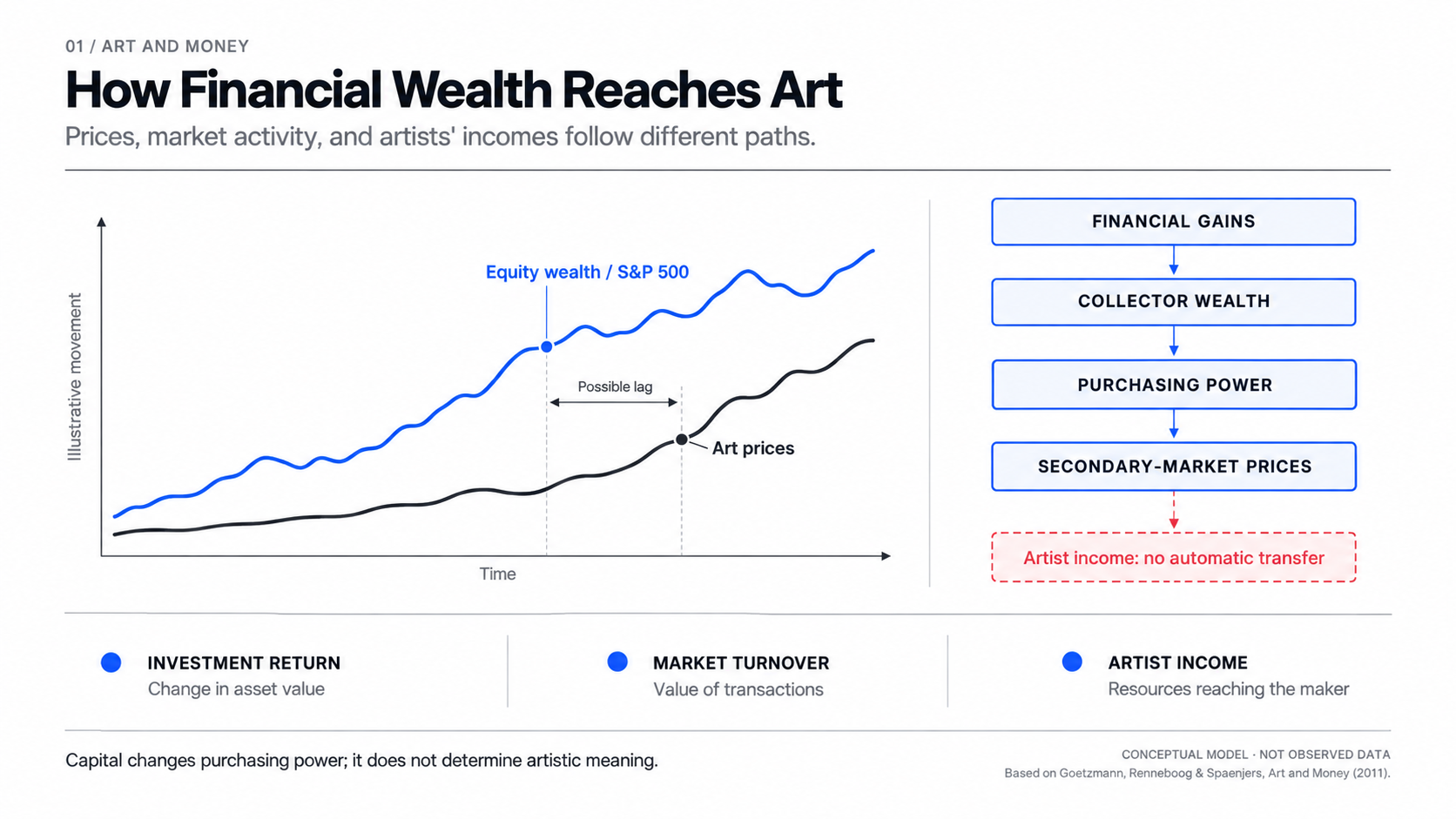
Generative systems can reduce the time and resources required to produce certain kinds of images, but the economic consequences of this reduction are not distributed uniformly. Greater productive capacity may increase the supply of visual material without producing a corresponding expansion in the attention, institutional resources, or purchasing power available to support it.
Under such conditions, artistic value may become increasingly dependent on forms of differentiation that cannot be established through visual appearance alone. Historical circumstances, sustained commitments, and specific conditions of production may become more consequential in some sectors of the art world. In others, the accessibility and flexibility of generative production may create new forms of artistic and economic activity whose value does not depend on resistance at all.
Both developments can occur simultaneously.
The distinction between generable and non-generable practices is unlikely to produce a stable hierarchy. Technological capabilities will continue to change, and the cultural significance of particular limitations will change with them. Some processes currently difficult to model may become routine. Other forms of artistic production may emerge from technologies whose consequences remain insufficiently understood.
The concept of non-generability is therefore most useful when it remains provisional. It identifies a relationship between the conditions of an artistic practice and the capacities of the systems attempting to anticipate it. That relationship can reveal where existing infrastructures encounter limits, but it cannot determine in advance which works will matter.
Its broader significance lies in the way it complicates the equation between technical possibility and artistic possibility.
A system capable of generating a convincing representation does not necessarily reproduce the circumstances that make the represented work significant. At the same time, the inability to generate those circumstances provides no independent measure of their value. Artistic significance continues to emerge through relationships between production, interpretation, historical context, and the institutions that make works available to experience.
Generative technologies change these relationships by expanding the range of forms that can be produced without reconstructing the processes from which they historically emerged. They also introduce new possibilities for artistic practices that operate directly within computational systems. The resulting transformation cannot be adequately described as the replacement of one form of creativity by another. It concerns a reorganization of the conditions under which artistic production becomes possible and recognizable.
Non-generability occupies a shifting position within that reorganization. It may emerge from material constraints, temporal commitments, institutional circumstances, or procedures whose consequences remain open. It may disappear as technological capacities develop, or become newly relevant when established forms of production lose their previous distinctions.
For this reason, it offers little basis for defending a particular medium, historical tradition, or conception of authorship. Its relevance is analytical rather than prescriptive. It allows us to examine what predictive infrastructures can incorporate, what they leave unresolved, and how those boundaries influence the organization of contemporary artistic practice.
The future of art will not be determined exclusively by the increasing capacity to generate cultural forms. It will also depend on the conditions under which those forms are encountered, interpreted, sustained, and assigned significance. Some of these conditions will become increasingly accessible to computational modeling. Others may arise from developments that existing systems have not yet made recognizable.
What remains open is the possibility that new artistic practices will emerge from precisely these unresolved conditions, including forms of production and valuation for which no established model yet provides an adequate description.
Non-generability names that uncertainty without resolving it. Its significance lies in reminding us that the capacity to anticipate an outcome and the conditions that make an artwork possible are not necessarily the same thing.