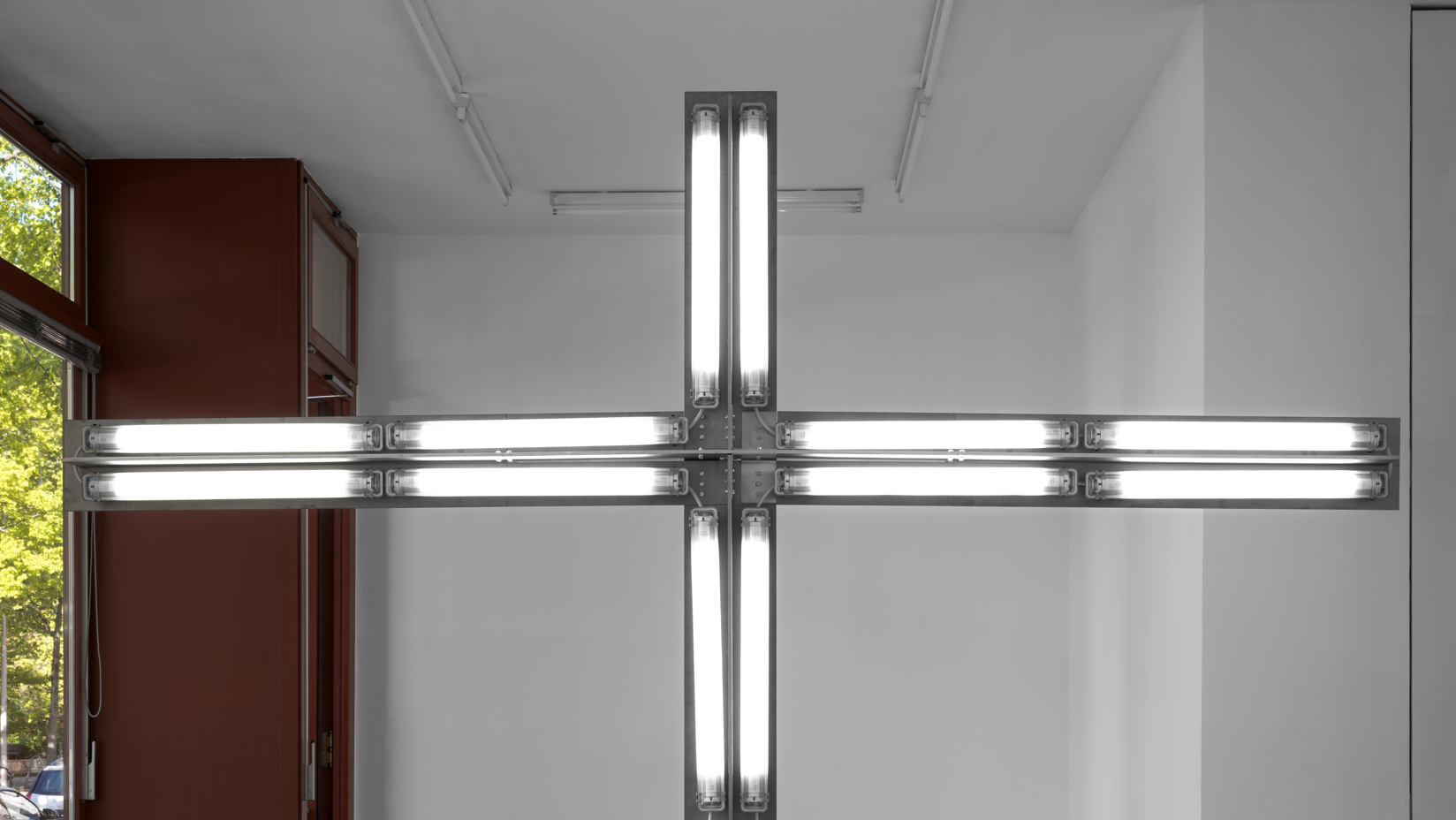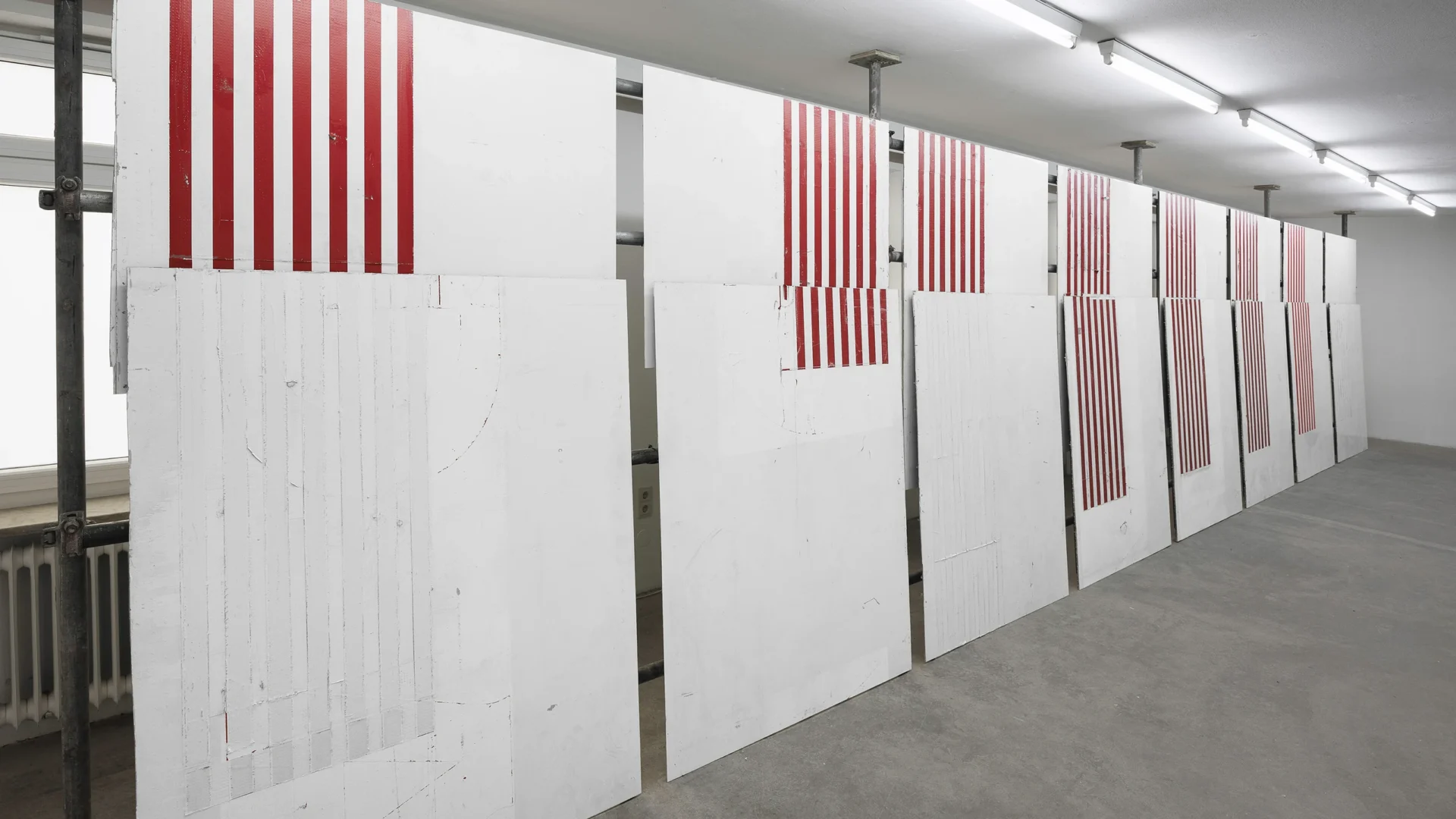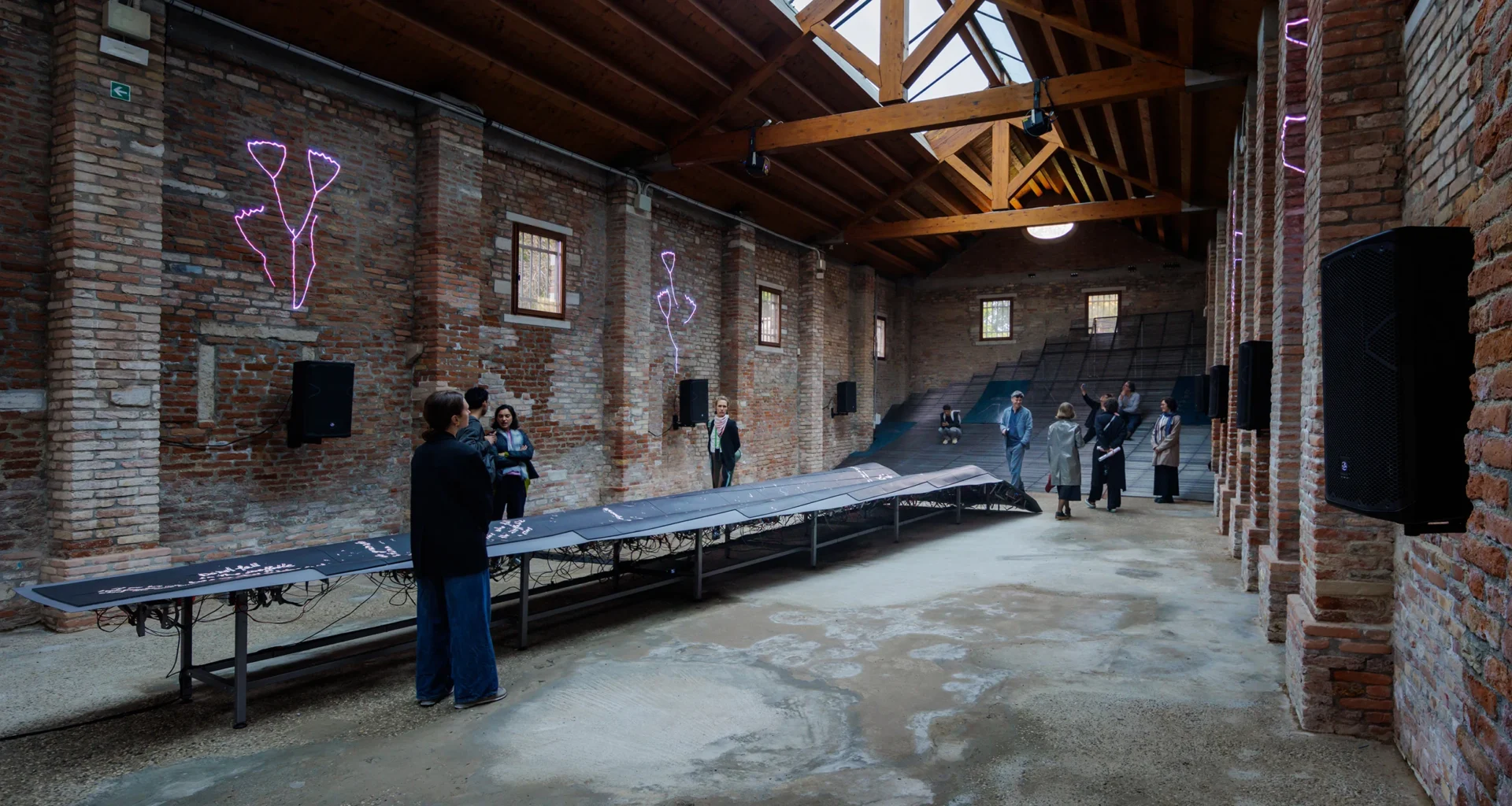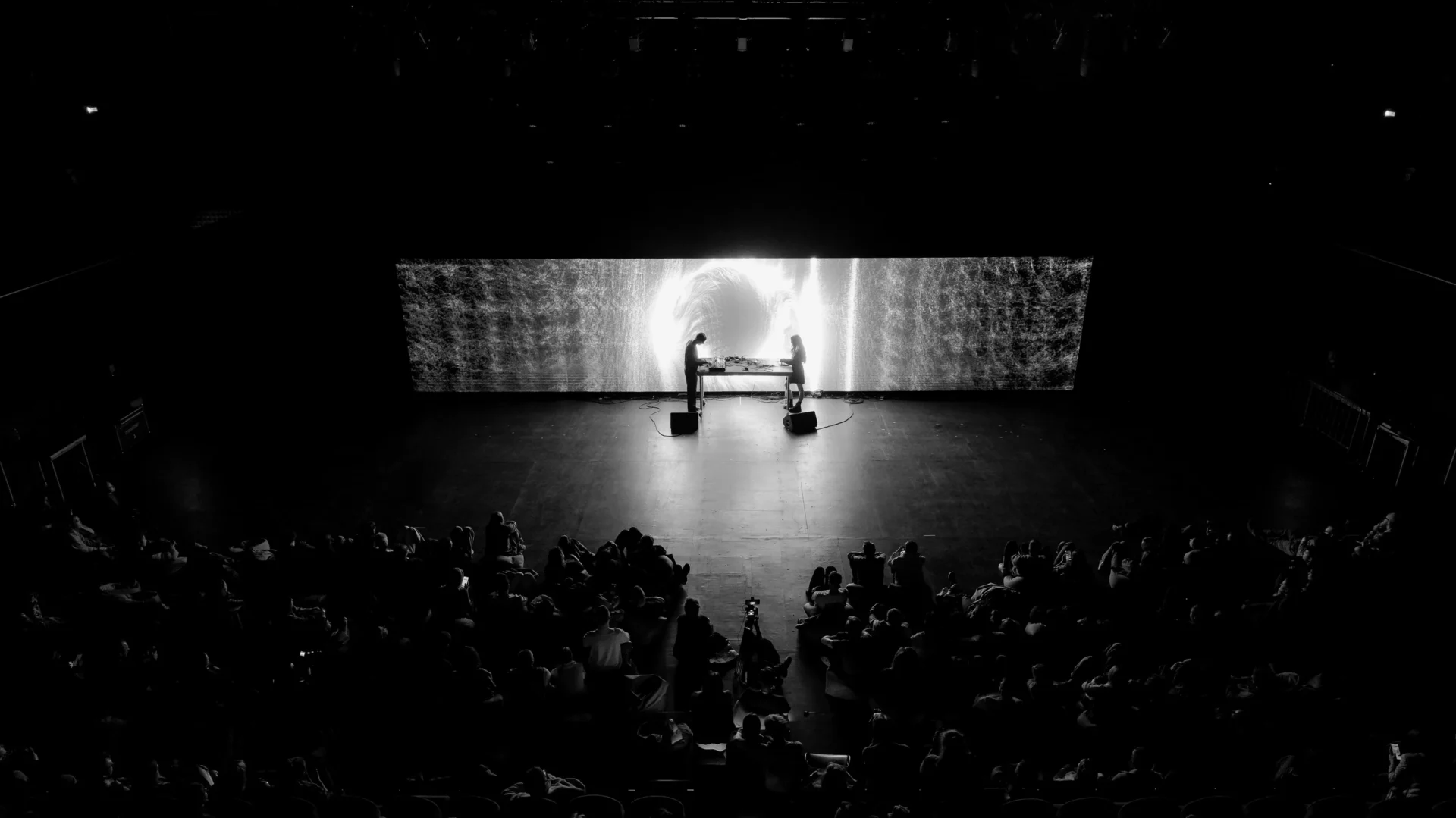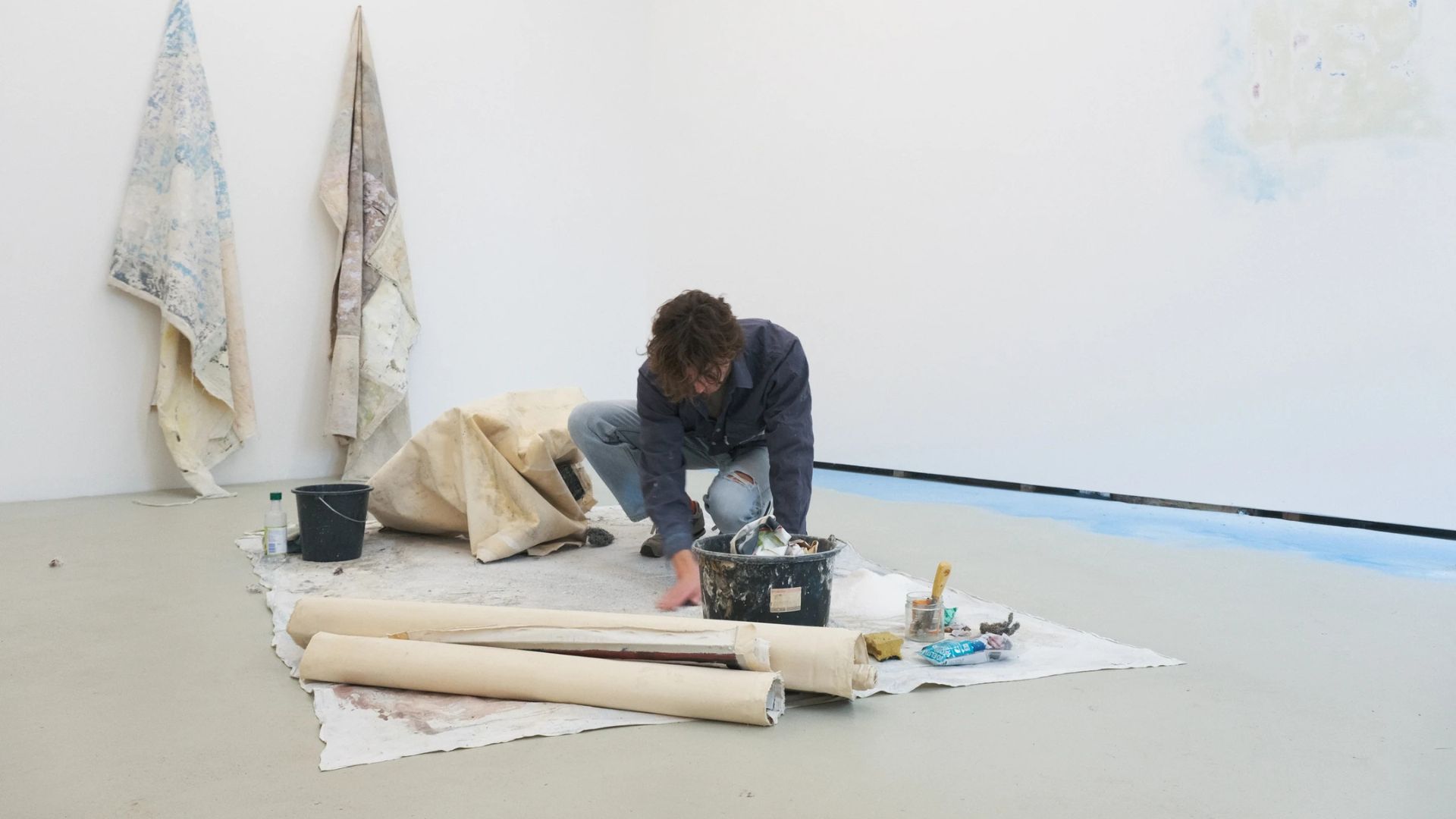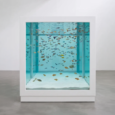
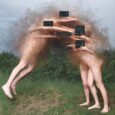
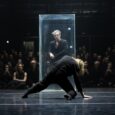
On the occasion of All Tomorrow’s Parties, Winnie Claessens’ new solo exhibition at Fred&Ferry, we spoke with the artist about fragmented realities, invisible infrastructures, and the construction of truth in an age shaped by media saturation and polarization. Through installations that combine sculpture, video, and theatrical language, Claessens reflects on a present in which parallel realities coexist without ever resolving into a single narrative, leaving space for doubt, ambiguity, and the many shades that exist between black and white.
Fakewhale: The exhibition text describes a contemporary tragedy in which three versions of the Earth coexist, each claiming to hold the truth. How did this idea of parallel, equally certain realities become the starting point for All Tomorrow’s Parties?
Winnie Claessens: Over the past few years, I began noticing more and more “social patterns,” both on a geographical scale and within my immediate surroundings. Perhaps one of the biggest turning points was the outbreak of COVID-19, followed by the wars between Russia and Ukraine, and Palestine and Israel, along with all the smaller moments and developments in between. In my view, the division into opposing camps has never been greater. Although I can only speak from the timeframe of my own life and experience, not from other moments in history.
Politically, it feels as though today you can almost only be either right-wing or left-wing, and each side seems to come with a fixed set of opinions and behavioral rules that you automatically adopt once you align yourself with a particular camp. Both sides accuse each other of polarization, yet neither truly looks critically at itself or at what it says and does. This black-and-white thinking is present everywhere, while the most important conversations actually take place in the grey areas, where thousands of nuances exist.
With the arrival of COVID-19 also came conspiracy theories and growing distrust. The idea that a government, or some higher (non-divine) power, is trying to control us. Of course, this distrust had already existed for a long time, but the major events of the past six years made these tensions far more visible. We collectively moved online and began using social media as an outlet, and since then everything seems to have escalated even further.
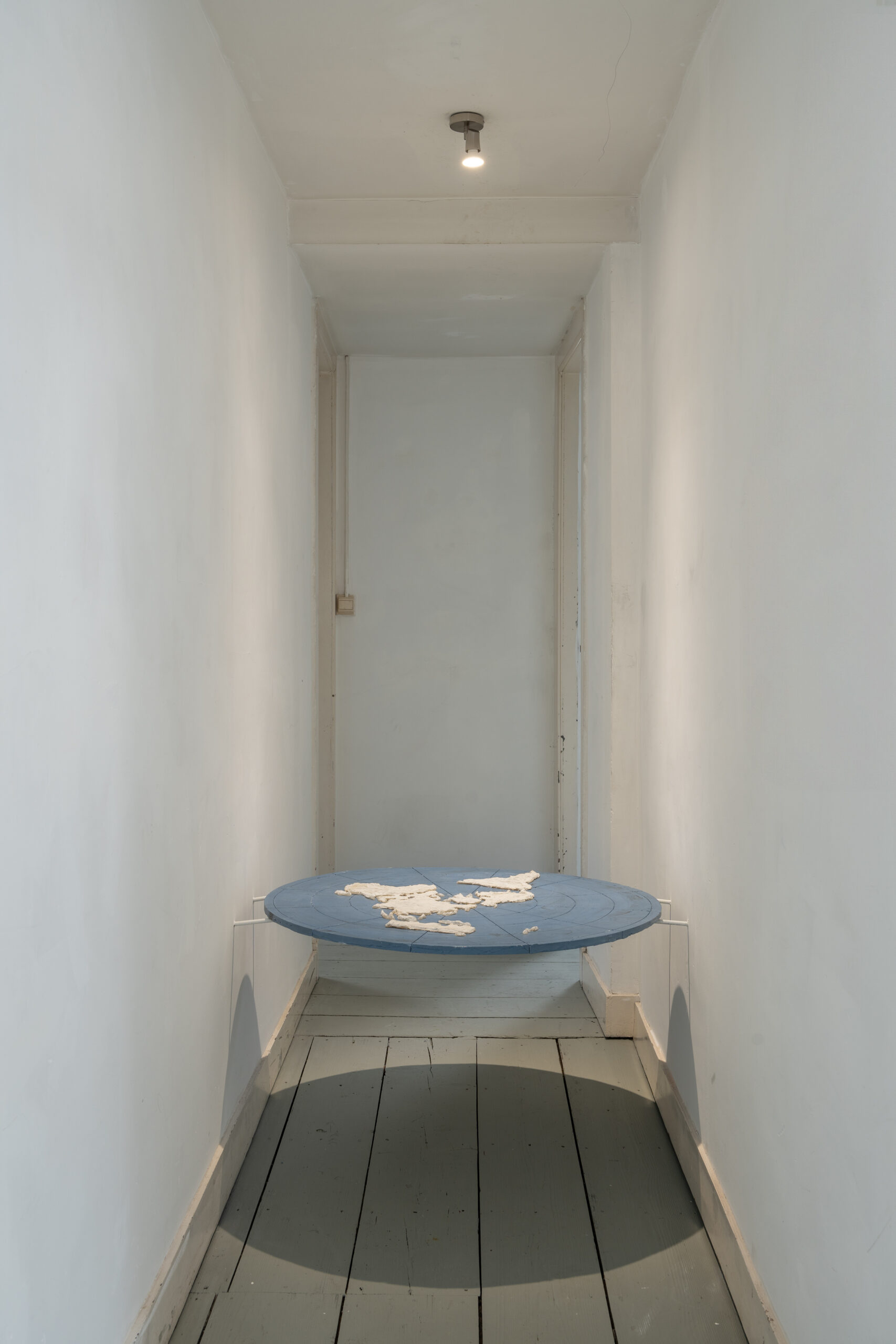
From these observations, I started thinking about what happens when different realities coexist, each considering itself to be the absolute truth. That tension eventually became the starting point for All Tomorrow’s Parties. The various Earth theories became, for me, a kind of magnifying glass for that idea. I selected three theories that I believe are the most widely represented.
My belief in the theory of the spherical Earth mainly comes from the fact that I was taught this from a young age, and because I trust that people who are smarter than me have tested and proven it. But the truth is also that, until the day comes (which most of us will probably never experience) when we can travel into space ourselves and look at Earth from orbit, we ultimately have to assume ( and trust) that what we are told and taught is correct. At the same time, I do think it is worthwhile to question these things from time to time and to step back and look at everything again from a distance.
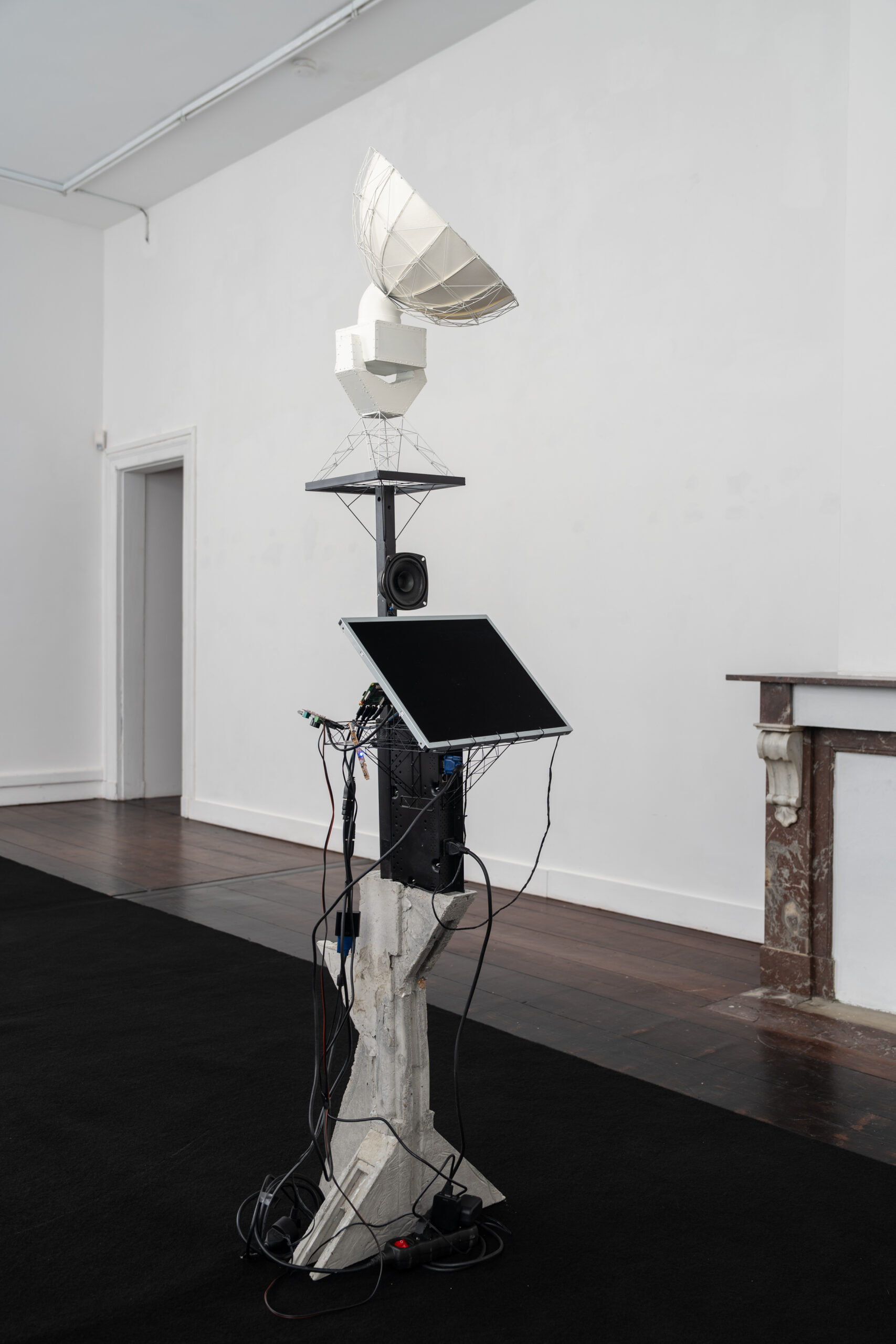
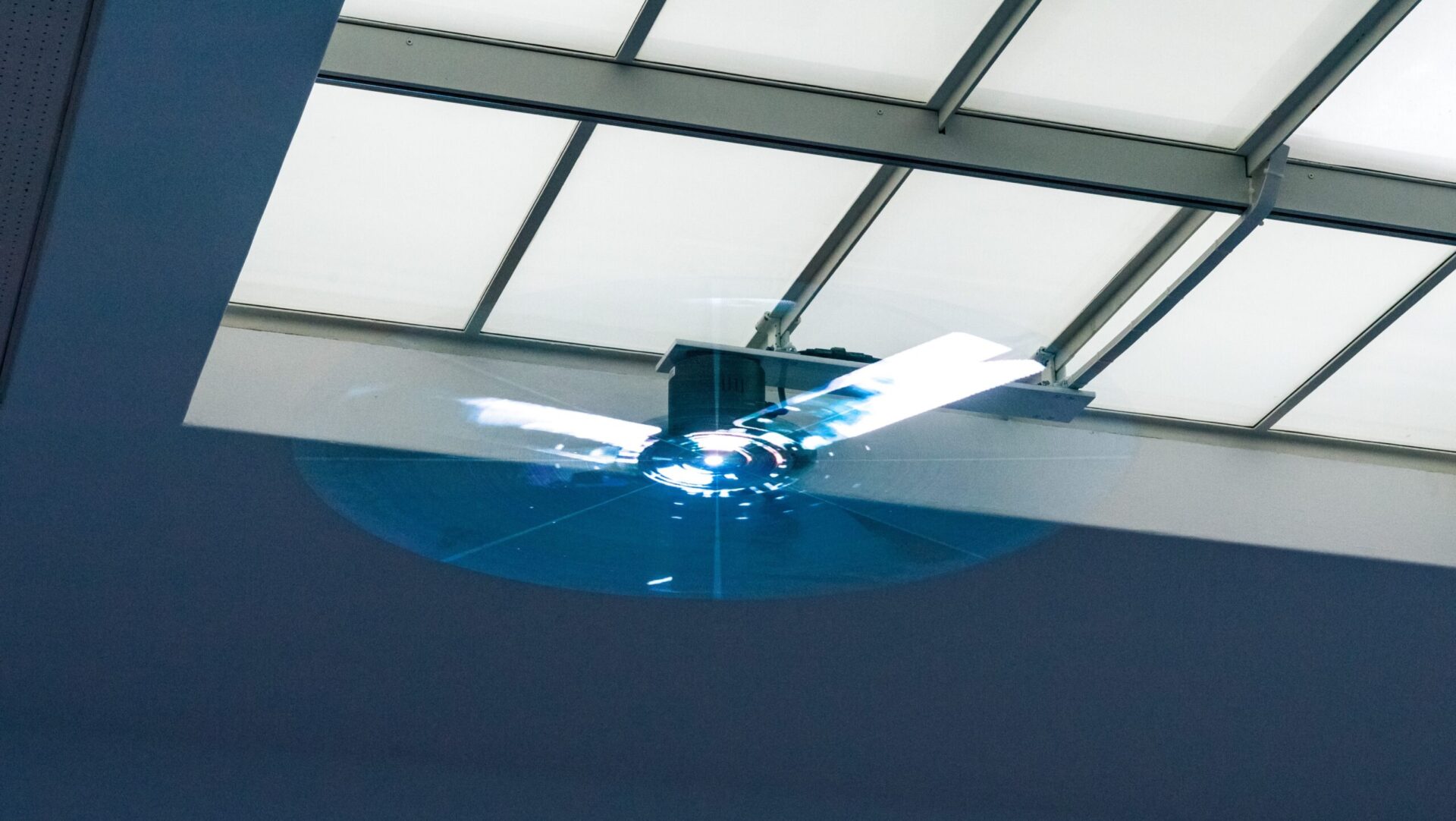
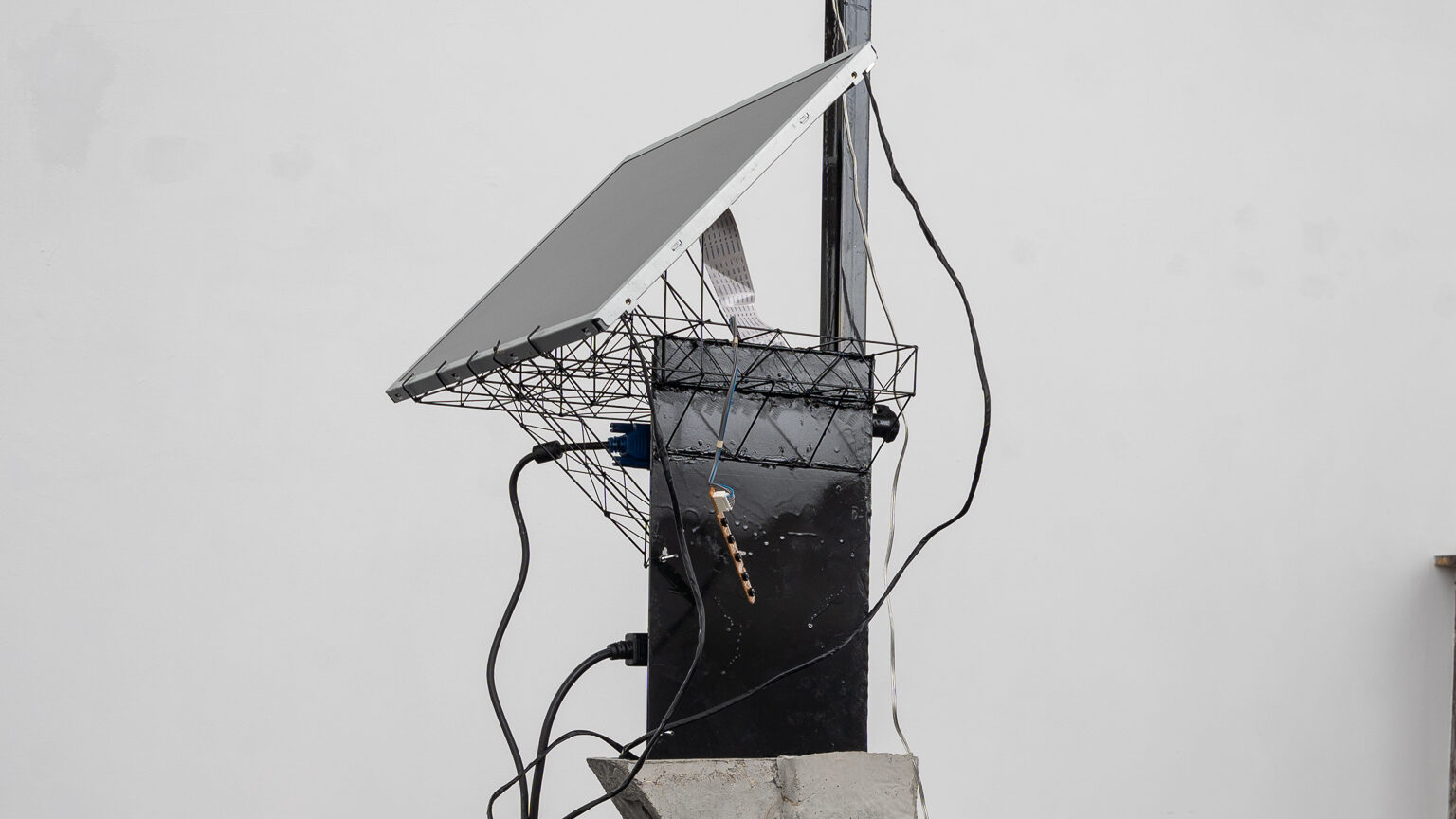
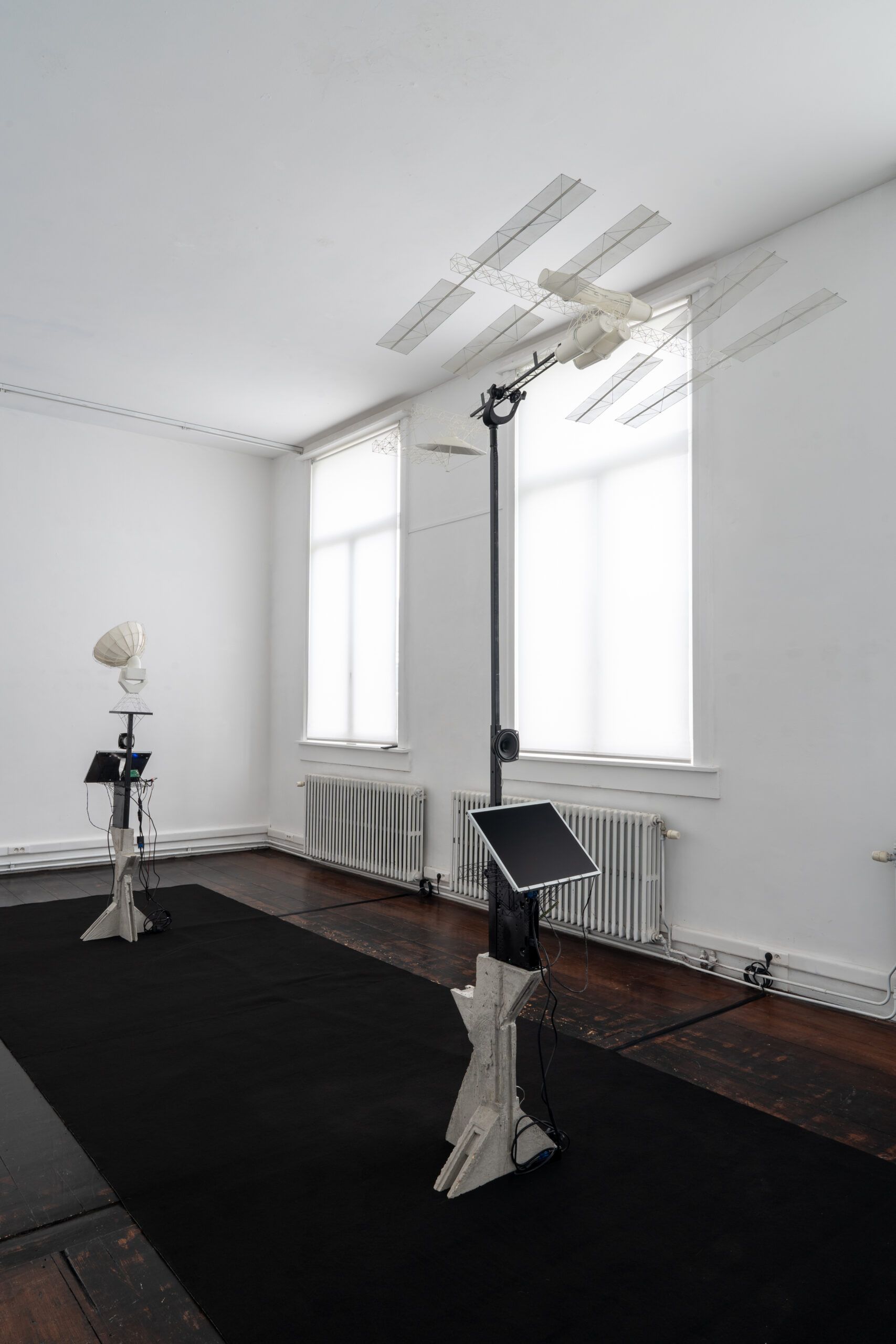
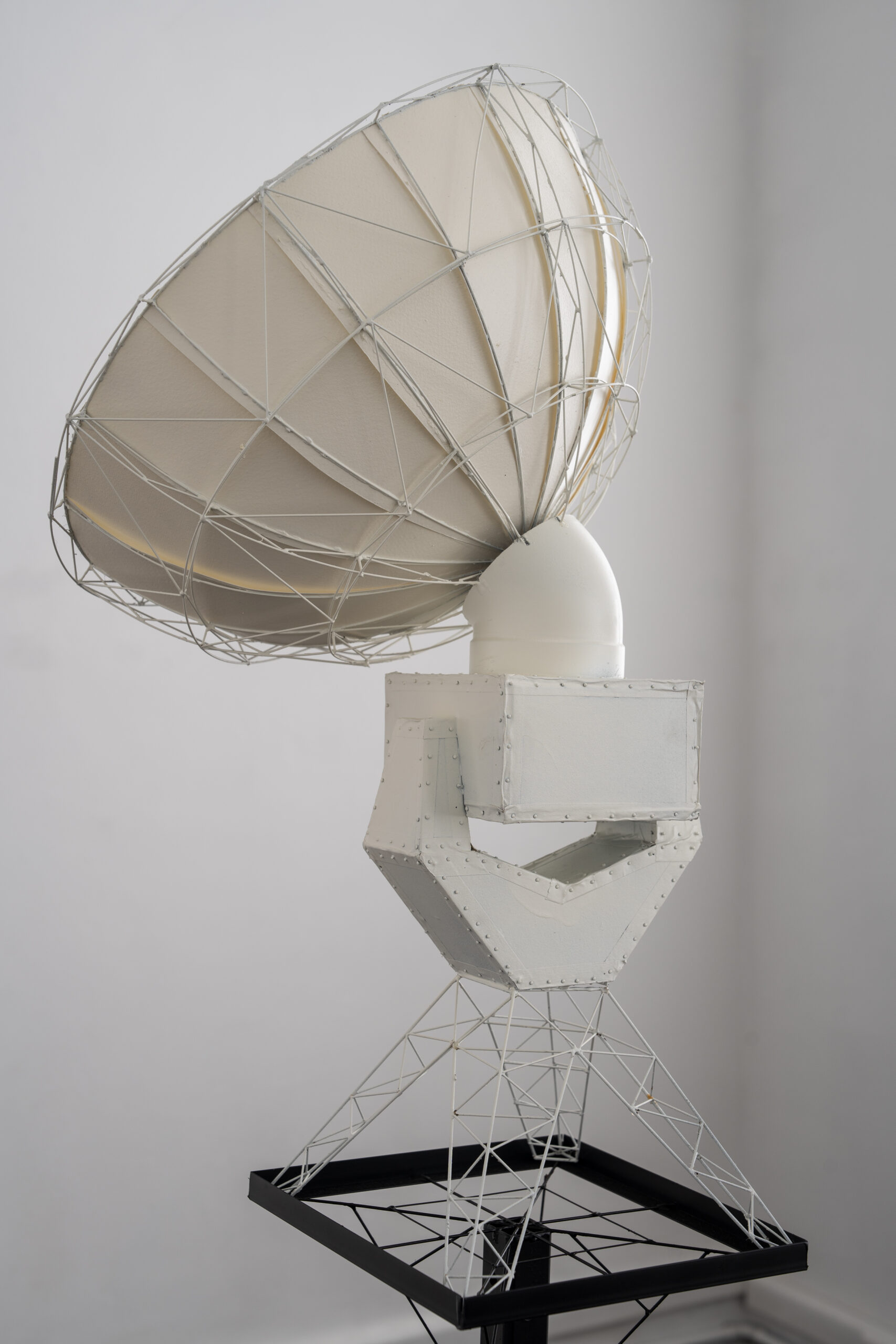
The Silent Message Overhead sits at the centre of the show. How does this work, with1 its video and two large sculptures containing built-in screens, embody the tension between mediated knowledge and direct experience that runs through the entire exhibition?
In the work, three figures carry the narrative: the ground satellite, the space station, and the narrator. The narrator sketches a romanticized image and immediately sets the tone for the reality they inhabit. A reality shaped by love, communication, and longing.
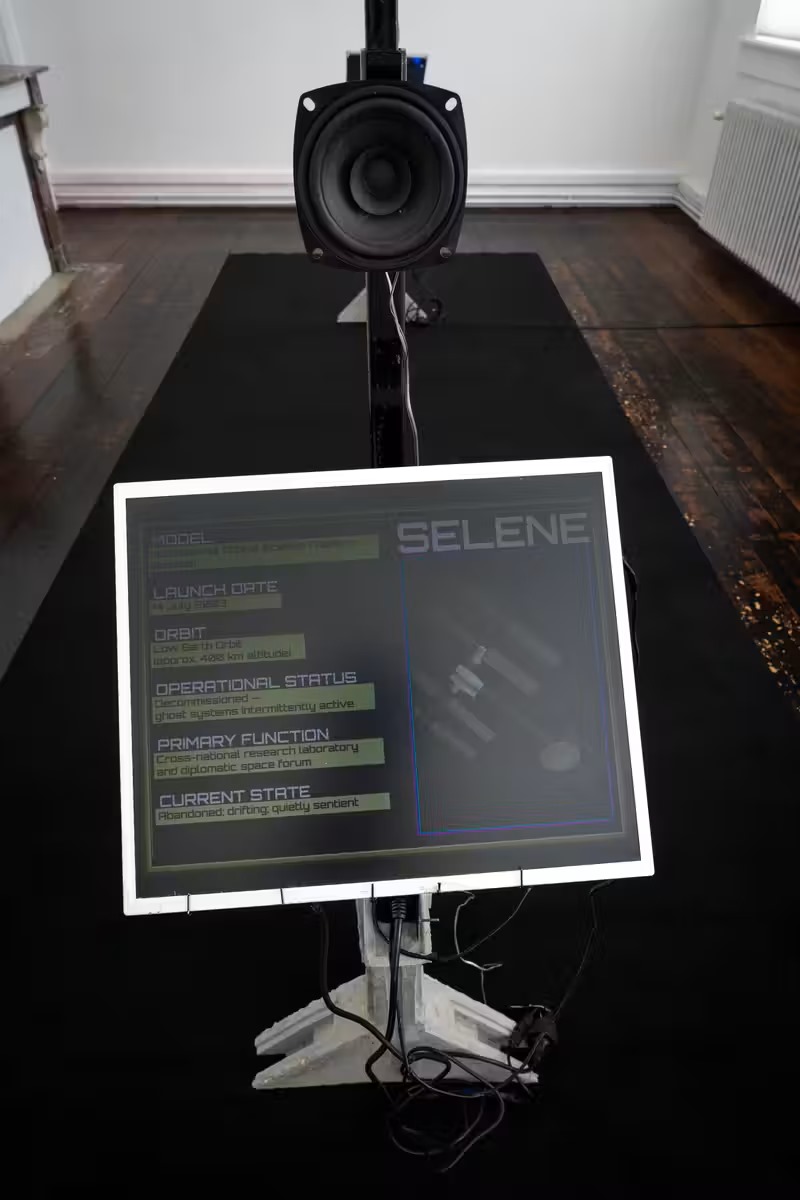
When the other two characters are introduced, they are presented through two different information sheets: one describing their so-called technical capabilities, and another presenting their personalities. At that moment, their influences and positions within the conversation are already made clear: shy, built to be a soldier, moving in a dramatic manner, far away from Earth in complete isolation,… all elements that will shape both the conversation itself and the way they come to understand one another.
As a result, the work constantly plays with the distinction between direct experience and constructed information. Even before the characters truly begin communicating with each other, we are already given a framework that determines how we read and interpret them. The viewer first encounters them through systems, descriptions, and mediated information, rather than through direct experience.
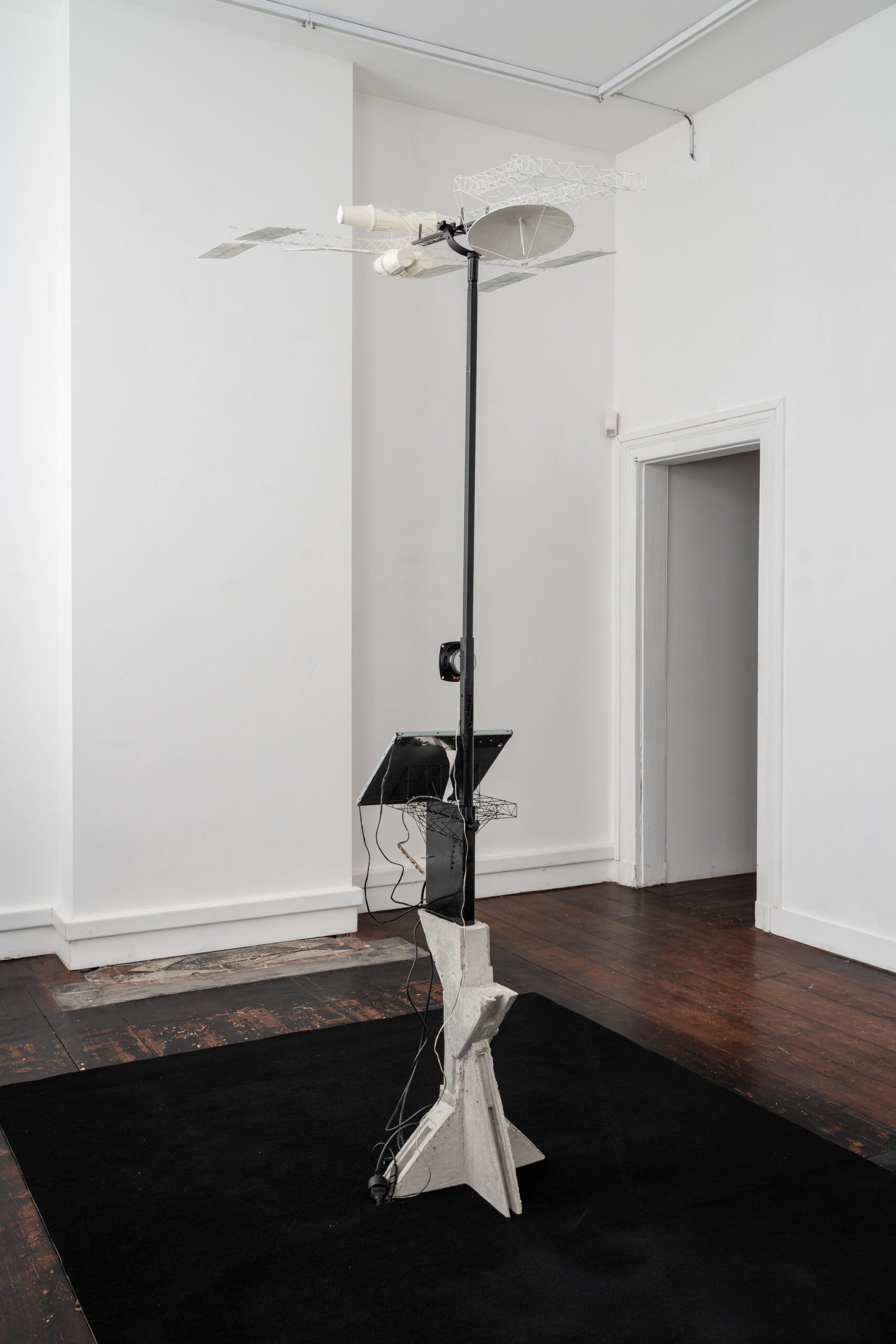
The title All Tomorrow’s Parties is taken from William Gibson. In what way does the novel’s atmosphere of overlapping futures and transitional zones resonate with the way you constructed this particular exhibition?
The book was written in the 1990s and seems, in part, to predict the society we live in today. We have already partially arrived there. It deals with themes such as fragmented reality, technological influence, information overload, and humanity searching for meaning in a world where reality and truth are becoming increasingly diffuse.
The book portrays a society driven by networks, media, technology, predictions, and systems of control. The characters move through different layers of reality; physical, digital, political, and psychological. Yet a singular truth always remains out of reach. People understand the world through screens, data, rumors, technology, and a form of collective paranoia. The boundary between direct experience and constructed reality is constantly blurred. Much like today, we can speak of “mediated knowledge.”
What particularly inspired me was the atmosphere of shifting realities. The book starts from a world in which multiple futures seem to exist simultaneously, making it increasingly difficult to speak of one shared reality.
I used that idea of overlapping futures and transitional zones as a kind of conceptual space for the exhibition. I started from the feeling that reality today is no longer a singular whole, but rather exists as parallel versions functioning alongside one another: politics, media, online information, personal beliefs. Everything overlaps and develops its own “truth.”
There is no single narrative or linear structure, but rather a condition in which things continue to coexist without resolving into one final conclusion. Works, images, and spaces operate as different layers that neither fully confirm nor entirely exclude one another.
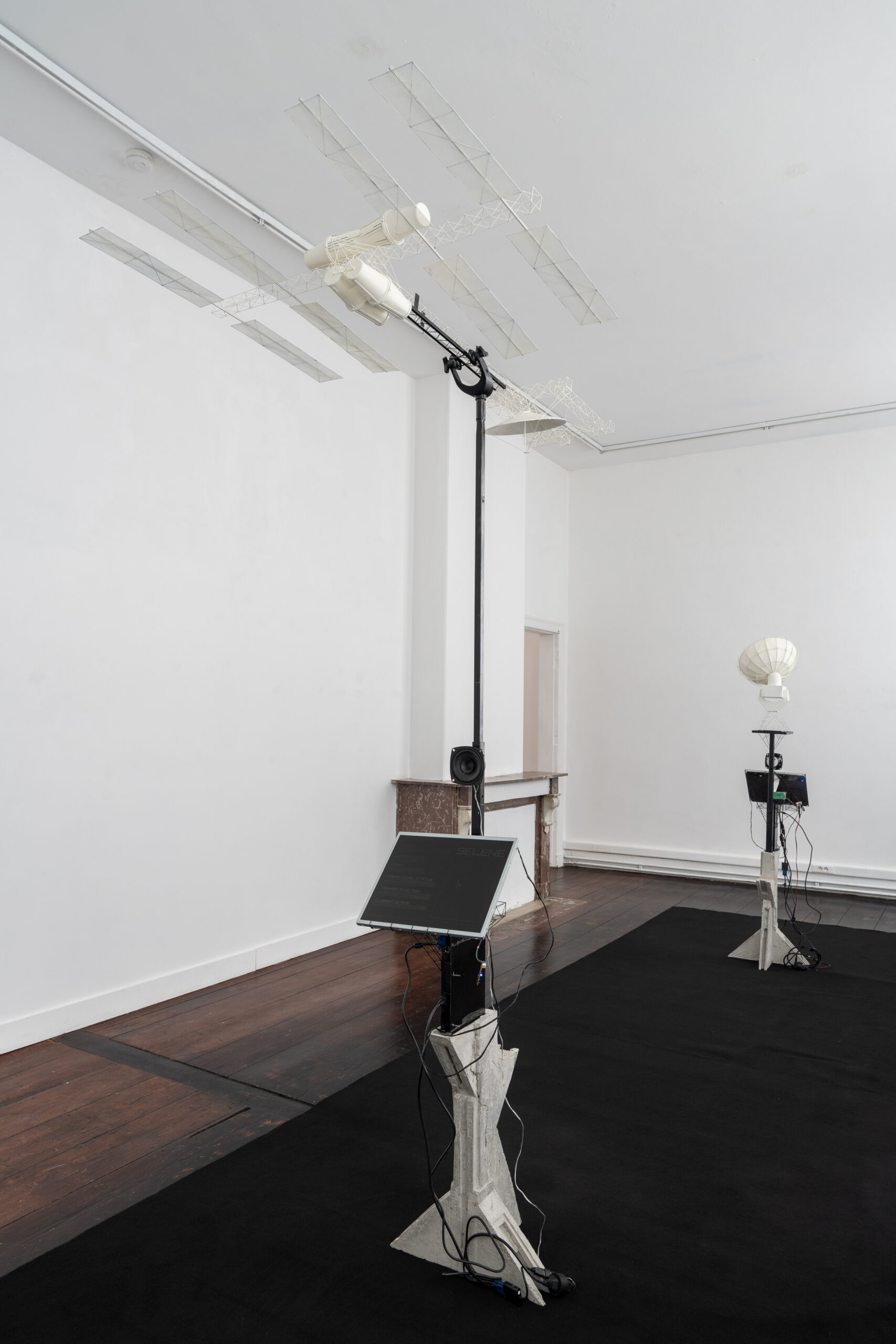
Your practice often brings together sculpture and video in installations that feel both technological and theatrical. How do you think about the relationship between the physical presence of the sculptural objects and the moving images they contain?
I have always been a film enthusiast, particularly interested in the technical aspects of filmmaking and in special effects. If you look at CGI, we still have not reached the point where it feels entirely real. Although creators often aim to make it appear as realistic as possible, the effect still does something to our brains and creates a certain friction.
In older films, and also in the work of some contemporary filmmakers, scale models or claymation were used to achieve effects that are now often recreated digitally. For me, there is a kind of honesty in that approach that is less present in CGI, precisely because it originates from physical and tangible material. It has a different presence and feels “real” in another way.
When I begin a work, I usually start from a video piece, with the sculptures functioning as the protagonists within that video. Often, those sculptures first exist independently from the video, but are later incorporated into the complete installation of the exhibition.
Because I make things to scale, they also become manageable. I can literally look down upon the situations and therefore understand or analyze them more clearly. In the video, the entire idea ultimately comes together; that is where the work exists as a whole, while the sculptures function more as fragments or individual components of it.
Because I create things on a smaller scale, they become manageable: I can look down upon situations and understand them more clearly. In the video, the complete idea comes together. That is where the work exists as a whole, while the sculptures function more as fragments of it.
In The Silent Message Overhead images, voices and signs try to persuade the viewer while doubt lingers in the background. How do you build that subtle layer of doubt within an otherwise highly persuasive visual language?
The work always originates from a question I ask myself, and that is something I try to embed within it as well. I do not have the answer myself. Through the work, I aim more to initiate a conversation than to take a clear position.
This specific work emerged from the idea that in 2030 the ISS (International Space Station) will be taken offline. Until now, the ISS has been a place where different spacefaring nations collaborated within the same orbit. But in the lead-up to 2030, nearly all major space nations have been developing their own separate space stations, causing orbit itself to become increasingly divided into distinct zones and interests.
Where the ISS long functioned as a symbol of international cooperation, the future seems to be evolving more toward separation and parallel systems. I found that particularly interesting because it also reflects something about the way we interact with one another in society today.
I think the sense of doubt within the work also simply comes from my own uncertainty. I do not try to construct the works from a place of certainty or clear conclusions. The images and voices may feel convincing or romanticized, but underneath them there is always an uncertainty that I carry myself. The work therefore does not attempt to confirm a truth, but rather to create a space in which that uncertainty is allowed to remain present.
The exhibition speaks of conviction becoming a matter of choosing rather than questioning. How do you invite the viewer to step back into that fragile “in-between space” you describe in the exhibition text?
In my work, I do not really try to take a clear position or provide an answer. The works usually emerge from my own questions and uncertainties, and I hope that this allows the viewer to step out of that automatic tendency to immediately take a firm stance. Today it often feels as though you have to choose a side right away, whereas I am more interested in that fragile space in between, where things are not yet fully fixed.
I try to create that space by allowing different voices, images, and perspectives to coexist without any single one being presented as the truth. In doing so, I hope to create a moment of distance, in which the viewer starts to look again and to doubt, rather than immediately taking a position.
This is your third solo show at Fred&Ferry. How has your thinking about infrastructure, geopolitics and mediated reality evolved since the work was first presented at M HKA in the context of The Geopolitics of Infrastructure?
In the past, I mainly looked at physical infrastructures as symbols of humanity: space stations, satellites, architecture, industrial systems… things that are literally built and that say something about power, progress, cooperation and bqeing human.
In my more recent work, I have started to focus more on mediated reality and how it almost functions as an invisible infrastructure. It is no longer only physical systems that shape how we live, but also the networks of information, social media, images, and digital communication that constantly surround us.
This invisible infrastructure has an enormous influence on how we move through the world, how we communicate, how we understand ourselves, and how we relate to the outside world. It also operates at extreme speed. Ideas, beliefs, and emotions spread almost instantly today, which means that realities form and solidify much more quickly as well.
You studied scenography. To what extent does your background in theatre influence the way you stage these overlapping realities and the viewer’s position within them?
A large part of my inspiration comes from theatre. The work The Silent Message Overhead, for instance, is a reworking of Shakespeare’s Romeo & Juliet, specifically the balcony scene, in which two lovers from opposing worlds face each other and enter into dialogue.
The mantra heard further in the exhibition is also a rewritten version of Sophocles’ Ode to Man, from the prologue of Antigone. In the original text, the human being is praised for their greatness, ingenuity, and fragility. In my adaptation, this shifts more toward humanity’s search for truth, and the attempt to grasp and fix it into rules, often driven by a fear of uncertainty.
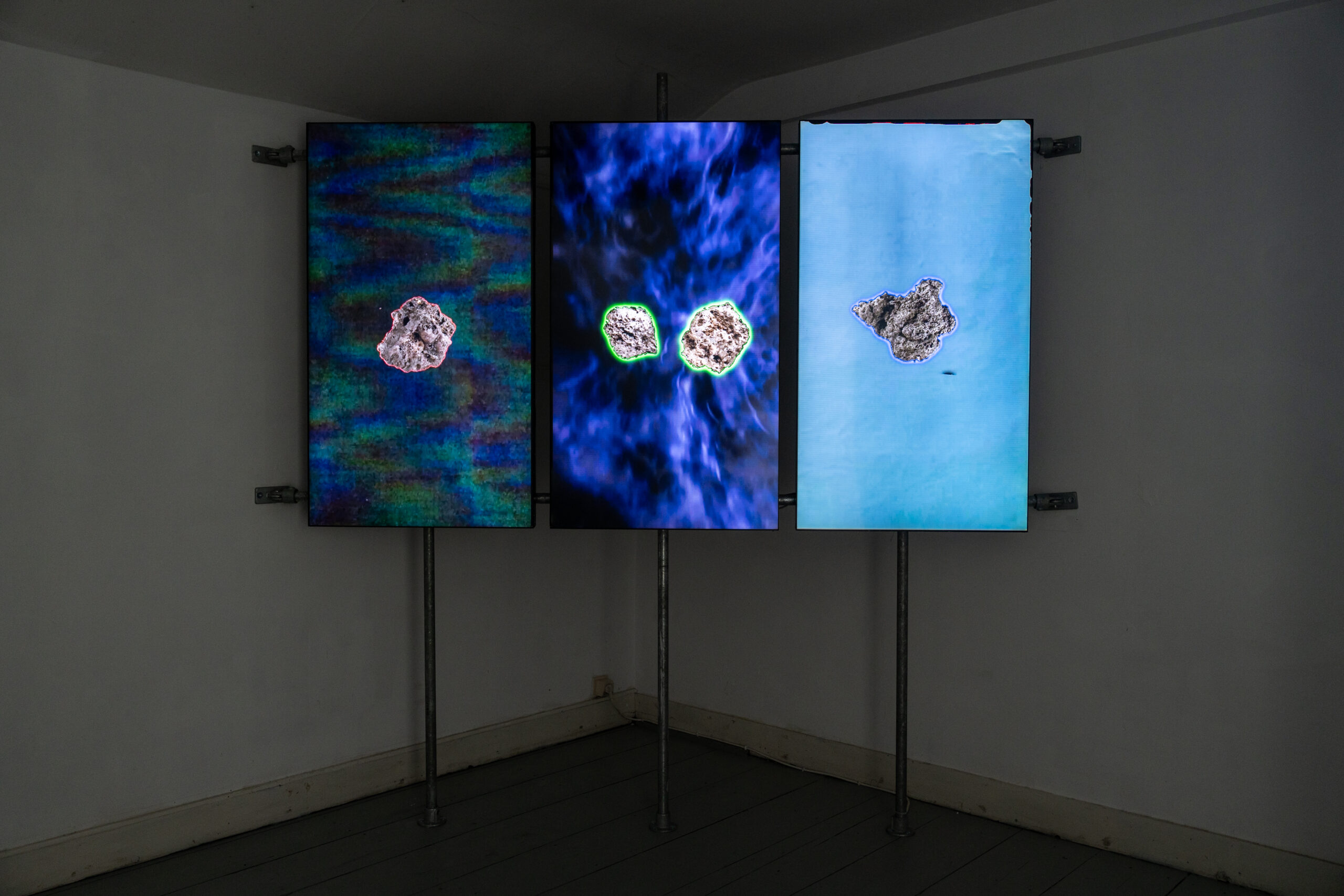
The sculptures consistently function as a kind of animistic protagonists within the larger theatrical structure. In The Silent Message Overhead, the protagonists also literally face each other while conducting their dialogue, which can be followed through screens. In other videos throughout the exhibition, you see different asteroids that function more as a supportive and neutral chorus of the overall setup, guiding the viewer through the space.
Because of my background in scenography, I always approach exhibitions in terms of a total concept. I am not only concerned with individual works, but also with how everything together forms a kind of scenography in which the viewer moves, and through which different layers of reality can be experienced.
Have you ever destroyed or set aside a work for a long time only to return to it much later? What is your relationship with pieces that are already completed and exhibited, especially when they travel from a group show into a solo context?
I often have ideas that keep returning. When an idea persists long enough, it eventually grows into a work. In most cases, once I start a work, I also finish it. Then it either becomes something, or it doesn’t.
In addition, I also develop more basic scale models that I later further refine into their final form.
For me, it is often difficult to look back at older work, because my positions and thoughts at that time were different. Sometimes it feels as though an idea has already been surpassed, and I do not always feel the need to show it again. There are, however, a few works that transcend this. I notice this especially with video work: those pieces can remain relevant for me for a longer time.
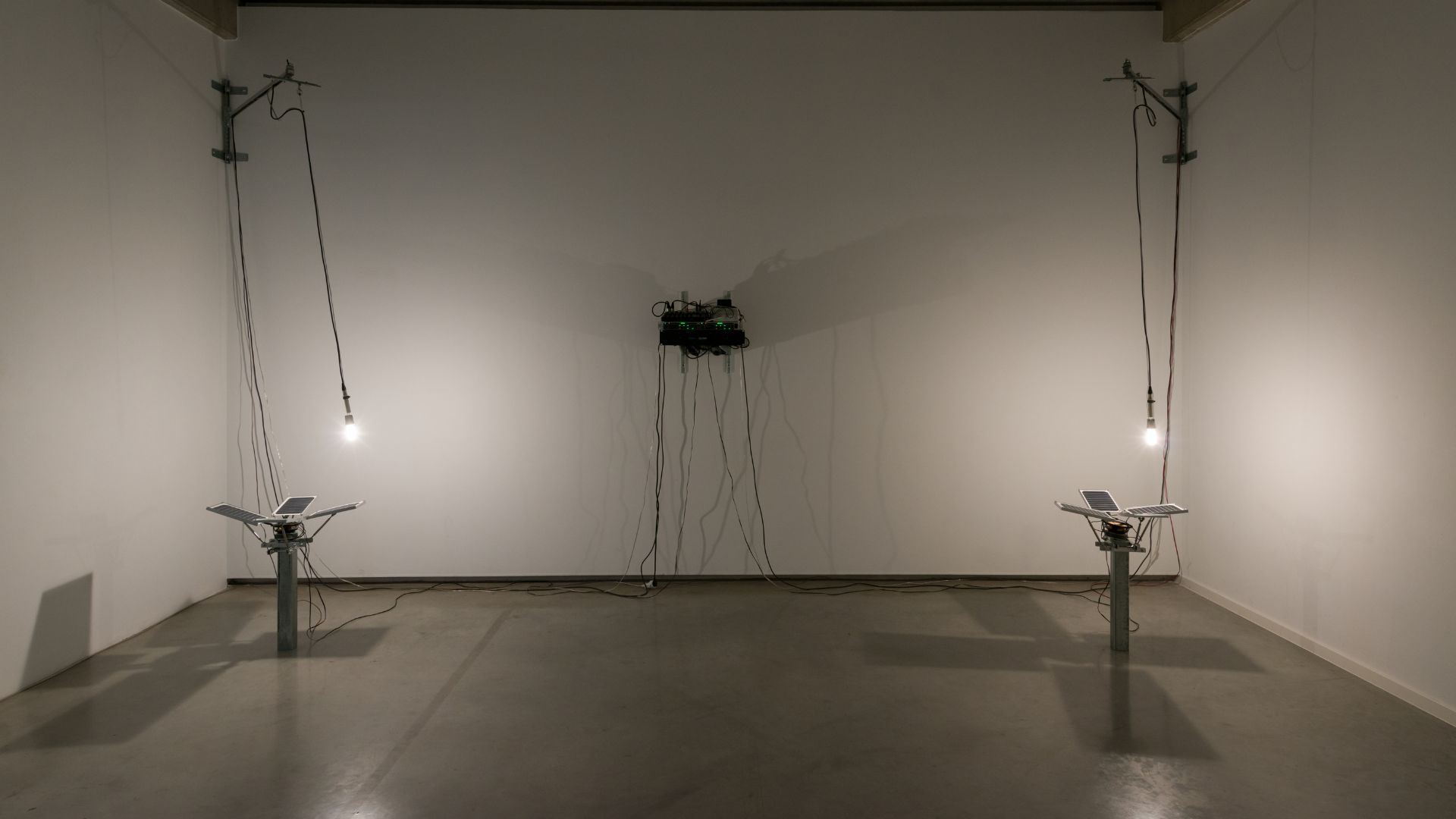
For The Silent Message Overhead, originally created for an exhibition at the M HKA, this show offered an opportunity to present the work in a different configuration. In the M HKA installation, the works were placed far apart, meaning you never saw them within a single
image, yet a kind of dialogue still remained between them, even if this was not always immediately legible to the viewer.
In this new setting, they are placed directly opposite each other, which makes the dialogical structure more pronounced and clearer.
Another aspect is that I usually approach solo exhibitions as a total concept in which the works are carefully attuned to one another. When I later see them in a group exhibition, this can sometimes feel somewhat uneasy. In The Geopolitics of Infrastructures, for example, ( There were several works of mine ) it worked well because the works were in dialogue with the overarching concept. It therefore depends strongly on the curator and the context of the group show.
Looking at All Tomorrow’s Parties as a whole, what do you hope the public might understand, or feel, about the way reality is shaped in these transitional zones between black and white?
I mainly hope for humour. In my work, I often try to bring a certain lightness and sense of humour in relation to quite heavy subjects. Every story is not simply made up of two sides,
but of a multitude of influences, perspectives, and circumstances that eventually come together to form certain positions.
I sometimes receive the comment that my work combines lightness and tragedy, and I think that is also what I want to convey to the viewer. That tension between the two is important to me.
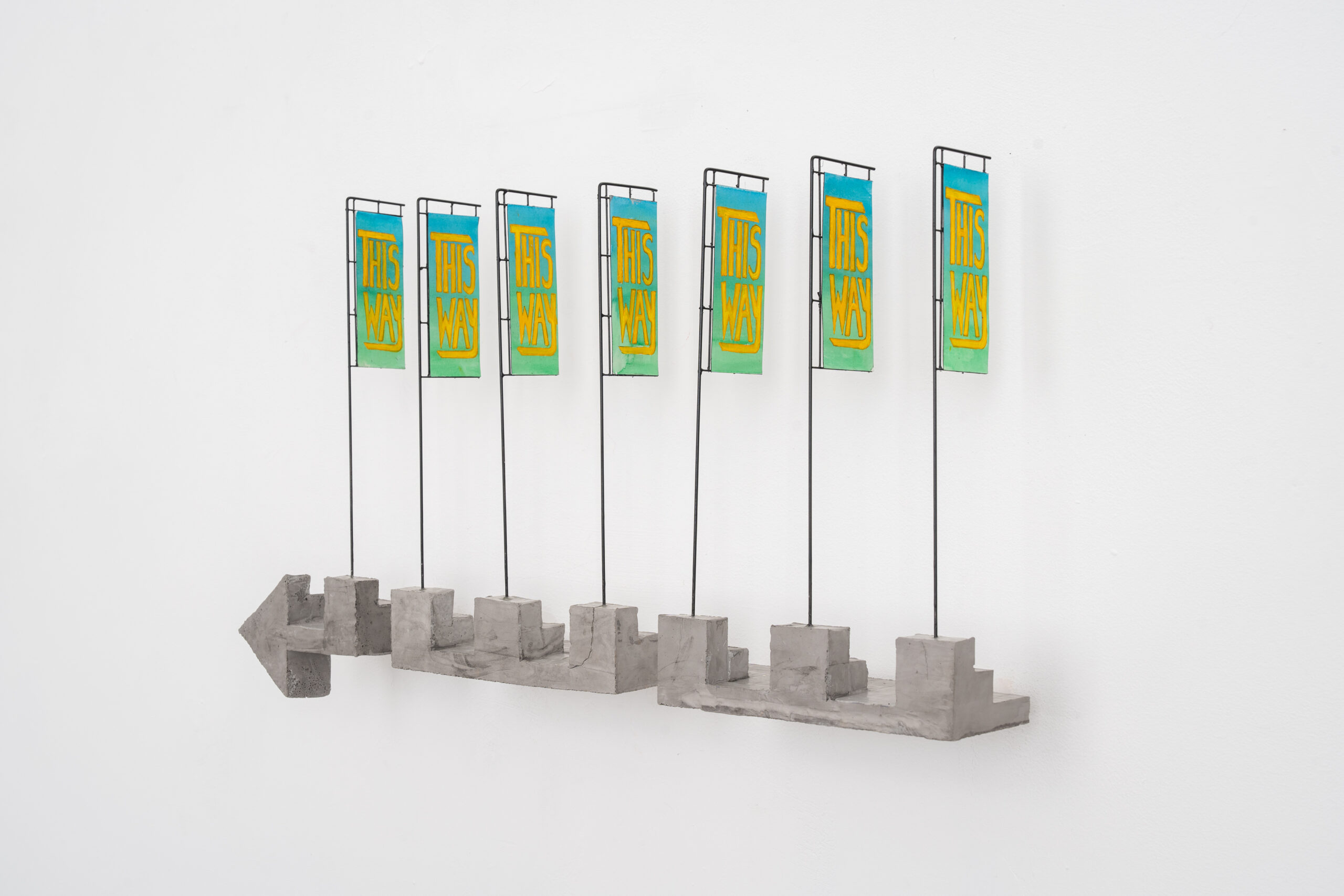
I hope that the viewer lingers for a moment in those grey zones, rather than quickly falling back into black-and-white thinking. Although that statement might sound like a cliché, (something that could even be printed on a decorative tile) for me it contains an essential idea that helps us better understand each other and avoid fixing things too quickly into absolute positions.