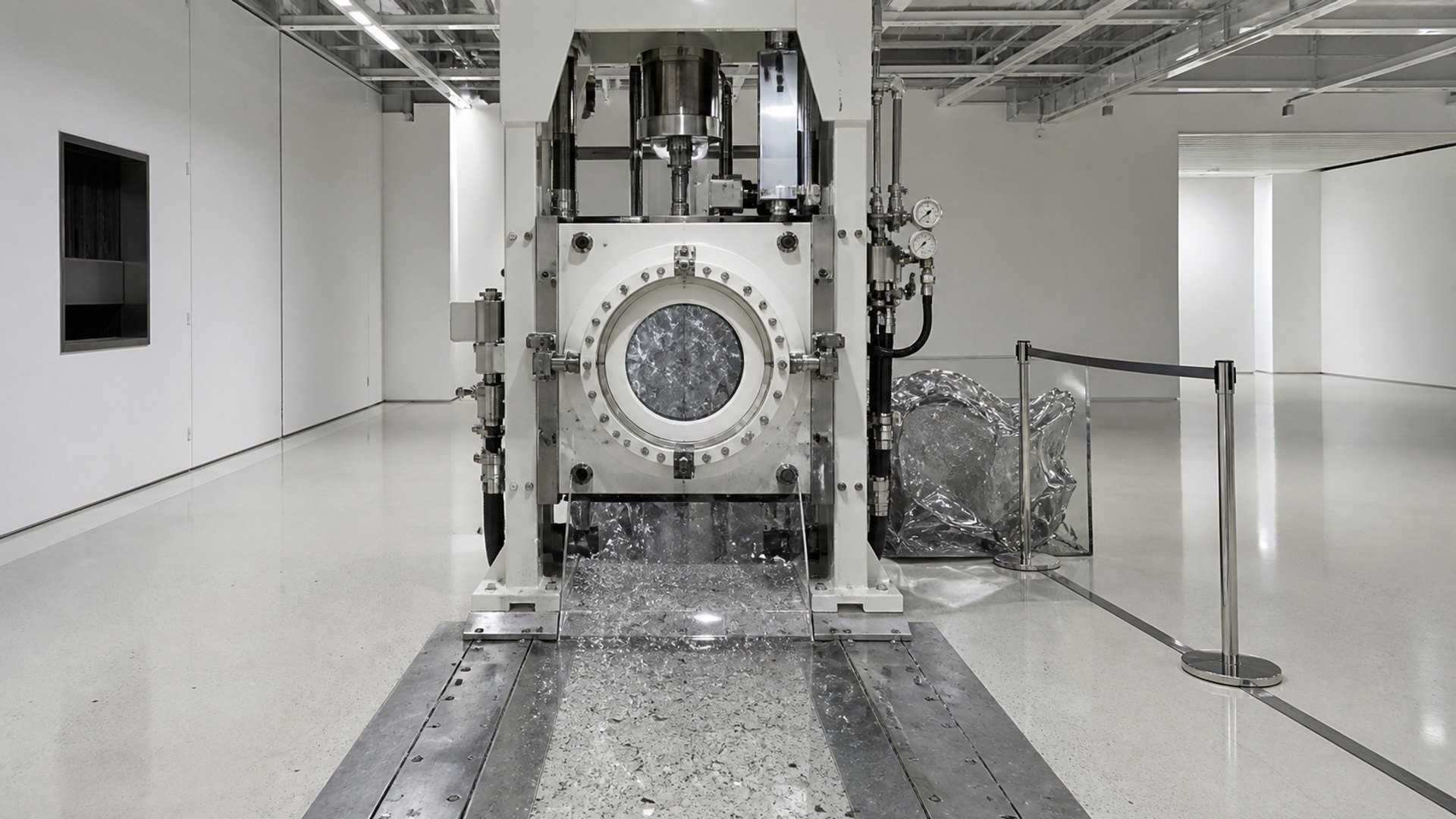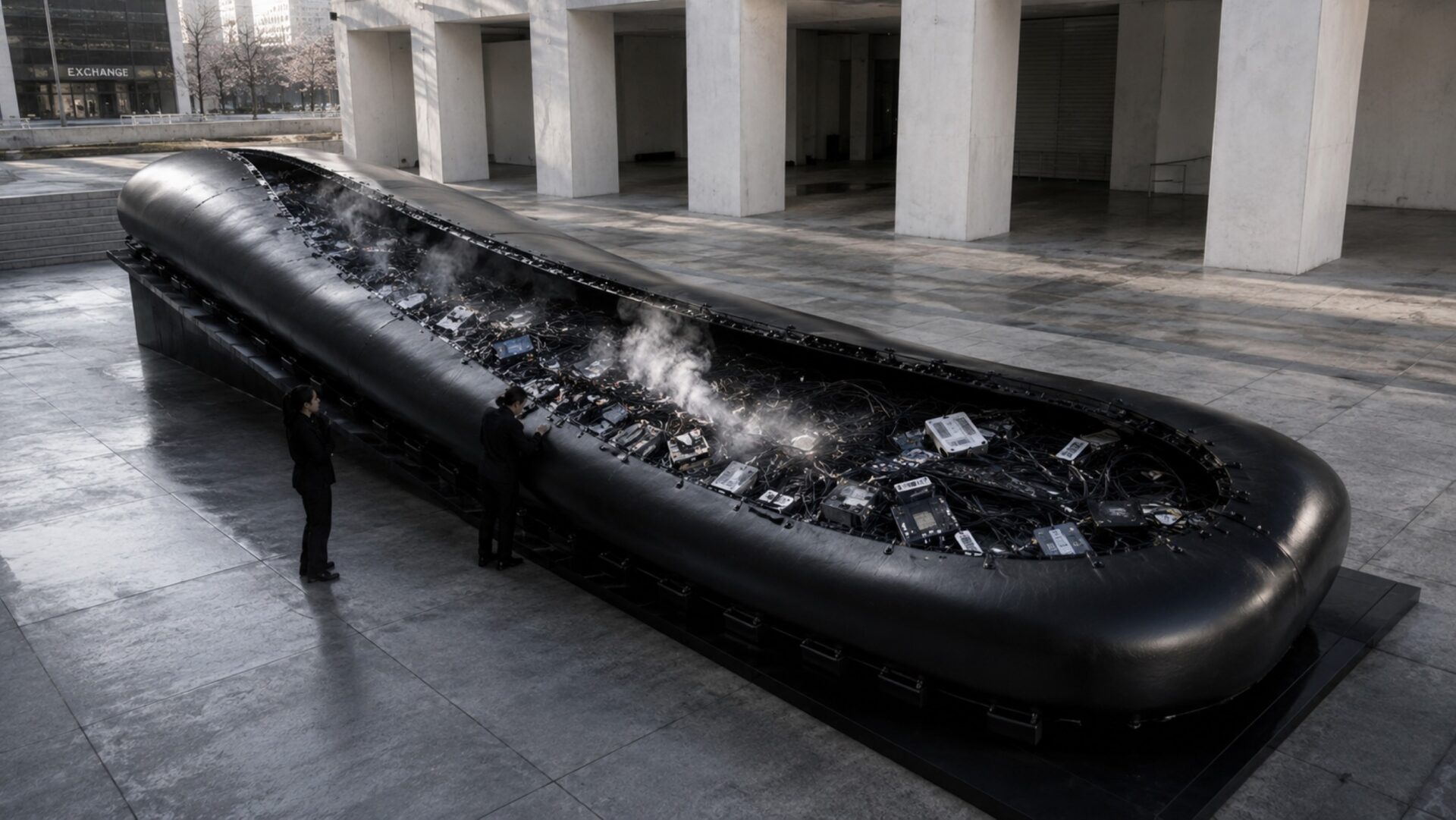
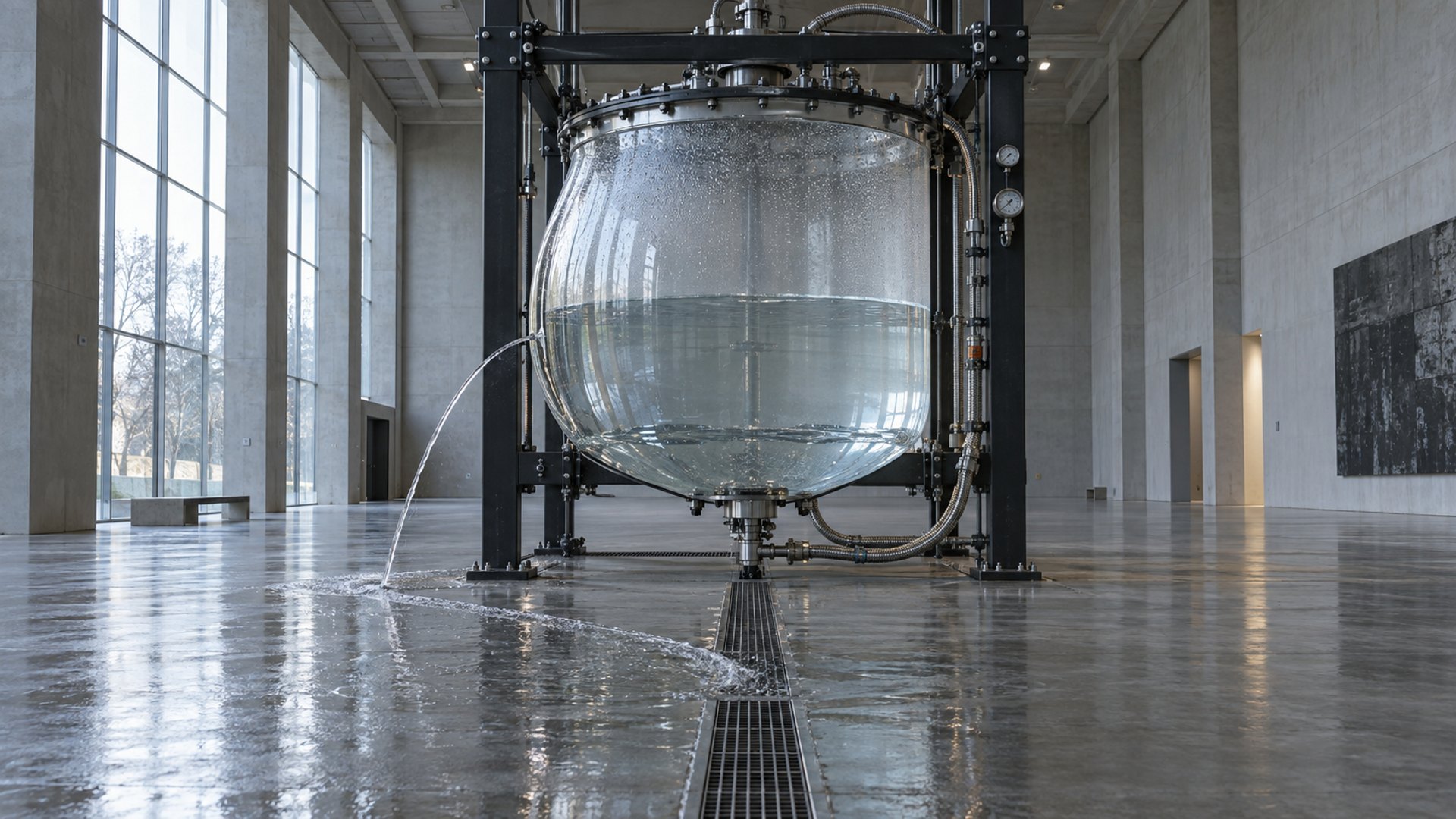
A bead of water gathers on the inner wall of a transparent cube. Gravity pulls it downward, temperature slows it, and another bead absorbs its path. The event seems slight, yet its conditions reach across the entire room. Air conditioning, body heat, illumination, acrylic, distilled water, and exhibition time participate in the shape that appears. Hans Haacke’s Condensation Cube turns this dispersed activity into sculpture. The work gives form to a system by allowing matter to keep changing inside a precise enclosure.
Water enters contemporary art through such arrangements of control and contingency. Pumps lift it, nozzles atomize it, cameras slow its fall, glass columns classify it, and heating elements return it to the air. Each device establishes a temporary agreement between liquid and form. The visible artwork arrives through pressure, flow rate, temperature, circulation, and maintenance. Liquidity therefore changes the question asked of an object. Shape becomes an event distributed across equipment, architecture, labor, and duration.
This distribution also carries political weight. A water sample can preserve the retreat of a glacier, hold residue from a site of violence, or acquire the standardized color of a marketed body. Its movement records who gathers it, who contains it, who encounters it, and which institution authorizes the encounter. Liquid offers continuity between sites while preserving the history of contact. The same capacity that makes water appear universal allows a work to reveal the protocols that assign it meaning and risk.
The works considered here move from enclosure toward diffusion. Condensation makes a gallery climate legible. Fog and an indoor river reorganize architecture as weather. Video converts immersion into a passage through the image. An archive of glacier water joins environmental change to language and place. Forensic traces enter public custody. Foam and engineered fluid expand the medium into participation, chemistry, and product design. Across these operations, liquid matter establishes form as a relation that must continually be produced.
The Vessel Becomes Visible
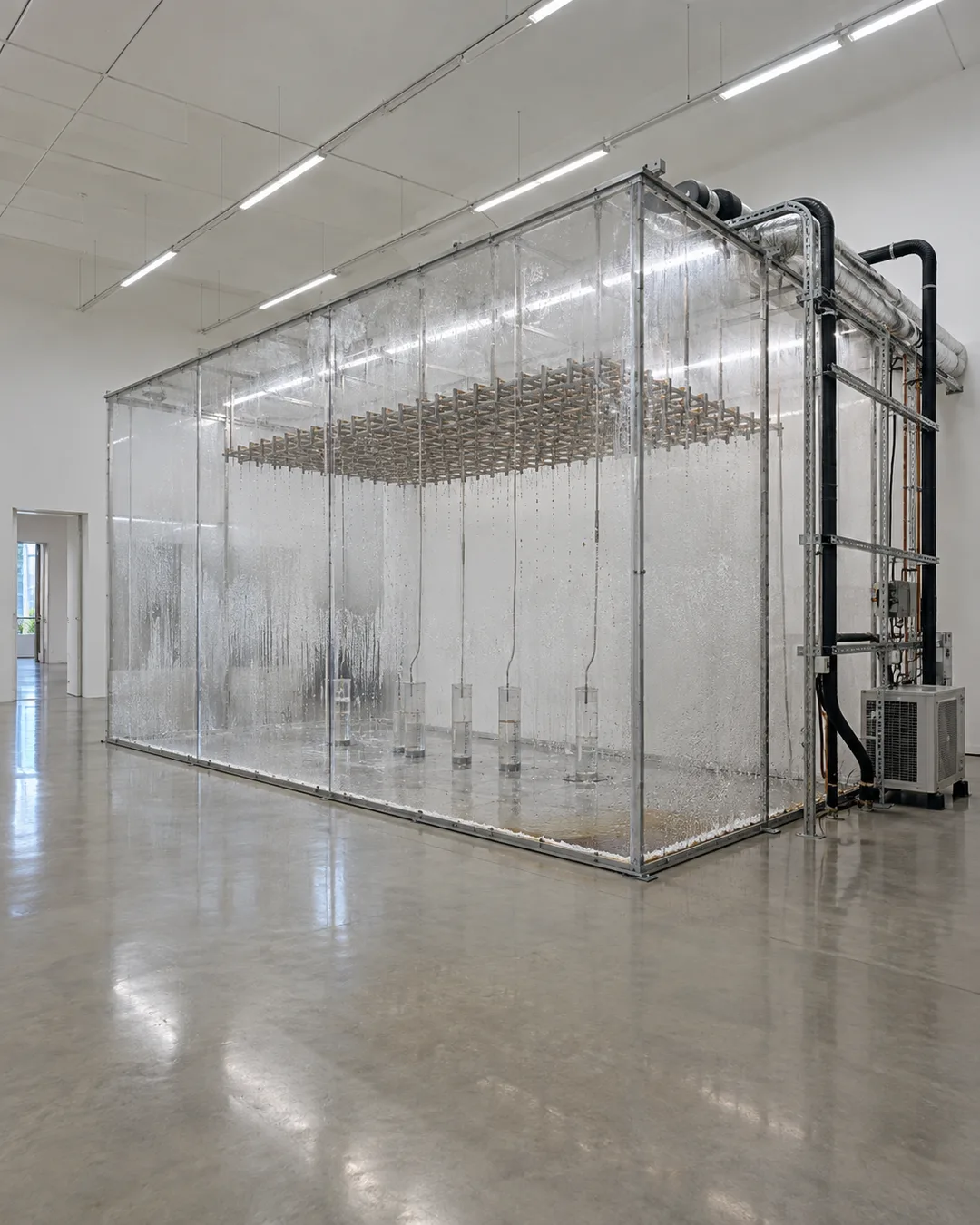
Hans Haacke’s Condensation Cube, developed between 1963 and 1965, joins clear acrylic plastic with a small quantity of distilled water. The cube appears geometrically stable while its interior surface changes through evaporation and condensation. Droplets emerge, merge, descend, and disappear according to the surrounding light and temperature. The sculpture’s most active material occupies a cycle between visible water and invisible vapor. Its form resides in this exchange, calibrated by a vessel that permits observation while sustaining the conditions of change.
The acrylic walls perform several roles at once. They contain the water, separate it from direct touch, transmit light, and create the temperature differential on which condensation depends. A familiar Minimalist geometry becomes a climatic instrument. Every face of the cube registers an interaction between the sealed interior and the gallery outside it. The edge gives the work a crisp silhouette, while the moisture makes that edge operational. Containment becomes a method for exposing relation.
Gallery infrastructure enters the work through the air surrounding the cube. A thermostat alters the rate of evaporation. Sunlight or exhibition lighting warms one surface. Visitors add heat and humidity to the room. Cleaning schedules affect the transparency through which the process is read. The museum acts as an environmental regulator, and the sculpture converts its regulation into a changing pattern. A supposedly neutral display space acquires measurable agency in the production of the artwork.
The water also reorganizes time. A conventional object supports repeated viewing through material continuity. Condensation Cube supports repeated viewing through cyclical difference. Its identity survives because the droplets never settle into a final composition. The viewer meets a current state produced by earlier shifts and already moving toward another. Conservation therefore concerns a set of viable conditions: the integrity of the acrylic, the amount and quality of water, and the capacity of the system to continue cycling.
Haacke’s cube establishes a fundamental proposition for liquid art. The vessel provides a temporary boundary, and the liquid reveals everything that boundary recruits. Form extends from the visible object into temperature control, institutional care, visitor presence, and elapsed time. The cube becomes legible as a node within a larger field. Water gives that field a surface and a tempo, allowing the artwork to show how every stable outline depends on a maintained environment.
Weather Enters the Gallery
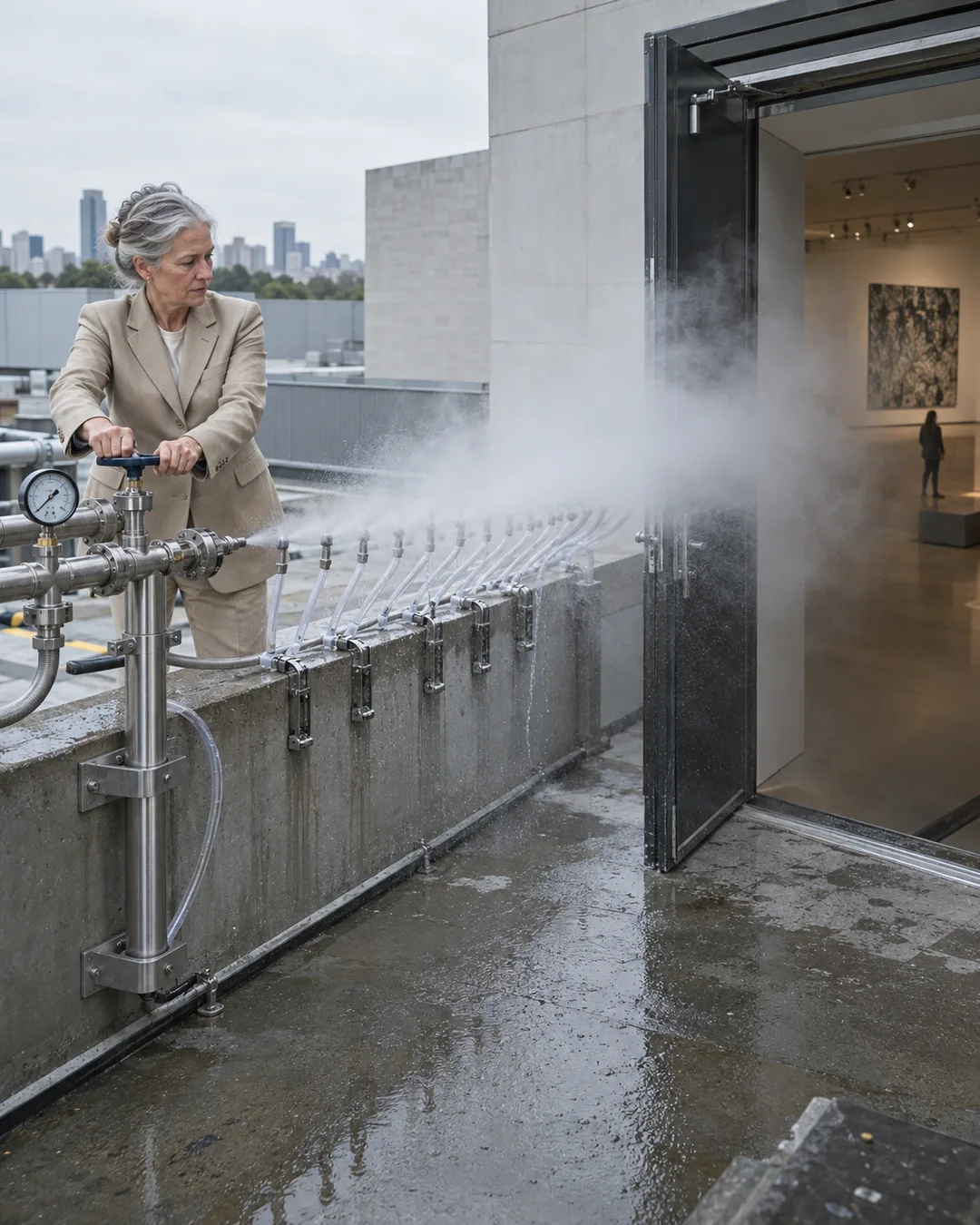
Fujiko Nakaya expands the liquid system until the vessel becomes architecture and open air. Fog Sculpture 08025 (F.O.G.), installed at the Guggenheim Museum Bilbao in 1998, uses one thousand nozzles and a high-pressure pump to atomize water around the building. Droplets remain suspended long enough to produce a moving volume. Wind divides it, humidity thickens it, and heat accelerates its disappearance. The sculpture acquires shape through a continuous negotiation among machinery and local atmosphere.
Nakaya’s apparatus produces weather at the scale of encounter. A visitor enters a field whose visibility changes from one step to the next. The museum facade appears, dissolves, and returns as currents move across it. The nozzles establish a repeatable release, while each release develops a singular contour. Programming and meteorology share authorship. The work turns control into a precise invitation for contingency, making atmospheric variation the central behavior of the installation.
Fog changes the social use of space because it changes what bodies can perceive about one another. Distance contracts when a path disappears. Sound arrives before a person becomes visible. Skin meets cool moisture while the eye loses architectural depth. These effects create a temporary public whose members navigate through partial information. The sculpture distributes attention across breathing, movement, and proximity, using water to recalibrate the sensory protocols through which a museum ordinarily guides its visitors.
Olafur Eliasson’s Riverbed, first made for Louisiana Museum of Modern Art in 2014, brings another engineered climate indoors. Stones, gravel, sand, plastic sheeting, hoses, pumps, a cooling unit, and flowing water transformed the museum’s south wing into a sloping terrain crossed by a stream. Visitors selected routes across loose rock and followed the water toward its source. The installation joined geological appearance to a concealed hydraulic circuit, placing constructed nature inside the galleries as a navigable operating system.
Nakaya and Eliasson expose different scales of atmospheric manufacture. Fog disperses an image of architecture through droplets released into air. Riverbed rebuilds circulation under a landscape whose stream depends on pumps and waterproof layers. Both works make weather inseparable from technical support. Their environments gain intensity through careful maintenance, water supply, energy, and institutional permission. The gallery becomes a climate-producing machine, and the visitor encounters nature as a condition assembled through infrastructure.
Bodies Cross the Surface
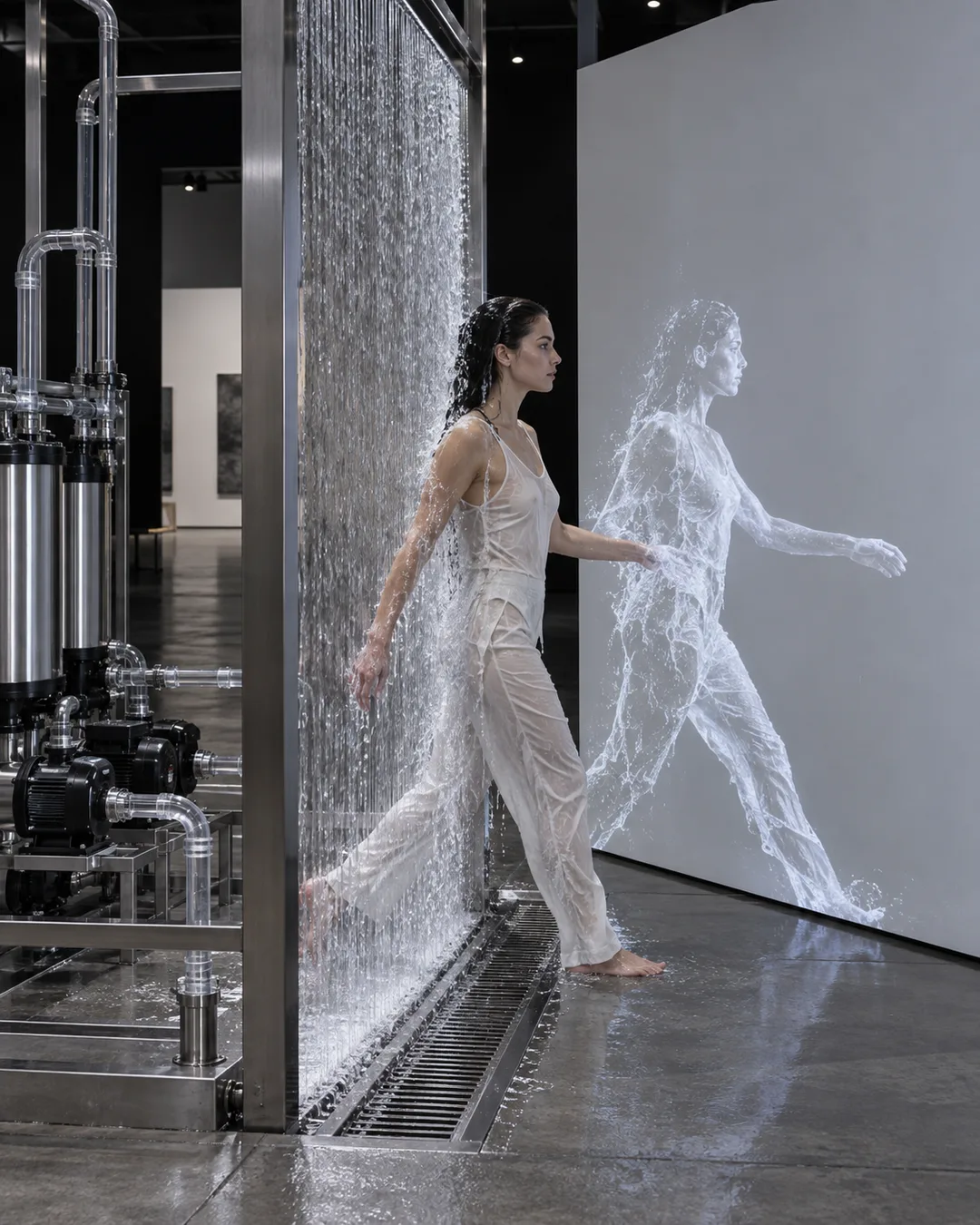
Bill Viola’s The Crossing, created in 1996, places a double-sided projection screen in a darkened room. On each side, a figure approaches from distant black space and stops near the picture plane. Water begins as a light fall on one projection, then grows into a torrent that engulfs the body. Fire performs a corresponding escalation on the opposite face. When each element recedes, the figure has vanished and the loop prepares to begin again.
The recorded cascade turns water into a force that acts simultaneously on a body and an image. Droplets strike the performer during production, while projected light reconstructs their impact at architectural scale. Slow motion extends the instant of contact, allowing separate streams and splashes to remain perceptible within the larger fall. The screen receives an event that appears to exceed its flatness. Liquid gives the moving image weight, pressure, and an apparent depth organized by duration.
Sound enlarges this passage. The rising volume of falling water reaches the viewer before the projected body disappears. Acoustic pressure occupies the room and joins the visual torrent to the spectator’s own body. The installation therefore coordinates several thresholds: the performer’s skin, the camera’s frame, the screen’s surface, and the gallery’s sonic field. Each threshold passes the event forward through a different material channel.
The loop gives immersion a ritual structure. Approach, pause, impact, disappearance, darkness, and return establish a sequence that viewers enter at uncertain points. A person arriving during the torrent reconstructs the earlier approach through the next cycle. Exhibition time and video time overlap as the audience moves around the double-sided screen. The work produces transformation through repetition, with water operating as the agent that carries a recognizable figure beyond its visible coherence.
The Crossing demonstrates how liquid can alter the status of an image. Water functions as an event recorded by a camera, a luminous pattern projected on a screen, and a force reproduced through sound. The body crosses among these registers while remaining anchored to a simple action. Its disappearance completes no final escape. The loop returns the figure to the same path, turning transformation into a maintained circuit whose emotional power depends on media equipment, spatial arrangement, and repeated exposure.
Memory Held in Water
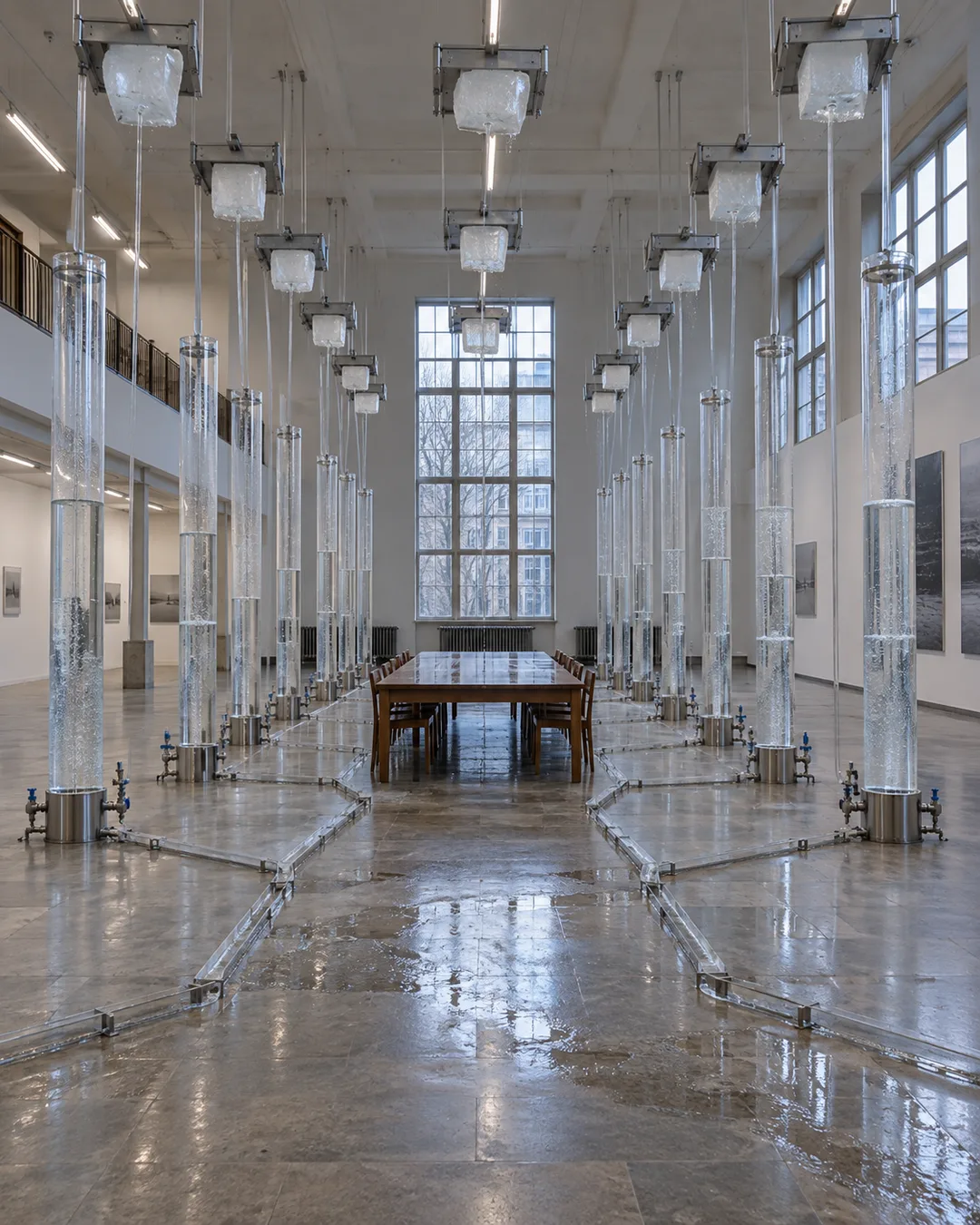
Roni Horn’s Vatnasafn / Library of Water opened in 2007 inside a converted library in Stykkishólmur, Iceland. Its central installation, Water, Selected, consists of floor-to-ceiling glass columns containing water gathered as ice from twenty-four Icelandic glaciers. The columns give distinct samples a shared architecture. Light moves through them, bodies appear distorted behind them, and the room’s weather remains visible through surrounding windows. Collection becomes an encounter among water, site, and changing perception.
Each column performs an archival operation. A glacier is sampled, transported, melted, and assigned a place inside an ordered display. The water retains no legible image of its source, so provenance depends on naming, documentation, and institutional custody. The archive holds a material continuity with the glacier and a procedural account of how that continuity was established. Memory resides across the sample and the system that identifies it.
Environmental change intensifies this relation. Artangel records that all the sampled glaciers have receded and that Ok has disappeared. The columns therefore occupy an evolving temporal position. A sample gathered as part of a geographic collection becomes evidence of a landscape undergoing transformation. The installation gains historical pressure through events outside the building, while the water continues to look clear and present. Visibility and knowledge separate, then reconnect through the archive’s labels and records.
Library of Water extends its archive through Weather Reports You, a collection of accounts gathered from residents of Stykkishólmur and the surrounding peninsula. Voices describe weather through memory, work, sensation, and local language. These reports place meteorology inside lived experience. The project also supports meetings, concerts, writing, and community use, allowing the former library to circulate knowledge through speech and gathering alongside the silent columns.
Horn’s work shows that preservation can remain dynamic. Glass stabilizes the samples, while light, weather, language, and community activity continually change their significance. The water carries a physical link to specific glaciers, and the surrounding protocols turn that link into public memory. An archive of liquid therefore preserves relation more strongly than appearance. It holds origin, transport, classification, environmental loss, and present use within the same transparent volume.
Contamination Has a Custody Chain
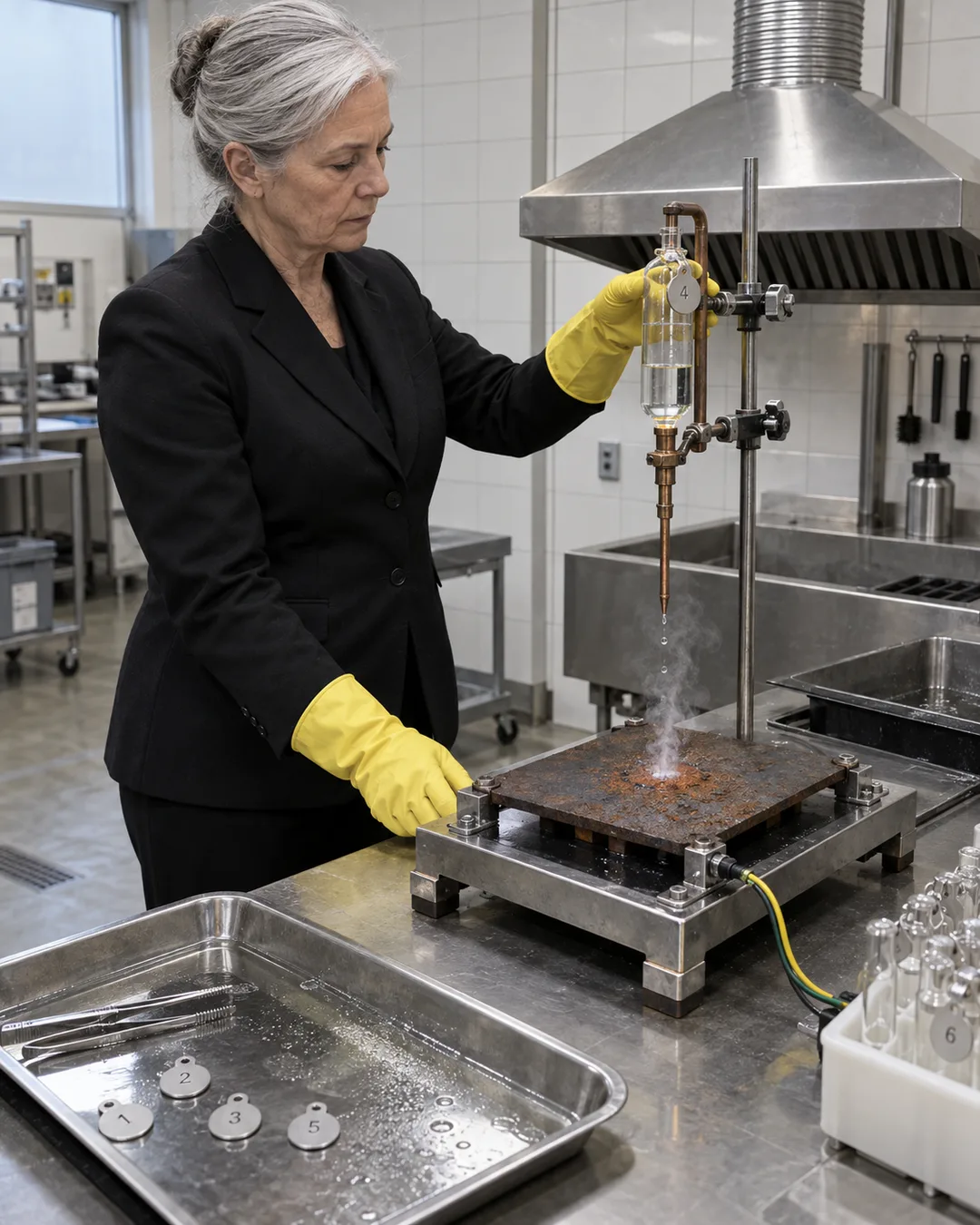
Teresa Margolles gives water a radically charged provenance. In Plancha, first realized in 2010 and later developed through site-responsive forms, droplets fall onto heated metal plates. The water carries residue gathered from places where people were killed. Each drop produces a sharp hiss and a brief cloud of steam. Repetition stains and rusts the metal, turning evaporation into a record of contact that accumulates across the exhibition.
The work depends on a custody chain. Water is applied at a site, absorbs particles, enters a container, travels to the institution, and passes through a controlled dripping mechanism. Its significance follows this route. Material evidence reaches the gallery through acts of collection and authorization, and the installation makes those acts part of the encounter. The visitor receives the trace through sound, vapor, and corrosion, forms that disperse through shared space.
Heat converts the liquid into an atmosphere that briefly occupies the distance between artwork and audience. The transformation carries forensic and ethical stakes because the residue belongs to a history of violent death. The mechanism regulates contact through dosage and interval. A drop arrives, flashes into steam, and leaves a mark on steel. This controlled rhythm gives absence a material procedure, allowing the work to hold attention on events that public systems often permit to fade.
Margolles has also used water distilled after washing the bodies of murdered people to make concrete benches. Cement cures through hydration, binding the charged water into a structure designed for sitting and conversation. The resulting object places bodily trace inside civic furniture. A visitor’s weight completes the work’s social circuit, joining rest, proximity, and dialogue to a material history carried within the bench.
These works establish contamination as a relation among event, sample, transport, institution, and viewer. Purity loses its authority as the default meaning of water. Trace becomes the medium through which social violence gains duration and public address. The ethical force rests in the protocols that preserve provenance and regulate encounter. Liquid moves the artwork beyond representation by carrying matter from one location into another field of responsibility.
A Medium Without Edges
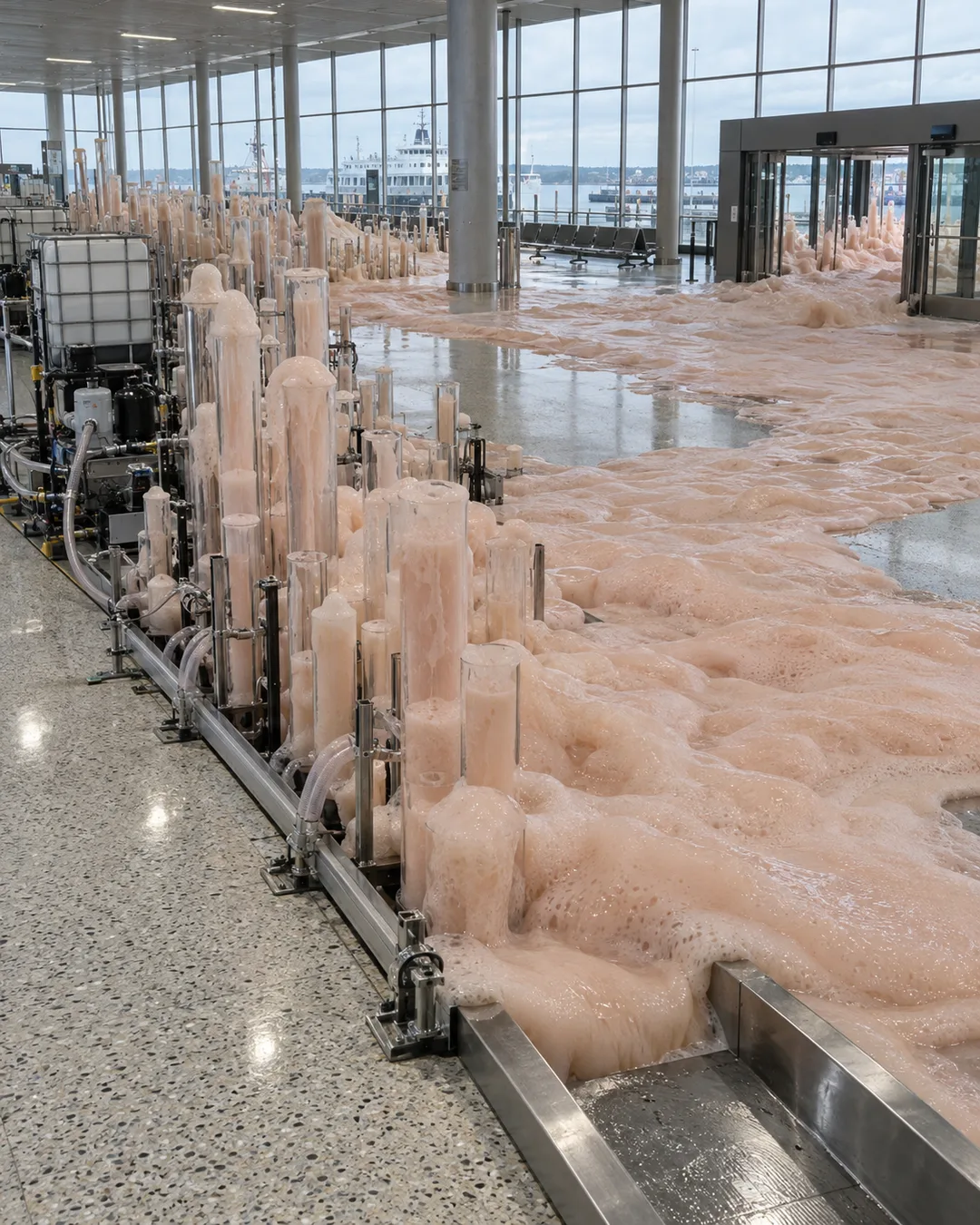
David Medalla’s Cloud Canyons sculptures use pumps, water, detergent, and Plexiglas tubing to generate columns of foam. In Cloud Canyons No.25, a work dated 1963/2015, bubbles rise above their mechanical supports, curl outward, collapse, and collect below. Temperature, gravity, humidity, and atmospheric pressure alter each formation. The sculpture continuously exceeds the architecture that produces it, making overflow its primary mode of composition.
Foam occupies a peculiar material interval. Each bubble holds air inside a thin liquid membrane, and the larger mass survives through constant production and collapse. The pump supplies continuity while individual forms remain brief. Visitors encounter an object whose edges grow, sag, and scatter across time. Medalla turns sculpture into a population of temporary enclosures, each one carrying the conditions of its own disappearance.
Pamela Rosenkranz’s Our Product, presented in the Swiss Pavilion at the 2015 Venice Biennale, directs liquidity toward industrial chemistry and cultural standardization. Approximately 140,000 litres of water mixed with additives filled a basin inside the pavilion. Circulation pumps animated its pink surface, and an algorithmic sound environment extended the installation through the building. The liquid’s color referred to a generalized European skin tone produced as a technical average.
The title frames the fluid as a manufactured commodity. Water, pigment, scent, sound, architecture, and pumping equipment combine into an environment whose bodily associations arrive through formulation. The basin performs a liquid image of skin at monumental scale, converting identity into a managed surface. Its apparent organic presence depends on recipes, logistics, branding codes, and continuous circulation. The work makes the body legible as something industry already measures and produces.
Medalla’s foam and Rosenkranz’s reservoir bring the essay’s systems into an expanded field. Liquid form passes through pumps, membranes, algorithms, additives, labor, and public movement. Its edges occur wherever these relations temporarily become perceptible. Water and its chemical relatives give contemporary art a medium capable of carrying climate, memory, violence, image, and commerce through the same physical logic of contact. Matter keeps escaping its outline, and every escape reveals the system that gives it somewhere to go.