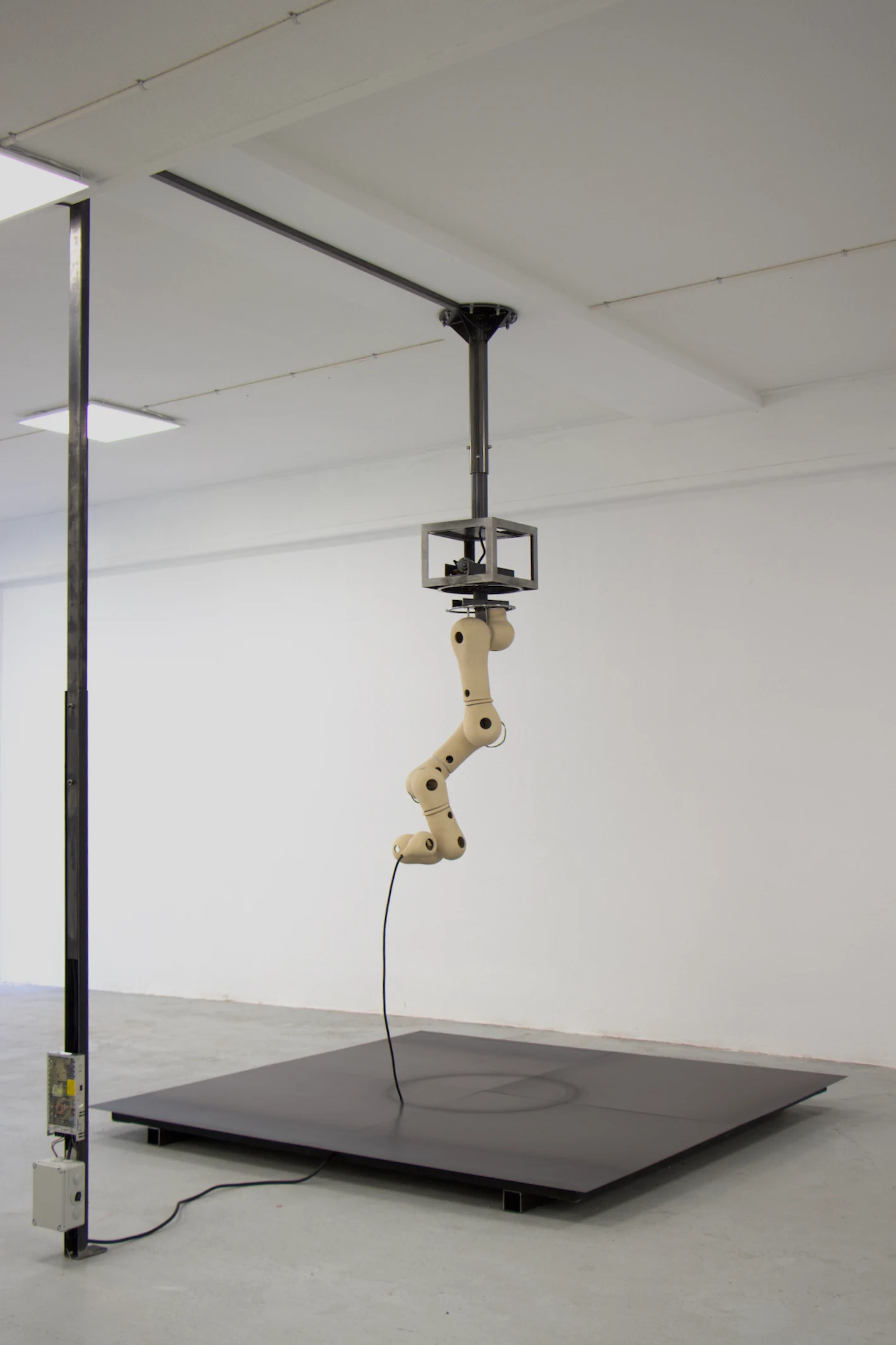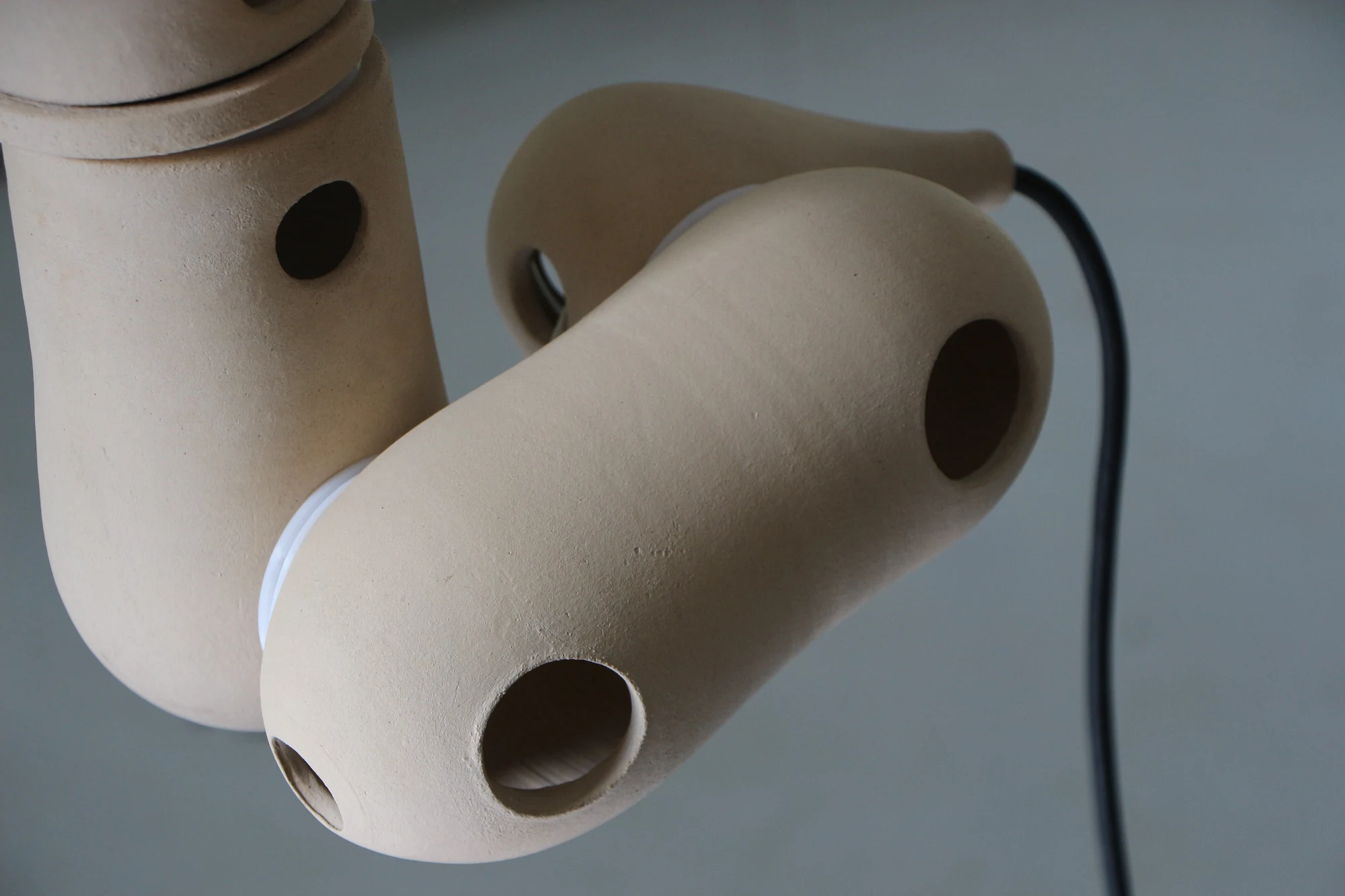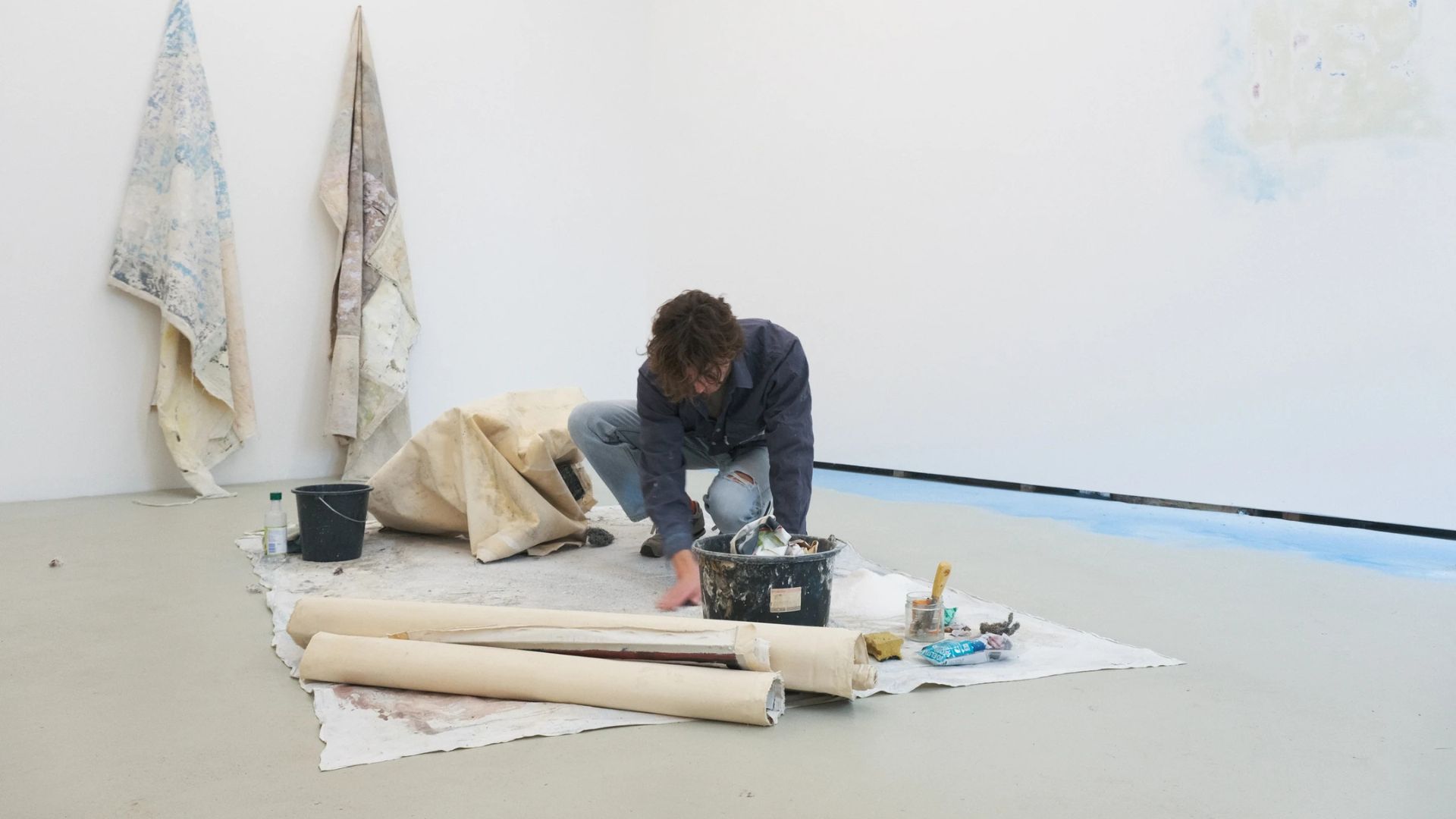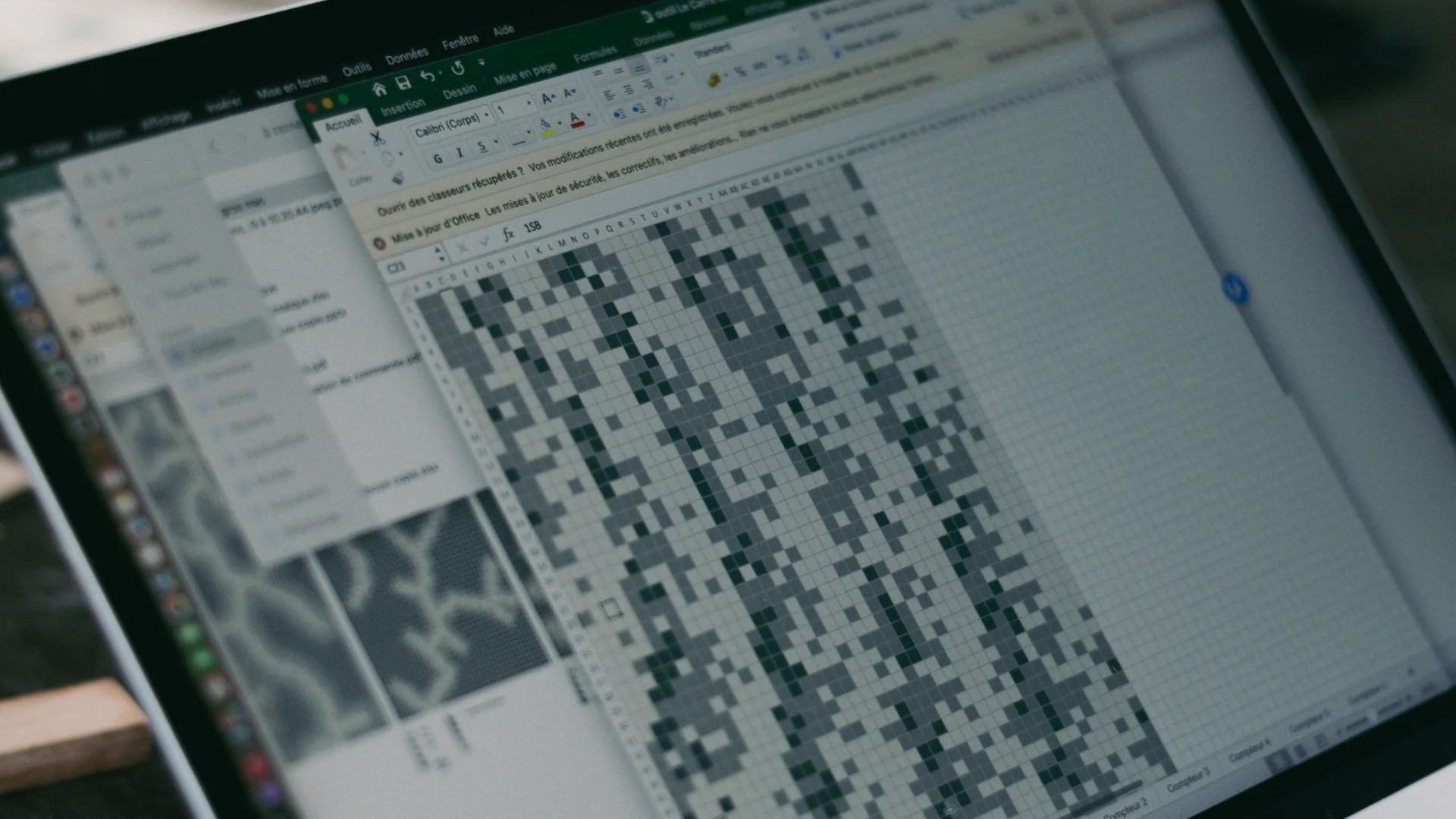
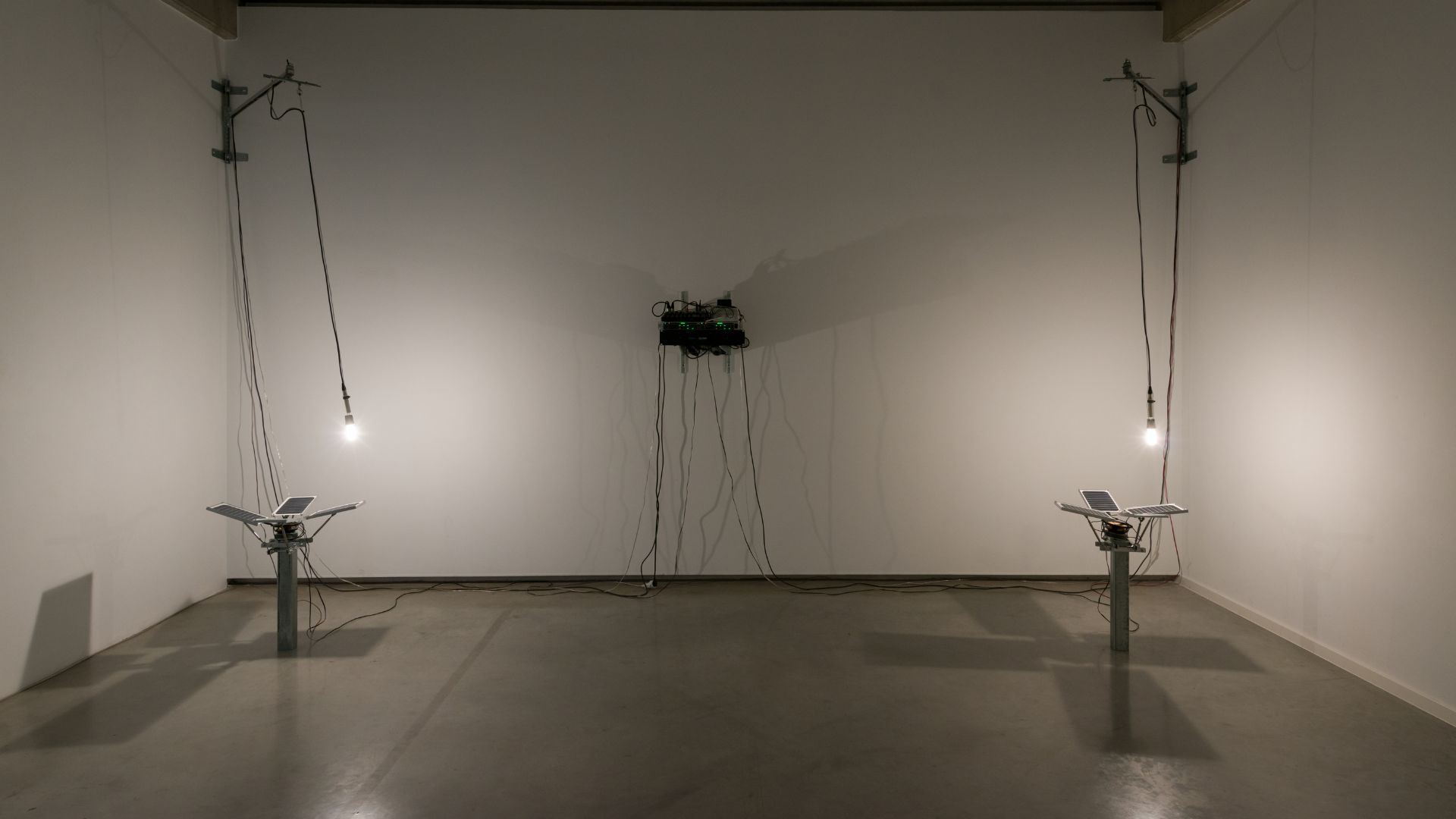
We have been closely following Nika Schmitt’s work, struck by her ability to transform physical phenomena such as electrical energy, repetition, and instability into complex systems that oscillate between autonomous behaviour and perceptual tension. The Fakewhale team has engaged deeply with her practice, exploring how systems, materials, and environments intertwine to produce works that resist complete control, continuously operating on the threshold between equilibrium and collapse.
Fakewhale: Across your practice, energy often appears not as a neutral resource but as something expressive, unstable and almost psychological. What first drew you to treating energy as an artistic material rather than simply a technical condition behind the work?
Nika Schmitt: Electrical energy became relevant when I started coupling different types of energy sources and generators to build self-regulating mechanisms. In that process, I experienced how electricity behaves almost like a material, with its own kind of pressure and instability. It has tendencies, it leaks, produces excess, and resists complete containment. It became an independent and equal element within my setups, introducing change through inconsistencies. What drew me in was precisely this tension, the fact that electricity always slightly escapes the framework constructed around it.
From there, I became interested in how energy is understood more broadly. Even though electricity is deeply embedded in the contemporary infrastructure and is, in fact, a very physical phenomenon, I think for most people it remains an abstract subject. Historically and culturally, it has shifted from being perceived as an almost mythical force to something measurable and commodified. I like this transition, and dual status of energy as both violent and ungraspable and something supposedly controllable and consumable. This tension never fully resolves in practice, and it is something I try to articulate in my work.
Repetition is central to many of your installations, yet in your hands it never feels static or identical. How has your understanding of repetition evolved, from perceptual patterning in earlier works to the autonomous behavioural loops present in more recent systems?
Repetition has been essential to my practice from the very beginning. Depending on context, intensity, and whether variation is generated, repetition as a structural principle can evoke very different, even contradictory experiences. It can have a meditative effect, function as a comedic device, or take on an almost compulsive quality, sometimes even within the same sequence.
At the same time, repetition plays a fundamental role in perception. It forms the basis for pattern recognition, measurability, and the perception of difference itself. Change is usually perceived through iteration, as the mind compares successive states of the same object or system, allowing differences to emerge against a stable reference point. This may also explain why absolute uniformity can feel unsettling, as it seems to suspend the possibility of change. I am interested in the entire spectrum, including repetitions that appear static or identical.
Initially, I approached repetition primarily as a compositional and perceptual element, particularly because of its strong influence on human cognition. Over time, I began to understand repetition, or more precisely recurrence, as an underlying logic of many processes: from biological rhythms in organisms and to motion dynamics in physics and operational structures in computation.
This led me to adopt an approach in which the systems generate their own patterns. By linking devices and modules in feedback loops, repetition becomes a structural condition through which systems organise themselves. The installations produce cyclical behaviour rather than merely displaying it. So, instead of starting with a composition, I now focus on placing components within a system that allows for both physical and conceptual tensions to emerge from the relationships between them.
In several works, the machine seems to develop a character of its own: anxious, stubborn, fragile, even theatrical. Do you consciously think of your systems as performers, or does that sense of personality emerge unintentionally through movement and sound?
This became a topic for multiple reasons. One is that when I started working with feedback loops, I was confronted with the fact that simple systems tend to either move toward equilibrium, amplify toward runaway extremes or collapse at some point. For instability, oscillation or variation to occur and to stick around for a while, some components within the loop need to be fragile, change or be susceptible to temporary failure. Therefore, maintaining instability is much harder than finding equilibrium. Consequently, as soon as a device or construction appears to malfunction and behaves erratically, it seems to have an ‘attitude’. They start to appear slightly clumsy and independent and therefore a little anthropomorphic. Humans register failure as a fundamental human quality. This sense of empathy with the viewer is an important aspect when it comes to the attention span and engagement of the viewer with the process of the work. However, I like to emancipate the installation or sculpture from the need to express such qualities. Whatever is happening is because of the consequences of interconnected devices. I try to avoid amplifying certain behaviours before they start to become entertaining and a spectacle to the viewer. Besides trying to maintain a functional approach I actually prefer the awkwardness, frustration or boredom that some behaviours evoke. It potentially raises the question: “is it supposed to do this?”. It goes against the confirmation of an already encoded expectation towards technological devices or artworks. There is a constant need for a ‘handshake’ between human and device that reassures the user that the device is OK. I think it confronts the relationship that we have built towards these devices, one with a persistent sense of control and demand for entertainment.
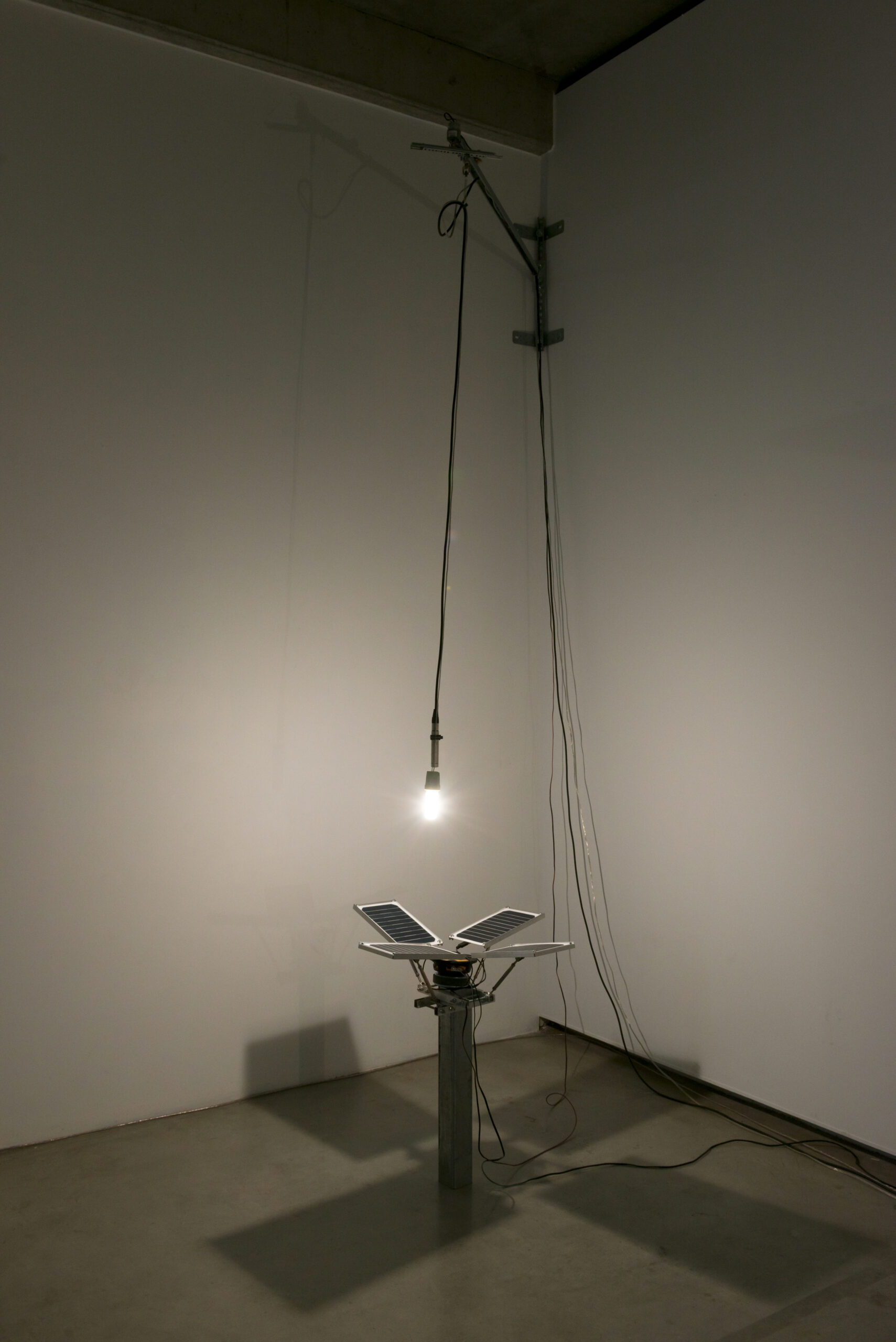
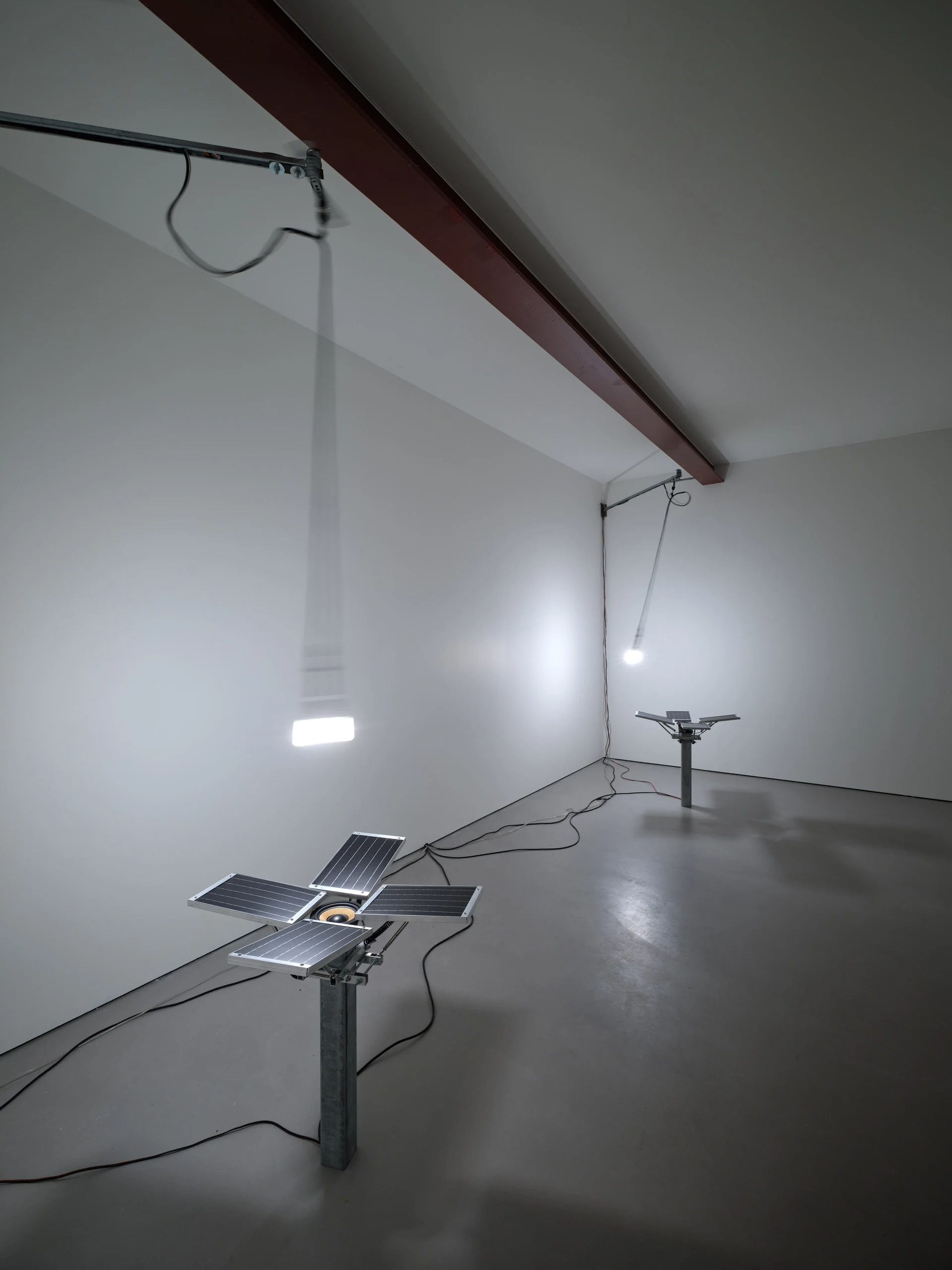
In Sweet Zenith, sound becomes light, light becomes movement, and movement generates sound again in a seemingly endless cycle. When building a feedback-based work like this, how much is engineered beforehand, and how much must be discovered through trial, accident, and the behaviour of the space itself?
It feels as if I’m still working on ‘sweet zenith’ today. Every time I exhibit it, I rework some aspect of it, mostly to maintain its instability. The process of such a work involves an extended trial-and-error phase and very specific search missions to find the right elements that match each other’s energy. For example, for ‘sweet zenith’ I had to find a light bulb that produces a specific spectrum of light, the right amount of luminosity, and that could sustain extreme variations in voltage. Later, the challenge moved towards managing feedback sound within the conditions of different exhibition spaces. Besides ‘sweet zenith’ I usually try to avoid making changes to the essential parts of a work. Since I like to maintain an element of improvisation in the construction and aesthetic, reworking some aspects for too long risks killing that mood.
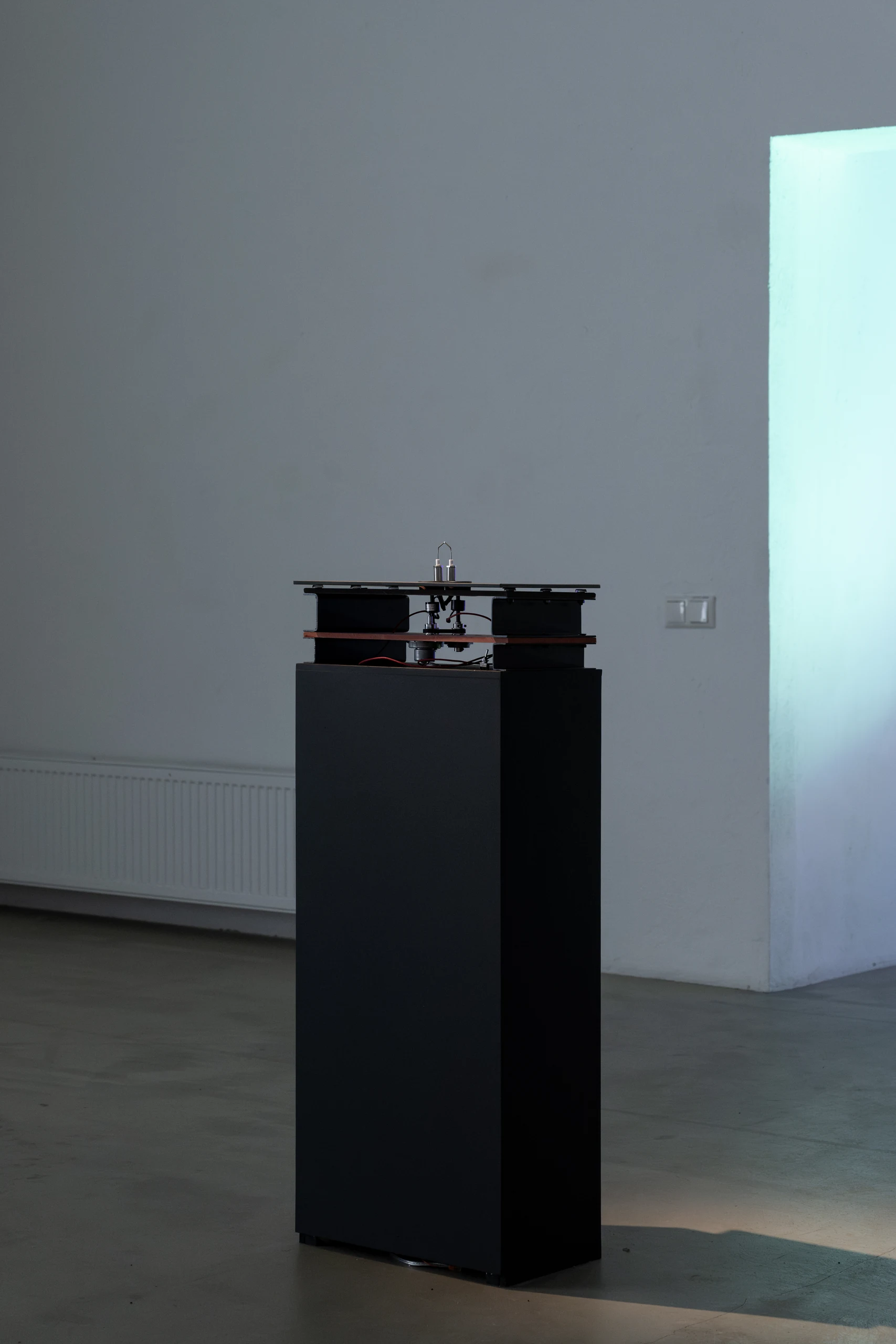
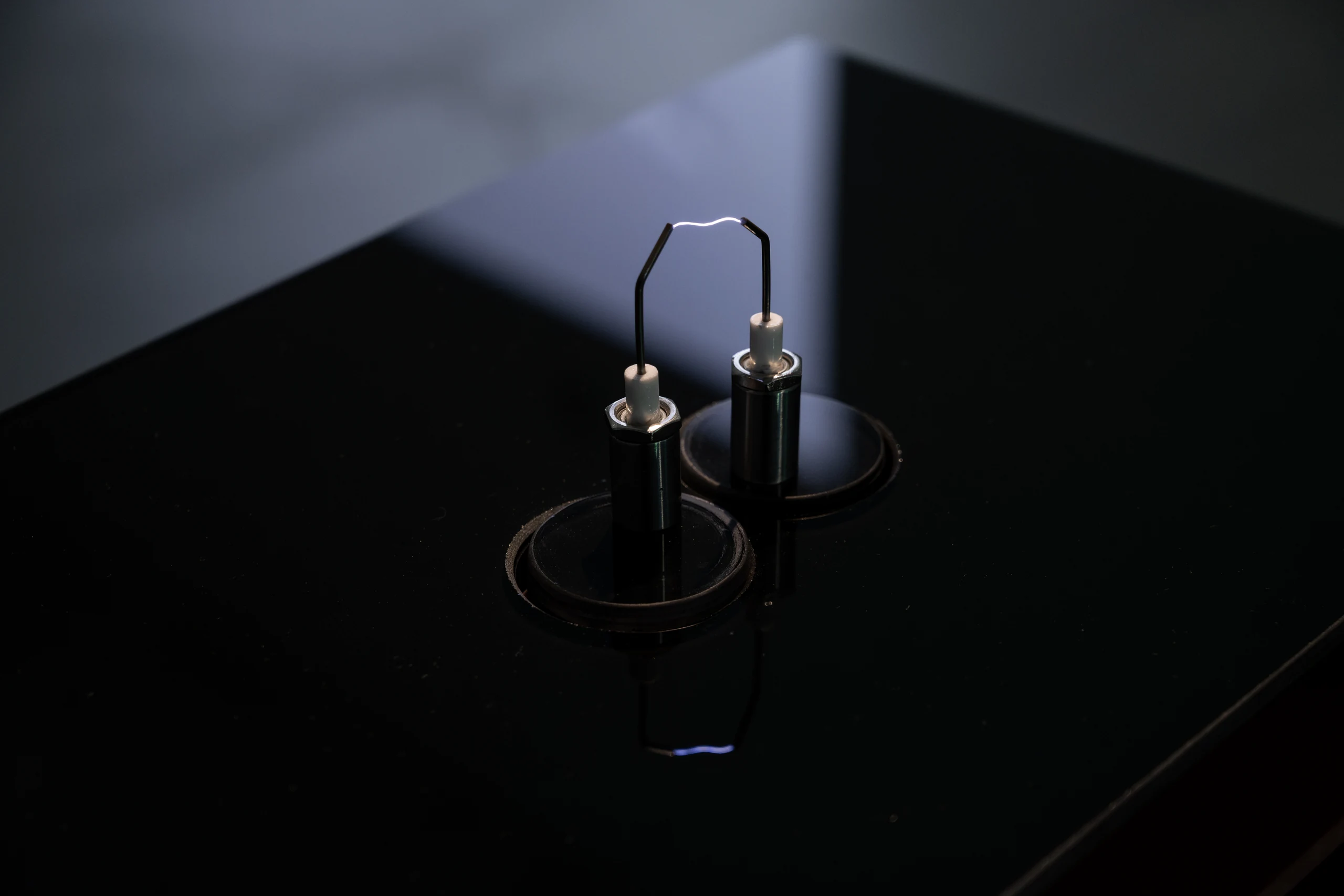
Sometimes, the engineering aspect of a work, or rather its failure, has become the research process for the next piece. Once, I stopped the production of a work because I could not meet the required safety measurements in time. While testing a setup using magnesium dust for a flash-based system, the construction failed due to a malfunctioning valve and exploded. This pulled the research in another direction altogether. Working with the ignition needles from that setup led me towards researching the spatial acoustics of high-voltage discharges, which became the basis for the work, Ignition (2025) later on.
Many of your installations are highly sensitive to their surroundings, where architecture, acoustics or atmosphere alter the system’s behaviour. Does each exhibition space become a collaborator in the final work, and how do you negotiate authorship when the environment actively reshapes the piece?
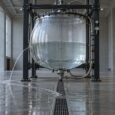
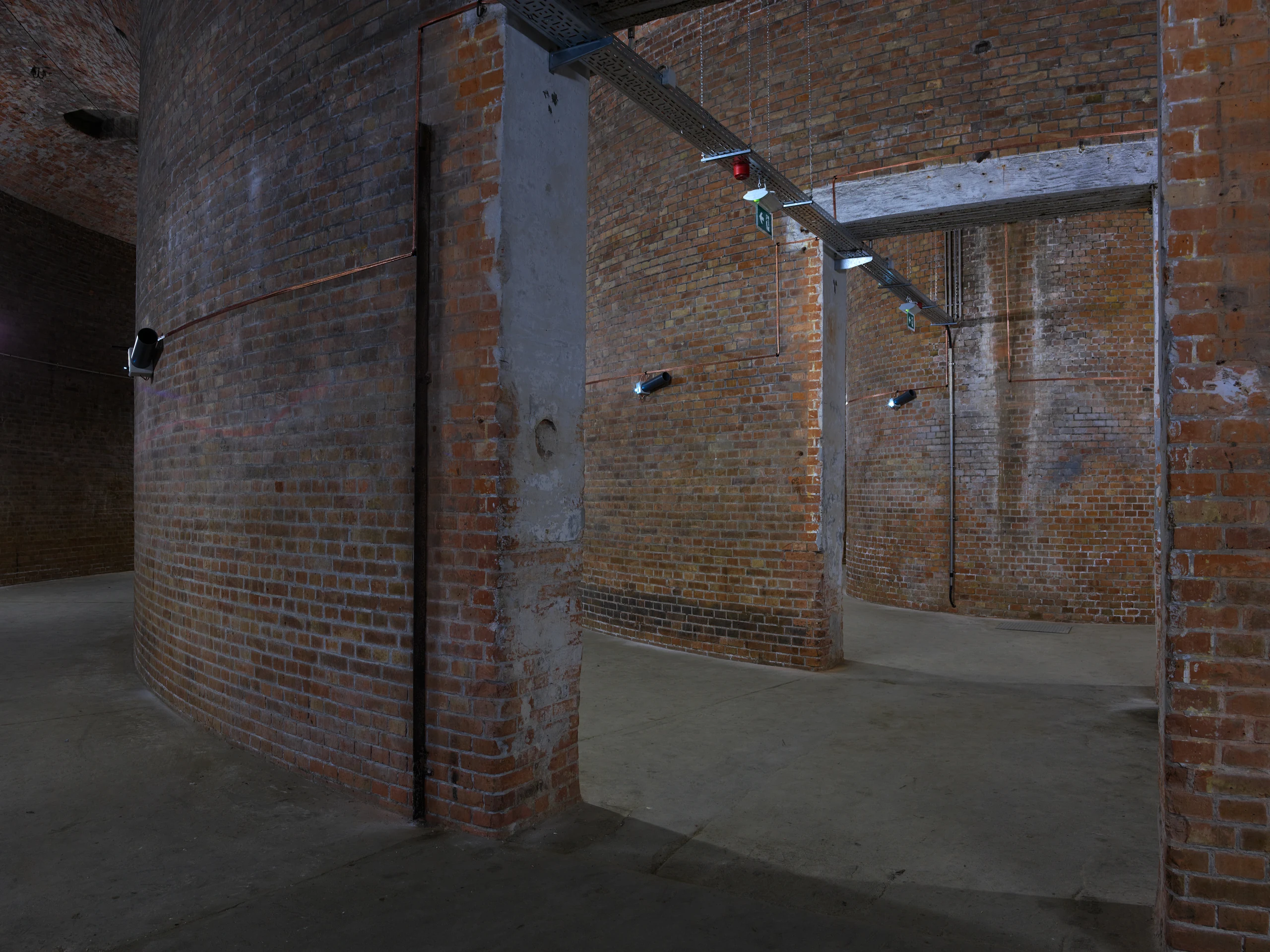
Most of my installations are quite adaptable, as their behaviour is shaped by common environmental conditions such as light, temperature, and acoustics. But there are cases where this relationship becomes much more fixed. Umwandler, for example, was developed for an empty water reservoir ‘großer Wasserspeicher’ in Berlin and could not be adapted elsewhere with nearly the same effect. The building extended the work’s core principle of a copper coil: cables ran for over a kilometre through its concentric vaults, while a central turbine, driven by speaker magnetism, generated electricity distributed across the space. Due to voltage loss and a reverberation time of up to 18 seconds, the architecture transformed the electrical pulses into a densely accumulating, low drone, effectively acting as an acoustic rectifier. In those situations, authorship becomes distributed, as the outcome depends on how the system and the specific conditions of the site interact.
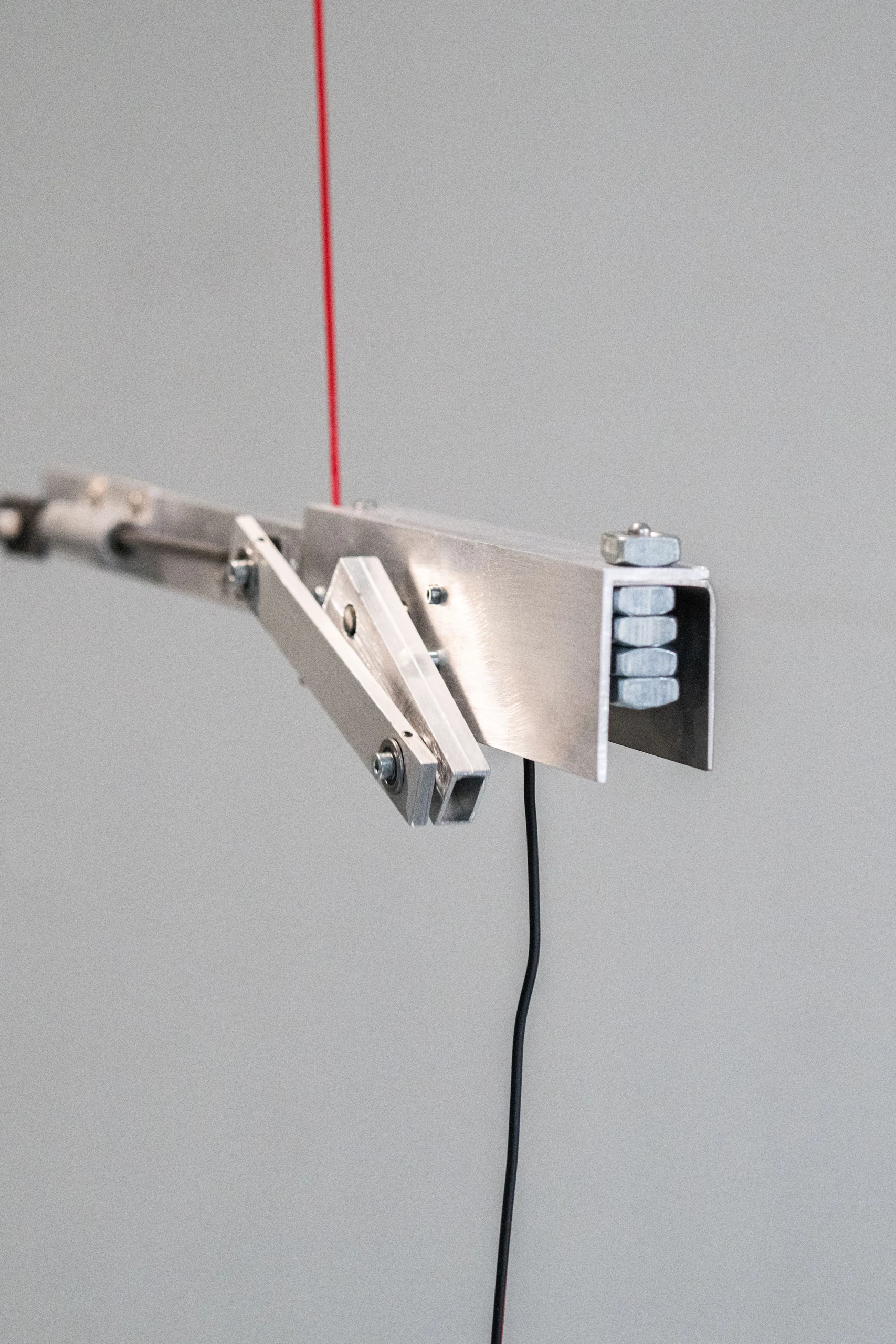
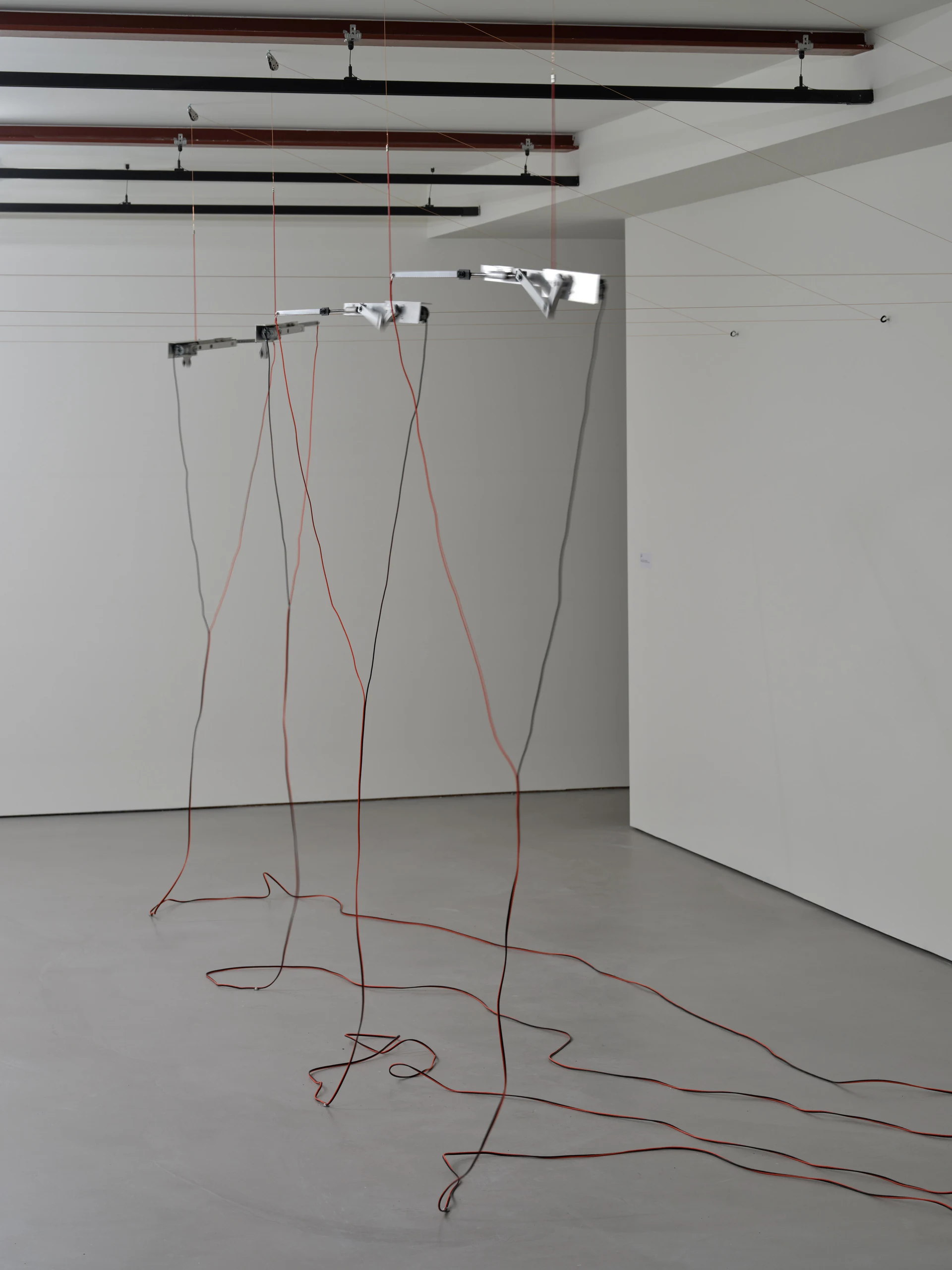
Works such as more power and Harm introduce self-sabotage, where machines interrupt or destroy their own source of power. Do you see these gestures as metaphors for larger social, ecological or economic systems, or do you prefer them to remain open-ended physical events?
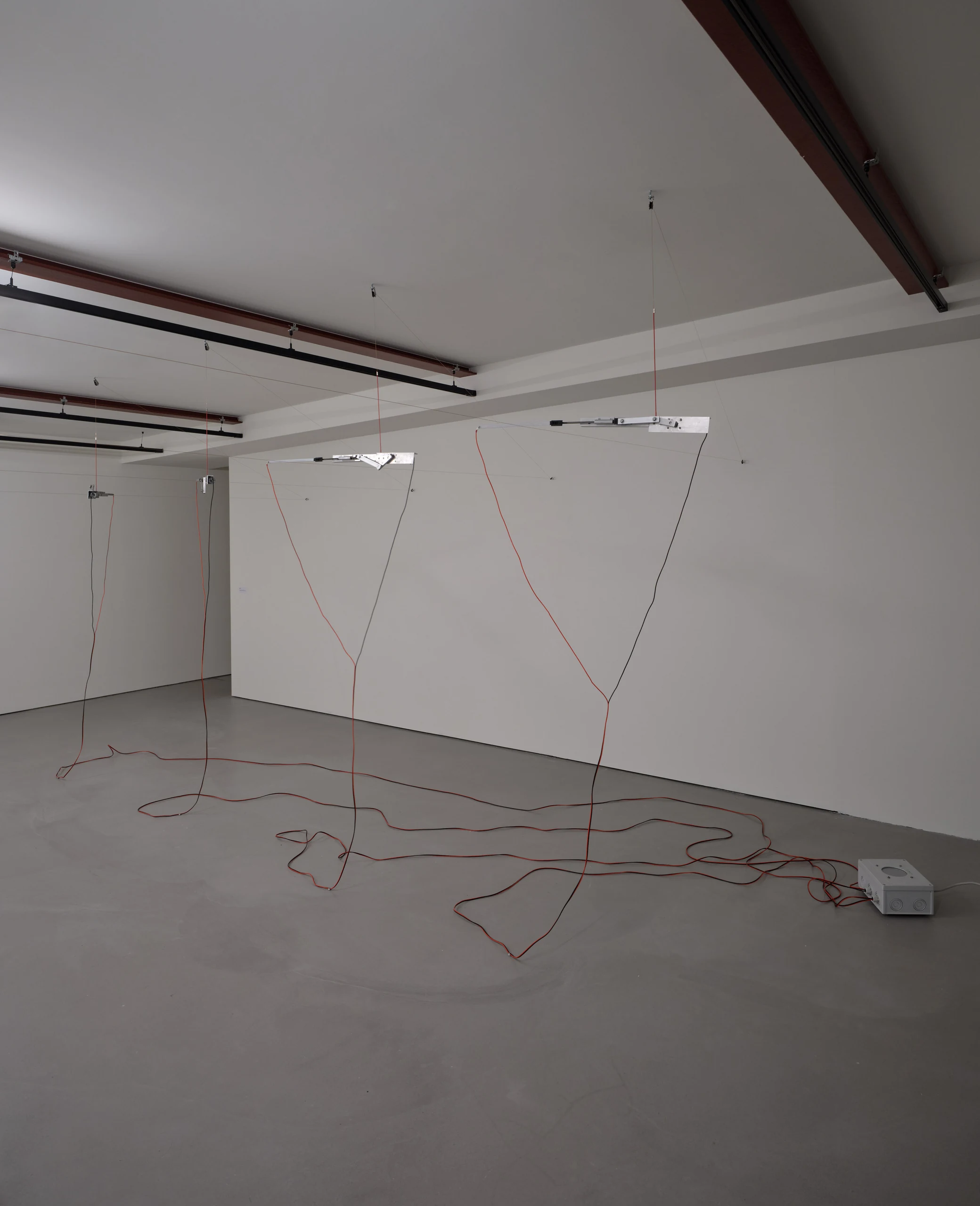
‘harm’ was initially based on the saying “sawing the branch you’re sitting on”. The work is composed of four electric saws hanging vertically by their own power cable. They are balanced in such a way that they inevitably touch their own bare wire with the edge of their saw. By touching the horizontally stretched wire, electricity is conducted to the motor and they start grinding off their own cable. The source of energy is at the same time the source of destruction. Self-sabotage operates within this work as both a metaphor and a function. Less as a gesture of simple self-destruction and more as a way to test the physical balance between states of operation and interruption. Each saw follows the same repetitive action, but establishes electrical contact at different moments each time. This desynchronization produces irregular, shifting patterns of movement and sound. The title ‘harm’ also carries a second reading as harmony. In this sense, it relates to Theodor W. Adorno’s understanding of harmony, instead as unity or closure, he describes it as something that contains tension and contradiction, never fully reconciling its elements. In this sense, harmony describes something that persists through imbalance, always on the verge of breaking. What remains constant in this work is a sense of anticipation towards the actual breaking point of the wire.
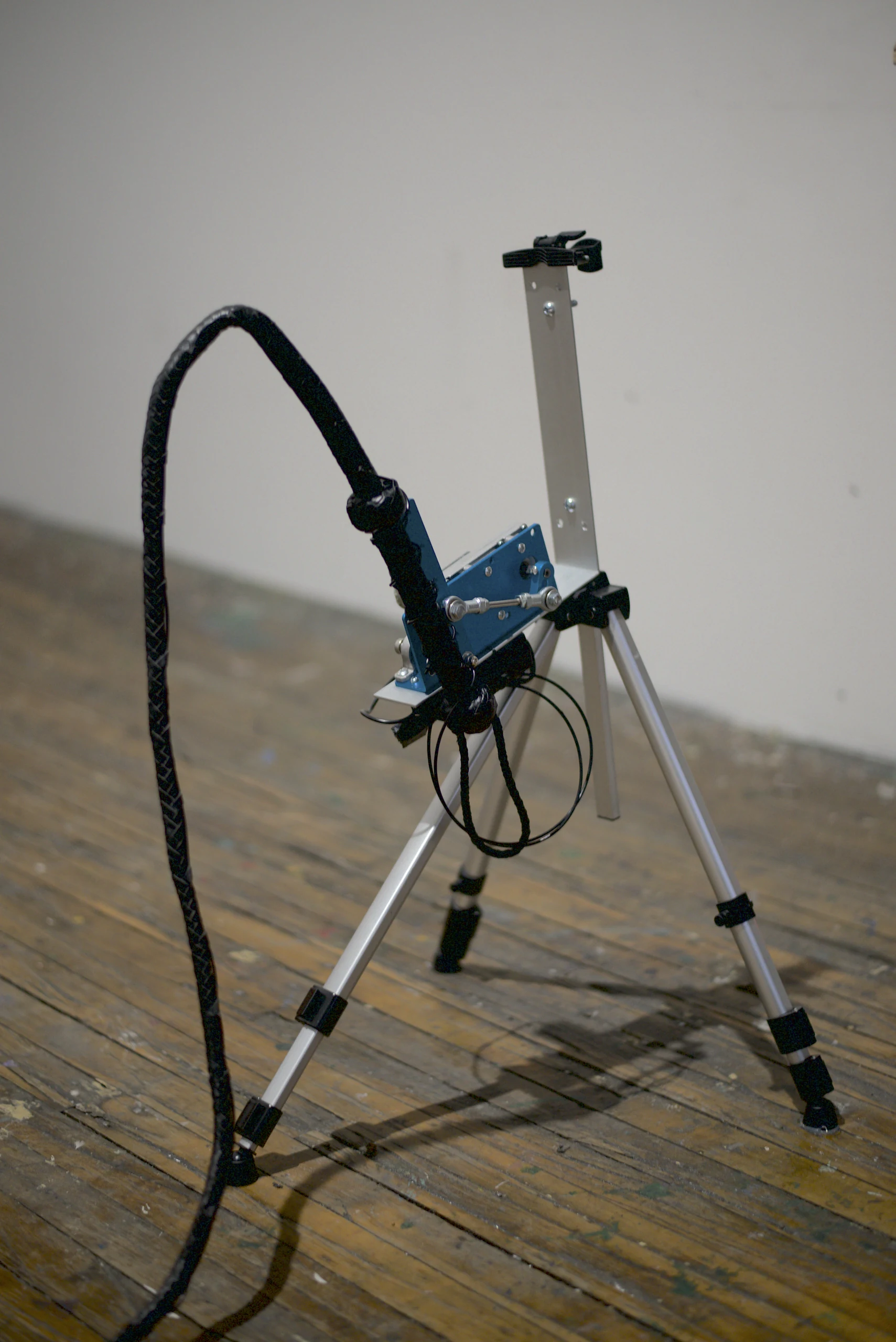
‘more power!’ builds on a much more rapid and yet ultimately anti-climactic principle. It consists of an extension cord braided as a traditional bull-whip. Installed on a tripod with a reciprocating swing motor, when plugged into the wall, it thrashes wildly. The kinetic force eventually snaps the whip out of the socket, killing the power and leaving it at a standstill. The performance can be endlessly repeated, the moment of standstill varies per iteration. Sometimes I place recognisable tools and objects within my configurations to see how their function and symbolism evolve throughout the process of the work. Through the repetitive nature of it, attention ideally shifts between the material behaviour and the unfolding metaphorical interpretations of the work.
.Your notion of the “non-machine,” particularly in works like Ton Ton, resists contemporary expectations of efficiency, productivity and precision. In a culture increasingly shaped by optimisation and automation, is uselessness becoming a radical artistic position?
No, I don’t think so, at least not in terms of “uselessness” as a standalone position. It might have been a radical one in the early 20th century in response to Futurism’s technophilia but it wouldn’t have the same effect today. The position of “uselessness” feels like a simple mode of rejection. In terms of optimisation, I’m into this persistent human impulse to control and optimise everything, from the fine-grained environmental regulation of digital devices to climate management and the terraforming of entire planets. I’m interested in redirecting this impulse toward the excess and waste generated by the same processing devices, engaging them in direct relation to their own physicality and immediate context. The excess heat of drivers or leftover RF signals of wireless remote controls are conditions I’m currently working with, using these as inputs to induce erratic behaviour in circuitry and movement.
Some of my work is annoyingly simple, I think this simplicity allows for a kind of sustained attention.There is maybe something quietly resistant in a simple repetitive act, for example grinding a sandstone into a heap of sand. Not in a dramatic sense, but in refusing the logic of output. To me this type of “uselessness” becomes interesting when it is precise, when it is not failure but a chosen mode of operation.